


SIST EN 13946:2025
(Main)Water quality - Guidance standard for the routine sampling and preparation of benthic diatoms from rivers and lakes
Water quality - Guidance standard for the routine sampling and preparation of benthic diatoms from rivers and lakes
This document specifies a method for the sampling and laboratory preparation of benthic diatoms for ecological status and water quality assessments. The sampling and preparation procedures described can be used for later investigations using either light microscopy or molecular methods. Data produced by this method are suitable for production of indices based on the relative abundance of taxa.
Analysis using molecular methods is not within the scope of the document.
Wasserbeschaffenheit - Anleitung zur Probenahme und Probenaufbereitung von benthischen Kieselalgen aus Fließgewässern und Seen
Dieses Dokument legt ein Verfahren zur Probenahme und Laborpräparation benthischer Diatomeen zur Überwachung des ökologischen Zustands und der Wasserbeschaffenheit fest. Die beschriebenen Probenahme- und Präparationsverfahren können für spätere Untersuchungen mit Lichtmikroskopie oder molekularen Verfahren verwendet werden. Daten, die nach diesem Verfahren erhoben werden, sind zur Erzeugung Indizes, die auf der relativen Häufigkeit der Taxa basieren, geeignet.
Die Analyse mit molekularen Verfahren fällt nicht in den Anwendungsbereich dieses Dokuments.
Qualité de l'eau - Guide pour l'échantillonnage en routine et le prétraitement des diatomées benthiques de rivières et de plans d'eau
Le présent document spécifie une méthode d’échantillonnage et de préparation en laboratoire de diatomées benthiques en vue d’évaluer l'état écologique et la qualité de l’eau. Les modes opératoires d'échantillonnage et de préparation décrits peuvent être utilisés pour des études ultérieures en utilisant soit la microscopie optique soit des méthodes moléculaires. Les données obtenues par cette méthode conviennent pour la production d'indices basés sur l’abondance relative des taxons.
L’analyse par des méthodes moléculaires ne fait pas partie du domaine d’application du document.
Kakovost vode - Navodilo za rutinsko vzorčenje in pripravo vzorcev bentoških kremenastih alg iz rek in jezer
Ta dokument določa metodo za vzorčenje in laboratorijsko pripravo bentoških kremenastih alg za oceno ekološkega stanja in kakovosti vode. Opisane postopke vzorčenja in priprave je mogoče uporabiti za poznejše preiskave z uporabo svetlobne mikroskopije ali molekularnih metod. Podatki, pridobljeni s to metodo, so primerni za pripravo indeksov, ki temeljijo na relativni številčnosti tega reda. Analiza z uporabo molekularnih metod ne spada na področje uporabe tega dokumenta.
General Information
- Status
- Published
- Public Enquiry End Date
- 01-Nov-2024
- Publication Date
- 16-Oct-2025
- Technical Committee
- KAV - Water quality
- Current Stage
- 6060 - National Implementation/Publication (Adopted Project)
- Start Date
- 16-Sep-2025
- Due Date
- 21-Nov-2025
- Completion Date
- 17-Oct-2025
Relations
- Effective Date
- 01-Nov-2025
Overview
EN 13946:2025 - Water quality: Guidance standard for the routine sampling and preparation of benthic diatoms from rivers and lakes (CEN) - specifies standardized field and laboratory procedures to collect and prepare benthic diatom samples for ecological status and water quality assessments. The standard updates and supersedes EN 13946:2014, adding measures to enable downstream molecular approaches (e.g., metabarcoding) by minimizing contamination and adapting preservation protocols. It produces data suitable for indices based on the relative abundance of taxa (light microscopy or molecular pipelines). Analysis protocols for molecular methods themselves are outside the scope.
Key topics and technical requirements
- Scope and intent: Routine sampling of benthic diatoms from hard substrates, macrophytes and littoral zones to support water quality and ecological status assessments.
- Sampling substrata and site selection: Definitions of substrata (boulder, cobble, pebble, introduced substratum) and guidance for choosing representative habitats (riffles, littoral zones, macrophytes).
- Field equipment and contamination control: Required items include waders, toothbrush or blade for scraping, plastic trays, sample bottles, labeled waterproof markers, hoe with net for vertical surfaces and an Aquascope. Strict cleaning protocols are mandated to avoid cross‑contamination - e.g., rinsing brushes and, for samples destined for metabarcoding, disinfecting with 10 % bleach followed by thorough rinsing and drying.
- Preservation and storage: Recommended preservatives and concentrations:
- Buffered formaldehyde (stock diluted to ≈4 %; final 1–4 % in sample) for long‑term storage (buffer prevents silica dissolution in alkaline waters).
- Lugol’s iodine (recipe provided) for short‑term storage prior to light microscopy.
- Ethanol: ~20 % final for medium‑term microscopy storage; ≥70 % for molecular sample preservation (suitable up to ≈1 year).
- Freezing of samples or pellets is also described as an option.
- Laboratory preparation: Methods for cleaning diatom frustules with oxidizing agents and preparing permanent light‑microscopy slides. Annex A details cleaning procedures. The standard emphasizes that procedures produce material fit for relative‑abundance indices; absolute abundance or biomass estimation requires different protocols.
Applications
- Routine biomonitoring of rivers and lakes for ecological status and water quality (e.g., eutrophication, acidification indicators)
- Supporting compliance and assessments under the EU Water Framework Directive and other regulatory programs
- Generating standardized sample archives suitable for light microscopy and for downstream molecular workflows (metabarcoding), provided users follow contamination‑avoidance and preservation guidance
Who should use this standard
- Environmental laboratories and field survey teams
- Water‑quality managers and regulatory agencies
- Ecologists, biomonitoring consultants and researchers implementing diatom‑based indices
Related standards and context
- Supersedes EN 13946:2014
- Intended to support monitoring required by the Water Framework Directive (2000/60/EC) and Urban Wastewater Treatment Directive (2024/301)
- Prepared by CEN/TC 230 (Water analysis)
Keywords: EN 13946:2025, benthic diatoms, water quality, routine sampling, sample preparation, rivers, lakes, light microscopy, metabarcoding, ecological status, CEN.

Frequently Asked Questions
SIST EN 13946:2025 is a standard published by the Slovenian Institute for Standardization (SIST). Its full title is "Water quality - Guidance standard for the routine sampling and preparation of benthic diatoms from rivers and lakes". This standard covers: This document specifies a method for the sampling and laboratory preparation of benthic diatoms for ecological status and water quality assessments. The sampling and preparation procedures described can be used for later investigations using either light microscopy or molecular methods. Data produced by this method are suitable for production of indices based on the relative abundance of taxa. Analysis using molecular methods is not within the scope of the document.
This document specifies a method for the sampling and laboratory preparation of benthic diatoms for ecological status and water quality assessments. The sampling and preparation procedures described can be used for later investigations using either light microscopy or molecular methods. Data produced by this method are suitable for production of indices based on the relative abundance of taxa. Analysis using molecular methods is not within the scope of the document.
SIST EN 13946:2025 is classified under the following ICS (International Classification for Standards) categories: 13.060.10 - Water of natural resources; 13.060.70 - Examination of biological properties of water. The ICS classification helps identify the subject area and facilitates finding related standards.
SIST EN 13946:2025 has the following relationships with other standards: It is inter standard links to SIST EN 13946:2014. Understanding these relationships helps ensure you are using the most current and applicable version of the standard.
SIST EN 13946:2025 is associated with the following European legislation: EU Directives/Regulations: 2000/60/EC. When a standard is cited in the Official Journal of the European Union, products manufactured in conformity with it benefit from a presumption of conformity with the essential requirements of the corresponding EU directive or regulation.
SIST EN 13946:2025 is available in PDF format for immediate download after purchase. The document can be added to your cart and obtained through the secure checkout process. Digital delivery ensures instant access to the complete standard document.
Standards Content (Sample)
SLOVENSKI STANDARD
01-november-2025
Nadomešča:
SIST EN 13946:2014
Kakovost vode - Navodilo za rutinsko vzorčenje in pripravo vzorcev bentoških
kremenastih alg iz rek in jezer
Water quality - Guidance standard for the routine sampling and preparation of benthic
diatoms from rivers and lakes
Wasserbeschaffenheit - Anleitung zur Probenahme und Probenaufbereitung von
benthischen Kieselalgen aus Fließgewässern und Seen
Qualité de l'eau - Guide pour l'échantillonnage en routine et le prétraitement des
diatomées benthiques de rivières et de plans d'eau
Ta slovenski standard je istoveten z: EN 13946:2025
ICS:
13.060.10 Voda iz naravnih virov Water of natural resources
13.060.70 Preiskava bioloških lastnosti Examination of biological
vode properties of water
2003-01.Slovenski inštitut za standardizacijo. Razmnoževanje celote ali delov tega standarda ni dovoljeno.
EN 13946
EUROPEAN STANDARD
NORME EUROPÉENNE
September 2025
EUROPÄISCHE NORM
ICS 13.060.70 Supersedes EN 13946:2014
English Version
Water quality - Guidance standard for the routine
sampling and preparation of benthic diatoms from rivers
and lakes
Qualité de l'eau - Guide pour l'échantillonnage en Wasserbeschaffenheit - Anleitung zur Probenahme und
routine et le prétraitement des diatomées benthiques Probenaufbereitung von benthischen Kieselalgen aus
de rivières et de plans d'eau Fließgewässern und Seen
This European Standard was approved by CEN on 4 August 2025.
CEN members are bound to comply with the CEN/CENELEC Internal Regulations which stipulate the conditions for giving this
European Standard the status of a national standard without any alteration. Up-to-date lists and bibliographical references
concerning such national standards may be obtained on application to the CEN-CENELEC Management Centre or to any CEN
member.
This European Standard exists in three official versions (English, French, German). A version in any other language made by
translation under the responsibility of a CEN member into its own language and notified to the CEN-CENELEC Management
Centre has the same status as the official versions.
CEN members are the national standards bodies of Austria, Belgium, Bulgaria, Croatia, Cyprus, Czech Republic, Denmark, Estonia,
Finland, France, Germany, Greece, Hungary, Iceland, Ireland, Italy, Latvia, Lithuania, Luxembourg, Malta, Netherlands, Norway,
Poland, Portugal, Republic of North Macedonia, Romania, Serbia, Slovakia, Slovenia, Spain, Sweden, Switzerland, Türkiye and
United Kingdom.
EUROPEAN COMMITTEE FOR STANDARDIZATION
COMITÉ EUROPÉEN DE NORMALISATION
EUROPÄISCHES KOMITEE FÜR NORMUNG
CEN-CENELEC Management Centre: Rue de la Science 23, B-1040 Brussels
© 2025 CEN All rights of exploitation in any form and by any means reserved Ref. No. EN 13946:2025 E
worldwide for CEN national Members.
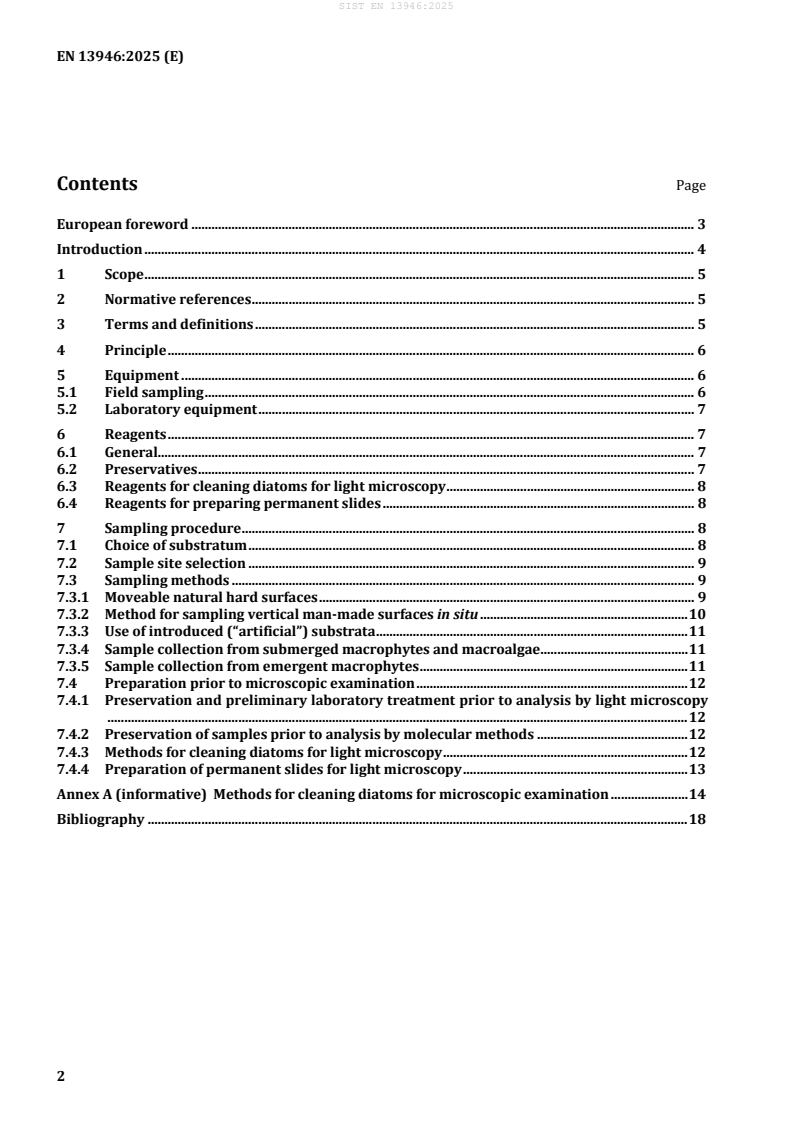
Contents Page
European foreword . 3
Introduction . 4
1 Scope . 5
2 Normative references . 5
3 Terms and definitions . 5
4 Principle . 6
5 Equipment . 6
5.1 Field sampling . 6
5.2 Laboratory equipment . 7
6 Reagents . 7
6.1 General. 7
6.2 Preservatives . 7
6.3 Reagents for cleaning diatoms for light microscopy . 8
6.4 Reagents for preparing permanent slides . 8
7 Sampling procedure . 8
7.1 Choice of substratum . 8
7.2 Sample site selection . 9
7.3 Sampling methods . 9
7.3.1 Moveable natural hard surfaces . 9
7.3.2 Method for sampling vertical man-made surfaces in situ . 10
7.3.3 Use of introduced (“artificial”) substrata . 11
7.3.4 Sample collection from submerged macrophytes and macroalgae . 11
7.3.5 Sample collection from emergent macrophytes . 11
7.4 Preparation prior to microscopic examination . 12
7.4.1 Preservation and preliminary laboratory treatment prior to analysis by light microscopy
............................................................................................................................................................................. 12
7.4.2 Preservation of samples prior to analysis by molecular methods . 12
7.4.3 Methods for cleaning diatoms for light microscopy . 12
7.4.4 Preparation of permanent slides for light microscopy . 13
Annex A (informative) Methods for cleaning diatoms for microscopic examination . 14
Bibliography . 18
European foreword
This document (EN 13946:2025) has been prepared by Technical Committee CEN/TC 230 “Water
analysis”, the secretariat of which is held by DIN.
This European Standard shall be given the status of a national standard, either by publication of
an identical text or by endorsement, at the latest by March 2026, and conflicting national standards
shall be withdrawn at the latest by March 2026.
Attention is drawn to the possibility that some of the elements of this document may be the subject of
patent rights. CEN shall not be held responsible for identifying any or all such patent rights.
This document supersedes EN 13946:2014.
— the method has been adapted to process the samples obtained for subsequent molecular methods by
adding additional solvents and requirements to avoid contamination of samples.
Any feedback and questions on this document should be directed to the users’ national standards body.
A complete listing of these bodies can be found on the CEN website.
According to the CEN-CENELEC Internal Regulations, the national standards organisations of the
following countries are bound to implement this European Standard: Austria, Belgium, Bulgaria, Croatia,
Cyprus, Czech Republic, Denmark, Estonia, Finland, France, Germany, Greece, Hungary, Iceland, Ireland,
Italy, Latvia, Lithuania, Luxembourg, Malta, Netherlands, Norway, Poland, Portugal, Republic of North
Macedonia, Romania, Serbia, Slovakia, Slovenia, Spain, Sweden, Switzerland, Türkiye and the United
Kingdom.
Introduction
Diatoms are an important component of aquatic ecosystems and constitute a water quality monitoring
tool where the primary objective is either a measure of ecological status or the impact of specific
components of water quality (e.g. eutrophication, acidification). The method is appropriate for
assessments required by the Water Framework Directive (2000/60/EC) and Urban Wastewater
Treatment Directive (2024/301) in addition to other EU Directives and international agreements. This
document covers aspects of sampling and preparation relevant to assessment of water quality and
ecological status using benthic diatoms. These instructions will result in samples suitable for quantifying
relative numbers of benthic diatom taxa present using either light microscopy or molecular methods. If
it is necessary to quantify absolute numbers of taxa, or fresh weight per unit area, modifications to the
method are required, which are not within the scope of this document.
The use of diatoms as indicators of river and lake quality is widely accepted both in Europe and beyond.
The method is based on observations that all diatom species have distinct preferences for particular
environmental conditions such as nutrients, organic pollution and acidity. Polluted waters will tend to
support an increased abundance of those species whose optima correspond with the levels of the
pollutant in question. Conversely, certain species are intolerant of elevated levels of one or more
pollutants, whilst others may occur in a wide range of water qualities.
Methods using diatoms to assess water quality have been developed in several European countries
(recent work is summarized in references [1] to [4]). Methods for evaluating the data vary but the
sampling and preparation processes are similar [5, 6]. In recent years, molecular methods such as
metabarcoding have been developed to the point where they are suitable for routine use [7, 8] and
modifications to procedures appropriate for this approach have been included in this revision of the
standard.
According to the precise usage to which this document is to be put, it is essential for specifiers and users
to mutually agree on any necessary variations or optional procedural details prior to use.
All numerical values given in this document are approximate.
WARNING — Persons using this document should be familiar with normal laboratory practice.
This document does not purport to address all of the safety problems, if any, associated with its
use. It is the responsibility of the user to establish appropriate health and safety practices.
IMPORTANT — It is absolutely essential that tests conducted in accordance with this document
be carried out by suitably qualified staff.
1 Scope
This document specifies a method for the sampling and laboratory preparation of benthic diatoms for
ecological status and water quality assessments. The sampling and preparation procedures described can
be used for later investigations using either light microscopy or molecular methods. Data produced by
this method are suitable for production of indices based on the relative abundance of taxa.
Analysis using molecular methods is not within the scope of the document.
2 Normative references
There are no normative references in this document.
3 Terms and definitions
For the purposes of this document, the following terms and definitions apply.
ISO and IEC maintain terminology databases for use in standardization at the following addresses:
— ISO Online browsing platform: available at https://www.iso.org/obp/
— IEC Electropedia: available at https://www.electropedia.org/
3.1
benthic diatoms
diatoms living on substrata, rather than suspended in the water column
3.2
boulder
mineral substratum with a diameter > 256 mm
3.3
cobble
mineral substratum with a diameter > 64 mm and ≤ 256 mm
3.4
ecological status
measure of the structure and functioning of aquatic ecosystems
3.5
euphotic zone
part of the water column in which there is sufficient light for photosynthesis
3.6
frustule
cell wall of diatoms, composed of silica and consisting of two valves linked by two or more girdle bands
3.7
habitat
specific environment in which an organism lives
3.8
introduced substratum
substratum (often artificial) introduced into river or lake specifically for colonisation by diatoms
3.9
metabarcoding
identification (and quantification) of many species from a single sample based on sequences from a short
DNA/RNA region
3.10
molecular method
method that use molecular genetic technologies in order to elucidate the properties of biological samples
3.11
pebble
mineral substratum with a diameter > 16 mm ≤ 64 mm
3.12
riffle
shallow part of a stream with swift flow, usually with a broken surface
3.13
substratum
natural or non-natural material from which benthic diatoms are sampled
3.14
taxa
taxonomic units, for example families, genera or species
3.15
valve
structural component of the diatom frustule (3.6)
4 Principle
Benthic diatoms from submerged hard surfaces, macrophytes and other substrata in rivers, streams or
littoral zones of lakes are sampled in order to produce representative collections of the diatom
assemblage indicative of ecological status and water quality. Samples are cleaned using strong oxidizing
agents in order to prepare diatoms for identification and enumeration, or preserved for analysis by
molecular methods.
The data obtained from the microscopic or molecular methods analysis of these samples are suitable for
the production of diatom-based water quality indices (see references [1], [2], and [3]).
5 Equipment
5.1 Field sampling
Apparatus and equipment used for removing biofilms from surfaces shall be free from any contamination
that may bring diatoms or DNA traces from other samples. It is not necessary to use a brand new
toothbrush for every site, but a strict cleaning procedure after use is recommended to avoid cross
contamination [9, 10]. Toothbrushes can be cleaned by rinsing and rubbing to remove coarse materials.
When samples are to be used for metabarcoding, stronger cleaning agents (e.g. a 10 % bleach solution for
10 min) should be used before thoroughly rinsing and drying.
5.1.1 Appropriate water safety equipment.
5.1.2 Waders.
5.1.3 Toothbrush with stiff bristles (or other similar instrument) or knife (or other suitable blade).
5.1.4 Plastic tray (approximately 30 cm × 20 cm or larger).
5.1.5 Sample bottle with a tight-fitting lid.
5.1.6 Indelible marker pen or other means of labelling samples.
If labels are used, these should be capable of surviving wet conditions.
5.1.7 Hoe, with a fine-meshed net attached, attached to long handle if vertical hard surfaces are to
be sampled.
5.1.8 A glass-bottomed box or bucket (“Aquascope”/”Hydroscope”).
Useful for finding suitable substrata under some circumstances.
5.2 Laboratory equipment
See Annex A.
NOTE Laboratory methods for light microscopy only are included in this document.
6 Reagents
6.1 General
Reagents used in the preparation of the diatom frustules need not be of analytical grade but should be of
a quality appropriate for the process.
6.2 Preservatives
These are required to stop cell division of diatoms and decomposition of organic matter or, in the case of
samples collected for analysis by metabarcoding, degradation of their DNA. No preservative is necessary
if the sample is to be processed for light microscopy within a few hours of collection, so long as steps are
taken to minimize cell division (i.e. by storage in cool, dark place). Lugol’s iodine can be used for short-
term storage prior to analysis by light microscopy; however, it is not suitable for long-term storage, due
to problems caused by sublimation. Buffered formaldehyde or ethanol are recommended for long-term
storage of samples. Samples for light microscopy may also be frozen.
For metabarcoding, Lugol’s iodine and formaldehyde should not be used because they do not adequately
preserve environmental DNA [11]. Ethanol or a nucleic acid preservative is recommended for the
preservation and storage of samples for analysis by metabarcoding [12]. Samples may also be frozen (as
centrifuged pellets) immediately on return from the field.
6.2.1 Buffered 4 % (minimum volume fraction) formaldehyde (HCHO) solution
Dilute a stock solution of formaldehyde to 4 % in a solution buffered to pH 7. Suitable buffers include
HEPES (N-2-hydroxymethylpiperazine-N-2’-sulfonic acid), borate and hexamethylene-tetramine.
A final solution of 1 % to 4 % (volume fraction) in the sample is recommended (the quantity required will
depend upon the amount of organic matter present).
NOTE The buffer is necessary to prevent dissolution of the silica frustules. This is only necessary in alkaline
waters, as diatoms dissolve in alkaline water.
6.2.2 Lugol’s iodine
Dissolve 2 g potassium iodide and 1 g iodine crystals in 300 ml distilled or demineralized water. The
resultant liquid should be dark brown in colour. It should be stored in an air-tight and light-proof
container to minimize sublimation.
Add 1 drops to 5 drops of Lugol’s iodine per 100 ml sample to give a final “straw” colour. More may be
necessary if samples are rich in organic matter.
6.2.3 Ethanol (C H OH)
2 5
A final concentration of 20 % is recommended for medium-term storage for light microscopy.
A final concentration of at least 70 % is recommended for storage for molecular methods.
70 % ethanol has been shown to be suitable for storage for periods of up to a year prior to analysis by
molecular methods [12]. For longer-term storage, higher concentrations may be appropriate.
6.2.4 Hydrochloric acid (HCl)
10 % hydrochloric acid can also be used for medium-term storage for light microscopy. By adding acid,
the diatoms detach from their substrata and iron- and calcium-complexes will dissolve.
6.2.5 Freezing
Immediate freezing to −20 °C or below is also recommended for preservation and storage of samples
intended for analysis by molecular methods.
6.2.6 Other preservatives for metabarcoding
Nucleic acid preservatives are suitable for storing samples for analysis by molecular methods. For
example, a mixture of 3,5 mol/l ammonium sulphate, 17 mmol/l sodium citrate and 13 mmol/l
ethylenediaminetetraacetic acid (EDTA) (sold commercially as “RNAlater”) can be used, so long as the
sample is frozen immediately on return to the laboratory.
This mixture has been shown to be suitable for storage for periods of up to three years prior to analysis
by molecular methods [13]
6.3 Reagents for cleaning diatoms for light microscopy
See Annex A.
6.4 Reagents for preparing permanent slides
A diatom mountant with a refractive index > 1,6 is required (e.g. Naphrax).
7 Sampling procedure
7.1 Choice of substratum
Diatoms can be found growing on most submerged surfaces; however, the composition of the assemblage
varies depending upon the substratum chosen. Ideally, a single substratum should be used at all sites
included in a survey.
Areas of the riverbed or lake littoral zone with naturally occurring moveable hard surfaces (large pebbles,
cobbles and boulders) are recommended wherever possible. If such hard surfaces do not occur naturally,
then it is also possible to sample vertical faces of man-made structures such as quays and bridge supports
(so long as these are not made from wood). Other man-made hard surfaces, such as bricks may also be
sampled, if these have been in the river or lake for long enough to ensure that assemblages are in
equilibrium with their environment. At least four weeks is recommended but the period depends upon
environmental conditions.
Samples of diatoms may also be collected from submerged macrophytes. Where possible, comparative
studies in rivers or lakes should be based on samples collected from the same macrophyte species (or
group of morphologically similar species).
There will also be situations where other substrata (e.g. sand, finer silts) are characteristic of the water
body. These can also be sampled; however, there is no widespread agreement on appropriate methods.
Users should consult the technical literature and conduct preliminary experiments before deciding on
their approach. Consideration should also be given to the introduction of artificial substrata within the
euphotic zone.
7.2 Sample site selection
A segment of river or lake shore that has substrata suitable for sampling should be selected. As a general
rule, this segment should be about 10 m in length, but longer lengths may be appropriate, depending
upon the physical uniformity of the sampling site and the availability of substrata. In rivers, “riffles” are
preferred, as these tend to have a good variety of natural hard surfaces (6.1) but “runs” and “glides” are
also suitable.
When the purpose is to determine the overall condition or status of a lake (rather than to locate hotspots
of pressures), then sampling locations should be well away from inflow streams or obvious human
influences and in locations where free exchange of water with the main basin is possible (enclosed bays
should be avoided).
A detailed description of the site (location, width, depth, substratum type, percent cover of macrophytes,
shade etc.) is required on the first occasion that a sample is collected. A photographic record is also
recommended. This information serves as an aid to data interpretation and to help future samplers locate
the site. On subsequent visits, notes may be limited to major changes that have occurred since the
previous visit, and any variations in sampling protocol employed.
7.3 Sampling methods
7.3.1 Moveable natural hard surfaces
In general, cobbles are the preferred substratum for sampling, as these balance substratum stability
(allowing benthic algal communities to develop) with manoeuvrability. Pebbles and boulders may also
be used. At least five cobbles should be sampled. However, if cobbles are unavailable, then either 5 small
boulders or 10 pebbles should be sampled. A total area of at least 10 cm or more should be scraped or
brushed from the upper surface of each stone. If fewer suitable substrata are available, then a note of this
should be made.
The following microhabitat conditions should be fulfilled:
a) Areas of heavy shade should be avoided (if it cannot be avoided, then a note should be made to this
effect). Areas very close to the bank should also be avoided.
b) The substrata shall be submerged for long enough to ensure that assemblages are in equilibrium with
their environment. At least four weeks is recommended but the period depends upon environmental
conditions. The precise depth is unimportant so long as the surfaces have not been exposed to air. All
depth
...
Questions, Comments and Discussion
Ask us and Technical Secretary will try to provide an answer. You can facilitate discussion about the standard in here.
Loading comments...