


OSIST ISO 9735-2:2004
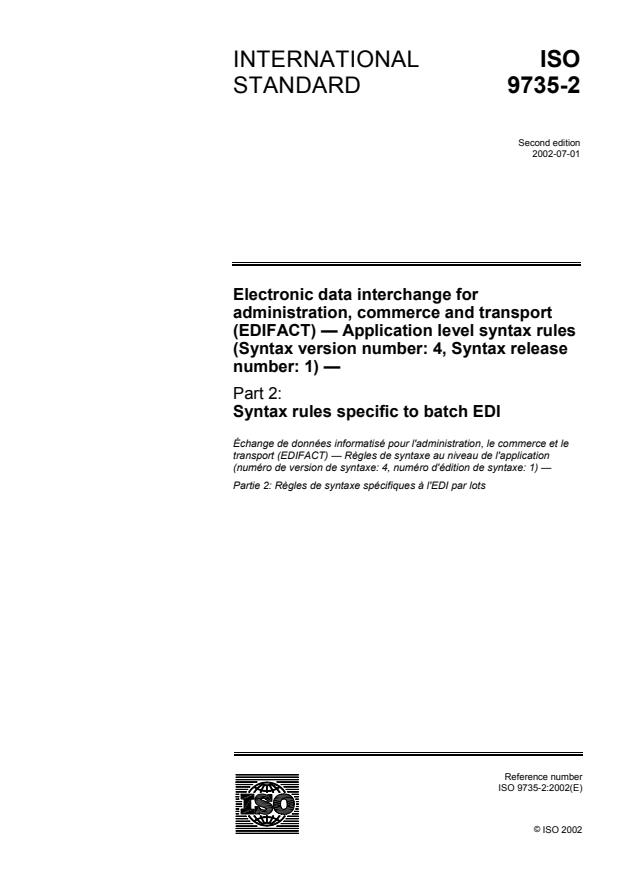
(Main)Electronic data interchange for administration, commerce and transport (EDIFACT) -- Application level syntax rules (Syntax version number: 4, Syntax release number: 1) -- Part 2: Syntax rules specific to batch EDI
Electronic data interchange for administration, commerce and transport (EDIFACT) -- Application level syntax rules (Syntax version number: 4, Syntax release number: 1) -- Part 2: Syntax rules specific to batch EDI
This part of ISO 9735 specifies syntax rules specifically for the formatting of batch messages to be interchanged between computer application systems. For the transfer of packages in a batch environment, see ISO 9735-8.
Échange de données informatisé pour l'administration, le commerce et le transport (EDIFACT) -- Règles de syntaxe au niveau de l'application (numéro de version de syntaxe: 4, numéro d'édition de syntaxe: 1) -- Partie 2: Règles de syntaxe spécifiques à l'EDI par lots
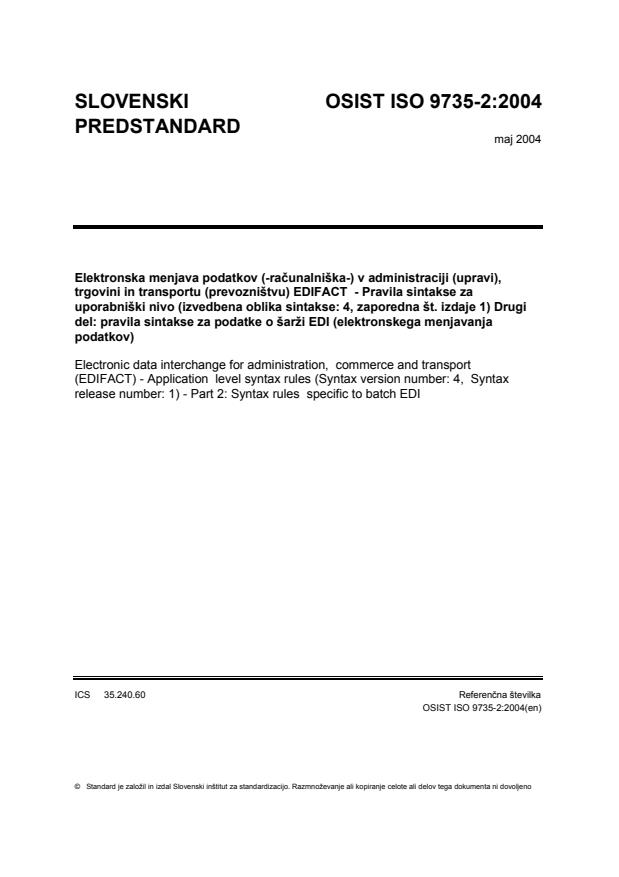
Elektronska menjava podatkov (-računalniška-) v administraciji (upravi), trgovini in transportu (prevozništvu) EDIFACT - Pravila sintakse za uporabniški nivo (izvedbena oblika sintakse: 4, zaporedna št. izdaje 1) Drugi del: pravila sintakse za podatke o šarži EDI (elektronskega menjavanja podatkov)
General Information
- Status
- Not Published
- Technical Committee
- EDI - Documents and data elements in administration , commerce and industry
- Current Stage
- 4020 - Public enquire (PE) (Adopted Project)
- Start Date
- 01-May-2004
- Due Date
- 01-May-2004
- Completion Date
- 01-May-2004
Buy Documents
ISO 9735-2:2002 - Electronic data interchange for administration, commerce and transport (EDIFACT) — Application level syntax rules (Syntax version number: 4, Syntax release number: 1) — Part 2: Syntax rules specific to batch EDI Released:7/4/2002

Relations
- Effective Date
- 12-May-2008
Overview
OSIST ISO 9735-2:2004 is an international standard developed by SIST and ISO for the formatting of batch messages in electronic data interchange (EDI) systems. Specifically focused on the EDIFACT framework, this standard defines the application-level syntax rules necessary for structuring and exchanging batch EDI messages between various computer application systems. These rules ensure interoperability, data consistency, and facilitate the smooth transfer of electronic documents across diverse administrative, commercial, and transport domains.
Key Topics
Batch Message Formatting
Specifies syntax rules for organizing multiple messages into a single batch for electronic interchange. This includes the required sequence of service strings and segments for batch EDI.Conformance and Versioning
Details the use of version and release numbers for format identification (Syntax version number: 4, Syntax release number: 1), ensuring that systems clearly recognize the applied standard and maintain compatibility with different versions.Interchange Structure
Outlines the composition of a batch EDI interchange, including service string advice, header and trailer segments (such as UNA, UNB, UNZ), group headers and trailers (UNG, UNE), and message headers and trailers (UNH, UNT).Hierarchical Organization
Describes the nesting of data elements: from interchanges containing groups or messages, to groups holding multiple messages, with each message consisting of headers, bodies (segment groups), and trailers.Data Element Rules
Defines how segments, composite data elements, and stand-alone data elements are structured, repeated, and combined for accurate data transmission.
Applications
Implementing OSIST ISO 9735-2:2004 is vital for organizations involved in international and domestic data exchanges in sectors such as:
- Administration
- Logistics and Transportation
- Commerce and Trade
By adhering to these batch EDI syntax rules, businesses and government entities benefit from:
Process Automation
Automates data transmission, reducing manual intervention and errors.Interoperability and Scalability
Enables seamless data exchange between disparate systems and supports large-scale message transfers.Cost and Time Efficiency
Streamlines administrative processes, decreases document turnaround time, and reduces operational costs.Regulatory Compliance
Assists organizations in meeting legal and industry-specific requirements for data interchange.
Related Standards
- ISO 9735-1: Application-level syntax rules common to all EDIFACT parts
- ISO 9735-10: Syntax service directories, necessary for interpreting header and trailer segments in batch EDI
- ISO 9735-3: Syntax rules specific to interactive EDI
- ISO 9735-4 to ISO 9735-9: Include standards for service report, security, associated data, and message types such as CONTRL, AUTACK, and KEYMAN
- UNTDID: United Nations Trade Data Interchange Directory, providing message design guidelines and segment definitions
For the transfer of packages in a batch EDI environment, refer to ISO 9735-8.
Organizations planning to implement or upgrade EDI systems for administrative, commercial, or logistics operations should use OSIST ISO 9735-2:2004 alongside related ISO 9735 standards to ensure full compatibility and optimal performance in batch electronic data interchange. This standard supports process streamlining, regulatory alignment, and reliable global data exchange, making it essential for efficient EDI operations.
Buy Documents
ISO 9735-2:2002 - Electronic data interchange for administration, commerce and transport (EDIFACT) — Application level syntax rules (Syntax version number: 4, Syntax release number: 1) — Part 2: Syntax rules specific to batch EDI Released:7/4/2002
Get Certified
Connect with accredited certification bodies for this standard

BSI Group
BSI (British Standards Institution) is the business standards company that helps organizations make excellence a habit.

NYCE
Mexican standards and certification body.
Sponsored listings
Frequently Asked Questions
OSIST ISO 9735-2:2004 is a standard published by the Slovenian Institute for Standardization (SIST). Its full title is "Electronic data interchange for administration, commerce and transport (EDIFACT) -- Application level syntax rules (Syntax version number: 4, Syntax release number: 1) -- Part 2: Syntax rules specific to batch EDI". This standard covers: This part of ISO 9735 specifies syntax rules specifically for the formatting of batch messages to be interchanged between computer application systems. For the transfer of packages in a batch environment, see ISO 9735-8.
This part of ISO 9735 specifies syntax rules specifically for the formatting of batch messages to be interchanged between computer application systems. For the transfer of packages in a batch environment, see ISO 9735-8.
OSIST ISO 9735-2:2004 is classified under the following ICS (International Classification for Standards) categories: 35.240.60 - IT applications in transport. The ICS classification helps identify the subject area and facilitates finding related standards.
OSIST ISO 9735-2:2004 has the following relationships with other standards: It is inter standard links to ISO 9735-2:1998. Understanding these relationships helps ensure you are using the most current and applicable version of the standard.
OSIST ISO 9735-2:2004 is available in PDF format for immediate download after purchase. The document can be added to your cart and obtained through the secure checkout process. Digital delivery ensures instant access to the complete standard document.
Standards Content (Sample)
INTERNATIONAL ISO
STANDARD 9735-2
Second edition
2002-07-01
Electronic data interchange for
administration, commerce and transport
(EDIFACT) — Application level syntax rules
(Syntax version number: 4, Syntax release
number: 1) —
Part 2:
Syntax rules specific to batch EDI
Échange de données informatisé pour l'administration, le commerce et le
transport (EDIFACT) — Règles de syntaxe au niveau de l'application
(numéro de version de syntaxe: 4, numéro d'édition de syntaxe: 1) —
Partie 2: Règles de syntaxe spécifiques à l'EDI par lots
Reference number
©
ISO 2002
PDF disclaimer
This PDF file may contain embedded typefaces. In accordance with Adobe's licensing policy, this file may be printed or viewed but shall not
be edited unless the typefaces which are embedded are licensed to and installed on the computer performing the editing. In downloading this
file, parties accept therein the responsibility of not infringing Adobe's licensing policy. The ISO Central Secretariat accepts no liability in this
area.
Adobe is a trademark of Adobe Systems Incorporated.
Details of the software products used to create this PDF file can be found in the General Info relative to the file; the PDF-creation parameters
were optimized for printing. Every care has been taken to ensure that the file is suitable for use by ISO member bodies. In the unlikely event
that a problem relating to it is found, please inform the Central Secretariat at the address given below.
© ISO 2002
All rights reserved. Unless otherwise specified, no part of this publication may be reproduced or utilized in any form or by any means, electronic
or mechanical, including photocopying and microfilm, without permission in writing from either ISO at the address below or ISO's member body
in the country of the requester.
ISO copyright office
Case postale 56 • CH-1211 Geneva 20
Tel. + 41 22 749 01 11
Fax + 41 22 749 09 47
E-mail copyright@iso.ch
Web www.iso.ch
Printed in Switzerland
ii © ISO 2002 – All rights reserved
Foreword
ISO (the International Organization for Standardization) is a worldwide federation of national standards bodies (ISO
member bodies). The work of preparing International Standards is normally carried out through ISO technical
committees. Each member body interested in a subject for which a technical committee has been established has
the right to be represented on that committee. International organizations, governmental and non-governmental, in
liaison with ISO, also take part in the work. ISO collaborates closely with the International Electrotechnical
Commission (IEC) on all matters of electrotechnical standardization.
International Standards are drafted in accordance with the rules given in the ISO/IEC Directives, Part 3.
The main task of technical committees is to prepare International Standards. Draft International Standards adopted
by the technical committees are circulated to the member bodies for voting. Publication as an International
Standard requires approval by at least 75 % of the member bodies casting a vote.
Attention is drawn to the possibility that some of the elements of this part of ISO 9735 may be the subject of patent
rights. ISO shall not be held responsible for identifying any or all such patent rights.
ISO 9735-2 was prepared by Technical Committee ISO/TC 154, Processes, data elements and documents in
commerce, industry and administration in collaboration with UN/CEFACT through the Joint Syntax Working Group
(JSWG).
This second edition cancels and replaces the first edition (ISO 9735-2:1998). However ISO 9735:1988 and its
Amendment 1:1992 are provisionally retained for the reasons given in clause 2.
Furthermore, for maintenance reasons the Syntax service directories have been removed from all parts of the
ISO 9735 series. They are now consolidated in a new part, ISO 9735-10.
At the time of publication of ISO 9735-1:1998, ISO 9735-10 had been allocated as a part for “Security rules for
interactive EDI”. This was subsequently withdrawn because of lack of user support, and as a result, all relevant
references to the title “Security rules for interactive EDI” were removed in this second edition of ISO 9735-2.
Definitions from all parts of the ISO 9735 series have been consolidated and included in ISO 9735-1.
Together with ISO 9735-1, this part of ISO 9735 is an enhancement of ISO 9735:1988 and its Amendment 1:1992.
ISO 9735 consists of the following parts, under the general title Electronic data interchange for administration,
commerce and transport (EDIFACT) — Application level syntax rules (Syntax version number: 4, Syntax release
number: 1):
— Part 1: Syntax rules common to all parts
— Part 2: Syntax rules specific to batch EDI
— Part 3: Syntax rules specific to interactive EDI
— Part 4: Syntax and service report message for batch EDI (message type — CONTRL)
— Part 5: Security rules for batch EDI (authenticity, integrity and non-repudiation of origin)
— Part 6: Secure authentication and acknowledgement message (message type — AUTACK)
— Part 7: Security rules for batch EDI (confidentiality)
— Part 8: Associated data in EDI
— Part 9: Security key and certificate management message (message type — KEYMAN)
— Part 10: Syntax service directories
Further parts may be added in the future.
iv © ISO 2002 – All rights reserved
Introduction
This part of ISO 9735 includes the rules at the application level for the structuring of data in the interchange of
electronic messages in an open environment, based on the requirements of either batch or interactive processing.
These rules have been agreed by the United Nations Economic Commission for Europe (UN/ECE) as syntax rules
for Electronic Data Interchange for Administration, Commerce and Transport (EDIFACT) and are part of the United
Nations Trade Data Interchange Directory (UNTDID) which also includes both batch and interactive Message
Design Guidelines.
This part of ISO 9735 may be used in any application, but messages using these rules may only be referred to as
EDIFACT messages if they comply with other guidelines, rules and directories in the UNTDID. For UN/EDIFACT
batch messages, the m
...
SLOVENSKI OSIST ISO 9735-2:2004
PREDSTANDARD
maj 2004
Elektronska menjava podatkov (-računalniška-) v administraciji (upravi),
trgovini in transportu (prevozništvu) EDIFACT - Pravila sintakse za
uporabniški nivo (izvedbena oblika sintakse: 4, zaporedna št. izdaje 1) Drugi
del: pravila sintakse za podatke o šarži EDI (elektronskega menjavanja
podatkov)
Electronic data interchange for administration, commerce and transport
(EDIFACT) - Application level syntax rules (Syntax version number: 4, Syntax
release number: 1) - Part 2: Syntax rules specific to batch EDI
ICS 35.240.60 Referenčna številka
© Standard je založil in izdal Slovenski inštitut za standardizacijo. Razmnoževanje ali kopiranje celote ali delov tega dokumenta ni dovoljeno
INTERNATIONAL ISO
STANDARD 9735-2
Second edition
2002-07-01
Electronic data interchange for
administration, commerce and transport
(EDIFACT) — Application level syntax rules
(Syntax version number: 4, Syntax release
number: 1) —
Part 2:
Syntax rules specific to batch EDI
Échange de données informatisé pour l'administration, le commerce et le
transport (EDIFACT) — Règles de syntaxe au niveau de l'application
(numéro de version de syntaxe: 4, numéro d'édition de syntaxe: 1) —
Partie 2: Règles de syntaxe spécifiques à l'EDI par lots
Reference number
©
ISO 2002
PDF disclaimer
This PDF file may contain embedded typefaces. In accordance with Adobe's licensing policy, this file may be printed or viewed but shall not
be edited unless the typefaces which are embedded are licensed to and installed on the computer performing the editing. In downloading this
file, parties accept therein the responsibility of not infringing Adobe's licensing policy. The ISO Central Secretariat accepts no liability in this
area.
Adobe is a trademark of Adobe Systems Incorporated.
Details of the software products used to create this PDF file can be found in the General Info relative to the file; the PDF-creation parameters
were optimized for printing. Every care has been taken to ensure that the file is suitable for use by ISO member bodies. In the unlikely event
that a problem relating to it is found, please inform the Central Secretariat at the address given below.
© ISO 2002
All rights reserved. Unless otherwise specified, no part of this publication may be reproduced or utilized in any form or by any means, electronic
or mechanical, including photocopying and microfilm, without permission in writing from either ISO at the address below or ISO's member body
in the country of the requester.
ISO copyright office
Case postale 56 • CH-1211 Geneva 20
Tel. + 41 22 749 01 11
Fax + 41 22 749 09 47
E-mail copyright@iso.ch
Web www.iso.ch
Printed in Switzerland
ii © ISO 2002 – All rights reserved
Foreword
ISO (the International Organization for Standardization) is a worldwide federation of national standards bodies (ISO
member bodies). The work of preparing International Standards is normally carried out through ISO technical
committees. Each member body interested in a subject for which a technical committee has been established has
the right to be represented on that committee. International organizations, governmental and non-governmental, in
liaison with ISO, also take part in the work. ISO collaborates closely with the International Electrotechnical
Commission (IEC) on all matters of electrotechnical standardization.
International Standards are drafted in accordance with the rules given in the ISO/IEC Directives, Part 3.
The main task of technical committees is to prepare International Standards. Draft International Standards adopted
by the technical committees are circulated to the member bodies for voting. Publication as an International
Standard requires approval by at least 75 % of the member bodies casting a vote.
Attention is drawn to the possibility that some of the elements of this part of ISO 9735 may be the subject of patent
rights. ISO shall not be held responsible for identifying any or all such patent rights.
ISO 9735-2 was prepared by Technical Committee ISO/TC 154, Processes, data elements and documents in
commerce, industry and administration in collaboration with UN/CEFACT through the Joint Syntax Working Group
(JSWG).
This second edition cancels and replaces the first edition (ISO 9735-2:1998). However ISO 9735:1988 and its
Amendment 1:1992 are provisionally retained for the reasons given in clause 2.
Furthermore, for maintenance reasons the Syntax service directories have been removed from all parts of the
ISO 9735 series. They are now consolidated in a new part, ISO 9735-10.
At the time of publication of ISO 9735-1:1998, ISO 9735-10 had been allocated as a part for “Security rules for
interactive EDI”. This was subsequently withdrawn because of lack of user support, and as a result, all relevant
references to the title “Security rules for interactive EDI” were removed in this second edition of ISO 9735-2.
Definitions from all parts of the ISO 9735 series have been consolidated and included in ISO 9735-1.
Together with ISO 9735-1, this part of ISO 9735 is an enhancement of ISO 9735:1988 and its Amendment 1:1992.
ISO 9735 consists of the following parts, under the general title Electronic data interchange for administration,
commerce and transport (EDIFACT) — Application level syntax rules (Syntax version number: 4, Syntax release
number: 1):
— Part 1: Syntax rules common to all parts
— Part 2: Syntax rules specific to batch EDI
— Part 3: Syntax rules specific to interactive EDI
— Part 4: Syntax and service report message for batch EDI (message type — CONTRL)
— Part 5: Security rules for batch EDI (authenticity, integrity and non-repudiation of origin)
— Part 6: Secure authentication and acknowledgement message (message type — AUTACK)
— Part 7: Security rules for batch EDI (confidentiality)
— Part 8: Associated data in EDI
— Part 9: Security key and certificate management message (message type — KEYMAN)
— Part 10: Syntax service directories
Further parts may be added in the future.
iv © ISO 2002 – All rights reserved
Introduction
This part of ISO 9735 includes the rules at the application level for the structuring of data in the interchange of
electronic messages in an open environment, based on the requirements of either batch or interactive processing.
These rules have been agreed by the United Nations Economic Commission for Europe (UN/ECE)
...