


oSIST prEN ISO 10426-1:2026
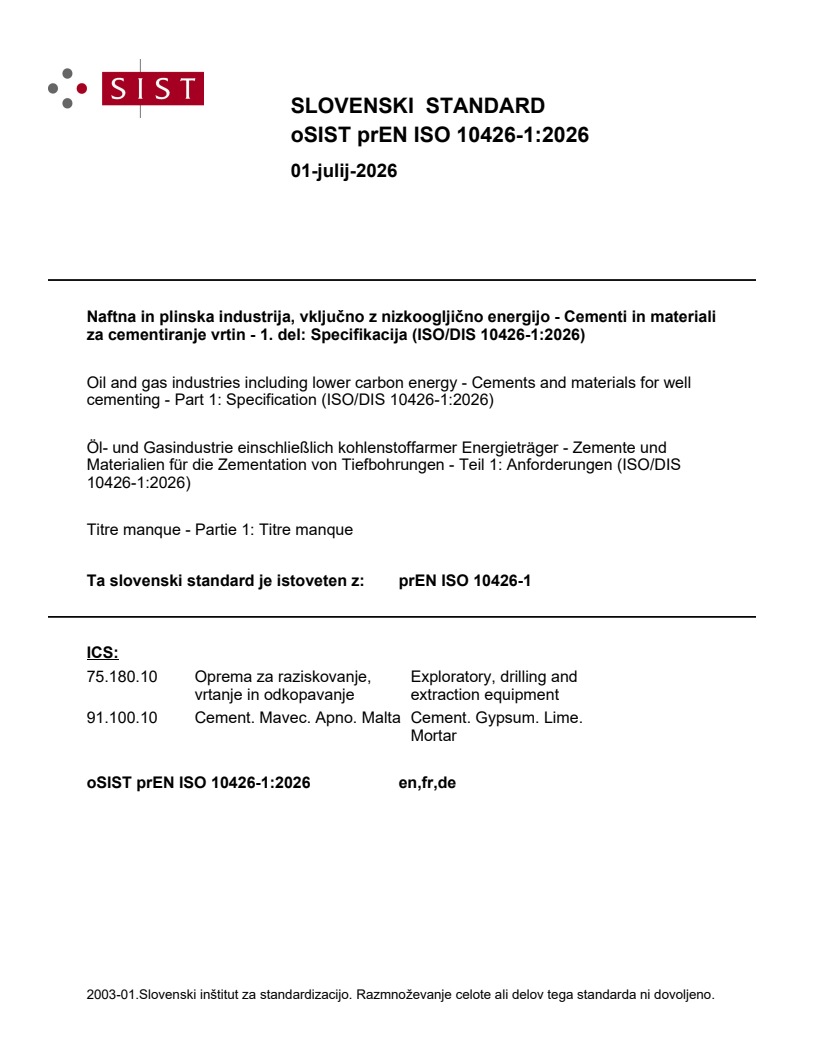
(Main)Oil and gas industries including lower carbon energy - Cements and materials for well cementing - Part 1: Specification (ISO/DIS 10426-1:2026)
Oil and gas industries including lower carbon energy - Cements and materials for well cementing - Part 1: Specification (ISO/DIS 10426-1:2026)
ISO 10426-1:2009 specifies requirements and gives recommendations for six classes of well cements, including their chemical and physical requirements and procedures for physical testing.
ISO 10426-1:2009 is applicable to well cement classes A, B, C and D, which are the products obtained by grinding Portland cement clinker and, if needed, calcium sulfate as an interground additive. Processing additives can be used in the manufacture of cement of these classes. Suitable set-modifying agents can be interground or blended during manufacture of class D cement.
ISO 10426-1:2009 is also applicable to well cement classes G and H, which are the products obtained by grinding clinker with no additives other than one or more forms of calcium sulfate, water or chemical additives as required for chromium (VI) reduction.
Öl- und Gasindustrie einschließlich kohlenstoffarmer Energieträger - Zemente und Materialien für die Zementation von Tiefbohrungen - Teil 1: Anforderungen (ISO/DIS 10426-1:2026)
Titre manque - Partie 1: Titre manque
Le présent document spécifie des exigences et fournit des recommandations pour 8 classes de ciments de puits, incluant des exigences chimiques et physiques ainsi que des modes opératoires d’essais physiques.
La présente partie de l'ISO 10426 s'applique aux ciments de puits de classes A, B, C et D, obtenus par broyage de clinker de ciment Portland et, si nécessaire, de sulfate de calcium en tant qu’additif incorporé par broyage. Des additifs de traitement peuvent être utilisés lors de la fabrication des ciments de ces classes. Des modificateurs de prise appropriés peuvent être broyés ou mélangés lors de la fabrication du ciment de classe D.
La présente partie de l'ISO 10426 s'applique aussi au ciment de puits de classes G et H, qui sont des produits obtenus en broyant un clinker de ciment sans aucune addition autre que celles de sulfate de calcium sous une ou plusieurs formes, d'eau ou d'additifs chimiques nécessaires à la réduction du chrome (VI).
La présente partie de l'ISO 10426 s'applique également aux ciments composites pour puits de classes K et L, qui sont des produits obtenus par broyage de clinker de ciment Portland et d'une ou plusieurs formes de CaSO4 avec des constituants composites spécifiés, ou par mélange ultérieur de ciment Portland produit séparément avec des constituants composites spécifiés traités séparément.
Le présent document est un supplément à l’API Spec 10A 25ème édition (2019) et à son addendum 1 (novembre 2019) et à son addendum 2 (août 2022), dont les exigences sont applicables avec les exceptions précisées dans le présent document.
Naftna in plinska industrija, vključno z nizkoogljično energijo - Cementi in materiali za cementiranje vrtin - 1. del: Specifikacija (ISO/DIS 10426-1:2026)
ISO 10426-1:2009 določa zahteve in podaja priporočila za šest razredov cementov za vrtine, vključno z njihovimi kemijskimi in fizikalnimi zahtevami ter postopki za fizikalno testiranje.
ISO 10426-1:2009 se uporablja za razrede cementov za vrtine A, B, C in D, ki so proizvodi, pridobljeni z mletjem klinkerja portlandskega cementa in, če je potrebno, kalcijevega sulfata kot dodatka, zmletega skupaj s klinkerjem. Pri izdelavi cementov teh razredov se lahko uporabljajo dodatki za obdelavo. Primerni modifikatorji vezave (set-modifying agents) se lahko zmeljejo skupaj ali zmešajo med proizvodnjo cementa razreda D.
ISO 10426-1:2009 se uporablja tudi za razrede cementov za vrtine G in H, ki so proizvodi, pridobljeni z mletjem klinkerja brez dodatkov, razen ene ali več oblik kalcijevega sulfata, vode ali kemičnih dodatkov, kot je potrebno za zmanjšanje kroma (VI).
General Information
- Status
- Not Published
- Public Enquiry End Date
- 14-Jul-2026
- Technical Committee
- I13 - Imaginarni 13
- Current Stage
- 4020 - Public enquire (PE) (Adopted Project)
- Start Date
- 21-May-2026
- Due Date
- 08-Oct-2026

Relations
- Effective Date
- 25-Feb-2026
- Effective Date
- 25-Feb-2026
- Effective Date
- 25-Feb-2026
Get Certified
Connect with accredited certification bodies for this standard

DIBt (Deutsches Institut für Bautechnik)
German Institute for Building Technology.
DIN CERTCO
DIN Group product certification.

Element Materials Technology
Materials testing and product certification.
Sponsored listings
Frequently Asked Questions
oSIST prEN ISO 10426-1:2026 is a draft published by the Slovenian Institute for Standardization (SIST). Its full title is "Oil and gas industries including lower carbon energy - Cements and materials for well cementing - Part 1: Specification (ISO/DIS 10426-1:2026)". This standard covers: ISO 10426-1:2009 specifies requirements and gives recommendations for six classes of well cements, including their chemical and physical requirements and procedures for physical testing. ISO 10426-1:2009 is applicable to well cement classes A, B, C and D, which are the products obtained by grinding Portland cement clinker and, if needed, calcium sulfate as an interground additive. Processing additives can be used in the manufacture of cement of these classes. Suitable set-modifying agents can be interground or blended during manufacture of class D cement. ISO 10426-1:2009 is also applicable to well cement classes G and H, which are the products obtained by grinding clinker with no additives other than one or more forms of calcium sulfate, water or chemical additives as required for chromium (VI) reduction.
ISO 10426-1:2009 specifies requirements and gives recommendations for six classes of well cements, including their chemical and physical requirements and procedures for physical testing. ISO 10426-1:2009 is applicable to well cement classes A, B, C and D, which are the products obtained by grinding Portland cement clinker and, if needed, calcium sulfate as an interground additive. Processing additives can be used in the manufacture of cement of these classes. Suitable set-modifying agents can be interground or blended during manufacture of class D cement. ISO 10426-1:2009 is also applicable to well cement classes G and H, which are the products obtained by grinding clinker with no additives other than one or more forms of calcium sulfate, water or chemical additives as required for chromium (VI) reduction.
oSIST prEN ISO 10426-1:2026 is classified under the following ICS (International Classification for Standards) categories: 75.180.10 - Exploratory, drilling and extraction equipment; 91.100.10 - Cement. Gypsum. Lime. Mortar. The ICS classification helps identify the subject area and facilitates finding related standards.
oSIST prEN ISO 10426-1:2026 has the following relationships with other standards: It is inter standard links to SIST EN ISO 10426-1:2010/AC:2010, SIST EN ISO 10426-1:2010, SIST EN ISO 10426-1:2010/AC:2018. Understanding these relationships helps ensure you are using the most current and applicable version of the standard.
oSIST prEN ISO 10426-1:2026 is available in PDF format for immediate download after purchase. The document can be added to your cart and obtained through the secure checkout process. Digital delivery ensures instant access to the complete standard document.
Standards Content (Sample)
SLOVENSKI STANDARD
01-julij-2026
Naftna in plinska industrija, vključno z nizkoogljično energijo - Cementi in materiali
za cementiranje vrtin - 1. del: Specifikacija (ISO/DIS 10426-1:2026)
Oil and gas industries including lower carbon energy - Cements and materials for well
cementing - Part 1: Specification (ISO/DIS 10426-1:2026)
Öl- und Gasindustrie einschließlich kohlenstoffarmer Energieträger - Zemente und
Materialien für die Zementation von Tiefbohrungen - Teil 1: Anforderungen (ISO/DIS
10426-1:2026)
Titre manque - Partie 1: Titre manque
Ta slovenski standard je istoveten z: prEN ISO 10426-1
ICS:
75.180.10 Oprema za raziskovanje, Exploratory, drilling and
vrtanje in odkopavanje extraction equipment
91.100.10 Cement. Mavec. Apno. Malta Cement. Gypsum. Lime.
Mortar
2003-01.Slovenski inštitut za standardizacijo. Razmnoževanje celote ali delov tega standarda ni dovoljeno.
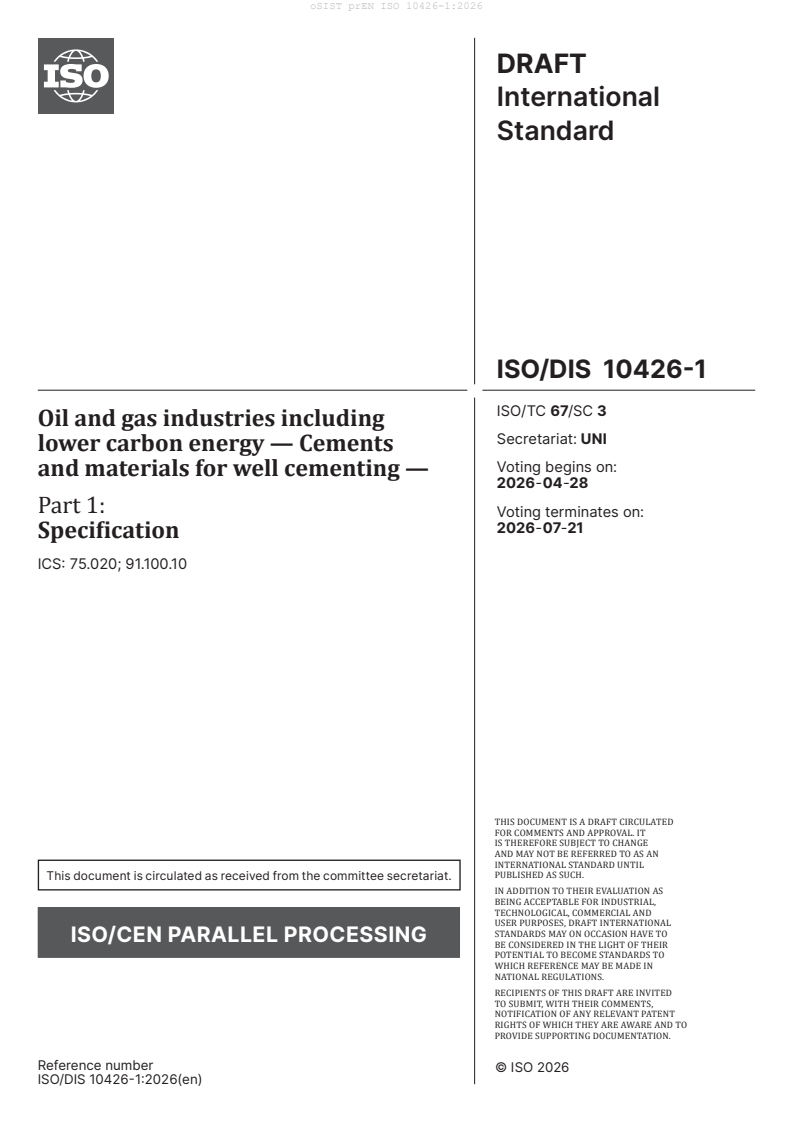
DRAFT
International
Standard
ISO/DIS 10426-1
ISO/TC 67/SC 3
Oil and gas industries including
Secretariat: UNI
lower carbon energy — Cements
Voting begins on:
and materials for well cementing —
2026-04-28
Part 1:
Voting terminates on:
2026-07-21
Specification
ICS: 75.020; 91.100.10
THIS DOCUMENT IS A DRAFT CIRCULATED
FOR COMMENTS AND APPROVAL. IT
IS THEREFORE SUBJECT TO CHANGE
AND MAY NOT BE REFERRED TO AS AN
INTERNATIONAL STANDARD UNTIL
PUBLISHED AS SUCH.
This document is circulated as received from the committee secretariat.
IN ADDITION TO THEIR EVALUATION AS
BEING ACCEPTABLE FOR INDUSTRIAL,
TECHNOLOGICAL, COMMERCIAL AND
USER PURPOSES, DRAFT INTERNATIONAL
STANDARDS MAY ON OCCASION HAVE TO
ISO/CEN PARALLEL PROCESSING
BE CONSIDERED IN THE LIGHT OF THEIR
POTENTIAL TO BECOME STANDARDS TO
WHICH REFERENCE MAY BE MADE IN
NATIONAL REGULATIONS.
RECIPIENTS OF THIS DRAFT ARE INVITED
TO SUBMIT, WITH THEIR COMMENTS,
NOTIFICATION OF ANY RELEVANT PATENT
RIGHTS OF WHICH THEY ARE AWARE AND TO
PROVIDE SUPPORTING DOCUMENTATION.
Reference number
ISO/DIS 10426-1:2026(en)
DRAFT
ISO/DIS 10426-1:2026(en)
International
Standard
ISO/DIS 10426-1
ISO/TC 67/SC 3
Oil and gas industries including
Secretariat: UNI
lower carbon energy — Cements
Voting begins on:
and materials for well cementing —
Part 1:
Voting terminates on:
Specification
ICS: 75.020; 91.100.10
THIS DOCUMENT IS A DRAFT CIRCULATED
FOR COMMENTS AND APPROVAL. IT
IS THEREFORE SUBJECT TO CHANGE
AND MAY NOT BE REFERRED TO AS AN
INTERNATIONAL STANDARD UNTIL
PUBLISHED AS SUCH.
This document is circulated as received from the committee secretariat.
IN ADDITION TO THEIR EVALUATION AS
BEING ACCEPTABLE FOR INDUSTRIAL,
© ISO 2026
TECHNOLOGICAL, COMMERCIAL AND
USER PURPOSES, DRAFT INTERNATIONAL
All rights reserved. Unless otherwise specified, or required in the context of its implementation, no part of this publication may
STANDARDS MAY ON OCCASION HAVE TO
ISO/CEN PARALLEL PROCESSING
be reproduced or utilized otherwise in any form or by any means, electronic or mechanical, including photocopying, or posting on
BE CONSIDERED IN THE LIGHT OF THEIR
the internet or an intranet, without prior written permission. Permission can be requested from either ISO at the address below
POTENTIAL TO BECOME STANDARDS TO
WHICH REFERENCE MAY BE MADE IN
or ISO’s member body in the country of the requester.
NATIONAL REGULATIONS.
ISO copyright office
RECIPIENTS OF THIS DRAFT ARE INVITED
CP 401 • Ch. de Blandonnet 8
TO SUBMIT, WITH THEIR COMMENTS,
CH-1214 Vernier, Geneva
NOTIFICATION OF ANY RELEVANT PATENT
Phone: +41 22 749 01 11
RIGHTS OF WHICH THEY ARE AWARE AND TO
PROVIDE SUPPORTING DOCUMENTATION.
Email: copyright@iso.org
Website: www.iso.org
Published in Switzerland Reference number
ISO/DIS 10426-1:2026(en)
ii
ISO/DIS 10426-1:2026(en)
Contents Page
Foreword .iv
1 Scope . 1
2 Normative references . 1
3 Terms and definitions . 2
4 Supplements to API Spec 10A, 25th edition (2019) . 2
4.1 General requirements .2
4.2 Determining The Global Warming Potential (GWP) of Well Cements .2
iii
ISO/DIS 10426-1:2026(en)
Foreword
ISO (the International Organization for Standardization) is a worldwide federation of national standards
bodies (ISO member bodies). The work of preparing International Standards is normally carried out through
ISO technical committees. Each member body interested in a subject for which a technical committee
has been established has the right to be represented on that committee. International organizations,
governmental and non-governmental, in liaison with ISO, also take part in the work. ISO collaborates closely
with the International Electrotechnical Commission (IEC) on all matters of electrotechnical standardization.
The procedures used to develop this document and those intended for its further maintenance are described
in the ISO/IEC Directives,
...