


SIST EN 300 175-5 V2.8.1:2020
(Main)Digital Enhanced Cordless Telecommunications (DECT) - Common Interface (CI) - Part 5: Network (NWK) layer
Digital Enhanced Cordless Telecommunications (DECT) - Common Interface (CI) - Part 5: Network (NWK) layer
The present document is one of the parts of the specification of the Digital Enhanced Cordless Telecommunications (DECT) Common Interface (CI).
The present document specifies the Network (NWK) layer. The NWK layer is part 5 of the ETSI EN 300 175 and layer 3 of the DECT protocol stack. The present document only specifies the C-plane (control plane) of the DECT NWK layer. It contains no specification for the U-plane (user plane) because the U-plane is null for all services at the DECT NWK layer. The C-plane contains all of the internal signalling information, and the NWK layer protocols are grouped into the following families of procedures:
• Call Control (CC);
• Supplementary Services (SS);
• Connection Oriented Message Service (COMS);
• ConnectionLess Message Service (CLMS);
• Mobility Management (MM);
• Link Control Entity (LCE).
The present document uses the layered model principles and terminology as described in Recommendation ITU-T X.200 [i.3] and Recommendation ITU-T X.210 [i.4]. The present document includes New Generation DECT, a further development of the DECT standard introducing wideband speech, improved data services, new slot types and other technical enhancements. The present document also includes super-wideband and fullband speech and audio services.
Digitalne izboljšane brezvrvične telekomunikacije (DECT) - Skupni vmesnik (CI) - 5. del: Omrežna plast (NWK)
Ta dokument je eden od delov specifikacije skupnega vmesnika (CI) za digitalne izboljšane brezvrvične telekomunikacije (DECT).
Ta dokument določa omrežno plast (NWK). Omrežna plast je 5. del standarda ETSI EN 300 175 in plast 3 sklada protokolov digitalnih izboljšanih brezvrvičnih telekomunikacij. Ta dokument določa samo C-raven (nadzorno raven) omrežne plasti digitalnih izboljšanih brezvrvičnih telekomunikacij. Ne vsebuje specifikacije za U-raven (uporabniško raven), ker je U-raven na omrežni plasti digitalnih izboljšanih brezvrvičnih telekomunikacij enaka nič za vse storitve. C-raven vsebuje vse notranje signalizacijske informacije in protokoli omrežne plasti so združeni v naslednje družine postopkov:
• nadzor klicev (CC),
• nadomestne storitve (SS),
• sporočilna storitev, usmerjena na povezavo (COMS),
• sporočilna storitev brez povezave (CLMS),
• upravljanje mobilnosti (MM),
• entiteta kontrole povezave (LCE).
Ta dokument uporablja načela in terminologijo modela plasti, kot je opisano v priporočilih ITU-T X.200 [i.3] in X.210 [i.4]. Ta dokument vključuje novo generacijo digitalnih izboljšanih brezvrvičnih telekomunikacij, nadaljnji razvoj standarda za digitalne izboljšane brezvrvične telekomunikacije, ki uvaja širokopasovni govor, izpopolnjene podatkovne storitve, nove tipe rež in druge tehnične izpopolnitve. Ta dokument vključuje tudi super širokopasovne in polnopasovne govorne in zvočne storitve.
General Information
- Status
- Published
- Public Enquiry End Date
- 27-Nov-2019
- Publication Date
- 16-Dec-2019
- Technical Committee
- MOC - Mobile Communications
- Current Stage
- 6060 - National Implementation/Publication (Adopted Project)
- Start Date
- 16-Dec-2019
- Due Date
- 20-Feb-2020
- Completion Date
- 17-Dec-2019
Buy Documents
ETSI EN 300 175-5 V2.7.9 (2019-08) - Digital Enhanced Cordless Telecommunications (DECT); Common Interface (CI); Part 5: Network (NWK) layer
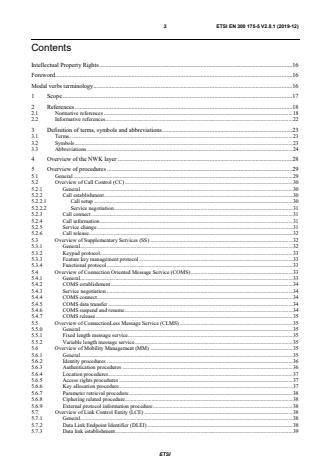
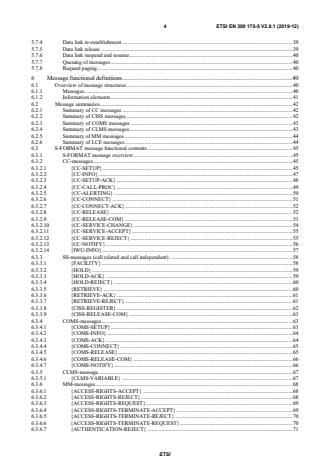
ETSI EN 300 175-5 V2.8.1 (2019-12) - Digital Enhanced Cordless Telecommunications (DECT); Common Interface (CI); Part 5: Network (NWK) layer

Overview
SIST EN 300 175-5 V2.8.1:2020 defines the Network (NWK) layer of the Digital Enhanced Cordless Telecommunications (DECT) Common Interface (CI). Published by the Slovenian Institute for Standardization (SIST), this standard aligns with ETSI EN 300 175-5 V2.8.1 (2019-12) and specifies Layer 3 protocols within the DECT stack, focusing exclusively on the C-plane (control plane). The NWK layer is foundational for managing signaling, call control, supplementary services, mobility, and messaging in DECT-based wireless systems.
This standard is critical for manufacturers, system integrators, and telecom operators who require interoperable, high-quality, and feature-rich cordless communication solutions. It supports the ongoing evolution of DECT technology, including New Generation DECT, with enhanced speech and data services.
Key keywords: DECT standard, network layer, common interface, mobility management, cordless telecommunication, signaling protocols, ETSI EN 300 175.
Key Topics
- Control Plane Focus: The standard specifies only the C-plane protocols of the NWK layer-responsible for internal signaling and management activities within DECT systems.
- Procedure Families:
- Call Control (CC): Establishment, management, and termination of voice and data calls.
- Supplementary Services (SS): Protocols for additional features such as call hold, transfer, and conferencing.
- Connection Oriented Message Service (COMS): For reliable, connection-based message transfer.
- ConnectionLess Message Service (CLMS): For quick, one-way communications requiring no connection setup.
- Mobility Management (MM): Processes and messages that enable roaming, user authentication, location updating, and access rights management.
- Link Control Entity (LCE): Establishment and management of logical links within the DECT system.
- Layered Model Compliance: Utilizes ITU-T X.200 and X.210 terminology and principles for OSI layering, ensuring compatibility and clear protocol separation.
- Enhanced Services: Addresses new and future requirements with provisions for wideband, super-wideband, and fullband audio services as part of New Generation DECT.
- Signaling Structures: Comprehensive definition of message formats, information elements, and protocol discrimination for robust interoperability between DECT devices.
Applications
The practical applications of SIST EN 300 175-5 V2.8.1:2020 cover a wide range of professional and consumer telecommunications scenarios:
- Cordless Telephony Systems: For enterprises and home users requiring stable, high-quality voice and supplementary services.
- Wireless Office Solutions: Integration into PBX, hospitality, retail, and healthcare environments where cordless mobility and supplementary services are critical.
- Industrial Automation: Use in factories, warehouses, and logistics where robust wireless signaling and device management are essential.
- Broadband & Enhanced Audio: Support for advanced audio applications, including wideband and fullband voice connections suited for modern unified communications.
- Scalability and Mobility: Essential for systems with user mobility, enabling seamless handovers, location tracking, and security within and across DECT coverage areas.
Compliance with this standard ensures interoperability, future-proofing, and efficient network management for all DECT-based devices and services.
Related Standards
To build a secure and standards-based DECT infrastructure, consider pairing SIST EN 300 175-5 V2.8.1:2020 with the following related standards:
- SIST EN 300 175-1: Overview of the DECT Common Interface.
- SIST EN 300 175-2: Physical Layer (Layer 1) specification.
- SIST EN 300 175-3: Medium Access Control (MAC) Layer.
- SIST EN 300 175-4: Data Link Control (DLC) Layer.
- ETSI EN 300 175 Series: Collective suite for complete DECT protocol stack specification.
- ITU-T X.200 and X.210: OSI reference model definitions used as a methodological basis.
- Relevant security and supplementary service standards within the DECT family.
By adhering to these standards, organizations ensure robust, interoperable, and high-quality digital cordless telecommunications infrastructure in compliance with both European and international requirements.
Buy Documents
ETSI EN 300 175-5 V2.7.9 (2019-08) - Digital Enhanced Cordless Telecommunications (DECT); Common Interface (CI); Part 5: Network (NWK) layer
ETSI EN 300 175-5 V2.8.1 (2019-12) - Digital Enhanced Cordless Telecommunications (DECT); Common Interface (CI); Part 5: Network (NWK) layer
Get Certified
Connect with accredited certification bodies for this standard

BSI Group
BSI (British Standards Institution) is the business standards company that helps organizations make excellence a habit.

NYCE
Mexican standards and certification body.

ANCE
Mexican certification and testing association.
Sponsored listings
Frequently Asked Questions
SIST EN 300 175-5 V2.8.1:2020 is a standard published by the Slovenian Institute for Standardization (SIST). Its full title is "Digital Enhanced Cordless Telecommunications (DECT) - Common Interface (CI) - Part 5: Network (NWK) layer". This standard covers: The present document is one of the parts of the specification of the Digital Enhanced Cordless Telecommunications (DECT) Common Interface (CI). The present document specifies the Network (NWK) layer. The NWK layer is part 5 of the ETSI EN 300 175 and layer 3 of the DECT protocol stack. The present document only specifies the C-plane (control plane) of the DECT NWK layer. It contains no specification for the U-plane (user plane) because the U-plane is null for all services at the DECT NWK layer. The C-plane contains all of the internal signalling information, and the NWK layer protocols are grouped into the following families of procedures: • Call Control (CC); • Supplementary Services (SS); • Connection Oriented Message Service (COMS); • ConnectionLess Message Service (CLMS); • Mobility Management (MM); • Link Control Entity (LCE). The present document uses the layered model principles and terminology as described in Recommendation ITU-T X.200 [i.3] and Recommendation ITU-T X.210 [i.4]. The present document includes New Generation DECT, a further development of the DECT standard introducing wideband speech, improved data services, new slot types and other technical enhancements. The present document also includes super-wideband and fullband speech and audio services.
The present document is one of the parts of the specification of the Digital Enhanced Cordless Telecommunications (DECT) Common Interface (CI). The present document specifies the Network (NWK) layer. The NWK layer is part 5 of the ETSI EN 300 175 and layer 3 of the DECT protocol stack. The present document only specifies the C-plane (control plane) of the DECT NWK layer. It contains no specification for the U-plane (user plane) because the U-plane is null for all services at the DECT NWK layer. The C-plane contains all of the internal signalling information, and the NWK layer protocols are grouped into the following families of procedures: • Call Control (CC); • Supplementary Services (SS); • Connection Oriented Message Service (COMS); • ConnectionLess Message Service (CLMS); • Mobility Management (MM); • Link Control Entity (LCE). The present document uses the layered model principles and terminology as described in Recommendation ITU-T X.200 [i.3] and Recommendation ITU-T X.210 [i.4]. The present document includes New Generation DECT, a further development of the DECT standard introducing wideband speech, improved data services, new slot types and other technical enhancements. The present document also includes super-wideband and fullband speech and audio services.
SIST EN 300 175-5 V2.8.1:2020 is classified under the following ICS (International Classification for Standards) categories: 33.070.30 - Digital Enhanced Cordless Telecommunications (DECT); 35.100.30 - Network layer. The ICS classification helps identify the subject area and facilitates finding related standards.
SIST EN 300 175-5 V2.8.1:2020 is available in PDF format for immediate download after purchase. The document can be added to your cart and obtained through the secure checkout process. Digital delivery ensures instant access to the complete standard document.
Standards Content (Sample)
Draft ETSI EN 300 175-5 V2.7.9 (2019-08)
EUROPEAN STANDARD
Digital Enhanced Cordless Telecommunications (DECT);
Common Interface (CI);
Part 5: Network (NWK) layer
2 Draft ETSI EN 300 175-5 V2.7.9 (2019-08)
Reference
REN/DECT-00325
Keywords
DECT, IMT-2000, mobility, radio, TDD, TDMA
ETSI
650 Route des Lucioles
F-06921 Sophia Antipolis Cedex - FRANCE
Tel.: +33 4 92 94 42 00 Fax: +33 4 93 65 47 16
Siret N° 348 623 562 00017 - NAF 742 C
Association à but non lucratif enregistrée à la
Sous-Préfecture de Grasse (06) N° 7803/88
Important notice
The present document can be downloaded from:
http://www.etsi.org/standards-search
The present document may be made available in electronic versions and/or in print. The content of any electronic and/or
print versions of the present document shall not be modified without the prior written authorization of ETSI. In case of any
existing or perceived difference in contents between such versions and/or in print, the prevailing version of an ETSI
deliverable is the one made publicly available in PDF format at www.etsi.org/deliver.
Users of the present document should be aware that the document may be subject to revision or change of status.
Information on the current status of this and other ETSI documents is available at
https://portal.etsi.org/TB/ETSIDeliverableStatus.aspx
If you find errors in the present document, please send your comment to one of the following services:
https://portal.etsi.org/People/CommiteeSupportStaff.aspx
Copyright Notification
No part may be reproduced or utilized in any form or by any means, electronic or mechanical, including photocopying
and microfilm except as authorized by written permission of ETSI.
The content of the PDF version shall not be modified without the written authorization of ETSI.
The copyright and the foregoing restriction extend to reproduction in all media.
© ETSI 2019.
All rights reserved.
TM TM TM
DECT , PLUGTESTS , UMTS and the ETSI logo are trademarks of ETSI registered for the benefit of its Members.
TM TM
3GPP and LTE are trademarks of ETSI registered for the benefit of its Members and
of the 3GPP Organizational Partners.
oneM2M™ logo is a trademark of ETSI registered for the benefit of its Members and
of the oneM2M Partners. ®
GSM and the GSM logo are trademarks registered and owned by the GSM Association.
ETSI
3 Draft ETSI EN 300 175-5 V2.7.9 (2019-08)
Contents
Intellectual Property Rights . 16
Foreword . 16
Modal verbs terminology . 16
1 Scope . 17
2 References . 18
2.1 Normative references . 18
2.2 Informative references . 22
3 Definition of terms, symbols and abbreviations . 23
3.1 Terms . 23
3.2 Symbols . 23
3.3 Abbreviations . 24
4 Overview of the NWK layer . 28
5 Overview of procedures . 29
5.1 General . 29
5.2 Overview of Call Control (CC) . 30
5.2.1 General . 30
5.2.2 Call establishment . 30
5.2.2.1 Call setup . 30
5.2.2.2 Service negotiation . 31
5.2.3 Call connect . 31
5.2.4 Call information . 31
5.2.5 Service change . 31
5.2.6 Call release. 32
5.3 Overview of Supplementary Services (SS) . 32
5.3.1 General . 32
5.3.2 Keypad protocol . 33
5.3.3 Feature key management protocol . 33
5.3.4 Functional protocol . 33
5.4 Overview of Connection Oriented Message Service (COMS) . 33
5.4.1 General . 33
5.4.2 COMS establishment . 34
5.4.3 Service negotiation . 34
5.4.4 COMS connect . 34
5.4.5 COMS data transfer . 34
5.4.6 COMS suspend and resume . 34
5.4.7 COMS release . 35
5.5 Overview of ConnectionLess Message Service (CLMS) . 35
5.5.0 General . 35
5.5.1 Fixed length message service. 35
5.5.2 Variable length message service . 35
5.6 Overview of Mobility Management (MM) . 35
5.6.1 General . 35
5.6.2 Identity procedures . 36
5.6.3 Authentication procedures . 36
5.6.4 Location procedures . 37
5.6.5 Access rights procedures . 37
5.6.6 Key allocation procedure . 37
5.6.7 Parameter retrieval procedure . 38
5.6.8 Ciphering related procedure . 38
5.6.9 External protocol information procedure . 38
5.7 Overview of Link Control Entity (LCE) . 38
5.7.1 General . 38
5.7.2 Data Link Endpoint Identifier (DLEI) . 38
ETSI
4 Draft ETSI EN 300 175-5 V2.7.9 (2019-08)
5.7.3 Data link establishment . 39
5.7.4 Data link re-establishment . 39
5.7.5 Data link release . 39
5.7.6 Data link suspend and resume. 40
5.7.7 Queuing of messages . 40
5.7.8 Request paging . 40
6 Message functional definitions . 40
6.1 Overview of message structures . 40
6.1.1 Messages . 40
6.1.2 Information elements . 41
6.2 Message summaries . 42
6.2.1 Summary of CC messages . 42
6.2.2 Summary of CISS messages . 42
6.2.3 Summary of COMS messages . 43
6.2.4 Summary of CLMS messages . 43
6.2.5 Summary of MM messages . 44
6.2.6 Summary of LCE messages . 44
6.3 S-FORMAT message functional contents . 45
6.3.1 S-FORMAT message overview . 45
6.3.2 CC-messages. 45
6.3.2.1 {CC-SETUP} . 45
6.3.2.2 {CC-INFO} . 47
6.3.2.3 {CC-SETUP-ACK} . 48
6.3.2.4 {CC-CALL-PROC} . 49
6.3.2.5 {CC-ALERTING} . 50
6.3.2.6 {CC-CONNECT} . 51
6.3.2.7 {CC-CONNECT-ACK} . 52
6.3.2.8 {CC-RELEASE} . 52
6.3.2.9 {CC-RELEASE-COM} . 53
6.3.2.10 {CC-SERVICE-CHANGE} . 54
6.3.2.11 {CC-SERVICE-ACCEPT} . 55
6.3.2.12 {CC-SERVICE-REJECT} . 55
6.3.2.13 {CC-NOTIFY}. 56
6.3.2.14 {IWU-INFO} . 57
6.3.3 SS-messages (call related and call independent) . 58
6.3.3.1 {FACILITY} . 58
6.3.3.2 {HOLD} . 59
6.3.3.3 {HOLD-ACK} . 59
6.3.3.4 {HOLD-REJECT} . 60
6.3.3.5 {RETRIEVE} . 60
6.3.3.6 {RETRIEVE-ACK} . 61
6.3.3.7 {RETRIEVE-REJECT} . 61
6.3.3.8 {CISS-REGISTER} . 62
6.3.3.9 {CISS-RELEASE-COM} . 63
6.3.4 COMS-messages . 63
6.3.4.1 {COMS-SETUP} . 63
6.3.4.2 {COMS-INFO} . 64
6.3.4.3 {COMS-ACK} . 64
6.3.4.4 {COMS-CONNECT} . 65
6.3.4.5 {COMS-RELEASE} . 65
6.3.4.6 {COMS-RELEASE-COM} . 66
6.3.4.7 {COMS-NOTIFY}. 66
6.3.5 CLMS-message . 67
6.3.5.1 {CLMS-VARIABLE} . 67
6.3.6 MM-messages . 68
6.3.6.1 {ACCESS-RIGHTS-ACCEPT} . 68
6.3.6.2 {ACCESS-RIGHTS-REJECT} . 68
6.3.6.3 {ACCESS-RIGHTS-REQUEST} . 69
6.3.6.4 {ACCESS-RIGHTS-TERMINATE-ACCEPT} . 69
6.3.6.5 {ACCESS-RIGHTS-TERMINATE-REJECT} . 70
6.3.6.6 {ACCESS-RIGHTS-T ERMI NAT E-REQUEST } . 70
ETSI
5 Draft ETSI EN 300 175-5 V2.7.9 (2019-08)
6.3.6.7 {AUTHENTICATION-REJECT} . 71
6.3.6.8 {AUTHENTICATION-REPLY} . 71
6.3.6.9 {AUTHENTICATION-REQUEST} . 72
6.3.6.10 {CIPHER-REJECT} . 73
6.3.6.11 {CIPHER-REQUEST} . 73
6.3.6.12 {CIPHER-SUGGEST} . 74
6.3.6.13 {DETACH} . 74
6.3.6.14 {IDENTITY-REPLY} . 75
6.3.6.15 {IDENTITY-REQUEST} . 75
6.3.6.16 {KEY-ALLOCATE} . 76
6.3.6.17 {LOCATE-ACCEPT} . 77
6.3.6.18 {LOCATE-REJECT} . 77
6.3.6.19 {LOCATE-REQUEST} . 78
6.3.6.20 {MM-INFO-ACCEPT} . 79
6.3.6.21 {MM-INFO-REJECT} . 79
6.3.6.22 {MM-INFO-REQUEST} . 80
6.3.6.23 {MM-INFO-SUGGEST} . 80
6.3.6.24 {TEMPORARY-IDENTITY-ASSIGN} . 81
6.3.6.25 {TEMPORARY-IDENTITY-ASSIGN-ACK} . 82
6.3.6.26 {TEMPORARY-IDENTITY-ASSIGN-REJ} . 82
6.3.6.27 {MM-IWU} . 83
6.3.6.28 {MM-NOTIFY} . 83
6.3.7 LCE-messages . 84
6.3.7.1 {LCE-PAGE-RESPONSE} . 84
6.3.7.2 {LCE-PAGE-REJECT} . 84
6.4 B-FORMAT message functional contents . 85
6.4.1 B-FORMAT message overview . 85
6.4.2 {LCE-REQUEST-PAGE} . 85
6.4.3 {CLMS-FIXED}. 86
7 S-FORMAT message structures . 86
7.1 Overview . 86
7.2 Protocol Discrimination (PD) element . 87
7.3 Transaction Identifier (TI) element . 87
7.4 Message type element . 88
7.4.0 General . 88
7.4.1 Messages for CC . 89
7.4.2 Messages for SS . 89
7.4.3 Messages for COMS . 89
7.4.4 Messages for CLMS . 90
7.4.5 Messages for MM . 90
7.4.6 Messages for LCE . 90
7.5 Other information elements . 91
7.5.1 Coding rules . 91
7.5.2 Extensions of codesets . 93
7.5.3 Locking shift procedure . 93
7.5.4 Non-locking shift procedure . 94
7.5.5 Display and keypad elements. 94
7.5.6 Repeated elements . 94
7.6 Fixed length information elements . 95
7.6.1 Summary . 95
7.6.2 Sending complete, delimiter request and use TPUI . 95
7.6.3 Repeat indicator . 96
7.6.4 Basic service . 96
7.6.5 Single display. 97
7.6.6 Single keypad . 97
7.6.7 Release reason . 97
7.6.8 Signal . 99
7.6.9 Timer restart. 100
7.6.10 Test hook control . 100
7.7 Variable length information elements . 100
7.7.1 Summary . 100
ETSI
6 Draft ETSI EN 300 175-5 V2.7.9 (2019-08)
7.7.2 Allocation type . 102
7.7.3 Alphanumeric . 102
7.7.4 Auth type . 103
7.7.5 Call attributes . 106
7.7.6 Call identity . 111
7.7.7 Called party number. 111
7.7.8 Called party subaddress . 112
7.7.9 Calling party number . 113
7.7.10 Cipher info . 114
7.7.11 Connection attributes . 115
7.7.12 Connection identity . 123
7.7.13 Duration . 124
7.7.14 End-to-end compatibility . 124
7.7.15 Facility . 127
7.7.16 Feature activate . 128
7.7.17 Feature indicate . 130
7.7.18 Fixed identity . 132
7.7.19 Identity type . 133
7.7.20 Info type . 134
7.7.21 InterWorking Unit (IWU) attributes . 135
7.7.22 IWU packet . 139
7.7.23 IWU to IWU . 141
7.7.24 Key. 143
7.7.25 Location area . 143
7.7.26 Multi-display. 144
7.7.27 Multi-keypad. 145
7.7.28 NetWorK (NWK) assigned identity . 145
7.7.29 Network parameter . 146
7.7.30 Portable identity . 148
7.7.31 Progress indicator . 151
7.7.32 RAND . 152
7.7.33 Rate parameters . 153
7.7.34 Reject reason . 154
7.7.35 RES . 155
7.7.36 RS . 155
7.7.37 Segmented info . 156
7.7.38 Service change info . 156
7.7.39 Service class. 158
7.7.40 Setup capability . 158
7.7.41 Terminal capability . 160
7.7.42 Transit delay . 166
7.7.43 Window size . 167
7.7.44 ZAP field . 168
7.7.45 Escape to proprietary . 168
7.7.46 Model identifier . 169
7.7.47 MMS Generic Header . 170
7.7.48 MMS Object Header . 170
7.7.49 MMS Extended header . 170
7.7.50 Time-Date . 170
7.7.51 Ext h/o indicator . 172
7.7.52 Called party Name . 173
7.7.53 Calling party Name . 174
7.7.54 Codec List . 174
7.7.55 Events notification . 176
7.7.55.1 General structure . 176
7.7.55.2 Event types . 177
7.7.56 Call information . 181
7.7.57 List change details . 185
7.7.58 ULE MAC Configuration Info. 187
8 B-FORMAT message structures . 187
8.1 General . 187
ETSI
7 Draft ETSI EN 300 175-5 V2.7.9 (2019-08)
8.2 LCE request paging messages . 188
8.2.0 General . 188
8.2.1 Short format message. 188
8.2.2 Full format message . 189
8.2.3 Long format message . 191
8.2.4 Message elements . 191
8.2.4.1 LCE paging header . 191
8.2.4.2 Info fields (Full format) . 192
8.2.4.3 Default setup behaviour . 193
8.2.4.4 Address elements in collective or group ringing . 194
8.3 CLMS-FIXED messages . 195
8.3.1 General message structure . 195
8.3.2 Message elements . 195
8.3.3 Standard message structures . 197
8.3.3.1 General . 197
8.3.3.2 Messages using 4-bit characters . 197
8.3.3.3 Messages using 8-bit characters . 197
9 Call Control (CC) procedures . 198
9.1 General . 198
9.2 Call Control (CC) states . 201
9.2.1 States at PT . 201
9.2.1.0 General . 201
9.2.1.1 State T-00: "NULL" . 201
9.2.1.2 State T-19: "RELEASE PENDING" . 201
9.2.1.3 State T-10: "ACTIVE" . 201
9.2.1.4 State T-01: "CALL INITIATED" . 201
9.2.1.5 State T-02: "OVERLAP SENDING" . 201
9.2.1.6 State T-03: "CALL PROCEEDING" . 201
9.2.1.7 State T-04: "CALL DELIVERE
...
EUROPEAN STANDARD
Digital Enhanced Cordless Telecommunications (DECT);
Common Interface (CI);
Part 5: Network (NWK) layer
2 ETSI EN 300 175-5 V2.8.1 (2019-12)
Reference
REN/DECT-00325
Keywords
DECT, IMT-2000, mobility, radio, TDD, TDMA
ETSI
650 Route des Lucioles
F-06921 Sophia Antipolis Cedex - FRANCE
Tel.: +33 4 92 94 42 00 Fax: +33 4 93 65 47 16
Siret N° 348 623 562 00017 - NAF 742 C
Association à but non lucratif enregistrée à la
Sous-Préfecture de Grasse (06) N° 7803/88
Important notice
The present document can be downloaded from:
http://www.etsi.org/standards-search
The present document may be made available in electronic versions and/or in print. The content of any electronic and/or
print versions of the present document shall not be modified without the prior written authorization of ETSI. In case of any
existing or perceived difference in contents between such versions and/or in print, the prevailing version of an ETSI
deliverable is the one made publicly available in PDF format at www.etsi.org/deliver.
Users of the present document should be aware that the document may be subject to revision or change of status.
Information on the current status of this and other ETSI documents is available at
https://portal.etsi.org/TB/ETSIDeliverableStatus.aspx
If you find errors in the present document, please send your comment to one of the following services:
https://portal.etsi.org/People/CommiteeSupportStaff.aspx
Copyright Notification
No part may be reproduced or utilized in any form or by any means, electronic or mechanical, including photocopying
and microfilm except as authorized by written permission of ETSI.
The content of the PDF version shall not be modified without the written authorization of ETSI.
The copyright and the foregoing restriction extend to reproduction in all media.
© ETSI 2019.
All rights reserved.
DECT™, PLUGTESTS™, UMTS™ and the ETSI logo are trademarks of ETSI registered for the benefit of its Members.
3GPP™ and LTE™ are trademarks of ETSI registered for the benefit of its Members and
of the 3GPP Organizational Partners.
oneM2M™ logo is a trademark of ETSI registered for the benefit of its Members and
of the oneM2M Partners. ®
GSM and the GSM logo are trademarks registered and owned by the GSM Association.
ETSI
3 ETSI EN 300 175-5 V2.8.1 (2019-12)
Contents
Intellectual Property Rights . 16
Foreword . 16
Modal verbs terminology . 16
1 Scope . 17
2 References . 18
2.1 Normative references . 18
2.2 Informative references . 22
3 Definition of terms, symbols and abbreviations . 23
3.1 Terms . 23
3.2 Symbols . 23
3.3 Abbreviations . 24
4 Overview of the NWK layer . 28
5 Overview of procedures . 29
5.1 General . 29
5.2 Overview of Call Control (CC) . 30
5.2.1 General . 30
5.2.2 Call establishment . 30
5.2.2.1 Call setup . 30
5.2.2.2 Service negotiation . 31
5.2.3 Call connect . 31
5.2.4 Call information . 31
5.2.5 Service change . 31
5.2.6 Call release. 32
5.3 Overview of Supplementary Services (SS) . 32
5.3.1 General . 32
5.3.2 Keypad protocol . 33
5.3.3 Feature key management protocol . 33
5.3.4 Functional protocol . 33
5.4 Overview of Connection Oriented Message Service (COMS) . 33
5.4.1 General . 33
5.4.2 COMS establishment . 34
5.4.3 Service negotiation . 34
5.4.4 COMS connect . 34
5.4.5 COMS data transfer . 34
5.4.6 COMS suspend and resume . 34
5.4.7 COMS release . 35
5.5 Overview of ConnectionLess Message Service (CLMS) . 35
5.5.0 General . 35
5.5.1 Fixed length message service. 35
5.5.2 Variable length message service . 35
5.6 Overview of Mobility Management (MM) . 35
5.6.1 General . 35
5.6.2 Identity procedures . 36
5.6.3 Authentication procedures . 36
5.6.4 Location procedures . 37
5.6.5 Access rights procedures . 37
5.6.6 Key allocation procedure . 37
5.6.7 Parameter retrieval procedure . 38
5.6.8 Ciphering related procedure . 38
5.6.9 External protocol information procedure . 38
5.7 Overview of Link Control Entity (LCE) . 38
5.7.1 General . 38
5.7.2 Data Link Endpoint Identifier (DLEI) . 38
5.7.3 Data link establishment . 39
ETSI
4 ETSI EN 300 175-5 V2.8.1 (2019-12)
5.7.4 Data link re-establishment . 39
5.7.5 Data link release . 39
5.7.6 Data link suspend and resume. 40
5.7.7 Queuing of messages . 40
5.7.8 Request paging . 40
6 Message functional definitions . 40
6.1 Overview of message structures . 40
6.1.1 Messages . 40
6.1.2 Information elements . 41
6.2 Message summaries . 42
6.2.1 Summary of CC messages . 42
6.2.2 Summary of CISS messages . 42
6.2.3 Summary of COMS messages . 43
6.2.4 Summary of CLMS messages . 43
6.2.5 Summary of MM messages . 44
6.2.6 Summary of LCE messages . 44
6.3 S-FORMAT message functional contents . 45
6.3.1 S-FORMAT message overview . 45
6.3.2 CC-messages. 45
6.3.2.1 {CC-SETUP} . 45
6.3.2.2 {CC-INFO} . 47
6.3.2.3 {CC-SETUP-ACK} . 48
6.3.2.4 {CC-CALL-PROC} . 49
6.3.2.5 {CC-ALERTING} . 50
6.3.2.6 {CC-CONNECT} . 51
6.3.2.7 {CC-CONNECT-ACK} . 52
6.3.2.8 {CC-RELEASE} . 52
6.3.2.9 {CC-RELEASE-COM} . 53
6.3.2.10 {CC-SERVICE-CHANGE} . 54
6.3.2.11 {CC-SERVICE-ACCEPT} . 55
6.3.2.12 {CC-SERVICE-REJECT} . 55
6.3.2.13 {CC-NOTIFY}. 56
6.3.2.14 {IWU-INFO} . 57
6.3.3 SS-messages (call related and call independent) . 58
6.3.3.1 {FACILITY} . 58
6.3.3.2 {HOLD} . 59
6.3.3.3 {HOLD-ACK} . 59
6.3.3.4 {HOLD-REJECT} . 60
6.3.3.5 {RETRIEVE} . 60
6.3.3.6 {RETRIEVE-ACK} . 61
6.3.3.7 {RETRIEVE-REJECT} . 61
6.3.3.8 {CISS-REGISTER} . 62
6.3.3.9 {CISS-RELEASE-COM} . 63
6.3.4 COMS-messages . 63
6.3.4.1 {COMS-SETUP} . 63
6.3.4.2 {COMS-INFO} . 64
6.3.4.3 {COMS-ACK} . 64
6.3.4.4 {COMS-CONNECT} . 65
6.3.4.5 {COMS-RELEASE} . 65
6.3.4.6 {COMS-RELEASE-COM} . 66
6.3.4.7 {COMS-NOTIFY}. 66
6.3.5 CLMS-message . 67
6.3.5.1 {CLMS-VARIABLE} . 67
6.3.6 MM-messages . 68
6.3.6.1 {ACCESS-RIGHTS-ACCEPT} . 68
6.3.6.2 {ACCESS-RIGHTS-REJECT} . 68
6.3.6.3 {ACCESS-RIGHTS-REQUEST} . 69
6.3.6.4 {ACCESS-RIGHTS-TERMINATE-ACCEPT} . 69
6.3.6.5 {ACCESS-RIGHTS-TERMINATE-REJECT} . 70
6.3.6.6 {ACCESS-RIGHTS-T ERMI NAT E-REQUEST } . 70
6.3.6.7 {AUTHENTICATION-REJECT} . 71
ETSI
5 ETSI EN 300 175-5 V2.8.1 (2019-12)
6.3.6.8 {AUTHENTICATION-REPLY} . 71
6.3.6.9 {AUTHENTICATION-REQUEST} . 72
6.3.6.10 {CIPHER-REJECT} . 73
6.3.6.11 {CIPHER-REQUEST} . 73
6.3.6.12 {CIPHER-SUGGEST} . 74
6.3.6.13 {DETACH} . 74
6.3.6.14 {IDENTITY-REPLY} . 75
6.3.6.15 {IDENTITY-REQUEST} . 75
6.3.6.16 {KEY-ALLOCATE} . 76
6.3.6.17 {LOCATE-ACCEPT} . 77
6.3.6.18 {LOCATE-REJECT} . 77
6.3.6.19 {LOCATE-REQUEST} . 78
6.3.6.20 {MM-INFO-ACCEPT} . 79
6.3.6.21 {MM-INFO-REJECT} . 79
6.3.6.22 {MM-INFO-REQUEST} . 80
6.3.6.23 {MM-INFO-SUGGEST} . 80
6.3.6.24 {TEMPORARY-IDENTITY-ASSIGN} . 81
6.3.6.25 {TEMPORARY-IDENTITY-ASSIGN-ACK} . 82
6.3.6.26 {TEMPORARY-IDENTITY-ASSIGN-REJ} . 82
6.3.6.27 {MM-IWU} . 83
6.3.6.28 {MM-NOTIFY} . 83
6.3.7 LCE-messages . 84
6.3.7.1 {LCE-PAGE-RESPONSE} . 84
6.3.7.2 {LCE-PAGE-REJECT} . 84
6.4 B-FORMAT message functional contents . 85
6.4.1 B-FORMAT message overview . 85
6.4.2 {LCE-REQUEST-PAGE} . 85
6.4.3 {CLMS-FIXED}. 86
7 S-FORMAT message structures . 86
7.1 Overview . 86
7.2 Protocol Discrimination (PD) element . 87
7.3 Transaction Identifier (TI) element . 87
7.4 Message type element . 88
7.4.0 General . 88
7.4.1 Messages for CC . 89
7.4.2 Messages for SS . 89
7.4.3 Messages for COMS . 89
7.4.4 Messages for CLMS . 90
7.4.5 Messages for MM . 90
7.4.6 Messages for LCE . 90
7.5 Other information elements . 91
7.5.1 Coding rules . 91
7.5.2 Extensions of codesets . 93
7.5.3 Locking shift procedure . 93
7.5.4 Non-locking shift procedure . 94
7.5.5 Display and keypad elements. 94
7.5.6 Repeated elements . 94
7.6 Fixed length information elements . 95
7.6.1 Summary . 95
7.6.2 Sending complete, delimiter request and use TPUI . 95
7.6.3 Repeat indicator . 96
7.6.4 Basic service . 96
7.6.5 Single display. 97
7.6.6 Single keypad . 97
7.6.7 Release reason . 97
7.6.8 Signal . 99
7.6.9 Timer restart. 100
7.6.10 Test hook control . 100
7.7 Variable length information elements . 100
7.7.1 Summary . 100
7.7.2 Allocation type . 102
ETSI
6 ETSI EN 300 175-5 V2.8.1 (2019-12)
7.7.3 Alphanumeric . 103
7.7.4 Auth type . 104
7.7.5 Call attributes . 106
7.7.6 Call identity . 111
7.7.7 Called party number. 112
7.7.8 Called party subaddress . 113
7.7.9 Calling party number . 113
7.7.10 Cipher info . 114
7.7.11 Connection attributes . 115
7.7.12 Connection identity . 124
7.7.13 Duration . 125
7.7.14 End-to-end compatibility . 125
7.7.15 Facility . 128
7.7.16 Feature activate . 129
7.7.17 Feature indicate . 131
7.7.18 Fixed identity . 133
7.7.19 Identity type . 134
7.7.20 Info type . 135
7.7.21 InterWorking Unit (IWU) attributes . 136
7.7.22 IWU packet . 140
7.7.23 IWU to IWU . 142
7.7.24 Key. 144
7.7.25 Location area . 144
7.7.26 Multi-display. 145
7.7.27 Multi-keypad. 146
7.7.28 NetWorK (NWK) assigned identity . 146
7.7.29 Network parameter . 147
7.7.30 Portable identity . 149
7.7.31 Progress indicator . 152
7.7.32 RAND . 153
7.7.33 Rate parameters . 154
7.7.34 Reject reason . 155
7.7.35 RES . 156
7.7.36 RS . 156
7.7.37 Segmented info . 157
7.7.38 Service change info . 157
7.7.39 Service class. 159
7.7.40 Setup capability . 159
7.7.41 Terminal capability . 161
7.7.42 Transit delay . 167
7.7.43 Window size . 168
7.7.44 ZAP field . 169
7.7.45 Escape to proprietary . 169
7.7.46 Model identifier . 170
7.7.47 MMS Generic Header . 171
7.7.48 MMS Object Header . 171
7.7.49 MMS Extended header . 171
7.7.50 Time-Date . 171
7.7.51 Ext h/o indicator . 173
7.7.52 Called party Name . 174
7.7.53 Calling party Name . 175
7.7.54 Codec List . 175
7.7.55 Events notification . 177
7.7.55.1 General structure . 177
7.7.55.2 Event types . 178
7.7.56 Call information . 182
7.7.57 List change details . 186
7.7.58 ULE MAC Configuration Info. 188
8 B-FORMAT message structures . 188
8.1 General . 188
8.2 LCE request paging messages . 189
ETSI
7 ETSI EN 300 175-5 V2.8.1 (2019-12)
8.2.0 General . 189
8.2.1 Short format message. 189
8.2.2 Full format message . 190
8.2.3 Long format message . 192
8.2.4 Message elements . 192
8.2.4.1 LCE paging header . 192
8.2.4.2 Info fields (Full format) . 193
8.2.4.3 Default setup behaviour . 194
8.2.4.4 Address elements in collective or group ringing . 195
8.3 CLMS-FIXED messages . 196
8.3.1 General message structure . 196
8.3.2 Message elements . 196
8.3.3 Standard message structures . 198
8.3.3.1 General . 198
8.3.3.2 Messages using 4-bit characters . 198
8.3.3.3 Messages using 8-bit characters . 198
9 Call Control (CC) procedures . 199
9.1 General . 199
9.2 Call Control (CC) states . 202
9.2.1 States at PT . 202
9.2.1.0 General . 202
9.2.1.1 State T-00: "NULL" . 202
9.2.1.2 State T-19: "RELEASE PENDING" . 202
9.2.1.3 State T-10: "ACTIVE" . 202
9.2.1.4 State T-01: "CALL INITIATED" . 202
9.2.1.5 State T-02: "OVERLAP SENDING" . 202
9.2.1.6 State T-03: "CALL PROCEEDING" . 202
9.2.1.7 State T-04: "CALL DELIVERED" .
...
SLOVENSKI STANDARD
01-februar-2020
Digitalne izboljšane brezvrvične telekomunikacije (DECT) - Skupni vmesnik (CI) - 5.
del: Omrežna plast (NWK)
Digital Enhanced Cordless Telecommunications (DECT) - Common Interface (CI) - Part
5: Network (NWK) layer
Ta slovenski standard je istoveten z: ETSI EN 300 175-5 V2.8.1 (2019-12)
ICS:
33.070.30 Digitalne izboljšane Digital Enhanced Cordless
brezvrvične telekomunikacije Telecommunications (DECT)
(DECT)
35.100.30 Omrežni sloj Network layer
2003-01.Slovenski inštitut za standardizacijo. Razmnoževanje celote ali delov tega standarda ni dovoljeno.
EUROPEAN STANDARD
Digital Enhanced Cordless Telecommunications (DECT);
Common Interface (CI);
Part 5: Network (NWK) layer
2 ETSI EN 300 175-5 V2.8.1 (2019-12)
Reference
REN/DECT-00325
Keywords
DECT, IMT-2000, mobility, radio, TDD, TDMA
ETSI
650 Route des Lucioles
F-06921 Sophia Antipolis Cedex - FRANCE
Tel.: +33 4 92 94 42 00 Fax: +33 4 93 65 47 16
Siret N° 348 623 562 00017 - NAF 742 C
Association à but non lucratif enregistrée à la
Sous-Préfecture de Grasse (06) N° 7803/88
Important notice
The present document can be downloaded from:
http://www.etsi.org/standards-search
The present document may be made available in electronic versions and/or in print. The content of any electronic and/or
print versions of the present document shall not be modified without the prior written authorization of ETSI. In case of any
existing or perceived difference in contents between such versions and/or in print, the prevailing version of an ETSI
deliverable is the one made publicly available in PDF format at www.etsi.org/deliver.
Users of the present document should be aware that the document may be subject to revision or change of status.
Information on the current status of this and other ETSI documents is available at
https://portal.etsi.org/TB/ETSIDeliverableStatus.aspx
If you find errors in the present document, please send your comment to one of the following services:
https://portal.etsi.org/People/CommiteeSupportStaff.aspx
Copyright Notification
No part may be reproduced or utilized in any form or by any means, electronic or mechanical, including photocopying
and microfilm except as authorized by written permission of ETSI.
The content of the PDF version shall not be modified without the written authorization of ETSI.
The copyright and the foregoing restriction extend to reproduction in all media.
© ETSI 2019.
All rights reserved.
DECT™, PLUGTESTS™, UMTS™ and the ETSI logo are trademarks of ETSI registered for the benefit of its Members.
3GPP™ and LTE™ are trademarks of ETSI registered for the benefit of its Members and
of the 3GPP Organizational Partners.
oneM2M™ logo is a trademark of ETSI registered for the benefit of its Members and
of the oneM2M Partners. ®
GSM and the GSM logo are trademarks registered and owned by the GSM Association.
ETSI
3 ETSI EN 300 175-5 V2.8.1 (2019-12)
Contents
Intellectual Property Rights . 16
Foreword . 16
Modal verbs terminology . 16
1 Scope . 17
2 References . 18
2.1 Normative references . 18
2.2 Informative references . 22
3 Definition of terms, symbols and abbreviations . 23
3.1 Terms . 23
3.2 Symbols . 23
3.3 Abbreviations . 24
4 Overview of the NWK layer . 28
5 Overview of procedures . 29
5.1 General . 29
5.2 Overview of Call Control (CC) . 30
5.2.1 General . 30
5.2.2 Call establishment . 30
5.2.2.1 Call setup . 30
5.2.2.2 Service negotiation . 31
5.2.3 Call connect . 31
5.2.4 Call information . 31
5.2.5 Service change . 31
5.2.6 Call release. 32
5.3 Overview of Supplementary Services (SS) . 32
5.3.1 General . 32
5.3.2 Keypad protocol . 33
5.3.3 Feature key management protocol . 33
5.3.4 Functional protocol . 33
5.4 Overview of Connection Oriented Message Service (COMS) . 33
5.4.1 General . 33
5.4.2 COMS establishment . 34
5.4.3 Service negotiation . 34
5.4.4 COMS connect . 34
5.4.5 COMS data transfer . 34
5.4.6 COMS suspend and resume . 34
5.4.7 COMS release . 35
5.5 Overview of ConnectionLess Message Service (CLMS) . 35
5.5.0 General . 35
5.5.1 Fixed length message service. 35
5.5.2 Variable length message service . 35
5.6 Overview of Mobility Management (MM) . 35
5.6.1 General . 35
5.6.2 Identity procedures . 36
5.6.3 Authentication procedures . 36
5.6.4 Location procedures . 37
5.6.5 Access rights procedures . 37
5.6.6 Key allocation procedure . 37
5.6.7 Parameter retrieval procedure . 38
5.6.8 Ciphering related procedure . 38
5.6.9 External protocol information procedure . 38
5.7 Overview of Link Control Entity (LCE) . 38
5.7.1 General . 38
5.7.2 Data Link Endpoint Identifier (DLEI) . 38
5.7.3 Data link establishment . 39
ETSI
4 ETSI EN 300 175-5 V2.8.1 (2019-12)
5.7.4 Data link re-establishment . 39
5.7.5 Data link release . 39
5.7.6 Data link suspend and resume. 40
5.7.7 Queuing of messages . 40
5.7.8 Request paging . 40
6 Message functional definitions . 40
6.1 Overview of message structures . 40
6.1.1 Messages . 40
6.1.2 Information elements . 41
6.2 Message summaries . 42
6.2.1 Summary of CC messages . 42
6.2.2 Summary of CISS messages . 42
6.2.3 Summary of COMS messages . 43
6.2.4 Summary of CLMS messages . 43
6.2.5 Summary of MM messages . 44
6.2.6 Summary of LCE messages . 44
6.3 S-FORMAT message functional contents . 45
6.3.1 S-FORMAT message overview . 45
6.3.2 CC-messages. 45
6.3.2.1 {CC-SETUP} . 45
6.3.2.2 {CC-INFO} . 47
6.3.2.3 {CC-SETUP-ACK} . 48
6.3.2.4 {CC-CALL-PROC} . 49
6.3.2.5 {CC-ALERTING} . 50
6.3.2.6 {CC-CONNECT} . 51
6.3.2.7 {CC-CONNECT-ACK} . 52
6.3.2.8 {CC-RELEASE} . 52
6.3.2.9 {CC-RELEASE-COM} . 53
6.3.2.10 {CC-SERVICE-CHANGE} . 54
6.3.2.11 {CC-SERVICE-ACCEPT} . 55
6.3.2.12 {CC-SERVICE-REJECT} . 55
6.3.2.13 {CC-NOTIFY}. 56
6.3.2.14 {IWU-INFO} . 57
6.3.3 SS-messages (call related and call independent) . 58
6.3.3.1 {FACILITY} . 58
6.3.3.2 {HOLD} . 59
6.3.3.3 {HOLD-ACK} . 59
6.3.3.4 {HOLD-REJECT} . 60
6.3.3.5 {RETRIEVE} . 60
6.3.3.6 {RETRIEVE-ACK} . 61
6.3.3.7 {RETRIEVE-REJECT} . 61
6.3.3.8 {CISS-REGISTER} . 62
6.3.3.9 {CISS-RELEASE-COM} . 63
6.3.4 COMS-messages . 63
6.3.4.1 {COMS-SETUP} . 63
6.3.4.2 {COMS-INFO} . 64
6.3.4.3 {COMS-ACK} . 64
6.3.4.4 {COMS-CONNECT} . 65
6.3.4.5 {COMS-RELEASE} . 65
6.3.4.6 {COMS-RELEASE-COM} . 66
6.3.4.7 {COMS-NOTIFY}. 66
6.3.5 CLMS-message . 67
6.3.5.1 {CLMS-VARIABLE} . 67
6.3.6 MM-messages . 68
6.3.6.1 {ACCESS-RIGHTS-ACCEPT} . 68
6.3.6.2 {ACCESS-RIGHTS-REJECT} . 68
6.3.6.3 {ACCESS-RIGHTS-REQUEST} . 69
6.3.6.4 {ACCESS-RIGHTS-TERMINATE-ACCEPT} . 69
6.3.6.5 {ACCESS-RIGHTS-TERMINATE-REJECT} . 70
6.3.6.6 {ACCESS-RIGHTS-T ERMI NAT E-REQUEST } . 70
6.3.6.7 {AUTHENTICATION-REJECT} . 71
ETSI
5 ETSI EN 300 175-5 V2.8.1 (2019-12)
6.3.6.8 {AUTHENTICATION-REPLY} . 71
6.3.6.9 {AUTHENTICATION-REQUEST} . 72
6.3.6.10 {CIPHER-REJECT} . 73
6.3.6.11 {CIPHER-REQUEST} . 73
6.3.6.12 {CIPHER-SUGGEST} . 74
6.3.6.13 {DETACH} . 74
6.3.6.14 {IDENTITY-REPLY} . 75
6.3.6.15 {IDENTITY-REQUEST} . 75
6.3.6.16 {KEY-ALLOCATE} . 76
6.3.6.17 {LOCATE-ACCEPT} . 77
6.3.6.18 {LOCATE-REJECT} . 77
6.3.6.19 {LOCATE-REQUEST} . 78
6.3.6.20 {MM-INFO-ACCEPT} . 79
6.3.6.21 {MM-INFO-REJECT} . 79
6.3.6.22 {MM-INFO-REQUEST} . 80
6.3.6.23 {MM-INFO-SUGGEST} . 80
6.3.6.24 {TEMPORARY-IDENTITY-ASSIGN} . 81
6.3.6.25 {TEMPORARY-IDENTITY-ASSIGN-ACK} . 82
6.3.6.26 {TEMPORARY-IDENTITY-ASSIGN-REJ} . 82
6.3.6.27 {MM-IWU} . 83
6.3.6.28 {MM-NOTIFY} . 83
6.3.7 LCE-messages . 84
6.3.7.1 {LCE-PAGE-RESPONSE} . 84
6.3.7.2 {LCE-PAGE-REJECT} . 84
6.4 B-FORMAT message functional contents . 85
6.4.1 B-FORMAT message overview . 85
6.4.2 {LCE-REQUEST-PAGE} . 85
6.4.3 {CLMS-FIXED}. 86
7 S-FORMAT message structures . 86
7.1 Overview . 86
7.2 Protocol Discrimination (PD) element . 87
7.3 Transaction Identifier (TI) element . 87
7.4 Message type element . 88
7.4.0 General . 88
7.4.1 Messages for CC . 89
7.4.2 Messages for SS . 89
7.4.3 Messages for COMS . 89
7.4.4 Messages for CLMS . 90
7.4.5 Messages for MM . 90
7.4.6 Messages for LCE . 90
7.5 Other information elements . 91
7.5.1 Coding rules . 91
7.5.2 Extensions of codesets . 93
7.5.3 Locking shift procedure . 93
7.5.4 Non-locking shift procedure . 94
7.5.5 Display and keypad elements. 94
7.5.6 Repeated elements . 94
7.6 Fixed length information elements . 95
7.6.1 Summary . 95
7.6.2 Sending complete, delimiter request and use TPUI . 95
7.6.3 Repeat indicator . 96
7.6.4 Basic service . 96
7.6.5 Single display. 97
7.6.6 Single keypad . 97
7.6.7 Release reason . 97
7.6.8 Signal . 99
7.6.9 Timer restart. 100
7.6.10 Test hook control . 100
7.7 Variable length information elements . 100
7.7.1 Summary . 100
7.7.2 Allocation type . 102
ETSI
6 ETSI EN 300 175-5 V2.8.1 (2019-12)
7.7.3 Alphanumeric . 103
7.7.4 Auth type . 104
7.7.5 Call attributes . 106
7.7.6 Call identity . 111
7.7.7 Called party number. 112
7.7.8 Called party subaddress . 113
7.7.9 Calling party number . 113
7.7.10 Cipher info . 114
7.7.11 Connection attributes . 115
7.7.12 Connection identity . 124
7.7.13 Duration . 125
7.7.14 End-to-end compatibility . 125
7.7.15 Facility . 128
7.7.16 Feature activate . 129
7.7.17 Feature indicate . 131
7.7.18 Fixed identity . 133
7.7.19 Identity type . 134
7.7.20 Info type . 135
7.7.21 InterWorking Unit (IWU) attributes . 136
7.7.22 IWU packet . 140
7.7.23 IWU to IWU . 142
7.7.24 Key. 144
7.7.25 Location area . 144
7.7.26 Multi-display. 145
7.7.27 Multi-keypad. 146
7.7.28 NetWorK (NWK) assigned identity . 146
7.7.29 Network parameter . 147
7.7.30 Portable identity . 149
7.7.31 Progress indicator . 152
7.7.32 RAND . 153
7.7.33 Rate parameters . 154
7.7.34 Reject reason . 155
7.7.35 RES . 156
7.7.36 RS . 156
7.7.37 Segmented info . 157
7.7.38 Service change info . 157
7.7.39 Service class. 159
7.7.40 Setup capability . 159
7.7.41 Terminal capability . 161
7.7.42 Transit delay . 167
7.7.43 Window size . 168
7.7.44 ZAP field . 169
7.7.45 Escape to proprietary . 169
7.7.46 Model identifier . 170
7.7.47 MMS Generic Header . 171
7.7.48 MMS Object Header . 171
7.7.49 MMS Extended header . 171
7.7.50 Time-Date . 171
7.7.51 Ext h/o indicator . 173
7.7.52 Called party Name . 174
7.7.53 Calling party Name . 175
7.7.54 Codec List . 175
7.7.55 Events notification . 177
7.7.55.1 General structure . 177
7.7.55.2 Event types . 178
7.7.56 Call information . 182
7.7.57 List change details . 186
7.7.58 ULE MAC Configuration Info. 188
8 B-FORMAT message structures . 188
8.1 General . 188
8.2 LCE request paging messages . 189
ETSI
7 ETSI EN 300 175-5 V2.8.1 (2019-12)
8.2.0 General . 189
8.2.1 Short format message. 189
8.2.2 Full format message . 190
8.2.3 Long format message . 192
8.2.4 Message elements . 192
8.2.4.1 LCE paging header . 192
8.2.4.2 Info fields (Full format) . 193
8.2.4.3 Default setup behaviour . 194
8.2.4.4 Address elements in collective or group ringing . 195
8.3 CLMS-FIXED messages . 196
8.3.1 General message structure . 196
8.3.2 Message elements . 196
8.3.3 Standard message structures . 198
8.3.3.1 General . 198
8.3.3.2 Messages using 4-bit characters . 198
8.3.3.3 Messages using 8-bit characters . 198
9 Call Control (CC) procedures . 199
9.1 General . 199
9.2 Call Control (CC) states . 202
9.2.1 States at PT . 202
9.2.1.0 General .
...