


SIST EN 15384-1:2017
(Main)Packaging - Test method to determine the porosity of the internal coating of flexible aluminium tubes - Part 1: Sodium chloride test
Packaging - Test method to determine the porosity of the internal coating of flexible aluminium tubes - Part 1: Sodium chloride test
This European Standard is applicable for internally coated cylindrical and conical aluminium tubes, mainly used for the packing of pharmaceutical, cosmetic, hygiene, food or other household products.
The internal coating is used as a barrier and should avoid any contact between aluminium and the product. This European Standard defines the sodium chloride method to detect the electrolyte conductivity as one criterion for the quality of the internal coating.
NOTE The electrolyte conductivity of the internal coating is only one criterion for evaluation of the quality of an internal coating. It does not give any information on the quantity or size of any pores or uncoated areas, nor any hint on possible reactions between the aluminium tube and the product. The electrolyte conductivity is never used as the sole criterion for quality evaluation of the internal coating, but always with other parameters, e.g. film thickness, acetone and/or ammonia resistance and of course results of enhanced stability studies.
Packmittel - Prüfverfahren zur Bestimmung der Porosität der Innenbeschichtung von Aluminiumtuben - Teil 1: Natriumchlorid-Verfahren
Diese Europäische Norm gilt für innenbeschichtete zylindrische und konische Aluminiumtuben, die überwiegend für die Verpackung von Produkten der Pharmazie, der Kosmetik, der Hygiene sowie von Lebensmitteln oder anderen Haushaltsprodukten verwendet werden.
Die Innenbeschichtung dient als Sperrschicht und sollte jeden Kontakt zwischen Aluminium und dem Produkt verhindern. Diese Norm legt das Natriumchlorid-Verfahren zur Bestimmung der elektrolytischen Leitfähigkeit als ein Kennzeichen der Qualität der Innenbeschichtung fest.
ANMERKUNG Die elektrolytische Leitfähigkeit der Innenbeschichtung ist nur ein Kennzeichen zur Beurteilung der Qualität einer Innenbeschichtung. Sie gibt weder Informationen über Anzahl oder Größe von Poren oder unbeschichteten Flächen noch Hinweise auf mögliche Reaktionen zwischen Aluminiumtube und Produkt an.
Die elektrolytische Leitfähigkeit sollte nie als einziges Kennzeichen zur Qualitätsbeurteilung einer Innenbeschichtung angesehen werden, sondern immer gemeinsam mit anderen Kennwerten, wie z. B. Schichtdicke, Aceton und/oder Ammoniakbeständigkeit und selbstverständlich Ergebnissen erweiterter Stabilitätsstudien.
Emballage - Méthode d'essai pour déterminer la porosité du revêtement intérieur des tubes souples en aluminium - Partie 1 : Essai au chlorure de sodium
La présente Norme européenne est applicable aux tubes cylindriques et coniques en aluminium à revêtement intérieur, principalement utilisés pour emballer des produits pharmaceutiques, cosmétiques, alimentaires, des produits d’hygiène et autres produits de première nécessité.
Le revêtement intérieur a pour fonction d’empêcher tout contact entre l’aluminium et le produit. La présente norme définit la méthode au chlorure de sodium pour détecter la conductivité de l’électrolyte, qui est un critère de qualité du revêtement intérieur.
NOTE La conductivité de l’électrolyte du revêtement intérieur n’est qu’un critère d’évaluation de la qualité d’un revêtement intérieur. Elle ne donne aucune information sur la quantité ou la taille d’éventuels pores ou zones non revêtues, ni sur les possibles réactions entre le tube d’aluminium et le produit.
Il convient de ne jamais utiliser la conductivité de l’électrolyte comme seul critère d’évaluation de la qualité du revêtement intérieur mais de toujours l’associer à d’autres paramètres, comme l’épaisseur du film, la résistance à l’acétone et/ou à l’ammoniaque, et, bien sûr, aux résultats des études de stabilité détaillées.
Embalaža - Preskusna metoda za ugotavljanje poroznosti notranjih prevlek prožnih aluminijastih tub - 1. del: Preskus z natrijevim kloridom
Ta evropski standard se uporablja za cilindrične in stožčaste aluminijaste tube z notranjo prevleko, namenjene predvsem pakiranju farmacevtskih, kozmetičnih, higienskih, prehrambenih ali drugih gospodinjskih proizvodov.
Notranja prevleka se uporablja kot pregrada in preprečuje stik med aluminijem in proizvodom. Ta evropski standard določa metodo z natrijevim kloridom za zaznavanje elektrolitske prevodnosti kot eno merilo za kakovost notranje prevleke.
OPOMBA: Elektrolitska prevodnost notranje prevleke je samo eno merilo za oceno kakovosti notranje prevleke. Ne podaja nobenih informacij o količini ali velikosti morebitnih por ali območij brez prevleke ter nobenih namigov o mogočih reakcijah med aluminijasto tubo in proizvodom. Elektrolitska prevodnost se nikoli ne uporablja kot edino merilo za oceno kakovosti notranje prevleke, ampak se vedno uporablja z drugimi parametri, npr. debelino premaza, odpornostjo na aceton in/ali amoniak, in rezultati študij večje stabilnosti.
General Information
- Status
- Published
- Public Enquiry End Date
- 30-Nov-2015
- Publication Date
- 08-Aug-2017
- Technical Committee
- EPO - Packaging - sales and grouped
- Current Stage
- 6060 - National Implementation/Publication (Adopted Project)
- Start Date
- 31-Jul-2017
- Due Date
- 05-Oct-2017
- Completion Date
- 09-Aug-2017

Relations
- Effective Date
- 01-Sep-2017
- Effective Date
- 01-Jun-2026
Overview
SIST EN 15384-1:2017 specifies a standardized test method for determining the porosity of the internal coating of flexible aluminium tubes, using the sodium chloride test. These aluminium tubes, both cylindrical and conical, are commonly used as packaging for pharmaceutical, cosmetic, hygiene, food, and other household products. The purpose of the internal coating is to create a barrier that prevents direct contact between the aluminium and the product, thus maintaining quality, safety, and product integrity.
The sodium chloride test outlined in this European Standard assesses the electrolyte conductivity of the internal coating as one indicator of coating quality. While electrolyte conductivity provides valuable information, it is only one aspect of evaluating the coating's protective performance and should be used together with other criteria (e.g., coating thickness, chemical resistance) for comprehensive quality assurance.
Key Topics
- Purpose of Internal Coating: To prevent interaction between the packaged product and aluminium tube material by acting as a barrier.
- Test Principle: The sodium chloride test uses an enamel conductometer and a sodium chloride solution to detect the presence of pores or flaws in the internal coating, measured via induced current.
- Applicability: Relevant to aluminium tubes used for sensitive contents requiring high-quality barrier properties, such as pharmaceuticals and food products.
- Complementary Criteria: The test for electrolyte conductivity must be supplemented by checks on film thickness, chemical resistance, and results from stability studies for a thorough evaluation.
- Testing Apparatus: Includes an enamel conductometer, stainless steel electrodes, and a sodium chloride electrolyte solution prepared to specific concentrations.
Applications
The SIST EN 15384-1:2017 standard offers practical value for industries and laboratories dealing with packaging integrity, especially where product safety and regulatory compliance are critical. Applications of this standard include:
- Quality Control: Routine testing in production to ensure the integrity and uniformity of the internal coating of aluminium tubes.
- Supplier Evaluation: Auditing and qualification of tube suppliers by verifying compliance with electrolyte conductivity requirements.
- Regulatory Compliance: Meeting European and global market requirements for packaging materials in the pharmaceutical, food, cosmetics, and household sectors.
- Product Development: Assessing new coating formulations or tube designs to ensure they offer sufficient barrier protection as part of R&D activities.
- Failure Analysis: Identifying the root cause of packaging failures, such as product contamination or corrosion, by testing for coating defects.
Related Standards
To gain a comprehensive approach to flexible aluminium tube quality and packaging compliance, the following related standards are often used in conjunction:
- EN 12374: Packaging - Flexible tubes - Terminology
- Provides essential definitions for terms used in aluminium tube packaging.
- EN 13046: Packaging - Flexible cylindrical metallic tubes - Dimensions and tolerances
- Details dimensional standards for cylindrical tubes.
- EN 13047: Packaging - Flexible conical metallic tubes - Dimensions and tolerances
- Covers dimensional requirements for conical tubes.
- ISO 2859-1: Sampling procedures for inspection by attributes
- Defines sampling schemes used for batch acceptance, ensuring representative quality control.
By applying SIST EN 15384-1:2017, manufacturers and quality assurance professionals can systematically assess the porosity of internal coatings, reducing the risk of contamination and extending product shelf life-a critical component of best practices in aluminium packaging.
Get Certified
Connect with accredited certification bodies for this standard

Element Materials Technology
Materials testing and product certification.

BRCGS (Brand Reputation Compliance Global Standards)
Global food safety and quality standards owner.
Inštitut za kovinske materiale in tehnologije
Institute of Metals and Technology. Materials testing, metallurgical analysis, NDT.
Sponsored listings
Frequently Asked Questions
SIST EN 15384-1:2017 is a standard published by the Slovenian Institute for Standardization (SIST). Its full title is "Packaging - Test method to determine the porosity of the internal coating of flexible aluminium tubes - Part 1: Sodium chloride test". This standard covers: This European Standard is applicable for internally coated cylindrical and conical aluminium tubes, mainly used for the packing of pharmaceutical, cosmetic, hygiene, food or other household products. The internal coating is used as a barrier and should avoid any contact between aluminium and the product. This European Standard defines the sodium chloride method to detect the electrolyte conductivity as one criterion for the quality of the internal coating. NOTE The electrolyte conductivity of the internal coating is only one criterion for evaluation of the quality of an internal coating. It does not give any information on the quantity or size of any pores or uncoated areas, nor any hint on possible reactions between the aluminium tube and the product. The electrolyte conductivity is never used as the sole criterion for quality evaluation of the internal coating, but always with other parameters, e.g. film thickness, acetone and/or ammonia resistance and of course results of enhanced stability studies.
This European Standard is applicable for internally coated cylindrical and conical aluminium tubes, mainly used for the packing of pharmaceutical, cosmetic, hygiene, food or other household products. The internal coating is used as a barrier and should avoid any contact between aluminium and the product. This European Standard defines the sodium chloride method to detect the electrolyte conductivity as one criterion for the quality of the internal coating. NOTE The electrolyte conductivity of the internal coating is only one criterion for evaluation of the quality of an internal coating. It does not give any information on the quantity or size of any pores or uncoated areas, nor any hint on possible reactions between the aluminium tube and the product. The electrolyte conductivity is never used as the sole criterion for quality evaluation of the internal coating, but always with other parameters, e.g. film thickness, acetone and/or ammonia resistance and of course results of enhanced stability studies.
SIST EN 15384-1:2017 is classified under the following ICS (International Classification for Standards) categories: 55.120 - Cans. Tins. Tubes; 77.150.10 - Aluminium products. The ICS classification helps identify the subject area and facilitates finding related standards.
SIST EN 15384-1:2017 has the following relationships with other standards: It is inter standard links to SIST EN 15384:2008, oSIST prEN 15384-1:2026. Understanding these relationships helps ensure you are using the most current and applicable version of the standard.
SIST EN 15384-1:2017 is available in PDF format for immediate download after purchase. The document can be added to your cart and obtained through the secure checkout process. Digital delivery ensures instant access to the complete standard document.
Standards Content (Sample)
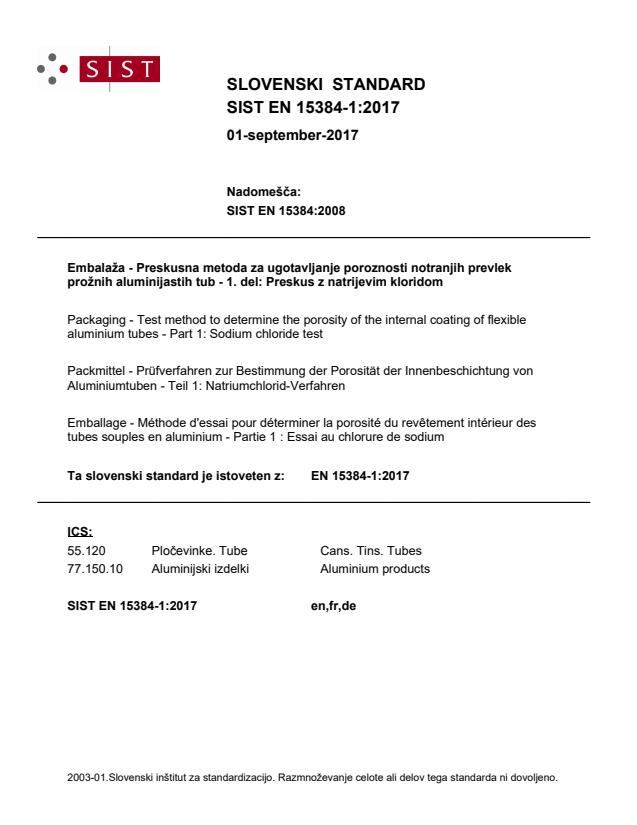
2003-01.Slovenski inštitut za standardizacijo. Razmnoževanje celote ali delov tega standarda ni dovoljeno.Embalaža - Preskusna metoda za ugotavljanje poroznosti notranjih prevlek prožnih aluminijastih tub - 1. del: Preskus z natrijevim kloridomPackmittel - Prüfverfahren zur Bestimmung der Porosität der Innenbeschichtung von Aluminiumtuben - Teil 1: Natriumchlorid-VerfahrenEmballage - Méthode d'essai pour déterminer la porosité du revêtement intérieur des tubes souples en aluminium - Partie 1 : Essai au chlorure de sodiumPackaging - Test method to determine the porosity of the internal coating of flexible aluminium tubes - Part 1: Sodium chloride test77.150.10Aluminijski izdelkiAluminium products55.120Cans. Tins. TubesICS:Ta slovenski standard je istoveten z:EN 15384-1:2017SIST EN 15384-1:2017en,fr,de01-september-2017SIST EN 15384-1:2017SLOVENSKI
STANDARDSIST EN 15384:20081DGRPHãþD
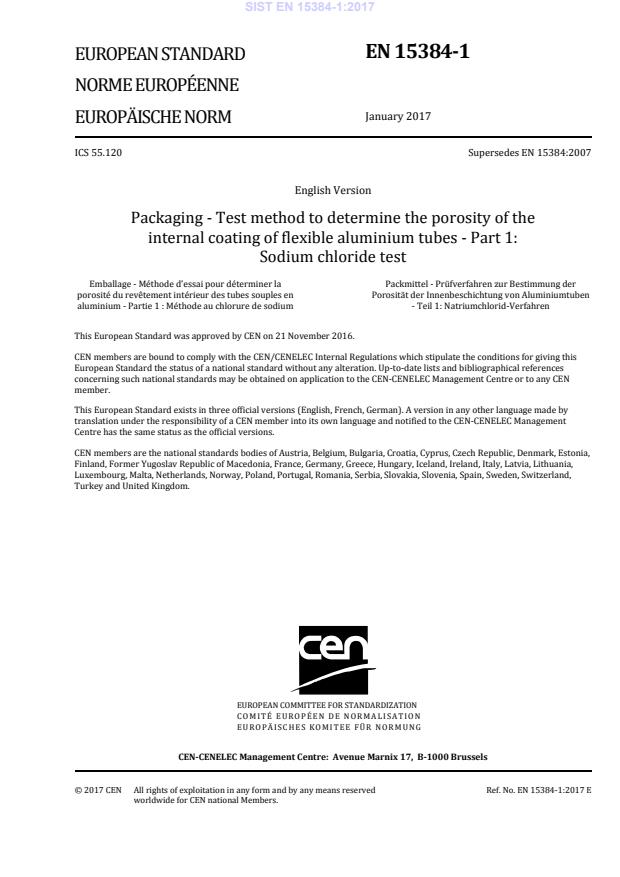
EUROPEAN STANDARD NORME EUROPÉENNE EUROPÄISCHE NORM
EN 15384-1
January
t r s y ICS
w wä s t r Supersedes EN
s w u z vã t r r yEnglish Version
Packaging æ Test method to determine the porosity of the internal coating of flexible aluminium tubes æ Part
sã Sodium chloride test Emballage æ Méthode d 5essai pour déterminer la porosité du revêtement intérieur des tubes souples en aluminium æ Partie
s ã Méthode au chlorure de sodium Packmittel æ Prüfverfahren zur Bestimmung der Porosität der Innenbeschichtung von Aluminiumtuben æ Teil
sã NatriumchloridæVerfahren This European Standard was approved by CEN on
t s November
t r s xä
egulations which stipulate the conditions for giving this European Standard the status of a national standard without any alterationä Upætoædate lists and bibliographical references concerning such national standards may be obtained on application to the CENæCENELEC Management Centre or to any CEN memberä
translation under the responsibility of a CEN member into its own language and notified to the CENæCENELEC Management Centre has the same status as the official versionsä
CEN members are the national standards bodies of Austriaá Belgiumá Bulgariaá Croatiaá Cyprusá Czech Republicá Denmarká Estoniaá Finlandá Former Yugoslav Republic of Macedoniaá Franceá Germanyá Greeceá Hungaryá Icelandá Irelandá Italyá Latviaá Lithuaniaá Luxembourgá Maltaá Netherlandsá Norwayá Polandá Portugalá Romaniaá Serbiaá Slovakiaá Sloveniaá Spainá Swedená Switzerlandá Turkey and United Kingdomä
EUROPEAN COMMITTEE FOR STANDARDIZATION COMITÉ EUROPÉEN DE NORMALISATION EUROPÄISCHES KOMITEE FÜR NORMUNG
CEN-CENELEC Management Centre:
Avenue Marnix 17,
B-1000 Brussels
t r s y CEN All rights of exploitation in any form and by any means reserved worldwide for CEN national Membersä Refä Noä EN
s w u z væ sã t r s y ESIST EN 15384-1:2017
...