


SIST EN 12516-3:2003
(Main)Valves - Shell design strength - Part 3: Experimental method
Valves - Shell design strength - Part 3: Experimental method
This standard specifies requirements for an experimental method, to prove by type test that the design of shells and their body ends, made in cast iron, steel or copper alloy materials, possess the required pressure containing capability, with an adequate margin of safety. This standard is not applicable to valves designed on the basis of time dependent strength values. e.g. pulsating pressure applications and/or creep range temperatures.
Armaturen - Gehäusefestigkeit - Teil 3: Experimentelles Verfahren
Diese Norm legt die Anforderung für ein experimentelles Verfahren fest, mit dem über eine Typprüfung nachgewiesen werden kann, daß die Auslegung der drucktragenden Gehäuse und deren Endöffnungen, hergestellt aus Gußeisen, Stahl oder Kupferlegierung, die erforderliche Druckfestigkeit mit einer angemessenen Sicherheitsspanne besitzt. Diese Norm ist nicht anwendbar auf Armaturen, die auf der Basis von zeitabhängigen Festigkeitskennwerten ausgelegt sind, z.B. für Anwendung bei Druckstößen und/oder bei Temperaturen im Kriechbereich.
Appareils de robinetterie - Résistance mécanique des enveloppes - Partie 3: Méthode expérimentale
La présente norme spécifie les prescriptions d'une méthode expérimentale desti- née à prouver que des enveloppes et leurs extrémités, fabriquées dans des matériaux tels que fonte, acier, ou alliage de cuivre ont la résistance à la pression exigée avec une marge de sécurité appropriée. Cette norme ne s'applique pas aux appareils de robinetterie conçus sur la base de valeurs de résistance à la rupture fonction du temps, telles que des applications d'une pression pulsatoire et/ou des gammes de température de fluage.
Ventili - Trdnost ohišja - 3. del: Eksperimentalna metoda
General Information
- Status
- Published
- Publication Date
- 30-Jun-2003
- Technical Committee
- TLP - Pressure vessels
- Current Stage
- 6060 - National Implementation/Publication (Adopted Project)
- Start Date
- 01-Jul-2003
- Due Date
- 01-Jul-2003
- Completion Date
- 01-Jul-2003
- Directive
- Harmonized Standard2014/68/EU - Directive 2014/68/EU of the European Parliament and of the Council of 15 May 2014 on the harmonisation of the laws of the Member States relating to the making available on the market of pressure equipmentOJ Ref: C 293/01 OJ Date: 12-Aug-2016
Not Harmonized97/23/EC - Pressure equipmentOJ Ref: C 118 OJ Date: 15-Apr-2011
Not HarmonizedEUR-PUB - European Union - Public Standards

Relations
- Effective Date
- 28-Jan-2026
- Effective Date
- 28-Jan-2026
- Effective Date
- 28-Jan-2026
- Effective Date
- 28-Jan-2026
- Effective Date
- 28-Jan-2026
- Effective Date
- 28-Jan-2026
- Effective Date
- 28-Jan-2026
- Effective Date
- 28-Jan-2026
- Effective Date
- 28-Jan-2026
- Effective Date
- 28-Jan-2026
- Effective Date
- 28-Jan-2026
- Effective Date
- 28-Jan-2026
- Effective Date
- 28-Jan-2026
- Effective Date
- 28-Jan-2026
- Effective Date
- 28-Jan-2026
Overview
SIST EN 12516-3:2003 sets out the requirements for an experimental method to verify the shell design strength of valves. Developed by the Slovenski inštitut za standardizacijo (SIST) in alignment with European Standard EN 12516-3:2002, this document specifies procedures to ensure that valve shells and their body ends-manufactured from cast iron, steel, or copper alloys-demonstrate sufficient pressure containment capability with a suitable safety margin. This standard applies to type testing by subjecting representative samples to elevated hydrostatic pressure at room temperature and is an alternative to calculation and tabulation methods found in the other parts of EN 12516.
Notably, SIST EN 12516-3:2003 excludes valves designed for time-dependent strength scenarios, such as those experiencing pulsating pressures or operating in creep range temperatures.
Key Topics
Scope and Application
- Applies to shell and end body design verification for valves made from cast iron, steel, and copper alloys
- Focuses on hydrostatic pressure testing at room temperature
- Excludes valves under time-dependent conditions (e.g., fatigue, creep)
Test Methodology
- Defines sample requirements and how to prepare valve ends for testing
- Details the use of hydrostatic test pressure, selection of test fluid (water), and minimum test durations
- Outlines measurement of actual wall thickness and comparison to design values
Safety and Documentation
- Emphasizes the need for safety risk analysis and proper precautions during testing
- Requires comprehensive documentation of test procedures, parameters, and results
Acceptance Criteria
- Successful tests show no visible leakage through metallic valve parts under pressure
- Specifies how to interpret leakages and criteria for passing/failing components
Compliance and EU Directives
- Supports conformity with EU Directive 97/23/EC (Pressure Equipment Directive - PED)
- Provides a means to demonstrate essential safety and strength requirements under European law
Applications
Industrial Valve Manufacturers
- Ensures that new designs for cast iron, steel, and copper alloy valves meet national and European safety requirements
- Used as part of product approval, certification, and CE marking processes under the PED
Quality Control and Type Testing
- Provides a repeatable, standardized pressure test methodology for batch or sample valve verification
- Useful for validating manufacturing consistency and design robustness
Compliance and Market Access
- Facilitates market access across Europe by ensuring harmonization with relevant EU directives and standards
- Reduces risk of valve failure in service, supporting safe operation in various industries, including water treatment, oil & gas, and process engineering
Related Standards
- EN 12516-1 - Valves - Shell design strength - Part 1: Tabulation method for steel valve shells
- EN 12516-2 - Valves - Shell design strength - Part 2: Calculation method for steel valve shells
- EN 736-2 - Valves - Terminology - Part 2: Definition of components of valves
- EN 736-3 - Valves - Terminology - Part 3: Definition of terms
- DIN 3840 - Valve bodies – Strength calculation for internal pressure
By adhering to SIST EN 12516-3:2003, manufacturers and engineers can confidently demonstrate that their valve shells are rigorously tested for strength and safety, fulfilling both technical and regulatory requirements for modern industrial applications. This standard is an essential reference for those involved in the design, production, and certification of industrial valves in European and international markets.
Get Certified
Connect with accredited certification bodies for this standard

Institut za varilstvo d.o.o. (Welding Institute)
Slovenia's leading welding institute since 1952. ISO 3834, EN 1090, pressure equipment certification, NDT personnel, welder qualification. Only IIW Au
Sponsored listings
Frequently Asked Questions
SIST EN 12516-3:2003 is a standard published by the Slovenian Institute for Standardization (SIST). Its full title is "Valves - Shell design strength - Part 3: Experimental method". This standard covers: This standard specifies requirements for an experimental method, to prove by type test that the design of shells and their body ends, made in cast iron, steel or copper alloy materials, possess the required pressure containing capability, with an adequate margin of safety. This standard is not applicable to valves designed on the basis of time dependent strength values. e.g. pulsating pressure applications and/or creep range temperatures.
This standard specifies requirements for an experimental method, to prove by type test that the design of shells and their body ends, made in cast iron, steel or copper alloy materials, possess the required pressure containing capability, with an adequate margin of safety. This standard is not applicable to valves designed on the basis of time dependent strength values. e.g. pulsating pressure applications and/or creep range temperatures.
SIST EN 12516-3:2003 is classified under the following ICS (International Classification for Standards) categories: 23.060.01 - Valves in general. The ICS classification helps identify the subject area and facilitates finding related standards.
SIST EN 12516-3:2003 has the following relationships with other standards: It is inter standard links to SIST EN 736-2:2016, SIST EN 736-3:2008, SIST EN 12480:2015, SIST EN 13789:2011, SIST EN 16678:2022, SIST EN 12288:2011, SIST EN 14433:2023, SIST EN ISO 4126-1:2004, SIST EN 14433:2015, SIST EN 16668:2016+A1:2018, SIST-TS CEN/TS 13547:2007, SIST EN 1983:2014, SIST EN 12480:2026, SIST EN 13709:2011, SIST EN 676:2020. Understanding these relationships helps ensure you are using the most current and applicable version of the standard.
SIST EN 12516-3:2003 is associated with the following European legislation: EU Directives/Regulations: 2014/68/EU, 97/23/EC, EUR-PUB; Standardization Mandates: M/071. When a standard is cited in the Official Journal of the European Union, products manufactured in conformity with it benefit from a presumption of conformity with the essential requirements of the corresponding EU directive or regulation.
SIST EN 12516-3:2003 is available in PDF format for immediate download after purchase. The document can be added to your cart and obtained through the secure checkout process. Digital delivery ensures instant access to the complete standard document.
Standards Content (Sample)
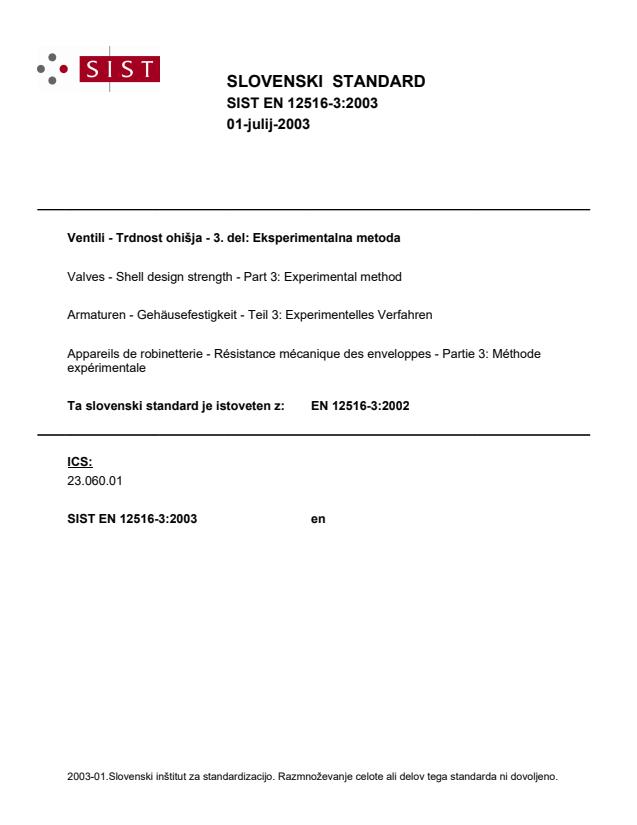
2003-01.Slovenski inštitut za standardizacijo. Razmnoževanje celote ali delov tega standarda ni dovoljeno.Valves - Shell design strength - Part 3: Experimental methodVentili - Trdnost ohišja - 3. del: Eksperimentalna metodaAppareils de robinetterie - Résistance mécanique des enveloppes - Partie 3: Méthode expérimentaleArmaturen - Gehäusefestigkeit - Teil 3: Experimentelles VerfahrenTa slovenski standard je istoveten z:EN 12516-3:2002SIST EN 12516-3:2003en23.060.01ICS:SLOVENSKI
STANDARDSIST EN 12516-3:200301-julij-2003
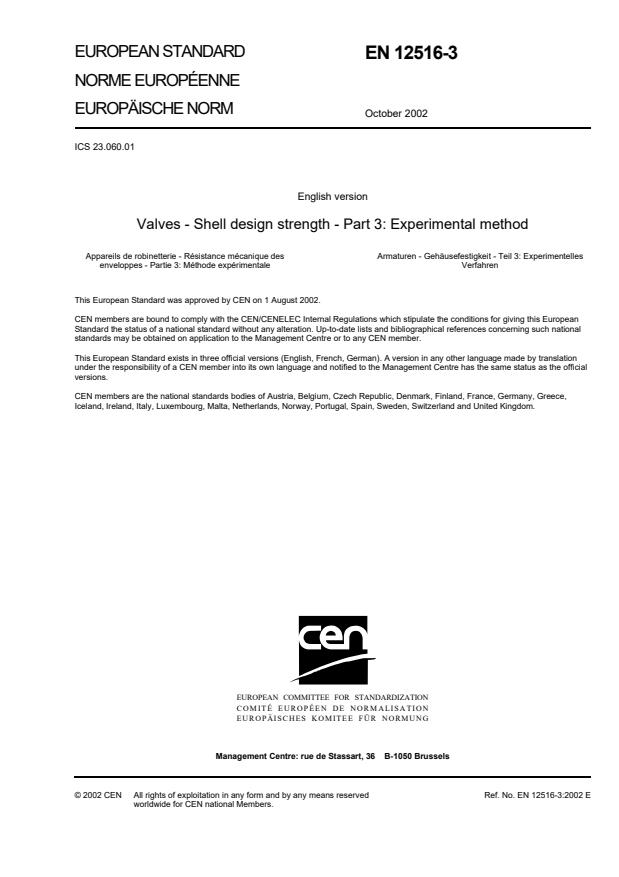
EUROPEAN STANDARDNORME EUROPÉENNEEUROPÄISCHE NORMEN 12516-3October 2002ICS 23.060.01English versionValves - Shell design strength - Part 3: Experimental methodAppareils de robinetterie - Résistance mécanique desenveloppes - Partie 3: Méthode expérimentaleArmaturen - Gehäusefestigkeit - Teil 3: ExperimentellesVerfahrenThis European Standard was approved by CEN on 1 August 2002.CEN members are bound to comply with the CEN/CENELEC Internal Regulations which stipulate the conditions for giving this EuropeanStandard the status of a national standard without any alteration. Up-to-date lists and bibliographical references concerning such nationalstandards may be obtained on application to the Management Centre or to any CEN member.This European Standard exists in three official versions (English, French, German). A version in any other language made by translationunder the responsibility of a CEN member into its own language and notified to the Management Centre has the same status as the officialversions.CEN members are the national standards bodies of Austria, Belgium, Czech Republic, Denmark, Finland, France, Germany, Greece,Iceland, Ireland, Italy, Luxembourg, Malta, Netherlands, Norway, Portugal, Spain, Sweden, Switzerland and United Kingdom.EUROPEAN COMMITTEE FOR STANDARDIZATIONCOMITÉ EUROPÉEN DE NORMALISATIONEUROPÄISCHES KOMITEE FÜR NORMUNGManagement Centre: rue de Stassart, 36
B-1050 Brussels© 2002 CENAll rights of exploitation in any form and by any means reservedworldwide for CEN national Members.Ref. No. EN 12516-3:2002 E
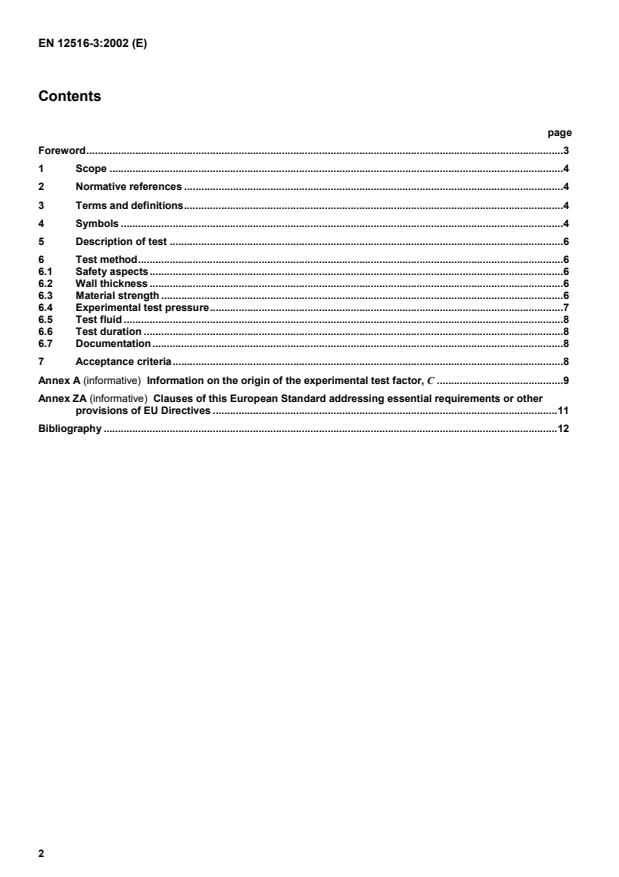
Information on the origin of the experimental test factor, C.9Annex ZA (informative)
Clauses of this European Standard addressing essential requirements or otherprovisions of EU Directives.11Bibliography.12
...