


SIST-TP CEN/TR 18172:2025
(Main)Determination of aerobic biological degradation of fully formulated lubricants in an aqueous solution - Test method based on O2-consumption Lubricants - Study report
Determination of aerobic biological degradation of fully formulated lubricants in an aqueous solution - Test method based on O2-consumption Lubricants - Study report
Creation of a Technical Report summarizing the information on the biodegradation testing of fully formulated biobased lubricants. The document will comprise general and advanced technical information on the study and on the results.
Bestimmung des aeroben biologischen Abbaus von fertig formulierten Schmierstoffen in wässriger Lösung - Prüfverfahren auf der Grundlage des O2-Verbrauchs von Schmierstoffen - Studienbericht
Določanje aerobne biološke razgradnje popolnoma formuliranih maziv v vodni raztopini - Preskusna metoda na podlagi maziv, ki porabljajo O2 - Poročilo o študiji
Ta dokument opisuje ozadje preskusne metode standarda EN 17181, njene izboljšave v primerjavi z obstoječimi standardnimi preskusnimi metodami za merjenje aerobne biološke razgradnje organskih snovi ter načrtovanje in izvedbo medlaboratorijske študije.
V tem poročilu so navedeni različni podatki, zbrani pri razvoju metode in medlaboratorijski študiji, s čimer se podpirajo prihodnje dejavnosti, povezane z biomazivi, ter opredelitev standardnih zahtev.
Aerobno biološko razgradnjo, ki povzroča mineralizacijo organske snovi, je mogoče določiti z merjenjem sproščenega CO2 z ustrezno analitsko tehniko.
Standard EN 17181 določa postopek za določanje stopnje aerobne razgradnje popolnoma formuliranih biomaziv. Ta organska snov je v sintetičnem vodnem mediju pod laboratorijskimi pogoji izpostavljena inokulumu iz aktivnega blata. Za razliko od obstoječih preskusnih metod za merjenje sproščenega CO2 ta nova metoda uporablja natančen postopek priprave vzorca za slabo vodotopne organske snovi. Standard EN 17181 se kljub temu uporablja tudi za merjenje aerobne razgradnje organskih snovi, prisotnih v popolnoma formuliranih mazivih, ki so vodotopna ali emulzivna.
OPOMBA: Standard EN 17181 je mogoče na splošno uporabljati za določanje biološke razgradnje končnih formuliranih maziv, ki vsebujejo neznan delež snovi na biološki osnovi oziroma takih snovi sploh ne vsebujejo.
Vsi rezultati in statistično vrednotenje podatkov v tem dokumentu temeljijo na sladki vodi kot preskusnem mediju. Preskusi v morski vodi trenutno niso zajeti v standardu EN 17181.
General Information
- Status
- Published
- Public Enquiry End Date
- 04-May-2025
- Publication Date
- 18-Aug-2025
- Technical Committee
- NAD - Petroleum products, lubricants and related products
- Current Stage
- 6060 - National Implementation/Publication (Adopted Project)
- Start Date
- 04-Aug-2025
- Due Date
- 09-Oct-2025
- Completion Date
- 19-Aug-2025
Overview
CEN/TR 18172:2025 is a CEN Technical Report that summarizes methods, study data and results for the aerobic biological degradation testing of fully formulated lubricants (including biobased and finished formulated products). The report documents the development and validation work around laboratory procedures - including a test method referenced as EN 17181 - and presents the results of an interlaboratory study that quantifies method precision (repeatability and reproducibility). The report is relevant to biodegradation testing in aqueous media using activated sludge inocula and addresses both O2‑consumption and CO2‑evolution approaches to measuring mineralisation.
Key topics and technical requirements
- Scope and purpose: Testing the ultimate (mineralisation) aerobic biodegradation of all organic material in fully formulated lubricants under controlled, freshwater laboratory conditions.
- Test principle: Organic material is exposed to a mineral medium and an inoculum (activated sludge). Mineralisation is monitored by gas exchange measurements (O2 consumption and/or CO2 evolution) and expressed relative to a theoretical maximum (ThCO2) based on TOC.
- Sample preparation: Improved procedures for poorly water‑soluble, emulsifiable and formulated products to increase bioavailability and measurement precision.
- Controls and references: Use of blank flasks (endogenous respiration correction) and reference compounds to verify inoculum activity and detect toxicity.
- Performance characterization: Results include biodegradation curves, lag/biodegradation/plateau phases, and statistical evaluation of repeatability (r) and reproducibility (R) from an interlaboratory study.
- Limitations: Current method data and statistics apply to freshwater test media; seawater testing is outside the present scope.
Practical applications
- Supporting product development and environmental performance assessment of bio‑lubricants and conventional lubricants.
- Substantiating biodegradability claims for regulatory compliance and ecolabels (e.g., to meet criteria in EN 16807).
- Laboratory validation and quality assurance: method adoption, interlaboratory comparison, and troubleshooting for labs performing biodegradation testing.
- Risk assessment and life‑cycle analyses where aquatic mineralisation data are required.
Who should use this standard
- R&D and formulation teams in lubricant and bio‑lubricant manufacturing.
- Environmental testing laboratories and contract research organizations (CROs).
- Regulatory bodies, ecolabelling schemes, and procurement specialists assessing biodegradability claims.
- Standards committees and researchers conducting interlaboratory validation or method development.
Related standards
- EN 17181 (test method described and evaluated within this report)
- EN 16807 (bio‑lubricant definition)
- OECD 301 series, ISO 9439, ISO 14593 and ISO 8245 (background and related biodegradation test principles)
Keywords: CEN/TR 18172:2025, aerobic biodegradation, biobased lubricants, fully formulated lubricants, O2‑consumption, CO2 evolution, EN 17181, interlaboratory study, activated sludge, TOC, biodegradation testing.

Frequently Asked Questions
SIST-TP CEN/TR 18172:2025 is a technical report published by the Slovenian Institute for Standardization (SIST). Its full title is "Determination of aerobic biological degradation of fully formulated lubricants in an aqueous solution - Test method based on O2-consumption Lubricants - Study report". This standard covers: Creation of a Technical Report summarizing the information on the biodegradation testing of fully formulated biobased lubricants. The document will comprise general and advanced technical information on the study and on the results.
Creation of a Technical Report summarizing the information on the biodegradation testing of fully formulated biobased lubricants. The document will comprise general and advanced technical information on the study and on the results.
SIST-TP CEN/TR 18172:2025 is classified under the following ICS (International Classification for Standards) categories: 75.100 - Lubricants, industrial oils and related products. The ICS classification helps identify the subject area and facilitates finding related standards.
SIST-TP CEN/TR 18172:2025 is available in PDF format for immediate download after purchase. The document can be added to your cart and obtained through the secure checkout process. Digital delivery ensures instant access to the complete standard document.
Standards Content (Sample)
SLOVENSKI STANDARD
01-september-2025
Določanje aerobne biološke razgradnje popolnoma formuliranih maziv v vodni
raztopini - Preskusna metoda na podlagi maziv, ki porabljajo O2 - Poročilo o študiji
Determination of aerobic biological degradation of fully formulated lubricants in an
aqueous solution - Test method based on O2-consumption Lubricants - Study report
Bestimmung des aeroben biologischen Abbaus von fertig formulierten Schmierstoffen in
wässriger Lösung - Prüfverfahren auf der Grundlage des O2-Verbrauchs von
Schmierstoffen - Studienbericht
Ta slovenski standard je istoveten z: CEN/TR 18172:2025
ICS:
75.100 Maziva Lubricants, industrial oils and
related products
2003-01.Slovenski inštitut za standardizacijo. Razmnoževanje celote ali delov tega standarda ni dovoljeno.
CEN/TR 18172
TECHNICAL REPORT
RAPPORT TECHNIQUE
June 2025
TECHNISCHER REPORT
ICS 75.100
English Version
Determination of aerobic biological degradation of fully
formulated lubricants in an aqueous solution - Test
method based on O2-consumption Lubricants - study
report
Bestimmung des aeroben biologischen Abbaus von
fertig formulierten Schmierstoffen in wässriger Lösung
- Prüfverfahren auf der Grundlage des O2-Verbrauchs
von Schmierstoffen - Studienbericht
This Technical Report was approved by CEN on 25 May 2025. It has been drawn up by the Technical Committee CEN/TC 19.
CEN members are the national standards bodies of Austria, Belgium, Bulgaria, Croatia, Cyprus, Czech Republic, Denmark, Estonia,
Finland, France, Germany, Greece, Hungary, Iceland, Ireland, Italy, Latvia, Lithuania, Luxembourg, Malta, Netherlands, Norway,
Poland, Portugal, Republic of North Macedonia, Romania, Serbia, Slovakia, Slovenia, Spain, Sweden, Switzerland, Türkiye and
United Kingdom.
EUROPEAN COMMITTEE FOR STANDARDIZATION
COMITÉ EUROPÉEN DE NORMALISATIO N
EUROPÄISCHES KOMITEE FÜR NORMUN G
CEN-CENELEC Management Centre: Rue de la Science 23, B-1040 Brussels
© 2025 CEN All rights of exploitation in any form and by any means reserved Ref. No. CEN/TR 18172:2025 E
worldwide for CEN national Members.
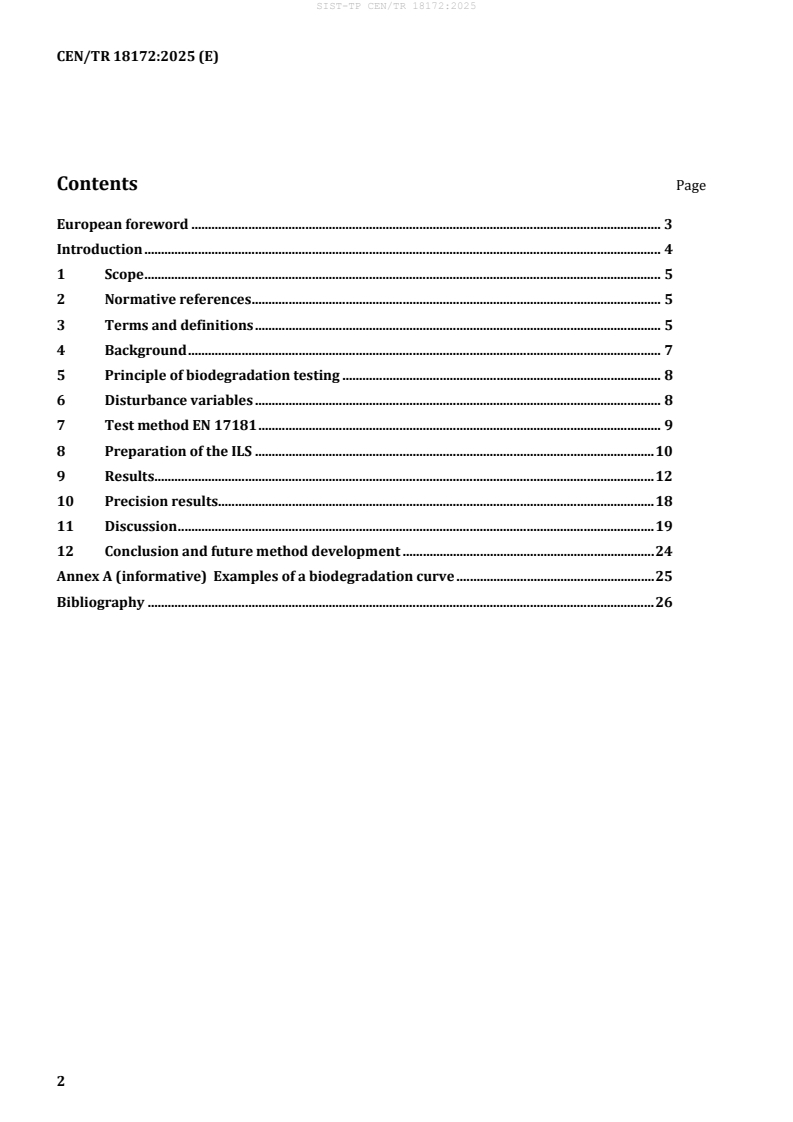
Contents Page
European foreword . 3
Introduction . 4
1 Scope . 5
2 Normative references . 5
3 Terms and definitions . 5
4 Background . 7
5 Principle of biodegradation testing . 8
6 Disturbance variables . 8
7 Test method EN 17181 . 9
8 Preparation of the ILS . 10
9 Results . 12
10 Precision results . 18
11 Discussion . 19
12 Conclusion and future method development . 24
Annex A (informative) Examples of a biodegradation curve . 25
Bibliography . 26
European foreword
This document (CEN/TR 18172:2025) has been prepared by Technical Committee CEN/TC 19 “Gaseous
and liquid fuels, lubricants and related products of petroleum, synthetic and biological origin”, the
secretariat of which is held by NEN.
Attention is drawn to the possibility that some of the elements of this document may be the subject of
patent rights. CEN shall not be held responsible for identifying any or all such patent rights.
This document has been prepared under a Mandate M/430 of the European Commission, addressed to
CEN for the development of European standards for bio-lubricants in relation to bio-based product
aspects. It has been prepared by CEN/TC 19/WG 33 “bio-lubricants”, the secretariat of which is held by
DIN.
Any feedback and questions on this document should be directed to the users’ national standards body.
A complete listing of these bodies can be found on the CEN website.
Introduction
[1]
Mandate M/430 of the European Commission addressed to CEN the development of a definition
[2]
standard for bio-lubricants. Currently, EN 16807 is the active standard to define a bio-lubricant.
EN 16807 defines a bio-lubricant as a lubricant fulfilling a minimum set of environmental requirements,
namely biodegradability, aquatic toxicity and content of renewable resources together with minimum
technical requirements depending on the application of the lubricant.
The aim of the definition standard was to create a transparent definition for a bio-lubricant and easy-to-
test parameters to enable customers to monitor products claiming to be a bio-lubricant, to ensure they
fulfil its requirements, independent of their composition or from third parties’ control.
For this reason, it is necessary to establish test methods which allow for the testing of these parameters
on finished formulated products.
Regarding the content of renewable resources and aquatic toxicity, existing standard test methods are
already suitable for finished formulated products. Due to the broad variety of water-soluble, emulsifiable
and poorly water-soluble organic substances these standard test methods offer various preparation
procedures enabling the testing of complex mixtures such as finished formulated products. In contrast,
existing test methods for measuring aerobic biodegradation are optimised for organic substances rather
than finished formulated products.
In TC19/WG 33 a new test method for measuring the biodegradation of finished formulated products,
namely EN 17181 [3], has been developed based on ISO 9439 [4] (itself based on OECD 301B [5]). The
new method includes improvements to sample preparation in order to overcome the difficulties of testing
poorly water-soluble organic substances, and aims to provide a standard method for measuring aerobic
biodegradation of finished formulated products with the best possible precision.
Additionally, it has been noted that most existing test methods lack a published precision statement.
Based on this new standard test method EN 17181, and with significant financial support from industrial
partners, an interlaboratory study was performed to determine the reproducibility (R) and the
repeatability (r) of this new test method.
Annex A provides an example of biodegradation curves
1 Scope
This document describes the background of test method EN 17181, its improvements compared to the
existing standard test methods for measuring aerobic biodegradation of organic substances and the
planning and execution of the interlaboratory study .
A variety of data collected in the development of the method and the interlaboratory study is provided in
this report, thereby supporting future activity associated with bio-lubricants and the definition of
standard requirements.
Aerobic biodegradation resulting in mineralisation of the organic material can be determined by
measuring released CO using an appropriate analytical technique.
EN 17181 specifies a procedure for determining the degree of aerobic degradation of organic material in
fully formulated bio-lubricants. This organic material is exposed in a synthetic aqueous medium under
laboratory conditions to an inoculum prepared from activated sludge. In contrast to existing test methods
measuring released CO this new method uses a precise sample preparation procedure for poorly water-
soluble organic material. Nevertheless, EN 17181 is also applicable to measuring the aerobic degradation
of organic material present within fully formulated lubricants which are water-soluble or emulsifiable.
NOTE In general, EN 17181 can be used to determine biodegradation of finished formulated lubricants, which
contain biobased material of unknown amount or do not contain biobased material at all.
All results and statistical data evaluation in this document are based on fresh water as test medium. Tests
in sea water are currently not part of EN 17181.
2 Normative references
There are no normative references in this document.
3 Terms and definitions
For the purposes of this document, the following terms and definitions apply.
3.1
organic material
total amount of all organic compounds present in a fully formulated lubricant.
3.2
aerobic biodegradation
consumption of organic materials by microorganisms in a biochemical process using oxygen resulting in
cleavage of chemical bonds and carbon dioxide (CO ) production providing energy and/or new biomass.
3.3
primary biodegradation
structural change (transformation) of an organic chemical compound by microorganisms resulting in the
loss of a specific property.
3.4
mineralisation / ultimate biodegradation
aerobic biodegradation of organic material by microorganisms to yield carbon dioxide, water and mineral
salts of any other elements present (mineralization) and new biomass
3.5
activated sludge
biomass produced in the aerobic treatment of wastewater by the growth of bacteria and other
microorganisms in the presence of dissolved oxygen
3.6
inoculum
sample of activated sludge used in degradation procedures described in this method
3.7
reference compound
organic compound of known biodegradability with a degradation degree of more than 60%
3.8
dissolved organic carbon
DOC
part of the organic carbon in water which cannot be removed by specified phase separation, for example
by centrifugation at 4000 rpm for 15 min or by membrane filtration using membranes with pores of 0,2
μm to 0,45 μm diameter
3.09
theoretically released amount of carbon dioxide
ThCO
theoretical maximum amount of CO released from total oxidation of a lubricant, calculated from TOC
content, expressed in this case as milligrams of CO evolved per milligram or gram of test compound
3.10
total organic carbon
TOC
amount of carbon bound in an organic compound
Note 1 to entry: Refer to ISO 8245 for further details<
3.11
lag phase
time from the start of a test until adaptation and selection of the degrading microorganisms is achieved
and the biodegradation degree of a chemical compound or organic matter has increased to about 10 % of
the theoretical maximum biodegradation
Note 1 to entry: It is expressed in days.
3.12
maximum level of biodegradation
Maximum biodegradation degree of a chemical compound or organic matter in a test, above which no
further biodegradation takes place during the test
Note 1 to entry: It is expressed as a percentage
3.13
biodegradation phase
time from the end of the lag phase of a test until about 90 % of the maximum level of biodegradation has
been reached
Note 1 to entry: It is expressed in days
3.14
plateau phase
time from the end of the biodegradation phase when the maximum level of biodegradation is reached
until the end of the test
3.15
pre-conditioning
pre-incubation of an inoculum under the conditions of the subsequent test in the absence of the test
chemical compound or organic matter, with the aim of improving the performance of the test by
acclimatization of the microorganisms to the test conditions
3.16
pre-exposure / pre-adaption
pre-incubation of an inoculum in the presence of the test chemical compound or organic matter under
test, with the aim of enhancing the ability of the inoculum to biodegrade the test material by adaptation
and/or selection of the microorganisms
3.17
repeatability
r
difference between two independent results obtained in the normal and correct operation of the same
method, for test material considered to be the same, within a short interval of time, under the same test
conditions, that is expected to be exceeded with a probability of 5 % due to random variation, can be
calculated using the following function:
r = fr(x)
where x is the average of the two test results being compared
3.18
repeatability
R
difference between two independent results obtained in the normal and correct operation of the same
method, for test material considered to be the same, under different test conditions, that is expected to
be exceeded with a probability of 5 % due to random variation, can be calculated using the following
function:
R = fR(x)
where x is the average of the two test results being compared.
4 Background
Test procedures to detect the elimination of surfactants in waste-waters were developed in the 1970s [6]
with the aim of reducing the amount of visible foaming in surface waters. These methods measured the
elimination of material by determination of the DOC and only water-soluble material could be determined
with sufficient precision.
To enable measurement of the degradation of non-water soluble two-stroke outboard engine oils this
method was adapted for lubricants in the so-called “Zürich-Workshops” [7] in 1982 and was published
by the Coordinating European Council (CEC) as CEC L-33-T-82. This test method describes the
elimination of the test material during the microbiological degradation process and measured primary
biodegradation. As an alternative approach to describe biodegradation in the aqueous environment, it
was the first test for finished formulated lubricants.
With ongoing discussions about the fate of chemicals in the environment it wasn’t sufficient to assume
the disappearance of chemical substances by measuring primary degradation. Therefore, in 1981, OECD
adopted 5 screening test methods for ready biodegradation to measure the potential of a chemical
compound to undergo ultimate biodegradation in aqueous environment. These were OECD Guidelines
301 A to E [8] and another version of these methods, OECD 301 F, was added to this set in 1992.
In 1988, an interlaboratory study was performed. Thirty-seven laboratories took part in an OECD ring-
test of methods for determining ready biodegradability. Four different organic substances were tested
using six different test methods. Despite ring-test coordinator´s recommendation to develop more
reliable methods for the determination of CO and even though no precision statement have been
reported, OECD 301 test-methods have since been established in different industries and applications
[9].
Other biodegradation test methods have been evaluated later under the regime of ISO following the
principles laid down in OECD 301:
— ISO 9408 [10],
— ISO 9439 and
— ISO 14593 [11].
ISO 14593 includes a precision statement.
5 Principle of biodegradation testing
The extent of the mineralisation of organic materials is determined using aerobic microorganisms in a
static aqueous test system. The test system consists of a mineral medium, an inoculum and the organic
material, which is the sole source of carbon and energy for the microorganisms.
This mixture is stirred in test flasks and aerated using CO -free air for a maximum time of 28 days. The
amount of carbon dioxide evolved from biological degradation is collected in external flasks, determined
using a suitable analytical process, and expressed as a percentage of ThCO .
In order to correct for the CO production due to the inoculum itself (i.e. endogenous respiration), blank
flasks solely containing inoculum and test medium are run in parallel to determine the amount of CO
which has to be subtracted from the test run.
Additionally, test flasks with a reference substance are run in parallel in order to verify the activity of the
inoculum and possibly, to assess any toxic effects of the test sample on the inoculum.
6 Disturbance variables
6.1 General
The test equipment and the test protocol introduce sources of variance which can influence the precision
of the experiment. The testing of replicate samples together with the use of a blank control and a
reference substance minimise the impact of some of these variables so that the test result can be
considered reliable and precise.
Nevertheless, certain parameters turned out not to be controlled in a sufficient way by the standard
procedures.
6.2 Discontinuous measurement
Test methods based on determining CO production typically are not performed using continuously
operating analysis equipment, and measurements are therefore taken periodically over the test period
often by different individuals. This can introduce variances depending on the type of measurement,
calculation of CO amounts each time or the presence of slightly differing test environment conditions at
each measurement.
6.3 Adsorption of test material
Certain organic material tends to exhibit a strong adherence on the glass or metal equipment, which
might lead to deviations in measured CO due to an amount of the test material not being available to the
microorganisms and therefore not contributing to the degradation process.
6.4 Limited solubility of test material
Water-soluble test material is fully bioavailable to microorganisms, but this is not the case when
insoluble, poorly water-soluble or emulsifiable material is tested. In such cases it is known that the
method of sample preparation has a significant influence on the measured CO amount due to variables
such as how much surface area is bioavailable to the microorganisms.
6.5 Variation of inoculum quality
The inoculum is a significant source of variability as its composition can vary substantially from location
to location. Moreover, the growth of microorganisms in each test can vary due to population dynamics
[e.g. 12].
and stochasticity.
6.6 Measurement bias
[12,
Chemicals, but above all microbiological processes can strongly influence the measured CO amount
13]
. Chemical retention, a process whereby released CO binds to organic matter in the medium or to salts
can influence the measurement result. It is for this reason that hydrochloric acid is added to each flask at
the end of the test period to release any bound CO .
Common to all existing biodegradation tests, microbial CO2 production from reserve materials and
microbial CO fixation by autotrophic bacteria can also introduce experimental variances. However, the
greatest microbiological contributor to experimental variance is an increased microbial growth causing
an associated reduction in measurable CO2.
7 Test method EN 17181
In an effort to better control the influence of the parameters listed in section 6, the new test method EN
17181 has been developed based on the existing test methods for biodegradation, namely OECD 301B
and ISO 9439.
In contrast to OECD 301B and ISO 9439 which allow adding test sample in concentrations between
10 mg/L TOC and 40 mg/L TOC this method requires the application of exactly 20 mg/L TOC into each
test flask. Experimenters who are familiar with performing biodegradation tests using the OECD/ISO
methods have observed that adding 10 mg/L TOC of an oil-based test sample often results in high
variation of test results due to weighing error involved with such a small amount of an oily sample.
Conversely, adding the test material at 40 mg/L TOC was observed to result in the formation of large
droplets of test sample thereby reducing the bioavailability of the sample to the microorganisms. It was
considered that adding exactly 20 mg/L TOC test sample to each flask would improve comparability of
test results of the same test sample tested in different laboratories.
Lubricants are mostly hydrophobic and oily in nature and in order to reduce the risk of the test sample
partitioning from the water phase due to its low water solubility the test material was applied as a stock
solution in a solvent which can be easily removed without eliminating the test material itself. This stock
solution was applied onto a glass fibre filter to create a film of test sample on the glass fibres and thereby
providing a maximum surface area to increase bioavailability of the test sample to the microorganisms.
Additionally, this procedure allows for a more precise addition of the test sample than just adding 20
mg/L of an oily material directly.
Most common reference substances in biodegradation tests are low molecular weight water-soluble
substances (e.g. aniline or sodium benzoate), which are not representative of the oily, poorly water-
soluble lubricants to be evaluated using this new method. Therefore, a high oleic reference oil (HORO)
was chosen as the reference compound. In a pre-test for the interlaboratory study it was shown that this
reference material exhibits a mean biodegradation of 85% and therefore was fulfilling the validity
criterion of >60% degradation after 28 days.
OECD 301B and ISO 9439 allow the use of inoculum from different sources (e.g. waste water treatment
plants, soil, surface water etc.). The concentration of microorganisms (measured in colony forming units,
CFU) from different sources can vary dramatically leading to high variations in biodegradation results for
the same test sample using different inoculum sources. Therefore, it was decided that EN 17181 only
allows inoculum to be sourced from wastewater treatment plants. Additionally, it was decided to subject
the inoculum used in the test to pre-conditioning in order to allow the inoculum to adapt from the
conditions present in wastewater treatment plants to the artificial mineral medium.
It was decided not to include pre-exposure of the inoculum to the test material as part of the new test
method to avoid any misinterpretation of results due to different preparation processes.
Finally, validity criteria were pre-defined to justify the elimination of any implausible test result from the
interlaboratory study as well as any results considered to be unreliable due to error conditions or
measurement failures
8 Preparation of the ILS
8.1 Pre-study
After establishing the new test procedure described in EN 17181, which modified existing test methods
for biodegradation by specifying a different method of sample preparation and allowing inoculum to be
sourced only from wastewater treatment plants, a pre-study was performed to make a preliminary
assessment about the influence of these methodological improvements on the precision of the proposed
new method.
This work was performed under the supervision of a task force of WG33 and each laboratory chosen to
participate in the ILS was experienced in biodegradation testing of lubricants. In this pre-study three
different, commercially available hydraulic fluids were tested representing fluids that were expected to
show low, medium and high levels of biodegradation respectively. These samples were sent to four
different laboratories which prepared the samples and performed the test according to EN 17181. Results
of the pre-study are presented in Figure 1.
Figure 1 — Results of pre-test in task force biodegradation WG 33
The pre-study showed that the new method could still differentiate between bio-lubricants that were
expected to biodegrade to different levels.
Differences in biodegradation level of the same test sample and HORO reference material between the
four laboratories were observed suggesting that systematic differences in the test performance and/or
preparation of test samples and/or inoculum. Therefore, it was decided to define the sample preparation
procedure and the test performance in a more precise way in try to reduce these systematic differences
as far as possible.
Due to the
...
Questions, Comments and Discussion
Ask us and Technical Secretary will try to provide an answer. You can facilitate discussion about the standard in here.
Loading comments...