


SIST EN 549:2019+A2:2024/oprA3:2025
(Amendment)Rubber materials for seals and diaphragms for gas appliances and gas equipment
Elastomer-Werkstoffe für Dichtungen und Membranen in Gasgeräten und Gasanlagen
The scope of EN 549+ A1 will not be modified
The intended Amendment, consisting of two informative Annexes, specify optional additional requirements and associated test methods for rubber materials used in gas installations, gas equipment and gas appliances that are intended to be used in contact with hydrogen (H2) or (r)DME.
Matériaux à base de caoutchouc pour joints d'étanchéité et membranes destinés aux appareils à gaz et matériels pour le gaz
Gumeni materiali za tesnila in membrane v plinskih aparatih in plinskih napravah - Dopolnilo A3
General Information
- Status
- Not Published
- Public Enquiry End Date
- 09-Jul-2025
- Technical Committee
- I13 - Imaginarni 13
- Current Stage
- 4020 - Public enquire (PE) (Adopted Project)
- Start Date
- 13-May-2025
- Due Date
- 30-Sep-2025
- Completion Date
- 21-Jul-2025

Relations
- Effective Date
- 19-Jun-2024
Overview
SIST EN 549:2019+A2:2024/oprA3:2025 is a Slovenian standard that specifies requirements and test methods for rubber materials used in seals and diaphragms intended for gas appliances and gas equipment. Developed by the Technical Committee CEN/TC 208, this standard ensures the reliability and safety of elastomeric components exposed to various gases. The 2025 draft amendment introduces additional requirements for materials in contact with hydrogen and (renewable) dimethyl ether (DME), reflecting developments in gas supply and emerging energy transition technologies.
Key Topics
- Material suitability: Specifies requirements for rubber materials’ resistance, permeability, and compatibility with gases such as natural gas, hydrogen, and (r)DME.
- Testing methods: Details standardized testing procedures for determining gas transmission rates, permeation, and compatibility using international test methods such as ISO 15105-1 and ISO 1817.
- Hydrogen requirements: Outlines additional tests and classification criteria for elastomers intended for use with high-purity hydrogen (up to 100% by volume), supporting the shift to hydrogen as an alternative fuel.
- DME compatibility: Introduces classifications and testing protocols for rubber components exposed to DME, both in pure form and as blends with LPG, addressing material changes in volume and mass.
- Classification: Provides permeability classes and designations for rubber materials, aiding in component selection for various gas service applications.
Applications
SIST EN 549:2019+A2:2024/oprA3:2025 has practical significance across several sectors in the gas supply chain:
- Gas appliances and equipment: Manufacturers of domestic and industrial gas appliances rely on this standard to specify suitable elastomeric seals and diaphragms that ensure operational safety and durability.
- Hydrogen infrastructure: As hydrogen becomes increasingly integrated into gas supply systems, standardized permeability testing and material classifications help guide safe material selection for hydrogen-containing gas mixtures.
- Renewable fuels: The inclusion of requirements for (renewable) dimethyl ether highlights the standard’s relevance for companies exploring sustainable fuel alternatives and LPG blending, providing clear guidance for compatible elastomeric materials.
- Maintenance and replacement: Service providers benefit from standardized classifications and performance data, enabling informed maintenance, procurement, and system upgrades according to the latest regulatory guidelines.
- Regulatory compliance: Alignment with national (SIST), European (CEN), and international (ISO) standards supports product conformity and access to the broader European market.
Related Standards
For a comprehensive approach to elastomeric materials in gas systems, the following standards are referenced and complement SIST EN 549:
- ISO 15105-1: Methods for determining the gas-transmission rate of plastic films and sheetings using differential pressure.
- ISO 1817: Rubber, vulcanized or thermoplastic - Determination of the effect of liquids (used in compatibility and change in mass/volume tests).
- EN ISO 11114-2: Compatibility of cylinder and valve materials with gas contents, specifically non-metallic materials, relevant for safe gas storage and handling.
- EN 437: Test gases, test pressures, and categories of appliances, which is in the process of revision to address gases like hydrogen and DME.
Practical Value
Implementing SIST EN 549:2019+A2:2024/oprA3:2025 helps organizations ensure:
- Consistent product quality and reliability for gas seals and diaphragms.
- Safe use and handling of emerging gases like hydrogen and renewable DME.
- Streamlined compliance with current and future European energy and safety regulations.
- Facilitated product development for the energy transition towards greener fuel sources.
By following this standard, industry stakeholders can enhance the safety, performance, and marketability of gas system components on both the national and international stage.
Keywords: SIST EN 549, gas appliances, rubber seals, diaphragms, hydrogen compatibility, renewable dimethyl ether, elastomeric materials, gas equipment standards, permeability testing, gas transmission rate, ISO 15105-1, ISO 1817, EN ISO 11114-2, gas supply systems, energy transition.
Get Certified
Connect with accredited certification bodies for this standard

DIN CERTCO
DIN Group product certification.
DIBt (Deutsches Institut für Bautechnik)
German Institute for Building Technology.

Aboma Certification B.V.
Specialized in construction, metal, and transport sectors.
Sponsored listings
Frequently Asked Questions
SIST EN 549:2019+A2:2024/oprA3:2025 is a draft published by the Slovenian Institute for Standardization (SIST). Its full title is "Rubber materials for seals and diaphragms for gas appliances and gas equipment". This standard covers: The scope of EN 549+ A1 will not be modified The intended Amendment, consisting of two informative Annexes, specify optional additional requirements and associated test methods for rubber materials used in gas installations, gas equipment and gas appliances that are intended to be used in contact with hydrogen (H2) or (r)DME.
The scope of EN 549+ A1 will not be modified The intended Amendment, consisting of two informative Annexes, specify optional additional requirements and associated test methods for rubber materials used in gas installations, gas equipment and gas appliances that are intended to be used in contact with hydrogen (H2) or (r)DME.
SIST EN 549:2019+A2:2024/oprA3:2025 is classified under the following ICS (International Classification for Standards) categories: 23.040.80 - Seals for pipe and hose assemblies; 83.140.50 - Seals; 91.140.40 - Gas supply systems. The ICS classification helps identify the subject area and facilitates finding related standards.
SIST EN 549:2019+A2:2024/oprA3:2025 has the following relationships with other standards: It is inter standard links to SIST EN 549:2019+A2:2024. Understanding these relationships helps ensure you are using the most current and applicable version of the standard.
SIST EN 549:2019+A2:2024/oprA3:2025 is associated with the following European legislation: EU Directives/Regulations: 2016/426; Standardization Mandates: M/595. When a standard is cited in the Official Journal of the European Union, products manufactured in conformity with it benefit from a presumption of conformity with the essential requirements of the corresponding EU directive or regulation.
SIST EN 549:2019+A2:2024/oprA3:2025 is available in PDF format for immediate download after purchase. The document can be added to your cart and obtained through the secure checkout process. Digital delivery ensures instant access to the complete standard document.
Standards Content (Sample)
SLOVENSKI STANDARD
01-julij-2025
Gumeni materiali za tesnila in membrane v plinskih aparatih in plinskih napravah -
Dopolnilo A3
Rubber materials for seals and diaphragms for gas appliances and gas equipment
Elastomer-Werkstoffe für Dichtungen und Membranen in Gasgeräten und Gasanlagen
Matériaux à base de caoutchouc pour joints d'étanchéité et membranes destinés aux
appareils à gaz et matériels pour le gaz
Ta slovenski standard je istoveten z: EN 549:2019+A2:2024/prA3
ICS:
83.140.50 Tesnila Seals
91.140.40 Sistemi za oskrbo s plinom Gas supply systems
2003-01.Slovenski inštitut za standardizacijo. Razmnoževanje celote ali delov tega standarda ni dovoljeno.
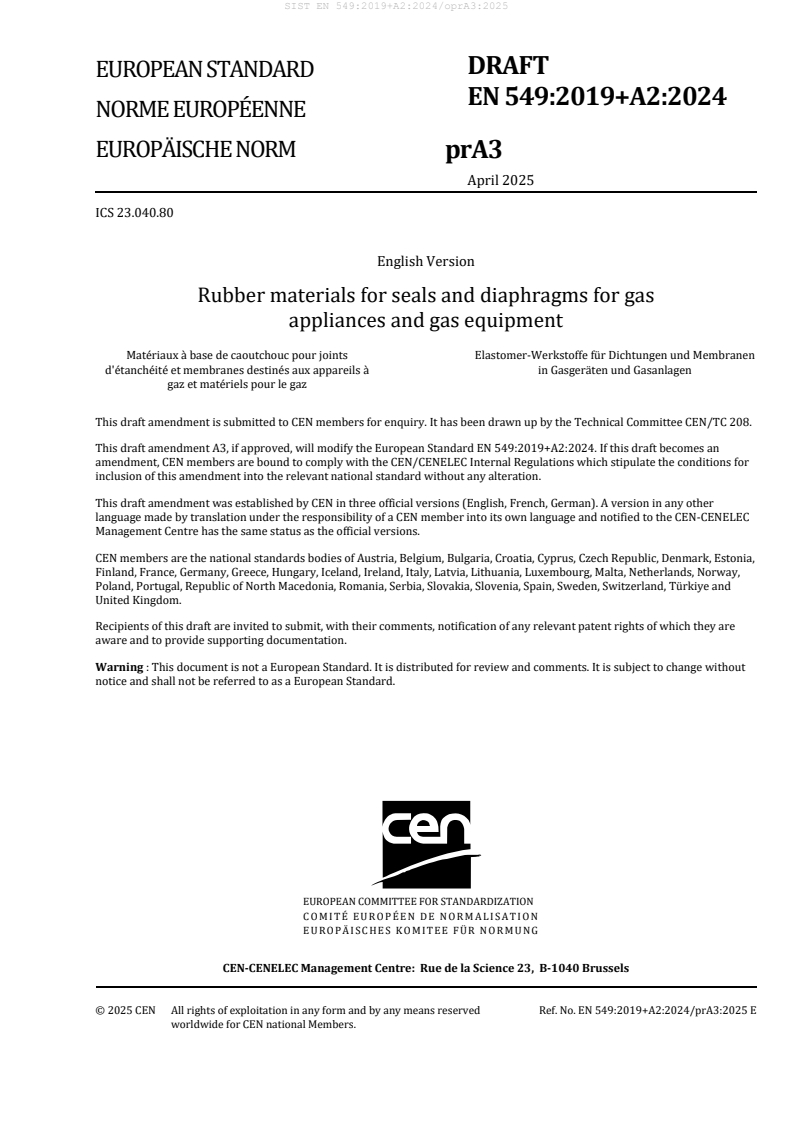
DRAFT
EUROPEAN STANDARD
EN 549:2019+A2:2024
NORME EUROPÉENNE
EUROPÄISCHE NORM
prA3
April 2025
ICS 23.040.80
English Version
Rubber materials for seals and diaphragms for gas
appliances and gas equipment
Matériaux à base de caoutchouc pour joints Elastomer-Werkstoffe für Dichtungen und Membranen
d'étanchéité et membranes destinés aux appareils à in Gasgeräten und Gasanlagen
gaz et matériels pour le gaz
This draft amendment is submitted to CEN members for enquiry. It has been drawn up by the Technical Committee CEN/TC 208.
This draft amendment A3, if approved, will modify the European Standard EN 549:2019+A2:2024. If this draft becomes an
amendment, CEN members are bound to comply with the CEN/CENELEC Internal Regulations which stipulate the conditions for
inclusion of this amendment into the relevant national standard without any alteration.
This draft amendment was established by CEN in three official versions (English, French, German). A version in any other
language made by translation under the responsibility of a CEN member into its own language and notified to the CEN-CENELEC
Management Centre has the same status as the official versions.
CEN members are the national standards bodies of Austria, Belgium, Bulgaria, Croatia, Cyprus, Czech Republic, Denmark, Estonia,
Finland, France, Germany, Greece, Hungary, Iceland, Ireland, Italy, Latvia, Lithuania, Luxembourg, Malta, Netherlands, Norway,
Poland, Portugal, Republic of North Macedonia, Romania, Serbia, Slovakia, Slovenia, Spain, Sweden, Switzerland, Türkiye and
United Kingdom.
Recipients of this draft are invited to submit, with their comments, notification of any relevant patent rights of which they are
aware and to provide supporting documentation.
Warning : This document is not a European Standard. It is distributed for review and comments. It is subject to change without
notice and shall not be referred to as a European Standard.
EUROPEAN COMMITTEE FOR STANDARDIZATION
COMITÉ EUROPÉEN DE NORMALISATION
EUROPÄISCHES KOMITEE FÜR NORMUNG
CEN-CENELEC Management Centre: Rue de la Science 23, B-1040 Brussels
© 2025 CEN All rights of exploitation in any form and by any means reserved Ref. No. EN 549:2019+A2:2024/prA3:2025 E
worldwide for CEN national Members.
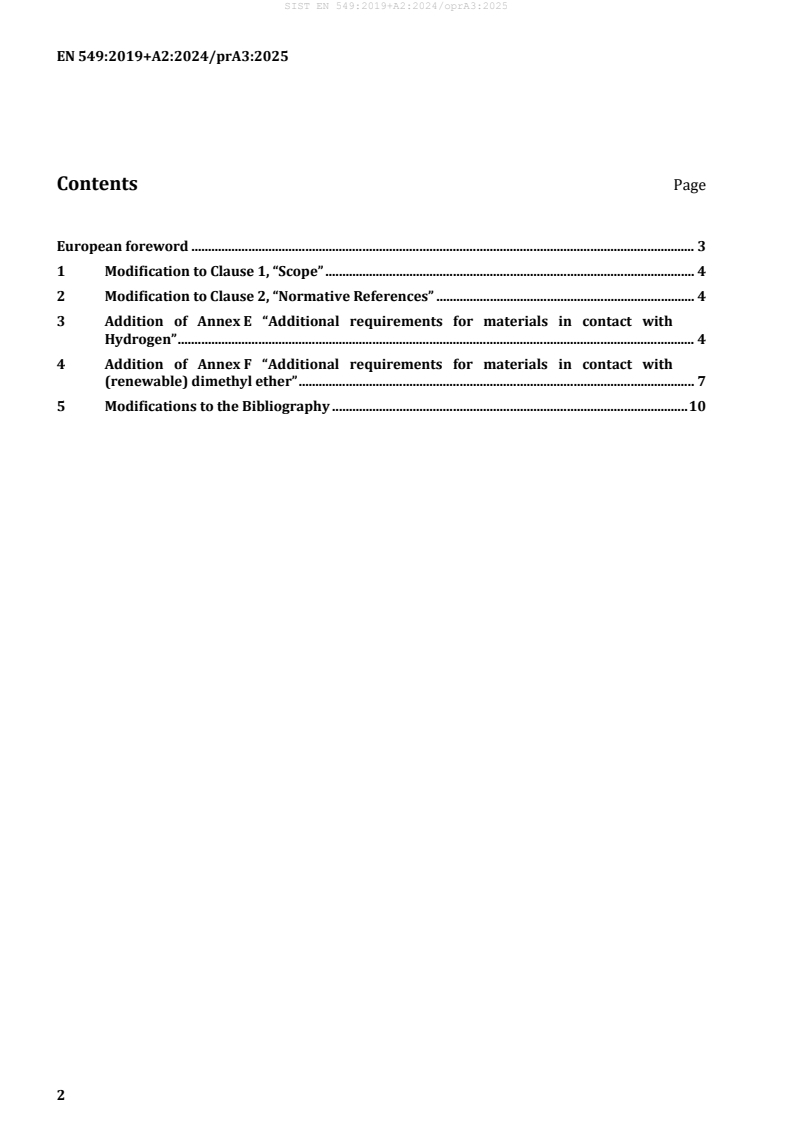
Contents Page
European foreword . 3
1 Modification to Clause 1, “Scope” . 4
2 Modification to Clause 2, “Normative References” . 4
3 Addition of Annex E “Additional requirements for materials in contact with
Hydrogen” . 4
4 Addition of Annex F “Additional requirements for materials in contact with
(renewable) dimethyl ether” . 7
5 Modifications to the Bibliography . 10
European foreword
This document (EN 549:2019+A2:2024/prA3:2025) has been prepared by Technical Committee
CEN/TC 208 “Elastomeric seals for joints in pipework and pipelines”, the secretariat of which is held by
BSI.
This document is currently submitted to the CEN Enquiry.
This document has been prepared under a standardization request addressed to CEN by the European
Commission. The Standing Committee of the EFTA States subsequently approves these requests for its
Member States.
For the relationship with EU Legislation, see informative Annex ZA, which is an integral part of
EN 549:2019+A2:2024.
1 Modification to Clause 1, “Scope”
Add the following after the first paragraph:
“NOTE Within the energy transition hydrogen (H ) is playing an important role. The gas definition according to
EN 437 does not consider H nor (renewable) Dimethyl ether ((r)DME) within the gas families, yet. Therefore,
the normative scope of this document does not cover H nor (r)DME application.
The informative Annexes E and F specify additional requirements and associated test methods for
rubber materials used in gas installations, gas equipment and gas appliances that are intended to be
used in contact with H or (r)DME.”
2 Modification to Clause 2, “Normative References”
Add the following reference:
“ISO 15105-1:2007, Plastics — Film and sheeting — Determination of gas-transmission rate — Part 1:
Differential-pressure methods”
3 Addition of Annex E “Additional requirements for materials in contact with
Hydrogen”
Add the entire Annex E
Annex E
(informative)
Additional requirements for materials in contact with Hydrogen
E.1 Scope
This annex specifies additional requirements and associated test methods for rubber materials used in
gas installations, gas equipment and gas appliances that are intended to be used in contact with H .
This informative annex describes the requirements, motivation, and tests to characterize elastomer
materials for seals and diaphragms in gas equipment and systems for the use with up to 100 % by
volume H with respect to permeation of H .
2 2
NOTE The revision of EN 437 is in progress, it is intended to define 2nd gas family with a H content up to
20 % by volume H and define the new 4th family for high H content (for example higher than 98 % by volume
2 2
H ).
E.2 General
In general, the material compatibility of elastomer materials with H is given. (For example,
EN ISO 11114-2 incorporates findings on the service life, durability and long-term behaviour of various
families of plastics and elastomers.) The compatibility data contained therein refer to single gases but
can also be used to a certain extent for gas mixtures. This therefore also applies to elastomers tested
according to EN 549 regarding H containing gases.
The method described in this annex leads to an additional material property regarding H
permeability. This technical parameter can be used to compare different materials regarding the
permeation of H . To support the selection of elastomer materials regarding their specific behaviour
for H applications a limit value for H permeation is not specified but a classification is given. The
2 2
technically relevant H permeation on material samples with standardized dimensions is considered.
E.3 Requirements
The additional material property is determined without specifying a limit value. Based on the results
gained in testing according to E.4 materials shall be classified according to H permeability as given in
Table E.1
Table E.1 — hydrogen (H ) permeability classes
Range of permeability
3 2
[(cm mm) / (m 24
...