


oSIST prEN IEC 63608-1:2026
(Main)Semiconductor devices - Reliability test methods for vibration energy harvesters - Part 1: Mechanical reliability under shock
Polprevodniški elementi - Preskusne metode zanesljivosti za vibracijske energetske zbiralnike - 1. del: Mehanska zanesljivost pri udarcih
General Information
- Status
- Not Published
- Public Enquiry End Date
- 25-Jun-2026
- Technical Committee
- I11 - Imaginarni 11
- Current Stage
- 4020 - Public enquire (PE) (Adopted Project)
- Start Date
- 09-Apr-2026
- Due Date
- 27-Aug-2026
- Completion Date
- 27-May-2026

Overview
oSIST prEN IEC 63608-1:2026 – Semiconductor devices – Reliability test methods for vibration energy harvesters – Part 1: Mechanical reliability under shock is a forthcoming international standard developed by CLC in collaboration with IEC TC 47. It provides standardized reliability test methods for vibration energy harvesters (VEHs) under mechanical shock conditions. By defining essential procedures for evaluating the mechanical robustness of VEHs, this standard aims to ensure the quality and reliability of energy harvesting devices used in various electronic and industrial applications.
Key Topics
- Mechanical Reliability under Shock: Establishes how to assess the ability of VEHs to withstand sudden shocks and mechanical impacts, which are common in transportation, handling, and everyday use of portable devices.
- Test Methods: Includes procedures for shock, resonance vibration, frequency sweep, and free-fall/drop testing to simulate real-world scenarios.
- Required Test Equipment: Specifies apparatus such as drop testers, vibration exciters, accelerometers, function generators, and power amplifiers necessary for conducting reliability tests.
- Device Under Test (DUT) Characterization: Details the mechanical and electrical characteristics to be measured before and after testing, including output power and resonant frequency.
- Measurement and Reporting: Provides guidance on collecting and documenting environmental conditions, device parameters, test conditions, and performance degradation or failure after shock exposure.
- Scope and Applicability: Applies to all vibration energy harvesting devices regardless of size, energy conversion principle (e.g., piezoelectric, electromagnetic, electrostatic, triboelectric, magnetostrictive), or intended application.
Applications
Implementing oSIST prEN IEC 63608-1:2026 delivers practical value in the following areas:
- Consumer Electronics: Ensures MEMS-based energy harvesters in smartphones, wearable devices, and sensors maintain functionality after accidental drops or shocks.
- Automotive and Industrial Sensors: Supports development and verification of VEH reliability for harsh environments, improving operational safety and extending device lifespan.
- Quality Assurance: Assists manufacturers in verifying mechanical robustness during product development and quality control, reducing the risk of field failures.
- Research and Development: Provides a standard framework for academia and industry to evaluate new VEH designs and materials against internationally recognized protocols.
- Product Certification: Facilitates regulatory compliance and accelerates the commercialization of new VEH products through standardized reliability testing.
Related Standards
- IEC 60068-2-6: Environmental testing – Part 2-6: Tests – Test Fc: Vibration (sinusoidal)
- IEC 60068-2-27: Environmental testing – Part 2-27: Tests – Test Ea and guidance: Shock
- IEC 60068-2-31: Environmental testing – Part 2-31: Tests – Test Ec: Rough handling shocks
- IEC 62969-3: Semiconductor devices – Semiconductor interface for automotive vehicles – Part 3: Shock driven piezoelectric energy harvesting for automotive sensors
Practical Value
Adopting oSIST prEN IEC 63608-1:2026 benefits organizations by providing:
- Consistency: Uniform assessment criteria for mechanical reliability of vibration energy harvesters.
- Improved Durability: Enhanced product design through early identification of weaknesses under shock conditions.
- Market Access: Streamlined approval and acceptance in international markets due to compliance with established standardization.
- Risk Mitigation: Reduced likelihood of device failure in real-world applications, resulting in increased customer satisfaction.
By standardizing reliability test methods for vibration energy harvesters under mechanical shock, oSIST prEN IEC 63608-1:2026 supports innovation and quality in semiconductor device manufacturing and application.
Frequently Asked Questions
oSIST prEN IEC 63608-1:2026 is a draft published by the Slovenian Institute for Standardization (SIST). Its full title is "Semiconductor devices - Reliability test methods for vibration energy harvesters - Part 1: Mechanical reliability under shock". This standard covers: Semiconductor devices - Reliability test methods for vibration energy harvesters - Part 1: Mechanical reliability under shock
Semiconductor devices - Reliability test methods for vibration energy harvesters - Part 1: Mechanical reliability under shock
oSIST prEN IEC 63608-1:2026 is classified under the following ICS (International Classification for Standards) categories: 31.080.99 - Other semiconductor devices. The ICS classification helps identify the subject area and facilitates finding related standards.
oSIST prEN IEC 63608-1:2026 is available in PDF format for immediate download after purchase. The document can be added to your cart and obtained through the secure checkout process. Digital delivery ensures instant access to the complete standard document.
Standards Content (Sample)
SLOVENSKI STANDARD
01-junij-2026
Polprevodniški elementi - Preskusne metode zanesljivosti za vibracijske
energetske zbiralnike - 1. del: Mehanska zanesljivost pri udarcih
Semiconductor devices - Reliability test methods for vibration energy harvesters - Part 1:
Mechanical reliability under shock
Ta slovenski standard je istoveten z: prEN IEC 63608-1:2026
ICS:
31.080.99 Drugi polprevodniški elementi Other semiconductor devices
2003-01.Slovenski inštitut za standardizacijo. Razmnoževanje celote ali delov tega standarda ni dovoljeno.
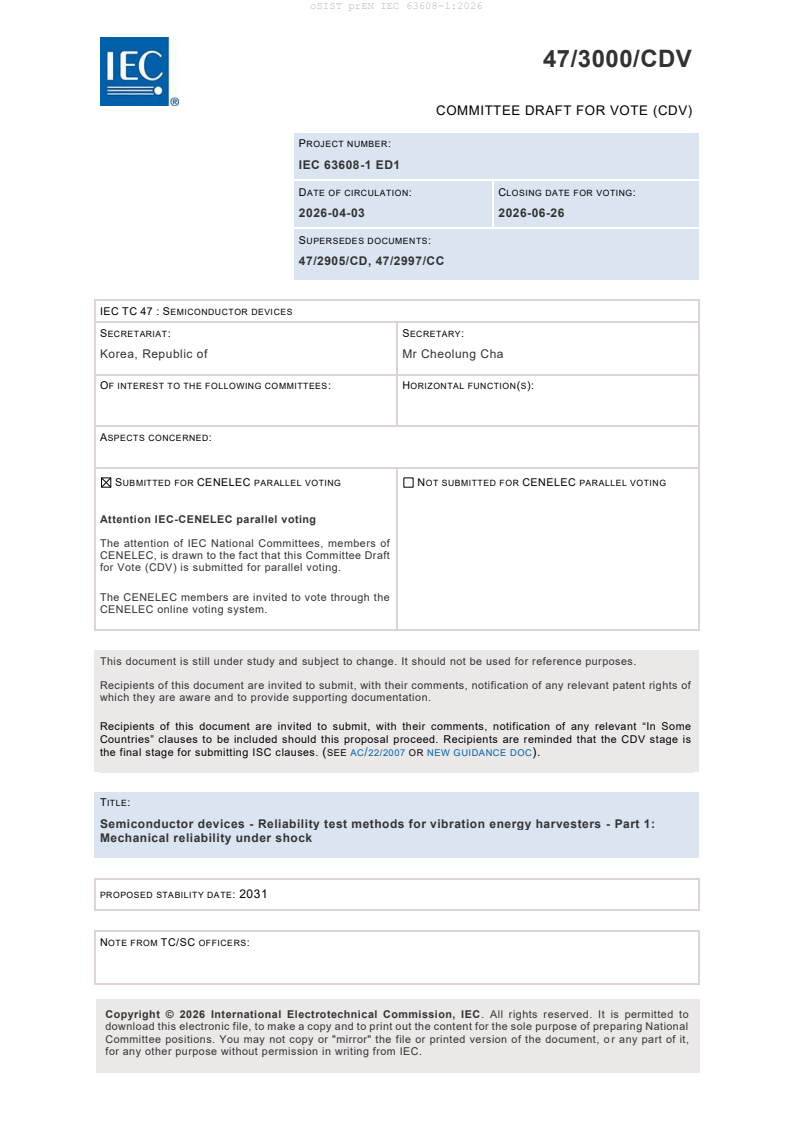
47/3000/CDV
COMMITTEE DRAFT FOR VOTE (CDV)
PROJECT NUMBER:
IEC 63608-1 ED1
DATE OF CIRCULATION: CLOSING DATE FOR VOTING:
2026-04-03 2026-06-26
SUPERSEDES DOCUMENTS:
47/2905/CD, 47/2997/CC
IEC TC 47 : SEMICONDUCTOR DEVICES
SECRETARIAT: SECRETARY:
Korea, Republic of Mr Cheolung Cha
OF INTEREST TO THE FOLLOWING COMMITTEES: HORIZONTAL FUNCTION(S):
ASPECTS CONCERNED:
SUBMITTED FOR CENELEC PARALLEL VOTING NOT SUBMITTED FOR CENELEC PARALLEL VOTING
Attention IEC-CENELEC parallel voting
The attention of IEC National Committees, members of
CENELEC, is drawn to the fact that this Committee Draft
for Vote (CDV) is submitted for parallel voting.
The CENELEC members are invited to vote through the
CENELEC online voting system.
This document is still under study and subject to change. It should not be used for reference purposes.
Recipients of this document are invited to submit, with their comments, notification of any relevant patent rights of
which they are aware and to provide supporting documentation.
Recipients of this document are invited to submit, with their comments, notification of any relevant “In Some
Countries” clauses to be included should this proposal proceed. Recipients are reminded that the CDV stage is
the final stage for submitting ISC clauses. (SEE AC/22/2007 OR NEW GUIDANCE DOC).
TITLE:
Semiconductor devices - Reliability test methods for vibration energy harvesters - Part 1:
Mechanical reliability under shock
PROPOSED STABILITY DATE: 2031
NOTE FROM TC/SC OFFICERS:
download this electronic file, to make a copy and to print out the content for the sole purpose of preparing National
Committee positions. You may not copy or "mirror" the file or printed version of the document, o r any part of it,
for any other purpose without permission in writing from IEC.
IEC CDV 63608-1 ED1 © IEC 2026
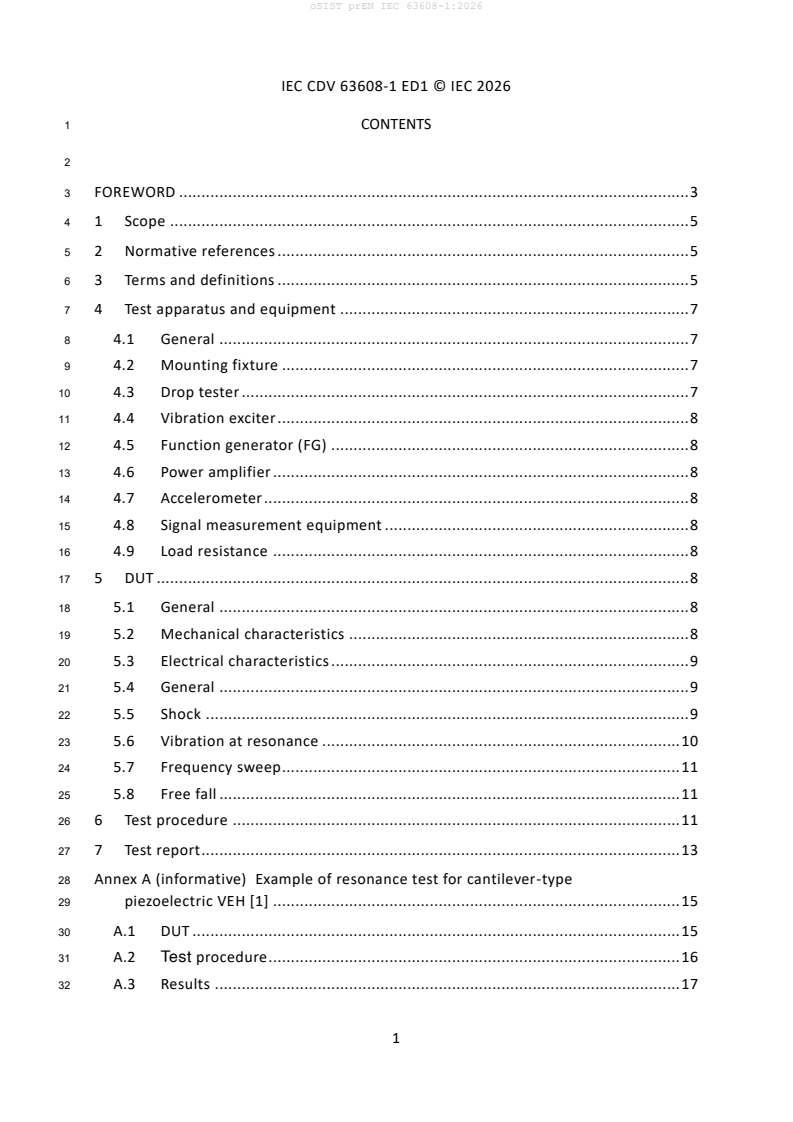
1 CONTENTS
3 FOREWORD . 3
4 1 Scope . 5
5 2 Normative references . 5
6 3 Terms and definitions . 5
7 4 Test apparatus and equipment . 7
8 4.1 General . 7
9 4.2 Mounting fixture . 7
10 4.3 Drop tester . 7
11 4.4 Vibration exciter . 8
12 4.5 Function generator (FG) . 8
13 4.6 Power amplifier . 8
14 4.7 Accelerometer . 8
15 4.8 Signal measurement equipment . 8
16 4.9 Load resistance . 8
17 5 DUT . 8
18 5.1 General . 8
19 5.2 Mechanical characteristics . 8
20 5.3 Electrical characteristics . 9
21 5.4 General . 9
22 5.5 Shock . 9
23 5.6 Vibration at resonance . 10
24 5.7 Frequency sweep . 11
25 5.8 Free fall . 11
26 6 Test procedure . 11
27 7 Test report . 13
28 Annex A (informative) Example of resonance test for cantilever-type
29 piezoelectric VEH [1] . 15
30 A.1 DUT . 15
31 A.2 Test procedure . 16
32 A.3 Results . 17
IEC CDV 63608-1 ED1 © IEC 2026
33 Annex B (informative) Example of shock reliability test for MEMS electrostatic
34 type VEH aimed at commercialization [2] . 18
35 B.1 DUT . 18
36 B.2 Test procedure . 18
37 B.2.1 Frequency sweep . 18
38 B.2.2 Half-sine shock . 19
39 B.2.3 Free Fall . 20
40 B.3 Results . 20
41 Bibliography . 20
43 Figure 1 – Drop tester . 10
44 Figure 2 – Vibration exciter . 10
45 Figure 3 – Half-sine waveform . 10
46 Figure 4 – Free fall . 11
47 Figure 5 – Test setup for the electrical characteristics . 12
48 Figure 6 – Graphical record of output power . 12
49 Figure A.1 – Cross section of the cantilever-type piezoelectric VEH. 15
50 Figure A.2 – Radius of curvature vs. stress in fixed part . 15
51 Figure A.3 – SEM image of fillet shape . 16
52 Figure A.4 – Test environment . 16
53 Figure A.5 – MEMS sample and resin package . 17
54 Figure A.6 – Destruction test by resonance drive . 17
55 Figure B.1 – Electrostatic electret type MEMS-VEH . 18
56 Figure B.2 – Fixture on vibration exciter . 19
57 Figure B.3 – Measurement apparatus for sweep test . 19
58 Figure B.4 – Measurement apparatus for shock test . 19
59 Figure B.5 – Waveform of half-sine . 20
60 Figure B.6 – Free-fall test with packaging box . 20
62 Table B.1 – Test results for three samples . 20
IEC CDV 63608-1 ED1 © IEC 2026
66 INTERNATIONAL ELECTROTECHNICAL COMMISSION
67 ____________
69 SEMICONDUCTOR DEVICES
70 – RELIABILITY TEST METHODS FOR VIBRATION ENERGY HARVESTERS –
71 Part 1: Mechanical Reliability Under Shock
75 FOREWORD
76 1) The International Electrotechnical Commission (IEC) is a worldwide organization for standardization comprising all national
77 electrotechnical committees (IEC National Committees). The object of IEC is to promote international co -operation on all
78 questions concerning standardization in the electrical and electronic fields. To this end and in addition to other activities ,
79 IEC publishes International Standards, Technical Specifications, Technical Reports, Publicly Available Specifications (PAS)
80 and Guides (hereafter referred to as "IEC Publication(s)"). Their preparation is entrusted to technical committees; any IEC
81 National Committee interested in the subject dealt with may participate in this preparatory work. International,
82 governmental and non-governmental organizations liaising with the IEC also participate in this preparation. IEC
83 collaborates closely with the International Organization for Standardization (ISO) in accordance with conditions
84 determined by agreement between the two organizations.
85 2) The formal decisions or agreements of IEC on technical matters express, as nearly as possible, an international consensus
86 of opinion on the relevant subjects since each technical committee has representation from all interested IEC National
87 Committees.
88 3) IEC Publications have the form of recommendations for international use and are accepted by IEC National Committees in
89 that sense. While all reasonable efforts are made to ensure that the technical content of IEC Publications is accurate, IEC
90 cannot be held responsible for the way in which they are used or for any misinterpretation by any end user.
91 4) In order to promote international uniformity, IEC National Committees undertake to apply IEC Publications transparently
92 to the maximum extent possible in their national and regional publications. Any divergence between any IEC Publication
93 and the corresponding national or regional publication shall be clearly indicated in the latter.
94 5) IEC itself does not provide any attestation of conformity. Independent certification bodies provide conformity assessment
95 services and, in some areas, access to IEC marks of conformity. IEC is not responsible for any services carried out by
96 independent certification bodies.
97 6) All users should ensure that they have the latest edition of this publication.
98 7) No liability shall attach to IEC or its directors, employees, servants or agents including individual experts and members of
99 its technical committees and IEC National Committees for any personal injury, property damage or other damage of any
100 nature whatsoever, whether direct or indirect, or for costs (including legal fees) and expenses arising out of the
101 publication, use of, or reliance upon, this IEC Publication or any other IEC Publications.
102 8) Attention is drawn to the Normative references cited in this publication. Use of the referenced publications is
103 indispensable for the correct application of this publication.
104 9) IEC draws attention to the possibility that the implementation of this document may involve the use of (a) patent(s). IEC
105 takes no position concerning the evidence, validity or applicability of any claimed patent rights in respect thereof. As of
106 the date of publication of this document, IEC had not received notice of (a) patent(s), which may be required to implement
107 this document. However, implementers are cautioned that this may not represent the latest information, which may be
108 obtained from the patent database available at https://patents.iec.ch or www.iso.org/patents. IEC shall not be held
109 responsible for identifying any or all such patent rights.
110 IEC 63608-1 has been prepared by IEC technical committee TC47: Semiconductor Devices. It
111 is an International Standard.
113 The text of this International Standard is based on the following documents:
IEC CDV 63608-1 ED1 © IEC 2026
Draft Report on voting
XX/XX/FDIS XX/XX/RVD
115 Full information on the voting for its approval can be found in the report on voting indicated in
116 the above table.
117 The language used for the development of this International Standard is English.
118 This document was drafted in accordance with ISO/IEC Directives, Part 2, and developed in
119 accordance with ISO/IEC Directives, Part 1 and ISO/IEC Directives, IEC Supplement, [and the
120 ISO/IEC Directives, JTC 1 Supplement] available at www.iec.ch/members_experts/refdocs. The
121 main document types developed by IEC are described in greater detail at
122 www.iec.ch/publications.
123 The committee has decided that the contents of this document will remain unchanged until the
124 stability date indicated on the IEC website under webstore.iec.ch in the data related to the
125 specific document. At this date, the document will be
126 • reconfirmed,
127 • withdrawn,
128 • replaced by a revised edition, or
129 • amended.
IEC CDV 63608-1 ED1 © IEC 2026
132 SEMICONDUCTOR DEVICES
133 –RELIABILITY TEST METHODS FOR VIBRATION ENERGY HARVESTERS–
135 Part 1: Mechanical Reliability Under Shock
139 1 Scope
140 This document specifies test methods for the mechanical reliability of vibration energy
141 harvesting devices. This standard applies to all vibration energy harvesting devices, regardless
142 of size and power generation principle. The method includes shock, vibration, frequency sweep,
143 and drop tests. Shock vibration covers a wide range of definitions, including its peak
144 acceleration, duration/frequency, and the shape of the shock pulse (e.g., half-sine, square,
145 sawtooth, etc.). According to typical usage conditions, the change in power is measured before
146 and after the tests under conditions that include actual power management circuits or load
147 resistances. Fatigue and long-term reliability are excluded.
148 2 Normative references
149 The following documents are referred to in the text in such a way that some or all of their content
150 constitutes requirements of this document. For dated references, only the edition cited applies.
151 For undated references, the latest edition of the referenced document (including any
152 amendments) applies.
153 IEC 60068-2-6, Environmental testing - Part 2-6: Tests - Test Fc: Vibration (sinusoidal)
154 IEC 60068-2-27, Environmental testing - Part 2-27: Tests - Test Ea and guidance: Shock
155 IEC 60068-2-31, Environmental testing - Part 2-31: Tests - Test Ec: Rough handling shocks,
156 primarily for equipment-type specimens
157 IEC 62969-3, Semiconductor devices - Semiconductor interface for automotive vehicles - Part
158 3: Shock driven piezoelectric energy harvesting for automotive vehicle sensors
159 3 Terms and definitions
160 For the purposes of this document, the following terms and definitions apply.
161 ISO and IEC maintain terminology databases for use in standardization at the following
162 addresses:
163 • IEC Electropedia: available at https://www.electropedia.org/
164 • ISO Online browsing platform: available at https://www.iso.org/obp
166 3.1
167 Vibration Energy Harvester
168 VEH
IEC CDV 63608-1 ED1 © IEC 2026
169 small size electric power generators by mechanical motion input
170 Note 1 to entry: Typical energy transforming methods are piezoelectric, electrostatic, electromagnetic , triboelectric, and
171 magnetostrictive systems.
172 3.2
173 mechanical motion
174 movement of an object with six degrees of freedom—three translational (X, Y, Z) and
175 three rotational (around X, Y, Z axes)
176 3.3
177 nominal parameter
178 specified or designed parameter used as a reference or target
179 Note 1 to entry: E.g., vibration frequency, applied acceleration, motion amplitude, operating temperature range, operating
180 humidity range, and load resistance etc.
181 3.4
182 shock
183 rapid acceleration or deceleration caused by a transient physical stimulus
184 Note 1 to entry: Characterized by the peak acceleration, duration/frequency, and shape of the shock pulse (e.g., half -sine,
185 square, sawtooth, etc.).
186 [SOURCE: IEC 62969-3, 3.1.1]
187 3.5
188 resonant frequency
189 frequency at which a system tends to vibrate with the maximum amplitude due to
190 resonance. For an undamped single degree-of-freedom (SDOF) system, the natural
191 (resonant) frequency f is given by:
n
1 𝑘
√
192 𝑓 =
𝑛
2𝜋 𝑚
193 where k is the stiffness and m is the mass of the system.
194 In the case of damping, the damped natural frequency f is:
d
𝟐
195 𝒇 =𝒇 √𝟏−𝛇
𝒅 𝒏
197 where ζ is the damping ratio.
198 Resonance occurs when the excitation frequency approaches fₙ or f , resulting in
d
199 increased amplitude of vibration.
IEC CDV 63608-1 ED1 © IEC 2026
200 3.6
201 damping / damped natural frequency
202 dissipation of energy of an oscillating system with time or distance / frequency of free
203 oscillation of a damped linear system
204 [SOURCE: Electropedia]
205 3.7
206 frequency sweep
207 frequency of vibration is varied to examine the behaviour at different frequencies. The
208 direction in which the frequency is increased or decreased, and the rate of frequency
209 change are also of interest specified or designed parameter used as a reference or
210 target
211 3.8
212 shock response spectrum
213 SRS
214 graphical representation of the magnitude of a structural response to a transient
215 impact or shock event over a range of frequencies. It is used to evaluate and quantify
216 potential damage and structural response to sudden, short duration forces and can be
217 calculated from the amplitude, duration and shape of the shock pulse specified or
218 designed parameter used as a reference or target
219 3.9
220 output power
221 [SOURCE: IEC 62969-3, 5.2.7]
222 4 Test apparatus and equipment
...