


oSIST prEN 15171:2005
(Main)Characterization of sludges - Determination of adsorbable organically bound halogens
Characterization of sludges - Determination of adsorbable organically bound halogens
This European Standard describes an empirical method for the direct determination of an amount ranging from 5 mg/kg to approximately 6 g/kg dry matter in sludge of organically bound chlorine, bromine and iodine (but not fluorine) adsorbed and occluded to the sludge matrix. Non-volatile organically bound halogens adsorbable on activated carbon present in the aqueous phase of sludge prior to drying are included in the determination.
NOTE The upper range of the method is instrument dependent.
Charakterisierung von Schlämmen - Bestimmung von adsorbierbaren organisch gebundenen Halogenen (AOX)
Diese Europäische Norm beschreibt ein empirisches Verfahren zur direkten Bestimmung einer Menge von 5 mg/kg bis etwa 6 g/kg Trockenmasse an den organisch gebundenen Halogenen Chlor, Brom und Iod (nicht jedoch Fluor) in Schlamm, die an die Schlammmatrix adsorbiert oder in dieser okkludiert sind. Nicht flüchtige organisch gebundene Halogene, die an Aktivkohle adsorbierbar sind und vor dem Trocknen in der wässrigen Phase des Schlammes vorliegen, sind in die Bestimmung mit einbezogen.
ANMERKUNG Der obere Bereich des Verfahrens ist von den verwendeten Geräten abhängig.
Caractérisation des boues - Détermination des composés organiques halogénés adsorbables
Karakterizacija blata – Določanje organsko vezanih halogenov, sposobnih adsorpcije (AOX)
General Information
- Status
- Not Published
- Technical Committee
- KAT - Soil quality
- Current Stage
- 98 - Abandoned project (Adopted Project)
- Start Date
- 08-Jun-2010
- Due Date
- 13-Jun-2010
- Completion Date
- 08-Jun-2010

Overview
oSIST prEN 15171:2005 is a European draft standard published by the Slovenian Institute for Standardization (SIST). It provides an empirical laboratory method for the direct determination of adsorbable organically bound halogens (AOX) in sludges. This parameter encompasses organically bound chlorine, bromine, and iodine - but not fluorine - that are adsorbed and occluded within the sludge matrix. The standard is essential for environmental laboratories, wastewater treatment operators, and regulatory bodies concerned with monitoring organohalogen compounds in sewage and industrial sludge.
The AOX value assessed by this procedure reflects the sum of non-volatile, organically bound halogens that can be adsorbed on activated carbon under prescribed conditions. The determination range typically spans from 5 mg/kg up to approximately 6 g/kg of dry matter, depending on the instrumentation used.
Key Topics
- Sludge Characterization: Focuses on the identification and quantification of organically bound halogens, crucial for understanding environmental impact and regulatory compliance.
- Empirical AOX Determination: Describes direct measurement of AOX through adsorption, combustion, and subsequent detection by argentometric titration.
- Method Scope: Includes both adsorbed and occluded halogens in the sludge, covering a comprehensive spectrum of AOX present.
- Calibration and Quality Assurance: Stresses the need for daily instrument calibration, blank determinations, duplicate analyses, and the use of spiked samples for performance verification.
- Sample Handling: Outlines proper sampling, storage, and pre-treatment to ensure accuracy and minimize contamination or loss of volatile analytes.
Applications
The method detailed in oSIST prEN 15171:2005 is valuable for:
- Environmental Monitoring: Evaluating contamination in sewage sludge and water treatment waste, supporting regulatory reporting and risk assessment.
- Wastewater Treatment: Assessing the performance of treatments aimed at removing or reducing organohalogen compounds, contributing to process optimization.
- Compliance with Environmental Regulations: Helping organizations meet national and EU requirements on sludge disposal, land application, or incineration by quantifying AOX contents.
- Industrial Process Control: Monitoring by-products in industries generating halogenated organic compounds, thus facilitating better waste management practices.
- Research and Development: Supporting scientific studies into the fate and transport of halogenated organic pollutants in waste streams, contributing to environmental protection strategies.
Related Standards
This standard refers to several essential European and international standards to ensure methodological consistency and interoperability:
- EN ISO 3696:1995 - Water for laboratory use – Specifications and test methods, essential for ensuring the purity of reagents and rinsing waters.
- EN ISO 5667-13:1997 - Water quality – Sampling – Guidance on sampling of sludges from sewage and water treatment works.
- EN 12880:2000 - Characterisation of sludges – Determination of dry residue and water content, critical for calculating AOX per dry mass.
- ISO 5725:1994 - Accuracy (trueness and precision) of measurement methods and results, providing framework for method validation and QA/QC procedures.
oSIST prEN 15171:2005 is a foundational resource for laboratories, regulators, and environmental professionals working with sludge characterization and AOX analysis, promoting reliable, traceable, and comparable monitoring of organohalogen loads in waste streams.
Get Certified
Connect with accredited certification bodies for this standard

CIS Institut d.o.o.
Personal Protective Equipment (PPE) certification body. Notified Body NB-2890 for EU Regulation 2016/425 PPE.

Kiwa BDA Testing
Building and construction product certification.
Kmetijski inštitut Slovenije
Agricultural Institute of Slovenia. Soil testing, plant health, agricultural product analysis.
Sponsored listings
Frequently Asked Questions
oSIST prEN 15171:2005 is a draft published by the Slovenian Institute for Standardization (SIST). Its full title is "Characterization of sludges - Determination of adsorbable organically bound halogens". This standard covers: This European Standard describes an empirical method for the direct determination of an amount ranging from 5 mg/kg to approximately 6 g/kg dry matter in sludge of organically bound chlorine, bromine and iodine (but not fluorine) adsorbed and occluded to the sludge matrix. Non-volatile organically bound halogens adsorbable on activated carbon present in the aqueous phase of sludge prior to drying are included in the determination. NOTE The upper range of the method is instrument dependent.
This European Standard describes an empirical method for the direct determination of an amount ranging from 5 mg/kg to approximately 6 g/kg dry matter in sludge of organically bound chlorine, bromine and iodine (but not fluorine) adsorbed and occluded to the sludge matrix. Non-volatile organically bound halogens adsorbable on activated carbon present in the aqueous phase of sludge prior to drying are included in the determination. NOTE The upper range of the method is instrument dependent.
oSIST prEN 15171:2005 is classified under the following ICS (International Classification for Standards) categories: 13.030.20 - Liquid wastes. Sludge. The ICS classification helps identify the subject area and facilitates finding related standards.
oSIST prEN 15171:2005 is available in PDF format for immediate download after purchase. The document can be added to your cart and obtained through the secure checkout process. Digital delivery ensures instant access to the complete standard document.
Standards Content (Sample)
SLOVENSKI oSIST prEN 15171:2005
PREDSTANDARD
april 2005
Karakterizacija blata – Določanje organsko vezanih halogenov, sposobnih
adsorpcije (AOX)
Characterization of sludges - Determination of adsorbable organically bound
halogens
ICS 13.030.20 Referenčna številka
© Standard je založil in izdal Slovenski inštitut za standardizacijo. Razmnoževanje ali kopiranje celote ali delov tega dokumenta ni dovoljeno
EUROPEAN STANDARD
DRAFT
NORME EUROPÉENNE
EUROPÄISCHE NORM
February 2005
ICS
English version
Characterization of sludges - Determination of adsorbable
organically bound halogens
Caractérisation des boues - Détermination des composés Charakterisierung von Schlämmen - Bestimmung von
organiques halogénés adsorbables adsorbierbaren organisch gebundenen Halogenen (AOX)
This draft European Standard is submitted to CEN members for enquiry. It has been drawn up by the Technical Committee CEN/TC 308.
If this draft becomes a European Standard, CEN members are bound to comply with the CEN/CENELEC Internal Regulations which
stipulate the conditions for giving this European Standard the status of a national standard without any alteration.
This draft European Standard was established by CEN in three official versions (English, French, German). A version in any other language
made by translation under the responsibility of a CEN member into its own language and notified to the Management Centre has the same
status as the official versions.
CEN members are the national standards bodies of Austria, Belgium, Cyprus, Czech Republic, Denmark, Estonia, Finland, France,
Germany, Greece, Hungary, Iceland, Ireland, Italy, Latvia, Lithuania, Luxembourg, Malta, Netherlands, Norway, Poland, Portugal, Slovakia,
Slovenia, Spain, Sweden, Switzerland and United Kingdom.
Warning : This document is not a European Standard. It is distributed for review and comments. It is subject to change without notice and
shall not be referred to as a European Standard.
EUROPEAN COMMITTEE FOR STANDARDIZATION
COMITÉ EUROPÉEN DE NORMALISATION
EUROPÄISCHES KOMITEE FÜR NORMUNG
Management Centre: rue de Stassart, 36 B-1050 Brussels
© 2005 CEN All rights of exploitation in any form and by any means reserved Ref. No. prEN 15171:2005: E
worldwide for CEN national Members.
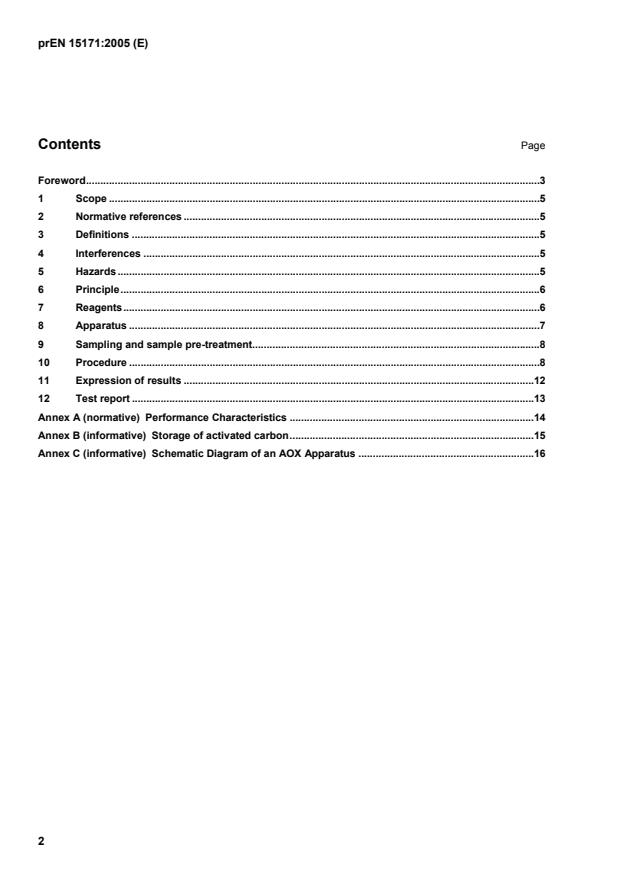
Contents Page
Foreword.3
1 Scope .5
2 Normative references .5
3 Definitions .5
4 Interferences .5
5 Hazards .5
6 Principle.6
7 Reagents.6
8 Apparatus .7
9 Sampling and sample pre-treatment.8
10 Procedure .8
11 Expression of results .12
12 Test report .13
Annex A (normative) Performance Characteristics .14
Annex B (informative) Storage of activated carbon.15
Annex C (informative) Schematic Diagram of an AOX Apparatus .16
Foreword
This document (prEN 15171:2005) has been prepared by Technical Committee CEN/TC 308
“Characterization of sludges”, the secretariat of which is held by AFNOR.
This document is currently submitted to the CEN Enquiry.
Introduction
It is absolutely essential that tests conducted according to this standard are carried out by suitably qualified
staff.
AOX is an empirical method originally used for water quality control purposes. It represents the sum of
organically bound chlorine, bromine and iodine (but not fluorine) which can be adsorbed on activated carbon
under specified conditions.
When applied to sludges, the method determines both adsorbable and occluded organically bound halogens.
The term AOX is, however, conventionally used for this parameter. The AOX is a sum parameter measuring a
range of different substances and gives as such no indication of the overall toxicity present in any sample, or
the nature of substances present in any sample.
1 Scope
This European Standard describes an empirical method for the direct determination of an amount ranging
from 5 mg/kg to approximately 6 g/kg dry matter in sludge of organically bound chlorine, bromine and iodine
(but not fluorine) adsorbed and occluded to the sludge matrix. Non-volatile organically bound halogens
adsorbable on activated carbon present in the aqueous phase of sludge prior to drying are included in the
determination.
NOTE The upper range of the method is instrument dependent.
2 Normative references
The following referenced documents are indispensable for the application of this document. For dated
references, only the edition cited applies. For undated references, the latest edition of the referenced
document (including any amendments) applies.
EN ISO 3696:1995, Water for laboratory use — Specification and test methods.
EN ISO 5667-13:1997, Water quality — Sampling — Part 13: Guidance on sampling of sludges from sewage
and water treatment works.
EN 12880:2000, Characterisation of sludges — Determination of dry residue and water content.
ISO 5725:1994, Accuracy (trueness and precision) of measurement methods and results.
3 Definitions
For the purpose of this European Standard, the following definitions apply:
3.1
adsorbable organically bound halogens (AOX)
the equivalent amount of chlorine, bromine, and iodine contained in organic compounds, expressed as
chloride when determined according to this European standard.
4 Interferences
4.1 Sparingly soluble or occluded inorganic halides are included in the determination and may, if present,
give a significant positive bias.
4.2 Organic bromine and iodine compounds may; during combustion, decompose to elemental bromine or
iodine respectively and this can yield higher oxidation states of these elements. These fractions of AOX may
be incompletely determined, thus leading to negative bias.
4.3 Loss of halogenated substances that volatilise during the drying stage at 105°C on prolonged heating.
5 Hazards
Waste and sludge samples may contain hazardous and inflammable substances. They may contain
pathogens and be liable to biological action. Consequently it is recommended that these samples should be
handled with special care. The gases which may be produced by microbiological activity are potentially
inflammable and will pressurise sealed bottles. Exploding bottles are likely to result in infectious shrapnel
and/or pathogenic aerosols. Glass bottles should be avoided wherever possible. National regulations should
be followed with respect to microbiological hazards associated with this method.
6 Principle
Addition of activated carbon to dried, homogenised sludge. Elution of inorganic halides and simultaneous
adsorption of water soluble organic compounds on the activated carbon by shaking with acidified sodium
nitrate solution.
Combustion of the loaded carbon / sludge mixture in an oxygen stream.
Absorption of the hydrogen halides followed by determination of the halide ions by an argentometric titration,
such as microcoulometry. Expression of the result as the mass concentration of chloride.
7 Reagents
Use only reagents of recognised analytical grade and, water grade 1 in accordance with ISO 3696. The AOX
content should be significantly less than the lowest AOX content to be determined.
The overall AOX contribution from water, chemicals, and gases shall be checked by measuring the total blank
(see 10.4).
7.1 Activated carbon
Use an activated carbon of about 10 µm to 50 µm grain size
For the storage of activated carbon, see annex A
The blank value of the washed activated carbon shall be less than 15 µg of chloride equivalent per gram of
activated carbon.
7.2 Nitric acid, HNO , p = 1,4 g/ml, 65% (m/m) solution.
7.3 Hydrochloric acid, c(HCl) = 0,100 mol/l.
The molarity shall precisely be known, since the acid is used for checking the microtitration (see 10.3.2).
7.4 Sulphuric acid, H SO , p = 1,84 g/ml.
2 4
7.5 Gases for combustion, for example oxygen (O ), or a mixture of oxygen and an inert gas.
7.6 Acidified sodium nitrate, stock solution, c(NaNO ) = 0,2 mol/l
Dissolve 17 g of sodium nitrate (NaNO ) in water in a 1000 ml volumetric flask, add 15 ml of nitric acid (see
7.2), and make up to volume with water.
7.7 Sodium nitrate washing solution, c(NaNO ) = 0,01 mol/l
Pipette 50 ml of the nitrate stock solution (see 7.6) in a 1000 ml volumetric flask, and make up to volume with
water.
7.8 Methanol, CH OH
7.9 4-Chlorophenol, stock solution, Equivalent to AOX = 2,0 g/l
Dissolve 0,725 g of 4-chlorophenol (C H ClO) in methanol (See 7.8) in a 100 ml volumetric flask and make up
6 5
to volume with methanol (See 7.8).
7.10 4-Chlorophenol, working solutions, Equivalent to AOX = 100 mg/l and 500 mg/l
Pipette 5 and 25 ml of 4-chlorophenol, stock solution, (see 7.9) into two separate 100 ml volumetric flask, and
make up to volume with methanol (See 7.8). These solutions contains 0,1 and 0,5 µg/µl AOX, respectively.
7.11 2-Chlorobenzoic acid, stock solution, Equivalent to AOX = 100 mg/l
Dissolve 110,4 mg of 2-chlorobenzoic acid (C H ClO ) in water in a 250 ml volumetric flask and make up to
7 5 2
volume with water.
The stock solutions (see 7.9 and 7.11) may be stored for at least 1 month and the working solutions (see 7.10)
for 1 week in a refrigerator in glass bottles.
8 Apparatus
8.1 Apparatus for the combustion and detection
Suitable commercial equipment should be used for the determination. This will comprise of the following.
8.1.1 Combustion apparatus
A furnace, capable of being heated to at least 950 °C, equipped with a quartz tube approximately 30 cm long
with an internal diameter of between 2 cm and 4 cm (see figure 1 in annex C) in accordance with the
manufacturer’s instructions.
8.1.2 Quartz sample boat, to fit in the quartz tube.
8.1.3 Argentometric measuring device for determining halide concentrations, for example a
microcoulometer, capable of determining at least 1 µg chloride with a coefficient of variation (repeatability) of
less than 10 %, or an equivalent device to determine chloride ions.
8.1.4 Absorber, filled with sulphuric acid (see 7.4), to dry the gas stream and designed so that the acid does
not backf1ush into the furnace.
8.1.5 Syringe, to pipette volumes of 1 µl to 10 µl of hydrochloric acid (see 7.3) or 4-chlorophenol solutions
(see 7.9 and 7.10).
8.2 Equipment for adsorption
8.2.1 Filtration apparatus, for example with a funnel capacity of 0,15 l and filter diameter 25 mm.
8.2.2 Low-halide polycarbonate membrane filter, for example with internal diameter of 25 mm and a pore
size of 0,45 µm, or any equivalent filtration material, such as a dedicated quartz filter for AOX determination.
8.2.3 Conical flask (Erlenmeyer flask) of 25 ml capacity with ground glass stopper or 12 – 20 ml screw cap
vial with PTFE lined cap.
8.2.4 Mechanical shaker for the flasks described in 8.2.3 above, equipped for example with a carrier plate.
8.3 Equipment for sample preparation
8.3.1 Porcelain evaporati
...