


SIST-TP CEN/TR 18137:2025
(Main)High chairs and learning towers - Compiled interpretations of CEN/TC 364 standards
High chairs and learning towers - Compiled interpretations of CEN/TC 364 standards
Gathering the responses to the various interpretation requests received over the years into a single document to be referred to.
Hochstühle und Lerntürme - Zusammengestellte Interpretationen zu Normen des CEN/TC 364
Otroški visoki stoli in učni stolpi - Zbrane interpretacije standardov CEN/TC 364
Namen tega dokumenta je zagotoviti odgovore na zahteve po interpretaciji in pojasnilih naslednjih standardov:
– EN 14988:2017+A2:2024, Otroški visoki stoli – Zahteve in preskusne metode;
– prEN 18122:2024, Učni stolpi – Zahteve in preskusne metode.
General Information
- Status
- Published
- Public Enquiry End Date
- 02-Oct-2024
- Publication Date
- 17-Dec-2024
- Technical Committee
- POH - Furniture
- Current Stage
- 6060 - National Implementation/Publication (Adopted Project)
- Start Date
- 27-Nov-2024
- Due Date
- 01-Feb-2025
- Completion Date
- 18-Dec-2024

Overview
SIST-TP CEN/TR 18137:2025 – High Chairs and Learning Towers: Compiled Interpretations of CEN/TC 364 Standards is a technical report published by the Slovenian Institute for Standardization (SIST). This document consolidates official responses to requests for interpretation and clarification related to the application and understanding of key European standards governing high chairs (EN 14988:2017+A2:2024) and learning towers (prEN 18122:2024). The aim is to provide a single reference for stakeholders requiring authoritative guidance on how specific clauses in these standards should be interpreted in practical scenarios.
Compiled by CEN/TC 364, the document does not introduce new mandatory requirements but supports correct and consistent application of existing standards, further promoting child safety and compliance in the design, manufacture, and testing of children's furniture.
Key Topics
- Interpretation Processes: Overview of how requests for interpretation are submitted, reviewed, and published by CEN/TC 364, as well as clarification of their advisory status.
- Clarifications for EN 14988:2017+A2:2024: Collates answers to common questions on topics such as seat adjustment mechanisms, entrapment hazards, compression points, restraint systems, lateral protection, and product stability.
- Guidance for Learning Towers: Includes a section for prEN 18122:2024, though no interpretations have been issued at the time of publication.
- Regular Updates: States that the interpretations will be updated as new issues arise, ensuring ongoing relevance.
Applications
The compiled interpretations in SIST-TP CEN/TR 18137:2025 are particularly valuable for:
- Manufacturers of High Chairs and Learning Towers: Assisting in the correct implementation of safety features and test protocols as described in CEN/TC 364 standards.
- Testing Laboratories: Helping assessors apply standardized methods consistently, reducing discrepancies in product evaluation.
- Regulatory Authorities: Offering a consensus view on ambiguous or complex requirements within existing European standards and supporting market surveillance efforts.
- Product Designers and Engineers: Facilitating product development processes by addressing potential areas of non-compliance before market entry.
- Retailers and Importers: Increasing confidence in the compliance of sourced products and providing accurate information to consumers.
- Standardization Committees: Providing a reference for improving or amending future editions of the relevant EN standards based on documented challenges and interpretations.
By centralizing expert-driven answers to detailed technical questions, this document improves the uniform understanding and application of furniture safety standards for children. Examples of practical clarifications include requirements around restraint systems (active vs. passive), specific test conditions for stability and durability, and the appropriate assessment of hazard points like compression and entrapment areas.
Related Standards
- EN 14988:2017+A2:2024: Specifies requirements and test methods for children's high chairs, focusing on safety, durability, and ergonomics.
- prEN 18122:2024: Draft standard outlining requirements and test methods for learning towers, supporting child engagement and safety in home environments.
- EN 12790: Pertains to reclined cradle functionality, referenced in the context of lateral protection requirements.
- Other CEN/TC 364 Standards: Related documents governing various aspects of children's furniture and equipment, managed by the relevant Technical Committee.
For those working with children’s high chairs, learning towers, and related products, SIST-TP CEN/TR 18137:2025 serves as a critical resource for interpreting and faithfully applying European safety standards. Use this compiled guidance to ensure compliance, minimize risk, and advance best practices in children's furniture safety.
Frequently Asked Questions
SIST-TP CEN/TR 18137:2025 is a technical report published by the Slovenian Institute for Standardization (SIST). Its full title is "High chairs and learning towers - Compiled interpretations of CEN/TC 364 standards". This standard covers: Gathering the responses to the various interpretation requests received over the years into a single document to be referred to.
Gathering the responses to the various interpretation requests received over the years into a single document to be referred to.
SIST-TP CEN/TR 18137:2025 is classified under the following ICS (International Classification for Standards) categories: 97.140 - Furniture; 97.190 - Equipment for children. The ICS classification helps identify the subject area and facilitates finding related standards.
SIST-TP CEN/TR 18137:2025 is available in PDF format for immediate download after purchase. The document can be added to your cart and obtained through the secure checkout process. Digital delivery ensures instant access to the complete standard document.
Standards Content (Sample)
SLOVENSKI STANDARD
01-januar-2025
Otroški visoki stoli in učni stolpi - Zbrane interpretacije standardov CEN/TC 364
High chairs and learning towers - Compiled interpretations of CEN/TC 364 standards
Hochstühle und Lerntürme - Zusammengestellte Interpretationen zu Normen des
CEN/TC 364
Ta slovenski standard je istoveten z: CEN/TR 18137:2024
ICS:
97.140 Pohištvo Furniture
97.190 Otroška oprema Equipment for children
2003-01.Slovenski inštitut za standardizacijo. Razmnoževanje celote ali delov tega standarda ni dovoljeno.
CEN/TR 18137
TECHNICAL REPORT
RAPPORT TECHNIQUE
December 2024
TECHNISCHER REPORT
ICS 97.140; 97.190
English Version
High chairs and learning towers - Compiled
interpretations of CEN/TC 364 standards
Hochstühle und Lerntürme - Zusammengestellte
Interpretationen zu Normen des CEN/TC 364
This Technical Report was approved by CEN on 1 December 2024. It has been drawn up by the Technical Committee CEN/TC
364.
CEN members are the national standards bodies of Austria, Belgium, Bulgaria, Croatia, Cyprus, Czech Republic, Denmark, Estonia,
Finland, France, Germany, Greece, Hungary, Iceland, Ireland, Italy, Latvia, Lithuania, Luxembourg, Malta, Netherlands, Norway,
Poland, Portugal, Republic of North Macedonia, Romania, Serbia, Slovakia, Slovenia, Spain, Sweden, Switzerland, Türkiye and
United Kingdom.
EUROPEAN COMMITTEE FOR STANDARDIZATION
COMITÉ EUROPÉEN DE NORMALISATION
EUROPÄISCHES KOMITEE FÜR NORMUNG
CEN-CENELEC Management Centre: Rue de la Science 23, B-1040 Brussels
© 2024 CEN All rights of exploitation in any form and by any means reserved Ref. No. CEN/TR 18137:2024 E
worldwide for CEN national Members.
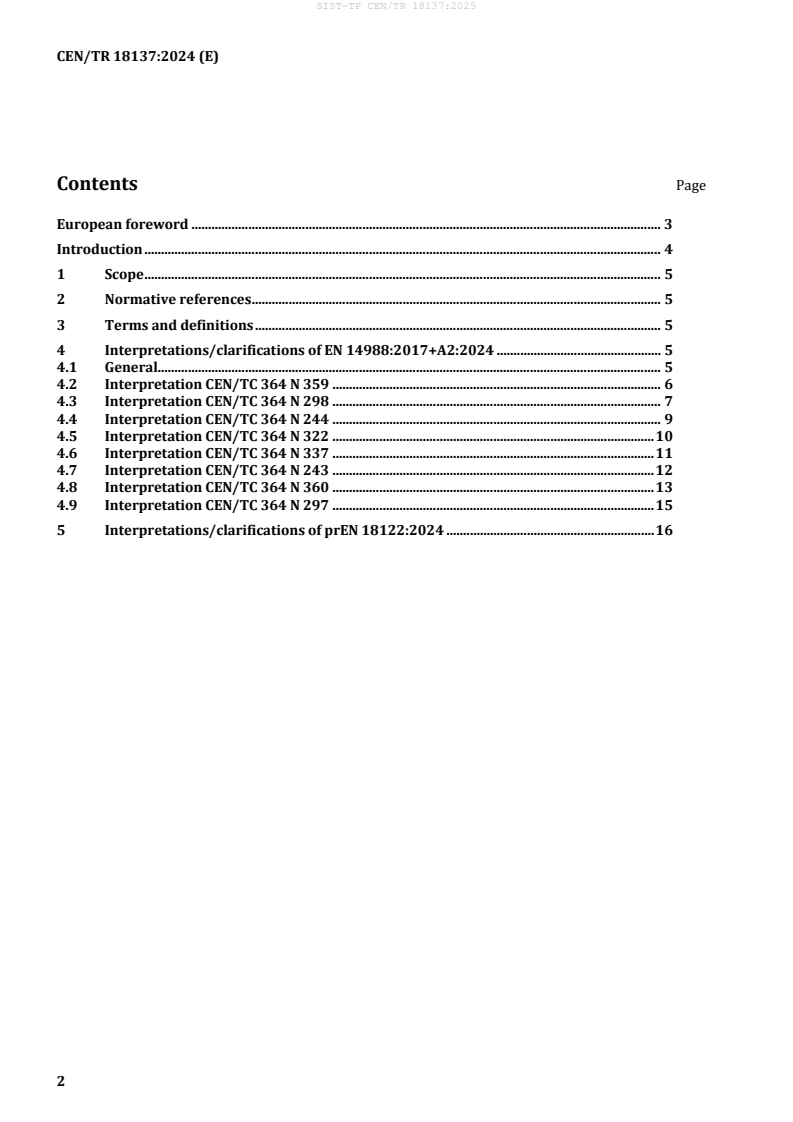
Contents Page
European foreword . 3
Introduction . 4
1 Scope . 5
2 Normative references . 5
3 Terms and definitions . 5
4 Interpretations/clarifications of EN 14988:2017+A2:2024 . 5
4.1 General. 5
4.2 Interpretation CEN/TC 364 N 359 . 6
4.3 Interpretation CEN/TC 364 N 298 . 7
4.4 Interpretation CEN/TC 364 N 244 . 9
4.5 Interpretation CEN/TC 364 N 322 . 10
4.6 Interpretation CEN/TC 364 N 337 . 11
4.7 Interpretation CEN/TC 364 N 243 . 12
4.8 Interpretation CEN/TC 364 N 360 . 13
4.9 Interpretation CEN/TC 364 N 297 . 15
5 Interpretations/clarifications of prEN 18122:2024 . 16
European foreword
This document (CEN/TR 18137:2024) has been prepared by Technical Committee CEN/TC CEN/TC 364
“High chairs and learning towers”, the secretariat of which is held by UNI.
Attention is drawn to the possibility that some of the elements of this document may be the subject of
patent rights. CEN shall not be held responsible for identifying any or all such patent rights.
Any feedback and questions on this document should be directed to the users’ national standards body.
A complete listing of these bodies can be found on the CEN website.
Introduction
This document contains replies to requests for interpretation and clarifications with regard to the
understanding of clauses in the standards elaborated within the CEN/TC 364. The replies concern those
requests which have resulted in an interpretation or the decision that no action is necessary.
An interpretation does not have the same status as the text of the standard, nor can it overrule the text of
the standard. However, following an interpretation should give assurance that the relevant clause of the
standard has been correctly applied. An interpretation will only be regarded as a clarification of the
meaning of the standard.
a) Disclaimer:
The information contained herein is for guidance only and does not reflect the formal approval by
CEN or CEN member bodies. It should be noted that the interpretations are neither part of any
standard nor have been referenced in the Official Journal of the European Union.
b) Requests for interpretation:
Requests for interpretations may be submitted by a CEN member body through its national
committee or by a CEN/TC 364 liaison (but not directly by an individual or a company) – in
accordance with the interpretation protocols agreed by CEN/TC 364.
A request for an interpretation may lead to:
1) an interpretation of the standard:
this should reflect a reasonable interpretation of how the standard should be used, while taking
into account:
i) the wording of the standard;
ii) the rationale of the standard;
iii) the history of the standard;
2) a no-action decision:
this is applicable when it is agreed that the standard appropriately specifies how a high chair
and a learning tower article should be assessed;
3) a proposal for an amendment of the standard:
this is applicable when it is agreed that the standard is deficient in some way.
NOTE Interpretations are published in CEN/TR 18137, which will be updated on a regular basis.
Proposals for amendments will be progressed as new work item proposals in accordance with CEN
rules.
c) Answers to requests for interpretations:
Since requests for interpretations are submitted through a CEN member body, it is assumed that the
member body will keep itself informed about decisions concerning the request and its progress and
will itself inform the originator of the request as appropriate.
1 Scope
The purpose of this document is to provide replies to requests for interpretations and clarifications of:
— EN 14988:2017+A2:2024, Children's high chairs - Requirements and test methods;
— prEN 18122:2024, Learning towers - Requirements and test methods
2 Normative references
There are no normative references in this document.
3 Terms and definitions
No terms and definitions are listed in this document.
4 Interpretations/clarifications of EN 14988:2017+A2:2024
4.1 General
Table 1 — Summary table of the request for interpretations classified in the order of the
clauses/subclauses of EN 14988
Clause/Subclause Title Interpretation
CEN/TC 364
Doc.
8.2.3 Unintentional release of the seat height adjustment N 359
mechanism
8.3.2 Entrapment of head N 298
8.4.1 Requirements on compression points N 244
8.8 Strength and durability hazards (Structural integrity, see N 322
A.4.7)
8.9.1.1.1 and 9.3a Requirements on restraint systems N 337
8.9.1.1.2 Requirements for high chair with an active restraint system N 243
8.9.2 Lateral protection N 360
8.12.1 Stability – Requirements N 297
4.2 Interpretation CEN/TC 364 N 359
Question
Clause 8.2.3 the standard reads
In order to prevent unintentional release of the seat adjustment mechanism, one of the following
requirements shall be fulfilled before and after testing in accordance with 8.1.2.1:
a) at least one operating device requires a minimum force of 50 N to activate, with and without test
mass A on the seat, or
b) height adjustment requires the use of a tool, or
c) release is only possible when two independent operating devices are operated simultaneously, or
d) there are two or more automatically engaging locking devices that both cannot be released by one
single action, or
e) height adjustment requires two consecutive actions, the first of which shall be maintained while the
second is carried out.
A lot of highchairs currently sold on the EU market and that are adjustable in height, feature a button on
either side of the seat and located on the front leg of the chair.
The question is related to the condition c) above, to assess whether these 2 independent operating
devices (the 2 buttons) are operated simultaneously.
If, when pushing the button on one side; then pushing the button on the other side, the seat is reengaged
automatically in the position immediately below; can we consider inadvertent release is prevented and
the condition c) is met?
Proposed answer
We think the requirement is intended to prevent sudden drop of the seat, caused by one inadvertent
operation.
Therefore, we consider for such a case, the safety of the product is ensured. By operating the operating
devices separately there is no unexpected drop of the seat and the locking devices automatically reengage
in the next position of use and condition c) is met.
Answer from the TC364
Adjustment of the seat height is made through the operation of two locking devices, which cannot be
operated at the same time by one single action, therefore the height adjustment mechanism complies
with d)
4.3 Interpretation CEN/TC 364 N 298
Question
Clause 8.3.2.1 of the standard says
‘With the exception of the entrance to the seat unit, the two openings for the child’s legs and openings in
the frame above the level of the top surface of the lateral protection, there shall be no holes, gaps or
openings above the seat surface which allow the small torso probe to pass through when tested
according to 8.3.2.2.’
Usually, entrapment hazard happens in openings that are completely bounded; but it is not clear in the
standard.
On the example below, shall the torso probe be applied in the gap between the backrest and the limit of
the lateral protection when the backrest is inclined, if this gap is completely open?
Proposed answer
The standard is not clear: the hazard is entrapment, but the assessment is not limited to completely
bounded openings.
We would consider there is not entrapment hazard here and not apply the torso probe as described in
8.3.2.2
Answer from the TC364
The requirement aims to cover the entrapment hazard, should the child fall out of the high chairs feet
first through a bounded opening, causing the child being retained and hanged by the head causing
strangulation.
In the cases shown in the pictures, as the openings are not completely bounded, the test is not applicable.
4.4 Interpretation CEN/TC 364 N 244
Question
The last paragraph of Clause 8.4.1 defines the following requirement:
“Hazardous compression points between the tray and the structure shall be assessed by applying a force of
50 N in the most onerous directions on the tray.”
Was it the intention of this requirement to apply the force in any possible direction, i.e. also from below
the tray or sideways?
Or was it the intention of the words “most onerous direction” to refer the application of a downward force
in the position on the tray most onerous for the test to simulate the real use situation when the
...