


SIST EN ISO 41018:2022
(Main)Facility management - Development of a facility management policy (ISO 41018:2022)
Facility management - Development of a facility management policy (ISO 41018:2022)
This document gives guidance on the development of a facility management (FM) policy when the organization:
a) intends to establish a framework for setting FM objectives and the effective management of risk;
b) intends to achieve alignment between the FM strategy and operational FM requirements;
c) wants to improve the usefulness and benefits provided by the FM system;
d) aims to meet the needs of interested parties and applicable FM requirements consistently;
e) aims to be sustainable.
Facility Management - Entwicklung einer Facility-Management-Politik (ISO 41018:2022)
Dieses Dokument gibt Leitlinien für die Entwicklung einer Facility-Management-Politik (FM), wenn die Organisation:
a) beabsichtigt, ein Rahmenwerk für die Festlegung von FM Zielen und das effektive Risikomanagement zu erstellen;
b) beabsichtigt, die FM Strategie und die betrieblichen FM Anforderungen abzustimmen;
c) die Nützlichkeit und die Vorteile des FM Systems verbessern möchte;
d) darauf abzielt, die Erfordernisse interessierter Parteien und die geltenden FM Anforderungen konsistent zu erfüllen;
e) darauf abzielt, nachhaltig zu sein.
Facility management - Élaboration d’une politique de facility management (ISO 41018:2022)
Le présent document fournit des recommandations relatives à l’élaboration d’une politique de facility management (FM) lorsque l’organisme:
a) entend définir un cadre pour l’établissement d’objectifs de FM et un management efficace du risque;
b) entend assurer l’alignement entre la stratégie de FM et les exigences opérationnelles relatives au FM;
c) veut améliorer l’utilité et les avantages fournis par le système de FM;
d) cherche à répondre aux besoins des parties intéressées et aux exigences applicables relatives au FM de manière cohérente;
e) s’inscrit dans une perspective de développement durable.
Upravljanje objektov in storitev - Razvoj politike upravljanja objektov (ISO 41018:2022)
Standard bo zagotovil smernice s priporočili o načinih, na katere lahko organizacija oblikuje politiko upravljanja objektov, ki bo omogočala podporo pri načrtovanju vsakodnevnih dejavnosti s prenosom strategije upravljanja objektov organizacije v izvedljive ukrepe. V smernicah bo opredeljen okvir za oblikovanje politike upravljanja objektov, ki ga bo mogoče uporabiti za določitev ključnih načel, odločitev in ukrepov, potrebnih za vzpostavitev take politike upravljanja objektov, ki bo skladna s strateškim ciljem organizacije. Obravnavana bo tudi opredelitev splošnih zahtev, pričakovanih praks, postopkov, protokolov in kontrol, s katerimi se zagotovi, da politika upravljanja objektov ustreza svojemu namenu. Standard bo zajemal tudi izvajanje politike upravljanja objektov, vključno s komuniciranjem, pregledovanjem in revizijo, da se ohrani kot aktualen dokument, ki ga bodo lahko organizacije uporabljale pri svojem delu tudi v prihodnje.
Glej priloženi osnutek standarda ISO 41018, podan v dokumentu N 308 standarda ISO/TC 267.
General Information
- Status
- Published
- Public Enquiry End Date
- 30-Nov-2021
- Publication Date
- 24-Aug-2022
- Technical Committee
- I13 - Imaginarni 13
- Current Stage
- 6060 - National Implementation/Publication (Adopted Project)
- Start Date
- 10-Aug-2022
- Due Date
- 15-Oct-2022
- Completion Date
- 25-Aug-2022
Overview
EN ISO 41018:2022 (ISO 41018:2022) provides guidance for the development of a facility management (FM) policy. It helps organisations establish a clear FM policy framework to set FM objectives, manage risk, align FM strategy with operations, improve FM system usefulness, meet interested‑party and regulatory requirements, and support sustainability. The document is published by CEN as EN ISO 41018:2022 and is aligned with international FM standardization activities.
Key topics and requirements
This standard focuses on practical elements needed to compile, implement and maintain an effective FM policy. Key technical topics include:
- FM policy framework
- Key principles, strategic intent and expected impacts
- Sustainability goals covering environmental, social and economic performance
- Leadership and governance
- Leadership and commitment, alignment with the demand organisation, roles and responsibilities, authority and approval
- Risk management
- Integration of risk considerations into FM policy design and decision-making
- Operational requirements and expected practices
- Translating policy into operational FM requirements and support functions
- Implementation and participation
- Statement of expectations, user participation, handling deviations and lessons learned
- Review, revision and continual improvement
- Evaluation, corrective/preventive actions, revising the FM policy and updating FM plans
- Supporting material
- Informative annexes with an example FM policy outline and a sample health, safety, security and environment statement
Practical applications and who uses it
EN ISO 41018:2022 is intended for organisations that design, manage or deliver facility services and who want to formalise FM policy and governance. Typical users include:
- Facility managers and FM teams
- Property and asset managers
- FM service providers and contractors
- Organisational leadership and strategy teams
- FM consultants, auditors and compliance officers
- Public-sector bodies and large occupiers improving workplace sustainability, safety and service alignment
Practical benefits:
- Creates a framework for setting measurable FM objectives
- Reduces disconnect between FM strategy and frontline operations
- Improves risk control, health, safety and security performance
- Supports sustainability commitments and stakeholder expectations
Related standards
- ISO 41001 - FM management systems (references FM policy in the context of an FM system)
- ISO 41014 - FM strategy (alignment with FM policy is recommended)
- CEN/TC 348 and national standards bodies for regional implementation (EN ISO adoption)
Use EN ISO 41018:2022 when developing or revising your FM policy to ensure governance, risk management and sustainability are embedded in facility management practice.


Frequently Asked Questions
SIST EN ISO 41018:2022 is a standard published by the Slovenian Institute for Standardization (SIST). Its full title is "Facility management - Development of a facility management policy (ISO 41018:2022)". This standard covers: This document gives guidance on the development of a facility management (FM) policy when the organization: a) intends to establish a framework for setting FM objectives and the effective management of risk; b) intends to achieve alignment between the FM strategy and operational FM requirements; c) wants to improve the usefulness and benefits provided by the FM system; d) aims to meet the needs of interested parties and applicable FM requirements consistently; e) aims to be sustainable.
This document gives guidance on the development of a facility management (FM) policy when the organization: a) intends to establish a framework for setting FM objectives and the effective management of risk; b) intends to achieve alignment between the FM strategy and operational FM requirements; c) wants to improve the usefulness and benefits provided by the FM system; d) aims to meet the needs of interested parties and applicable FM requirements consistently; e) aims to be sustainable.
SIST EN ISO 41018:2022 is classified under the following ICS (International Classification for Standards) categories: 03.080.10 - Maintenance services. Facilities management. The ICS classification helps identify the subject area and facilitates finding related standards.
SIST EN ISO 41018:2022 is available in PDF format for immediate download after purchase. The document can be added to your cart and obtained through the secure checkout process. Digital delivery ensures instant access to the complete standard document.
Standards Content (Sample)
SLOVENSKI STANDARD
01-september-2022
Upravljanje objektov in storitev - Razvoj politike upravljanja objektov (ISO
41018:2022)
Facility management - Development of a facility management policy (ISO 41018:2022)
Facility Management - Entwicklung einer Facility-Management-Politik (ISO 41018:2022)
Facility management - Élaboration d’une politique de facility management (ISO
41018:2022)
Ta slovenski standard je istoveten z: EN ISO 41018:2022
ICS:
03.080.10 Vzdrževalne storitve. Maintenance services.
Upravljanje objektov Facilities management
2003-01.Slovenski inštitut za standardizacijo. Razmnoževanje celote ali delov tega standarda ni dovoljeno.
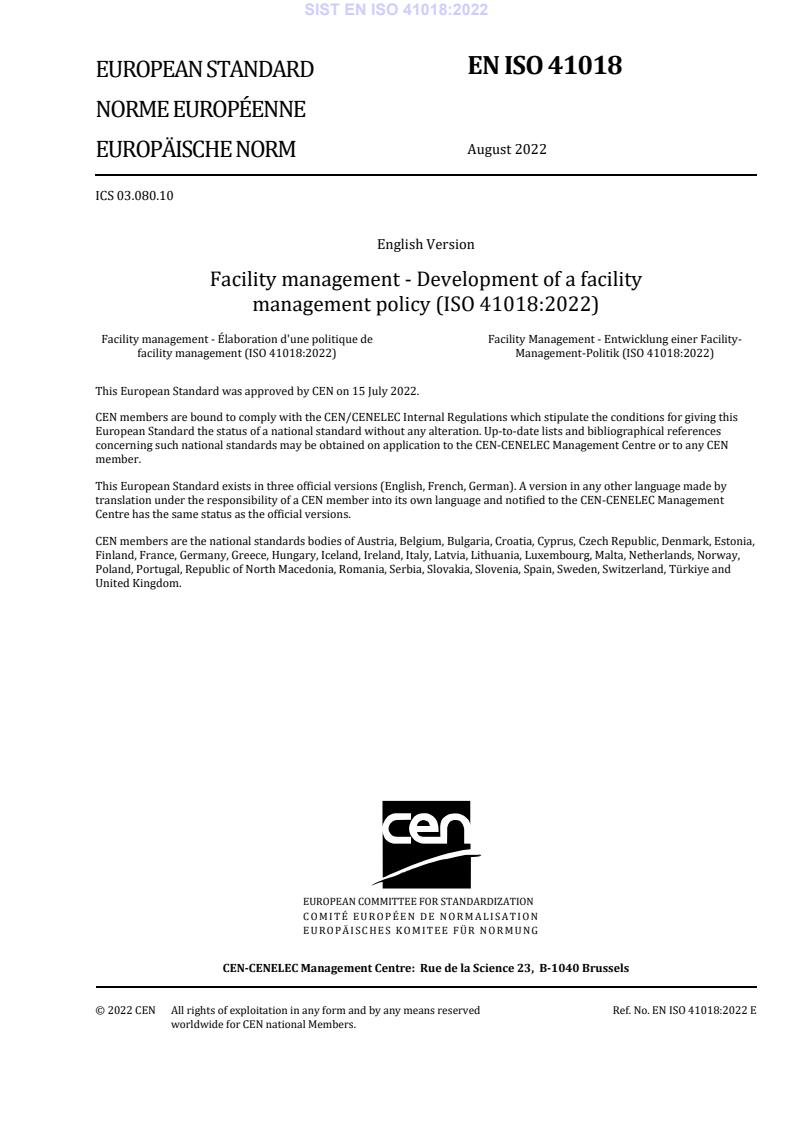
EN ISO 41018
EUROPEAN STANDARD
NORME EUROPÉENNE
August 2022
EUROPÄISCHE NORM
ICS 03.080.10
English Version
Facility management - Development of a facility
management policy (ISO 41018:2022)
Facility management - Élaboration d'une politique de Facility Management - Entwicklung einer Facility-
facility management (ISO 41018:2022) Management-Politik (ISO 41018:2022)
This European Standard was approved by CEN on 15 July 2022.
CEN members are bound to comply with the CEN/CENELEC Internal Regulations which stipulate the conditions for giving this
European Standard the status of a national standard without any alteration. Up-to-date lists and bibliographical references
concerning such national standards may be obtained on application to the CEN-CENELEC Management Centre or to any CEN
member.
This European Standard exists in three official versions (English, French, German). A version in any other language made by
translation under the responsibility of a CEN member into its own language and notified to the CEN-CENELEC Management
Centre has the same status as the official versions.
CEN members are the national standards bodies of Austria, Belgium, Bulgaria, Croatia, Cyprus, Czech Republic, Denmark, Estonia,
Finland, France, Germany, Greece, Hungary, Iceland, Ireland, Italy, Latvia, Lithuania, Luxembourg, Malta, Netherlands, Norway,
Poland, Portugal, Republic of North Macedonia, Romania, Serbia, Slovakia, Slovenia, Spain, Sweden, Switzerland, Türkiye and
United Kingdom.
EUROPEAN COMMITTEE FOR STANDARDIZATION
COMITÉ EUROPÉEN DE NORMALISATION
EUROPÄISCHES KOMITEE FÜR NORMUNG
CEN-CENELEC Management Centre: Rue de la Science 23, B-1040 Brussels
© 2022 CEN All rights of exploitation in any form and by any means reserved Ref. No. EN ISO 41018:2022 E
worldwide for CEN national Members.
Contents Page
European foreword . 3
European foreword
This document (EN ISO 41018:2022) has been prepared by Technical Committee ISO/TC 267 "Facility
management" in collaboration with Technical Committee CEN/TC 348 “Facility Management” the
secretariat of which is held by SN.
This European Standard shall be given the status of a national standard, either by publication of an
identical text or by endorsement, at the latest by February 2023, and conflicting national standards
shall be withdrawn at the latest by February 2023.
Attention is drawn to the possibility that some of the elements of this document may be the subject of
patent rights. CEN shall not be held responsible for identifying any or all such patent rights.
Any feedback and questions on this document should be directed to the users’ national standards
body/national committee. A complete listing of these bodies can be found on the CEN website.
According to the CEN-CENELEC Internal Regulations, the national standards organizations of the
following countries are bound to implement this European Standard: Austria, Belgium, Bulgaria,
Croatia, Cyprus, Czech Republic, Denmark, Estonia, Finland, France, Germany, Greece, Hungary, Iceland,
Ireland, Italy, Latvia, Lithuania, Luxembourg, Malta, Netherlands, Norway, Poland, Portugal, Republic of
North Macedonia, Romania, Serbia, Slovakia, Slovenia, Spain, Sweden, Switzerland, Türkiye and the
United Kingdom.
Endorsement notice
The text of ISO 41018:2022 has been approved by CEN as EN ISO 41018:2022 without any modification.
INTERNATIONAL ISO
STANDARD 41018
First edition
2022-07
Facility management — Development
of a facility management policy
Facility management — Élaboration d’une politique de facility
management
Reference number
ISO 41018:2022(E)
ISO 41018:2022(E)
© ISO 2022
All rights reserved. Unless otherwise specified, or required in the context of its implementation, no part of this publication may
be reproduced or utilized otherwise in any form or by any means, electronic or mechanical, including photocopying, or posting on
the internet or an intranet, without prior written permission. Permission can be requested from either ISO at the address below
or ISO’s member body in the country of the requester.
ISO copyright office
CP 401 • Ch. de Blandonnet 8
CH-1214 Vernier, Geneva
Phone: +41 22 749 01 11
Email: copyright@iso.org
Website: www.iso.org
Published in Switzerland
ii
ISO 41018:2022(E)
Contents Page
Foreword .iv
Introduction .v
1 Scope . 1
2 Normative references . 1
3 Terms and definitions . 1
4 Defining the FM policy framework . 2
4.1 Key principles . 2
4.2 Strategic intent . 2
4.3 Expected impacts . 3
4.3.1 General . 3
4.3.2 Expected outcomes . 3
4.3.3 Unintended consequences . 3
4.4 Sustainability goals . 4
4.4.1 Environmental performance . 4
4.4.2 Social performance . 4
4.4.3 Economic performance . 5
4.5 Leadership and commitment . 5
4.5.1 Alignment with the demand organization . 5
4.5.2 Management decision-making . 5
4.5.3 Access, inclusiveness and equality . 5
4.5.4 Health, safety and security . 5
4.6 Governance . 6
4.6.1 General . 6
4.6.2 Authority and approval . 6
4.6.3 Roles and responsibilities . 6
4.6.4 Risk management . 7
5 Compiling the FM policy . 7
5.1 Operational requirements . 7
5.2 Expected practices . 8
5.2.1 General . 8
5.2.2 Specific considerations . 9
5.2.3 Support functions . 10
6 Implementing the FM policy .10
6.1 Statement of expectations . 10
6.2 User participation . 10
6.3 Deviations from the policy . . 11
6.4 Lessons learned . 11
7 Review and revision of the FM policy .11
7.1 Evaluation of lessons learned . 11
7.2 Corrective and preventive actions . 11
7.3 Revising the FM policy . 11
7.4 Updating FM plans .12
Annex A (informative) Example of an outline FM policy .13
Annex B (informative) Example of a health, safety, security and environment statement .15
Bibliography .16
iii
ISO 41018:2022(E)
Foreword
ISO (the International Organization for Standardization) is a worldwide federation of national standards
bodies (ISO member bodies). The work of preparing International Standards is normally carried out
through ISO technical committees. Each member body interested in a subject for which a technical
committee has been established has the right to be represented on that committee. International
organizations, governmental and non-governmental, in liaison with ISO, also take part in the work.
ISO collaborates closely with the International Electrotechnical Commission (IEC) on all matters of
electrotechnical standardization.
The procedures used to develop this document and those intended for its further maintenance are
described in the ISO/IEC Directives, Part 1. In particular, the different approval criteria needed for the
different types of ISO documents should be noted. This document was drafted in accordance with the
editorial rules of the ISO/IEC Directives, Part 2 (see www.iso.org/directives).
Attention is drawn to the possibility that some of the elements of this document may be the subject of
patent rights. ISO shall not be held responsible for identifying any or all such patent rights. Details of
any patent rights identified during the development of the document will be in the Introduction and/or
on the ISO list of patent declarations received (see www.iso.org/patents).
Any trade name used in this document is information given for the convenience of users and does not
constitute an endorsement.
For an explanation of the voluntary nature of standards, the meaning of ISO specific terms and
expressions related to conformity assessment, as well as information about ISO’s adherence to the
World Trade Organization (WTO) principles in the Technical Barriers to Trade (TBT), see www.iso.org/
iso/foreword.html.
This document was prepared by Technical Committee ISO/TC 267, Facility management, in collaboration
with the European Committee for Standardization (CEN) Technical Committee CEN/TC 348, Facility
Management, in accordance with the Agreement on technical cooperation between ISO and CEN (Vienna
Agreement).
Any feedback or questions on this document should be directed to the user’s national standards body. A
complete listing of these bodies can be found at www.iso.org/members.html.
iv
ISO 41018:2022(E)
Introduction
0.1 General
Facility management (FM) integrates multiple disciplines in order to have an influence on the efficiency
and productivity of economies of organizations, societies and communities, as well as the manner in
which individuals interact with the built environment. FM affects the safety, well-being and quality of
life of much of the world’s societies and population through the services it manages and delivers (see
ISO 41001).
This document makes reference to the demand organization and to the organization responsible for FM
and facility services. A distinction is necessary because of the variable nature in which FM is organized
and where facility services are delivered through personnel within the demand organization, through
external service providers or a combination of the two.
The guidance in this document applies principally to the FM organization. In situations where there
is presently no formal FM organization, a person (or body) should be appointed to take an active role
in developing the FM policy. Unless otherwise stated in this document, “organization” refers to the FM
organization.
ISO 41001 makes reference to an FM policy in the context of an FM system.
The benefits of developing an FM policy include:
— a framework for setting FM objectives;
— support for the management of risk;
— a commitment to the continual improvement of the FM system;
— leadership and commitment by top management or an agent of the demand organization to the
operation of the FM system;
— reduced likelihood of a disconnect between the FM strategy and operational FM requirements;
— improved efficiency in the provision of FM in general and in the delivery of facility services in
particular;
— a commitment to the protection of people, property and the environment;
— strengthening of related policies of the demand organization.
In a hierarchy of decision-making and actions, the FM policy is positioned between the FM strategy and
operational plans. The FM policy is derived from the FM system, which is all-encompassing in its scope
although not in terms of detailed requirements or recommendations.
This document is intended to complement the current provision of guidance on FM policy in the context
of the FM system (see ISO 41001). The aim is to promote awareness, competence development and
expertise by providing advice on those decisions that affect the management of the facility and the
delivery of facility services.
Specifically, this document is applicable to any organization that wishes to:
— utilize a methodology for developing an FM policy;
— assure itself of the alignment of the FM policy with the FM strategy (see ISO 41014);
— provide a framework for setting FM objectives and operational FM requirements.
This document provides guidance for internal or external audit programmes. Users of this document
can compare practices for developing an FM policy with an internationally recognized benchmark,
providing sound principles for the effective management of those practices.
v
ISO 41018:2022(E)
0.2 Process approach
This document provides a common basis for understanding the factors that the organization should
consider when developing an FM policy. It promotes a methodology to assist the organization in
determining the most appropriate approach to, and arrangements for, the development of an FM policy
as a basis for the implementation of operational FM requirements to support the demand organization’s
core business, primarily its business activities.
This document emphasizes the decisions, activities, information, data and interested parties that have
to be coordinated into a manageable process for the development of an FM policy and the stages within
it, including:
— defining the FM policy framework (see Clause 4);
— compiling the FM policy (see Clause 5);
— implementing the FM policy (see Clause 6);
— review and revision of the FM policy (see Clause 7).
The methodology is intended to be scalable, meaning that this document’s provisions are applicable
to any organization to a greater or lesser extent. As such, the organization can determine which of the
provisions apply fully or partially to the development of the FM policy.
vi
INTERNATIONAL STANDARD ISO 41018:2022(E)
Facility management — Development of a facility
management policy
1 Scope
This document gives guidance on the development of a facility management (FM) policy when the
organization:
a) intends to establish a framework for setting FM objectives and the effective management of risk;
b) intends to achieve alignment between the FM strategy and operational FM requirements;
c) wants to improve the usefulness and benefits provided by the FM system;
d) aims to meet the needs of interested parties and applicable FM requirements consistently;
e) aims to be sustainable.
2 Normative references
The following documents are referred to in the text in such a way that some or all of their content
constitutes requirements of this document. For dated references, only the edition cited applies. For
undated references, the latest edition of the referenced document (including any amendments) applies.
ISO 41011, Facility management — Vocabulary
3 Terms and definitions
For the purposes of this document, the terms and definitions given in ISO 41011 and the following apply.
ISO and IEC maintain terminology databases for use in standardization at the following addresses:
— ISO Online browsing platform: available at https:// www .iso .org/ obp
— IEC Electropedia: available at https:// www .electropedia .org/
3.1
acceptance criteria
evidence required for considering that requirements have been fulfilled
[SOURCE: ISO 22263:2008, 2.1]
3.2
after-action review
structured review or debriefing process for analysing an event, capturing lessons learned and
identifying opportunities for improvement
3.3
facility management policy
FM policy
course or principle of action adopted or proposed that is intended to achieve defined outcomes
Note 1 to entry: Example principles include net zero carbon operations, workplace well-being, zero incidents and
minimal whole-life cost.
ISO 41018:2022(E)
3.4
operational plan
documented collection of procedures and information that is developed, compiled and maintained in
readiness for the conduct of operations
[SOURCE: ISO 24516-3:2017, 3.16]
4 Defining the FM policy framework
4.1 Key principles
The organization should be guided by the demand organization’s business strategy and objectives, and
the FM strategy when developing, implementing, maintaining and updating the FM policy. Specifically,
the FM policy should be:
— aligned with the business objectives of the demand organization;
— supported by top management;
— appropriate to the nature and scale of the organization and its operations;
— consistent with other relevant organizational policies, including those of the demand organization;
— part of the daily work of the organization;
— clear, unambiguous and actionable, stating the actions that are acceptable and those that are not
acceptable;
— coordinated with interested parties, with interdependent policy and with statutory and regulatory
requirements;
— communicated to interested parties responsible for implementation and maintenance;
— periodically reviewed and updated.
NOTE ISO 41001 provides requirements for an FM system. ISO 41014 gives guidance with recommendations
for the development of an FM strategy.
4.2 Strategic intent
The FM policy should inform FM procedures and operations.
The distinction between the strategic, tactical and operational levels of the organization’s management
should be made clear. Policy declares the intent or guiding principle. Processes and procedures are
then the tactical level output that implements the policy in terms of operations. Figure 1 shows the
relationships.
Figure 1 — Relationship between FM policy and FM strategy, procedures and operations
There can be overlap where the organization influences other demand organization objectives
[e.g. occupational health and safety (OH&S), environmental impact and sustainability]; however,
in a hierarchical context, FM should yield to, adopt and support, as applicable, policies developed by
ISO 41018:2022(E)
the demand organization (e.g. sourcing, procurement, information and data, quality, employment,
inclusiveness and equity, and corporate social responsibility).
The FM policy should provide guidance on the following:
— approach to work and or other human-centred activities and functions;
— the way in which business is conducted in the organization, including environmental, social and
corporate governance;
— beliefs, values, attitudes and behaviour of people within the organization, taking into account cross-
cultural impacts;
— roles, responsibilities and relationships with external bodies.
4.3 Expected impacts
4.3.1 General
Appropriate behaviour can be expected to create a safe, healthy and secure environment for users
and visitors. For the demand organization, there are likely to be benefits in terms of more efficient
and effective FM operations, which can be expected to continue to support the core business. The FM
policy should raise awareness of what is acceptable and what is not, and have the potential to reform
inappropriate behaviour.
The FM policy should provide users and all other interested parties with a frame of reference for their
day-to-day work, or other role, as well as guidance on the operation and use of the facility and expected
behaviour. In framing the FM policy, the organization should make explicit the type and nature of
facility services that are delivered so that expected outcomes (see 4.3.2) are achieved and unintended
consequences are avoided (see 4.3.3).
The extent to which users are satisfied or dissatisfied with any aspect of FM and the delivery of facility
services should be established through periodic surveys or other forms of inquiry. Care should be
exercised when canvassing the opinions of users so that it is seen as a genuine attempt to understand
the suitability of the facility and facility services.
NOTE User satisfaction is a key success factor in FM. ISO 10001 gives guidelines for planning, designing,
developing, implementing, maintaining and improving customer satisfaction codes of conduct.
4.3.2 Expected outcomes
Policies that are intended to create awareness and appropriate behaviour are more likely to succeed if
they are explained, practicable and backed-up by leadership and commitment from top management
(see 4.5).
Top management should review its decisions before committing to them to determine if they are likely
to achieve the expected outcomes.
EXAMPLE A procedure for waste reduction and elimination is more likely to be followed by users if
understood from their perspective and supported by practical guidelines.
4.3.3 Unintended consequences
A well-intended policy can fail to meet its intended outcome for a variety of reasons. The following
factors should be avoided:
— its impracticality for users to implement;
— a conflict with an individual’s beliefs or values;
— an implicit conflict of interest with an individual’s performance expectations;
ISO 41018:2022(E)
— failure to consider the impact on related functions.
Depending on location, many workforces and interested parties are likely to reflect a mix of different
ethnic, religious and cultural backgrounds.
The organization should consider the implications of its policymaking so that it avoids unintended
consequences for users, its own personnel and other interested parties arising from incompatibilities
between their beliefs and values, and the organization’s policies.
NOTE A health, safety, security and environment policy that has the aim of minimizing accidents and which
is linked with a reward scheme, even if unintentional, can result in the underreporting of accidents.
4.4 Sustainability goals
4.4.1 Environmental performance
The organization should document the legislation applicable to environmental performance in the
context of achieving the FM objectives (e.g. energy use, CO emissions, water quality, water consumption,
waste reduction, recycling) and all supporting standards and procedures in the FM system.
The organization should state how it intends to be compliant with the legislation and supporting
standards and procedures. This statement should form part of the FM policy (see C
...
Questions, Comments and Discussion
Ask us and Technical Secretary will try to provide an answer. You can facilitate discussion about the standard in here.
Loading comments...