


SIST EN ISO 8504-4:2025
(Main)Preparation of steel substrates before application of paints and related products - Surface preparation methods - Part 4: Acid pickling (ISO 8504-4:2022)
Preparation of steel substrates before application of paints and related products - Surface preparation methods - Part 4: Acid pickling (ISO 8504-4:2022)
This document describes the typical method for acid pickling generally used in a shop facility for the preparation of steel substrates before application of paints and related products. It is in general applicable to new steelwork.
This method is essentially intended to remove rust and mill scale. Typically, only slight oil residues can be removed during this process. It can be used on steel surfaces that are easily deformed by abrasive blasting.
Vorbereitung von Stahloberflächen vor dem Auftragen von Beschichtungsstoffen - Verfahren für die Oberflächenvorbereitung - Teil 4: Säurebeizung (ISO 8504-4:2022)
Dieses Dokument beschreibt das gängige Verfahren zum Säurebeizen, das in einer Betriebsanlage zur Vorbereitung von Stahloberflächen vor dem Auftragen von Beschichtungsstoffen üblicherweise angewendet wird. Es wird im Allgemeinen bei neuen Stahlkonstruktionen angewendet.
Dieses Verfahren dient im Wesentlichen der Entfernung von Rost und Walzhaut. In der Regel können mit diesem Verfahren nur leichte Ölrückstände entfernt werden. Es kann auf Stahloberflächen verwendet werden, die sich durch Strahlen leicht verformen.
WARNUNG — Die in diesem Dokument beschriebenen Verfahren sind von entsprechend geschultem und/oder beaufsichtigtem Personal durchzuführen. Die für diese Verfahren verwendeten Substanzen und Arbeitsschritte können gesundheitsgefährdend sein, wenn keine angemessenen Vorsichtsmaßnahmen getroffen werden. In diesem Text wird auf einige spezielle Gefährdungen hingewiesen. Dieses Dokument bezieht sich ausschließlich auf die technische Eignung der Verfahren und entbindet den Anwender nicht von rechtlichen Verpflichtungen hinsichtlich Arbeits- und Gesundheitsschutz.
Préparation des subjectiles d'acier avant application de peintures et de produits assimilés - Méthodes de préparation des subjectiles - Partie 4: Décapage à l'acide (ISO 8504-4:2022)
Le présent document décrit la méthode habituelle de décapage à l’acide généralement utilisée en atelier pour la préparation des subjectiles d’acier avant application de peintures et de produits assimilés. Elle est en général applicable à l’acier neuf.
Cette méthode est essentiellement destinée à éliminer la rouille et la calamine. En général, il n’est possible d’éliminer qu’une infime quantité de résidus d’huile durant ce processus. Elle peut être utilisée sur les subjectiles d’acier qui se déforment facilement lorsqu’ils sont préparés par projection d’abrasif.
Priprava jeklenih podlag pred nanašanjem barv in sorodnih premazov - Postopki priprave površine - 4. del: Obdelava s kislino (ISO 8504-4:2022)
Ta dokument določa značilno metodo za obdelavo s kislino, ki se običajno uporablja v trgovinskem objektu za pripravo jeklenih podlag pred nanašanjem barv in sorodnih premazov. Na splošno se uporablja za nova jekla.
Ta metoda je v osnovi namenjena odstranjevanju rje in varjalniške škaje. Med tem postopkom je običajno mogoče odstraniti le manjše ostanke olja. Uporabljati ga je mogoče na jeklenih površinah, ki se pri peskanju zlahka poškodujejo.
General Information
- Status
- Published
- Public Enquiry End Date
- 01-Oct-2024
- Publication Date
- 14-Jan-2025
- Technical Committee
- IBLP - Paints and varnishes
- Current Stage
- 6060 - National Implementation/Publication (Adopted Project)
- Start Date
- 08-Jan-2025
- Due Date
- 15-Mar-2025
- Completion Date
- 15-Jan-2025


Relations
- Effective Date
- 28-Jan-2026
- Effective Date
- 28-Jan-2026
- Effective Date
- 28-Jan-2026
- Effective Date
- 28-Jan-2026
- Effective Date
- 28-Jan-2026
- Effective Date
- 28-Jan-2026
- Effective Date
- 28-Jan-2026
Overview
SIST EN ISO 8504-4:2025 provides comprehensive guidance for the preparation of steel substrates prior to the application of paints and related products, with a specific focus on acid pickling. This European and international standard, developed by SIST and based on ISO 8504-4:2022, specifies acid pickling as a typical shop floor method for removing rust and mill scale from new steelwork. Acid pickling is particularly effective for steel surfaces that may be easily deformed by abrasive blasting and is generally used when a high degree of surface cleanliness is required before coating.
Key Topics
- Acid Pickling Process: Details the use of acidic solutions, such as inorganic or organic acids, alongside inhibitors and surfactants, for the removal of rust and mill scale.
- Surface Cleanliness: Emphasizes assessment in alignment with ISO 8502 series to ensure suitability of the steel surface prior to coating application.
- Method Sequence:
- Initial degreasing (may remove slight oil residues)
- Rinsing with fresh water
- Acid pickling (full immersion recommended)
- Post-treatment, such as conversion coatings and drying
- Equipment and Safety:
- Recommends anti-corrosion materials for tanks and pipes
- Highlights the need for healthy and safe work practices due to the hazards of acids and other materials used
Applications
Acid pickling is primarily applied in the following situations:
- Preparation of New Steelwork: Used before applying protective paint systems in industrial, construction, or manufacturing settings.
- Delicate or Thin Steel Surfaces: Especially valuable when abrasive blasting might distort or damage the substrate.
- Complex Structures: Suitable for internal and external areas, including parts with intricate geometries that are challenging to clean with mechanical methods.
- Quality-critical Environments: Ensures optimal adhesion and performance of paints and related products by effectively removing corrosion products and contaminants.
Key practical benefits include:
- Achieving a clean, chemically active surface to maximize coating adhesion
- Reducing the risk of coating failure caused by embedded contaminants or incomplete rust removal
- Compatibility with subsequent conversion coatings (e.g., phosphatising) or alternative treatments to enhance corrosion protection
Related Standards
To ensure optimal steel surface preparation and paint performance, the following related standards are frequently referenced alongside SIST EN ISO 8504-4:
- ISO 8501 (all parts): Visual assessment of surface cleanliness of steel substrates
- ISO 8502 (all parts): Tests for the assessment of surface cleanliness, providing methods for verifying the effectiveness of acid pickling
- ISO 8503 (all parts): Surface roughness characteristics of blasted steel substrates
- ISO 9717: Metallic and other inorganic coatings - Phosphate conversion coating of metals, referenced for post-pickling treatment options
- ISO 12944-4: Corrosion protection of steel structures by protective paint systems - Types of surface and surface preparation
Using SIST EN ISO 8504-4:2025 together with these standards supports a holistic, standardized approach to steel substrate preparation, ensuring durability and long-term performance of protective coatings in industrial and construction sectors.
Keywords: steel substrate preparation, acid pickling, surface preparation methods, rust removal, mill scale removal, steel surface cleanliness, paint adhesion, ISO 8504-4, protective coating performance, conversion coating, surface treatment standard, SIST standards.
Get Certified
Connect with accredited certification bodies for this standard

DVS-ZERT GmbH
German welding certification society.
CARES (UK Certification Authority for Reinforcing Steels)
UK certification for reinforcing steels and construction.
EWF/IIW (European/International Welding Federation)
International welding personnel certification.
Sponsored listings
Frequently Asked Questions
SIST EN ISO 8504-4:2025 is a standard published by the Slovenian Institute for Standardization (SIST). Its full title is "Preparation of steel substrates before application of paints and related products - Surface preparation methods - Part 4: Acid pickling (ISO 8504-4:2022)". This standard covers: This document describes the typical method for acid pickling generally used in a shop facility for the preparation of steel substrates before application of paints and related products. It is in general applicable to new steelwork. This method is essentially intended to remove rust and mill scale. Typically, only slight oil residues can be removed during this process. It can be used on steel surfaces that are easily deformed by abrasive blasting.
This document describes the typical method for acid pickling generally used in a shop facility for the preparation of steel substrates before application of paints and related products. It is in general applicable to new steelwork. This method is essentially intended to remove rust and mill scale. Typically, only slight oil residues can be removed during this process. It can be used on steel surfaces that are easily deformed by abrasive blasting.
SIST EN ISO 8504-4:2025 is classified under the following ICS (International Classification for Standards) categories: 25.220.10 - Surface preparation; 87.020 - Paint coating processes. The ICS classification helps identify the subject area and facilitates finding related standards.
SIST EN ISO 8504-4:2025 has the following relationships with other standards: It is inter standard links to SIST EN ISO 14509-3:2009, SIST EN 286-1:1998/AC:2002, SIST EN ISO 18562-4:2024, oSIST prEN ISO 17966:2025, SIST-TP CEN/TR 17602-30-01:2022, SIST EN 1090-2:2018+A1:2024, SIST EN 1090-2:2018. Understanding these relationships helps ensure you are using the most current and applicable version of the standard.
SIST EN ISO 8504-4:2025 is available in PDF format for immediate download after purchase. The document can be added to your cart and obtained through the secure checkout process. Digital delivery ensures instant access to the complete standard document.
Standards Content (Sample)
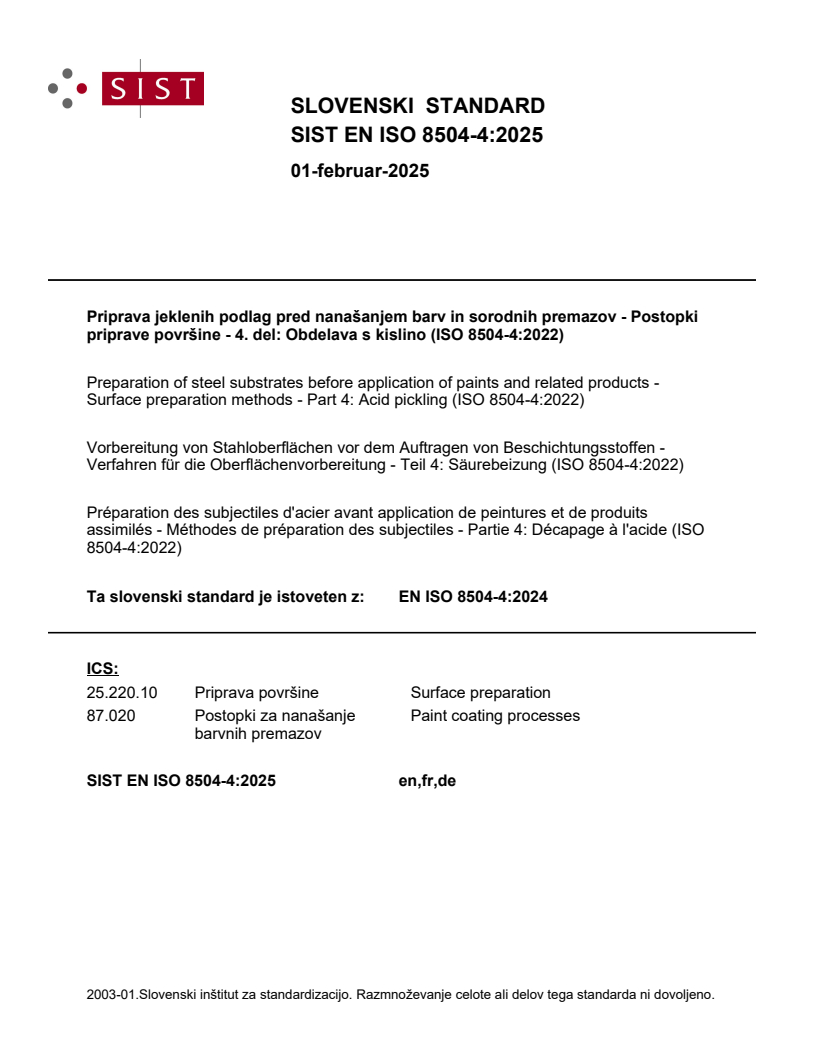
SLOVENSKI STANDARD
01-februar-2025
Priprava jeklenih podlag pred nanašanjem barv in sorodnih premazov - Postopki
priprave površine - 4. del: Obdelava s kislino (ISO 8504-4:2022)
Preparation of steel substrates before application of paints and related products -
Surface preparation methods - Part 4: Acid pickling (ISO 8504-4:2022)
Vorbereitung von Stahloberflächen vor dem Auftragen von Beschichtungsstoffen -
Verfahren für die Oberflächenvorbereitung - Teil 4: Säurebeizung (ISO 8504-4:2022)
Préparation des subjectiles d'acier avant application de peintures et de produits
assimilés - Méthodes de préparation des subjectiles - Partie 4: Décapage à l'acide (ISO
8504-4:2022)
Ta slovenski standard je istoveten z: EN ISO 8504-4:2024
ICS:
25.220.10 Priprava površine Surface preparation
87.020 Postopki za nanašanje Paint coating processes
barvnih premazov
2003-01.Slovenski inštitut za standardizacijo. Razmnoževanje celote ali delov tega standarda ni dovoljeno.
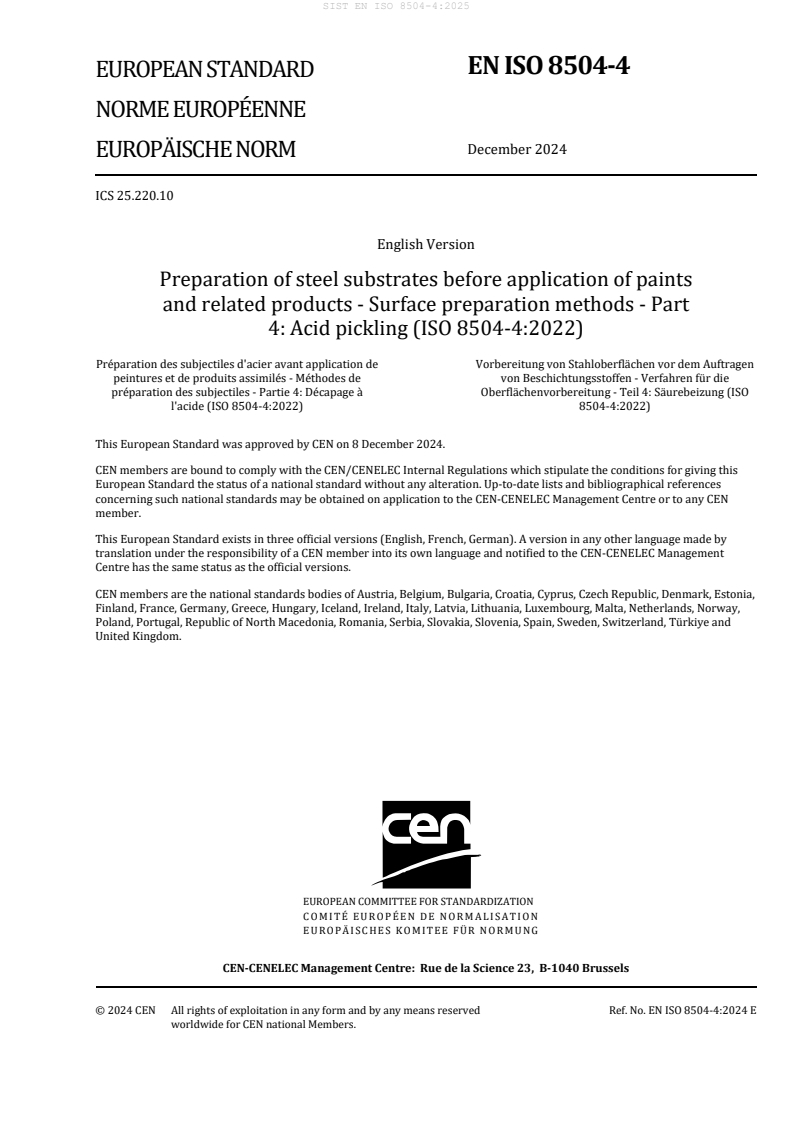
EN ISO 8504-4
EUROPEAN STANDARD
NORME EUROPÉENNE
December 2024
EUROPÄISCHE NORM
ICS 25.220.10
English Version
Preparation of steel substrates before application of paints
and related products - Surface preparation methods - Part
4: Acid pickling (ISO 8504-4:2022)
Préparation des subjectiles d'acier avant application de Vorbereitung von Stahloberflächen vor dem Auftragen
peintures et de produits assimilés - Méthodes de von Beschichtungsstoffen - Verfahren für die
préparation des subjectiles - Partie 4: Décapage à Oberflächenvorbereitung - Teil 4: Säurebeizung (ISO
l'acide (ISO 8504-4:2022) 8504-4:2022)
This European Standard was approved by CEN on 8 December 2024.
CEN members are bound to comply with the CEN/CENELEC Internal Regulations which stipulate the conditions for giving this
European Standard the status of a national standard without any alteration. Up-to-date lists and bibliographical references
concerning such national standards may be obtained on application to the CEN-CENELEC Management Centre or to any CEN
member.
This European Standard exists in three official versions (English, French, German). A version in any other language made by
translation under the responsibility of a CEN member into its own language and notified to the CEN-CENELEC Management
Centre has the same status as the official versions.
CEN members are the national standards bodies of Austria, Belgium, Bulgaria, Croatia, Cyprus, Czech Republic, Denmark, Estonia,
Finland, France, Germany, Greece, Hungary, Iceland, Ireland, Italy, Latvia, Lithuania, Luxembourg, Malta, Netherlands, Norway,
Poland, Portugal, Republic of North Macedonia, Romania, Serbia, Slovakia, Slovenia, Spain, Sweden, Switzerland, Türkiye and
United Kingdom.
EUROPEAN COMMITTEE FOR STANDARDIZATION
COMITÉ EUROPÉEN DE NORMALISATION
EUROPÄISCHES KOMITEE FÜR NORMUNG
CEN-CENELEC Management Centre: Rue de la Science 23, B-1040 Brussels
© 2024 CEN All rights of exploitation in any form and by any means reserved Ref. No. EN ISO 8504-4:2024 E
worldwide for CEN national Members.
Contents Page
European foreword . 3
European foreword
The text of ISO 8504-4:2022 has been prepared by Technical Committee ISO/TC 35 "Paints and
varnishes” of the International Organization for Standardization (ISO) and has been taken over as
which is held by DIN.
This European Standard shall be given the status of a national standard, either by publication of an
identical text or by endorsement, at the latest by June 2025, and conflicting national standards shall be
withdrawn at the latest by June 2025.
Attention is drawn to the possibility that some of the elements of this document may be the subject of
patent rights. CEN shall not be held responsible for identifying any or all such patent rights.
Any feedback and questions on this document should be directed to the users’ national standards body.
A complete listing of these bodies can be found on the CEN website.
According to the CEN-CENELEC Internal Regulations, the national standards organizations of the
following countries are bound to implement this European Standard: Austria, Belgium, Bulgaria,
Croatia, Cyprus, Czech Republic, Denmark, Estonia, Finland, France, Germany, Greece, Hungary, Iceland,
Ireland, Italy, Latvia, Lithuania, Luxembourg, Malta, Netherlands, Norway, Poland, Portugal, Republic of
North Macedonia, Romania, Serbia, Slovakia, Slovenia, Spain, Sweden, Switzerland, Türkiye and the
United Kingdom.
Endorsement notice
The text of ISO 8504-4:2022 has been approved by CEN as EN ISO 8504-4:2024 without any
modification.
INTERNATIONAL ISO
STANDARD 8504-4
First edition
2022-08
Preparation of steel substrates before
application of paints and related
products — Surface preparation
methods —
Part 4:
Acid pickling
Préparation des subjectiles d'acier avant application de peintures et
de produits assimilés — Méthodes de préparation des subjectiles —
Partie 4: Décapage à l'acide
Reference number
ISO 8504-4:2022(E)
ISO 8504-4:2022(E)
© ISO 2022
All rights reserved. Unless otherwise specified, or required in the context of its implementation, no part of this publication may
be reproduced or utilized otherwise in any form or by any means, electronic or mechanical, including photocopying, or posting on
the internet or an intranet, without prior written permission. Permission can be requested from either ISO at the address below
or ISO’s member body in the country of the requester.
ISO copyright office
CP 401 • Ch. de Blandonnet 8
CH-1214 Vernier, Geneva
Phone: +41 22 749 01 11
Email: copyright@iso.org
Website: www.iso.org
Published in Switzerland
ii
ISO 8504-4:2022(E)
Contents Page
Foreword .iv
Introduction .v
1 S c op e . 1
2 Nor m at i ve r ef er enc e s . 1
3 Terms and definitions . 1
4 G ener a l . 2
4.1 P ickling liquid . 2
4.1.1 Requirements to the chemical materials . 2
4.1.2 Requirements to the formulation and process conditions of a pickling liquid . 2
4.1.3 Example of formulation and process conditions of a pickling liquid . 2
4.2 General requirements . 2
4.2.1 R equirements to the bath equipment materials . 2
4.2.2 R equirements to the bath analysis . 2
4.3 H ealth and safety . . 2
5 M ethod of acid pickling . 3
5.1 P rocedure for acid pickling . 3
5 . 2 P r ep a r at ion . 3
5 . 3 D e g r e a s i ng. 3
5.3.1 Components and conditions . 3
5 . 3 . 2 I m mer s ion me t ho d . 4
5 . 3 . 3 P a r t pl ac ement . 4
5 . 3 .4 I m mer s ion t i me . 4
5 . 3 . 5 P r o c e s s t emp er at u r e . 4
5.4 F resh water rinsing and/or washing . 4
5.4.1 F resh water rinsing process. 4
5.4.2 R insing water temperature . 4
5.4.3 Fresh water washing process . 4
5 . 5 P ic k l in g . 4
5.5.1 I mmersion requirement . . . 4
5 . 5 . 2 P a r t placement . 4
5 . 5 . 3 I m mer s ion t i me . 4
5 . 5 .4 P r o c e s s t emp er at u r e . 4
5 . 6 Po s t t r e at ment . 5
5.6.1 C onversion layer . 5
5 . 6 . 2 Su r f ac e neut r a l i z at ion . 5
5.6.3 Improvement of the phosphate layer . 5
5.6.4 Q uality check and assurance . 5
5.6.5 Drying . 5
6 A ssessment of cleaned surface . 5
Annex A (informative) Formulation and condition of common process liquids .6
Bibliography . 8
iii
ISO 8504-4:2022(E)
Foreword
ISO (the International Organization for Standardization) is a worldwide federation of national standards
bodies (ISO member bodies). The work of preparing International Standards is normally carried out
through ISO technical committees. Each member body interested in a subject for which a technical
committee has been established has the right to be represented on that committee. International
organizations, governmental and non-governmental, in liaison with ISO, also take part in the work.
ISO collaborates closely with the International Electrotechnical Commission (IEC) on all matters of
electrotechnical standardization.
The procedures used to develop this document and those intended for its further maintenance are
described in the ISO/IEC Directives, Part 1. In particular, the different approval criteria needed for the
different types of ISO documents should be noted. This document was drafted in accordance with the
editorial rules of the ISO/IEC Directives, Part 2 (see www.iso.org/directives).
Attention is drawn to the possibility that some of the elements of this document may be the subject of
patent rights. ISO shall not be held responsible for identifying any or all such patent rights. Details of
any patent rights identified during the development of the document will be in the Introduction and/or
on the ISO list of patent declarations received (see www.iso.org/patents).
Any trade name used in this document is information given for the convenience of users and does not
constitute an endorsement.
For an explan
...