


oSIST prEN 4726:2026
(Main)Aerospace series - Aesthetical acceptance parameters for cabin equipment
Aerospace series - Aesthetical acceptance parameters for cabin equipment
This document specifies the inspection rules and the cosmetic acceptance criteria for surfaces of aircraft cabin equipment. Surfaces are considered under the aspects of technical feasibility of the industrial design.
This document outlines the framework between customers, suppliers or manufacturers and OEMs with regard to cosmetic issues.
This document aims to:
a) provide the supplier or manufacturer with quality criteria to be met during the production-, testing- and quality-inspection-process;
b) guide customer, OEM and supplier or manufacturer quality assurance with a description of cosmetic standards for the following inspections:
— supplier or manufacturer internal QA inspection;
— first article inspection;
— source inspection;
— incoming inspection;
— final assembly line, cabin inspection;
— customer presentation.
Luft- und Raumfahrt - Ästhetische Abnahmeparameter für Kabinenausrüstung
Dieses Dokument legt die Regeln für die Prüfung und die kosmetischen Abnahmekriterien für Oberflächen von Ausrüstungsteilen in der Flugzeugkabine fest. Die Oberflächen werden in Bezug auf die technische Umsetzbarkeit des industriellen Designs betrachtet.
Dieses Dokument umreißt den von den Kunden, Lieferanten oder Herstellern und Erstausrüstern (OEM, en: original equipment manufacturer) in Bezug auf kosmetische Aspekte anzuwendenden Rahmen.
Dieses Dokument ist für Folgendes vorgesehen:
a) Bereitstellung von Qualitätskriterien für den Lieferanten oder Hersteller, die bei Herstellung, Prüfung und Qualitätsprüfung einzuhalten sind;
b) Bereitstellung von Leitlinien bezüglich der Qualitätssicherung durch Kunden, OEM und Lieferanten oder Hersteller auf der Grundlage von Normen zu kosmetischen Aspekten in Bezug auf folgende Prüfungen:
interne Qualitätssicherungsprüfung des Lieferanten oder Herstellers;
Erstmusterprüfung;
nachfolgende Musterprüfung;
Eingangsprüfung;
Prüfung der Kabine an der Endmontagelinie;
Kundenpräsentation.
Série aérospatiale - Paramètres esthétiques d’acceptation des équipements de cabine
Le présent document spécifie les règles de contrôle et les critères d'acceptation esthétique des surfaces des équipements de cabine d'aéronef. Les surfaces y seront examinées en prenant en compte les aspects de faisabilité technique de la conception industrielle.
Le présent document décrit le cadre de référence entre les clients, les fournisseurs ou fabricants et les OEM en ce qui concerne les questions d'esthétisme.
Le présent document vise à :
a) donner au fournisseur ou au fabricant des critères de qualité, qui doivent être respectés pendant le processus de production, d'essai et de contrôle qualité ;
b) orienter l'assurance qualité des clients, OEM et fournisseurs ou fabricants grâce à une description des normes d'esthétisme pour les contrôles suivants :
— contrôle d'assurance qualité interne du fournisseur ou fabricant ;
— revue premier article ;
— contrôle à la source ;
— contrôle d'entrée ;
— contrôle de la cabine sur la chaîne de montage final ;
— présentation au client.
Aeronavtika - Estetska prevzemna merila za opremo kabine
Ta dokument določa pravila pregleda in merila za kozmetično sprejemljivost površin opreme letalske kabine. Površine se obravnavajo z vidika tehnične izvedljivosti industrijskega oblikovanja.
Ta dokument opredeljuje okvir med strankami, dobavitelji ali proizvajalci in OEM-ji glede kozmetičnih vprašanj.
Ta dokument si prizadeva:
a) zagotoviti dobavitelju ali proizvajalcu kakovostna merila, ki jih je treba izpolniti med proizvodnim, preskusnim in kakovostno-inšpekcijskim postopkom;
b) usmerjati zagotavljanje kakovosti stranke, OEM-ja in dobavitelja ali proizvajalca z opisom kozmetičnih standardov za naslednje preglede:
- notranji pregled zagotavljanja kakovosti dobavitelja ali proizvajalca;
- pregled prvega izdelka;
- pregled na izvoru;
- vhodni pregled;
- končna montažna linija, pregled kabine;
- predstavitev stranki.
General Information
- Status
- Not Published
- Public Enquiry End Date
- 24-May-2026
- Technical Committee
- I13 - Imaginarni 13
- Current Stage
- 4020 - Public enquire (PE) (Adopted Project)
- Start Date
- 23-Mar-2026
- Due Date
- 10-Aug-2026
- Completion Date
- 27-May-2026

Relations
- Effective Date
- 16-Jul-2025
Overview
oSIST prEN 4726:2026: Aerospace series - Aesthetical acceptance parameters for cabin equipment is a draft European Standard developed by the European Committee for Standardization (CEN), focusing on setting cosmetic inspection rules and acceptance criteria for aircraft cabin equipment. This standard is critical in defining a common framework between customers, suppliers, manufacturers, and OEMs for managing, evaluating, and agreeing on cosmetic quality parameters in the aerospace industry. The standard ensures that cabin equipment surfaces meet both technical feasibility and industrial design requirements, contributing to a consistent passenger experience and streamlined supplier quality assurance processes.
Key Topics
- Inspection Rules for Cabin Equipment Surfaces: Establishes criteria for assessing the cosmetics of surfaces, including visible defects, alignment, gloss, and texture.
- Zones of Inspection: Classifies cabin equipment surfaces into three zones (A, B, and C) based on how and by whom different surfaces are viewed, ranging from those in constant passenger view to those only accessible by support staff.
- Quality Criteria for Production and Inspection: Provides clear guidelines for quality checks during production, internal QA, first article inspection, source inspection, incoming inspection, assembly line checks, and customer presentation.
- Master Sample Process: Requires that agreed reference samples be used to benchmark cosmetic quality across production and supply chains.
- Documentation and Change Management: Outlines protocols for documentation, handling exceptions, and implementing changes (RFC/SCN) regarding classification of surfaces and acceptance standards.
- Handling of Defects: Defines unacceptable cosmetic characteristics and provides detailed tables and templates for defect assessment and size evaluation.
- Decorative Materials and Finishes: Includes requirements for decorative split lines, pattern alignment, stitching, sealing, and metallized finishes.
- Environmental Considerations: Addresses suitable light and viewing conditions for inspections, covering both interior and exterior aircraft environments.
- Material Types: Covers specific requirements for non-textile flooring (NTF), paints, varnishes, and decorative sheet materials.
Applications
The practical value of oSIST prEN 4726:2026 is substantial for the aerospace industry. It is used to:
- Align Stakeholders: Enables clear communication and agreement on cabin cosmetic standards between airlines, OEMs, suppliers, manufacturers, and customers.
- Support Compliance and Quality Assurance: Helps organizations meet regulatory and branding requirements for cabin aesthetics, critical during new product launches and cabin refurbishments.
- Guide Inspections: Provides structured inspection processes for various quality inspection stages (internal, incoming, assembly, and customer-facing).
- Enhance Passenger Experience: Ensures high aesthetic standards for all visible and functionally important cabin surfaces, directly impacting passenger perception and airline brand reputation.
- Reduce Disputes: Clearly mapped zones, defect definitions, and acceptance criteria reduce miscommunication and disputes, supporting efficient issue resolution.
Related Standards
For a comprehensive approach, oSIST prEN 4726:2026 references and is complemented by the following standards:
- EN 12464-1: Light and lighting – Lighting of work places – Part 1: Indoor work places. Defines lighting conditions for accurate visual inspection.
- EN ISO 2813: Paints and varnishes - Determination of gloss value. Establishes consistent evaluation of surface gloss.
- Additional CEN and ISO Standards: Detailing materials, upholstery, and finishing processes used in aircraft interiors.
Conclusion
Adoption of oSIST prEN 4726:2026 helps the aerospace industry ensure robust, harmonized cosmetic quality for cabin equipment, streamlining relationships between manufacturers and customers. With comprehensive criteria for inspection, defect identification, materials, and detailed documentation, it supports both product integrity and passenger satisfaction, key attributes in a competitive global market for cabin interiors.
Get Certified
Connect with accredited certification bodies for this standard

BUREAU VERITAS Certification Germany
Bureau Veritas certification in Germany.

Element Materials Technology
Materials testing and product certification.

AQMS Ltd.
AQMS provides ISO certification to SMEs across the UK.
Sponsored listings
Frequently Asked Questions
oSIST prEN 4726:2026 is a draft published by the Slovenian Institute for Standardization (SIST). Its full title is "Aerospace series - Aesthetical acceptance parameters for cabin equipment". This standard covers: This document specifies the inspection rules and the cosmetic acceptance criteria for surfaces of aircraft cabin equipment. Surfaces are considered under the aspects of technical feasibility of the industrial design. This document outlines the framework between customers, suppliers or manufacturers and OEMs with regard to cosmetic issues. This document aims to: a) provide the supplier or manufacturer with quality criteria to be met during the production-, testing- and quality-inspection-process; b) guide customer, OEM and supplier or manufacturer quality assurance with a description of cosmetic standards for the following inspections: — supplier or manufacturer internal QA inspection; — first article inspection; — source inspection; — incoming inspection; — final assembly line, cabin inspection; — customer presentation.
This document specifies the inspection rules and the cosmetic acceptance criteria for surfaces of aircraft cabin equipment. Surfaces are considered under the aspects of technical feasibility of the industrial design. This document outlines the framework between customers, suppliers or manufacturers and OEMs with regard to cosmetic issues. This document aims to: a) provide the supplier or manufacturer with quality criteria to be met during the production-, testing- and quality-inspection-process; b) guide customer, OEM and supplier or manufacturer quality assurance with a description of cosmetic standards for the following inspections: — supplier or manufacturer internal QA inspection; — first article inspection; — source inspection; — incoming inspection; — final assembly line, cabin inspection; — customer presentation.
oSIST prEN 4726:2026 is classified under the following ICS (International Classification for Standards) categories: 49.095 - Passenger and cabin equipment. The ICS classification helps identify the subject area and facilitates finding related standards.
oSIST prEN 4726:2026 has the following relationships with other standards: It is inter standard links to SIST EN 4726:2019+AC:2019. Understanding these relationships helps ensure you are using the most current and applicable version of the standard.
oSIST prEN 4726:2026 is available in PDF format for immediate download after purchase. The document can be added to your cart and obtained through the secure checkout process. Digital delivery ensures instant access to the complete standard document.
Standards Content (Sample)
SLOVENSKI STANDARD
01-maj-2026
Aeronavtika - Estetska prevzemna merila za opremo kabine
Aerospace series - Aesthetical acceptance parameters for cabin equipment
Luft- und Raumfahrt - Ästhetische Abnahmeparameter für Kabinenausrüstung
Série aérospatiale - Paramètres esthétiques d’acceptation des équipements de cabine
Ta slovenski standard je istoveten z: prEN 4726
ICS:
49.095 Oprema za potnike in Passenger and cabin
oprema kabin equipment
2003-01.Slovenski inštitut za standardizacijo. Razmnoževanje celote ali delov tega standarda ni dovoljeno.
DRAFT
EUROPEAN STANDARD
NORME EUROPÉENNE
EUROPÄISCHE NORM
March 2026
ICS 49.095 Will supersede EN 4726:2018+AC:2019
English Version
Aerospace series - Aesthetical acceptance parameters for
cabin equipment
Série aérospatiale - Paramètres esthétiques Luft- und Raumfahrt - Ästhetische Abnahmeparameter
d'acceptation des équipements de cabine für Kabinenausrüstung
This draft European Standard is submitted to CEN members for enquiry. It has been drawn up by the Technical Committee ASD-
STAN.
If this draft becomes a European Standard, CEN members are bound to comply with the CEN/CENELEC Internal Regulations
which stipulate the conditions for giving this European Standard the status of a national standard without any alteration.
This draft European Standard was established by CEN in three official versions (English, French, German). A version in any other
language made by translation under the responsibility of a CEN member into its own language and notified to the CEN-CENELEC
Management Centre has the same status as the official versions.
CEN members are the national standards bodies of Austria, Belgium, Bulgaria, Croatia, Cyprus, Czech Republic, Denmark, Estonia,
Finland, France, Germany, Greece, Hungary, Iceland, Ireland, Italy, Latvia, Lithuania, Luxembourg, Malta, Netherlands, Norway,
Poland, Portugal, Republic of North Macedonia, Romania, Serbia, Slovakia, Slovenia, Spain, Sweden, Switzerland, Türkiye and
United Kingdom.
Recipients of this draft are invited to submit, with their comments, notification of any relevant patent rights of which they are
aware and to provide supporting documentation.
Warning : This document is not a European Standard. It is distributed for review and comments. It is subject to change without
notice and shall not be referred to as a European Standard.
EUROPEAN COMMITTEE FOR STANDARDIZATION
COMITÉ EUROPÉEN DE NORMALISATION
EUROPÄISCHES KOMITEE FÜR NORMUNG
CEN-CENELEC Management Centre: Rue de la Science 23, B-1040 Brussels
© 2026 CEN All rights of exploitation in any form and by any means reserved Ref. No. prEN 4726:2026 E
worldwide for CEN national Members.
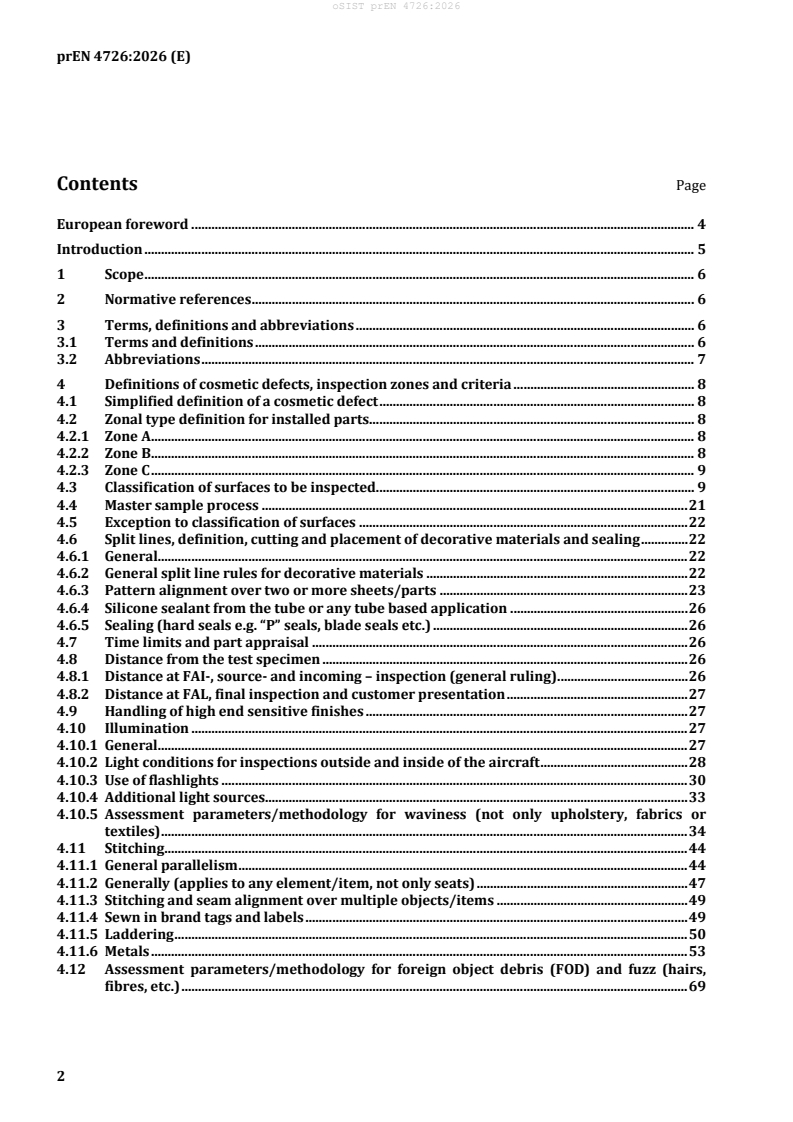
Contents Page
European foreword . 4
Introduction . 5
1 Scope . 6
2 Normative references . 6
3 Terms, definitions and abbreviations . 6
3.1 Terms and definitions . 6
3.2 Abbreviations . 7
4 Definitions of cosmetic defects, inspection zones and criteria . 8
4.1 Simplified definition of a cosmetic defect . 8
4.2 Zonal type definition for installed parts . 8
4.2.1 Zone A . 8
4.2.2 Zone B . 8
4.2.3 Zone C . 9
4.3 Classification of surfaces to be inspected. 9
4.4 Master sample process . 21
4.5 Exception to classification of surfaces . 22
4.6 Split lines, definition, cutting and placement of decorative materials and sealing . 22
4.6.1 General. 22
4.6.2 General split line rules for decorative materials . 22
4.6.3 Pattern alignment over two or more sheets/parts . 23
4.6.4 Silicone sealant from the tube or any tube based application . 26
4.6.5 Sealing (hard seals e.g. “P” seals, blade seals etc.) . 26
4.7 Time limits and part appraisal . 26
4.8 Distance from the test specimen . 26
4.8.1 Distance at FAI-, source- and incoming – inspection (general ruling) . 26
4.8.2 Distance at FAL, final inspection and customer presentation . 27
4.9 Handling of high end sensitive finishes . 27
4.10 Illumination . 27
4.10.1 General. 27
4.10.2 Light conditions for inspections outside and inside of the aircraft . 28
4.10.3 Use of flashlights . 30
4.10.4 Additional light sources. 33
4.10.5 Assessment parameters/methodology for waviness (not only upholstery, fabrics or
textiles) . 34
4.11 Stitching . 44
4.11.1 General parallelism . 44
4.11.2 Generally (applies to any element/item, not only seats) . 47
4.11.3 Stitching and seam alignment over multiple objects/items . 49
4.11.4 Sewn in brand tags and labels . 49
4.11.5 Laddering . 50
4.11.6 Metals . 53
4.12 Assessment parameters/methodology for foreign object debris (FOD) and fuzz (hairs,
fibres, etc.) . 69
4.13 Acceptance criteria for assembled parts: symmetry of multiple objects/shapes/elements
(or the misalignment of gaps, steps, parallelism). 72
4.13.1 General . 72
4.13.2 Misalignment . 72
4.13.3 Non-conformities perceived as an aesthetical misalignment defect . 77
4.13.4 Application example . 78
4.13.5 Surfaces . 80
4.14 Non-textile floor (NTF) . 83
4.14.1 Non-textile floor as seller furnished equipment from an OEM perspective . 83
4.14.2 Non-textile floor as buyer furnished equipment from an OEM perspective . 83
4.14.3 Definitions . 84
4.14.4 Inspection parameters — Specifically for NTF . 87
5 Unacceptable characteristics . 88
6 Evaluation tables and defect size assessment . 119
6.1 General . 119
6.2 Evaluation tables for defects on parts . 119
6.3 Evaluation tables and defect size assessment for NFT only . 120
7 Inspection template to ascertain defect sizes . 121
Bibliography . 123
European foreword
This document (prEN 4726:2026) has been prepared by ASD-STAN.
After enquiries and votes carried out in accordance with the rules of this Association, this document has
received the approval of the National Associations and the Official Services of the member countries of
ASD-STAN, prior to its presentation to CEN.
This document is currently submitted to the CEN Enquiry.
This document will supersede EN 4726:2018+AC:2019.
This document includes the following significant technical changes with respect to
EN 4726:2018+AC:2019:
— new title;
— addition on light conditions for inspections outside and inside of the aircraft;
— new assessment parameters/methodology for waviness (not only upholstery, fabrics or textiles);
— addition of requirements on stitching;
— addition of requirements on metals;
— new assessment parameters/methodology for foreign object debris and fuzz;
— new acceptance criteria for assembled parts: symmetry of multiple objects, shapes, elements (or the
misalignment of gaps, steps, parallelism);
— addition of bubbles, air pockets as example of cosmetic defects in Table 1;
— updated inspection template to ascertain defect sizes.
Introduction
In this document, the following verbal forms are used:
— “shall” indicates a requirement;
— “should” indicates a recommendation;
— “may” indicates a permission;
— “can” indicates a possibility or a capability.
1 Scope
This document specifies the inspection rules and the cosmetic acceptance criteria for surfaces of aircraft
cabin equipment. Surfaces are considered under the aspects of technical feasibility of the industrial
design.
This document outlines the framework between customers, suppliers or manufacturers and OEMs with
regard to cosmetic issues.
This document aims to:
a) provide the supplier or manufacturer with quality criteria to be met during the production-, testing-
and quality-inspection-process;
b) guide customer, OEM and supplier or manufacturer quality assurance with a description of cosmetic
standards for the following inspections:
— supplier or manufacturer internal QA inspection;
— first article inspection;
— source inspection;
— incoming inspection;
— final assembly line, cabin inspection;
— customer presentation.
2 Normative references
The following documents are referred to in the text in such a way that some or all of their content
constitutes requirements of this document. For dated references, only the edition cited applies. For
undated references, the latest edition of the referenced document (including any amendments) applies.
EN 12464-1, Light and lighting — Lighting of work places — Part 1: Indoor work places
EN ISO 2813, Paints and varnishes — Determination of gloss value at 20°, 60° and 85° (ISO 2813)
3 Terms, definitions and abbreviations
3.1 Terms and definitions
No terms and definitions are listed in this document.
ISO and IEC maintain terminology databases for use in standardization at the following addresses:
— ISO Online browsing platform: available at https://www.iso.org/obp/
— IEC Electropedia: available at https://www.electropedia.org/
3.2 Abbreviations
For the purposes of this document, the following abbreviations apply.
3D three dimensional
BFE buyer furnished equipment (from OEM perspective)
CAS cabin attendant seat
CDR critical design review
CIE International Commission on Illumination
DPI dots per inch
DSM decorative sheet material
e.g. for example
etc. and so on
FAI first article inspection
FAL final assembly line (OEM)
FFF fit, form and function
FOD foreign object debris
HTPT hydro transfer printing technology
i.e. that is to say
ICS industrial design colour specification (OEM)
incl. including
LED light emitting diode
LHS left hand side
NTF non-textile floor
OEM original equipment manufacturer
PTS purchaser technical specification
PVF polyvinyl fluoride film
RFC request for change
RHS right hand side
QC quality control
SCN specific change note
SFE seller furnished equipment (from OEM perspective)
SSBFE seller supplied BFE
SU standard unit
UV ultraviolet
4 Definitions of cosmetic defects, inspection zones and criteria
4.1 Simplified definition of a cosmetic defect
Cosmetic defects are deviations from the standard or customized specifications/definitions. They are
distinct from a certain distance without additional illumination and/or mirror and according to the
definitions thereof within this document. Cosmetic defects do not affect fit-form-function as a rule,
however in certain extreme cases this might actually be the case e.g. if paint build up impedes fitting.
The defects listed encompass any process relevant material.
Seller furnished equipment (SFE) or similar status: The supplier or manufacturer shall not to approach
the customer concerning cosmetic issues or definition changes.
Buyer furnished equipment (BFE)/seller supplied BFE (SSBFE) or similar status: Pickups or points of
contention raised by OEM which are disputed between both parties (OEM and supplier or
manufacturer) shall be submitted to the customer to make the definitive and binding decision for all
parties. Any decision shall be documented by the supplier or manufacturer and accompany each
individual unit in a conspicuous legible way without causing damage to the part/parts in question. All
parties shall adhere to the customer decision until as such times another supersedes it.
For SFE, SSBFE and BFE all samples shall be supplied by the supplier or manufacturer and/or the
customer to the OEM in order to validate the inspection.
4.2 Zonal type definition for installed parts
4.2.1 Zone A
Zone A is specified as all primary viewed surfaces by a potential passenger or crew either walking
through the aircraft or in any normal seating position or passenger/crew used furniture, e.g. table
top/backs. Zone A is specified as any surface which is directly seen, through either expected operation
or expected viewing movement, see Figure 1.
a) Passenger and crew b) Passenger and crew c) Passenger and crew
member seating, top view member seating, side view member walking
NOTE The viewing cone would move according to the head movements up/down and left/right.
Figure 1 — Passenger’s viewing cone when seating in any position or walking through the cabin
4.2.2 Zone B
Zone B is specified as secondary perceived surfaces – surfaces requiring extreme movement of the
viewing angle to be perceived, i.e. the viewer shall abnormally bend to be able to see it. Areas which can
be perceived by passengers or crew through normal operation e.g. stowages inside and stowage doors
inside. Standard stowage interiors are appraised from the stowage door threshold, not by climbing or
poking the head inside.
Purposely designed “walk in” monuments shall be entered and appraised in the standard method from
within i.e. interior walls are Zone A, etc.
4.2.3 Zone C
Zone C is specified as surfaces that require – first “opening up”, e.g. folding, moving or removal of
primary or secondarily viewed areas, in order to view the area in question e.g. inside a lavatory mirror
cabinet. Zone C can only be viewed using equipment. Areas which can be perceived by support staff and
not passengers are specified as Zone C. Areas not visible after installation and that have no defined
aesthetical surface treatment are still within the parameters of Zone C; however still maintaining other
requirements e.g. closed edges, fit, form and function. Sizes/dimensions of areas/surfaces eligible shall
be demonstrated in the technical documentation and require the OEM acceptance.
4.3 Classification of surfaces to be inspected
The surfaces that shall be inspected are classified into three zones (A, B, C).
Customers and suppliers or manufacturers shall document areas of exceptions at the initial technical
coordination meeting and in exceptional cases it shall be documented at the critical design review
(CDR). All other surfaces are specified according to the zonal prerequisites unless otherwise agreed.
For BFE additionally (or similar status): The customer shall clearly document and inform the OEM and
supplier or manufacturer of his expectations regarding classification of surfaces.
Figure 2 shows typical areas for the zones, which are applied cross programme i.e. irrelevant of
passenger aircraft model.
Cockpit areas (incl. freighters) are considered outside of this document and shall be specified on
demand between OEM, supplier or manufacturer and customer. The exception to this, is furniture, e.g.
lavatories or crew rest that share common walls with the cabin.
Freighters, currier or crew perceived or frequented areas i.e. cabin linings/furniture are Zone A, cargo
areas are considered outside this classification and shall be defined on demand between OEM, supplier
or manufacturer and customer.
Key
1 Outboard side of a window shade is Zone C. Inboard is Zone A
2 Side wall stowage lid shown open to view lid inside
3 Window funnel interior is Zone A
Zone A
Zone B
Zone C
NOTE 1 Endcaps on over head stowage compartment is not shown.
NOTE 2 LHS lining is a mirror of the RHS.
NOTE 3 Linings- outboard surfaces are generally Zone C.
NOTE 4 Linings- inboard surfaces are generally Zone A.
Figure 2 — Cabin lining
The Figures 3 to 14 show typical areas for the zones which are applied cross program, i.e. irrelevant of
passenger aircraft model or monument type.
Interior parts of monuments which the cabin crew or passenger potentially frequent, perceive or view,
e.g. lavatories, crew rest, special monuments, are equally governed by the same zone classifications as
for the outside of SFE (or similar status) monuments.
Areas covered by other components or monuments are considered as Zone C unless, see 4.5.
Supplied used BFE units, e.g. trolleys or standard units, shall not be part of an inspection concerning
aesthetical deviations, only new and SFE are eligible. Zonal areas are dedicated to the parts in questions
according to the expected operational status, i.e. with full compliment of inserts, trollies, standard units,
etc.
a) Typical monument with magazine rack and b) Typical monument without additional
doghouse furnishings
Key
Zone A
Zone C
Figure 3 — Cabin monument
a) Galley overview
b) Fixed parts e.g. c) Fixed parts e.g. d) SFE trolley: outside e) Removable parts
ovens, coffee makers, ovens, coffee makers, Zone A, door inside, e.g. SU: First 10 cm
boilers; no side boilers; sides visible: interior: Zone B, (4 in) of sides are
visible: Zone C Surrounding gap interior shelves, etc.: Zone A, thereafter
makes sides visible Zone B, underneath: Zone C
then first 10 cm (4 in) Zone C, tyres factory
of sides are Zone A new
thereafter Zone C
Key
1 Walls for fixed parts e.g. ovens, boilers: Zone C unless gap makes sides visible then first 10 cm (4 in):
Zone A
2 Walls for removable parts e.g. SU first 10 cm (4 in) is Zone A thereafter Zone C
3 Stowage inside: Zone B incl. door inside trolley doors inside
4 Underneath is Zone C
5 Underneath is Zone B, because it cannot be directly viewed; if higher this will become a Zone A
Zone A
Zone B
Zone C
Figure 4 — Galley
Figure 5 shows a typical economy seat. Zones can change with position. Figure 5 shows an example in
order to demonstrate the applied theory.
Key
1 Rear sides: if free standing or has any kind of seating behind: Zone A. If last row and screened off by a
wall: Zone B
2 Underneath head cloths (if present): due to the fact, they are not permanent and can be removed:
Zone A
3 Aisle sides: if aisle side: Zone A. If window side: Zone B (or next to a structure which screens off viewing
the side in question)
4 Underneath armrest: if movable: Zone A, if fixed: Zone B
5 Tables and mechanisms (incl. hidden in armrest): top and bottom i.e. all sides (incl. IFE if present):
Zone A
6 Underneath seat: if “with footrest” movable or fixed: Zone B. Top of footrest and mechanism when
deployed: Zone A. Non visible sides when deployed: Zone B
Zone A
NOTE 1 Passenger/crew used furniture directly viewed in open operating position:
compartments inside: Zone B;
(assuming surfaces mainly hidden by supplied amenities), areas of compartments which can be directly
viewed when open and seated: Zone A.
NOTE 2 Lids/flaps inside/outside: Zone A.
Figure 5 — Economy passenger seat
Figure 6 shows a typical business class seat. Zones can change with position. Figure 6 shows an example
in order to demonstrate the applied theory.
Key
1 Stowages insides: Zone B
2 Rear walls, if free standing: Zone A; if rear side very close to a wall (i.e. masked by wall): Zone B
3 Aisle walls, if aisle side: Zone A; if window side: Zone B
4 Underneath, if “footrest” returns down and backwards: Zone B; if “footrest” returns up and backwards:
Zone A; if “footrest” cannot be viewed incl. during operational movement: Zone C
5 Reade side: Zone A
6 Stowage insides: Zone B
7 Tables top and bottom: Zone A
8 LCD monitor: Zone A
Zone A
Zone B
Figure 6 — Business class passenger seat
Figures 7 to 12 show a typical First class seat. Zones can change with position. Figures 7 to 12 show an
example in order to demonstrate the applied theory.
Key
1 Hidden sides: not able to be viewed are Zone B
2 Inside open cupboards: could be a Zone B on the “shadow side only” according to the direct viewing
rules, (assuming this side is not visible when entering the compartment), otherwise Zone A
3 Moving furniture parts: if, when operating the table, all sides are revealed, then all Zone A (underside
Zone B, only if never viewable)
4 Recessed areas: only ones not naturally visible are Zone B
Zone A
Zone B
Zone C
Figure 7 — Typical first class minisuite – inside, front view (looking forward)
Key
1 Blocked off areas: Zone C
2 Stowages inside: Zone B, incl. door inside
3 Undersides: Zone B, unless they can be viewed from other natural positions e.g. sleep, then Zone A
4 Covered areas: Zone C, areas hidden e.g. by the seat, but run into a Zone A at the top. In cases of
contention, the highest quality is default. To establish zonal transitions/boundaries, all
permutations of natural/possible usage viewing angles are vectored in
5 Recessed areas: only ones not naturally visible are Zone B. If visible when entering minisuite then
Zone A
6 Blocked off areas: Zone C
Zone A
Zone B
Zone C
Figure 8 — Typical first class credenza, side view (looking forward)
Key
1 Passenger seat used furniture directly viewed in open or operating position: compartments inside:
Zone B (assuming surfaces mainly hidden by supplied amenities), areas of compartment which can
be directly viewed when open and seated: Zone A
2 Lids/flaps inside/outside: Zone A
3 Tops: Zone A (unless so high it cannot be viewed from a standing position i.e. over 1,90 m (74,8 in))
Zone A
Zone B
Figure 9 — Typical first class minisuite with table deployed and doors open, plan view
(looking from top)
Key
1 Plastic screens: Zone A (unless otherwise pre-agreed due to manufacturing tolerances)
Areas behind moving parts: Zone C, incl. door inside areas, as long as they are never visible
(rest: Zone A)
Zone A
Zone C
Figure 10 — Typical first class minisuite – outside, doors shown closed, side view
(looking outboard)
Key
1 Blocked off areas: Zone C
2 Parts close to each other: Zone A (where clearly visible)
3 Shadowed parts: Zone B which will transition to a Zone A e.g. the seat and wall are relatively close, the
bottom of these parts are in shadow and cannot be clearly perceived. In case of contention, the
highest quality is default (to establish zonal transitions/boundaries – all permutations of
natural/possible usage viewing angles are vectored in)
Zone A
Zone B
Zone C
Figure 11 — Typical first class minisuite – inside, doors shown closed, side view
(looking inboard)
Key
1 Covered area (this side only): Zone C
2 Underneath: Zone B
Zone A
Zone B
Figure 12 — Typical first class minisuite seat
Figure 13 shows a typical cabin attendant seat. Zones can change with position. Figure 13 shows an
example in order to demonstrate the applied theory.
Figure 13 shows typical areas for the zonal classification. Areas/parts allowing functional manual or
driven movement; thereby becoming fully visible to the passenger or cabin crew are classed as Zones A.
In some cases, the installation position is paramount, facets covered up of wall flush items can have an
upgraded classification if free standing.
Key
1 Only if flush to a wall: Zone B behind headrest, back of seat
2 Zone A, under seat pan shroud, underneath of footrest
Zone A
Zone B
Figure 13 — Cabin attendant seat
Figure 14 shows a doghouse, which depends on position in aircraft. Zones can change with position.
Figure 14 shows an example in order to demonstrate the applied theory.
Key
1 Corpus outside: Zone A; if masked by wall, seat, etc. visible area: Zone B, any areas completely not
visible: Zone C
2 Corpus inside: Zone B; if part of inside not visible by normal operation: Zone C
3 Drawer and door inside: Zone B
4 Door outside: Zone A
5 Drawer bottom: Zone C
6 Corpus bottom inside: Zone C
7 Corpus bottom: Zone C
8 Backside if outboard lateral side: Zone B; if free standing: Zone A
Zone A
Zone B
Zone C
Figure 14 — Example of doghouse
4.4 Master sample process
Master samples shall reach an acceptance status at the OEM before closure of the relevant critical
design review to be able to secure production quality. Iteration loops during master sample
development shall be considered. Once a master sample has been commonly agreed upon and accepted
by the OEM by signature, the supplier or manufacturer shall ensure their supply chain on their own
with the commonly agreed master samples.
The supplier or manufacturer shall ensure the surface finish quality by themselves according to the
OEM accepted master sample even if e.g. their supply chain changes. The quantity of samples that shall
be provided shall be agreed between OEM and supplier or manufacturer. The OEM may raise a request
for additional master samples in order to be able to secure delivery quality consistency. The requisition
shall be defined in a case by case manner.
Master samples as defined shall be used for all visible surface finish material. Samples submitted to the
OEM shall fulfill the following requirements. Master samples shall:
a) reflect the intended production quality;
b) represent the collective aesthetical properties (e.g. colour, texture, gloss);
c) be large enough to be representative of the intended surface finish;
d) be large enough and suitable for measuring (if applicable);
e) be protected against transport damage;
— any storage or transportation packaging shall not influence the properties of the surface finish;
f) be labelled by the supplier or manufacturers in accordance with OEM’s specification;
g) be of the default quantity or prior agreed quantity;
h) have a return address.
If applicable, the expiry date of the master samples shall be determined by the supplier or manufacturer
and mentioned on the relevant label. Master samples with an expiry date shall be re-submitted to OEM
or renewed and accepted by the OEM accordingly prior to expiry. Master samples that have surpassed
their expiry date shall lose validity.
4.5 Exception to classification of surfaces
If the customer has an accepted request for change (RFC)/specific change note (SCN) to upgrade a
particular area of a monument, e.g. the inside of a stowage door, the door inside shall become a Zone A
surface instead of a Zone B.
4.6 Split lines, definition, cutting and placement of decorative materials and sealing
4.6.1 General
Split lines refer to the physical split of decorative material and not to a pattern alignment which is
covered in 4.6.3. Decor split line positions shall be defined by the pertinent OEM department under
advisement and in conjunction with the supplier or manufacturer so as to include all aspects of design
prerequisites and feasibility.
Split lines are inherent to a successful and controllable development and in some cases a necessity to
achieve pattern harmony; therefore, a split line or its position shall not be accepted as a reason for
customer rejection. Due to the complex nature of the definition process split lines are shown in the
corresponding colour specification to provide design direction and understanding.
4.6.2 General split line rules for decorative materials
General split line rules for decorative materials are:
a) Any applied film, split line position tolerance shall be 2 mm, i.e. ± 1 mm (0,079 in, i.e. ± 0,039 in) on
curved or wavy surfaces and shall be 1 mm, i.e. ± 0,5 mm (0,039 in, i.e. ± 0,02 in) on purely flat
surfaces. For decorative sheet material (DSM) film see 4.6.3 b).
b) In cases of split line production templates, the templates can also be used for quality inspection
checks.
c) Split line necessity shall overrule aesthetic reasoning.
d) Parts with integrated deep recesses or 3D shapes surpass most technical solutions for films and
therefore generally split lines shall be set or a different medium chosen.
e) Decorative sheet material (DSM) (formally known as PVF film) split lines are always overlapped by
10 mm (0,393 in) and if wrapped around edges, e.g. doors, shall also have a minimum of 10 mm
(0,393 in) wrap around. Reinforced material (DSM film) shall always butt jointed.
f) All split lines in all mediums shall be optically straight, neat (no over spray by painting) and run
parallel to edges, i.e. vertical or horizontal, unless otherwise defined. If a split line is noticeable to
the eye, i.e. slanted it shall be considered a defect. Butt joint edges shall cover the substrate panel
completely, i.e. nothing of the panel is visible through the butt joint.
g) Split lines are visible and are therefore shall be acceptable, although the goal is always to make
them as least obvious as possible.
h) Split lines for hydro transfer printing technology (HTPT) have a different set of rules and can be
found in the HTPT document.
i) Paint split lines whereby two different colours meet on a single part shall have a smooth transition,
i.e. no noticeable (to the touch) paint depth difference at the edge (supplier or manufacturer to
provide samples for acceptance).
j) DSM cut edges shall never be left exposed except when an overlap is defined.
k) Split lines that are not to the OEM interior colour specifications i.e. definitions are considered a
defect and shall be re-worked.
4.6.3 Pattern alignment over two or more sheets/parts
Pattern alignment over two or more sheets/parts are:
a) Pattern alignment refers generally to the printed decorative layer of a decorative sheet material
(DSM) film. Non-standard materials that are embossed, engraved, textile, natural products,
imitations of natural products, suspended compounds and special effects or have a structured
surfaces, etc. shall be handled on a case by case method during the prototyping phase and thereby
the parameters documented by the supplier or manufacturer and submitted to the OEM for
validation.
b) The decorative sheet material (DSM) expands and contracts under varying environmental
conditions which are apparent during production, stowage and ultimately application. Hence
perfect pattern alignment across two decor sheets is not possible due to these mechanical
properties inherent in the manufacturing. However it is possible to align one control point within
the pattern, this control point and the position thereof shall be defined in the appropriate OEM
interior colour specification (ICS), deviations from the ICS are regarded as defects and shall be
reworked. Any DSM defined control point position can have a tolerance of 2 mm, i.e. ± 1 mm
(0,079 in, i.e. ± 0,039 in) on purely flat surfaces. On curved or wavy surfaces it can be 4 mm,
i.e. ± 2 mm (0,158 in, i.e. ± 0,079 in).
c) Symmetrical patterns whether produced by silk screen or digital will show a degree of “pattern
warping” as already mentioned, this is inherent to the manufacturing process and is thereby not
considered a cosmetic defect. The tolerances shall be assessed and agreed upon by the OEM and the
supplier or manufacturer, latest at the material first article inspection (FAI). A full size actual
production sheet shall be sent to the OEM for archiving and thereby a record of each agreement.
d) These rules shall apply in vertical and horizontal axis or in some unusual cases at a predefined angle
as listed in the appropriate OEM colour specifications. See pictorial and simplified examples in
Figure 15 for basic rules about acceptance.
e) Unusual decors shall have their own additional set of rules, these shall be defined in the pertinent
OEM interior colour specification for orientation or/and documentation of exception.
f) If pattern and/or texture alignment is good but the wrong formats have been used i.e. against
definition, then the decors shall be considered as a defect and shall be reworked by the supplier or
manufacturer as a non-conformity.
g) Some decors will incur a pre-trimming to produce the control point needed for a serial solution.
These preparation instructions/definitions although seemingly intensive shall be available as they
secure a serial repetitiveness, failure to conform is a defect and shall be reworked by the supplier or
manufacturer as a non-conformity.
h) Perfect pattern and/or texture alignment around corners (e.g. from the aisle across to the rear wall)
and including integrated corner decoration strips is not possible.
i) Pattern and/or texture on moving, multi part walls e.g. aisle walls with doors - although “perfect”
alignment can first be achieved by cutting the required parts from one full size sheet; after module
installation and door/wall adjustments have concluded, the pattern alignment can be negatively
influenced. This shall not be a reason for rejection. Only if it is obvious that multiple sheets/bits
have been used or a rework on one part only took place and including the prerequisite the
definition calls for one sheet to be used, then the decor shall be considered as a non-conformity. Any
subsequent replacement part introduced thereafter can negate any optimal alignment previously
achieved and shall be considered as a non-conformity.
j) Decor applied from other than the nominated vendor shall be considered as a non-conformity.
k) Decors, applied inappropriately, with the wrong texture, wrong format, wrong OEM interior colour
code number, not validated, not qualified, not certified, wrong gloss level or are not in a pristine
condition shall be considered non-conformities.
l) To achieve the best results and minimize environmental influences, it shall be stored the decor at a
constant supplier or manufacturer’s recommended temperature. Reckless exposure to heat, cold
and humidity will impair efforts in following instructions.
m) Unless otherwise instructed or agreed by OEM any digitally printed medium from other than the
original first article inspection (FAI) set up shall be considered as a non-conformity due to the fact
that all digital printers have a unique output.
n) Any parts “printed” from 2D or 3D printers shall be subjected to similar technological pre-
requisites. A business strategy shall establish mitigation factors to fully compensate for
material/technological obsolescence or technological evolutionary improvements. New models of
printers usually require new qualification, the supplier or manufacturer shall have a mitigation plan
and give the OEM due warning of possible change.
a) Material planning, original pattern data as b) Production material, “warping” exaggerated
example (perfect) for better comprehension
c) Control point for both sheets positioned d) Control point for both sheets positioned
correctly, sheet 1 and sheet 2 are correctly, horizontal or vertical application has
approximately the same size not been followed
e) Control point for both sheets positioned f) Both (or even one) control point are not
correctly, sheet 1 and sheet 2 are not exactly positioned correctly
the same size, sheet 2 has expanded slightly
g) Control points at the correct height but not h) Control points at the correct height but not
position, sheet 1 and sheet 2 are positioned position, décor not trimmed properly and
wrongly aligned to give continuous flow
Key
1 Predefined control point
Ok
Not ok
a Decor sheet 1
b Decor sheet 2
Figure 15 — Pattern alignment basic rules
4.6.4 Silicone sealant from the tube or any tube based application
Sealant shall be applied in a neat, consistent, uniform way and according to the OEM specifications and
definitions. Using a finger to smear the silicone flat shall be considered as a defect due to the obvious
poor results. Silicone that has imprints in it, imperfections i.e. foreign bodies or contamination,
discoloured, missing, excessive, not ordered, dirty or faded shall be considered defects. Only in proven
cases where the appropriate smear tool cannot be applied, this may be accepted, see Figure 16.
a) b) c)
Figure 16 — Examples of smoothing tools to be used to apply the silicon uniformly
4.6.5 Sealing (hard seals e.g. “P” seals, blade seals)
Seals shall follow the master sample process in accordance with 4.4 and be submitted to the OEM for
validation.
4.7 Time limits and part appraisal
There is no specific time limitation for part appraisal. This is due to the diversity and complexity of
parts and finishes which shall also be cross-referenced with the pertinent interior colour specification
and any special inspection requirements.
The inspector shall be allowed to assess the complete validated area of inspection, without time
constraints. All inspections should be carried out as expediently as possible with a fair and sensible
or
...