


SIST EN 12385-3:2021
(Main)Steel wire ropes - Safety - Part 3: Information for use and maintenance
Steel wire ropes - Safety - Part 3: Information for use and maintenance
This document specifies the type of information for use and maintenance of steel wire ropes to be provided by the rope manufacturer or to be included in the manufacturer’s handbook that accompanies a machine, piece of equipment or installation of which the steel wire rope forms a part.
The particular hazards covered by this document are identified in Clause 4.
For steel wire ropes conforming to Parts 8 and 9 used on cableway installations designed to carry persons, additional information for use and maintenance is given in EN 12927.
For steel wire rope slings, specific information on use and maintenance is given in EN 13414-2.
This document is not applicable to steel wire ropes manufactured before the date of publication of this document by CEN.
Drahtseile aus Stahldraht - Sicherheit - Teil 3: Informationen für Gebrauch und Instandhaltung
Dieses Dokumentlegt die Art der Informationen für den Gebrauch und die Instandhaltung von Stahldrahtseilen fest, die der Seilhersteller bereitstellen muss oder die in der Betriebsanleitung für eine Maschine, ein Geräteteil oder eine Anlage, wovon das Seil ein Bestandteil ist, enthalten sein muss.
Die besonderen Gefährdungen nach dieser Europäischen Norm werden in Abschnitt 4 behandelt.
Besondere Informationen für den Gebrauch und die Instandhaltung von Stahldrahtseilen nach Teil 8 und Teil 9 für Seilbahnen zum Transport von Personen sind in EN 12927 beschrieben.
Besondere Informationen für den Gebrauch und die Instandhaltung von Anschlagseilen aus Drahtseilen sind in EN 13414 2 beschrieben.
Diese Europäische Norm ist nicht für Stahldrahtseile anwendbar, die vor dem Datum der Veröffentlichung dieses Dokuments durch CEN hergestellt wurden.
Câbles en acier - Sécurité - Partie 3: Informations pour l'utilisation et la maintenance
Le présent document spécifie le type d’informations pour l’utilisation et la maintenance des câbles en acier que doit fournir le fabricant de câbles ou qui doivent être incluses dans le manuel du fabricant qui accompagne une machine, un équipement ou une installation équipée d’un câble en acier.
Les phénomènes dangereux particuliers couverts par le présent document sont identifiés à l’Article 4.
Les informations spécifiques sur l’utilisation et la maintenance des câbles en acier conformes aux parties 8 et 9 utilisés sur les installations équipées de câbles prévues pour le transport de personnes sont données dans l'EN 12927.
Les informations spécifiques relatives à l’utilisation et à la maintenance des élingues en acier sont données dans l’EN 13414-2.
Le présent document n’est pas applicable aux câbles en acier fabriqués avant la date de publication de ce document par le CEN.
Jeklene žične vrvi - Varnost - 3. del: Podatki za uporabo in vzdrževanje
General Information
- Status
- Published
- Public Enquiry End Date
- 30-Dec-2018
- Publication Date
- 26-Jan-2021
- Technical Committee
- DTN - Lift and transport appliances
- Current Stage
- 6060 - National Implementation/Publication (Adopted Project)
- Start Date
- 16-Dec-2020
- Due Date
- 20-Feb-2021
- Completion Date
- 27-Jan-2021
Relations
- Effective Date
- 16-Dec-2020
Overview
EN 12385-3:2020 - Steel wire ropes - Safety - Part 3: Information for use and maintenance (CEN) defines the type of information that rope manufacturers must provide about steel wire ropes. It specifies what should be included in the manufacturer’s handbook or documentation that accompanies a machine, equipment or installation in which a steel wire rope forms part. The standard identifies significant hazards (Clause 4) and gives practical examples and guidance in informative Annexes A, B and C. It applies to ropes manufactured from the publication date onward and complements other parts of the EN 12385 series.
Key topics and requirements
- Manufacturer documentation: Minimum content and topics to be supplied with the rope or in the equipment handbook.
- Use and maintenance information (Clause 5.2 / Annex A): temperature limits, use in exceptionally hazardous conditions, advice for first use, handling, installation, running‑in, inspection routines and maintenance (including lubrication).
- Rope selection guidance (Clause 5.3 / Annex B): construction vs. abrasion and wear, core type vs. drum crushing, wire finish vs. corrosion resistance, direction of lay, coiling direction, rotational behaviour and fleet angle considerations.
- Material health & safety (Clause 5.4 / Annex C): composition of rope materials and components, occupational protective measures, emergency medical procedures, fire/explosion risks and disposal instructions.
- Inspection definitions: differentiates routine visual “inspection” (frequent checks) from periodic “thorough examination” by a competent person and references EN ISO 12100 for risk assessment.
- Specifics included in the standard: examples of temperature limits - e.g., fibre‑cored stranded ropes up to 100 °C; steel‑cored/spiral ropes up to 200 °C (with derating guidance).
Applications and who uses it
EN 12385-3 is targeted at:
- Rope manufacturers - to prepare compliant user & maintenance documentation.
- OEMs and machine vendors - to include correct rope information in equipment handbooks.
- Maintenance engineers, riggers and safety officers - to follow safe installation, inspection, lubrication and replacement practices.
- Asset owners and inspection bodies - to establish inspection intervals, thorough examination procedures and safe operating limits. Typical sectors: lifting and hoisting, cranes, elevators, cableways (note: additional requirements for passenger cableways in EN 12927), mining, construction and industrial plant maintenance.
Related standards
- EN 12385 series (Parts 1, 2, 4–10) - general requirements, definitions, and application‑specific rope requirements
- EN 12927 - cableway‑specific information for ropes covered by Parts 8 & 9
- EN 13414-2 - information for steel wire rope slings
- EN ISO 12100 - safety of machinery; risk assessment and reduction
Keywords: EN 12385-3, steel wire ropes, rope maintenance, rope inspection, rope selection, safety standard, CEN, manufacturer handbook, temperature limits, lubrication, fleet angle.


Frequently Asked Questions
SIST EN 12385-3:2021 is a standard published by the Slovenian Institute for Standardization (SIST). Its full title is "Steel wire ropes - Safety - Part 3: Information for use and maintenance". This standard covers: This document specifies the type of information for use and maintenance of steel wire ropes to be provided by the rope manufacturer or to be included in the manufacturer’s handbook that accompanies a machine, piece of equipment or installation of which the steel wire rope forms a part. The particular hazards covered by this document are identified in Clause 4. For steel wire ropes conforming to Parts 8 and 9 used on cableway installations designed to carry persons, additional information for use and maintenance is given in EN 12927. For steel wire rope slings, specific information on use and maintenance is given in EN 13414-2. This document is not applicable to steel wire ropes manufactured before the date of publication of this document by CEN.
This document specifies the type of information for use and maintenance of steel wire ropes to be provided by the rope manufacturer or to be included in the manufacturer’s handbook that accompanies a machine, piece of equipment or installation of which the steel wire rope forms a part. The particular hazards covered by this document are identified in Clause 4. For steel wire ropes conforming to Parts 8 and 9 used on cableway installations designed to carry persons, additional information for use and maintenance is given in EN 12927. For steel wire rope slings, specific information on use and maintenance is given in EN 13414-2. This document is not applicable to steel wire ropes manufactured before the date of publication of this document by CEN.
SIST EN 12385-3:2021 is classified under the following ICS (International Classification for Standards) categories: 77.140.65 - Steel wire, wire ropes and link chains. The ICS classification helps identify the subject area and facilitates finding related standards.
SIST EN 12385-3:2021 has the following relationships with other standards: It is inter standard links to SIST EN 12385-3:2004+A1:2008. Understanding these relationships helps ensure you are using the most current and applicable version of the standard.
SIST EN 12385-3:2021 is associated with the following European legislation: EU Directives/Regulations: 2006/42/EC, 2014/33/EU; Standardization Mandates: M/396, M/549. When a standard is cited in the Official Journal of the European Union, products manufactured in conformity with it benefit from a presumption of conformity with the essential requirements of the corresponding EU directive or regulation.
SIST EN 12385-3:2021 is available in PDF format for immediate download after purchase. The document can be added to your cart and obtained through the secure checkout process. Digital delivery ensures instant access to the complete standard document.
Standards Content (Sample)
SLOVENSKI STANDARD
01-april-2021
Nadomešča:
SIST EN 12385-3:2004+A1:2008
Jeklene žične vrvi - Varnost - 3. del: Podatki za uporabo in vzdrževanje
Steel wire ropes - Safety - Part 3: Information for use and maintenance
Drahtseile aus Stahldraht - Sicherheit - Teil 3: Informationen für Gebrauch und
Instandhaltung
Câbles en acier - Sécurité - Partie 3: Informations pour l'utilisation et la maintenance
Ta slovenski standard je istoveten z: EN 12385-3:2020
ICS:
77.140.65 Jeklene žice, jeklene vrvi in Steel wire, wire ropes and
verige link chains
2003-01.Slovenski inštitut za standardizacijo. Razmnoževanje celote ali delov tega standarda ni dovoljeno.
EN 12385-3
EUROPEAN STANDARD
NORME EUROPÉENNE
December 2020
EUROPÄISCHE NORM
ICS 77.140.65 Supersedes EN 12385-3:2004+A1:2008
English Version
Steel wire ropes - Safety - Part 3: Information for use and
maintenance
Câbles en acier - Sécurité - Partie 3 : Informations pour Drahtseile aus Stahldraht - Sicherheit - Teil 3:
l'utilisation et la maintenance Informationen für Gebrauch und Instandhaltung
This European Standard was approved by CEN on 18 October 2020.
CEN members are bound to comply with the CEN/CENELEC Internal Regulations which stipulate the conditions for giving this
European Standard the status of a national standard without any alteration. Up-to-date lists and bibliographical references
concerning such national standards may be obtained on application to the CEN-CENELEC Management Centre or to any CEN
member.
This European Standard exists in three official versions (English, French, German). A version in any other language made by
translation under the responsibility of a CEN member into its own language and notified to the CEN-CENELEC Management
Centre has the same status as the official versions.
CEN members are the national standards bodies of Austria, Belgium, Bulgaria, Croatia, Cyprus, Czech Republic, Denmark, Estonia,
Finland, France, Germany, Greece, Hungary, Iceland, Ireland, Italy, Latvia, Lithuania, Luxembourg, Malta, Netherlands, Norway,
Poland, Portugal, Republic of North Macedonia, Romania, Serbia, Slovakia, Slovenia, Spain, Sweden, Switzerland, Turkey and
United Kingdom.
EUROPEAN COMMITTEE FOR STANDARDIZATION
COMITÉ EUROPÉEN DE NORMALISATION
EUROPÄISCHES KOMITEE FÜR NORMUNG
CEN-CENELEC Management Centre: Rue de la Science 23, B-1040 Brussels
© 2020 CEN All rights of exploitation in any form and by any means reserved Ref. No. EN 12385-3:2020 E
worldwide for CEN national Members.
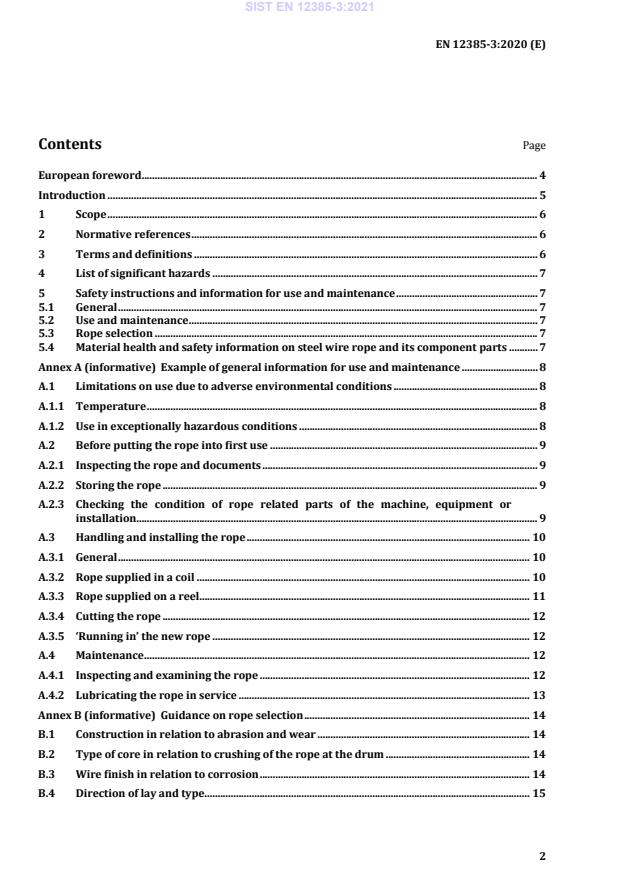
Contents Page
European foreword . 4
Introduction . 5
1 Scope . 6
2 Normative references . 6
3 Terms and definitions . 6
4 List of significant hazards . 7
5 Safety instructions and information for use and maintenance . 7
5.1 General . 7
5.2 Use and maintenance . 7
5.3 Rope selection . 7
5.4 Material health and safety information on steel wire rope and its component parts . 7
Annex A (informative) Example of general information for use and maintenance . 8
A.1 Limitations on use due to adverse environmental conditions . 8
A.1.1 Temperature . 8
A.1.2 Use in exceptionally hazardous conditions . 8
A.2 Before putting the rope into first use . 9
A.2.1 Inspecting the rope and documents . 9
A.2.2 Storing the rope . 9
A.2.3 Checking the condition of rope related parts of the machine, equipment or
installation . 9
A.3 Handling and installing the rope . 10
A.3.1 General . 10
A.3.2 Rope supplied in a coil . 10
A.3.3 Rope supplied on a reel . 11
A.3.4 Cutting the rope . 12
A.3.5 ‘Running in’ the new rope . 12
A.4 Maintenance . 12
A.4.1 Inspecting and examining the rope . 12
A.4.2 Lubricating the rope in service . 13
Annex B (informative) Guidance on rope selection . 14
B.1 Construction in relation to abrasion and wear . 14
B.2 Type of core in relation to crushing of the rope at the drum . 14
B.3 Wire finish in relation to corrosion . 14
B.4 Direction of lay and type. 15
B.4.1 Connecting ropes to each other (in series) or working alongside each other (in
parallel) . 15
B.4.2 Direction of coiling . 15
B.5 Rotational characteristics and use of a swivel . 16
B.6 Fleet angle . 17
Annex C (informative) Material health and safety information on steel wire rope and its
component parts . 20
C.1 Material . 20
C.1.1 General . 20
C.1.2 Fibre cores: . 20
C.1.3 Filling and covering materials: . 21
C.1.4 Manufacturing rope lubricants: . 21
C.2 General information . 22
C.2.1 Occupational protective measures: . 22
C.2.2 Emergency medical procedures: . 22
C.2.3 Safety information – fire or explosion hazard. 22
C.2.4 Disposal . 22
Annex ZA (informative) Relationship between this European Standard and the essential
requirements of Directive2006/42/EC aimed to be covered . 23
Annex ZB (informative) Relationship between this European Standard and the essential
requirements of Directive 2014/33/EU aimed to be covered . 25
Bibliography . 27
European foreword
This document (EN 12385-3:2020) has been prepared by Technical Committee CEN/TC 168 “Chains,
ropes, webbing, slings and accessories - Safety”, the secretariat of which is held by BSI.
This European Standard shall be given the status of a national standard, either by publication of an
identical text or by endorsement, at the latest by June 2021, and conflicting national standards shall be
withdrawn at the latest by June 2021.
Attention is drawn to the possibility that some of the elements of this document may be the subject of
patent rights. CEN shall not be held responsible for identifying any or all such patent rights.
This document supersedes EN 12385-3:2004+A1:2008.
Directive 2014/33/EU.
This document has been prepared under a mandate given to CEN by the European Commission and the
European Free Trade Association, and supports essential requirements of EU Directive(s).
For relationship with EU Directive(s), see informative Annex ZA and Annex ZB, which are integral parts
of this document.
The other Parts of this European standard are:
— Part 1: General requirements;
— Part 2: Definitions, designation and classification;
— Part 4: Stranded ropes for general lifting applications;
— Part 5: Stranded ropes for lifts;
— Part 6: Stranded ropes for mine shafts;
— Part 7: Locked coil ropes for mine shafts;
— Part 8: Stranded hauling and carrying-hauling ropes for cableway installations designed to carry
persons;
— Part 9: Locked coil carrying ropes for cableway installations designed to carry persons;
— Part 10: Spiral ropes for general structural applications.
According to the CEN-CENELEC Internal Regulations, the national standards organisations of the
following countries are bound to implement this European Standard: Austria, Belgium, Bulgaria,
Croatia, Cyprus, Czech Republic, Denmark, Estonia, Finland, France, Germany, Greece, Hungary, Iceland,
Ireland, Italy, Latvia, Lithuania, Luxembourg, Malta, Netherlands, Norway, Poland, Portugal, Republic of
North Macedonia, Romania, Serbia, Slovakia, Slovenia, Spain, Sweden, Switzerland, Turkey and the
United Kingdom.
Introduction
This document is a type C standard as stated in EN ISO 12100.
This Part of this European standard has been prepared to support the other Parts of this standard that
concern themselves with the particular requirements for steel wire ropes to be used in specific
applications.
The types of ropes concerned and the extent to which hazards are covered are indicated in the scope of
this document.
When provisions of this type C standard are different from those which are stated in type A and B
standards, the provisions of this type C standard take precedence over the provisions of the other
standards, for information for use and maintenance according to the provisions of this type C standard.
1 Scope
This document specifies the type of information for use and maintenance of steel wire ropes to be
provided by the rope manufacturer or to be included in the manufacturer’s handbook that accompanies
a machine, piece of equipment or installation of which the steel wire rope forms a part.
The particular hazards covered by this document are identified in Clause 4.
For steel wire ropes conforming to Parts 8 and 9 used on cableway installations designed to carry
persons, additional information for use and maintenance is given in EN 12927.
For steel wire rope slings, specific information on use and maintenance is given in EN 13414-2.
This document is not applicable to steel wire ropes manufactured before the date of publication of this
document by CEN.
2 Normative references
The following documents are referred to in the text in such a way that some or all of their content
constitutes requirements of this document. For dated references, only the edition cited applies. For
undated references, the latest edition of the referenced document (including any amendments) applies.
EN 12385-2:2002+A1:2008, Steel wire ropes — Safety — Part 2: Definitions, designation and
classification
EN ISO 12100:2010, Safety of machinery — General principles for design — Risk assessment and risk
reduction (ISO 12100:2010)
3 Terms and definitions
For the purposes of this document, the terms and definitions given in EN ISO 12100:2010 and
EN 12385-2:2002+A1:2008 and the following apply.
ISO and IEC maintain terminological databases for use in standardization at the following addresses:
— IEC Electropedia: available at http://www.electropedia.org/
— ISO Online browsing platform: available at https://www.iso.org/obp
3.1
inspection
routine visual check on the condition of the rope to identify obvious damage or deterioration which
might affect its fitness for use
Note 1 to entry: Often performed on a daily basis before initial utilization of machine.
3.2
thorough examination
detailed external (and where possible, internal) examination of the rope carried out by a competent
(trained and experienced) person at specific periodic time intervals as determined by national
regulations
Note 1 to entry: Visual examination supplemented by other means, such as measurement or electro-magnetic
non-destructive testing.
4 List of significant hazards
Table 1 contains all the significant hazards, hazardous situations and events, as far as they are dealt
with in this standard, identified by risk assessment and which require action to eliminate or reduce the
risk.
Table 1 — Hazards and associated requirements
Hazards relevant to this standard Relevant clause of this standard
identified by reference to
EN ISO 12100:2010
Inadequate information for use and 5.2
maintenance
Annex A
Inadequate information on rope selection 5.3
Annex B
Inadequate information about the effects on 5.4
health and safety of the materials used in wire
Annex C
ropes
5 Safety instructions and information for use and maintenance
5.1 General
Information shall be provided on the subjects listed in 5.2 to 5.4.
5.2 Use and maintenance
This information shall include temperature limits, use in exceptionally hazardous conditions, first use,
handling and installation and maintenance.
An example of such information is given in Annex A.
5.3 Rope selection
For stranded ropes this information shall include guidance on rope construction in relation to abrasion
and wear, type of core in relation to crushing of the rope at the drum, wire finish in relation to
corrosion, direction of lay and type in relation to direction of coiling, rotational characteristics in
relation to use of a swivel and fleet angle effects.
An example of such information is given in Annex B.
5.4 Material health and safety information on steel wire rope and its component parts
This information shall include details of all the individual materials that form part of the finished rope
and general information relating to occupational protective measures, emergency medical procedures,
safety (including any fire or explosion hazards) and disposal.
An example of such information is given in Annex C.
Annex A
(informative)
Example of general information for use and maintenance
A.1 Limitations on use due to adverse environmental conditions
A.1.1 Temperature
A.1.1.1 Steel wire ropes made from carbon steel wires
Account should be taken of the maximum temperature that may be reached by the wire rope in service.
An underestimation of the temperature involved can lead to a dangerous situation.
Stranded ropes with fibre cores or fibre centres can be used up to a maximum of 100 °C.
Stranded ropes with steel cores and spiral ropes (i.e. spiral strand and locked coil) can be used up to
200 °C although some de-rating of the working load limit is necessary, the amount being dependent
upon the exposure time at high temperature and the diameter of the wires. For operating temperatures
between 100 °C and 200 °C the loss in strength may be assumed to be 10 %.
For temperatures above 200 °C special lubricants may be necessary and greater losses in strength than
stated above will need to be taken into account. The rope or machinery manufacturer should be
contacted.
The strength of steel wire ropes will not be adversely affected by operating temperatures as low as –
40 °C and no reduction from the working load limit is necessary; however, rope performance may be
reduced, depending upon the effectiveness of the rope lubricant at low temperatures.
When the rope is fitted with a termination, also refer to A.1.1.2.
A.1.1.2 Terminations
In addition to the limits stated above for rope, and unless otherwise specified by the rope manufacturer
or the manufacturer of the machine, equipment or installation, the following operating temperatures
shall not be exceeded:
— turn-back eye with aluminium ferrule: 150 °C;
— ferrule-secured eye with steel ferrule: 200 °C;
— socket filled with a lead-based alloy: 80 °C;
— socket filled with zinc or a zinc-based alloy: 120 °C;
— socket filled with resin – refer to resin socketing system designer’s instructions.
A.1.2 Use in exceptionally hazardous conditions
In cases where exceptionally hazardous conditions are known to exist, e.g. offshore activities, the lifting
of persons and potentially dangerous loads such as molten metals, corrosive materials or radioactive
materials a risk assessment should be carried out and the working load limit selected or adjusted
accordingly.
A.2 Before putting the rope into first use
A.2.1 Inspecting the rope and documents
The rope should be unwrapped and examined immediately after delivery in order to check its identity
and condition and to ensure that the rope and its termination(s), if any, are compatible with the
machinery or equipment to which they are to be attached in service.
If damage to the rope or its package is observed, this should be recorded on the delivery note.
The Certificate of conformity by the rope manufacturer should be kept in a safe place, e.g. with the crane
handbook, for identification of the rope when carrying out periodic thorough examinations in service.
The rope should not be used for lifting purposes without the user having a Certificate in his possession.
A.2.2 Storing the rope
A clean, well-ventilated, dry, dust free, undercover location should be selected. The rope should be
covered with waterproof material if it cannot be stored inside.
The rope should be stored and protected in such a manner that it will not be exposed to any accidental
damage during the storage period or when placing the rope in, or taking it out of, storage.
The rope should be stored where it is not likely to be affected by chemical fumes, steam or any other
corrosive agents.
If supplied on a reel, the reel should be rotated periodically during long periods of storage, particularly
in warm environments, to prevent migration of the lubricant from the rope.
The rope should not be stored in areas subject to elevated temperatures as this may affect its future
performance. In extreme cases its original as-manufactured breaking force could be severely reduced
rendering it unfit for safe use.
The rope should not be allowed to make any direct contact with the floor and the reel should be so
positioned that there is a flow of air under the reel.
NOTE Failure to ensure the above can result in the rope becoming contaminated with foreign matter and
start the onset of corrosion even before the rope is put into service.
Preferably, the reel should be supported in an A-frame or cradle standing on ground which is capable of
safely supporting the total mass of rope and reel.
The rope should be inspected periodically and, when necessary, a suitable rope dressing, which is
compatible with the manufacturing lubricant, should be applied.
Any wet packaging, e.g. sackcloth, should be removed.
The rope marking should be checked to verify that it is legible and relates to the certificate. When
removing from store, the principle 'first in, first out' should be applied.
A.2.3 Checking the condition of rope related parts of the machine, equipment or
installation
Before installing the new rope, the condition and dimensions of rope related parts, e.g. drums, sheaves
and rope guards, should be checked to verify that they are within the operating limits as specified by
the original equipment manufacturer.
For ropes working on cranes, the effective groove diameter should be at least 5 % above the nominal
rope diameter. The groove diameter should be checked using a sheave gauge.
Sheaves should also be checked to ensure that they are free to rotate.
Under no circumstances should the actual rope diameter be greater than the pitch of the drum. In the
case of multi-layer coiling, the relationship between the actual rope diameter and the pitch should be
assessed.
When grooves become excessively worn, it may be possible to have them re-machined. Before doing so,
the sheave or drum should be examined to determine if sufficient strength will remain in the underlying
material supporting the rope after the machining has been carried out.
NOTE When grooves become worn and the rope is pinched at it sides, strand and wire movement is
restricted and the ability of the rope to bend is reduced, thus affecting rope performance.
A.3 Handling and installing the rope
A.3.1 General
The procedure for installing the rope should be carried out in accordance with a detailed plan issued by
the user of the steel wire rope.
The rope should be checked to verify that it is not damaged when unloaded and when transported to
storage compound or site. During these operations, the rope itself should not come into contact with
any part of the lifting device, such as the hook of a crane or a fork of a fork lift truck. Webbing slings may
be helpful.
A.3.2 Rope supplied in a coil
The coil of rope should be placed on the ground and rolled out straight, ensuring that it does not
become contaminated with dust, grit, moisture or other harmful material.
The rope should never be pulled away from a stationary coil as this will induce turn into the rope and
form kinks.
If the coil is too large to physically handle, it may need to be placed on a turntable which will allow the
rope to be paid out as the end of the rope is pulled away from the coil. Correct methods of paying out
rope from a coil are shown in Figure A.1.
Figure A.1 — Correct methods of paying out rope from a coil
A.3.3 Rope supplied on a reel
A shaft of adequate strength should be passed through the reel bore and the reel places in a suitable
stand which allows it to rotate and be braked to avoid overrun during installation.
Where multi-layer coiling is involved, the rope should be placed in equipment that has
...
Questions, Comments and Discussion
Ask us and Technical Secretary will try to provide an answer. You can facilitate discussion about the standard in here.
Loading comments...