


SIST EN 12098-1:2023
(Main)Energy Performance of Buildings - Controls for heating systems - Part 1: Control equipment for hot water heating systems - Modules M3-5, 6, 7, 8
Energy Performance of Buildings - Controls for heating systems - Part 1: Control equipment for hot water heating systems - Modules M3-5, 6, 7, 8
This document is applicable to electronic control equipment for heating systems with water as the heating medium and a supply water temperature up to 120 °C.
This control equipment controls the distribution and/or the generation of heat in relation to the outside temperature and time and other reference variables.
This document also is also applicable to controllers that contain an integrated optimum start or an optimum start-stop control function.
Safety requirements on heating systems remain unaffected by this document.
The dynamic behaviour of the valves and actuators are not covered in this document.
A multi-distribution and/or multi-generation system needs a coordinated solution to prevent undesired interaction and is not part of this document.
Engergieeffizienz von Gebäuden - Mess-, Steuer- und Regeleinrichtungen für Heizungen - Teil 1: Regeleinrichtungen für Warmwasserheizungen - Module M3-5, 6, 7, 8
Dieses Dokument ist anwendbar für elektronische Regeleinrichtungen für Heizungsanlagen mit Wasser als Wärme¬träger und einer Vorlauftemperatur bis 120 °C.
Diese Regeleinrichtungen dienen der Steuerung der Wärmeverteilung und/oder erzeugung in Abhängigkeit von der Außentemperatur, der Zeit und anderen Führungsgrößen.
Dieses Dokument behandelt auch Regler mit integrierter Einschalt-Optimierungsfunktion oder Ein-/Ausschalt-Optimierungsfunktion.
Sicherheitstechnische Anforderungen an Heizungsanlagen bleiben von diesem Dokument unberührt.
Das dynamische Verhalten von Ventilen und Stellgliedern wird in diesem Dokument nicht behandelt.
Eine Anlage mit mehreren Verteilkreisen und/oder Erzeugern erfordert eine koordinierte Lösung, um unerwünschte Wechselwirkungen zu vermeiden, und ist nicht Gegenstand dieses Dokuments.
Performance énergétique des bâtiments - Régulation pour les systèmes de chauffage - Partie 1 : Equipement de régulation pour les systèmes de chauffage à eau chaude - Modules M3-5, 6, 7, 8
Le présent document s’applique aux dispositifs électroniques de régulation pour les systèmes de chauffage qui utilisent l’eau comme fluide caloporteur, avec une température de l’eau allant jusqu’à 120 °C.
Ces dispositifs de régulation servent à la commande et à la régulation de la distribution et/ou de la production de chaleur en fonction de la température extérieure et du temps, ainsi que d’autres variables de référence.
Le présent document couvre également les régulateurs contenant une fonction intégrée de commande de démarrage optimisé ou de démarrage-arrêt optimisé.
Les exigences de sécurité relatives aux systèmes de chauffage ne sont pas affectées par le présent document.
Le comportement dynamique des vannes et des actionneurs n’est pas couvert par le présent document.
Un système multidistribution et/ou multiproduction nécessite une solution coordonnée pour empêcher toute interaction indésirable, mais un tel système ne relève pas du domaine d’application du présent document.
Energijske lastnosti stavb - Naprave za regulacijo sistemov za ogrevanje - 1. del: Naprave za regulacijo toplovodnih sistemov za ogrevanje - Moduli M3-5, 6, 7, 8
Ta evropski standard se uporablja za elektronske naprave za regulacijo sistemov za ogrevanje, pri katerih je grelni medij voda, ki dosega temperaturo do 120 °C.
Te naprave za regulacijo nadzirajo razporeditev in/ali proizvodnjo toplote glede na zunanjo temperaturo in čas ter druge referenčne spremenljivke.
Ta standard zajema tudi krmilnike z vgrajeno nadzorno funkcijo za optimalni zagon ali optimalni zagon/ustavitev.
Ta standard ne vpliva na varnostne zahteve za sisteme za ogrevanje.
Dinamično obnašanje ventilov in sprožilnikov ni zajeto v tem standardu.
Večdistribucijski in/ali večproizvodni sistem potrebuje usklajeno rešitev, da se preprečijo neželeni medsebojni vplivi, in ni del tega standarda.
Preglednica 1 prikazuje relativno mesto tega standarda znotraj skupine standardov EPB v kontekstu modularne strukture, kot je opredeljeno v standardu EN ISO 52000-1.
OPOMBA 1: V standardu CEN ISO/TR 52000-2 je za vsak modul mogoče najti enako preglednico s številkami ustreznih standardov EPB in spremnimi tehničnimi poročili, ki so objavljeni ali v pripravi.
OPOMBA 2: Moduli predstavljajo standarde EPB, čeprav lahko en standard EPB zajema več kot en modul, en modul pa je lahko zajet v več kot enem standardu EPB (na primer poenostavljena metoda in podrobna metoda).
General Information
- Status
- Published
- Public Enquiry End Date
- 01-Oct-2021
- Publication Date
- 13-Dec-2022
- Technical Committee
- OGS - Heating for buildings
- Current Stage
- 6060 - National Implementation/Publication (Adopted Project)
- Start Date
- 08-Dec-2022
- Due Date
- 12-Feb-2023
- Completion Date
- 14-Dec-2022
Relations
- Effective Date
- 01-Feb-2023
- Effective Date
- 01-Feb-2023
Overview
EN 12098-1:2022 - published by CEN - is a European standard on the energy performance of buildings covering electronic control equipment for hot water heating systems (Modules M3‑5, 6, 7, 8). It applies to controllers for systems using water as the heat transfer medium with supply temperatures up to 120 °C. The standard defines required control functions, modes and tests used within the EPB (Energy Performance of Buildings) framework. It includes controllers with integrated optimum start or optimum start‑stop functions. Note: safety requirements, valve/actuator dynamic behaviour and coordinated multi‑generation/distribution solutions are outside the scope.
Key topics and requirements
The standard sets out functionality, requirements and test methods for heating control equipment, including:
- Functional objectives and required controller functionality for energy-related control.
- Characteristic heating curve definition and default/factory settings.
- Input signals and sensors (outside temperature, time, other reference variables).
- Controller operation modes: comfort, economy, building protection, automatic and Manual Operation Mode (MOM).
- Additional functions: frost protection, summer/winter switch, set‑back, optimum start and optimum stop.
- Switching times, switching relays and parameter setting management (including data retention).
- Electrical requirements: connections, supply voltage ranges, electrical safety and electromagnetic compatibility (EMC).
- Environmental and mechanical aspects: degree of protection (IP), temperature stress, materials and graphical symbols.
- Test methods for verifying modes, heating curve performance, frost protection, switching times and optimum start/stop behaviour.
- Marking and documentation requirements (technical documents, installation instructions, user guidelines).
Practical applications
EN 12098-1:2022 is used to:
- Specify and test room and system controllers for hot‑water heating in residential, commercial and light‑industrial buildings.
- Ensure controller features that contribute to building energy efficiency (e.g., automatic/optimum start, set‑back strategies).
- Provide consistent requirements for manufacturers to demonstrate compliance within the EPB modular structure.
- Support energy assessors and regulators when classifying or modelling building heating controls for energy performance calculations.
Who should use this standard
- HVAC and building automation manufacturers (controller design & testing)
- Building services engineers and system designers
- Installers and commissioning engineers
- Energy assessors, building certifiers and regulators
- Facility managers implementing control strategies for energy savings
Related standards
- EN ISO 52000-1 (EPB over‑arching standard)
- Other documents in the EPB modular set (EN 12098 series); EN 12098-5 (2017) is rendered obsolete by this edition.
Keywords: EN 12098-1:2022, energy performance of buildings, controls for heating systems, hot water heating systems, heating controller, optimum start, heating curve, EPB standards, CEN.


Frequently Asked Questions
SIST EN 12098-1:2023 is a standard published by the Slovenian Institute for Standardization (SIST). Its full title is "Energy Performance of Buildings - Controls for heating systems - Part 1: Control equipment for hot water heating systems - Modules M3-5, 6, 7, 8". This standard covers: This document is applicable to electronic control equipment for heating systems with water as the heating medium and a supply water temperature up to 120 °C. This control equipment controls the distribution and/or the generation of heat in relation to the outside temperature and time and other reference variables. This document also is also applicable to controllers that contain an integrated optimum start or an optimum start-stop control function. Safety requirements on heating systems remain unaffected by this document. The dynamic behaviour of the valves and actuators are not covered in this document. A multi-distribution and/or multi-generation system needs a coordinated solution to prevent undesired interaction and is not part of this document.
This document is applicable to electronic control equipment for heating systems with water as the heating medium and a supply water temperature up to 120 °C. This control equipment controls the distribution and/or the generation of heat in relation to the outside temperature and time and other reference variables. This document also is also applicable to controllers that contain an integrated optimum start or an optimum start-stop control function. Safety requirements on heating systems remain unaffected by this document. The dynamic behaviour of the valves and actuators are not covered in this document. A multi-distribution and/or multi-generation system needs a coordinated solution to prevent undesired interaction and is not part of this document.
SIST EN 12098-1:2023 is classified under the following ICS (International Classification for Standards) categories: 91.140.10 - Central heating systems; 97.120 - Automatic controls for household use. The ICS classification helps identify the subject area and facilitates finding related standards.
SIST EN 12098-1:2023 has the following relationships with other standards: It is inter standard links to SIST EN 12098-1:2018, SIST EN 12098-5:2018. Understanding these relationships helps ensure you are using the most current and applicable version of the standard.
SIST EN 12098-1:2023 is associated with the following European legislation: EU Directives/Regulations: 2010/31/EU; Standardization Mandates: M/480. When a standard is cited in the Official Journal of the European Union, products manufactured in conformity with it benefit from a presumption of conformity with the essential requirements of the corresponding EU directive or regulation.
SIST EN 12098-1:2023 is available in PDF format for immediate download after purchase. The document can be added to your cart and obtained through the secure checkout process. Digital delivery ensures instant access to the complete standard document.
Standards Content (Sample)
SLOVENSKI STANDARD
01-februar-2023
Nadomešča:
SIST EN 12098-1:2018
SIST EN 12098-5:2018
Energijske lastnosti stavb - Naprave za regulacijo sistemov za ogrevanje - 1. del:
Naprave za regulacijo toplovodnih sistemov za ogrevanje - Moduli M3-5, 6, 7, 8
Energy Performance of Buildings - Controls for heating systems - Part 1: Control
equipment for hot water heating systems - Modules M3-5, 6, 7, 8
Engergieeffizienz von Gebäuden - Mess-, Steuer- und Regeleinrichtungen für Heizungen
- Teil 1: Regeleinrichtungen für Warmwasserheizungen - Module M3-5, 6, 7, 8
Performance énergétique des bâtiments - Régulation pour les systèmes de chauffage -
Partie 1 : Equipement de régulation pour les systèmes de chauffage à eau chaude -
Modules M3-5, 6, 7, 8
Ta slovenski standard je istoveten z: EN 12098-1:2022
ICS:
91.140.10 Sistemi centralnega Central heating systems
ogrevanja
97.120 Avtomatske krmilne naprave Automatic controls for
za dom household use
2003-01.Slovenski inštitut za standardizacijo. Razmnoževanje celote ali delov tega standarda ni dovoljeno.
EN 12098-1
EUROPEAN STANDARD
NORME EUROPÉENNE
November 2022
EUROPÄISCHE NORM
ICS 91.140.10; 97.120 Supersedes EN 12098-1:2017, EN 12098-5:2017
English Version
Energy performance of buildings - Controls for heating
systems - Part 1: Control equipment for hot water heating
systems - Modules M3-5, 6, 7, 8
Performance énergétique des bâtiments - Régulation Engergieeffizienz von Gebäuden - Mess-, Steuer- und
pour les systèmes de chauffage - Partie 1 : Equipement Regeleinrichtungen für Heizungen - Teil 1:
de régulation pour les systèmes de chauffage à eau Regeleinrichtungen für Warmwasserheizungen -
chaude - Modules M3-5, 6, 7, 8 Module M3-5, 6, 7, 8
This European Standard was approved by CEN on 26 September 2022.
CEN members are bound to comply with the CEN/CENELEC Internal Regulations which stipulate the conditions for giving this
European Standard the status of a national standard without any alteration. Up-to-date lists and bibliographical references
concerning such national standards may be obtained on application to the CEN-CENELEC Management Centre or to any CEN
member.
This European Standard exists in three official versions (English, French, German). A version in any other language made by
translation under the responsibility of a CEN member into its own language and notified to the CEN-CENELEC Management
Centre has the same status as the official versions.
CEN members are the national standards bodies of Austria, Belgium, Bulgaria, Croatia, Cyprus, Czech Republic, Denmark, Estonia,
Finland, France, Germany, Greece, Hungary, Iceland, Ireland, Italy, Latvia, Lithuania, Luxembourg, Malta, Netherlands, Norway,
Poland, Portugal, Republic of North Macedonia, Romania, Serbia, Slovakia, Slovenia, Spain, Sweden, Switzerland, Türkiye and
United Kingdom.
EUROPEAN COMMITTEE FOR STANDARDIZATION
COMITÉ EUROPÉEN DE NORMALISATION
EUROPÄISCHES KOMITEE FÜR NORMUNG
CEN-CENELEC Management Centre: Rue de la Science 23, B-1040 Brussels
© 2022 CEN All rights of exploitation in any form and by any means reserved Ref. No. EN 12098-1:2022 E
worldwide for CEN national Members.
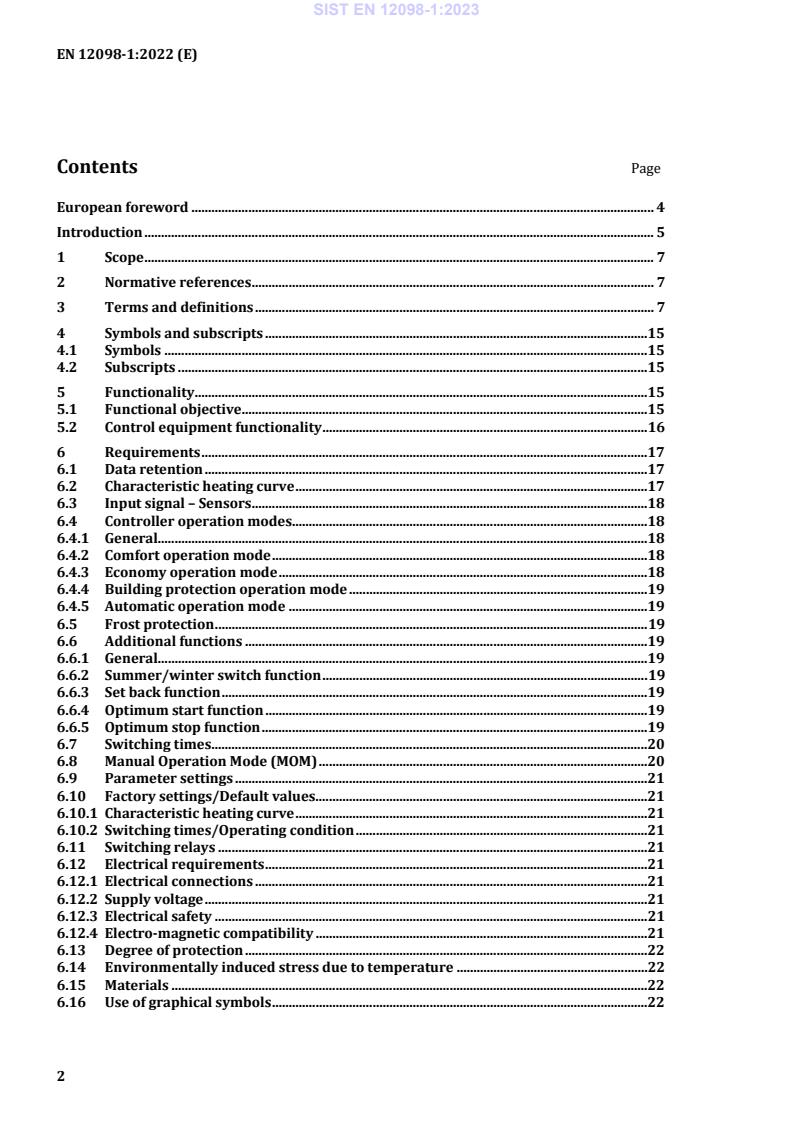
Contents Page
European foreword . 4
Introduction . 5
1 Scope . 7
2 Normative references . 7
3 Terms and definitions . 7
4 Symbols and subscripts .15
4.1 Symbols .15
4.2 Subscripts .15
5 Functionality .15
5.1 Functional objective .15
5.2 Control equipment functionality .16
6 Requirements .17
6.1 Data retention .17
6.2 Characteristic heating curve .17
6.3 Input signal – Sensors .18
6.4 Controller operation modes.18
6.4.1 General.18
6.4.2 Comfort operation mode .18
6.4.3 Economy operation mode .18
6.4.4 Building protection operation mode .19
6.4.5 Automatic operation mode .19
6.5 Frost protection .19
6.6 Additional functions .19
6.6.1 General.19
6.6.2 Summer/winter switch function .19
6.6.3 Set back function .19
6.6.4 Optimum start function .19
6.6.5 Optimum stop function .19
6.7 Switching times .20
6.8 Manual Operation Mode (MOM) .20
6.9 Parameter settings .21
6.10 Factory settings/Default values .21
6.10.1 Characteristic heating curve .21
6.10.2 Switching times/Operating condition .21
6.11 Switching relays .21
6.12 Electrical requirements .21
6.12.1 Electrical connections .21
6.12.2 Supply voltage .21
6.12.3 Electrical safety .21
6.12.4 Electro-magnetic compatibility .21
6.13 Degree of protection .22
6.14 Environmentally induced stress due to temperature .22
6.15 Materials .22
6.16 Use of graphical symbols .22
7 Test methods . 22
7.1 Data retention . 22
7.2 Controller operation modes . 22
7.3 Controller characteristic heating curve . 22
7.4 Frost protection . 27
7.5 Switching times . 27
7.6 Manual Operation Mode . 27
7.7 Optimum start-stop function . 27
7.7.1 General . 27
7.7.2 Test conditions . 29
7.7.3 Test run . 29
7.7.4 Test results start optimization . 30
7.8 Test results stop optimization . 31
7.9 Summer/winter switch . 32
7.10 Set back . 32
7.11 Parameter settings . 32
7.12 Factory settings . 32
7.13 Switching relays . 32
7.14 Electrical test . 32
7.15 Degrees of protection . 32
7.16 Environmental individual stress due to temperature . 32
8 Marking . 33
9 Documentation . 33
9.1 Technical documents . 33
9.2 Technical specifications . 33
9.2.1 Controller . 33
9.2.2 Output signals . 34
9.2.3 Input signals (sensors) . 34
9.3 Instruction installation . 34
9.4 User guideline . 34
Bibliography . 35
European foreword
This document (EN 12098-1:2022) has been prepared by Technical Committee CEN/TC 247 “Building
Automation, Controls and Building Management”, the secretariat of which is held by SNV.
This European Standard shall be given the status of a national standard, either by publication of an
identical text or by endorsement, at the latest by May 2023, and conflicting national standards shall be
withdrawn at the latest by May 2023.
Attention is drawn to the possibility that some of the elements of this document may be the subject of
patent rights. CEN shall not be held responsible for identifying any or all such patent rights.
This document supersedes EN 12098-1:2017 and EN 12098-5:2017.
In comparison with the previous edition, the following technical modifications have been made:
— respecting the presentation of this project in the frame of EPB in accordance with the drafting rules;
— subclause 6.7 “Switching times” and Table 5 introducing networked clocks improvements in line
with EN 12098-5 modifications have been updated. Consequently, EN 12098-5 becomes obsolete.
This document has been prepared under a Standardization Request given to CEN by the European
Commission and the European Free Trade Association.
This document is part of the set of standards on the energy performance of buildings (the set of EPB
standards).
Any feedback and questions on this document should be directed to the users’ national standards body.
A complete listing of these bodies can be found on the CEN website.
According to the CEN-CENELEC Internal Regulations, the national standards organisations of the
following countries are bound to implement this European Standard: Austria, Belgium, Bulgaria, Croatia,
Cyprus, Czech Republic, Denmark, Estonia, Finland, France, Germany, Greece, Hungary, Iceland, Ireland,
Italy, Latvia, Lithuania, Luxembourg, Malta, Netherlands, Norway, Poland, Portugal, Republic of North
Macedonia, Romania, Serbia, Slovakia, Slovenia, Spain, Sweden, Switzerland, Türkiye and the United
Kingdom.
Introduction
This document belongs to the family of standards aimed at international harmonization of the
methodology for the assessment of the energy performance of buildings. Throughout, this group of
standards is referred to as a set of called “EPB set of standards”.
As part of the “EPB set of standards” it complies with the requirements for the set of basic EPB
documents EN ISO 52000-1 (see Clause 2), CEN/TS 16628 and CEN/TS 16629 (see [2] and [3])
developed under a mandate given to CEN by the European Commission and the European Free Trade
Association (M/480 [11]).
The standards issued by TC 247 for M/480 belong to the EPB set of standards and are in line with the
over-arching standard (EN ISO 52000-1) and drafted in accordance with the basic principles and
detailed technical rules developed in the Phase I of the mandate.
Also, these standards are clearly identified in the modular structure developed to ensure a transparent
and coherent EPB standard set. BAC (Building Automation and Control) is identified in the modular
structure as Technical Building System M10. However, the standards of TC 247 deal with control
accuracy, control functions and control strategies using standards communications protocol (these last
standards do not belong to the EPB standards set).
To avoid a duplication of calculation due to the BAC (avoid double impact), no calculations are done in
the BAC EPB standard set, but in each underlying standard of the EPB set of standards (from M1 to M9
in the Modular Structure), an IDENTIFIER developed and present in the M10 covered by EN ISO 52120-1
is used where appropriate. This way of interaction is described in detail in the Technical Report
(CEN ISO/TR 52000-2) accompanying the over-arching standard. As a consequence, the Annex A and
Annex B concept as EXCEL sheet with the calculation formulas used in the EPB standards are not
applicable for the standards issued by TC 247 for M/480.
The main target groups of this document are all the users of the set of EPB standards (e.g. architects,
engineers, regulators).
Further target groups are parties wanting to motivate their assumptions by classifying the building
energy performance for a dedicated building stock.
More information is provided in the Technical Report accompanying this document
(CEN/TR 12098-6:2022, [5]).
Table 1 shows the relative position of this document within the set of EPB standards in the context of
the modular structure as set out in EN ISO 52000-1.
NOTE 1 In CEN ISO/TR 52000-2 the same table can be found, with, for each module, the numbers of the relevant
EPB standards and accompanying Technical Reports that are published or in preparation.
NOTE 2 The modules represent EPB standards, although one EPB standard can cover more than one module
and one module can be covered by more than one EPB standard, for instance a simplified and a detailed method,
respectively.
Table 1 — Position of this document (in casu M3–5, 6, 7, 8), within the modular structure of the
set of EPB standards
Over-arching Building Technical Building System
(as such)
sub1 M1 M2 M3 M4 M5 M6 M7 M8 M9 M10 M11
1 General General General
Common terms
and definitions; Building Energy
2 Needs
symbols, units Needs
and subscripts
(Free) Indoor
Maximum
Conditions
3 Application Load and
without
Power
Systems
Ways to
Ways to Express Ways to Express
Express
4 Energy Energy
Energy
Performance Performance
Performance
Building
Heat Transfer
Functions and Emission and
5 by x
Building control
Transmission
Boundaries
Building
Heat Transfer
Occupancy and Distribution
by Infiltration
6 x
Operating and control
and Ventilation
Conditions
Aggregation of
Energy Services Internal Heat Storage and
7 x
and Energy Gains control
Carriers
Building Generation
8 Solar Heat Gains x
Partitioning and control
Load
Calculated Building
dispatching
9 Energy Dynamics
and operating
Performance (thermal mass)
conditions
Measured Measured
Measured Energy
10 Energy Energy
Performance
Performance Performance
11 Inspection Inspection Inspection
Ways to Express
12 BMS
Indoor Comfort
External
13 Environment
Conditions
Economic
Calculation
NOTE The shaded modules are not applicable.
Submodule
Descriptions
Descriptions
Descriptions
Heating
Cooling
Ventilation
Humidification
Dehumidification
Domestic Hot waters
Lighting
Building automation
and control
PV, wind.
1 Scope
This document is applicable to electronic control equipment for heating systems with water as the
heating medium and a supply water temperature up to 120 °C.
This control equipment controls the distribution and/or the generation of heat in relation to the outside
temperature and time and other reference variables.
This document also is also applicable to controllers that contain an integrated optimum start or an
optimum start-stop control function.
Safety requirements on heating systems remain unaffected by this document.
The dynamic behaviour of the valves and actuators are not covered in this document.
A multi-distribution and/or multi-generation system needs a coordinated solution to prevent undesired
interaction and is not part of this document.
2 Normative references
The following documents are referred to in the text in such a way that some or all of their content
constitutes requirements of this document. For dated references, only the edition cited applies. For
dated references, only the edition cited applies. For undated references, the latest edition of the
referenced document (including any amendments) applies.
EN 60038, CENELEC standard voltages (IEC 60038)
EN 60529, Degrees of protection provided by enclosures (IP Code) (IEC 60529)
EN 60730-1, Automatic electrical controls for household and similar use — Part 1: General requirements
(IEC 60730-1)
EN ISO 7345, Thermal performance of buildings and building components — Physical quantities and
definitions (ISO 7345)
EN ISO 52000-1:2017, Energy performance of buildings — Overarching EPB assessment — Part 1:
General framework and procedures (ISO 52000-1:2017)
3 Terms and definitions
For the purposes of this document, the terms and definitions given in EN ISO 7345 and
EN ISO 52000-1:2017 and the following apply.
ISO and IEC maintain terminology databases for use in standardization at the following addresses:
— ISO Online browsing platform: available at https://www.iso.org/obp
— IEC Electropedia: available at https://www.electropedia.org/
3.1
outside temperature compensated controller
OTC controller
controller optimizing and regulating the generation and/or distribution of heat in relation to the outside
temperature, time and other reference variables
Note 1 to entry: The outside temperature compensated function calculates the flow (supply) temperature in
relation to the outside temperature, based on the heating curve.
Note 2 to entry: The outside temperature optimum start-stop function calculates the pre-heat time and/or stop
time to reach the comfort temperature level in relation with the outside temperature, switch time and several
parameters (e.g. room temperature).
3.2
control equipment
equipment which consists of the OTC controller, and connectors for sensor input signals and output
signals, but does not include the sensors and actuating equipment
Note 1 to entry: See Figure 1.
Key
1 OTC
2 output signals
3 input signals: reference variables
4 input signal: controlled variable
5 actuating equipment
6 heat generation or distribution
Figure 1 — Control equipment for heating systems
3.3
actuating equipment
equipment by which the controller affects the controlled variable
3.4
controlled variable
supply water temperature and/or boiler water temperature as a result of the heating curve in
accordance to the reference variables
Note 1 to entry: The controlled variable is an input signal.
3.5
output signal
signal generated by the OTC controller for operating the actuating equipment
3.6
reference variable
outside temperature with or without other influences or variables (e.g. room temperature) used to
determine the setpoint of the controlled variable
Note 1 to entry: The controlled variable is an input signal.
3.7
outside temperature
reference variable that is measured with a sensor fitted outside the building, mainly intended to
measure the ambient air temperature
3.8
room temperature
resulting temperature in the building arising in comfort, economy or building protection operation
mode of the OTC controller
Note 1 to entry: Room temperature can be different for individual rooms.
3.9
characteristic heating curve
relation between the setpoint value of the controlled variable (e.g. supply water temperature) and the
reference variables (outside air temperature) defined by two or more parameters and depending on
operation mode and additional variables
Note 1 to entry: The setpoint of supply water temperature is a function of the outside temperature and the
present room temperature setpoint. The setpoint of supply water temperature as function of the outside
temperature is graphically represented by the heating curve.
3.10
comfort operation mode
mode of operation between the switch-on time and the switch-off time, maintaining comfort room
temperature
Note 1 to entry: Mode of operation for normally occupied rooms.
3.11
economy operation mode
mode of operation between the switch-off time and the switch-on time, maintaining a reduced room
temperature compared to the comfort room temperature
Note 1 to entry: Economy operation mode is a reduced mode.
3.12
building protection operation mode
mode of operation between the switch-off time and the switch-on time, maintaining a room temperature
required for building protection
Note 1 to entry: Building protection operation mode is a reduced mode.
3.13
automatic operation mode
mode of operation of equipment when significant control functions are not overridden by the user
Note 1 to entry: The operation mode is selected automatically according to the scheduler, actual date and time.
3.14
summer/winter switch function
seasonal switch on/off of the heating depending on a function of the outside air temperature
3.15
set back function
function, starting when the operation mode changes from comfort to economy or building protection
mode
Note 1 to entry: During set back period, the heating is switched off until the calculated or measured room
temperature drops below the economy or building protection setpoint; the operation mode switches back to
comfort mode or the calculated switch-on time of the optimization start function is reached.
3.16
optimum start function
function, calculating the optimum pre-heat time to reach the comfort temperature level at the beginning
of the comfort occupation period
Note 1 to entry: See Figure 2.
Note 2 to entry: The optimum start functions and the optimum stop functions are illustrated by Figure 3.
Heating periods are different from scheduled occupation periods. These differences, due to thermal inertia, depend
mainly on heating loads (or temperature differences). A start and/or stop optimiser controls these switching
points, using outside and/or room temperatures of their differences in relation to setpoints.
Key
T
comfort room temperature
r,cmf
T
reduced room temperature
r,red
t
beginning of comfort occupation period
t switch-on time with start optimization (variable start)
t
switch-on time without start optimization (fixed start)
t
end of comfort occupation period without stop optimization (fixed stop)
t switch-off time with stop optimization (variable stop)
comfort occupation period: t tt−
t
cmf 4 1
cmf
t time period of wasted heat (energy saving potential with start optimization)
was
NOTE tt− is the optimum start period. tt− is the optimum stop period.
2 1 5 4
Figure 2 — Temperature time curve with optimizer function
=
Key
S schedule occupation period
O heating operation status
R room temperature profile
1 comfort room temperature
2 reduced room temperature
3 comfort occupation period
4 optimum start period
5 main controller function
6 optimum stop period
7 set back period
Figure 3 — Example of optimum start and stop function
3.17
adaptive optimum start function
added function to optimum start function, which recalculates the parameters used to determine the
switch-on time, based on measured room temperature
3.18
optimum stop function
function, switching off or reducing the heat generation at the earliest point in time so that the room
temperature will drop maximum 0,5 K below the comfort setpoint when the operation mode changes
from comfort mode to economy or building protection mode
Note 1 to entry: See Figure 2.
3.19
adaptive optimum stop function
added function to optimum stop function, which recalculates the parameters used to determine the
switch-off time, based on measured room temperature
3.20
scheduler
function which switches heating modes affecting the heating control system according to a program
Note 1 to entry: See Figure 3.
Note 2 to entry: The program includes memorized switch times, reproducing periods or periodic cycles, daily,
weekly or yearly. The program can include periods of exception.
3.21
switch points and time periods
3.21.1
switch on time
point in time at which the controller increases the setpoint for boiler/flow temperature in order to reach
the comfort room temperature
Note 1 to entry: If the optimum start function is applied, the switch on time is automatically determined by the
controller; otherwise, it is determined by the scheduler.
3.21.2
optimum start period
optimal pre heat period between the switch on time and the beginning of comfort occupation period
3.21.3
beginning of comfort occupation period
user programmed switch point when the comfort room temperature should be reached
3.21.4
comfort occupation period
operating period during which comfort room temperature should be maintained
3.21.5
end of comfort occupation period
user programmed switch point when the room temperature is allowed to decrease under the comfort
room temperature
Note 1 to entry: The room temperature setpoint is switched to economy and/or building protection setpoint.
3.21.6
switch off time
point in time at which the controller decreases the setpoint for boiler/supply water temperature
Note 1 to entry: If the optimum stop function is applied, the switch off time is automatically determined by the
controller; otherwise, it is determined by the scheduler.
3.21.7
optimum stop period
operating period between the optimal switch off time and the end of comfort occupation period
3.21.8
exception handling function
temporary override of program
Note 1 to entry: There are different possibilities for exception handling functions. Two examples for temporary
override of the program by exception and recovery of the periodic program are shown in Figure 4.
Key
ϑ
comfort room temperature
r,cmf
ϑ
reduced room temperature
r,red
A and B programmed switch times
C exception manual start
D programmable duration
NOTE 1 Upper diagram: “exception manual start” initiates a predefined timer which switches the mode to
comfort. After the timer elapsed, the mode defined by the scheduler is applied.
NOTE 2 Lower diagram: “exception manual start” changes the mode until the next programmed switch time.
Figure 4 — Examples of exception handling
3.22
valve protection function
anti-jamming function for valves in which the valves should be moved periodically during longer off
periods
Note 1 to entry: The valve protection function is a valve exercise function.
3.23
pump protection function
anti-jamming function for pump in which the pumps should be switched on during longer off periods
Note 1 to entry: The pump protection function is a pump exercise function.
3.24
frost protection function
function in all operation modes (except manual operation) to prevent the heating system from freezing
by providing specific output signals
3.25
Manual Operation Mode
MOM
mode in which the controller is inactive and the actuating equipment is manipulated manually
3.26
technical building sub-system
part of a technical building system that performs a specific function (e.g. heat generation, heat
distribution, heat emission)
4 Symbols and subscripts
4.1 Symbols
For the purposes of this document, the symbols given in EN ISO 52000-1:2017, Clause 4 and Annex C
and the specific symbol listed in Table 2 apply.
Table 2 — Symbols and units
Symbol Quantity Unit
F constant representing the response of the K/s
closed loop system
4.2 Subscripts
For the purposes of this document, the subscript given in EN ISO 52000-1:2017, Clause 4 and Annex C,
and the specific subscripts listed in Table 3 apply.
Table 3 — Subscripts
Subscript Term Subscript Term Subscript Term
cmf comfort os outside ret return
flow flow r room w water
HC heating curve ref reference was wasted
5 Functionality
5.1 Functional objective
The objective of outside temperature compensated control equipment is to save energy by reducing
waste potential and supply losses performing these main functions:
a) to control supply temperature so that the room temperature can be maintained at the desired level,
as determined by comfort and energy optimization criteria, estimating the heat demand from
measurements of the outside temperature with or without other reference variables;
b) to alter the heat supply to follow a scheduled change in order to match occupancy patterns.
OTC control equipment also incorporates a frost protection function and a manual operation mode.
5.2 Control equipment functionality
See Figure 5.
Key
M scheduler switches between two or more operation modes
t time to next switch of operation mode
Figure 5 — Block-scheme of control equipment – Example
6 Requirements
6.1 Data retention
Actual time and date shall be retained on failure of the power supply. All other data input on
commissioning shall be retained too.
6.2 Characteristic heating curve
The range of characteristic heating curve(s) shall be displayed graphically by the manufacturer on the
unit and/or in the technical documents, e.g. as shown in Figure 6.
Key
boiler/supply-water temperature
ϑ
w
outside temperature
ϑ
os
NOTE The graphical representation using a reversed outside temperature axis is also often used.
Figure 6 — Example of characteristic heating curves
The relations between the adjustable setting parameters and the characteristic heating curves shall be
shown.
The average supply water temperature shall not deviate from the set temperature points on the
characteristic heating curve by more than ±3 K.
Characteristic heating curves are defined for different temperature ranges:
— heating system for high temperature as oil/gas burners or district heating and flow/return
temperatures of 90 °C/70 °C;
— heating system for medium temperature as oil/gas burners with flow/return temperatures of
70 °C/50 °C;
— heating system for low temperature heat generation systems as renewable energies (solar/heat
pump) with flow/return temperatures of 55 °C/45 °C;
— heating system for floor heating applications with flow/return temperatures of 35 °C/28 °C.
At least one of these temperature ranges shall be provided by the controller. The characteristic heating
curves shall be adaptable to the related building.
6.3 Input signal – Sensors
The tolerances in Table 4 are required from sensors in the indicated ranges:
Table 4 — Sensor accuracy
Temperature range Sensor accuracy
Room temperature +15 °C to +25 °C ±0,8 K
Boiler water temp. or 0 °C to +60 °C ±1,0 K
Supply water temperature
Outside temperature −10 °C to +18 °C ±1,0 K
Outside these temperature ranges, no sensor accuracy is specified in this document.
6.4 Controller operation modes
6.4.1 General
Controllers shall facilitate at least automatic operation mode, comfort operation mode and one reduced
operation mode (economy/building protection). The current operation mode shall be displayed.
The following operation modes shall be available by switching manually:
— comfort;
— economy and/or building protection;
— automatic.
6.4.2 Comfort operation mode
Operation mode of occupied rooms. The supply water temperature setpoint is a function of the heating
curve, based on the outside temperature and the comfort room temperature setpoint.
6.4.3 Economy operation mode
Economy operation mode is the operation mode for rooms which do not need to be in the comfort
operation mode for an extended period of time for energy saving.
The supply water temperature is a function of the heating curve, based on the outside temperature and
the economy room temperature setpoint.
For the change from comfort to economy operation mode, the controller shall allow a reduction of the
boiler/supply water temperature of at least 20 % of the difference between the water temperature
during comfort operation and the comfort room temperature (e.g. 20 °C).
(1)
ϑϑ≤ − 0,2ϑ −ϑ
( )
w,red w,cmf w,cmf r,cmf
where
is the economy supply water temperature;
ϑ
w,red
is the comfort supply water temperature;
ϑ
w,cmf
is the comfort room temperature.
ϑ
r,cmf
6.4.4 Building protection operation mode
Mode of operation to protect the building including the technical building systems (e.g. the domestic
water supply system) from damages caused by low temperatures and humidity.
The supply water temperature is a function of the heating curve, based on the outside temperature and
the building protection room temperature setpoint. The building protection setpoint temperature is
below the economy setpoint temperature.
6.4.5 Automatic operation mode
The operation mode (comfort, economy and/or building protection) is selected automatically according
to the scheduler, actual date and time.
6.5 Frost protection
In all operating modes (except for manual operation mode) a frost protection function shall be effective
if the boiler supply water temperature falls to minimum of 5 °C or the outside air temperature falls
below 2 °C (can be lower for system with fluid frost protection (e.g. glycol)), then the pump operates,
and the valve opens. If the supply water temperature drops below 5 °C the heat generation shall be
switched on.
6.6 Additional functions
6.6.1 General
These functions are optional. If implemented the requirements of the corresponding function in this
subclause shall be fulfilled.
6.6.2 Summer/winter switch function
The summer/winter switch function automatically switches between summer and winter operation
mode.
In summer operation mode the summer/winter switch function switches off the heat generation and
pumps and closes the valves.
One possible solution for switching the operation mode is to calculate an attenuated outside air
temperature falling below or upper a switching limit. This limit is adjustable.
6.6.3 Set back function
During set back period the reduced room temperature setpoint is valid. The function switches off the
heat generation and the pump and closes the valves until the calculated or measured room temperature
drops below the reduced setpoint.
6.6.4 Optimum start function
The optimum start function calculates the pre-heat time to reach the comfort temperature level at the
beginning of the comfort time period within a limit of ±30 min. Once the comfort level is reached the
room temperature shall stay within ±0,5 K around the comfort room temperature.
6.6.5 Optimum stop function
The optimum stop function calculates the optimum switch-off time so that the room temperature at the
end of the comfort period is within the allowable temperature decrease of −0,5 K of the comfort
temperature level.
6.7 Switching times
A time switching function is required for changing operating modes. Setting and accuracy requirements
for the switching times and clock are shown in Table 5.
The two scheduler categories below (Table 5) should include optional functions, e.g.:
— Program exception handling started manually or by external signal (e.g. presence detector),
overriding temporary the program;
— Start heating period separated setting. A period preceding the normal occupation period allowing
the user to program a pre-heating period before the comfort period, this time being more easily
programmed than switch-on heating.
Table 5 — Switching time and clock
Minimum
Minimum
Programming Clock number of
Category number of daily
period synchronization switch time per
program types
day
Networked time and
date information
Yearly, weekly
synchronised from a
A 4 4
or daily
high precision master
a
clock
Internal time base,
B Weekly or daily mains or network 4 2
b
synchronization
a
e.g.: digital device, clock and scheduling linked to a network receiving precision master clock and calendar
(e.g.: European emitter in Mainflingen, D), allowing automatic winter-summer time and calendar leap year
update
b
e.g.: electronic device
6.8 Manual Operation Mode (MOM)
Due to a failure of the connected hardware like a sensor error or an abnormal operation of the control
equipment the heat flow may be interrupted.
For such abnormal situation, the control equipment shall have a MOM providing a possibility to restart
the heat distribution.
This MOM shall be activated in a user-friendly way like a switch or an easily available parameter.
If an independent control function of the heat generator is available and functional, the MOM shall:
— turn on flow water pump;
— switch off the control function regarding the motor drive or define a fix value for the valve;
— enable heat generation.
6.9 Parameter settings
The following setting facilities shall be provided for the u
...
Questions, Comments and Discussion
Ask us and Technical Secretary will try to provide an answer. You can facilitate discussion about the standard in here.
Loading comments...