


oSIST prEN ISO 11074:2026
(Main)Soil quality - Vocabulary (ISO/DIS 11074:2026)
General Information
- Abstract
This document defines terms used in the field of soil quality.
- Status
- Not Published
- Public Enquiry End Date
- 14-Sep-2026
- Technical Committee
- KAT - Soil quality
- Current Stage
- 4020 - Public enquire (PE) (Adopted Project)
- Start Date
- 21-Jul-2026
- Due Date
- 08-Dec-2026

Overview
oSIST prEN ISO 11074:2026: Soil Quality – Vocabulary (ISO/DIS 11074:2026), developed by CEN and ISO/TC 190, is a crucial international standard for professionals in environmental sciences, soil management, and regulatory compliance. This document defines essential terms used in the field of soil quality, providing a unified vocabulary for specialists, organizations, and regulators working on soil assessment, monitoring, remediation, and reporting worldwide.
The standard addresses the need for consistency and clarity in the terminology used throughout soil quality studies and documentation. With the expansion of cross-disciplinary teams and evolving environmental regulations, accurate and uniform definitions minimize misinterpretation and enhance collaboration across sectors.
Key Topics
- Standardized Definitions: Comprehensive terms covering soil sampling, contamination, remediation, pedology, soil health, and ecosystem services.
- Soil Contamination & Remediation: Terms relevant to contaminated sites, contaminant assessment, protective measures, and site management strategies.
- Sampling & Analysis: Definitions for various types of soil samples, sampling techniques, and analysis procedures.
- Soil Health & Ecosystem Services: New vocabulary relating to emerging themes such as soil health indicators and ecosystem service potential.
- Data & Information Management: Concepts related to data structure, model, and quality, supporting digital systems for soil information exchange.
- Risk Assessment: Introduces terms for quantitative and qualitative risk evaluation and guidelines compliance.
Applications
The standardized vocabulary provided by oSIST prEN ISO 11074:2026 supports practical applications in a variety of fields:
- Environmental Assessment & Compliance: Facilitates environmental reporting for regulatory submissions and audits by providing clear definitions that meet both national and international standards.
- Site Investigation & Remediation Projects: Enhances communication among multidisciplinary teams during site risk assessment, investigation, and remediation planning.
- Soil Monitoring & Data Exchange: Supports development of soil databases, data exchange between organizations, and implementation of information technology solutions in environmental monitoring.
- Research & Education: Provides a foundational language for soil science curricula, research publications, and knowledge dissemination.
- Policy & Decision Making: Assists policy makers and competent authorities in interpreting guidelines and technical reports based on uniform terminology.
- Consultancy & Industry: Ensures terminology alignment across consultancy documents, project tenders, site characterization, and construction projects impacting soil quality.
Related Standards
oSIST prEN ISO 11074:2026 is interlinked with several international soil and environmental standards. Adopting this vocabulary ensures compatibility and enhances integration across the following:
- ISO 25177:2019 – Field soil description
- ISO 28258:2013 – Soil quality – Digital exchange of soil-related data
- ISO/TS 18718:2026 – Soil health and ecosystem services terminology
- ISO 9000 – Quality management systems (general terms relating to quality)
- ISO 14050:2020 – Environmental management vocabulary
- ISO 11277:2020 – Determination of particle size distribution in mineral soil material
- ISO 18400-104:2018 – Soil quality – Sampling
By providing a robust vocabulary, oSIST prEN ISO 11074:2026 underpins accurate communication, reliable data management, and effective collaboration-fundamental for quality soil science and successful environmental management worldwide. Adherence to this standard is a best practice for any professional dealing with soil quality assessment, remediation, and reporting.
Relations
- Effective Date
- 01-Sep-2026
Get Certified
Connect with accredited certification bodies for this standard

CIS Institut d.o.o.
Personal Protective Equipment (PPE) certification body. Notified Body NB-2890 for EU Regulation 2016/425 PPE.

Kiwa BDA Testing
Building and construction product certification.
Kmetijski inštitut Slovenije
Agricultural Institute of Slovenia. Soil testing, plant health, agricultural product analysis.
Sponsored listings
Frequently Asked Questions
oSIST prEN ISO 11074:2026 is a draft published by the Slovenian Institute for Standardization (SIST). Its full title is "Soil quality - Vocabulary (ISO/DIS 11074:2026)". This standard covers: This document defines terms used in the field of soil quality.
This document defines terms used in the field of soil quality.
oSIST prEN ISO 11074:2026 is classified under the following ICS (International Classification for Standards) categories: 01.040.13 - Environment. Health protection. Safety (Vocabularies); 13.080.01 - Soil quality and pedology in general. The ICS classification helps identify the subject area and facilitates finding related standards.
oSIST prEN ISO 11074:2026 has the following relationships with other standards: It is inter standard links to SIST EN ISO 11074:2025. Understanding these relationships helps ensure you are using the most current and applicable version of the standard.
oSIST prEN ISO 11074:2026 is available in PDF format for immediate download after purchase. The document can be added to your cart and obtained through the secure checkout process. Digital delivery ensures instant access to the complete standard document.
Standards Content (Sample)
SLOVENSKI STANDARD
01-september-2026
Kakovost tal - Slovar (ISO/DIS 11074:2026)
Soil quality - Vocabulary (ISO/DIS 11074:2026)
Bodenbeschaffenheit - Wörterbuch (ISO/DIS 11074:2026)
Qualité du sol - Vocabulaire (ISO/DIS 11074:2026)
Ta slovenski standard je istoveten z: prEN ISO 11074
ICS:
01.040.13 Okolje. Varovanje zdravja. Environment. Health
Varnost (Slovarji) protection. Safety
(Vocabularies)
13.080.01 Kakovost tal in pedologija na Soil quality and pedology in
splošno general
2003-01.Slovenski inštitut za standardizacijo. Razmnoževanje celote ali delov tega standarda ni dovoljeno.
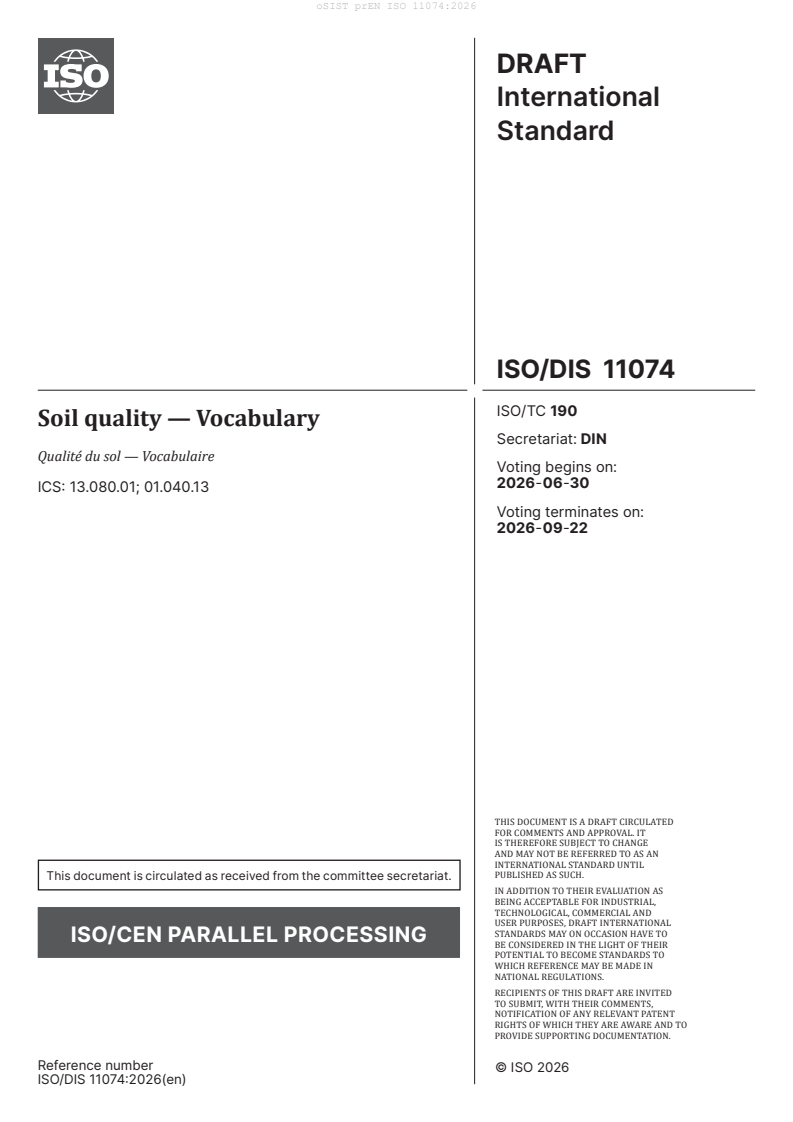
DRAFT
International
Standard
ISO/DIS 11074
ISO/TC 190
Soil quality — Vocabulary
Secretariat: DIN
Qualité du sol — Vocabulaire
Voting begins on:
2026-06-30
ICS: 13.080.01; 01.040.13
Voting terminates on:
2026-09-22
THIS DOCUMENT IS A DRAFT CIRCULATED
FOR COMMENTS AND APPROVAL. IT
IS THEREFORE SUBJECT TO CHANGE
AND MAY NOT BE REFERRED TO AS AN
INTERNATIONAL STANDARD UNTIL
PUBLISHED AS SUCH.
This document is circulated as received from the committee secretariat.
IN ADDITION TO THEIR EVALUATION AS
BEING ACCEPTABLE FOR INDUSTRIAL,
TECHNOLOGICAL, COMMERCIAL AND
USER PURPOSES, DRAFT INTERNATIONAL
STANDARDS MAY ON OCCASION HAVE TO
ISO/CEN PARALLEL PROCESSING
BE CONSIDERED IN THE LIGHT OF THEIR
POTENTIAL TO BECOME STANDARDS TO
WHICH REFERENCE MAY BE MADE IN
NATIONAL REGULATIONS.
RECIPIENTS OF THIS DRAFT ARE INVITED
TO SUBMIT, WITH THEIR COMMENTS,
NOTIFICATION OF ANY RELEVANT PATENT
RIGHTS OF WHICH THEY ARE AWARE AND TO
PROVIDE SUPPORTING DOCUMENTATION.
Reference number
ISO/DIS 11074:2026(en)
DRAFT
ISO/DIS 11074:2026(en)
International
Standard
ISO/DIS 11074
ISO/TC 190
Soil quality — Vocabulary
Secretariat: DIN
Qualité du sol — Vocabulaire
Voting begins on:
ICS: 13.080.01; 01.040.13
Voting terminates on:
THIS DOCUMENT IS A DRAFT CIRCULATED
FOR COMMENTS AND APPROVAL. IT
IS THEREFORE SUBJECT TO CHANGE
AND MAY NOT BE REFERRED TO AS AN
INTERNATIONAL STANDARD UNTIL
PUBLISHED AS SUCH.
This document is circulated as received from the committee secretariat.
IN ADDITION TO THEIR EVALUATION AS
BEING ACCEPTABLE FOR INDUSTRIAL,
© ISO 2026
TECHNOLOGICAL, COMMERCIAL AND
USER PURPOSES, DRAFT INTERNATIONAL
All rights reserved. Unless otherwise specified, or required in the context of its implementation, no part of this publication may
STANDARDS MAY ON OCCASION HAVE TO
ISO/CEN PARALLEL PROCESSING
be reproduced or utilized otherwise in any form or by any means, electronic or mechanical, including photocopying, or posting on
BE CONSIDERED IN THE LIGHT OF THEIR
the internet or an intranet, without prior written permission. Permission can be requested from either ISO at the address below
POTENTIAL TO BECOME STANDARDS TO
WHICH REFERENCE MAY BE MADE IN
or ISO’s member body in the country of the requester.
NATIONAL REGULATIONS.
ISO copyright office
RECIPIENTS OF THIS DRAFT ARE INVITED
CP 401 • Ch. de Blandonnet 8
TO SUBMIT, WITH THEIR COMMENTS,
CH-1214 Vernier, Geneva
NOTIFICATION OF ANY RELEVANT PATENT
Phone: +41 22 749 01 11
RIGHTS OF WHICH THEY ARE AWARE AND TO
PROVIDE SUPPORTING DOCUMENTATION.
Email: copyright@iso.org
Website: www.iso.org
Published in Switzerland Reference number
ISO/DIS 11074:2026(en)
ii
ISO/DIS 11074:2026(en)
Contents Page
Foreword .iv
Introduction .v
1 Scope . 1
2 Normative references . 1
3 Terms and definitions . 1
Annex A (informative) Relationships between sampling operations .69
Bibliography .71
Index .73
iii
ISO/DIS 11074:2026(en)
Foreword
ISO (the International Organization for Standardization) is a worldwide federation of national standards
bodies (ISO member bodies). The work of preparing International Standards is normally carried out through
ISO technical committees. Each member body interested in a subject for which a technical committee
has been established has the right to be represented on that committee. International organizations,
governmental and non-governmental, in liaison with ISO, also take part in the work. ISO collaborates closely
with the International Electrotechnical Commission (IEC) on all matters of electrotechnical standardization.
The procedures used to develop this document and those intended for its further maintenance are described
in the ISO/IEC Directives, Part 1. In particular, the different approval criteria needed for the different types
of ISO document should be noted. This document was drafted in accordance with the editorial rules of the
ISO/IEC Directives, Part 2 (see www.iso.org/directives).
ISO draws attention to the possibility that the implementation of this document may involve the use of (a)
patent(s). ISO takes no position concerning the evidence, validity or applicability of any claimed patent
rights in respect thereof. As of the date of publication of this document, ISO had not received notice of (a)
patent(s) which may be required to implement this document. However, implementers are cautioned that
this may not represent the latest information, which may be obtained from the patent database available at
www.iso.org/patents. ISO shall not be held responsible for identifying any or all such patent rights.
Any trade name used in this document is information given for the convenience of users and does not
constitute an endorsement.
For an explanation of the voluntary nature of standards, the meaning of ISO specific terms and expressions
related to conformity assessment, as well as information about ISO's adherence to the World Trade
Organization (WTO) principles in the Technical Barriers to Trade (TBT), see www.iso.org/iso/foreword.html.
This document was prepared by Technical Committee ISO/TC 190, Soil quality, in collaboration with
the European Committee for Standardization (CEN) Technical Committee CEN/TC 444, Environmental
characterization of solid matrices, in accordance with the Agreement on technical cooperation between ISO
and CEN (Vienna Agreement).
[1]
This fourth edition cancels and replaces the third edition ISO 11074:2005 ), which has been technically
revised.
The main changes are as follows:
— terminological entries have been reorganised with all the terms and definitions placed in Clause 3 in
alphabetical order;
[2]
— new terms have been added, mainly terms from ISO 25177:2019 that haven't been defined until now,
[3] [4]
the relevant terms from ISO 28258:2013 and the new terms from ISO/TS 18718:2026 .
Any feedback or questions on this document should be directed to the user’s national standards body. A
complete listing of these bodies can be found at www.iso.org/members.html.
iv
ISO/DIS 11074:2026(en)
Introduction
[1]
This document defines soil quality terms. The previous edition ISO 11074:2005 was a result of a large
update and the implementation of an amendment. With the revision and other standards of the making of
new standards, the terms and definitions are very important, so the vocabulary should be updated (revised)
often. In this updated document, most new and revised terms and definitions are related to the making and
revising of three soil quality standards.
[3]
When ISO 28258:2013 was published, the defined terms seemed so specific, that they were not taken
over in the vocabulary. Nowadays, soil quality experts use digitally data and store and exchange them using
[3]
different hard- and software systems. The relevant terms and definitions of ISO 28258:2013 are therefore
more relevant for broader experts and are now included in the vocabulary.
[2]
When ISO 25177:2019 was published first, the used terms seemed commonly used and the definitions
seemed well known, without describing them. Nowadays soil quality experts work more and more in mixed
[2]
teams with people with other expertises. Several terms of ISO 25177:2019 are in this new version of the
vocabulary introduced and defined.
Soil health and ecosystem services are relatively new subjects within ISO/TC 190, though they are connected
[4]
with most other subjects in soil quality. The new terms and definitions of ISO/TS 18718:2026 are taken
over in the vocabulary.
Though the terms apply to all other ISO/TC 190 soil quality standards, this document does not cover all the
terms used in ISO/TC 190 soil quality standards.
[5]
NOTE For general terms relating to quality, see ISO 9000 .
v
DRAFT International Standard ISO/DIS 11074:2026(en)
Soil quality — Vocabulary
1 Scope
This document defines terms used in the field of soil quality.
2 Normative references
There are no normative references in this document.
3 Terms and definitions
ISO and IEC maintain terminology databases for use in standardization at the following addresses:
— ISO Online browsing platform: available at https:// www .iso .org/ obp
— IEC Electropedia: available at https:// www .electropedia .org/
3.1
abandoned hazardous site
hazardous site (3.226) left by the owner or other responsible party in unmanaged condition
3.2
abandoned industrial site
industrial site (3.493) left by the owner or other responsible party in unmanaged condition
3.3
abandoned potentially hazardous site
site (3.493), left by the owner or other responsible party in unmanaged condition, whose history leads to a
suspicion that it can be hazardous
3.4
abandoned waste disposal site
waste disposal site (3.493) left by the owner or other responsible party in unmanaged condition
3.5
abiotic decomposition
decomposition (3.128) by physical and/or chemical processes (e.g. photolysis, hydrolysis (3.237), oxidation
(3.343), and reduction (3.418))
3.6
abiotic degradation
degradation (3.131) by physical and/or chemical processes
3.7
above-ground sampling
process of taking sample (3.443) from material that has been deposited on the ground surface
EXAMPLE Samples are taken from a stockpile (3.556) (including bulk volume (3.69) of excavated soil (3.171),
[6]
deposit of waste or embankment (see ISO 18400-104:2018 ).
ISO/DIS 11074:2026(en)
3.8
accumulation
increase of the concentration (3.100) of a substance in soil due to the fact that the substance input (3.569) is
larger than the substance output (3.570)
Note 1 to entry: Substance output includes material which is degraded.
3.9
active protective measure
process designed, for example, to control groundwater (3.216) migration or gas migration (3.200)
EXAMPLE Pumped water extraction or gas extraction system.
3.10
active soil gas sampling
sampling (3.455) by extracting a certain volume of soil gas (3.508)
3.11
actual increment size
amount of material that is present in an increment (3.245)
3.12
actual sample size
amount of material that is present in the sample (3.443)
3.13
aerobic
descriptive of a condition with molecular oxygen available
3.14
aerobic biological treatment
biological treatment (3.51) in the presence of oxygen
3.15
aftercare management
measures applied on completion of remedial works or as an integral part of a containment (3.104) strategy
to ensure continued effectiveness (3.157) over the long term
3.16
aggressive soil conditions
soil conditions potentially damaging to buildings and construction materials
3.17
air-sparging
introduction of air under pressure into the groundwater (3.216)
3.18
aliphatic hydrocarbon
acyclic or cyclic, saturated or unsaturated carbon compound, excluding aromatic compounds
3.19
aliquot
known amount of a homogeneous (3.229) material, assumed to be taken with negligible sampling error
(3.458)
Note 1 to entry: The term is usually applied to fluids.
ISO/DIS 11074:2026(en)
3.20
alluvium
loose, unconsolidated soil or sediments (from sands to large boulders), eroded, deposited and reshaped by
water in some form in a non-marine setting
[7]
[SOURCE: Reference ]
3.21
ammonification
microbial degradation (3.131) of organic nitrogen to ammonia
3.22
amplicon
DNA or RNA fragment obtained by polymerase chain reaction (3.371) from a template
3.23
anaerobic
descriptive of a condition in which molecular oxygen is not available
3.24
anaerobic biological treatment
biological treatment (3.51) in the absence of gaseous or soluble oxygen
3.25
anaerobic transformation
reaction occurring under exclusion of oxygen (reducing (3.417) condition)
Note 1 to entry: This generally occurs when the redox potential (Eh) is less than 200 mV.
3.26
analysis
process by which a sample is tested for composition or state according to a specified procedure
Note 1 to entry: Most analyses are carried out on dislocated samples, but analyses can also be carried out on material
in situ.
[8]
Note 2 to entry: ISO 19156:2023 uses the term specimen for what is called a sample in soil science.
[3]
[SOURCE: ISO 28258:2013 , 3.1 modified - "described procedure" changed in "specified procedure", note 2
to entry added.]
3.27
analytical and testing strategy
plan comprising the sample (3.443) to be analysed or tested, the parameters to be measured, sample
preparation methods, and the analytical or testing methods to be employed
Note 1 to entry: There should be associated quality assurance methods.
3.28
analytical result
qualitative or quantitative characteristic of a material obtained by an analysis
[3]
[SOURCE: ISO 28258:2013 , 3.2]
3.29
analytical sample
portion of material, resulting from the original sample (3.443) or composite sample (3.98) by means of an
appropriate method of sample pretreatment (3.447) and having the size (volume/mass) necessary for the
desired testing or analysis
ISO/DIS 11074:2026(en)
3.30
anisotropy
property of a soil or other volume of material to have different spatial variation structures depending on
direction and distance
Note 1 to entry: Usually illustrated in a variogram (3.630).
3.31
anthropogenic change
influence on soil properties caused by human activities
3.32
anthropogenic concentration
concentration (3.100) of a substance in a soil resulting from anthropogenic origin
[9]
Note 1 to entry: See ISO 19204:2017 .
3.33
anthropogenic ground
deposits which have accumulated through human activity
Note 1 to entry: These can consist of natural materials placed/replaced by man (e.g. clay) or man-made materials
(e.g. refuse).
[6]
[SOURCE: ISO 18400-104:2018 , 3.2]
3.34
application schema
conceptual schema for data required by one or more applications
[10]
[SOURCE: ISO 19101-1:2014 , 4.1.2]
3.35
aromatic hydrocarbon
hydrocarbon (3.236) of which the molecular structure incorporates one or more planar sets of six carbon
atoms that are connected by delocalized electrons, numbering the same as if they consisted of alternating
single and double covalent bonds
3.36
assessment criteria
criteria set up to help decide if a site (3.493) requires further investigation or other action (e.g. remediation
(3.425))
Note 1 to entry: The assessment criteria aid in interpreting the results of a quantitative risk (3.438) or other
assessment.
Note 2 to entry: For risk assessment (3.440), assessment criteria are often threshold (3.595) values for dose (3.146)
or media concentration (3.100), such as tolerable daily intake, tolerable air, water, and soil concentrations set by
international, national, or local authorities.
3.37
attribute
characteristic of a feature
Note 1 to entry: Objects and entities are features in the context of this document.
3.38
available water capacity
soil water (3.539) content usable by plants based on the effective root penetration depth
Note 1 to entry: The usable field capacity (3.187) in the effective root zone is expressed in millimetres of water column.
ISO/DIS 11074:2026(en)
Note 2 to entry: The available water capacity (AWC) is generally taken to be the water content between field capacity
(FC) and the permanent wilting point (3.636) (PWP) or 10 kPa to 1 500 kPa.
3.39
avoidance behaviour
tendency (of an organism) to avoid the test soil while preferring the control soil (3.109)
3.40
background concentration
concentration (3.100) of an element or a substance characteristic (3.75) of a soil type in an area or region
arising from both natural sources and anthropogenic diffuse sources such as atmospheric deposition
3.41
background value
statistical characteristic (3.555) of the total (natural pedo-geochemical and anthropogenic) content of
substances in soil
3.42
basal respiration
microbial soil respiration without addition of substrate
3.43
basal respiration rate
R
B
constant mass of CO released or mass of O consumed per unit mass of soil per unit time without substrate
2 2
addition
3.44
bedrock
in situ naturally consolidated rock either underlying drift deposits such as glacial till or exposed by past or
current erosion processes
3.45
bioaccessibility
fraction of a substance in soil or soil material (3.516) that is liberated in (human) gastrointestinal juices and
thus available for absorption
3.46
bioavailability
〈general〉 degree to which chemicals present in the soil can be absorbed or metabolised by a human or
ecological receptor (3.415) or are available for interaction with biological systems
3.47
bioavailability
〈human health〉 fraction of a substance present in ingested soil that reaches the systemic circulation (blood
stream)
3.48
bioconcentration factor
BCF
ratio of the concentration (3.100) of a substance in an organism to that in the soil
3.49
biodegradation
molecular degradation (3.131) of an organic substance resulting from the complex actions of living organisms
ISO/DIS 11074:2026(en)
3.50
biodiversity
variability among living organisms on the earth, including the variability within and between species, and
within and between ecosystems
Note 1 to entry: This is also often used to refer to the number and variety of organisms found within a specified
geographic region.
[11]
[SOURCE: ISO 14050:2020 , 3.8.22, modified — Note 1 to entry has been added.]
3.51
biological treatment
methods using the natural activities of plants or microorganism (3.301), such as bacteria and fungi, to
transform, destroy, fix or immobilise contaminant (3.105)
3.52
biomass
〈general〉 total mass of living organisms or parts of them
Note 1 to entry: Biomass is expressed as fresh or dry mass of test organism or fresh or dry mass per test unit.
3.53
biomass
〈fauna〉 total mass of test organisms or parts of them expressed as dry mass or fresh mass of test organism
or dry mass or fresh mass per test unit
3.54
biomass
〈plants〉 total mass of shoots, flowers and seed pods
Note 1 to entry: Biomass is expressed as dry mass per plant or, if needed, as dry mass per pot. During the test period,
some of the test plants can reach different growth (3.219) stages and their water content can differ when the plants
are harvested. Thus, the dry mass better represents the biomass produced during the growth period.
3.55
bioreactor
equipment in which biotreatment is applied to a solid, liquid, or slurry
3.56
bioremediation
use of biological treatment (3.51) methods to decontaminate soil or groundwater (3.216)
3.57
biosolid
organic product applied to soil
EXAMPLE Sewage sludge, compost, manure, industrial products.
Note 1 to entry: Without giving a specific context, biosolid is often regarded as a component of sewage sludge.
3.58
biotreatment bed
treatment bed
above-ground bed of soil designed to enhance biodegradation (3.49) processes, usually incorporating means
of collecting leachate and often means of maintaining oxygen (in aerobic processes) and nutrient levels
Note 1 to entry: It can also include means of capturing released volatiles or means of maintaining anaerobic (3.23)
conditions.
3.59
bioventing
in situ process in which vapour extraction or air infiltration rates, or both, are adjusted to optimize
biodegradation (3.49) reactions
ISO/DIS 11074:2026(en)
3.60
boiling point
BP
point at which the vapour pressure of a liquid equals the external pressure acting on the surface of liquid
Note 1 to entry: It is expressed in degrees Celsius.
3.61
boring
borehole
bore
man made penetration into the subsurface, with or without removing material, by drilling (3.149)
EXAMPLE Boring using, e.g. a tube-shaped tool or an auger.
Note 1 to entry: Generally, it is a vertical penetration.
3.62
bottom barrier system
in-ground (largely) horizontal barrier used to isolate or contain a site (3.493), or both
3.63
bound residues
non-extractable residues
chemical species in plants and soils, that cannot be extracted without significantly changing the chemical
nature of these residues
EXAMPLE Chemical species originating from organic molecules.
Note 1 to entry: These non-extractable residues are considered to exclude fragments recycled through metabolic
pathways leading to natural products.
3.64
break layer
stratum of high permeability granular material within a cover system (3.116)
Note 1 to entry: Its purpose is to stop upward capillary movement of soluble contaminant (3.105).
3.65
brownfield
〈general〉 land affected by former uses
3.66
brownfield
〈sustainable remediation〉 site (3.493) which:
— has been affected by former uses of the site or surrounding land;
— is derelict or underused;
— is mainly in fully developed or partly developed urban areas;
— requires intervention to bring it back to beneficial use; and/or
— can have real or perceived contaminant (3.105) problems
3.67
bulk density
ratio of the mass of a quantity of material (or one phase) and the total volume occupied by this material
(including other phases)
Note 1 to entry: This is typically a volumetric mass, but it is commonly named as “density”. The numerical values are
−3
identical or divided by the volumetric mass of water (1 t ∙ m ) at 4 °C.
ISO/DIS 11074:2026(en)
3.68
bulk sample
sample (3.443) resulting from the planned aggregation or the combination of sample units
Note 1 to entry: See also composite sample (3.98).
[12]
[SOURCE: Reference ]
3.69
bulk volume
volume, including the solids and pores, of an arbitrary soil mass
3.70
capillary water
water held on soil particles due to unbalanced inter-molecular attraction at the liquid boundary
EXAMPLE The rise or depression of liquids in narrow tubes, the formation of films, drops, bubbles, etc.
3.71
carcinogen
substance that causes the development of malignant cells in animals or humans
3.72
certified reference material
CRM
reference material (3.419), one or more of whose property values are certified by a technically valid procedure
accompanied by a certificate or any document allowing the identification of the origin of the certificate
3.73
chain-of-custody procedure
procedure to ensure sample (3.443) integrity (e.g. when transferred between the field and laboratory and
within a laboratory) and to ensure that the sample will provide legally and technically defensible data
[13]
Note 1 to entry: See ISO 5667-3:2024 , 3.2 for a definition of integrity.
3.74
channel sample
sample (3.443) obtained by removal of material in a channel-like shape from the soil using suitable equipment
3.75
characteristic
property or attribute of a material that is measured, compared, or observed
3.76
chemical treatment
treatment of contaminated soil, sediment (3.480), water, or other material in which the principal mechanism
for degradation (3.131) or conversion to a less environmentally harmful form is a chemical reaction or
combination of reactions
3.77
chemico-physical treatment
process-based treatment relying on combination of physical and chemical processes
3.78
class
description of a set of objects that share the same attributes, operations, methods, relationships, and
semantics
[14]
[SOURCE: ISO/IEC 19501:2005 ]
ISO/DIS 11074:2026(en)
3.79
classification system
ranking system
formalized system to perform a preliminary assessment (3.382)
Note 1 to entry: Formalized procedures can also aid in interpreting results of the preliminary investigation (3.383).
3.80
clay
〈particle〉 a soil size fraction consisting of particles <0.002 mm in equivalent diameter
Note 1 to entry: A clay size fraction is a texture class.
Note 2 to entry: A naturrally occuring material, composed primarily of fine-grained minerals, which is genearally
plastic at appropriate water contents and will harden when dried or fired. Although clay usually contains
phyllosilicates, it may contain other materials that impart plasticity and harden when dried or fired.
Note 3 to entry: The nature of the clay varies in function of the nature of materials and their mixture, eg. clay minerals,
oxides and hydro-hydroxides, mica, quartz, amorphous particles, sulfurs etc.
3.81
clay
〈soil type〉 textural class of soil, in some soil taxonomies the clay refers to soils characterized by a large
proportion of particles <0,002 mm
Note 1 to entry: The proportion of the textural class of soil particles < 0,002 mm differ in function of the taxonomic
systems.
[15]
Note 2 to entry: For the determination of particle size determination see ISO 11277:2020 .
3.82
clay content
proportion of soil particles with a particle size < 2 µm
3.83
cloning vector
a small piece of DNA that can be stably maintained in an organism, and into which a foreign DNA fragment
can be inserted for cloning purposes
3.84
cluster sample
composite sample (3.97) (3.98) for which the increment (3.245) are taken over a small area around a
predefined sampling point (3.463)
2 2
Note 1 to entry: Sampled area is typically about 0,5 m to 1,0 m .
Note 2 to entry: Material sampled is taken from within the same stratum or from material with the same characteristic
(3.75).
3.85
coarse particles
coarse fragments
material retained by seiving at 2 mm, mainly composed by rock fragments, stone, gravels, plant debris
Note 1 to entry: Coarse particles could als have an anthropogenic sourc, like brick, glass.
3.86
code
member of a code list
[3]
[SOURCE: ISO 28258:2013 , 3.7]
ISO/DIS 11074:2026(en)
3.87
code list
defined set of valid values of an attribute parameter
[3]
[SOURCE: ISO 28258:2013 , 3.8]
3.88
colluvium
transported material by diffuse run-off and deposited along the slope or at their bottom
Note 1 to entry: The caracteristics of the coarse fragments is an angulous form, compared to the alluvium.
Note 2 to entry: The nature of the colluvium material present a composition which reflects the caracteristics of the
superficial earth formations of the landscape.
3.89
community relations
processes involved in informing and consulting the local community affected by a hazardous site (3.226) and
activities to investigate or remediate it
3.90
community relations plan
formal statement of measures to be taken to inform and consult the local community
3.91
compaction
the process of permanent volume reduction of a bulk material by application of a consolidating stress,
sourced by the increasing soil bulk density, and cocomitantly decreasing soil porosity, by the application
of mechanical or other forces to a soil, particularly when the soil is worked at inappropriate water contents
3.92
compactness
quality of the degree of compaction of the soil horizon, soil layer, or soil volume, observed at field
3.93
competent authority
〈contaminated sites〉 authority that assesses investigation results and takes decisions about the severity and
urgency of the soil contamination (3.107) found, and that also assesses proposals for remediation (3.425) or
protective measure (3.399)
Note 1 to entry: Depending on the site (3.493) and the country, the competent authority can be very different.
3.94
compliance control
performance control
investigation or programme of ongoing inspection, testing, or monitoring (3.311) to confirm that a
remediation strategy (3.428) has been properly implemented (e.g. all contaminated materials have been
removed) and/or when a containment (3.104) approach has been adopted, that this continues to perform to
the specified level
3.95
compliance point
location (e.g. soil or groundwater (3.216)) where the assessment criteria (3.36) is measured to check if the
criteria are met
3.96
composite extract
extract obtained by mixing (3.307) two or more extracts from different test sample (3.589) in an equivalent
manner
Note 1 to entry: Composite extracts are used instead of composite sample (3.97) (3.98) if mixing influences the
composition of a composite sample, as is to be expected for e.g. volatile components.
ISO/DIS 11074:2026(en)
3.97
composite sample
average sample
aggregated sample
〈general〉 two or more increment (3.245) or subsample (3.564) mixed together in appropriate proportions,
either discretely or continuously, from which the average result of a desired characteristic (3.75) can be
obtained
3.98
composite sample
〈field〉 sample (3.443) made of a number of increment (3.245)
Note 1 to entry: See cluster sample (3.84).
3.99
composting
biological treatment (3.51) of contaminated soil usually (but not always) in biotreatment bed (3.58) where
organic substances are submitted to aerobic (3.13) transformation
3.100
concentration
mass of test substance (3.591) per unit mass of material
Note 1 to entry: Concentration is expressed as a mass fraction, in milligrams per kilogram (mg/kg) of dry soil.
3.101
concentration method
adsorption method
method in which substances to be determined are concentrated adsorptively on an adsorbent, subsequently
desorbed and analysed
EXAMPLE Adsorbent can be activated charcoal or XAD 4 resin.
3.102
conceptual site model
synthesis of all information about a potentially contaminated site (3.106) relevant to the task in hand with
interpretation as necessary and recognition of uncertainty (3.616)
3.103
construction works
applications where soil material (3.516) are not required to have a direct productive use although they can
support other layers intended to have a productive use
EXAMPLE Earthwork (3.153) (e.g. embankments), landscape engineering, road construction, construction of
waste disposal site (3.493), and back filling of excavated sites or mines.
3.104
containment
isolation
control of migration of gaseous, liquid, or solid contaminated media from a site (3.493) by use of measures
such as covering systems, vertical in-ground barriers, and in-ground horizontal barriers
Note 1 to entry: Depending on site-specific factors, measures can be used alone or in combination.
3.105
contaminant
substance or agent present in an environmental medium (3.164) as a result of human activity or a result of
natural event, or both
Note 1 to entry: There is no assumption in this definition that harm (3.223) results from the presence of the
contaminant. See also pollutant (3.369).
ISO/DIS 11074:2026(en)
3.106
contaminated site
site (3.493) where contamination (3.107) is present
Note 1 to entry: There is no assumption in this definition that harm (3.223) results from the presence of contamination.
3.107
contamination
substance(s) or agent(s) present in the soil as a result of human activity
3.108
contaminant release assessment
assessment of the possibility and rate of contaminant (3.105) release based on the contaminant characteristic
(3.75) and the site (3.493) characteristics
3.109
control soil
uncontaminated substrate or natural soil, used as a control and as medium (3.296) for preparing dilution
series with test soils or chemicals, that allows the growth (3.219) of healthy plants
Note 1 to entry: Either artificial or natural standard or reference soil (3.421) can be used, if unhindered growth of the
test plants in these soils can be expected. In any case, differences in nutrient levels between a test soil and a control
soil can affect the dose (3.146) (response pattern). For example, a control soil much richer in nutrients than a test soil
can result in a false-positive result (i.e. the test soil appears to have a “toxic” effect on the growth of the test plants). If
a control soil is poorer in nutrients than a test soil, hormesis (3.232) can be expected at low soil-mixture ratios, or even
an inverse dose-response relationship (3.147), if nutrient supply becomes the main effect.
3.110
control substrate
inert substrate which does not affect spore germination, used as a control or diluent
3.111
convenience sample
sample (3.443) chosen on the basis of accessibility, expediency, cost, efficiency, or other reason not directly
concerned with sampling parameters
Note 1 to entry: The term “ad hoc sample” is sometimes applied to this type of sample.
3.112
convenience sampling
process of taking sample (3.443) based on accessibility, expediency, cost, efficiency, or other reason not
directly concerned with sampling parameters
Note 1 to entry: The samples can be taken to a predetermined plan (locations, depths etc.) or taken from locations
and/or depths decided on site (3.493) (the term “ad hoc sampling” is sometimes applied to this type of sampling).
3.113
core
more or less cylindrical section of soil or rock, usually 40 mm to 150 mm in diameter and sometimes up to
several metres in length, obtained from a borehole (see boring (3.61)) or drillhole
Note 1 to entry: The complete core can also be the sample (3.443).
3.114
core sample
sample (3.443) obtained from a core (3.113)
3.115
correlatory sample
sample (3.443) collected to describe correspondence in character and/or stratigraphic position of two or
more separated areas
ISO/DIS 11074:2026(en)
3.116
cover system
one or more layers of materials, such as soils, suitable mineral wastes, and geosynthetic (3.211)
(e.g. membranes, geotextile (3.212)) superimposed on the surface of a site (3.493) (sometimes following
partial excavation (3.172)) designed to control migration of contaminant (3.105) upwards and infiltration of
rainfall, etc. downwards, and often to perform other functions such as to sustain vegetation or to provide a
platform on which construction can take place
3.117
critical concentration
quantitative estimate of a concentration (3.100) of one or more pollutant (3.369) below which significant
harmful effects on specified sensitive elements of the (soil) environment do not occur, according to existing
knowledge
3.118
critical load
quantitative estimate of the input of one or more pollutant (3.369) below which significant harmful effects
on specified sensitive elements of the (soil) environment do not occur, according to existing knowledge
3.119
cross contamination
undesired result due to:
— collection of a sample (3.443) with uncontrolled mixing (3.307) of soil material (3.516) from different soil
horizons/layers;
— addition of chemical substances to a soil sample from sampling device (3.457), containers, reagents of
preservation, by transport conditions, means of preparation, and during analytical processing
3.120
cumulative CO evolution
cumulative O consumption
C
R
total area bounded by the line of the soil respiration rate (3.529) curve to the time axis from time of the
addition of substrate to the time of peak maximum (t )
peakmax
3.121
cutting cylinder
cylindrical device with removable top and base forced into the surface of the ground/exposed soil to obtain
an undisturbed sample (3.618)
3.122
cycle threshold
number of quantitative polymerase chain reaction (3.405) cycles required for the fluorescent signal to cross
the threshold (3.595) (i.e. to exceed background level)
3.123
degraded land
land which, due to natural processes or human activity, is no longer able to properly sustain an economic
function and/or the natural or near natural ecological function
3.124
data model
description of the organization of data in a manner that reflects an information structure
[3]
[SOURCE: ISO 28258:2013 , 3.9]
ISO/DIS 11074:2026(en)
3.125
data quality objectives
statement of the required detection limits, accuracy, reproducibility, and repeatability of the required
analytical data and other data
Note 1 to entry: Generic data quality objectives can sometimes be set at national level. Data quality objectives can
also embrace amount of data required for an area of land (or part of a site (3.493)) to enable a sound comparison with
generic guidelines or standards or for a site-specific or material-specific estimation of risk (3.438).
3.126
dead volume
volume which is present between the suction opening of the soil gas probe (3.510) and the sampling vial,
including the volume of the sampling vial or the absorption tube
3.127
dechlorination
chemical process designed to remove chlorine from organic chemicals, such as polychlorinated biphenyls
(PCB)
3.128
decomposition
breakdown of complex organic substances into simpler molecules or ions by physical, chemical, or biological
processes, or a combination of these
3.129
decontamination
removal or partial removal of hazardous substance (3.227) from the soil, with the aim of restoring soil
function (3.507) and reclaiming the soil for intended usage
Note 1 to entry: “Decontamination” is different from “removal of contamination”, since contamination (3.107) is not
necessarily harmful.
3.130
deep soil
〈biological/human exposure〉 soil in which plants can achieve a rooting depth of 50 cm or more
3.131
degradation
physical and chemical breakdown of the substances
3.132
degraded soil
soil whose natural properties and soil function (3.507) have been damaged by physical, chemical and/or
biological processes
Note 1 to entry: A soil can be degraded as a result of contamination (3.107).
3.133
dehydrogenase activity
activity of hydrogen-abstracting enzyme (3.166) which are involved in many energy and biosynthesis
metabolic processes (e.g. the respiratory chain) and which require cell integrity to be produced
3.134
dense non-aqueous phase liquid
DNAPL
non-aqueous phase liquid (3.327) denser than water
EXAMPLE Trichloroethene.
Note 1 to entry: For light non-aqueous phase liquid (LNAPL), see 3.275.
ISO/DIS 11074:2026(en)
3.135
depth related sample
metric sample
sample (3.443) collected at a predefined depth independent of the present soil conditions and characteristic
(3.75)
3.136
derelict site
site (3.493) so damaged by human activity as to be incapable of beneficial use without treatment
Note 1 to entry: Damage can be to the aesthetic, physical, engineering, environmental, or contamination (3.107)
aspects of the site.
3.137
dermal exposure
rate or concentration (3.100) of substances capable of penetrating through the skin
3.138
diapause
interruption of metabolism during egg, larva, pupa, or imago development
EXAMPLE Resting phase or period of quiescence of some earthworm species to resist drought.
3.139
diffuse source input
input of a substance emitted from moving sources, from sources with a large area or from many sources
Note 1 to entry: In practice, two situations are commonly recognized: rural areas with diffuse source (3.544) inputs
typically from land spreading and aerial deposition; and urban areas where the diffuse source inputs come typically
from traffic and industrial activities.
Note 2 to entry: Diffuse source input usually leads to site (3.493) that are relatively uniformly contaminated. At some
sites, the input conditions can nevertheless cause a higher local input, such as near the source or where atmospheric
deposition/rain is increased.
3.140
direct method
direct measuring method
method of analysis where the soil gas (3.508) sample (3.443) (aliquot (3.19)) is directly introduced into a
suitable equipment without first being concentrated and subjected to analysis
3.141
direct-reading detecting tube
tube filled with reagents which, after drawing through certain gaseous compounds, show concentration-
dependent chromophoric reactions, and which is thus used for qualitative and semi-quantitative analyses as
well
Note 1 to entry: Attention should be paid to cross-sensitivities.
Note 2 to entry: The tube can be made of glass.
3.142
displacement barrier
in-ground barrier installed without excavation (3.172)
EXAMPLE Sheet steel piling.
ISO/DIS 11074:2026(en)
3.143
dissolved organic carbon
DOC
concentration (3.100) of organic carbon (3.338) remaining in solution after filtration and/or centrifugation
under defined conditions
Note 1 to entry: It is expressed in mg/l, g/m .
3.144
disturbed sample
sample (3.443) obtained from the ground without preservation of the soil structure (3.534)
EXAMPLE Sample obtained by using an auger.
3.145
donor site
site (3.493) from which soil material (3.516) is removed for use on a target site (3.583)
3.146
dose
amount of a substance reaching a receptor (3.415)
Note 1 to entry: For a human or other animal receptor, this is commonly expressed in terms of the amount of substance
per unit of body weight per unit of time (e.g. mg/kg/day). Analogous concepts can be applied to other potential
receptors.
3.147
dose-response relationship
effect a given dose (3.146) (or equivalent quantity for non-animal receptor (3.415)) has on the receptor
3.148
...