


SIST-TP IEC TR 61439-0:2023
(Main)Low-voltage switchgear and controlgear assemblies- Part 0: Guidance to specifying assemblies
Low-voltage switchgear and controlgear assemblies- Part 0: Guidance to specifying assemblies
IEC TR 61439-0:2022 standards for low-voltage switchgear and controlgear assemblies, there are system and application details that are specified by the specifier to enable the manufacturer to produce an assembly that meets the needs and expectations of the specifier.
IEC/TR 61439-0:2022, identifies from the specifier’s perspective those functions and characteristics that are defined when specifying assemblies. It provides:
an explanation of the assembly characteristics and options within the IEC 61439 series;
a guidance on how to select the appropriate options and define characteristics so as to meet specific application needs; and
an assistance in the specification of assemblies. References within this document to the interface characteristics of an assembly and the requirements with which they will comply assume that the assembly is designed, manufactured, and verified in accordance with the relevant part of the IEC 61439 series.
This third edition cancels and replaces the second edition published in 2013. It constitutes a technical revision.
This third edition includes the following significant technical changes with respect to the previous edition:
alignment with IEC 61439-1:2020;
addition of new content in Clause 13 regarding current ratings;
addition of a new subclause 12.8.1 detailing the fundamentals of the forms of internal separation;
alignment of Annex B with Annex AA of 61439-2:2020;
removal of the annexes detailing items subject to agreement between specifier and manufacturer for all product parts as not all of them can always be up to date
Ensembles d'appareillage à basse tension - Partie 0: Recommandations pour la spécification d’ensembles
IEC TR 61439-0:2022 la série de normes IEC 61439 couvrant les ensembles d’appareillage à basse tension, certains détails de système et d’application sont spécifiés par le prescripteur afin de permettre au constructeur de produire un ensemble qui satisfait aux besoins et aux attentes du prescripteur.
L’IEC 61439-0:2022, identifie du point de vue du prescripteur les fonctions et les caractéristiques qui sont définies lors de la spécification des ensembles. Elle fournit:
une explication des caractéristiques et des options contenues dans la série IEC 61439;
des recommandations relatives à la manière de choisir les options appropriées et de définir des caractéristiques de manière à satisfaire aux besoins spécifiques de l’application; et
une aide à la spécification des ensembles. Les références faites dans le présent document aux caractéristiques d’interface d’un ensemble et aux exigences auxquelles elles sont conformes partent du principe que l’ensemble est conçu, construit et vérifié conformément à la partie pertinente de la série IEC 61439.
Cette troisième édition annule et remplace la deuxième édition parue en 2013. Cette édition constitue une révision technique.
Cette troisième édition inclut les modifications techniques majeures suivantes par rapport à l’édition précédente:
alignement sur l’IEC 61439-1:2020;
ajout d’un nouveau contenu à l’Article 13 concernant les caractéristiques assignées de courant;
ajout d’un nouveau paragraphe 12.8.1 décrivant les principes fondamentaux des formes de séparation interne;
alignement de l’Annexe B sur l’Annexe AA de l’IEC 61439-2:2020;
suppression des annexes décrivant les sujets soumis à accord entre le prescripteur et le constructeur pour toutes les parties de produit, car elles ne peuvent pas toutes être toujours à jour.
Sestavi nizkonapetostnih stikalnih in krmilnih naprav - 0. del: Navodila za specificiranje sestavov
V standardih IEC TR 61439-0:2022 za sestave nizkonapetostnih stikalnih in krmilnih naprav določevalec določi podrobnosti glede sistema in uporabe, na podlagi česar lahko proizvajalec izdela sestav, ki ustreza potrebam in pričakovanjem določevalca.
Standard IEC/TR 61439-0:2022 opredeljuje funkcije in lastnosti, ki se določijo pri specificiranju sestavov z vidika določevalca. Standard vključuje:
pojasnilo lastnosti sestava in možnosti v okviru skupine standardov IEC 61439;
smernice za izbiro ustreznih možnosti in določitev lastnosti, da bodo ustrezale posameznim potrebam glede uporabe; in
pomoč pri specificiranju sestavov. Sklici na vmesniške lastnosti sestava v tem dokumentu in zahteve, ki jih morajo te lastnosti izpolnjevati, predpostavljajo, da je sestav zasnovan, proizveden in preverjen v skladu z ustreznim delom skupine standardov IEC 61439.
Tretja izdaja razveljavlja in nadomešča drugo izdajo, objavljeno leta 2013. Ta izdaja je tehnično popravljena izdaja.
Ta tretja izdaja vključuje naslednje znatne tehnične spremembe glede na prejšnjo izdajo:
uskladitev s standardom IEC 61439-1:2020;
dodana nova vsebina v točki 13 glede trenutnih nazivnih tokov;
dodana je nova podtočka 12.8.1, ki podrobno določa temelje oblik notranjega ločevanja;
uskladitev dodatka B z dodatkom AA standarda 61439-2:2020;
odstranjeni so dodatki, ki podrobno določajo elemente, ki so predmet dogovora med določevalcem in proizvajalcem, za vse dele izdelkov, saj vsi ne morejo biti ažurirani.
General Information
- Status
- Published
- Publication Date
- 20-Aug-2023
- Technical Committee
- SKA - Switchgear and control gear
- Current Stage
- 6100 - Translation of adopted SIST standards (Adopted Project)
- Start Date
- 22-Apr-2024
- Due Date
- 21-Apr-2025
- Completion Date
- 27-Mar-2026
Buy Documents

IEC TR 61439-0:2022 - Low-voltage switchgear and controlgear assemblies- Part 0: Guidance to specifying assemblies Released:7/22/2022
SIST-TP IEC TR 61439-0:2023 - BARVE
Overview
IEC TR 61439-0:2022 - “Low‑voltage switchgear and controlgear assemblies - Part 0: Guidance to specifying assemblies” - is a Technical Report that helps specifiers define the functions, interface characteristics and options needed so manufacturers can produce assemblies that meet application requirements. This third edition (2022) replaces the 2013 edition and aligns the guidance with IEC 61439‑1:2020. It is written from the specifier’s perspective and assumes assemblies are designed, manufactured and verified in accordance with the relevant parts of the IEC 61439 series.
Key topics and requirements
This guidance document explains and clarifies the assembly characteristics and options within the IEC 61439 series and provides practical help to specify them. Major technical topics include:
- Electrical system requirements
- Earthing system, nominal voltage, rated frequency, transient and temporary overvoltages.
- Short‑circuit withstand capability
- Prospective short‑circuit currents at supply, neutral and protective conductors; coordination with short‑circuit protective devices.
- Protection of persons
- Basic and fault protection measures, protective conductor requirements, electrical separation and Class II considerations.
- Installation environment
- Location type, IP/IK codes, EMC, pollution degree, ambient conditions, altitude and corrosion resistance.
- Installation and mechanical constraints
- Assembly type, portability, maximum dimensions and weights, external conductor terminations.
- Maintenance, upgrade and accessibility
- Accessibility for inspection, maintenance under voltage, operating gangways and upgrade capability.
- Internal separation and forms
- Fundamentals of internal separation (new subclause 12.8.1) and guidance to select appropriate forms of separation.
- Current carrying capability
- New or expanded guidance on rated current of assemblies and loading of outgoing circuits (Clause 13).
- Design and verification
- Design verification methods, routine verification processes and record keeping.
- Practical tools
- Informative annexes: forms of internal separation, specification templates, optional items and cross‑reference tables.
Practical applications and users
IEC TR 61439‑0:2022 is intended for:
- Specifiers (engineers and consultants) writing procurement specifications
- Manufacturers and panel builders interpreting user requirements
- Electrical design engineers, facility managers, installers and integrators
- Test laboratories and compliance officers
Use cases include specifying LV switchgear and controlgear assemblies for commercial buildings, industrial plants, data centers, renewable-energy systems and transport installations where clear interface, protection and verification requirements are critical.
Related standards
- IEC 61439 series (general and product‑specific parts)
- IEC 61439‑1:2020 (general rules) - alignment noted in this edition
- IEC 61439‑2:2020 (power switchgear assemblies) - Annex alignment
Keywords: IEC TR 61439‑0:2022, low‑voltage switchgear, controlgear assemblies, specification guidance, internal separation, current ratings, IP code, short‑circuit withstand.
Buy Documents
IEC TR 61439-0:2022 - Low-voltage switchgear and controlgear assemblies- Part 0: Guidance to specifying assemblies Released:7/22/2022
SIST-TP IEC TR 61439-0:2023 - BARVE
Get Certified
Connect with accredited certification bodies for this standard

IMQ S.p.A. (Certification)
Italian electrical product certification.

SLG Prüf- und Zertifizierungs GmbH
German testing and certification body.

UL Solutions
Global safety science company with testing, inspection and certification.
Sponsored listings
Frequently Asked Questions
SIST-TP IEC TR 61439-0:2023 is a technical report published by the Slovenian Institute for Standardization (SIST). Its full title is "Low-voltage switchgear and controlgear assemblies- Part 0: Guidance to specifying assemblies". This standard covers: IEC TR 61439-0:2022 standards for low-voltage switchgear and controlgear assemblies, there are system and application details that are specified by the specifier to enable the manufacturer to produce an assembly that meets the needs and expectations of the specifier. IEC/TR 61439-0:2022, identifies from the specifier’s perspective those functions and characteristics that are defined when specifying assemblies. It provides: an explanation of the assembly characteristics and options within the IEC 61439 series; a guidance on how to select the appropriate options and define characteristics so as to meet specific application needs; and an assistance in the specification of assemblies. References within this document to the interface characteristics of an assembly and the requirements with which they will comply assume that the assembly is designed, manufactured, and verified in accordance with the relevant part of the IEC 61439 series. This third edition cancels and replaces the second edition published in 2013. It constitutes a technical revision. This third edition includes the following significant technical changes with respect to the previous edition: alignment with IEC 61439-1:2020; addition of new content in Clause 13 regarding current ratings; addition of a new subclause 12.8.1 detailing the fundamentals of the forms of internal separation; alignment of Annex B with Annex AA of 61439-2:2020; removal of the annexes detailing items subject to agreement between specifier and manufacturer for all product parts as not all of them can always be up to date
IEC TR 61439-0:2022 standards for low-voltage switchgear and controlgear assemblies, there are system and application details that are specified by the specifier to enable the manufacturer to produce an assembly that meets the needs and expectations of the specifier. IEC/TR 61439-0:2022, identifies from the specifier’s perspective those functions and characteristics that are defined when specifying assemblies. It provides: an explanation of the assembly characteristics and options within the IEC 61439 series; a guidance on how to select the appropriate options and define characteristics so as to meet specific application needs; and an assistance in the specification of assemblies. References within this document to the interface characteristics of an assembly and the requirements with which they will comply assume that the assembly is designed, manufactured, and verified in accordance with the relevant part of the IEC 61439 series. This third edition cancels and replaces the second edition published in 2013. It constitutes a technical revision. This third edition includes the following significant technical changes with respect to the previous edition: alignment with IEC 61439-1:2020; addition of new content in Clause 13 regarding current ratings; addition of a new subclause 12.8.1 detailing the fundamentals of the forms of internal separation; alignment of Annex B with Annex AA of 61439-2:2020; removal of the annexes detailing items subject to agreement between specifier and manufacturer for all product parts as not all of them can always be up to date
SIST-TP IEC TR 61439-0:2023 is classified under the following ICS (International Classification for Standards) categories: 29.130.20 - Low voltage switchgear and controlgear. The ICS classification helps identify the subject area and facilitates finding related standards.
SIST-TP IEC TR 61439-0:2023 is available in PDF format for immediate download after purchase. The document can be added to your cart and obtained through the secure checkout process. Digital delivery ensures instant access to the complete standard document.
Standards Content (Sample)
SLOVENSKI STANDARD
01-september-2023
Sestavi nizkonapetostnih stikalnih in krmilnih naprav - 0. del: Navodila za
specificiranje sestavov
Low-voltage switchgear and controlgear assemblies- Part 0: Guidance to specifying
assemblies
Ensembles d'appareillage à basse tension - Partie 0: Recommandations pour la
spécification d’ensembles
Ta slovenski standard je istoveten z: IEC TR 61439-0:2022
ICS:
29.130.20 Nizkonapetostne stikalne in Low voltage switchgear and
krmilne naprave controlgear
2003-01.Slovenski inštitut za standardizacijo. Razmnoževanje celote ali delov tega standarda ni dovoljeno.
IEC TR 61439-0 ®
Edition 3.0 2022-07
TECHNICAL
REPORT
RAPPORT
TECHNIQUE
Low-voltage switchgear and controlgear assemblies –
Part 0: Guidance to specifying assemblies
Ensembles d’appareillage à basse tension –
Partie 0: Recommandations pour la spécification d’ensembles
INTERNATIONAL
ELECTROTECHNICAL
COMMISSION
COMMISSION
ELECTROTECHNIQUE
INTERNATIONALE
ICS 29.130.20 ISBN 978-2-8322-4027-4
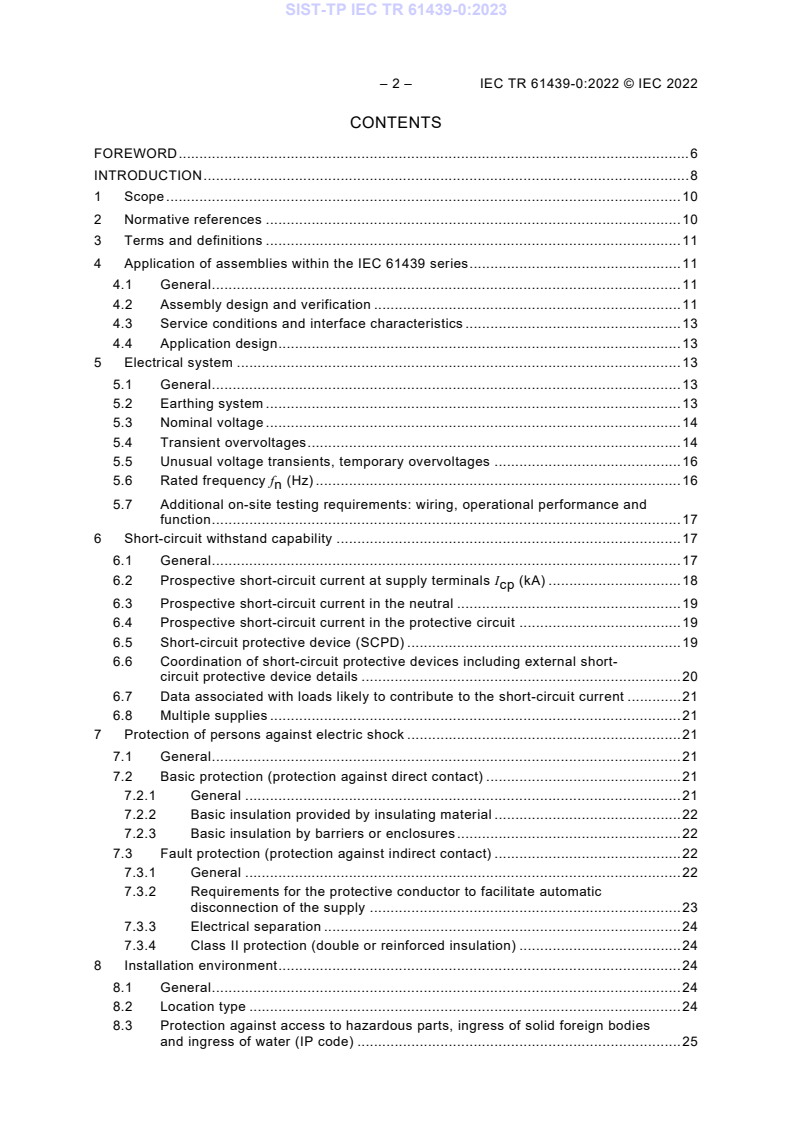
– 2 – IEC TR 61439-0:2022 © IEC 2022
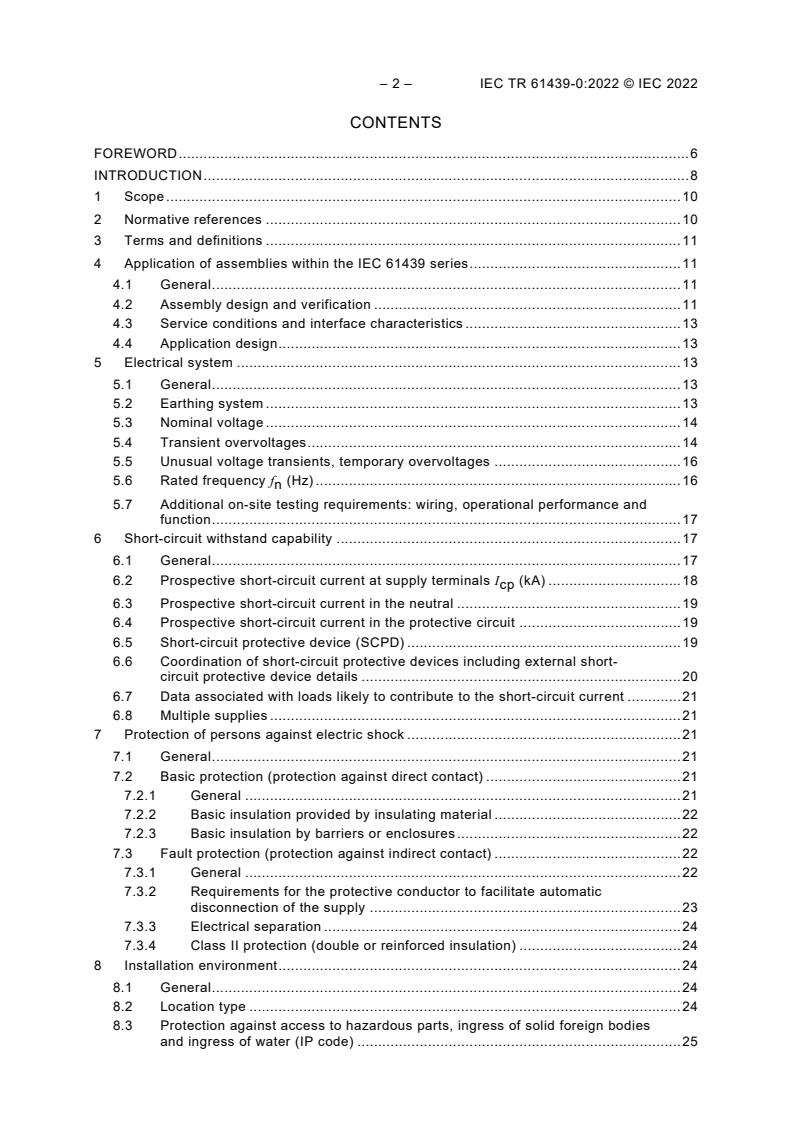
CONTENTS
FOREWORD . 6
INTRODUCTION . 8
1 Scope . 10
2 Normative references . 10
3 Terms and definitions . 11
4 Application of assemblies within the IEC 61439 series . 11
4.1 General . 11
4.2 Assembly design and verification . 11
4.3 Service conditions and interface characteristics . 13
4.4 Application design . 13
5 Electrical system . 13
5.1 General . 13
5.2 Earthing system . 13
5.3 Nominal voltage . 14
5.4 Transient overvoltages . 14
5.5 Unusual voltage transients, temporary overvoltages . 16
5.6 Rated frequency f (Hz) . 16
n
5.7 Additional on-site testing requirements: wiring, operational performance and
function . 17
6 Short-circuit withstand capability . 17
6.1 General . 17
6.2 Prospective short-circuit current at supply terminals I (kA) . 18
cp
6.3 Prospective short-circuit current in the neutral . 19
6.4 Prospective short-circuit current in the protective circuit . 19
6.5 Short-circuit protective device (SCPD) . 19
6.6 Coordination of short-circuit protective devices including external short-
circuit protective device details . 20
6.7 Data associated with loads likely to contribute to the short-circuit current . 21
6.8 Multiple supplies . 21
7 Protection of persons against electric shock . 21
7.1 General . 21
7.2 Basic protection (protection against direct contact) . 21
7.2.1 General . 21
7.2.2 Basic insulation provided by insulating material . 22
7.2.3 Basic insulation by barriers or enclosures . 22
7.3 Fault protection (protection against indirect contact) . 22
7.3.1 General . 22
7.3.2 Requirements for the protective conductor to facilitate automatic
disconnection of the supply . 23
7.3.3 Electrical separation . 24
7.3.4 Class II protection (double or reinforced insulation) . 24
8 Installation environment . 24
8.1 General . 24
8.2 Location type . 24
8.3 Protection against access to hazardous parts, ingress of solid foreign bodies
and ingress of water (IP code) . 25
8.4 External mechanical impact (IK code) . 28
8.5 Resistance to radiation . 29
8.5.1 General . 29
8.5.2 Solar irradiance . 29
8.5.3 Ultraviolet (UV) radiation . 29
8.6 Resistance to corrosion . 29
8.7 Ambient air temperature . 30
8.8 Maximum relative humidity . 30
8.9 Pollution degree . 31
8.10 Altitude . 32
8.11 Electromagnetic compatibility (EMC) . 32
8.12 Special service conditions . 33
8.12.1 General . 33
8.12.2 Climatic conditions . 34
8.12.3 Protection against ingress of solid foreign bodies and ingress of water
(IP code) . 34
8.12.4 Shock, vibration, seismic occurrence and external mechanical impact
(IK code) . 34
8.12.5 Fire and explosion hazards . 34
8.12.6 Exceptional overvoltages . 34
8.12.7 Polluted atmospheres . 35
8.12.8 EMC environment . 35
9 Installation method . 35
9.1 General . 35
9.2 Assembly type . 35
9.3 Portability . 36
9.4 Maximum overall dimensions and weight . 36
9.5 External conductor type(s) . 36
9.6 Direction(s) of external conductors . 37
9.7 External conductor material . 37
9.8 External line conductor, cross sections, and terminations . 37
9.9 External PE, N, PEN, PEM, PEL conductors’ cross sections, and
terminations . 37
9.10 Special terminal identification requirements . 38
10 Storage and handling. 38
10.1 General . 38
10.2 Maximum dimensions and weight of transport units . 38
10.3 Methods of transport (e.g. forklift, crane) . 38
10.4 Environmental conditions different from the service conditions . 39
10.5 Packing details . 39
11 Operating arrangements . 39
11.1 General . 39
11.2 Access to manually operated devices . 39
12 Maintenance and upgrade capabilities . 40
12.1 General . 40
12.2 Requirements related to accessibility for inspection and similar operations . 40
12.3 Requirements related to accessibility for maintenance in service by
authorized persons . 41
12.4 Requirements related to extension under voltage . 41
– 4 – IEC TR 61439-0:2022 © IEC 2022
12.5 Protection against direct contact with hazardous live internal parts during
maintenance or upgrade . 41
12.6 Method of functional unit connection . 42
12.7 Operating and maintenance gangways within an assembly . 42
12.8 Internal separation (only relevant for assemblies in accordance with
IEC 61439-2) . 42
12.8.1 Fundamentals of separation . 42
12.8.2 Considerations when determining a form of separation . 43
12.8.3 Selecting the most appropriate form of separation . 44
13 Current carrying capability . 46
13.1 General . 46
13.2 Rated current of the assembly I (A) (maximum current allowable) . 46
nA
13.3 Loading of outgoing circuits within an assembly . 47
13.4 Ratio of cross section of the neutral conductor to line conductors . 48
13.4.1 General . 48
13.4.2 Line conductors up to and including 16 mm . 48
13.4.3 Line conductors above 16 mm . 48
14 Assembly design and routine verification processes . 49
14.1 Design verification . 49
14.1.1 Object . 49
14.1.2 Methods . 49
14.1.3 Records . 50
14.2 Routine verification . 50
14.2.1 General . 50
14.2.2 Records . 50
Annex A (informative) Cross section of copper cables suitable for connection to
terminals for external cables . 51
Annex B (informative) Forms of internal separation (see 12.8) . 52
Annex C (informative) Specification template for assemblies . 58
Annex D (informative) Optional information . 62
D.1 General . 62
D.2 Electrical conditions . 63
D.2.1 Internal arc-fault considerations . 63
D.2.2 Insulated busbars . 64
Annex E (informative) List of notes concerning certain countries . 65
Bibliography . 66
Figure 1 – Required rated impulse withstand voltage . 16
Figure 2 – Examples of separation included in IEC 61439-2 . 45
Figure B.1 – Symbols used in Figure B.2, Figure B.3 and Figure B.4 . 53
Figure B.2 – Form 1 and Form 2 . 55
Figure B.3 – Form 3 . 56
Figure B.4 – Form 4 . 57
Table 1 – IP codes, first numeral . 26
Table 2 – IP codes, second numeral . 27
Table 3 – IP codes, additional letter (optional) . 28
Table 4 – Assemblies and application ratings . 48
Table A.1 – Cross section of copper cables suitable for connection to terminals for
external cables . 51
Table B.1 – Forms of internal separation. 52
Table C.1 – Example of items typically subject to agreement between the assembly
manufacturer and the user . 58
Table D.1 – Examples of optional items subject to agreement between the assembly
manufacturer and the specifier . 62
– 6 – IEC TR 61439-0:2022 © IEC 2022
INTERNATIONAL ELECTROTECHNICAL COMMISSION
____________
LOW-VOLTAGE SWITCHGEAR AND CONTROLGEAR ASSEMBLIES –
Part 0: Guidance to specifying assemblies
FOREWORD
1) The International Electrotechnical Commission (IEC) is a worldwide organization for standardization comprising
all national electrotechnical committees (IEC National Committees). The object of IEC is to promote international
co-operation on all questions concerning standardization in the electrical and electronic fields. To this end and
in addition to other activities, IEC publishes International Standards, Technical Specifications, Technical Reports,
Publicly Available Specifications (PAS) and Guides (hereafter referred to as “IEC Publication(s)”). Their
preparation is entrusted to technical committees; any IEC National Committee interested in the subject dealt with
may participate in this preparatory work. International, governmental and non-governmental organizations liaising
with the IEC also participate in this preparation. IEC collaborates closely with the International Organization for
Standardization (ISO) in accordance with conditions determined by agreement between the two organizations.
2) The formal decisions or agreements of IEC on technical matters express, as nearly as possible, an international
consensus of opinion on the relevant subjects since each technical committee has representation from all
interested IEC National Committees.
3) IEC Publications have the form of recommendations for international use and are accepted by IEC National
Committees in that sense. While all reasonable efforts are made to ensure that the technical content of IEC
Publications is accurate, IEC cannot be held responsible for the way in which they are used or for any
misinterpretation by any end user.
4) In order to promote international uniformity, IEC National Committees undertake to apply IEC Publications
transparently to the maximum extent possible in their national and regional publications. Any divergence between
any IEC Publication and the corresponding national or regional publication shall be clearly indicated in the latter.
5) IEC itself does not provide any attestation of conformity. Independent certification bodies provide conformity
assessment services and, in some areas, access to IEC marks of conformity. IEC is not responsible for any
services carried out by independent certification bodies.
6) All users should ensure that they have the latest edition of this publication.
7) No liability shall attach to IEC or its directors, employees, servants or agents including individual experts and
members of its technical committees and IEC National Committees for any personal injury, property damage or
other damage of any nature whatsoever, whether direct or indirect, or for costs (including legal fees) and
expenses arising out of the publication, use of, or reliance upon, this IEC Publication or any other IEC
Publications.
8) Attention is drawn to the Normative references cited in this publication. Use of the referenced publications is
indispensable for the correct application of this publication.
9) Attention is drawn to the possibility that some of the elements of this IEC Publication may be the subject of patent
rights. IEC shall not be held responsible for identifying any or all such patent rights.
IEC TR 61439-0 has been prepared by subcommittee 121B: Low-voltage switchgear and
controlgear assemblies, of IEC technical committee 121: Switchgear and controlgear and their
assemblies for low voltage. It is a Technical Report.
This third edition cancels and replaces the second edition published in 2013. It constitutes a
technical revision.
This third edition includes the following significant technical changes with respect to the
previous edition:
a) alignment with IEC 61439-1:2020;
b) addition of new content in Clause 13 regarding current ratings;
c) addition of a new subclause 12.8.1 detailing the fundamentals of the forms of internal
separation;
d) alignment of Annex B with Annex AA of 61439-2:2020;
e) removal of the annexes detailing items subject to agreement between specifier and
manufacturer for all product parts as not all of them can always be up to date
The text of this Technical Report is based on the following documents:
Draft Report on voting
121B/126/DTR 121B/152/RVDTR
Full information on the voting for its approval can be found in the report on voting indicated in
the above table.
The language used for the development of this Technical Report is English.
This document was drafted in accordance with ISO/IEC Directives, Part 2, and developed in
accordance with ISO/IEC Directives, Part 1 and ISO/IEC Directives, IEC Supplement, available
at www.iec.ch/members_experts/refdocs. The main document types developed by IEC are
described in greater detail at www.iec.ch/standardsdev/publications.
The reader’s attention is drawn to the fact that Annex E lists all of the “in-some-country” clauses
on differing practices of a less permanent nature relating to the subject of this document.
A list of all parts of the IEC 61439 series, under the general title Low-voltage switchgear and
controlgear assemblies, can be found on the IEC web site.
The committee has decided that the contents of this publication will remain unchanged until the
stability date indicated on the IEC web site under "http://webstore.iec.ch" in the data related to
the specific publication. At this date, the publication will be
• reconfirmed,
• withdrawn,
• replaced by a revised edition, or
• amended.
– 8 – IEC TR 61439-0:2022 © IEC 2022
INTRODUCTION
Low-voltage assemblies form an integral part of most electrical distribution networks. In their
application they have two prime functions:
– to safely control and distribute electrical energy; and
– to safely isolate sections of faulted networks.
Whilst these two functions place very different demands on the assembly, an assembly has to
be capable of performing both these functions throughout its expected service life. Controlling
and distributing electrical energy is the assembly’s routine ongoing duty. The second function,
fault management, is a very rare occurrence within a well-managed and maintained system.
Some assemblies will never be called upon to manage a fault, but if a fault does occur, it can
place immense thermal and mechanical stresses on the assembly in an instant. Any ageing or
deterioration of the assembly should be limited such that its safety function is not impaired.
Due to the nature of the application, if there are weaknesses in the design or application of an
assembly, it is possible they will not be identified until years after the assembly was installed.
In order to avoid latent issues, and to ensure that assemblies are suitable for their application,
they will be designed and verified to meet the exacting requirements defined in the IEC 61439
series of standards. However, as the IEC 61439 series covers a wide range of applications, and
some applications can be partially outside the scope of the standard, it is equally important that
assemblies are correctly specified. Where options are given in the IEC 61439 series, the most
suitable for the application will be selected; where the requirements are outside the scope of
the standards, detailed requirements will be agreed between the specifier and manufacturer.
This document identifies the significance of each characteristic to be considered when
specifying an assembly and provides the specifier with guidance on defining a suitable
assembly for their application.
For the purposes of this document, the specifier is the party who specifies or selects the
assembly characteristics. The specifier may be the same party as the one who will use and
operate the assembly, or someone acting on their behalf. The aim of this document is to provide
the specifier with guidance on the specification that should be provided in order to obtain an
assembly with the required performance and at optimised costs.
Throughout this document, the term “assembly” is used for a low-voltage switchgear and
controlgear assembly. The term “manufacturer” refers to the assembly manufacturer unless
specifically indicated otherwise.
The term “line conductor” is used in many places throughout this document. Previously the
terminology was phase conductors.
This document is focussed on the specifier, that is, the person or organization providing the
specification for the assembly. It is assumed the specifier is acting on behalf of the user.
The purpose of the IEC 61439 series of standards is to harmonize, as far as practicable, all the
general rules and requirements that apply to assemblies. The series further seeks, in order to
obtain uniformity of requirements for assemblies, consistency in the verification of assemblies
and to avoid the need for verification to other standards.
All the requirements for the various assemblies that can be considered as general, together
with specific subjects dedicated to performances and application, for example temperature rise,
short-circuit, dielectric properties, have therefore been gathered in IEC 61439-1 as general
rules. For each type of assembly only two main standards are necessary to determine all
requirements and the corresponding methods of verification:
1) the standard giving the general rules designated “IEC 61439-1”, and
2) the specific product part of the IEC 61439 series, hereinafter referred to as the relevant
product part of the IEC 61439 series.
The IEC 61439 series of standards encompasses assemblies for a wide variety of uses, some
of which have specific needs as imposed by their particular application. In order to clearly define
these specific needs, relevant product parts of the IEC 61439 series focussed on a particular
type of application have been (or are being) developed. These are identified as IEC 61439-2,
IEC 61439-3, and so on (for a list of all parts of the IEC 61439 series, refer to the IEC web site).
Each relevant product part of the IEC 61439 series with reference to IEC 61439-1, the general
rules, as appropriate, specifies the characteristics and performance required by an assembly
within its defined scope of application. Each relevant product part of the IEC 61439 series
includes, as an annex, a template for “items subject to agreement between the assembly
manufacturer and the specifier” to facilitate the specifying of an assembly.
General characteristics of all types of assemblies are considered in this document. Details
which are applicable to each type of assembly can be determined by reference to the
specification schedule in the relevant product part of the IEC 61439 series.
Within this document, reference to IEC 61439 means the current edition of the IEC 61439 series
of standards, including:
• IEC 61439-1, Low-voltage switchgear and controlgear assemblies – Part 1: General rules
• IEC 61439-2, Low-voltage switchgear and controlgear assemblies – Part 2: Power
switchgear and controlgear assemblies
• IEC 61439-3, Low-voltage switchgear and controlgear assemblies – Part 3: Distribution
boards intended to be operated by ordinary persons (DBO)
• IEC 61439-4, Low-voltage switchgear and controlgear assemblies – Part 4: Particular
requirements for assemblies for construction sites (ACS)
• IEC 61439-5, Low-voltage switchgear and controlgear assemblies – Part 5: Assemblies for
power distribution in public networks
• IEC 61439-6, Low-voltage switchgear and controlgear assemblies – Part 6: Busbar trunking
systems (busways)
• IEC 61439-7, Low-voltage switchgear and controlgear assemblies – Part 7: Assemblies for
specific applications such as marinas, camping sites, market squares, electric vehicles
charging stations
Refer to the IEC web site for the latest edition of each product part of the IEC 61439 series and
additional product part of the IEC 61439 series published for other specific applications.
NOTE Each product part of the IEC 61439 series is related to the appropriate edition of IEC 61439-1, as listed in
the product part, and the corresponding edition of IEC TR 61439-0.
A reference to “general rules” means a reference to IEC 61439-1:2020.
A reference to “product standard” means the relevant part or parts of the IEC standard for the
components used in the assembly (e.g. IEC 60947-2 for circuit-breakers).
– 10 – IEC TR 61439-0:2022 © IEC 2022
LOW-VOLTAGE SWITCHGEAR AND CONTROLGEAR ASSEMBLIES –
Part 0: Guidance to specifying assemblies
1 Scope
Within the IEC 61439 series of standards for low-voltage switchgear and controlgear
assemblies, there are system and application details that are specified by the specifier to enable
the manufacturer to produce an assembly that meets the needs and expectations of the specifier.
This part of IEC 61439, which is a technical report, identifies from the specifier’s perspective
those functions and characteristics that are defined when specifying assemblies. It provides:
– an explanation of the assembly characteristics and options within the IEC 61439 series;
– a guidance on how to select the appropriate options and define characteristics so as to meet
specific application needs; and
– an assistance in the specification of assemblies.
References within this document to the interface characteristics of an assembly and the
requirements with which they will comply assume that the assembly is designed, manufactured,
and verified in accordance with the relevant part of the IEC 61439 series.
2 Normative references
The following documents are referred to in the text in such a way that some or all of their content
constitutes requirements of this document. For dated references, only the edition cited applies.
For undated references, the latest edition of the referenced document (including any
amendments) applies.
IEC 61439 (all parts), Low-voltage switchgear and controlgear assemblies
IEC 61439-1:2020, Low-voltage switchgear and controlgear assemblies – Part 1: General rules
IEC 61439-2:2020, Low-voltage switchgear and controlgear assemblies – Part 2: Power
switchgear and controlgear assemblies
IEC 61439-3, Low-voltage switchgear and controlgear assemblies – Part 3: Distribution boards
intended to be operated by ordinary persons (DBO)
IEC 61439-4, Low-voltage switchgear and controlgear assemblies – Part 4: Particular
requirements for assemblies for construction sites (ACS)
IEC 61439-5, Low-voltage switchgear and controlgear assemblies – Part 5: Assemblies for
power distribution in public networks
IEC 61439-6, Low-voltage switchgear and controlgear assemblies – Part 6: Busbar trunking
systems (busways)
IEC 61439-7, Low-voltage switchgear and controlgear assemblies – Part 7: Assemblies for
specific applications such as marinas, camping sites, market squares, electric vehicle charging
stations
3 Terms and definitions
For the purposes of this document, the terms and definitions given in the IEC 61439 series
apply.
ISO and IEC maintain terminological databases for use in standardization at the following
addresses:
• IEC Electropedia: available at http://www.electropedia.org/
• ISO Online browsing platform: available at http://www.iso.org/obp
4 Application of assemblies within the IEC 61439 series
4.1 General
Assemblies manufactured in accordance with the relevant product part of the IEC 61439 series
are suitable for installation in the majority of operating environments. Many of the
characteristics of assemblies are fully defined within the standard and do not require further
consideration by the specifier. In some instances, there can be a default condition specified
within the standard and a range of other identified alternative options, from which the specifier
can choose to suit the application. For other characteristics, the specifier can be required to
choose from a list of options within the standard.
Specifiers are cautioned against over-specifying their requirements; it may not lead to a more
appropriate assembly for their application. More onerous requirements for one criterion usually
have a negative impact on others. For example, an outdoor assembly being specified to comply
with IP66 of IEC 60529, when a lower IP degree, for example IP33, will suffice, can:
– increase temperatures within the assembly due to the lack of ventilation with the effect that
the insulation ages more quickly;
– increase the risk of condensation causing tracking due to there being no ventilation and
therefore no air exchange with the environment outside of the assembly; and
– make the assembly larger and more expensive due to the need to manage the lack of
ventilation.
If special and exceptionally onerous conditions are likely to exist, these conditions should be
identified by the specifier. Examples of these onerous conditions include high ultraviolet (UV)
radiation applications, conditions of high particulates/pollutants, more stringent short-circuit
conditions, special fault protection, special protection due to risk of fire, internal arc-faults,
explosions, burns, etc.
In some instances, the specifier can wish to seek the advice of experts in order to identify their
requirements correctly, for example the cross section of the neutral conductor considering the
system harmonics.
Annex C is typical of the items to be agreed between the specifier and manufacturer when
specifying an assembly. The equivalent annex for each product can be found in the relevant
part of the IEC 61439 series. The specifier should complete the appropriate annex when
defining the interface characteristics for the assembly for their particular application. An
explanation of each interface characteristic is given in Clause 5 to Clause 14 inclusive.
Annex D provides guidance on optional information that a specifier may require for their specific
application.
4.2 Assembly design and verification
An assembly is intended to be used within an electrical installation of defined characteristics.
The assembly can be designed and verified with a specific set of application criteria, to suit a
– 12 – IEC TR 61439-0:2022 © IEC 2022
particular use, or more usually, it can be designed and verified to meet typical application
criteria that make it usable in a range of common applications.
The configuration for a particular specifier application of an assembly usually requires four main
steps:
a) Specification of the requirements and functions particular to the application. The specifier
should complete the table given in Annex C of the relevant product part of the IEC 61439
series.
b) The manufacturer derives the necessary interface characteristics and design of the
assembly to meet the specification. The design will generally be based on the
manufacturer’s previously developed assembly arrangements, characteristics and
functions.
c) For assemblies or parts of assemblies where the design is not previously proven, design
verification is carried out by the manufacturer.
d) Routine verification, carried out on each assembly by the manufacturer.
It is essential that the specifier always insists upon assemblies that are fully verified in
accordance with the appropriate product part of the IEC 61439 series. The nature of the
application is such that deficiencies in an assembly design may not be initially apparent or
readily identified from a cursory examination. For example:
1) The complex thermal effects within an assembly cannot be determined without formal
verification (test, comparison or assessment). Operating components, particularly
insulation, within an assembly at temperatures higher than intended may not cause an
immediate failure but accelerated ageing of insulation can cause a premature failure.
2) Short-circuit protective devices operate rarely during the lifetime of the assembly to interrupt
a fault. When some types of short-circuit protective devices interrupt a fault, they emit a hot
ionized gas which can bridge clearances and/or reduce creepage distances and cause a
flashover within the assembly. There can also be sudden build-up of gas pressure within
the assembly that forces doors and covers to open, possibly endangering anyone in close
proximity.
3) On the rare occasions that a short-circuit occurs, there are complex magnetic effects
associated with high short-circuit currents. These impose substantial mechanical loads on
conductor supports. The forces on the supports are affected by the shape of the conductors,
bends in the conductors, proximity of conductors to each other and ferrous metalwork, phase
relationships between the current in different conductors, and transient effects. All these
effects are very complex and therefore difficult to determine. If not correctly addressed,
conductors can pull together and create an internal arc-fault, or earthed steel housings or
structural supports can be pulled onto live busbar or connections, resulting in assembly
failure.
4) Voltage surges can occur due to switching, lightning and similar. Particularly those
associated with lightning are random occurrences. If and when they do occur, the assembly
has to offer sufficient tolerance (impulse voltage withstand) to the transient overvoltages or
a flashover will occur.
NOTE Surge protective devices can also be required to limit voltage surges. See installation rules for further
details.
5) Corrosion takes time, possibly years. If sufficient protection is not offered, particularly
corrosion protection of parts made of ferrous material, the life of the assembly can be
reduced, and safety compromised, by, for example, reduced mechanical properties of
mounting plates and/or busbar support systems, and reduced earth continuity between
different constructional parts.
6) The ageing of insulating materials is mainly a function of temperature and time, but different
insulating materials age at dramatically different rates for given operating conditions. When
insulating materials age their mechanical, and in some instances electrical properties,
degrade and can cause failures.
The issues listed above, and others, are avoided by using completely verified assemblies. In
some instances, with suitable design margins, the IEC 61439 series permits the verification to
be undertaken by assessment or comparison to a reference design. Where the performance is
less predictable the standard insists on testing as the means of design verification.
For further information on the design and routine verification carried out by the manufacturer,
see Clause 14.
4.3 Service conditions and interface characteristics
The characteristics of the assembly should be compatible with the ratings of the circuits to
which it is connected and the installation conditions.
Where no specification is provided, information given in the manufacturer's documentation may
take the place of an agreement between the manufacturer and the specifier.
It is assumed that the specifier will provide an electrical single line diagram, or equivalent, to
define the incoming and outgoing circuit arrangements, prospective short-circuit current at the
incoming terminals, loads, external conductors, and selected interface characteristics that are
required for the application of a specific assembly.
4.4 Application design
Once the requirements and functions particular to the application have been specified, the
manufacturer is responsible for the design of the assembly, so that it complies with the relevant
product part of the IEC 61439 series. From the information provided by the specifier, the
manufacturer will derive additional assembly characteristics necessary to provide an assembly
that fulfils the application requirements stated. Where the specifier does not indicate particular
requirements, the manufacturer may adopt their usual arrangement or the default arrangement
as given in the relevant product part of the IEC 61439 series.
5 Electrical system
5.1 General
The electrical system determines the electrical characteristics (capabilities, e.g. short-circuit
withstand) an assembly should have in order to perform its required duty safely for the
installation. The characteristics of the assembly should at all times be at least equal to the
requirements of the application and, where essential, they may exceed those offered in the
standard options detailed in the IEC 61439 series.
The specifier should provide an electrical single line diagram and/or any other information
necessary to define their req
...
IEC TR 61439-0 ®
Edition 3.0 2022-07
TECHNICAL
REPORT
RAPPORT
TECHNIQUE
Low-voltage switchgear and controlgear assemblies –
Part 0: Guidance to specifying assemblies
Ensembles d’appareillage à basse tension –
Partie 0: Recommandations pour la spécification d’ensembles
All rights reserved. Unless otherwise specified, no part of this publication may be reproduced or utilized in any form
or by any means, electronic or mechanical, including photocopying and microfilm, without permission in writing from
either IEC or IEC's member National Committee in the country of the requester. If you have any questions about IEC
copyright or have an enquiry about obtaining additional rights to this publication, please contact the address below or
your local IEC member National Committee for further information.
Droits de reproduction réservés. Sauf indication contraire, aucune partie de cette publication ne peut être reproduite
ni utilisée sous quelque forme que ce soit et par aucun procédé, électronique ou mécanique, y compris la photocopie
et les microfilms, sans l'accord écrit de l'IEC ou du Comité national de l'IEC du pays du demandeur. Si vous avez des
questions sur le copyright de l'IEC ou si vous désirez obtenir des droits supplémentaires sur cette publication, utilisez
les coordonnées ci-après ou contactez le Comité national de l'IEC de votre pays de résidence.
IEC Secretariat Tel.: +41 22 919 02 11
3, rue de Varembé info@iec.ch
CH-1211 Geneva 20 www.iec.ch
Switzerland
About the IEC
The International Electrotechnical Commission (IEC) is the leading global organization that prepares and publishes
International Standards for all electrical, electronic and related technologies.
About IEC publications
The technical content of IEC publications is kept under constant review by the IEC. Please make sure that you have the
latest edition, a corrigendum or an amendment might have been published.
IEC publications search - webstore.iec.ch/advsearchform IEC Products & Services Portal - products.iec.ch
The advanced search enables to find IEC publications by a Discover our powerful search engine and read freely all the
variety of criteria (reference number, text, technical publications previews. With a subscription you will always
committee, …). It also gives information on projects, replaced have access to up to date content tailored to your needs.
and withdrawn publications.
Electropedia - www.electropedia.org
IEC Just Published - webstore.iec.ch/justpublished
The world's leading online dictionary on electrotechnology,
Stay up to date on all new IEC publications. Just Published
containing more than 22 300 terminological entries in English
details all new publications released. Available online and
and French, with equivalent terms in 19 additional languages.
once a month by email.
Also known as the International Electrotechnical Vocabulary
(IEV) online.
IEC Customer Service Centre - webstore.iec.ch/csc
If you wish to give us your feedback on this publication or
need further assistance, please contact the Customer Service
Centre: sales@iec.ch.
A propos de l'IEC
La Commission Electrotechnique Internationale (IEC) est la première organisation mondiale qui élabore et publie des
Normes internationales pour tout ce qui a trait à l'électricité, à l'électronique et aux technologies apparentées.
A propos des publications IEC
Le contenu technique des publications IEC est constamment revu. Veuillez vous assurer que vous possédez l’édition la
plus récente, un corrigendum ou amendement peut avoir été publié.
Recherche de publications IEC - IEC Products & Services Portal - products.iec.ch
webstore.iec.ch/advsearchform Découvrez notre puissant moteur de recherche et consultez
La recherche avancée permet de trouver des publications IEC gratuitement tous les aperçus des publications. Avec un
en utilisant différents critères (numéro de référence, texte, abonnement, vous aurez toujours accès à un contenu à jour
comité d’études, …). Elle donne aussi des informations sur adapté à vos besoins.
les projets et les publications remplacées ou retirées.
Electropedia - www.electropedia.org
IEC Just Published - webstore.iec.ch/justpublished
Le premier dictionnaire d'électrotechnologie en ligne au
Restez informé sur les nouvelles publications IEC. Just
monde, avec plus de 22 300 articles terminologiques en
Published détaille les nouvelles publications parues.
anglais et en français, ainsi que les termes équivalents dans
Disponible en ligne et une fois par mois par email.
19 langues additionnelles. Egalement appelé Vocabulaire
Electrotechnique International (IEV) en ligne.
Service Clients - webstore.iec.ch/csc
Si vous désirez nous donner des commentaires sur cette
publication ou si vous avez des questions contactez-nous:
sales@iec.ch.
IEC TR 61439-0 ®
Edition 3.0 2022-07
TECHNICAL
REPORT
RAPPORT
TECHNIQUE
Low-voltage switchgear and controlgear assemblies –
Part 0: Guidance to specifying assemblies
Ensembles d’appareillage à basse tension –
Partie 0: Recommandations pour la spécification d’ensembles
INTERNATIONAL
ELECTROTECHNICAL
COMMISSION
COMMISSION
ELECTROTECHNIQUE
INTERNATIONALE
ICS 29.130.20 ISBN 978-2-8322-4027-4
– 2 – IEC TR 61439-0:2022 © IEC 2022
CONTENTS
FOREWORD . 6
INTRODUCTION . 8
1 Scope . 10
2 Normative references . 10
3 Terms and definitions . 11
4 Application of assemblies within the IEC 61439 series . 11
4.1 General . 11
4.2 Assembly design and verification . 11
4.3 Service conditions and interface characteristics . 13
4.4 Application design . 13
5 Electrical system . 13
5.1 General . 13
5.2 Earthing system . 13
5.3 Nominal voltage . 14
5.4 Transient overvoltages . 14
5.5 Unusual voltage transients, temporary overvoltages . 16
5.6 Rated frequency f (Hz) . 16
n
5.7 Additional on-site testing requirements: wiring, operational performance and
function . 17
6 Short-circuit withstand capability . 17
6.1 General . 17
6.2 Prospective short-circuit current at supply terminals I (kA) . 18
cp
6.3 Prospective short-circuit current in the neutral . 19
6.4 Prospective short-circuit current in the protective circuit . 19
6.5 Short-circuit protective device (SCPD) . 19
6.6 Coordination of short-circuit protective devices including external short-
circuit protective device details . 20
6.7 Data associated with loads likely to contribute to the short-circuit current . 21
6.8 Multiple supplies . 21
7 Protection of persons against electric shock . 21
7.1 General . 21
7.2 Basic protection (protection against direct contact) . 21
7.2.1 General . 21
7.2.2 Basic insulation provided by insulating material . 22
7.2.3 Basic insulation by barriers or enclosures . 22
7.3 Fault protection (protection against indirect contact) . 22
7.3.1 General . 22
7.3.2 Requirements for the protective conductor to facilitate automatic
disconnection of the supply . 23
7.3.3 Electrical separation . 24
7.3.4 Class II protection (double or reinforced insulation) . 24
8 Installation environment . 24
8.1 General . 24
8.2 Location type . 24
8.3 Protection against access to hazardous parts, ingress of solid foreign bodies
and ingress of water (IP code) . 25
8.4 External mechanical impact (IK code) . 28
8.5 Resistance to radiation . 29
8.5.1 General . 29
8.5.2 Solar irradiance . 29
8.5.3 Ultraviolet (UV) radiation . 29
8.6 Resistance to corrosion . 29
8.7 Ambient air temperature . 30
8.8 Maximum relative humidity . 30
8.9 Pollution degree . 31
8.10 Altitude . 32
8.11 Electromagnetic compatibility (EMC) . 32
8.12 Special service conditions . 33
8.12.1 General . 33
8.12.2 Climatic conditions . 34
8.12.3 Protection against ingress of solid foreign bodies and ingress of water
(IP code) . 34
8.12.4 Shock, vibration, seismic occurrence and external mechanical impact
(IK code) . 34
8.12.5 Fire and explosion hazards . 34
8.12.6 Exceptional overvoltages . 34
8.12.7 Polluted atmospheres . 35
8.12.8 EMC environment . 35
9 Installation method . 35
9.1 General . 35
9.2 Assembly type . 35
9.3 Portability . 36
9.4 Maximum overall dimensions and weight . 36
9.5 External conductor type(s) . 36
9.6 Direction(s) of external conductors . 37
9.7 External conductor material . 37
9.8 External line conductor, cross sections, and terminations . 37
9.9 External PE, N, PEN, PEM, PEL conductors’ cross sections, and
terminations . 37
9.10 Special terminal identification requirements . 38
10 Storage and handling. 38
10.1 General . 38
10.2 Maximum dimensions and weight of transport units . 38
10.3 Methods of transport (e.g. forklift, crane) . 38
10.4 Environmental conditions different from the service conditions . 39
10.5 Packing details . 39
11 Operating arrangements . 39
11.1 General . 39
11.2 Access to manually operated devices . 39
12 Maintenance and upgrade capabilities . 40
12.1 General . 40
12.2 Requirements related to accessibility for inspection and similar operations . 40
12.3 Requirements related to accessibility for maintenance in service by
authorized persons . 41
12.4 Requirements related to extension under voltage . 41
– 4 – IEC TR 61439-0:2022 © IEC 2022
12.5 Protection against direct contact with hazardous live internal parts during
maintenance or upgrade . 41
12.6 Method of functional unit connection . 42
12.7 Operating and maintenance gangways within an assembly . 42
12.8 Internal separation (only relevant for assemblies in accordance with
IEC 61439-2) . 42
12.8.1 Fundamentals of separation . 42
12.8.2 Considerations when determining a form of separation . 43
12.8.3 Selecting the most appropriate form of separation . 44
13 Current carrying capability . 46
13.1 General . 46
13.2 Rated current of the assembly I (A) (maximum current allowable) . 46
nA
13.3 Loading of outgoing circuits within an assembly . 47
13.4 Ratio of cross section of the neutral conductor to line conductors . 48
13.4.1 General . 48
13.4.2 Line conductors up to and including 16 mm . 48
13.4.3 Line conductors above 16 mm . 48
14 Assembly design and routine verification processes . 49
14.1 Design verification . 49
14.1.1 Object . 49
14.1.2 Methods . 49
14.1.3 Records . 50
14.2 Routine verification . 50
14.2.1 General . 50
14.2.2 Records . 50
Annex A (informative) Cross section of copper cables suitable for connection to
terminals for external cables . 51
Annex B (informative) Forms of internal separation (see 12.8) . 52
Annex C (informative) Specification template for assemblies . 58
Annex D (informative) Optional information . 62
D.1 General . 62
D.2 Electrical conditions . 63
D.2.1 Internal arc-fault considerations . 63
D.2.2 Insulated busbars . 64
Annex E (informative) List of notes concerning certain countries . 65
Bibliography . 66
Figure 1 – Required rated impulse withstand voltage . 16
Figure 2 – Examples of separation included in IEC 61439-2 . 45
Figure B.1 – Symbols used in Figure B.2, Figure B.3 and Figure B.4 . 53
Figure B.2 – Form 1 and Form 2 . 55
Figure B.3 – Form 3 . 56
Figure B.4 – Form 4 . 57
Table 1 – IP codes, first numeral . 26
Table 2 – IP codes, second numeral . 27
Table 3 – IP codes, additional letter (optional) . 28
Table 4 – Assemblies and application ratings . 48
Table A.1 – Cross section of copper cables suitable for connection to terminals for
external cables . 51
Table B.1 – Forms of internal separation. 52
Table C.1 – Example of items typically subject to agreement between the assembly
manufacturer and the user . 58
Table D.1 – Examples of optional items subject to agreement between the assembly
manufacturer and the specifier . 62
– 6 – IEC TR 61439-0:2022 © IEC 2022
INTERNATIONAL ELECTROTECHNICAL COMMISSION
____________
LOW-VOLTAGE SWITCHGEAR AND CONTROLGEAR ASSEMBLIES –
Part 0: Guidance to specifying assemblies
FOREWORD
1) The International Electrotechnical Commission (IEC) is a worldwide organization for standardization comprising
all national electrotechnical committees (IEC National Committees). The object of IEC is to promote international
co-operation on all questions concerning standardization in the electrical and electronic fields. To this end and
in addition to other activities, IEC publishes International Standards, Technical Specifications, Technical Reports,
Publicly Available Specifications (PAS) and Guides (hereafter referred to as “IEC Publication(s)”). Their
preparation is entrusted to technical committees; any IEC National Committee interested in the subject dealt with
may participate in this preparatory work. International, governmental and non-governmental organizations liaising
with the IEC also participate in this preparation. IEC collaborates closely with the International Organization for
Standardization (ISO) in accordance with conditions determined by agreement between the two organizations.
2) The formal decisions or agreements of IEC on technical matters express, as nearly as possible, an international
consensus of opinion on the relevant subjects since each technical committee has representation from all
interested IEC National Committees.
3) IEC Publications have the form of recommendations for international use and are accepted by IEC National
Committees in that sense. While all reasonable efforts are made to ensure that the technical content of IEC
Publications is accurate, IEC cannot be held responsible for the way in which they are used or for any
misinterpretation by any end user.
4) In order to promote international uniformity, IEC National Committees undertake to apply IEC Publications
transparently to the maximum extent possible in their national and regional publications. Any divergence between
any IEC Publication and the corresponding national or regional publication shall be clearly indicated in the latter.
5) IEC itself does not provide any attestation of conformity. Independent certification bodies provide conformity
assessment services and, in some areas, access to IEC marks of conformity. IEC is not responsible for any
services carried out by independent certification bodies.
6) All users should ensure that they have the latest edition of this publication.
7) No liability shall attach to IEC or its directors, employees, servants or agents including individual experts and
members of its technical committees and IEC National Committees for any personal injury, property damage or
other damage of any nature whatsoever, whether direct or indirect, or for costs (including legal fees) and
expenses arising out of the publication, use of, or reliance upon, this IEC Publication or any other IEC
Publications.
8) Attention is drawn to the Normative references cited in this publication. Use of the referenced publications is
indispensable for the correct application of this publication.
9) Attention is drawn to the possibility that some of the elements of this IEC Publication may be the subject of patent
rights. IEC shall not be held responsible for identifying any or all such patent rights.
IEC TR 61439-0 has been prepared by subcommittee 121B: Low-voltage switchgear and
controlgear assemblies, of IEC technical committee 121: Switchgear and controlgear and their
assemblies for low voltage. It is a Technical Report.
This third edition cancels and replaces the second edition published in 2013. It constitutes a
technical revision.
This third edition includes the following significant technical changes with respect to the
previous edition:
a) alignment with IEC 61439-1:2020;
b) addition of new content in Clause 13 regarding current ratings;
c) addition of a new subclause 12.8.1 detailing the fundamentals of the forms of internal
separation;
d) alignment of Annex B with Annex AA of 61439-2:2020;
e) removal of the annexes detailing items subject to agreement between specifier and
manufacturer for all product parts as not all of them can always be up to date
The text of this Technical Report is based on the following documents:
Draft Report on voting
121B/126/DTR 121B/152/RVDTR
Full information on the voting for its approval can be found in the report on voting indicated in
the above table.
The language used for the development of this Technical Report is English.
This document was drafted in accordance with ISO/IEC Directives, Part 2, and developed in
accordance with ISO/IEC Directives, Part 1 and ISO/IEC Directives, IEC Supplement, available
at www.iec.ch/members_experts/refdocs. The main document types developed by IEC are
described in greater detail at www.iec.ch/standardsdev/publications.
The reader’s attention is drawn to the fact that Annex E lists all of the “in-some-country” clauses
on differing practices of a less permanent nature relating to the subject of this document.
A list of all parts of the IEC 61439 series, under the general title Low-voltage switchgear and
controlgear assemblies, can be found on the IEC web site.
The committee has decided that the contents of this publication will remain unchanged until the
stability date indicated on the IEC web site under "http://webstore.iec.ch" in the data related to
the specific publication. At this date, the publication will be
• reconfirmed,
• withdrawn,
• replaced by a revised edition, or
• amended.
– 8 – IEC TR 61439-0:2022 © IEC 2022
INTRODUCTION
Low-voltage assemblies form an integral part of most electrical distribution networks. In their
application they have two prime functions:
– to safely control and distribute electrical energy; and
– to safely isolate sections of faulted networks.
Whilst these two functions place very different demands on the assembly, an assembly has to
be capable of performing both these functions throughout its expected service life. Controlling
and distributing electrical energy is the assembly’s routine ongoing duty. The second function,
fault management, is a very rare occurrence within a well-managed and maintained system.
Some assemblies will never be called upon to manage a fault, but if a fault does occur, it can
place immense thermal and mechanical stresses on the assembly in an instant. Any ageing or
deterioration of the assembly should be limited such that its safety function is not impaired.
Due to the nature of the application, if there are weaknesses in the design or application of an
assembly, it is possible they will not be identified until years after the assembly was installed.
In order to avoid latent issues, and to ensure that assemblies are suitable for their application,
they will be designed and verified to meet the exacting requirements defined in the IEC 61439
series of standards. However, as the IEC 61439 series covers a wide range of applications, and
some applications can be partially outside the scope of the standard, it is equally important that
assemblies are correctly specified. Where options are given in the IEC 61439 series, the most
suitable for the application will be selected; where the requirements are outside the scope of
the standards, detailed requirements will be agreed between the specifier and manufacturer.
This document identifies the significance of each characteristic to be considered when
specifying an assembly and provides the specifier with guidance on defining a suitable
assembly for their application.
For the purposes of this document, the specifier is the party who specifies or selects the
assembly characteristics. The specifier may be the same party as the one who will use and
operate the assembly, or someone acting on their behalf. The aim of this document is to provide
the specifier with guidance on the specification that should be provided in order to obtain an
assembly with the required performance and at optimised costs.
Throughout this document, the term “assembly” is used for a low-voltage switchgear and
controlgear assembly. The term “manufacturer” refers to the assembly manufacturer unless
specifically indicated otherwise.
The term “line conductor” is used in many places throughout this document. Previously the
terminology was phase conductors.
This document is focussed on the specifier, that is, the person or organization providing the
specification for the assembly. It is assumed the specifier is acting on behalf of the user.
The purpose of the IEC 61439 series of standards is to harmonize, as far as practicable, all the
general rules and requirements that apply to assemblies. The series further seeks, in order to
obtain uniformity of requirements for assemblies, consistency in the verification of assemblies
and to avoid the need for verification to other standards.
All the requirements for the various assemblies that can be considered as general, together
with specific subjects dedicated to performances and application, for example temperature rise,
short-circuit, dielectric properties, have therefore been gathered in IEC 61439-1 as general
rules. For each type of assembly only two main standards are necessary to determine all
requirements and the corresponding methods of verification:
1) the standard giving the general rules designated “IEC 61439-1”, and
2) the specific product part of the IEC 61439 series, hereinafter referred to as the relevant
product part of the IEC 61439 series.
The IEC 61439 series of standards encompasses assemblies for a wide variety of uses, some
of which have specific needs as imposed by their particular application. In order to clearly define
these specific needs, relevant product parts of the IEC 61439 series focussed on a particular
type of application have been (or are being) developed. These are identified as IEC 61439-2,
IEC 61439-3, and so on (for a list of all parts of the IEC 61439 series, refer to the IEC web site).
Each relevant product part of the IEC 61439 series with reference to IEC 61439-1, the general
rules, as appropriate, specifies the characteristics and performance required by an assembly
within its defined scope of application. Each relevant product part of the IEC 61439 series
includes, as an annex, a template for “items subject to agreement between the assembly
manufacturer and the specifier” to facilitate the specifying of an assembly.
General characteristics of all types of assemblies are considered in this document. Details
which are applicable to each type of assembly can be determined by reference to the
specification schedule in the relevant product part of the IEC 61439 series.
Within this document, reference to IEC 61439 means the current edition of the IEC 61439 series
of standards, including:
• IEC 61439-1, Low-voltage switchgear and controlgear assemblies – Part 1: General rules
• IEC 61439-2, Low-voltage switchgear and controlgear assemblies – Part 2: Power
switchgear and controlgear assemblies
• IEC 61439-3, Low-voltage switchgear and controlgear assemblies – Part 3: Distribution
boards intended to be operated by ordinary persons (DBO)
• IEC 61439-4, Low-voltage switchgear and controlgear assemblies – Part 4: Particular
requirements for assemblies for construction sites (ACS)
• IEC 61439-5, Low-voltage switchgear and controlgear assemblies – Part 5: Assemblies for
power distribution in public networks
• IEC 61439-6, Low-voltage switchgear and controlgear assemblies – Part 6: Busbar trunking
systems (busways)
• IEC 61439-7, Low-voltage switchgear and controlgear assemblies – Part 7: Assemblies for
specific applications such as marinas, camping sites, market squares, electric vehicles
charging stations
Refer to the IEC web site for the latest edition of each product part of the IEC 61439 series and
additional product part of the IEC 61439 series published for other specific applications.
NOTE Each product part of the IEC 61439 series is related to the appropriate edition of IEC 61439-1, as listed in
the product part, and the corresponding edition of IEC TR 61439-0.
A reference to “general rules” means a reference to IEC 61439-1:2020.
A reference to “product standard” means the relevant part or parts of the IEC standard for the
components used in the assembly (e.g. IEC 60947-2 for circuit-breakers).
– 10 – IEC TR 61439-0:2022 © IEC 2022
LOW-VOLTAGE SWITCHGEAR AND CONTROLGEAR ASSEMBLIES –
Part 0: Guidance to specifying assemblies
1 Scope
Within the IEC 61439 series of standards for low-voltage switchgear and controlgear
assemblies, there are system and application details that are specified by the specifier to enable
the manufacturer to produce an assembly that meets the needs and expectations of the specifier.
This part of IEC 61439, which is a technical report, identifies from the specifier’s perspective
those functions and characteristics that are defined when specifying assemblies. It provides:
– an explanation of the assembly characteristics and options within the IEC 61439 series;
– a guidance on how to select the appropriate options and define characteristics so as to meet
specific application needs; and
– an assistance in the specification of assemblies.
References within this document to the interface characteristics of an assembly and the
requirements with which they will comply assume that the assembly is designed, manufactured,
and verified in accordance with the relevant part of the IEC 61439 series.
2 Normative references
The following documents are referred to in the text in such a way that some or all of their content
constitutes requirements of this document. For dated references, only the edition cited applies.
For undated references, the latest edition of the referenced document (including any
amendments) applies.
IEC 61439 (all parts), Low-voltage switchgear and controlgear assemblies
IEC 61439-1:2020, Low-voltage switchgear and controlgear assemblies – Part 1: General rules
IEC 61439-2:2020, Low-voltage switchgear and controlgear assemblies – Part 2: Power
switchgear and controlgear assemblies
IEC 61439-3, Low-voltage switchgear and controlgear assemblies – Part 3: Distribution boards
intended to be operated by ordinary persons (DBO)
IEC 61439-4, Low-voltage switchgear and controlgear assemblies – Part 4: Particular
requirements for assemblies for construction sites (ACS)
IEC 61439-5, Low-voltage switchgear and controlgear assemblies – Part 5: Assemblies for
power distribution in public networks
IEC 61439-6, Low-voltage switchgear and controlgear assemblies – Part 6: Busbar trunking
systems (busways)
IEC 61439-7, Low-voltage switchgear and controlgear assemblies – Part 7: Assemblies for
specific applications such as marinas, camping sites, market squares, electric vehicle charging
stations
3 Terms and definitions
For the purposes of this document, the terms and definitions given in the IEC 61439 series
apply.
ISO and IEC maintain terminological databases for use in standardization at the following
addresses:
• IEC Electropedia: available at http://www.electropedia.org/
• ISO Online browsing platform: available at http://www.iso.org/obp
4 Application of assemblies within the IEC 61439 series
4.1 General
Assemblies manufactured in accordance with the relevant product part of the IEC 61439 series
are suitable for installation in the majority of operating environments. Many of the
characteristics of assemblies are fully defined within the standard and do not require further
consideration by the specifier. In some instances, there can be a default condition specified
within the standard and a range of other identified alternative options, from which the specifier
can choose to suit the application. For other characteristics, the specifier can be required to
choose from a list of options within the standard.
Specifiers are cautioned against over-specifying their requirements; it may not lead to a more
appropriate assembly for their application. More onerous requirements for one criterion usually
have a negative impact on others. For example, an outdoor assembly being specified to comply
with IP66 of IEC 60529, when a lower IP degree, for example IP33, will suffice, can:
– increase temperatures within the assembly due to the lack of ventilation with the effect that
the insulation ages more quickly;
– increase the risk of condensation causing tracking due to there being no ventilation and
therefore no air exchange with the environment outside of the assembly; and
– make the assembly larger and more expensive due to the need to manage the lack of
ventilation.
If special and exceptionally onerous conditions are likely to exist, these conditions should be
identified by the specifier. Examples of these onerous conditions include high ultraviolet (UV)
radiation applications, conditions of high particulates/pollutants, more stringent short-circuit
conditions, special fault protection, special protection due to risk of fire, internal arc-faults,
explosions, burns, etc.
In some instances, the specifier can wish to seek the advice of experts in order to identify their
requirements correctly, for example the cross section of the neutral conductor considering the
system harmonics.
Annex C is typical of the items to be agreed between the specifier and manufacturer when
specifying an assembly. The equivalent annex for each product can be found in the relevant
part of the IEC 61439 series. The specifier should complete the appropriate annex when
defining the interface characteristics for the assembly for their particular application. An
explanation of each interface characteristic is given in Clause 5 to Clause 14 inclusive.
Annex D provides guidance on optional information that a specifier may require for their specific
application.
4.2 Assembly design and verification
An assembly is intended to be used within an electrical installation of defined characteristics.
The assembly can be designed and verified with a specific set of application criteria, to suit a
– 12 – IEC TR 61439-0:2022 © IEC 2022
particular use, or more usually, it can be designed and verified to meet typical application
criteria that make it usable in a range of common applications.
The configuration for a particular specifier application of an assembly usually requires four main
steps:
a) Specification of the requirements and functions particular to the application. The specifier
should complete the table given in Annex C of the relevant product part of the IEC 61439
series.
b) The manufacturer derives the necessary interface characteristics and design of the
assembly to meet the specification. The design will generally be based on the
manufacturer’s previously developed assembly arrangements, characteristics and
functions.
c) For assemblies or parts of assemblies where the design is not previously proven, design
verification is carried out by the manufacturer.
d) Routine verification, carried out on each assembly by the manufacturer.
It is essential that the specifier always insists upon assemblies that are fully verified in
accordance with the appropriate product part of the IEC 61439 series. The nature of the
application is such that deficiencies in an assembly design may not be initially apparent or
readily identified from a cursory examination. For example:
1) The complex thermal effects within an assembly cannot be determined without formal
verification (test, comparison or assessment). Operating components, particularly
insulation, within an assembly at temperatures higher than intended may not cause an
immediate failure but accelerated ageing of insulation can cause a premature failure.
2) Short-circuit protective devices operate rarely during the lifetime of the assembly to interrupt
a fault. When some types of short-circuit protective devices interrupt a fault, they emit a hot
ionized gas which can bridge clearances and/or reduce creepage distances and cause a
flashover within the assembly. There can also be sudden build-up of gas pressure within
the assembly that forces doors and covers to open, possibly endangering anyone in close
proximity.
3) On the rare occasions that a short-circuit occurs, there are complex magnetic effects
associated with high short-circuit currents. These impose substantial mechanical loads on
conductor supports. The forces on the supports are affected by the shape of the conductors,
bends in the conductors, proximity of conductors to each other and ferrous metalwork, phase
relationships between the current in different conductors, and transient effects. All these
effects
...
S L O V E N S K I SIST-TP IEC TR 61439-0
S T A N D A R D
september 2023
Sestavi nizkonapetostnih stikalnih in krmilnih naprav – 0. del: Navodila za
specificiranje sestavov
Low-voltage switchgear and controlgear assemblies – Part 0: Guidance to
specifying assemblies
Ensembles d'appareillage à basse tension – Partie 0: Recommandations pour la
spécification d’ensembles
Referenčna oznaka
ICS 29.130.20 SIST-TP IEC TR 61439-0:2023 (sl)
Nadaljevanje na straneh 2 do 67
© 2026-04. Slovenski inštitut za standardizacijo. Razmnoževanje celote ali delov tega standarda ni dovoljeno.
SIST-TP IEC TR 61439-0 : 2023
NACIONALNI UVOD
Tehnično poročilo SIST-TP IEC TR 61439-0 (sl), Sestavi nizkonapetostnih stikalnih in krmilnih naprav –
0. del: Navodila za specificiranje sestavov, 2023, ima status slovenskega tehničnega poročila in je
istoveten z mednarodnim tehničnim poročilom IEC TR 61439-0 (en), Low-voltage switchgear and
controlgear assemblies – Part 0: Guidance to specifying assemblies, 2022.
NACIONALNI PREDGOVOR
Mednarodno tehnično poročilo IEC TR 61439-0:2022 je pripravil tehnični odbor Mednarodne
elektrotehniške komisije IEC/SC 121B Sestavi nizkonapetostnih stikalnih in krmilnih naprav.
Slovensko tehnično poročilo SIST-TP IEC TR 61439-0:2023 je prevod mednarodnega tehničnega
poročila IEC TR 61439-0:2022. V primeru spora glede besedila slovenskega prevoda v tem tehničnem
poročilu je odločilno izvirno mednarodno tehnično poročilo v angleškem jeziku. Slovensko izdajo
tehničnega poročila je potrdil tehnični odbor SIST/TC SKA Stikalni in krmilni aparati.
Odločitev za privzem tega tehničnega poročila je septembra 2023 sprejel tehnični odbor SIST/TC SKA
Stikalni in krmilni aparati.
ZVEZA Z NACIONALNIMI STANDARDI
S privzemom tega evropskega tehničnega poročila veljajo za omejeni namen referenčnih standardov
vsi standardi, navedeni v izvirniku, razen tistih, ki so že sprejeti v nacionalno standardizacijo:
SIST EN IEC 61439 (vsi deli) Sestavi nizkonapetostnih stikalnih in krmilnih naprav
SIST EN IEC 61439-1:2021 Sestavi nizkonapetostnih stikalnih in krmilnih naprav – 1. del: Splošna
pravila
SIST EN IEC 61439-2:2021 Sestavi nizkonapetostnih stikalnih in krmilnih naprav – 2. del: Sestavi
močnostnih stikalnih in krmilnih naprav
SIST EN 61439-3 Sestavi nizkonapetostnih stikalnih in krmilnih naprav – 3. del: Električni
razdelilniki, s katerimi lahko ravnajo nestrokovnjaki (DBO)
SIST EN 61439-4 Sestavi nizkonapetostnih stikalnih in krmilnih naprav – 4. del: Posebne
zahteve za sestave na gradbiščih (ACS)
SIST EN IEC 61439-5 Sestavi nizkonapetostnih stikalnih in krmilnih naprav – 5. del: Sestavi
za distribucijo električne energije v javnih omrežjih
SIST EN 61439-6 Sestavi nizkonapetostnih stikalnih in krmilnih naprav – 6. del: Zbiralčni
povezovalni sistemi (zbiralčna vodila)
SIST EN IEC 61439-7 Sestavi nizkonapetostnih stikalnih in krmilnih naprav – 7. del: Sestavi
za posebno uporabo, na primer za marine, prostore za kampiranje,
tržnice, napajalne postaje za električna vozila
OSNOVA ZA IZDAJO TEHNIČNEGA POROČILA
– privzem tehničnega poročila IEC TR 61439-0:2022 (en)
OPOMBI
̶ Povsod, kjer se v besedilu tehničnega poročila uporablja izraz "mednarodno tehnično poročilo", v
– Nacionalni uvod in nacionalni predgovor nista sestavni del tehničnega poročila.
SIST-TP IEC TR 61439-0 : 2023
Vsebina Stran
Predgovor . 7
Uvod . 9
1 Področje uporabe .11
2 Zveze s standardi .11
3 Izrazi in definicije .11
4 Obravnava sestavov v skupini standardov IEC 61439 .12
4.1 Splošno .12
4.2 Zasnova in preverjanje sestava .12
4.3 Pogoji delovanja in karakteristike vmesnika .13
4.4 Zasnova .14
5 Električni sistem .14
5.1 Splošno .14
5.2 Ozemljitveni sistem .14
5.3 Nazivna napetost .15
5.4 Prehodne prenapetosti .15
5.5 Neobičajne prehodne napetosti, začasne prenapetosti .16
5.6 Naznačena frekvenca f (Hz) .17
n
5.7 Dodatne zahteve za preskušanje na mestu namestitve: ožičenje, obratovalne zmogljivosti
in funkcija .17
6 Kratkostična vzdržljivost .17
6.1 Splošno .17
6.2 Pričakovani kratkostični tok na napajalnih sponkah I (kA) .18
cp
6.3 Pričakovani kratkostični tok v nevtralnem vodniku .19
6.4 Pričakovani kratkostični tok v zaščitnem tokokrogu .19
6.5 Kratkostična zaščitna naprava .19
6.6 Koordinacija kratkostičnih zaščitnih naprav, vključno s podrobnostmi o zunanjih kratkostičnih
zaščitnih napravah .20
6.7 Podatki v zvezi z bremeni, ki lahko prispevajo h kratkostičnemu toku .21
6.8 Napajanje iz več virov.21
7 Zaščita oseb pred električnim udarom .21
7.1 Splošno .21
7.2 Osnovna zaščita (zaščita pred neposrednim dotikom) .21
7.2.1 Splošno .21
7.2.2 Osnovna izolacija, zagotovljena z izolacijskim materialom .22
7.2.3 Osnovna izolacija s pregradami in okrovi .22
7.3 Zaščita ob okvari (zaščita pred posrednim dotikom) .22
7.3.1 Splošno .22
SIST-TP IEC TR 61439-0 : 2023
7.3.2 Zahteve za zaščitni vodnik, ki omogoča samodejni odklop napajanja .22
7.3.3 Električna ločitev .23
7.3.4 Zaščita razreda II (dvojna ali ojačena izolacija) .23
8 Okolje namestitve .24
8.1 Splošno .24
8.2 Vrsta kraja namestitve .24
8.3 Zaščita pred dostopom do nevarnih delov, vdorom trdnih tujkov in vdorom vode (koda IP) .24
8.4 Zunanji mehanski vplivi (koda IK) .28
8.5 Odpornost proti sevanju .29
8.5.1 Splošno .29
8.5.2 Sončno obsevanje .29
8.5.3 Ultravijolično (UV) sevanje .29
8.6 Odpornost proti koroziji.29
8.7 Temperatura zraka okolice .30
8.8 Največja relativna vlažnost .30
8.9 Stopnja onesnaženja .31
8.10 Nadmorska višina .31
8.11 Elektromagnetna združljivost .32
8.12 Posebni obratovalni pogoji .33
8.12.1 Splošno .33
8.12.2 Podnebni pogoji .33
8.12.3 Zaščita pred vdorom trdnih tujkov in vode (koda IP) .33
8.12.4 Udar, vibracije, seizmični pojav in zunanji mehanski vpliv (koda IK) .34
8.12.5 Nevarnost požara in eksplozij .34
8.12.6 Izjemne prenapetosti .34
8.12.7 Onesnažene atmosfere .34
8.12.8 Okolje EMC .34
9 Način nameščanja .35
9.1 Splošno .35
9.2 Vrsta sestava .35
9.3 Prenosnost .36
9.4 Največje zunanje mere in masa .36
9.5 Vrsta(-e) zunanjih vodnikov .36
9.6 Smer(-i) zunanjih vodnikov .37
9.7 Material zunanjih vodnikov .37
9.8 Zunanji linijski vodnik, prerezi in končniki .37
9.9 Prerezi zunanjih vodnikov PE, N, PEN, PEM, PEL in končnikov .37
9.10 Posebne zahteve za označevanje sponk .38
10 Skladiščenje in ravnanje .38
10.1 Splošno .38
SIST-TP IEC TR 61439-0 : 2023
10.2 Največje mere in masa transportnih enot .38
10.3 Načini prevoza (na primer viličar, žerjav) .38
10.4 Okoljski pogoji, različni od delovnih pogojev .38
10.5 Posebnosti pakiranja .38
11 Izvedbe za obratovanje .39
11.1 Splošno .39
11.2 Dostop do ročno upravljanih naprav .39
12 Zmogljivosti za vzdrževanje in nadgradnjo.39
12.1 Splošno .39
12.2 Zahteve v zvezi z dostopnostjo pri pregledu in podobnih postopkih .40
12.3 Zahteve v zvezi z dostopnostjo, ko pooblaščene osebe izvajajo vzdrževanje
med delovanjem .40
12.4 Zahteve za širitev pod napetostjo .41
12.5 Zašita pred neposrednim dotikom z nevarnimi notranjimi deli pod napetostjo med
vzdrževanjem ali nadgradnjo .41
12.6 Način priključevanja funkcijskih enot .41
12.7 Strežni hodniki v sestavu za upravljanje in vzdrževanje .42
12.8 Notranja ločitev (samo za sestave v skladu z IEC 61439-2) .42
12.8.1 Osnove ločitve .42
12.8.2 Premisleki pri določanju forme ločitve .43
12.8.3 Izbira najprimernejše forme ločitve .43
13 Tokovna obremenljivost.45
13.1 Splošno .45
13.2 Naznačeni tok sestava I (A) (največji dovoljeni tok) .45
nA
13.3 Obremenitev izhodnih tokokrogov v sestavu .45
13.4 Razmerje prerezov nevtralnega vodnika in linijskih vodnikov .47
13.4.1 Splošno .47
13.4.2 Linijski vodniki do vključno 16 mm .47
13.4.3 Linijski vodniki nad 16 mm .47
14 Zasnova sestava in procesi kosovnega preverjanja .48
14.1 Preverjanje zasnove .48
14.1.1 Namen .48
14.1.2 Metode .48
14.1.3 Zapisi .48
14.2 Kosovno preverjanje .49
14.2.1 Splošno .49
14.2.2 Zapisi .49
Dodatek A (informativni): Prerez bakrenih kablov, primernih za priključitev na sponke
za zunanje kable.50
Dodatek B (informativni): Forme notranjih ločitev (glej 12.8) .51
Dodatek C (informativni): Specifikacija predloge za sestave .57
SIST-TP IEC TR 61439-0 : 2023
Dodatek D (informativni): Neobvezne informacije .62
D.1 Splošno .62
D.2 Električni pogoji .63
D.2.1 Premisleki o notranji obločni okvari .63
D.2.2 Izolirane zbiralke .64
Dodatek E (informativni): Seznam opomb v zvezi z določenimi državami .65
Viri in literatura .66
Slika 1: Zahtevana naznačena vzdržna udarna napetost .16
Slika 2: Primeri ločitve, vključeni v IEC 61439-2 .44
Slika B.1: Simboli, uporabljeni na slikah B.2, B.3 in B.4 .52
Slika B.2: Forma 1 in forma 2 .54
Slika B.3: Forma 3 .55
Slika B.4: Forma 4 .56
Preglednica 1: Kode IP. prva števka .26
Preglednica 2: Kode IP. druga števka .27
Preglednica 3: Kode IP. dodatna črka (neobvezno) .28
Preglednica 4: Sestavi in naznačene vrednosti uporabe .47
Preglednica A.1 Prerez bakrenih kablov, primernih za priključitev na sponke za zunanje kable .50
Preglednica C.1: Primer elementov, ki so običajno predmet dogovora med
proizvajalcem sestava in izdelovalcem specifikacije .57
Preglednica D.1: Primeri neobveznih informacij, ki so predmet dogovora med
proizvajalcem sestava in izdelovalcem specifikacije .62
....................................................................................................................................................................
SIST-TP IEC TR 61439-0 : 2023
MEDNARODNA ELEKTROTEHNIŠKA KOMISIJA
Sestavi nizkonapetostnih stikalnih in krmilnih naprav –
0. del: Navodila za specificiranje sestavov
Predgovor
1) IEC (Mednarodna elektrotehniška komisija) je svetovna organizacija za standardizacijo, ki združuje vse
nacionalne elektrotehniške komiteje (nacionalni komiteji IEC). Cilj IEC je pospeševati mednarodno
sodelovanje v vseh vprašanjih standardizacije s področja elektrotehnike in elektronike. V ta namen poleg
drugih aktivnosti izdaja mednarodne standarde, tehnične specifikacije, tehnična poročila, javnosti dostopne
specifikacije (PAS) in vodila (v nadaljevanju: publikacije IEC). Za njihovo pripravo so odgovorni tehnični odbori
(TC). Vsak nacionalni komite IEC, ki ga zanima obravnavana tema, lahko sodeluje v tem pripravljalnem delu.
Prav tako lahko v pripravi sodelujejo mednarodne organizacije ter vladne in nevladne ustanove, ki so
povezane z IEC. IEC deluje v tesni povezavi z mednarodno organizacijo za standardizacijo ISO skladno s
pogoji, določenimi v soglasju med obema organizacijama.
2) Uradne odločitve ali sporazumi IEC o tehničnih vprašanjih izražajo, kolikor je mogoče, mednarodno soglasje
o obravnavanih temah, ker so v vsakem tehniškem komiteju IEC predstavniki vseh nacionalnih komitejev, ki
jih tema zanima.
3) Publikacije IEC imajo obliko priporočil za uporabo na mednarodni ravni in so jih kot take sprejeli nacionalni
komiteji IEC. Čeprav so bili v publikacije IEC vloženi vsi razumni napori za zagotovitev točnosti tehnične
vsebine, IEC ne more biti odgovoren za način njihove uporabe ali za kakršnokoli napačno razlago pri
kateremkoli končnem uporabniku.
4) Za pospeševanje mednarodnega poenotenja so se nacionalni komiteji IEC zavezali, da bodo v svojih
nacionalnih in regionalnih standardih čim pregledneje uporabljali mednarodne standarde. Vsako odstopanje
med standardom IEC in ustreznim nacionalnim ali regionalnim standardom je treba v slednjem jasno označiti.
5) IEC sam ne izvaja potrjevanja skladnosti. Storitve ocenjevanja skladnosti in na nekaterih območjih dostop do
oznak skladnosti IEC zagotavljajo neodvisni certifikacijski organi. IEC ne prevzema odgovornosti za nobeno
od storitev, ki jih izvajajo neodvisni certifikacijski organi.
6) Vsi uporabniki naj bi si zagotovili zadnjo izdajo te publikacije.
7) IEC ali njegovi direktorji, zaposleni, uslužbenci ali agenti, vključno s posameznimi strokovnjaki ter člani
njegovih tehniških komitejev in nacionalnih komitejev IEC, ne prevzemajo nobenih poroštev za kakršnokoli
telesno poškodbo, premoženjsko škodo ali drugo škodo kakršnekoli vrste, bodisi neposredno ali posredno, ali
za stroške (vključno z odvetniškimi stroški) in izdatke, ki nastanejo zaradi objave ali uporabe te publikacije IEC
ali zanašanjem nanjo ali na katerekoli druge publikacije IEC.
8) Opozoriti je treba na zveze s standardi, na katere se sklicuje ta publikacija. Uporaba navedenih publikacij je
nujna za pravilno uporabo te publikacije.
9) Opozoriti je treba na možnost, da bi lahko bil kateri od element tega mednarodnega standarda predmet
patentnih pravic. IEC ne prevzema odgovornosti za prepoznavanje nobene ali vseh takih patentnih pravic.
IEC TR 61439-0 je pripravil pododbor 121B: Sestavi nizkonapetostnih stikalnih in krmilnih naprav pri
tehničnem odboru 121 Nizkonapetostne stikalne in krmilne naprave. To je tehnično poročilo.
Ta tretja izdaja razveljavlja in nadomešča drugo izdajo, objavljeno v letu 2013. Predstavlja tehnično
revizijo.
Ta tretja izdaja vključuje naslednje pomembne tehnične spremembe glede na prejšnjo izdajo:
a) usklajena je z IEC 61439-1:2020;
b) dodana je nova vsebina v točki 13 v zvezi s tokovnimi obremenljivostmi;
c) dodana je nova podtočka 12.8.1, ki podrobno opisuje osnove form notranjega ločevanja;
SIST-TP IEC TR 61439-0 : 2023
d) usklajen je dodatek B z dodatkom AA iz EN 61439-2:2020;
e) odstranjeni so dodatki, ki podrobno opisujejo predmet pogodbe med izdelovalcem specifikacije in
proizvajalcem za vse podenote, saj vsi ne morejo biti vedno posodobljeni.
Besedilo tega tehničnega poročila temelji na naslednjih dokumentih:
Osnutek Poročilo o glasovanju
121B/126/DTR 121B/152/RVDTR
Vse informacije o glasovanju za potrditev tega dokumenta so na voljo v poročilu o glasovanju,
navedenem v gornji preglednici.
Jezik, uporabljen v pripravi tega tehničnega poročila, je angleški.
Ta dokument je bil kot osnutek pripravljen v skladu z 2. delom Direktiv ISO/IEC in razvit v skladu s
1. delom Direktiv ISO/IEC in IEC Dopolnilom (Supplement) k Direktivam ISO/IEC ter je na voljo na
www.iec.ch/members_experts/refdocs. Glavne vrste dokumentov, ki jih je razvil IEC, so podrobneje
opisane na www.iec.ch/standardsdev/publications.
Bralca je treba opozoriti na dejstvo, da so v dodatku E podane določbe, ki v "določeni državi" v različnih
praksah odstopajo od predmeta tega dokumenta.
Seznam vseh delov skupine standardov IEC 61439 s splošnim naslovom Sestavi nizkonapetostnih
stikalnih in krmilnih naprav je na voljo na spletni strani IEC.
Odbor je sklenil, da bo vsebina te publikacije ostala nespremenjena do datuma stabilnosti, navedenega
na spletni strani IEC pod http://webstore.iec.ch v podatkih, ki se nanašajo na to publikacijo. Po tem
datumu, bo publikacija:
‒ ponovno potrjena,
‒ razveljavljena,
‒ nadomeščena z novo izdajo,
‒ dopolnjena.
SIST-TP IEC TR 61439-0 : 2023
Uvod
Nizkonapetostni sestavi so sestavni del večine električnih distribucijskih omrežij. Pri delovanju opravljajo
dve glavni funkciji:
‒ varno upravljanje in distribucijo električne energije in
‒ varno ločitev odsekov okvarjenih omrežij.
Medtem ko ti dve funkciji postavljata zelo različne zahteve za sestav, mora biti sestav sposoben izvajati
obe funkciji v svoji celotni pričakovani življenjski dobi. Krmiljenje in distribucija električne energije sta
stalni rutinski funkciji sestava. Druga funkcija, obvladovanje okvar, se zelo redko pojavi v dobro
upravljanem in vzdrževanem sistemu. Nekateri sestavi ne bodo nikoli vključeni v obvladovanje okvar,
če pa okvara nastane, lahko v trenutku povzroči ogromne termične in mehanske obremenitve sestava.
Vsako staranje ali kvarjenje sestava naj se omeji tako, da njegova varnostna funkcija ni prizadeta.
Zaradi narave uporabe je mogoče, da pomanjkljivosti v zasnovi ali uporabi sestava ne bodo odkrite še
leta po namestitvi sestava. Da bi se izognili prikritim težavam in zagotovili, da bodo sestavi primerni za
svojo uporabo, morajo biti sestavi zasnovani in preverjeni tako, da izpolnjujejo točno določene zahteve
iz skupine standardov IEC 61439. Vendar skupina standardov IEC 61439 zajema široko področje
uporabe, in ker so nekatere vrste uporabe lahko delno zunaj področja uporabe tega standarda, je enako
pomembno, da so sestavi pravilno specificirani. Če so v skupini standardov IEC 61439 dane možnosti
izbire, se izbere najprimernejša možnost za uporabo, kjer pa so zahteve zunaj področja uporabe
standardov, se morata izdelovalec specifikacije in proizvajalec dogovoriti o podrobnih zahtevah.
Ta dokument opredeljuje pomen vsake karakteristike, ki jo je treba upoštevati pri specifikaciji sestava in
nudi izdelovalcu specifikacije navodilo za določanje primernega sestava za njegovo uporabo.
V tem dokumentu izdelovalec specifikacije pomeni osebo, ki določi ali izbere karakteristike sestava.
Izdelovalec specifikacije je lahko tudi oseba, ki bo uporabljala in upravljala sestav, ali nekdo, ki deluje v
njenem imenu. Namen tega dokumenta je zagotoviti izdelovalcu specifikacije navodilo o specifikaciji, ki
naj se zagotovi s ciljem, da se dobi sestav, ki ima zahtevane tehnične lastnosti in deluje z optimalnimi
stroški.
V tem dokumentu se izraz "sestav" uporablja za sestav nizkonapetostne stikalne in krmilne naprave.
Izraz "proizvajalec" se nanaša na proizvajalca sestava, razen če ni posebej navedeno drugače.
Izraz "linijski vodnik" je uporabljen na mnogih mestih v tem dokumentu. V prejšnji terminologiji je bil
uporabljen izraz fazni vodniki.
Ta dokument je osredotočen na izdelovalca specifikacije, ki je oseba ali organizacija, ki zagotavlja
specifikacijo za sestav. Predpostavlja se, da izdelovalec specifikacije deluje v imenu uporabnika.
Namen skupine standardov IEC 61439 je uskladiti, kolikor je to izvedljivo, vsa splošna pravila in zahteve,
ki veljajo za sestave. Za dosego enotnosti zahtev za sestave si skupina prizadeva tudi za enotnost pri
preverjanju sestavov in se izogiba potrebi po preverjanju po drugih standardih.
Vse zahteve za različne sestave, ki se lahko štejejo za splošne, skupaj s posebnimi elementi,
namenjenimi tehničnim lastnostim in uporabi, na primer dvig temperature, kratki stik, dielektrične
lastnosti, so bile zato zbrane v IEC 61439-1 kot splošna pravila. Za vsako vrsto sestava sta potrebna le
dva glavna standarda za določitev vseh zahtev in ustreznih metod preverjanja:
1) standard, ki določa splošna pravila, označen z "IEC 61439-1", in
2) del skupine IEC 61439 za proizvod, v nadaljnjem besedilu ustrezni del skupine IEC 61439 za
proizvod.
Skupina standardov IEC 61439 zajema sestave za najrazličnejše vrste uporabe, od katerih imajo
nekateri sestavi posebne potrebe, ki jih nalaga njihova posebna uporaba. Za jasno določitev teh
SIST-TP IEC TR 61439-0 : 2023
posebnih potreb so bili razviti (ali so v razvoju) ustrezni deli skupine standardov IEC 61439, osredotočeni
na določeno vrsto uporabe. Označeni so kot IEC 61439-2, IEC 61439-3 in tako naprej (za seznam vseh
delov skupine IEC 61439 glej spletno mesto IEC). Vsak ustrezen del skupine IEC 61439 določa s
sklicevanjem na IEC 61439-1 splošna pravila, kot je primerno, karakteristike in tehnične lastnosti, ki jih
zahteva sestav na svojem področju uporabe. Vsak ustrezni del skupine IEC 61439 vključuje kot dodatek
še podlago za "postavke, ki so predmet dogovora med proizvajalcem sestava in izdelovalcem
specifikacije", da se olajša specifikacija sestava.
Ta dokument obravnava splošne karakteristike vseh vrst sestavov. Podrobnosti, ki so uporabne za vrsto
sestava, se lahko določijo s sklicevanjem na seznam specifikacij v ustreznem delu skupine IEC 61439.
V tem dokumentu sklicevanje na IEC 61439 pomeni trenutno izdajo skupine standardov IEC 61439,
vključno z:
– IEC 61439-1, Sestavi nizkonapetostnih stikalnih in krmilnih naprav – 1. del: Splošna pravila,
– IEC 61439-2, Sestavi nizkonapetostnih stikalnih in krmilnih naprav – 2. del: Sestavi močnostnih
nizkonapetostnih stikalnih in krmilnih naprav,
– IEC 61439-3, Sestavi nizkonapetostnih stikalnih in krmilnih naprav – 3. del: Električni razdelilniki, s
katerimi lahko ravnajo nestrokovnjaki,
– IEC 61439-4, Sestavi nizkonapetostnih stikalnih in krmilnih naprav – 4. del: Posebne zahteve za
sestave na gradbiščih,
– IEC 61439-5, Sestavi nizkonapetostnih stikalnih in krmilnih naprav – 5. del: Sestavi za distribucijo
električne energije v javnih omrežjih,
– IEC 61439-6, Sestavi nizkonapetostnih stikalnih in krmilnih naprav – 6. del: Zbiralčni povezovalni
sistemi (zbiralčna vodila),
– IEC 61439-7, Sestavi nizkonapetostnih stikalnih in krmilnih naprav – 7. del: Sestavi za posebne
aplikacije, npr. za marine, prostore za kampiranje, tržnice, napajalne postaje za električna vozila.
Za najnovejšo izdajo dela skupine IEC 61439 za vsak proizvod in dodatne del skupine IEC 61439 za
proizvode, objavljene za druge posebne uporabe, glej spletno stran IEC.
OPOMBA: Vsak del skupine IEC 61439 je povezan z ustrezno izdajo standarda IEC 61439-1, kot je navedeno v tem delu in
v ustrezni izdaji standarda IEC TR 61439-0.
Sklic na "splošna pravila" pomeni sklic na IEC 61439-1:2020.
Sklic na "standard za proizvod“ pomeni ustrezen del ali dele standarda IEC za sestavne dele,
uporabljene v sestavu (npr. IEC 60947-2 za odklopnike).
SIST-TP IEC TR 61439-0 : 2023
Sestavi nizkonapetostnih stikalnih in krmilnih naprav –
0. del: Navodila za specificiranje sestavov
1 Področje uporabe
V skupini standardov IEC 61439 za sestave nizkonapetostnih stikalnih in krmilnih naprav so določene
sistemske in druge podrobnosti za uporabo, ki jih določi izdelovalec specifikacije, da proizvajalcu
omogoči izdelati sestav, ki izpolnjuje potrebe in pričakovanja izdelovalca specifikacije.
Ta del standarda IEC 61439 je tehnično poročilo, ki z vidika izdelovalca specifikacije opredeljuje tiste
funkcije in karakteristike, ki so določene s specifikacijo sestavov. Zagotavlja:
– razlago karakteristik sestava in izbirnih možnosti v skupini IEC 61439,
– navodila o načinu izbiranja ustreznih možnosti in določanja karakteristik za izpolnjevanje posebnih
potreb uporabe ter
– pomoč pri specificiranju sestavov.
Sklicevanje v tem dokumentu na karakteristike vmesnika sestava in zahteve, s katerimi naj so skladne,
domneva, da je sestav konstruiran, izdelan in preverjen v skladu z ustreznim delom skupine IEC 61439.
2 Zveze s standardi
Zahteve tega dokumenta sestavljajo, delno ali v celoti, v besedilu navedeni naslednji referenčni
dokumenti. Pri datiranih sklicevanjih velja samo navedena izdaja. Pri nedatiranih sklicevanjih se
uporablja zadnja izdaja dokumenta (vključno z vsemi dopolnili).
IEC 61439 (vsi deli) Sestavi nizkonapetostnih stikalnih in krmilnih naprav
IEC 61439-1 Sestavi nizkonapetostnih stikalnih in krmilnih naprav – 1. del: Splošna pravila
IEC 61439-2 Sestavi nizkonapetostnih stikalnih in krmilnih naprav – 2. del: Sestavi
močnostnih nizkonapetostnih stikalnih in krmilnih naprav
IEC 61439-3 Sestavi nizkonapetostnih stikalnih in krmilnih naprav – 3. del: Električni
razdelilniki s katerimi lahko ravnajo nestrokovnjaki (DBO)
IEC 61439-4 Sestavi nizkonapetostnih stikalnih in krmilnih naprav – 4. del: Posebne
zahteve za sestave na gradbiščih (ACS)
IEC 61439-5 Sestavi nizkonapetostnih stikalnih in krmilnih naprav – 5. del: Sestavi za
distribucijo električne energije v javnih omrežjih
IEC 61439-6 Sestavi nizkonapetostnih stikalnih in krmilnih naprav – 6. del: Zbiralčni
povezovalni sistemi (zbiralčna vodila)
IEC 61439-7 Sestavi nizkonapetostnih stikalnih in krmilnih naprav – 7. del: Sestavi za
posebne aplikacije, npr. za marine, prostore za kampiranje, tržnice, napajalne
postaje za električna vozila
3 Izrazi in definicije
V tem dokumentu so uporabljeni izrazi in definicije, navedeni v skupini IEC 61439.
ISO in IEC vzdržujeta terminološke podatkovne zbirke za uporabo pri standardizaciji na naslednjih
naslovih:
– IEC Electropedia: na voljo na http://www.electropedia.org/
– platforma ISO za spletno brskanje: na voljo na http://www.iso.org/obp
SIST-TP IEC TR 61439-0 : 2023
4 Obravnava sestavov v skupini standardov IEC 61439
4.1 Splošno
Sestavi, izdelani v skladu z ustreznim delom skupine IEC 61439, so primerni za vgradnjo v večino
delovnih okolij. Številne karakteristike sestavov so v celoti določene v standardu in od izdelovalca
specifikacije ne zahtevajo dodatne obravnave. V nekaterih primerih so pogoji lahko privzeti iz standarda
in s področja drugih identificiranih alternativnih možnosti, med katerimi lahko izdelovalec specifikacije
izbira, da bodo ustrezali uporabi. Za druge karakteristike se lahko od izdelovalca specifikacije zahteva,
da izbere s seznama možnosti znotraj standarda.
Izdelovalca specifikacije opozarjamo pred pretiranim določanjem njegovih zahtev; to ne vodi do
ustreznejšega sestava za njegovo uporabo. Strožje zahteve enega merila navadno negativno vplivajo
na druga merila. Na primer, kadar je za zunanji sestav določen IP66 po standardu IEC 60529, čeprav
bi zadostovala nižja stopnja IP, na primer IP33, lahko:
– povišanje temperature znotraj sestava zaradi pomanjkanja prezračevanja povzroči hitrejše staranje
izolacije;
– se poveča tveganje kondenzacije, ki povzroča tvorjenje plazilnih poti zaradi pomanjkanja
prezračevanja, ker ni izmenjave zraka z okoljem zunaj sestava; in
– zahteva izdelavo večjega in dražjega sestava zaradi potrebe po urejanju pomanjkljivega
prezračevanja.
Če obstaja verjetnost posebnih in izjemno zahtevnih pogojev, naj te pogoje opredeli izdelovalec
specifikacije. Primeri teh težavnih pogojev so področje uporabe visokega ultravijoličnega (UV) sevanja,
visoka vsebnost delcev/onesnaževal, strožji pogoji kratkega stika, posebna zaščita pred okvarami,
posebna zaščita zaradi tveganja požara, notranjih obločnih okvar, eksplozij, opeklin itd.
V nekaterih primerih lahko izdelovalec specifikacije zaprosi za nasvet strokovnjakov, da bi pravilno
opredelil zahteve, na primer prerez nevtralnega vodnika zaradi sistemskih harmonikov.
Dodatek C je tipičen za elemente, o katerih se dogovorita izdelovalec specifikacije in proizvajalec, ko
določata sestav. Enakovreden dodatek za vsak izdelek je na voljo v ustreznem delu skupine standardov
IEC 61439. Izdelovalec specifikacije naj izpolni ustrezni dodatek, ko določa karakteristike vmesnika za
določeno uporabo. Razlage vsake karakteristike vmesnika so navedene v točkah 5 do vključno 14.
Dodatek D vsebuje navodila o neobveznih informacijah, ki jih izdelovalec specifikacije lahko zahteva za
svojo posebno uporabo.
4.2 Zasnova in preverjanje sestava
Sestav je namenjen za uporabo v električni inštalaciji, ki ima določene karakteristike. Zasnovan in
preverjen je lahko z določenim naborom meril glede uporabe, da ustreza določenemu namenu, ali bolj
splošno, lahko je zasnovan in preverjen, da izpolnjuje tipična merila uporabe, ki zagotavljajo njegovo
uporabnost v območju splošnih uporab.
Snovanje za posebno naročniško uporabo sestava navadno zahteva štiri glavne korake:
a) Specificiranje zahtev in funkcij, specifičnih za posebno uporabo. Izdelovalec specifikacije naj izpolni
preglednico iz dodatka C ustreznega dela skupine IEC 61439.
b) Proizvajalec izvede potrebne karakteristike vmesnika in zasnovo sestava, da ustreza specifikaciji.
Zasnova bo na splošno temeljila na proizvajalčevih predhodno razvitih izvedbah sestava,
karakteristikah in funkcijah.
SIST-TP IEC TR 61439-0 : 2023
c) Za sestave ali dele sestavov, pri katerih zasnova ni bila predhodno preskušena, zasnovo preveri
proizvajalec.
d) Kosovno preverjanje na vsakem sestavu izvede proizvajalec.
Bistveno je, da izdelovalec specifikacije vedno vztraja pri sestavih, ki so preverjeni v skladu z zahtevami
iz ustreznega dela skupine IEC 61439. Zaradi narave uporabe morda pomanjkljivosti v zasnovi sestava
na začetku niso očitne ali jih pri bežnem pregledu ni mogoče takoj prepoznati. Na primer:
1) Kompleksnih toplotnih učinkov v sestavu ni mogoče ugotoviti brez formalnega preverjanja (preskus,
primerjava ali ocena). Delujoči sestavni deli, zlasti izolacija, znotraj sestava pri temperaturah, višjih
od predvidenih, morda ne bodo povzročili takojšnje odpovedi, vendar lahko pospešeno staranje
izolacije povzroči prezgodnjo odpoved.
2) Kratkostične zaščitne naprave med življenjsko dobo sestava redko delujejo, da prekinejo okvaro.
Nekatere vrste kratkostičnih zaščitnih naprav pri prekinitvi okvare oddajajo vroč ioniziran plin, ki
lahko premosti izolacijske razdalje in/ali zmanjša plazilne razdalje ter povzroči preskok znotraj
sestava. V sestavu lahko pride tudi do nenadnega povišanja tlaka plina, ki povzroči odpiranje vrat
in pokrovov, kar lahko ogrozi vsakogar v neposredni bližini.
3) V redkih primerih, ko pride do kratkega stika, nastanejo zapleteni magnetni učinki, povezani z
velikimi kratkostičnimi toki. Ti povzročijo precejšne mehanske obremenitve na nosilcih prevodnih
delov. Na sile na nosilcih vplivajo oblika vodnikov, upogibi vodnikov, medsebojna razdalja vodnikov
in železnih ogrodij, fazna razmerja med tokom v različnih vodnikih in prehodni učinki. Vsi ti učinki
so zelo kompleksni in jih je zato težko ugotoviti. Če ti učinki niso obravnavani pravilno, se lahko
vodniki preveč približajo in povzročijo notranji oblok ali ozemljitev železnih ohišij ali pa lahko
strukturne nosilce povleče na zbiralko pod napetostjo ali na priključke, kar povzroči odpoved
sestava.
4) Napetostni udari lahko nastanejo zaradi preklopov, strele in podobno. Zlasti udari, ki so povezani
s strelo, so naključni pojavi. Če in ko se pojavijo, mora sestav nuditi zadostno toleranco (vzdržna
udarna napetost) za prehodne prenapetosti ali pa bo prišlo do preskoka.
OPOMBA: Nadnapetostne zaščitne naprave se lahko zahtevajo tudi za omejitev napetostnih udarov. Za več
podrobnosti glej inštalacijska pravila.
5) Korozija zahteva čas, morda leta. Če ni z
...