


SIST EN 4057-307:2009
(Main)Aerospace series - Cable ties for harnesses - Test methods - Part 307: Resistance to ultra violet radiation
Aerospace series - Cable ties for harnesses - Test methods - Part 307: Resistance to ultra violet radiation
This standard determines test methods for the resistance of cable ties for harnesses to the exposure to ultra violet radiation.
Luft- und Raumfahrt - Befestigungsbänder für Leitungsbündel - Prüfverfahren - Teil 307: UV-Beständigkeit
Diese Norm legt die Prüfverfahren für die Ermittlung der Beständigkeit von Befestigungsbändern für Leitungs¬bündel gegen ultraviolette Strahlung fest.
Série aérospatiale - Frettes de câblage pour harnais - Méthodes d'essais - Partie 307 : Résistance aux radiations des ultra-violet
Aeronavtika - Kabelske spojke za vezalno pasovje - Preskusne metode - 307. del: Odpornost proti ultravijoličnemu sevanju
General Information
- Status
- Published
- Publication Date
- 13-Apr-2009
- Technical Committee
- I13 - Imaginarni 13
- Current Stage
- 6060 - National Implementation/Publication (Adopted Project)
- Start Date
- 06-Apr-2009
- Due Date
- 11-Jun-2009
- Completion Date
- 14-Apr-2009

Relations
- Effective Date
- 28-Jan-2026
- Effective Date
- 28-Jan-2026
- Effective Date
- 28-Jan-2026
- Effective Date
- 28-Jan-2026
- Effective Date
- 28-Jan-2026
- Effective Date
- 28-Jan-2026
- Effective Date
- 28-Jan-2026
- Effective Date
- 28-Jan-2026
Overview
SIST EN 4057-307:2009 defines standardized test methods for evaluating the resistance of cable ties for harnesses to exposure from ultraviolet (UV) radiation. Developed by SIST and harmonized with European standard EN 4057-307:2006, this document is part of the broader aerospace series focusing on cable tie quality and reliability. Ensuring UV resistance is essential for electrical harnesses used in aerospace applications where prolonged exposure to sunlight or artificial UV sources can degrade materials, potentially compromising safety and performance.
Key Topics
- Test Methodology: Outlines a clear procedure to assess cable tie resistance to UV radiation, ensuring consistency and repeatability across laboratories and manufacturers.
- Specimen Preparation: Details the preparation of test specimens, including cutting, mounting, and the use of standardized backings for flexible materials.
- Exposure Conditions: Specifies UV radiation cycles, temperature, and humidity requirements during testing, in line with referenced international practices.
- Tensile Testing Procedures: After UV exposure, cable ties are tested for elongation at break, comparing aged and unaged samples to quantify material degradation.
- Acceptance Criteria: Defines the calculation method for evaluating change in elongation, providing manufacturers and users with clear criteria for compliance.
Applications
The test methods in SIST EN 4057-307:2009 are critical across several practical scenarios in aerospace and related industries:
- Aerospace Electrical Harnesses: Ensures that cable ties retain their mechanical integrity and reliability after prolonged UV exposure, essential for cabling in aircraft exposed to harsh environments.
- Quality Assurance in Manufacturing: Enables suppliers and manufacturers of cable ties to certify their products’ suitability for aerospace harness applications, maintaining high safety and performance standards.
- Product Development and Material Selection: Assists engineers and designers in selecting UV-resistant materials during the development phase of new cable tie products intended for outdoor or high-UV environments.
- Comparative Assessment: Provides a standardized approach to evaluate and compare different cable tie materials and designs based on UV resistance, supporting procurement and specification decisions.
Related Standards
For holistic compliance and improved product performance, consider the following related and referenced standards:
- EN 4056-001: Aerospace series - Cable ties for harnesses - Technical specification. This provides the general specification for cable ties used in aerospace harnessing applications.
- ASTM G53-88: Standard practice for operating light and water-exposure apparatus (fluorescent UV-condensation type) for exposure of non-metallic materials. This international reference is crucial for the correct setup of UV radiation test conditions as described in SIST EN 4057-307:2009.
- EN 4057 Series: The wider EN 4057 set covers various test methods for cable ties in aerospace use, including other environmental resistance and mechanical property assessments.
Practical Value
Adhering to SIST EN 4057-307:2009 ensures reliable testing of cable ties against UV radiation, a critical factor in aerospace cable harness durability and safety. This standard supports stakeholders across the aerospace supply chain by:
- Reducing material degradation-related failures,
- Enhancing long-term performance in demanding environments,
- Supporting regulatory and contractual compliance.
For aerospace professionals, manufacturers, and quality assurance organizations, implementing this standard is integral to safeguarding electrical systems and ensuring compliance with internationally recognized best practices for UV-resistant cable ties.
Get Certified
Connect with accredited certification bodies for this standard

BUREAU VERITAS Certification Germany
Bureau Veritas certification in Germany.

Element Materials Technology
Materials testing and product certification.

AQMS Ltd.
AQMS provides ISO certification to SMEs across the UK.
Sponsored listings
Frequently Asked Questions
SIST EN 4057-307:2009 is a standard published by the Slovenian Institute for Standardization (SIST). Its full title is "Aerospace series - Cable ties for harnesses - Test methods - Part 307: Resistance to ultra violet radiation". This standard covers: This standard determines test methods for the resistance of cable ties for harnesses to the exposure to ultra violet radiation.
This standard determines test methods for the resistance of cable ties for harnesses to the exposure to ultra violet radiation.
SIST EN 4057-307:2009 is classified under the following ICS (International Classification for Standards) categories: 49.060 - Aerospace electric equipment and systems. The ICS classification helps identify the subject area and facilitates finding related standards.
SIST EN 4057-307:2009 has the following relationships with other standards: It is inter standard links to SIST EN 4056-001:2015, SIST EN 4056-006:2014, SIST EN 4057-100:2009, SIST EN 4056-001:2009, SIST EN 4056-003:2016, SIST EN 4056-005:2023, SIST EN 4056-004:2015, SIST EN 4056-003:2019. Understanding these relationships helps ensure you are using the most current and applicable version of the standard.
SIST EN 4057-307:2009 is available in PDF format for immediate download after purchase. The document can be added to your cart and obtained through the secure checkout process. Digital delivery ensures instant access to the complete standard document.
Standards Content (Sample)
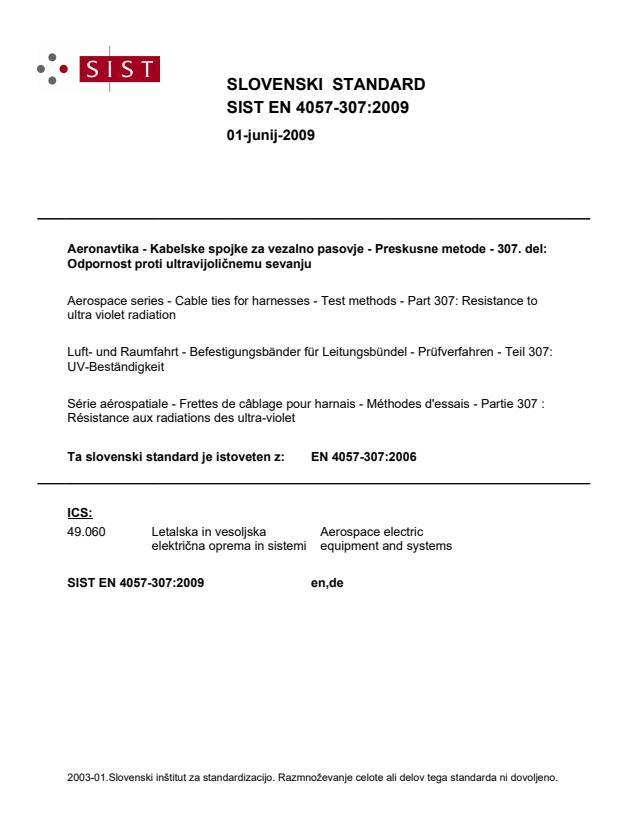
2003-01.Slovenski inštitut za standardizacijo. Razmnoževanje celote ali delov tega standarda ni dovoljeno.Luft- und Raumfahrt - Befestigungsbänder für Leitungsbündel - Prüfverfahren - Teil 307: UV-BeständigkeitSérie aérospatiale - Frettes de câblage pour harnais - Méthodes d'essais - Partie 307 : Résistance aux radiations des ultra-violetAerospace series - Cable ties for harnesses - Test methods - Part 307: Resistance to ultra violet radiation49.060Aerospace electric equipment and systemsICS:Ta slovenski standard je istoveten z:EN 4057-307:2006SIST EN 4057-307:2009en,de01-junij-2009SIST EN 4057-307:2009SLOVENSKI
STANDARD
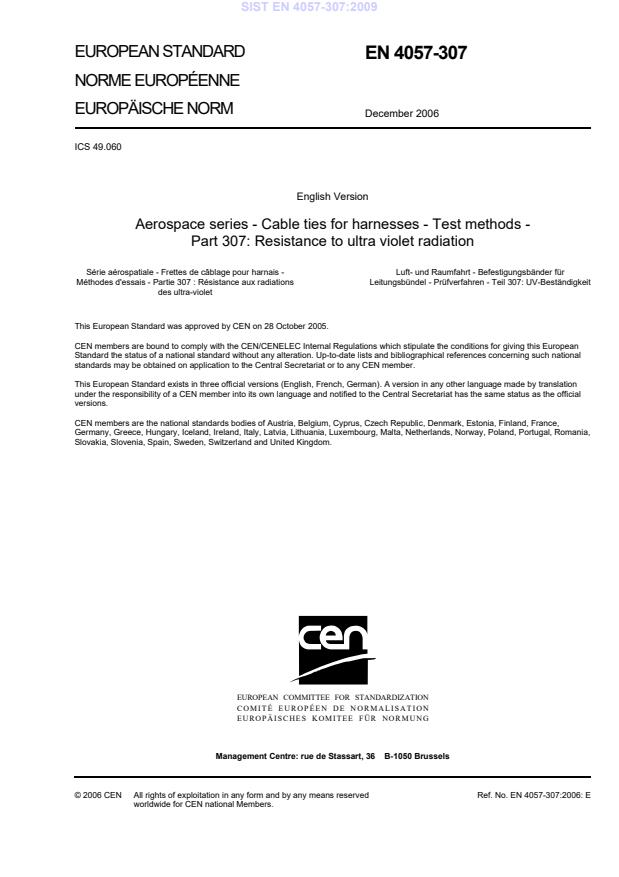
EUROPEAN STANDARDNORME EUROPÉENNEEUROPÄISCHE NORMEN 4057-307December 2006ICS 49.060 English VersionAerospace series - Cable ties for harnesses - Test methods -Part 307: Resistance to ultra violet radiationSérie aérospatiale - Frettes de câblage pour harnais -Méthodes d'essais - Partie 307 : Résistance aux radiationsdes ultra-violetLuft- und Raumfahrt - Befestigungsbänder fürLeitungsbündel - Prüfverfahren - Teil 307: UV-BeständigkeitThis European Standard was approved by CEN on 28 October 2005.CEN members are bound to comply with the CEN/CENELEC Internal Regulations which stipulate the conditions for giving this EuropeanStandard the status of a national standard without any alteration. Up-to-date lists and bibliographical references concerning such nationalstandards may be obtained on application to the Central Secretariat or to any CEN member.This European Standard exists in three official versions (English, French, German). A version in any other language made by translationunder the responsibility of a CEN member into its own language and notified to the Central Secretariat has the same status as the officialversions.CEN members are the national standards bodies of Austria, Belgium, Cyprus, Czech Republic, Denmark, Estonia, Finland, France,Germany, Greece, Hungary, Iceland, Ireland, Italy, Latvia, Lithuania, Luxembourg, Malta, Netherlands, Norway, Poland, Portugal, Romania,Slovakia, Slovenia, Spain, Sweden, Switzerland and United Kingdom.EUROPEAN COMMITTEE FOR STANDARDIZATIONCOMITÉ EUROPÉEN DE NORMALISATIONEUROPÄISCHES KOMITEE FÜR NORMUNGManagement Centre: rue de Stassart, 36
B-1050 Brussels© 2006 CENAll rights of exploitation in any form and by any means reservedworldwide for CEN national Members.Ref. No. EN 4057-307:2006: ESIST EN 4057-307:2009
...