


SIST ISO 11163:1997
(Main)Dried sweet basil (Ocimum basilicum L.) -- Specification
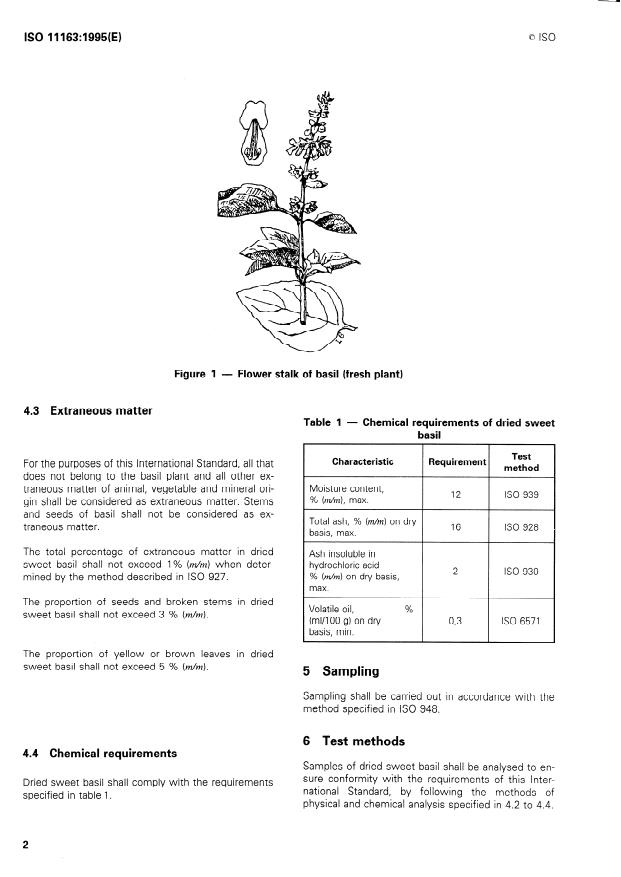
Dried sweet basil (Ocimum basilicum L.) -- Specification
Provides the requirements for dried sweet basil (Ocimum basilicum) leaves in cut form.
Basilic doux séché (Ocimum basilicum L.) -- Spécifications
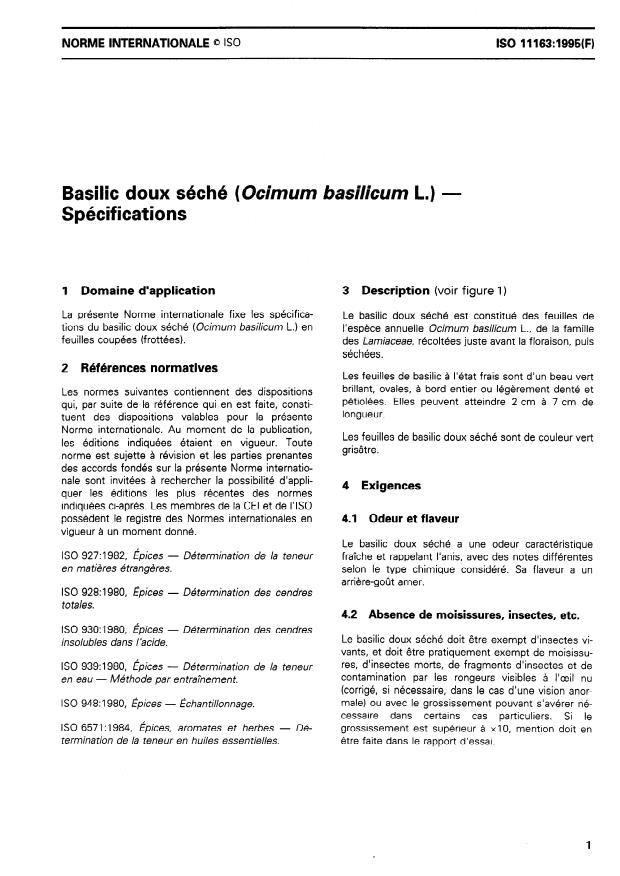
La présente Norme internationale fixe les spécifications du basilic doux séché (Ocimum basilicum L.) en feuilles coupées (frottées).
Sušena bazilika (Ocimum basilicum L.) - Specifikacija
General Information
- Status
- Published
- Publication Date
- 31-May-1997
- Technical Committee
- KŽP - Agricultural food products
- Current Stage
- 6060 - National Implementation/Publication (Adopted Project)
- Start Date
- 01-Jun-1997
- Due Date
- 01-Jun-1997
- Completion Date
- 01-Jun-1997
Buy Documents

ISO 11163:1995 - Dried sweet basil (Ocimum basilicum L.) — Specification Released:10/19/1995
ISO 11163:1995 - Basilic doux séché (Ocimum basilicum L.) — Spécifications Released:10/19/1995
ISO 11163:1995 - Basilic doux séché (Ocimum basilicum L.) — Spécifications Released:10/19/1995
Overview
SIST ISO 11163:1997 defines the specification requirements for dried sweet basil (Ocimum basilicum L.) in cut (rubbed) leaf form. Developed by the International Organization for Standardization (ISO), this standard ensures quality and consistency for dried sweet basil as an agricultural and food product. The document outlines specific criteria for the description, quality parameters, permissible extraneous matter, chemical requirements, packaging, and labelling of dried sweet basil. It is intended for use by producers, traders, food processors, laboratories, and regulatory authorities involved in the international supply chain for herbs and spices.
Key Topics
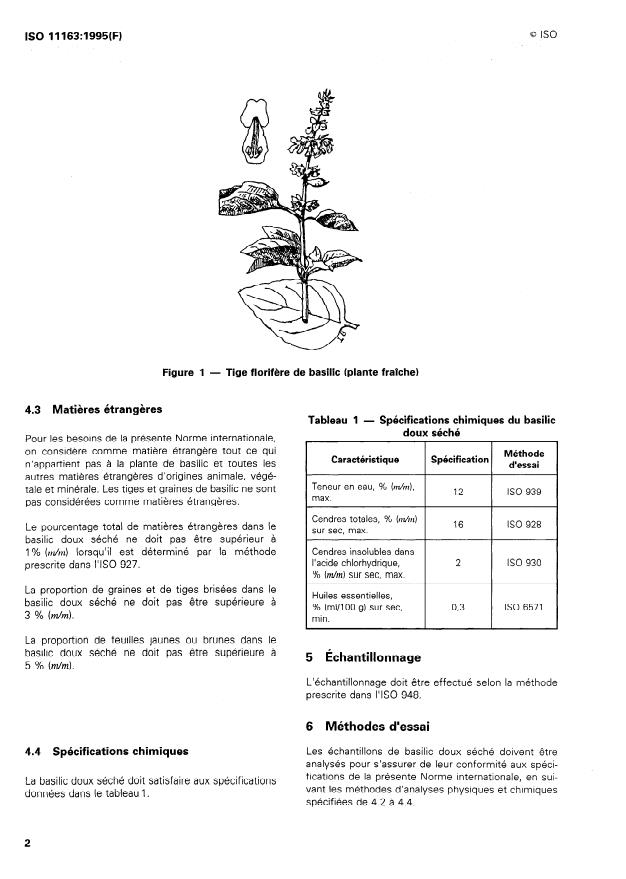
- Product Description: The standard specifies that dried sweet basil consists of leaves from Ocimum basilicum L., harvested before flowering and carefully dried. The leaves are generally greyish green, oval-shaped, and should meet visual quality requirements.
- Quality Requirements:
- Must have a characteristic fresh, aniseed-like odour and a mildly bitter aftertaste.
- Should be free from live insects, and practically free of mould, dead insects, insect fragments, and rodent contamination.
- Extraneous Matter:
- Non-basil plant matter must not exceed 1% by mass.
- Seeds and broken stems may be present but limited to 3%.
- Discoloured (yellow or brown) leaves not to exceed 5%.
- Chemical Properties:
- Maximum moisture content: 12%.
- Maximum total ash: 16% on a dry basis.
- Maximum acid-insoluble ash: 2%.
- Minimum volatile oil content: 0.3% on a dry basis.
- Sampling and Testing: Analysis methods to ensure conformity as referenced in related ISO standards.
- Packaging and Marking:
- Must be packed in suitable, food-grade containers protecting against moisture and loss of volatile compounds.
- Each package requires clear identification, including product name, producer details, batch number, country of origin, net mass, and standard reference.
Applications
Dried sweet basil specification is essential in several contexts:
- Spice and Herb Industry: Producers and traders use the standard to guarantee consistent quality for domestic and export markets, meeting food safety and import regulations.
- Food Processing: Manufacturers rely on these requirements to ensure the aromatic and flavour profile of dried basil is preserved in sauces, seasonings, and ready-made foods.
- Retail and Packaging: Retailers reference these specifications to assure customers of herb purity and safety.
- Laboratory Testing: Quality control laboratories employ the outlined analytical methods to confirm compliance with moisture, ash, oil content, and purity levels.
- Regulatory Oversight: Authorities use the standard for inspection and import/export certification to ensure product safety and traceability.
Related Standards
- ISO 927:1982 - Determination of extraneous matter in spices and condiments.
- ISO 928:1980 - Determination of total ash in spices and condiments.
- ISO 930:1980 - Determination of acid-insoluble ash content.
- ISO 939:1980 - Determination of moisture content in spices and condiments.
- ISO 948:1980 - Methods for sampling spices and condiments.
- ISO 6571:1984 - Determination of volatile oil content in spices, condiments, and herbs.
By adhering to SIST ISO 11163:1997, stakeholders in the herb and spice industry can assure the quality, safety, and international acceptance of dried sweet basil products, fostering global trade and consumer confidence.
Buy Documents
ISO 11163:1995 - Dried sweet basil (Ocimum basilicum L.) — Specification Released:10/19/1995
ISO 11163:1995 - Basilic doux séché (Ocimum basilicum L.) — Spécifications Released:10/19/1995
ISO 11163:1995 - Basilic doux séché (Ocimum basilicum L.) — Spécifications Released:10/19/1995
Get Certified
Connect with accredited certification bodies for this standard

BSI Group
BSI (British Standards Institution) is the business standards company that helps organizations make excellence a habit.

Bureau Veritas
Bureau Veritas is a world leader in laboratory testing, inspection and certification services.

DNV
DNV is an independent assurance and risk management provider.
Sponsored listings
Frequently Asked Questions
SIST ISO 11163:1997 is a standard published by the Slovenian Institute for Standardization (SIST). Its full title is "Dried sweet basil (Ocimum basilicum L.) -- Specification". This standard covers: Provides the requirements for dried sweet basil (Ocimum basilicum) leaves in cut form.
Provides the requirements for dried sweet basil (Ocimum basilicum) leaves in cut form.
SIST ISO 11163:1997 is classified under the following ICS (International Classification for Standards) categories: 67.220.10 - Spices and condiments. The ICS classification helps identify the subject area and facilitates finding related standards.
SIST ISO 11163:1997 is available in PDF format for immediate download after purchase. The document can be added to your cart and obtained through the secure checkout process. Digital delivery ensures instant access to the complete standard document.
Standards Content (Sample)
SLOVENSKI STANDARD
01-junij-1997
Sušena bazilika (Ocimum basilicum L.) - Specifikacija
Dried sweet basil (Ocimum basilicum L.) -- Specification
Basilic doux séché (Ocimum basilicum L.) -- Spécifications
Ta slovenski standard je istoveten z: ISO 11163:1995
ICS:
67.220.10 =DþLPEH Spices and condiments
2003-01.Slovenski inštitut za standardizacijo. Razmnoževanje celote ali delov tega standarda ni dovoljeno.
INTERNATIONAL ISO
STANDARD 11163
First edition
1995-10-15
Dried sweet basil (Ocimum basilicum L.)
- Specification
Basilic doux s&M (Ocimum basilicum L.) - Sp&ifications
Reference number
Foreword
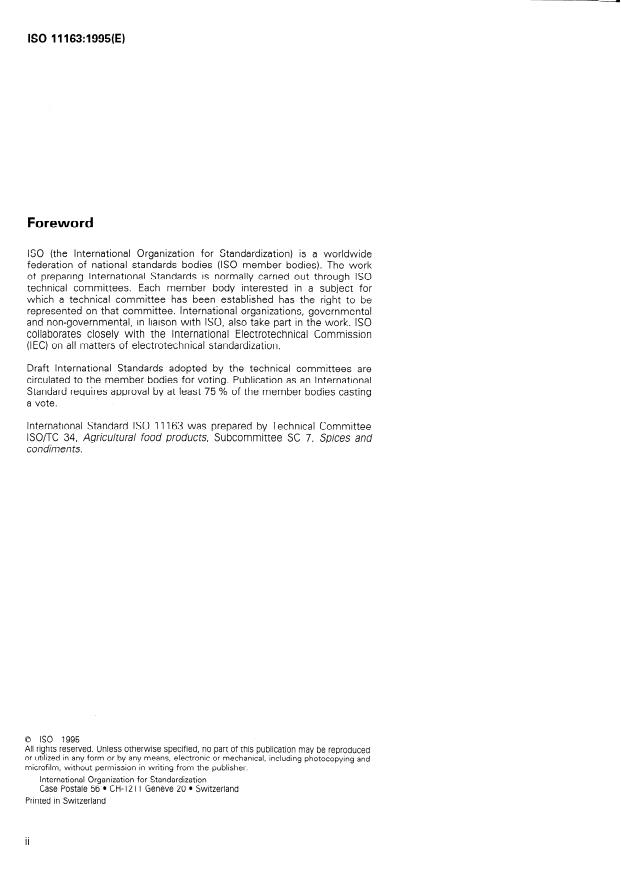
ISO (the International Organization for Standardization) is a worldwide
federation of national Standards bodies (ISO member bodies). The work
of preparing International Standards is normally carried out through ISO
technical committees. Esch member body interested in a subject for
which a technical committee has been established has the right to be
represented on that committee. International organizations, governmental
and non-governmental, in liaison with ISO, also take part in the work. ISO
collaborates closely with the International Electrotechnical Commission
(IEC) on all matters of electrotechnical standardization.
Draft International Standards adopted by the technical committees are
circulated to the member bodies for voting. Publication as an International
Standard requires approval by at least 75 % of the member bodies casting
a vote.
International Standard ISO 11163 was prepared by Technical Committee
lSO/TC 34, Agrkultural food products, Subcommittee SC 7, Spices and
condimen ts.
0 ISO 1995
All rights reserved. Unless otherwise specified, no part of this publication may be reproduced
or utilized in any form or by any means, electronie or mechanical, including photocopying and
microfilm, without Permission in writing from the publisher.
International Organization for Standardization
Case Postale 56 l CH-l 211 Geneve 20 l Switzerland
Printed in Switzerland
INTERNATIONAL STANDARD 0 60
Dried sweet basil (Ochwm basilicum L.) -
Specification
ISO 6571 :1984, Spices, condiments and herbs -
1 Scope
Determination o f vola tile oil con ten t.
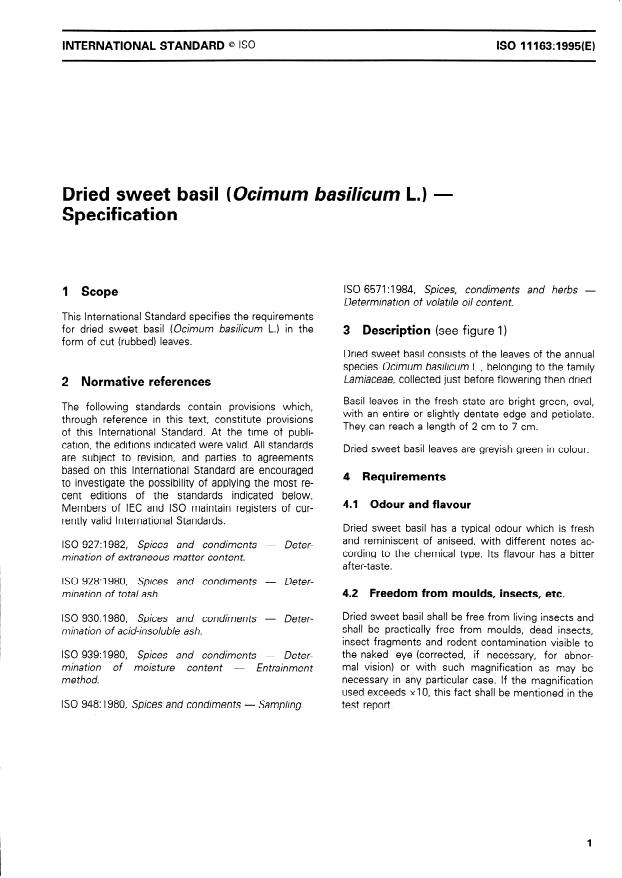
This International Standard specifies the requirements
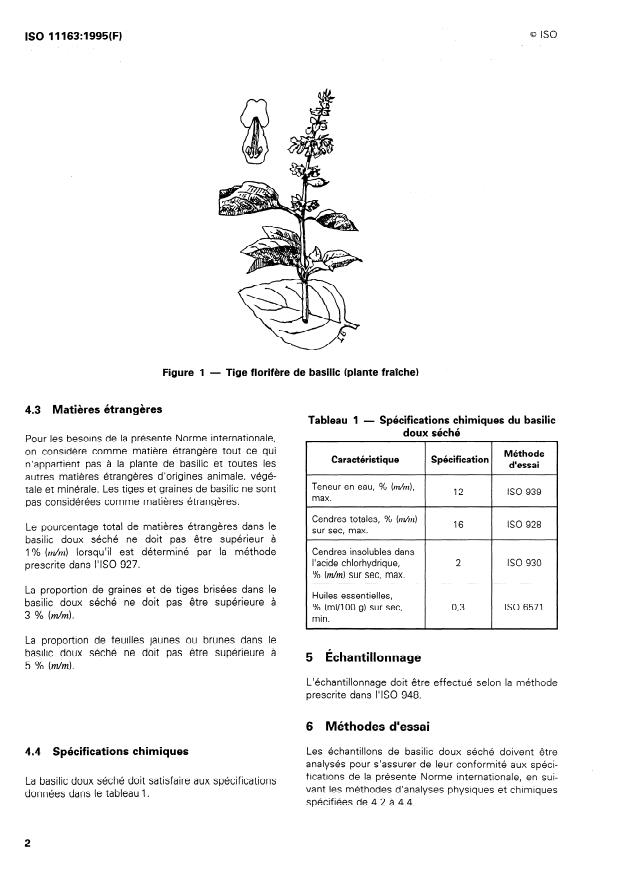
for dried sweet basil (Ocimum basilicum L.) in the 3 Description (see figure 1)
form of tut (rubbed) leaves.
Dried sweet basil consists of the leaves of the annual
species Ocimum basilicum L., belonging to the family
Lamiaceae, collected just before flowering then dried.
2 Normative references
Basil leaves in the fresh state are bright green, oval,
The following Standards contain provisions which,
with an entire or slightly dentate edge and petiolate.
through reference in this text, constitute provisions
They tan resch a length of 2 cm to 7 cm.
of this International Standard. At the time of publi-
cation, the editions indicated were valid. All Standards
Dried sweet basil leaves are greyish green in colour.
are subject to revision, and Parties to agreements
based on this International Standard are encouraged
4 Requirements
to investigate the possibility of applying the most re-
cent editions of the Standards indicated below.
4.1 Odour and flavour
Members of IEC and ISO maintain registers of cur-
rentl
...
INTERNATIONAL ISO
STANDARD 11163
First edition
1995-10-15
Dried sweet basil (Ocimum basilicum L.)
- Specification
Basilic doux s&M (Ocimum basilicum L.) - Sp&ifications
Reference number
Foreword
ISO (the International Organization for Standardization) is a worldwide
federation of national Standards bodies (ISO member bodies). The work
of preparing International Standards is normally carried out through ISO
technical committees. Esch member body interested in a subject for
which a technical committee has been established has the right to be
represented on that committee. International organizations, governmental
and non-governmental, in liaison with ISO, also take part in the work. ISO
collaborates closely with the International Electrotechnical Commission
(IEC) on all matters of electrotechnical standardization.
Draft International Standards adopted by the technical committees are
circulated to the member bodies for voting. Publication as an International
Standard requires approval by at least 75 % of the member bodies casting
a vote.
International Standard ISO 11163 was prepared by Technical Committee
lSO/TC 34, Agrkultural food products, Subcommittee SC 7, Spices and
condimen ts.
0 ISO 1995
All rights reserved. Unless otherwise specified, no part of this publication may be reproduced
or utilized in any form or by any means, electronie or mechanical, including photocopying and
microfilm, without Permission in writing from the publisher.
International Organization for Standardization
Case Postale 56 l CH-l 211 Geneve 20 l Switzerland
Printed in Switzerland
INTERNATIONAL STANDARD 0 60
Dried sweet basil (Ochwm basilicum L.) -
Specification
ISO 6571 :1984, Spices, condiments and herbs -
1 Scope
Determination o f vola tile oil con ten t.
This International Standard specifies the requirements
for dried sweet basil (Ocimum basilicum L.) in the 3 Description (see figure 1)
form of tut (rubbed) leaves.
Dried sweet basil consists of the leaves of the annual
species Ocimum basilicum L., belonging to the family
Lamiaceae, collected just before flowering then dried.
2 Normative references
Basil leaves in the fresh state are bright green, oval,
The following Standards contain provisions which,
with an entire or slightly dentate edge and petiolate.
through reference in this text, constitute provisions
They tan resch a length of 2 cm to 7 cm.
of this International Standard. At the time of publi-
cation, the editions indicated were valid. All Standards
Dried sweet basil leaves are greyish green in colour.
are subject to revision, and Parties to agreements
based on this International Standard are encouraged
4 Requirements
to investigate the possibility of applying the most re-
cent editions of the Standards indicated below.
4.1 Odour and flavour
Members of IEC and ISO maintain registers of cur-
rently valid International Standards.
Dried sweet basil has a typical odour which is fresh
and reminiscent of aniseed, with different notes ac-
ISO 927:1982, Spices and condiments - Deter-
cording to the Chemical type. Its flavour has a bitter
mination of extraneous matter content.
after-taste.
ISO 928:1980, Spices and condiments - Deter-
4.2 Freedom from moulds, insects, etc.
mina tion of total ash.
Dried sweet basil shall be free from living insects and
ISO 930: 1980, Spices and condiments - Deter-
shall be practic
...
ISO
NORME
INTERNATIONALE
Première édition
1995-10-15
Basilic doux séché (Ocimum basilicum L.)
- Spécifications
Dried svveet basil (Ocimum basilicum L.) - Specification
Numéro de référence
Avant-propos
L’ISO (Organisation internationale de normalisation) est une fédération
mondiale d’organismes nationaux de normalisation (comités membres de
I’ISO). L’élaboration des Normes internationales est en général confiée aux
comités techniques de I’ISO. Chaque comité membre intéressé par une
étude a le droit de faire partie du comité technique créé à cet effet. Les
organisations internationales, gouvernementales et non gouvernemen-
tales, en liaison avec I’ISO participent également aux travaux. L’ISO colla-
bore étroitement avec la Commission électrotechnique internationale (CEI)
en ce qui concerne la normalisation électrotechnique.
Les projets de Normes internationales adoptés par les comités techniques
sont soumis aux comités membres pour vote. Leur publication comme
Normes internationales requiert l’approbation de 75 % au moins des co-
mités membres votants.
La Norme internationale ISO II 163 a été élaborée par le comité technique
ISOnC 34, Produits agricoles alimentaires, sous-comité SC 7, Épices.
0 ISO 1995
Droits de reproduction réservés. Sauf prescription différente, aucune partie de cette publi-
cation ne peut être reproduite ni utilisée sous quelque forme que ce soit et par aucun pro-
cédé, électronique ou mécanique, y compris la photocopie et les microfilms, sans l’accord
écrit de l’éditeur.
Organisation internationale de normalisation
Case Postale 56 l CH-l 211 Genève 20 l Suisse
Imprimé en Suisse
NORME INTERNATIONALE @ ISO
Basilic doux séché (Ocimum basr7lr’cum L.) -
Spécifications
3 Description (voir figure 1)
1 Domaine d’appbcation
La présente Norme internationale fixe les spécifica-
Le basilic doux séché est constitué des feuilles de
tions du basilic doux séché (Ocimum basilicum L.) en
l’espèce annuelle Ocimum basilicum L., de la famille
feuilles coupées (frottées).
des Lamiaceae, récoltées juste avant la floraison, puis
séchées.
2 Références normatives
Les feuilles de basilic à l’état frais sont d’un beau vert
brillant, ovales, à bord entier ou légèrement denté et
Les normes suivantes contiennent des dispositions
pétiolées. Elles peuvent atteindre 2 cm à 7 cm de
qui, par suite de la référence qui en est faite, consti-
longueur.
tuent des dispositions valables pour la présente
Norme internationale. Au moment de la publication,
Les feuilles de basilic doux séché sont de couleur vert
les éditions indiquées étaient en vigueur. Toute
grisâtre.
norme est sujette à révision et les parties prenantes
des accords fondés sur la présente Norme internatio-
nale sont invitées à rechercher la possibilité d’appli-
4 Exigences
quer les éditions les plus récentes des normes
indiquées ci-après. Les membres de la CEI et de I’ISO
possèdent .le registre des Normes internationales en
4.1 Odeur et flaveur
vigueur à un moment donné.
Le basilic doux séché a une odeur caractéristique
ISO 927:1982, Épices - Détermination de la teneur fraîche et rappelant l’anis, avec des notes différentes
en matières étrangères. selon le type chimique considéré. Sa flaveur a un
arrière-goût amer.
ISO 928: 1980, Épices - Détermination des cendres
totales.
4.2 Absence de moisissures, insectes, etc.
ISO 930:1980, Épices - Détermination des cendres
Le basilic doux séché doit être exempt d’insectes vi-
insolubles dans I ‘acide.
vants, et doit être pratiquement exempt de moisissu-
res, d’insectes morts, de fragments d’insectes et de
ISO 939: 1980, Épi
...
ISO
NORME
INTERNATIONALE
Première édition
1995-10-15
Basilic doux séché (Ocimum basilicum L.)
- Spécifications
Dried svveet basil (Ocimum basilicum L.) - Specification
Numéro de référence
Avant-propos
L’ISO (Organisation internationale de normalisation) est une fédération
mondiale d’organismes nationaux de normalisation (comités membres de
I’ISO). L’élaboration des Normes internationales est en général confiée aux
comités techniques de I’ISO. Chaque comité membre intéressé par une
étude a le droit de faire partie du comité technique créé à cet effet. Les
organisations internationales, gouvernementales et non gouvernemen-
tales, en liaison avec I’ISO participent également aux travaux. L’ISO colla-
bore étroitement avec la Commission électrotechnique internationale (CEI)
en ce qui concerne la normalisation électrotechnique.
Les projets de Normes internationales adoptés par les comités techniques
sont soumis aux comités membres pour vote. Leur publication comme
Normes internationales requiert l’approbation de 75 % au moins des co-
mités membres votants.
La Norme internationale ISO II 163 a été élaborée par le comité technique
ISOnC 34, Produits agricoles alimentaires, sous-comité SC 7, Épices.
0 ISO 1995
Droits de reproduction réservés. Sauf prescription différente, aucune partie de cette publi-
cation ne peut être reproduite ni utilisée sous quelque forme que ce soit et par aucun pro-
cédé, électronique ou mécanique, y compris la photocopie et les microfilms, sans l’accord
écrit de l’éditeur.
Organisation internationale de normalisation
Case Postale 56 l CH-l 211 Genève 20 l Suisse
Imprimé en Suisse
NORME INTERNATIONALE @ ISO
Basilic doux séché (Ocimum basr7lr’cum L.) -
Spécifications
3 Description (voir figure 1)
1 Domaine d’appbcation
La présente Norme internationale fixe les spécifica-
Le basilic doux séché est constitué des feuilles de
tions du basilic doux séché (Ocimum basilicum L.) en
l’espèce annuelle Ocimum basilicum L., de la famille
feuilles coupées (frottées).
des Lamiaceae, récoltées juste avant la floraison, puis
séchées.
2 Références normatives
Les feuilles de basilic à l’état frais sont d’un beau vert
brillant, ovales, à bord entier ou légèrement denté et
Les normes suivantes contiennent des dispositions
pétiolées. Elles peuvent atteindre 2 cm à 7 cm de
qui, par suite de la référence qui en est faite, consti-
longueur.
tuent des dispositions valables pour la présente
Norme internationale. Au moment de la publication,
Les feuilles de basilic doux séché sont de couleur vert
les éditions indiquées étaient en vigueur. Toute
grisâtre.
norme est sujette à révision et les parties prenantes
des accords fondés sur la présente Norme internatio-
nale sont invitées à rechercher la possibilité d’appli-
4 Exigences
quer les éditions les plus récentes des normes
indiquées ci-après. Les membres de la CEI et de I’ISO
possèdent .le registre des Normes internationales en
4.1 Odeur et flaveur
vigueur à un moment donné.
Le basilic doux séché a une odeur caractéristique
ISO 927:1982, Épices - Détermination de la teneur fraîche et rappelant l’anis, avec des notes différentes
en matières étrangères. selon le type chimique considéré. Sa flaveur a un
arrière-goût amer.
ISO 928: 1980, Épices - Détermination des cendres
totales.
4.2 Absence de moisissures, insectes, etc.
ISO 930:1980, Épices - Détermination des cendres
Le basilic doux séché doit être exempt d’insectes vi-
insolubles dans I ‘acide.
vants, et doit être pratiquement exempt de moisissu-
res, d’insectes morts, de fragments d’insectes et de
ISO 939: 1980, Épi
...