


SIST EN 13941-1:2019+A1:2022
(Main)District heating pipes - Design and installation of thermal insulated bonded single and twin pipe systems for directly buried hot water networks - Part 1: Design
District heating pipes - Design and installation of thermal insulated bonded single and twin pipe systems for directly buried hot water networks - Part 1: Design
This European Standard specifies requirements for design, calculation and installation of factory made thermal insulated bonded single and twin pipe systems for directly buried hot water networks for continuous operation with treated hot water at various temperatures up to 120 ºC and occasionally with peak temperatures up to 140 ºC and maximum internal pressure 2,5 MPa. Flexible pipe systems according to EN 15632 are not under the scope of this standard.
The standard EN 13941, Design and installation of thermal insulated bonded single and twin pipe systems for directly buried hot water networks consists of two parts:
a) prEN 13941-1: Design;
b) prEN 13941-2: Installation.
The requirements and stipulations in this part: EN 13941-1, form an unbreakable unity with those of prEN 13941-2. This part shall therefore exclusively be used in combination with prEN 13941-2.
The principles of the standard may be applied to thermal insulated pipe systems with pressures higher than 2,5 MPa, provided that special attention is paid to the effects of pressure.
Adjacent pipes, not buried, but belonging to the network (e. g. pipes in ducts, valve chambers, road crossings above ground etc.) may be designed and installed according to this standard.
This standard presupposes the use of treated water, which by softening, demineralisation, de-aeration, adding of chemicals, or otherwise has been treated to effectively prevent internal corrosion and deposits in the pipes.
NOTE For further information on water qualities to be used in district heating pipe systems see also [1].
This standard is not applicable for such units as:
a) pumps;
b) heat exchangers;
c) boilers, tanks;
d) systems behind domestic substations.
Fernwärmerohre - Auslegung und Installation von gedämmten Einzel- und Doppelrohr-Verbundsystemen für direkt erdverlegte Heißwasser-Fernwärmenetze - Teil 1: Auslegung
Dieses Dokument legt Auslegungs-, Berechnungs- und Installationsanforderungen für werkmäßig gefertigte wärmegedämmte Einzel- und Doppelrohrverbundsysteme für erdverlegte Warmwassernetze fest, die für den Dauerbetrieb mit aufbereitetem Wasser bei unterschiedlichen Temperaturen bis 120 °C und gelegentlichen Spitzentemperaturen bis 140 °C für höchstens 300 h/a sowie bei maximalem Innendruck von 2,5 MPa vorgesehen sind.
Flexible Rohrsysteme nach der Normenreihe EN 15632 liegen nicht im Anwendungsbereich dieser Norm.
Die Norm EN 13941, Fernwärmerohre — Auslegung und Installation von gedämmten Einzel- und Doppelrohr-Verbundsystemen für direkt erdverlegte Fernwärmenetze besteht aus zwei Teilen:
a) EN 13941 1: Auslegung
b) EN 13941 2: Installation
Die Anforderungen in diesem Teil, EN 13941 1, bilden eine Einheit mit jenen aus EN 13941 2.
Die Grundsätze der Norm können auf wärmegedämmte Rohrleitungssysteme mit Drücken über 2,5 MPa angewendet werden, vorausgesetzt, die Auswirkungen der Drücke werden besonders beachtet.
Angrenzende Rohre, die zum Netz gehören, aber nicht erdverlegt sind (z. B. Rohre in unterirdischen Einbauten, Armaturenschächten, oberirdische Straßenüberquerungen usw.), können entsprechend dieser Norm ausgelegt und installiert werden.
Dieses Dokument setzt die Verwendung von aufbereitetem Wasser voraus, das durch Enthärtung, Entsalzung, Entlüftung, Zusatz von Chemikalien oder auf andere Art und Weise so behandelt worden ist, dass innere Korrosion und Ablagerungen in den Leitungen effektiv vermieden werden.
ANMERKUNG Für weitere Informationen zur Qualität des Wassers, welches bei Fernwärmesystemen eingesetzt wird, siehe auch Literaturhinweis [2].
Diese Norm gilt nicht für Geräte bzw. Anlagen wie z. B.:
a) Pumpen;
b) Wärmeübertrager;
c) Kessel, Speicher;
d) Systeme hinter Hausregelstationen.
Tuyaux de chauffage urbain - Conception et installation des systèmes bloqués de monotubes ou bitubes isolés thermiquement pour les réseaux d'eau chaude enterrés directement - Partie 1 : Conception
Le présent document spécifie les exigences relatives à la conception, au calcul et à l'installation de systèmes manufacturés bloqués de monotubes ou bitubes isolés thermiquement pour les réseaux d'eau chaude enterrés directement, pour un service continu avec de l'eau chaude traitée à différentes températures jusqu’à 120 °C, et occasionnellement avec des pics de température jusqu’à 140 °C pendant 300 h/a au maximum, et une pression interne maximale de 2,5 MPa.
Les systèmes de tuyaux flexibles conformes à la série de normes EN 15632 ne relèvent pas du domaine d'application de la présente norme.
La norme EN 13941, Conception et installation des systèmes bloqués de monotubes et bitubes isolés thermiquement pour les réseaux d'eau chaude enterrés directement comprend deux parties :
a) EN 13941-1 : Conception ;
b) EN 13941-2 : Installation.
Les exigences et stipulations de la présente partie, EN 13941-1, sont indissociables de celles de l'EN 13941-2.
Les principes de la présente norme peuvent être appliqués à des systèmes de tuyaux isolés thermiquement avec des pressions supérieures à 2,5 MPa, pourvu qu’il soit porté une attention spéciale aux effets de la pression.
Les tuyaux adjacents non enterrés, mais appartenant au réseau (par exemple, tubes en caniveaux, chambres de vanne, traversée de route en aérien, etc.) peuvent être conçus et installés conformément à la présente norme.
Le présent document présuppose l'utilisation d'eau traitée, par adoucissement, déminéralisation, désaération, ajout de substances chimiques, ou par tout autre moyen permettant d'éviter efficacement la corrosion interne et les dépôts dans les tuyaux.
NOTE Pour de plus amples informations sur les qualités d'eau à utiliser dans les systèmes de tuyaux pour le chauffage urbain, voir également la référence bibliographique [2].
La présente norme n'est pas applicable aux éléments tels que :
a) pompes ;
b) échangeurs de chaleur ;
c) chaudières, réservoirs ;
d) systèmes en aval des postes de raccordement.
Cevi za daljinsko ogrevanje - Projektiranje in vgradnja toplotno izoliranih spojenih eno- in dvocevnih sistemov za neposredno zakopana vročevodna omrežja - 1. del: Projektiranje (vključno z dopolnilom A1)
Ta evropski standard določa zahteve za projektiranje, izračun in vgradnjo tovarniško izdelanih toplotno izoliranih spojenih eno- in dvocevnih sistemov za neposredno zakopana vročevodna omrežja za neprekinjeno delovanje z obdelano vročo vodo pri različnih temperaturah do 120 °C in občasnih najvišjih temperaturah do 140 °C ter najvišjem notranjem tlaku 2,5 MPa. Ta standard ne zajema gibkih cevnih sistemov v skladu s standardom EN 15632.
Standard EN 13941, Projektiranje in vgradnja toplotno izoliranih spojenih eno- in dvocevnih sistemov za neposredno zakopana vročevodna omrežja je sestavljen iz dveh delov:
a) prEN 13941-1: Projektiranje
b) prEN 13941-2: Vgradnja
Zahteve in določbe iz tega dela standarda: EN 13941-1 je neločljivo povezan z zahtevami in določbami standarda prEN 13941-2. Ta del se zato uporablja izključno skupaj s standardom prEN 13941-2.
Načela standarda se lahko uporabljajo za toplotno izolirane cevne sisteme s tlaki, višjimi od 2,5 MPa, če je posebna pozornost namenjena učinkom tlaka.
Sosednje cevi, ki niso zakopane, vendar pripadajo omrežju (npr. cevi v jaških, ventilskih komorah, cestnih prehodih nad tlemi itd.), je mogoče projektirati in vgraditi na podlagi tega standarda.
Ta standard predpostavlja uporabo obdelane vode, ki z mehčanjem, demineralizacijo, razzračevanjem, dodajanjem kemikalij ali z drugo obdelavo učinkovito preprečuje notranjo korozijo in nastajanje oblog na ceveh.
OPOMBA: Za dodatne informacije o kakovosti vode za uporabo v cevnih sistemih za daljinsko ogrevanje glej tudi [1].
Ta standard se ne uporablja za enote, kot so:
a) črpalke;
b) toplotni izmenjevalniki;
c) kotli, rezervoarji;
d) sistemi za domačimi razdelilnimi postajami.
General Information
- Status
- Published
- Publication Date
- 23-Jan-2022
- Technical Committee
- I13 - Imaginarni 13
- Current Stage
- 6060 - National Implementation/Publication (Adopted Project)
- Start Date
- 22-Dec-2021
- Due Date
- 26-Feb-2022
- Completion Date
- 24-Jan-2022

Relations
- Effective Date
- 28-Jan-2026
- Effective Date
- 28-Jan-2026
- Effective Date
- 28-Jan-2026
- Effective Date
- 28-Jan-2026
- Effective Date
- 28-Jan-2026
- Effective Date
- 28-Jan-2026
- Effective Date
- 28-Jan-2026
- Effective Date
- 28-Jan-2026
- Refers
SIST EN 17248:2020 - District heating and district cooling pipe systems - Terms and definitions - Effective Date
- 28-Jan-2026
- Effective Date
- 28-Jan-2026
- Effective Date
- 28-Jan-2026
- Effective Date
- 28-Jan-2026
- Effective Date
- 28-Jan-2026
- Effective Date
- 28-Jan-2026
- Effective Date
- 28-Jan-2026
Overview
SIST EN 13941-1:2019+A1:2022 is a European standard that specifies the requirements for the design, calculation, and installation of factory-made thermal insulated bonded single and twin pipe systems used in directly buried hot water networks. It is applicable to district heating pipes designed for continuous operation with treated hot water at temperatures up to 120 ºC, with peak tolerances up to 140 ºC, and a maximum internal pressure of 2.5 MPa. This standard primarily focuses on the design aspects and forms a comprehensive system when used in conjunction with EN 13941-2, which addresses installation.
Key Topics
Scope and Exclusions
- Covers requirements for thermal insulated bonded pipe systems for directly buried district heating networks.
- Excludes flexible pipe systems as defined by EN 15632, as well as components such as pumps, heat exchangers, boilers, tanks, and customer-side installations.
General Design Requirements
- Provides guidance on functional requirements, service life, and necessary preliminary investigations.
- Details on project classification, risk assessment, and documentation of design procedures.
Pipe System Components and Materials
- Essential characteristics for steel service pipes, casing, polyurethane foam insulation, and expansion cushions.
- Quality control benchmarks for manufacturers and during the design and installation phases.
Technical Analysis and Calculations
- Specifies procedures for stress, strain, and fatigue analysis.
- Guidelines for pipe-soil interaction, route selection, and traffic or environmental load considerations.
- Requirements for horizontal and vertical stability, especially in challenging soil conditions.
Special Considerations
- Specific design considerations for twin pipe systems.
- Adaptable design principles for installations with higher operating pressures, provided specific attention to pressure effects.
Applications
District heating networks rely on robust and durable hot water pipe systems to deliver energy-efficient heating from central sources to residential, commercial, and industrial buildings. SIST EN 13941-1:2019+A1:2022 supports:
- Urban and Suburban District Heating: Direct burial of insulated pipes for new and existing urban infrastructure increases energy efficiency and improves network reliability.
- Industrial Facilities: Use in industrial campuses requiring secure, long-term hot water transmission.
- Upgrades and Modernization: Applies to both new installations and the replacement or extension of existing networks, ensuring compliance with best practices in thermal insulation and pipe longevity.
- Special Installations: Design includes provisions for above-ground sections (valve chambers, road crossings), provided they are part of the larger buried district heating system.
Treated water use is a precondition for compliance, ensuring internal pipe protection against corrosion and deposit buildup.
Related Standards
To ensure the comprehensive safety and performance of district heating systems, SIST EN 13941-1 should be understood in relation to other standards, including:
- EN 13941-2: Covers installation requirements, forming a unified system standard alongside Part 1.
- EN 15632: Defines requirements for flexible pre-insulated pipe systems (which are not covered by EN 13941-1).
- EN 17248: Provides detailed terms and definitions relevant to district heating pre-insulated pipe systems.
- Pressure Equipment Directive (PED) 2014/68/EU: Annex H in EN 13941-1 explains its relationship to EU safety regulations for pressure equipment.
- National standards and technical guidelines: Local regulations may supplement these requirements depending on region or specific project conditions.
Practical Value
For engineers, planners, and contractors, applying SIST EN 13941-1:2019+A1:2022 ensures that directly buried district heating pipes are designed with optimized safety, efficiency, and durability. Adherence to these guidelines prevents system failures, extends the operational life of the network, and minimizes heat loss, supporting sustainable and cost-effective district heating infrastructure across Europe.
Keywords: district heating, thermal insulated pipes, buried hot water networks, pipe system design, EN 13941-1, bonded pipe systems, energy efficiency, network durability.
Get Certified
Connect with accredited certification bodies for this standard

DIBt (Deutsches Institut für Bautechnik)
German Institute for Building Technology.
DIN CERTCO
DIN Group product certification.

Aboma Certification B.V.
Specialized in construction, metal, and transport sectors.
Sponsored listings
Frequently Asked Questions
SIST EN 13941-1:2019+A1:2022 is a standard published by the Slovenian Institute for Standardization (SIST). Its full title is "District heating pipes - Design and installation of thermal insulated bonded single and twin pipe systems for directly buried hot water networks - Part 1: Design". This standard covers: This European Standard specifies requirements for design, calculation and installation of factory made thermal insulated bonded single and twin pipe systems for directly buried hot water networks for continuous operation with treated hot water at various temperatures up to 120 ºC and occasionally with peak temperatures up to 140 ºC and maximum internal pressure 2,5 MPa. Flexible pipe systems according to EN 15632 are not under the scope of this standard. The standard EN 13941, Design and installation of thermal insulated bonded single and twin pipe systems for directly buried hot water networks consists of two parts: a) prEN 13941-1: Design; b) prEN 13941-2: Installation. The requirements and stipulations in this part: EN 13941-1, form an unbreakable unity with those of prEN 13941-2. This part shall therefore exclusively be used in combination with prEN 13941-2. The principles of the standard may be applied to thermal insulated pipe systems with pressures higher than 2,5 MPa, provided that special attention is paid to the effects of pressure. Adjacent pipes, not buried, but belonging to the network (e. g. pipes in ducts, valve chambers, road crossings above ground etc.) may be designed and installed according to this standard. This standard presupposes the use of treated water, which by softening, demineralisation, de-aeration, adding of chemicals, or otherwise has been treated to effectively prevent internal corrosion and deposits in the pipes. NOTE For further information on water qualities to be used in district heating pipe systems see also [1]. This standard is not applicable for such units as: a) pumps; b) heat exchangers; c) boilers, tanks; d) systems behind domestic substations.
This European Standard specifies requirements for design, calculation and installation of factory made thermal insulated bonded single and twin pipe systems for directly buried hot water networks for continuous operation with treated hot water at various temperatures up to 120 ºC and occasionally with peak temperatures up to 140 ºC and maximum internal pressure 2,5 MPa. Flexible pipe systems according to EN 15632 are not under the scope of this standard. The standard EN 13941, Design and installation of thermal insulated bonded single and twin pipe systems for directly buried hot water networks consists of two parts: a) prEN 13941-1: Design; b) prEN 13941-2: Installation. The requirements and stipulations in this part: EN 13941-1, form an unbreakable unity with those of prEN 13941-2. This part shall therefore exclusively be used in combination with prEN 13941-2. The principles of the standard may be applied to thermal insulated pipe systems with pressures higher than 2,5 MPa, provided that special attention is paid to the effects of pressure. Adjacent pipes, not buried, but belonging to the network (e. g. pipes in ducts, valve chambers, road crossings above ground etc.) may be designed and installed according to this standard. This standard presupposes the use of treated water, which by softening, demineralisation, de-aeration, adding of chemicals, or otherwise has been treated to effectively prevent internal corrosion and deposits in the pipes. NOTE For further information on water qualities to be used in district heating pipe systems see also [1]. This standard is not applicable for such units as: a) pumps; b) heat exchangers; c) boilers, tanks; d) systems behind domestic substations.
SIST EN 13941-1:2019+A1:2022 is classified under the following ICS (International Classification for Standards) categories: 23.040.07 - Pipeline and its parts for district heat; 91.140.10 - Central heating systems. The ICS classification helps identify the subject area and facilitates finding related standards.
SIST EN 13941-1:2019+A1:2022 has the following relationships with other standards: It is inter standard links to SIST EN 14419:2020, SIST EN 10204:2004, SIST EN 253:2019+A1:2024, SIST EN 15698-1:2025, SIST EN 10217-5:2019, SIST EN 10217-2:2019, SIST EN 13480-3:2024, SIST EN 10253-2:2021+A1:2026, SIST EN 17248:2020, SIST EN 448:2025, SIST EN 15698-2:2025, SIST EN 488-1:2025, SIST EN 489-1:2020, SIST EN 10216-2:2025, SIST EN ISO 1856:2018. Understanding these relationships helps ensure you are using the most current and applicable version of the standard.
SIST EN 13941-1:2019+A1:2022 is available in PDF format for immediate download after purchase. The document can be added to your cart and obtained through the secure checkout process. Digital delivery ensures instant access to the complete standard document.
Standards Content (Sample)
SLOVENSKI STANDARD
01-marec-2022
Cevi za daljinsko ogrevanje - Projektiranje in vgradnja toplotno izoliranih spojenih
eno- in dvocevnih sistemov za neposredno zakopana vročevodna omrežja - 1. del:
Projektiranje (vključno z dopolnilom A1)
District heating pipes - Design and installation of thermal insulated bonded single and
twin pipe systems for directly buried hot water networks - Part 1: Design
Fernwärmerohre - Auslegung und Installation von gedämmten Einzel- und Doppelrohr-
Verbundsystemen für direkt erdverlegte Heißwasser-Fernwärmenetze - Teil 1:
Auslegung
Tuyaux de chauffage urbain - Conception et installation des systèmes bloqués de
monotubes ou bitubes isolés thermiquement pour les réseaux d'eau chaude enterrés
directement - Partie 1 : Conception
Ta slovenski standard je istoveten z: EN 13941-1:2019+A1:2021
ICS:
23.040.07 Cevovodi za daljinsko Pipeline and its parts for
ogrevanje in njihovi deli district heat
91.140.10 Sistemi centralnega Central heating systems
ogrevanja
2003-01.Slovenski inštitut za standardizacijo. Razmnoževanje celote ali delov tega standarda ni dovoljeno.
EN 13941-1:2019+A1
EUROPEAN STANDARD
NORME EUROPÉENNE
December 2021
EUROPÄISCHE NORM
ICS 23.040.07; 23.040.10; 91.140.10 Supersedes EN 13941-1:2019
English Version
District heating pipes - Design and installation of thermal
insulated bonded single and twin pipe systems for directly
buried hot water networks - Part 1: Design
Tuyaux de chauffage urbain - Conception et installation Fernwärmerohre - Auslegung und Installation von
des systèmes bloqués de monotubes ou bitubes isolés gedämmten Einzel- und Doppelrohr-Verbundsystemen
thermiquement pour les réseaux d'eau chaude enterrés für direkt erdverlegte Heißwasser-Fernwärmenetze -
directement - Partie 1 : Conception Teil 1: Auslegung
This European Standard was approved by CEN on 14 December 2018 and includes Amendment 1 approved by CEN on 15
October 2021.
CEN members are bound to comply with the CEN/CENELEC Internal Regulations which stipulate the conditions for giving this
European Standard the status of a national standard without any alteration. Up-to-date lists and bibliographical references
concerning such national standards may be obtained on application to the CEN-CENELEC Management Centre or to any CEN
member.
This European Standard exists in three official versions (English, French, German). A version in any other language made by
translation under the responsibility of a CEN member into its own language and notified to the CEN-CENELEC Management
Centre has the same status as the official versions.
CEN members are the national standards bodies of Austria, Belgium, Bulgaria, Croatia, Cyprus, Czech Republic, Denmark, Estonia,
Finland, France, Germany, Greece, Hungary, Iceland, Ireland, Italy, Latvia, Lithuania, Luxembourg, Malta, Netherlands, Norway,
Poland, Portugal, Republic of North Macedonia, Romania, Serbia, Slovakia, Slovenia, Spain, Sweden, Switzerland, Turkey and
United Kingdom.
EUROPEAN COMMITTEE FOR STANDARDIZATION
COMITÉ EUROPÉEN DE NORMALISATION
EUROPÄISCHES KOMITEE FÜR NORMUNG
CEN-CENELEC Management Centre: Rue de la Science 23, B-1040 Brussels
© 2021 CEN All rights of exploitation in any form and by any means reserved Ref. No. EN 13941-1:2019+A1:2021 E
worldwide for CEN national Members.
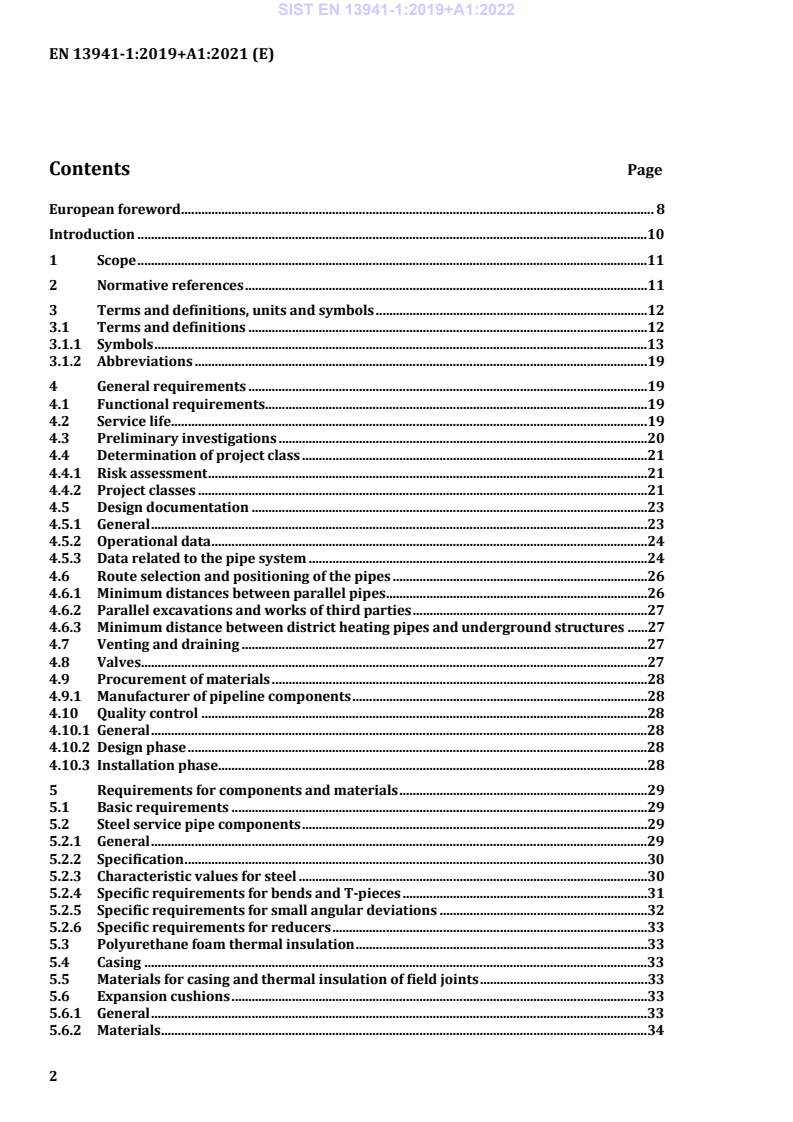
Contents Page
European foreword . 8
Introduction .10
1 Scope .11
2 Normative references .11
3 Terms and definitions, units and symbols .12
3.1 Terms and definitions .12
3.1.1 Symbols .13
3.1.2 Abbreviations .19
4 General requirements .19
4.1 Functional requirements.19
4.2 Service life .19
4.3 Preliminary investigations .20
4.4 Determination of project class .21
4.4.1 Risk assessment .21
4.4.2 Project classes .21
4.5 Design documentation .23
4.5.1 General .23
4.5.2 Operational data .24
4.5.3 Data related to the pipe system .24
4.6 Route selection and positioning of the pipes .26
4.6.1 Minimum distances between parallel pipes .26
4.6.2 Parallel excavations and works of third parties .27
4.6.3 Minimum distance between district heating pipes and underground structures .27
4.7 Venting and draining .27
4.8 Valves.27
4.9 Procurement of materials .28
4.9.1 Manufacturer of pipeline components .28
4.10 Quality control .28
4.10.1 General .28
4.10.2 Design phase .28
4.10.3 Installation phase .28
5 Requirements for components and materials .29
5.1 Basic requirements .29
5.2 Steel service pipe components .29
5.2.1 General .29
5.2.2 Specification .30
5.2.3 Characteristic values for steel .30
5.2.4 Specific requirements for bends and T-pieces .31
5.2.5 Specific requirements for small angular deviations .32
5.2.6 Specific requirements for reducers .33
5.3 Polyurethane foam thermal insulation .33
5.4 Casing .33
5.5 Materials for casing and thermal insulation of field joints .33
5.6 Expansion cushions .33
5.6.1 General .33
5.6.2 Materials .34
5.6.3 Stiffness properties . 34
5.6.4 Selecting required thickness of expansion cushions . 35
5.6.5 Marking . 35
5.7 Valves and accessories . 35
5.7.1 General requirements . 35
5.7.2 Marking and documentation . 36
6 Design and calculation . 36
6.1 General procedure . 36
6.2 Pipeline components, areas, conditions and interfaces to be included in the
analyses . 37
6.2.1 Components . 37
6.2.2 Areas requiring specific analyses . 38
6.2.3 Special conditions . 38
6.2.4 Interfaces . 38
6.3 Simplified analysis procedure . 39
6.4 Actions . 39
6.4.1 General . 39
6.4.2 Classification of actions and load combinations . 39
6.4.3 Temperature variations . 41
6.4.4 Top load from soil. 42
6.4.5 Traffic loads . 42
6.5 Global analysis and pipe-soil interaction . 44
6.5.1 General . 44
6.5.2 Modelling pipe-soil interaction . 44
6.5.3 Pipe to soil friction (axial) . 46
6.5.4 Horizontal soil reaction (lateral) . 48
6.5.5 Combined lateral stiffness of steel service pipe, PUR, expansion cushions and soil . 53
6.5.6 Soil properties . 56
6.5.7 Thermal expansion of buried pipe sections: . 56
6.5.8 Pipe systems with single use compensators (SUC’s) . 58
6.5.9 Specific requirements for vertical and horizontal stability . 60
6.5.10 Parallel excavations . 63
6.5.11 Requirements for soft soils and settlement areas . 64
6.5.12 Specific design requirements for above-ground pipelines with factory made pipe
and fitting assemblies . 64
6.5.13 Insertion into protection pipe. 64
6.6 Determination of stresses and strains . 65
6.6.1 General . 65
6.6.2 Cross section analyses, steel . 65
6.6.3 Assessment on the basis of a resultant (equivalent) stress . 66
6.6.4 Stresses and ovalization from top load . 67
6.6.5 Deflection . 69
6.6.6 Bends . 70
6.6.7 T-pieces . 71
6.6.8 Single Use Compensators (SUC’s) . 73
6.6.9 PUR and casing . 76
6.7 Fatigue analyses . 76
6.7.1 General . 76
6.7.2 Action cycles . 76
6.8 Further actions . 79
7 Limit states . 79
7.1 General . 79
7.2 Limit states for service pipes of steel . 80
7.2.1 General .80
7.2.2 Limit state A: Failure caused by plastic deformation .80
7.2.3 Limit state B: Failure caused by fatigue .83
7.2.4 Limit state C: Failure caused by instability of the system or part of it .86
7.2.5 Limit state D: Serviceability limit state .88
7.2.6 Survey of limit states for steel .88
7.3 Limit states for PUR and PE .91
7.3.1 Compressive stress .91
7.3.2 Limit state for !axial" shear stress.91
7.3.3 Limit state for PE .91
7.4 Limit states for valves .91
Annex A (normative) Design of piping components under internal pressure .93
A.1 General .93
A.2 Straight pipe and bends .93
A.2.1 Straight pipes .93
A.2.2 Bends .93
A.3 T-pieces and branch connections .94
A.3.1 General aspects and limitations .94
A.3.2 Reinforcement .94
A.3.2.1 General .94
A.3.2.2 Dissimilar material of shell and reinforcement .94
A.3.2.3 Thickness ratio .95
A.3.2.4 Calculation method for reinforcement area .95
A.3.2.5 Reinforcement by increased wall thickness .95
A.3.2.6 Reinforcement by compensating plates.96
A.4 Reducers and extensions .97
A.5 Dished ends .97
A.5.1 General .97
A.5.2 Ellipsoidal Dished Head Minimum required wall thickness for internal pressure .98
A.5.3 Straight cylindrical shells .98
Annex B (informative) Soil properties and geotechnical parameters for pipe/soil interaction
analyses .99
B.1 General requirements .99
B.2 Geotechnical parameters for global analysis (pipe-soil interaction) .99
B.3 Geotechnical Study . 100
B.3.1 Field study . 100
B.3.2 Typical values, referred to mean value . 100
B.3.3 Investigation of interface friction . 100
B.4 Characteristic values for soil properties . 100
B.4.1 Typical values, referred to mean value . 100
B.4.2 Spatial variation of soil properties . 101
B.5 Model uncertainty when determining geotechnical parameters. 102
Annex C (informative) Flexibility and stress concentration of pipe components . 104
C.1 General . 104
C.2 Flexibility factors for pipe components. 104
C.2.1 Bends . 104
C.2.2 T-pieces . 104
C.2.3 Other components . 105
C.3 Stress concentration in pipe elements . 105
C.3.1 Butt welds . 105
C.3.2 Bends . 105
C.3.2.1 Stress concentration factors for bends: Simplified method . 105
C.3.2.2 Stress concentration factors for bends: exact calculation . 106
C.3.3 T-pieces . 108
C.3.3.1 General . 108
C.3.4 Small angular deviations . 109
C.3.5 Reducers . 110
Annex D (informative) Calculation of heat losses . 112
D.1 General . 112
D.2 Heat losses of thermal insulated pipes . 112
D.2.1 Pair of single pipes — calculation of specific heat loss . 112
D.2.2 symmetrical and (a) antisymmetrical heat loss factors according to zero-order
multipole formulae: . 113
D.2.3 Using Zero-order approximation for (s) symmetrical and (a) antisymmetrical
problem the heat resistance can be calculated: . 114
D.2.4 specific heat loss of pipes . 114
D.2.5 Twin Pipes — calculation of specific heat loss . 115
D.2.6 temperatures of pipes . 115
D.2.7 (s) symmetrical and (a) antisymmetrical heat loss factors according to first-order
multipole formula: . 116
D.2.8 specific heat loss of pipes . 117
Annex E (informative) Specific requirements for twin pipe systems . 118
E.1 General . 118
E.2 Component and materials . 118
E.2.1 Twin Pipe assembly . 118
E.2.2 Fixing bars . 119
E.3 Max. allowable stresses for specific twin pipe system elements: . 120
E.3.1 Project classes . 120
E.3.2 Soil friction, twin pipe friction length and pipe expansion . 120
E.3.3 Axial stress in the flow and return steel service pipes . 122
E.3.4 Dimensions of the fixing bars . 124
E.3.4.1 General . 124
E.3.4.2 loads on the fixing bars type A . 125
E.3.4.3 loads on the fixing bar type B . 126
E.3.5 Stress proof of the fixing bar . 128
E.3.6 Proof of the welds . 129
E.3.7 Vertical and horizontal stability of the twin pipe assembly in the soil . 132
E.3.8 Stress concentration factors for bends, T-pieces. 132
E.3.9 Fatigue . 132
E.4 Installation requirements . 132
E.4.1 Installation methods: . 132
E.4.2 Straight pipe section terminations: . 132
E.4.3 Use of insulated twin pipe valves: . 132
E.4.4 Use of transition assembly (twin pipe — single pipe): . 132
E.4.5 requirements for welding and testing of steel service pipe joints: . 132
Annex F (normative) Compressive testing of expansion cushions . 133
Annex G (informative) Principles for determination of bending moments and axial forces for
testing of district heating valves . 135
G.1 Introduction . 135
G.2 General considerations for determination of test values for bending moments . 135
G.3 Determination of bending moments from soil settlements . 136
G.4 Calculation results and evaluation . 136
G.5 Resistance to axial forces . 139
Annex H (informative) Scope of EN 13941 in relation to Pressure Equipment Directive
(PED), 2014/68/EU, May 15th, 2014 . 140
H.1 General . 140
H.2 Guidelines . 141
Annex I (informative) Quality control program and documentation . 144
Annex J (informative) Casing: Formulas for Miner Rule . 147
Annex K (informative) Strength calculation of horizontal directional drillings . 149
K.1 Introduction . 149
K.2 Determination of pulling forces . 150
K.2.1 Pulling force, resulting from the roller system . 150
K.2.2 Pulling force, resulting from a straight section of borehole . 150
K.2.3 Pulling force, resulting from curved sections of the borehole . 152
K.2.3.1 General friction force . 152
K.2.3.2 Friction resulting from elastic soil reaction in curved borehole sections . 152
K.2.3.3 Friction due to the axial pulling force in curved borehole sections . 153
K.2.3.4 Total force in a curved section . 154
K.2.4 Total pulling force . 154
K.3 Determination of the longitudinal bending moment . 155
K.4 Determination of the circumferential bending moment from top load. 155
K.5 Determination of stress . 155
K.6 Assessment of possible collapse of the pipeline due to external drilling fluid
pressure or external ground water pressure (risk of buckling) . 155
K.7 Assessment of maximum soil pressure on PUR and casing . 155
K.8 Determination of maximum allowable pressure in the bore hole . 156
K.9 Vertical soil load after completion of horizontal directional drilling (HDD) . 156
K.9.1 Introduction . 156
K.9.2 Arching . 156
K.9.3 Calculation method for vertical soil load (homogeneous soil mass) . 156
K.9.4 Calculation method for horizontal support pressure (with reduced vertical load) 157
Bibliography . 159
European foreword
This document (EN 13941-1:2019+A1:2021) has been prepared by Technical Committee CEN/TC 107
“Prefabricated district heating and district cooling pipe system”, the secretariat of which is held by DS.
This European Standard shall be given the status of a national standard, either by publication of an
identical text or by endorsement, at the latest by June 2022, and conflicting national standards shall be
withdrawn at the latest by June 2022.
Attention is drawn to the possibility that some of the elements of this document may be the subject of
patent rights. CEN shall not be held responsible for identifying any or all such patent rights.
This document supersedes !EN 13941:2019".
This document includes Amendment 1 approved by CEN on 15 October 2021.
The start and finish of text introduced or altered by amendment is indicated in the text by tags !".
EN 13941, District heating pipes — Design and installation of thermal insulated bonded single and twin
pipe systems for directly buried hot water networks consists of the following parts:
— Part 1: Design;
— Part 2: Installation.
In comparison to EN 13941:2009+A1:2010, the following changes have been made:
a) EN 13941 is considered to be the “system standard”, including all requirements for materials and
components and where necessary referring to the related product standards;
b) chapters related to installation are moved to EN 13941-2;
c) terms and definitions are moved to EN 17248;
d) the document structure is improved, giving a better balance between standard text and annexes;
e) twin pipes are included in a new Annex E;
f) Annex H: “Scope of EN 13941 in relation to Pressure Equipment Directive (PED)” was added;
g) requirements for horizontal and vertical stability and for parallel excavations are made more explicit;
h) minimum free distances between parallel pipes are introduced as well as a warning to be aware of
works of third parties that might endanger the integrity or the required design conditions of the
district heating pipes;
i) requirements for horizontal directional drillings are included (also in EN 13941-2);
j) required properties and testing methods for expansion cushions are included;
k) a design fatigue curve for fillet welds (e. g. in single use compensators) is included;
l) the use of stress concentration factors for butt welds in district heating pipes is, in line with present
international pipeline codes, not considered necessary anymore;
m) a great number of smaller adjustments and editorial improvements.
!In comparison to EN 13941-1:2019, the following changes have been made:
a) minor corrections throughout the document."
Any feedback and questions on this document should be directed to the users’ national standards body.
A complete listing of these bodies can be found on the CEN website.
According to the CEN-CENELEC Internal Regulations, the national standards organisations of the
following countries are bound to implement this European Standard: Austria, Belgium, Bulgaria, Croatia,
Cyprus, Czech Republic, Denmark, Estonia, Finland, France, Germany, Greece, Hungary, Iceland, Ireland,
Italy, Latvia, Lithuania, Luxembourg, Malta, Netherlands, Norway, Poland, Portugal, Republic of North
Macedonia, Romania, Serbia, Slovakia, Slovenia, Spain, Sweden, Switzerland, Turkey and the United
Kingdom.
Introduction
This document has been prepared by CEN/TC 107/WG 13 “Prefabricated district heating and district
cooling pipe system”.
According to the scope of CEN/TC 107:
— the task of CEN/TC 107/WG 13 is to specify rules for design, calculation and installation for factory
made thermal insulated bonded single and twin pipe systems for directly buried hot water networks;
— CEN/TC 107/WG 13 also contributes to rules for functional tests for thermal-insulated bonded pipe
systems for underground hot water networks;
When use is made of the standard, the different sections of which it is made up is to be interpreted as
being interdependent and, because of this, cannot be dissociated.
The revision of EN 13941:2009+A1:2010 involves the subdivision of the document in two separate
documents:
— EN 13941-1, District heating pipes — Design and installation of thermal insulated bonded single and
twin pipe systems for directly buried hot water networks — Part 1: Design;
— EN 13941-2, District heating pipes — Design and installation of thermal insulated bonded single and
twin pipe systems for directly buried hot water networks — Part 2: Installation.
This volume (Part 1) consists of a main part and eight annexes.
Annexes A, and F are normative. Annexes B, C, D, E, G, H, I, J and K are informative.
This document contains a number of requirements aimed at ensuring the sound execution of distribution
networks and transportation pipelines for district heating.
The requirements and regulations contained in this document should be assessed and applied in
compliance with the intentions of the standard and in due consideration of the development taking place
in the field it concerns. It is therefore assumed that the user of the standard has the requisite technical
insight and that the user of the standard has adequate knowledge of legal and other external regulations
that are of consequence to the practical application of the standard.
NOTE Some paragraphs of this standard are possibly covered by national regulations in some countries which
naturally apply instead of this standard.
1 Scope
This document specifies requirements for design, calculation and installation of factory made thermal
insulated bonded single and twin pipe systems for buried hot water networks for continuous operation
with treated water at various temperatures up to 120 °C and occasionally peak temperatures up to 140 °C
for maximum 300 h/a, and maximum internal pressure 2,5 MPa.
Flexible pipe systems according to the EN 15632 series are not under the scope of this standard.
The standard EN 13941, Design and installation of thermal insulated bonded single and twin pipe systems
for directly buried hot water networks consists of two parts:
a) EN 13941-1: Design;
b) EN 13941-2: Installation.
The requirements in this part, EN 13941-1, form a unity with those of EN 13941-2.
The principles of the standard may be applied to thermal insulated pipe systems with pressures higher
than 2,5 MPa, provided that special attention is paid to the effects of pressure.
Adjacent pipes, not buried, but belonging to the network (e.g. pipes in ducts, valve chambers, road
crossings above ground etc.) may be designed and installed according to this standard.
This document presupposes the use of treated water, which by softening, demineralization, de-aeration,
adding of chemicals, or otherwise has been treated to effectively prevent internal corrosion and deposits
in the pipes.
NOTE For further information on water qualities to be used in district heating pipe systems see also
bibliographic entry [2].
This standard is not applicable for such units as:
a) pumps;
b) heat exchangers;
c) boilers, tanks;
d) systems behind domestic substations.
2 Normative references
The following documents are referred to in the text in such a way that some or all of their content
constitutes requirements of this document. For dated references, only the edition cited applies. For
undated references, the latest edition of the referenced document (including any amendments) applies.
EN 253, District heating pipes — Bonded single pipe systems for d
...