


oSIST prEN ISO 21294:2026
(Main)Oilseeds - Manual sampling of oilseeds (ISO/DIS 21294:2026)
General Information
- Abstract
This document specifies the requirements for manual sampling of oilseeds by manual means or by automated mechanical means, for the purpose of assessing their quality and condition.
Note An exemple of "condition" is an odour due to a treatment product.
Stockpiles are excluded of the scope of this document.
- Status
- Not Published
- Public Enquiry End Date
- 29-Oct-2026
- Technical Committee
- KŽP - Agricultural food products
- Current Stage
- 4020 - Public enquire (PE) (Adopted Project)
- Start Date
- 14-Aug-2026
- Due Date
- 01-Jan-2027

Overview
oSIST prEN ISO 21294:2026 specifies the internationally recognized requirements for the manual sampling of oilseeds. Developed by the Slovenian Institute for Standardization (SIST) in conjunction with ISO, this standard applies to both manual methods and automated mechanical means used to collect samples of oilseeds for the purpose of assessing their quality and condition. Its primary goal is to ensure that representative samples are consistently obtained from consignments and lots, providing a reliable basis for quality assessment and dispute resolution in the oilseed trade. The scope does not cover the sampling of oilseed stockpiles.
Key Topics
- Sampling Methods: The standard outlines how to take samples manually or with automated tools, both from oilseeds in motion (such as during loading or unloading) and from static storage (e.g., bags, silos).
- Representative Sampling: Emphasis is placed on obtaining samples that accurately reflect the quality and condition of the overall lot or consignment. The methodology specifies required increments, composite samples, and laboratory samples.
- Sampling Equipment: Only clean, dry, and odour-free equipment is permitted. Descriptions are provided for devices like scoopers, sampling probes, and specialized dividers designed for oilseeds.
- Sample Aggregation and Reduction: The document prescribes step-by-step methods, such as coning and quartering or the use of sample dividers, to prepare composite samples for laboratory analysis.
- Labelling and Reporting: Detailed requirements for sample labelling and documentation of sampling activities are provided to ensure traceability and reliability.
- Sample Preservation and Dispatch: Guidance addresses packaging to maintain sample integrity and moisture content, as well as prompt dispatch to laboratories to avoid alteration.
Applications
This standard is highly relevant for:
- Oilseed Traders and Exporters: Enables fair and transparent trade by ensuring that the quality assessment reflects the true condition of shipped or received goods.
- Quality Control Laboratories: Provides a reliable protocol for sample preparation, reducing variability and potential bias in analytical results.
- Inspection Agencies: Supports the certification of oilseed lots by establishing standard operating procedures for oilseed sampling and sample documentation.
- Processors in the Oilseed Industry: Ensures that raw material meets contractual specifications and regulatory or customer expectations.
- Regulatory Authorities: The standard can serve as a reference for compliance and for settling disputes in international or domestic markets.
By adhering to oSIST prEN ISO 21294:2026, stakeholders in the oilseed supply chain can foster confidence in analysis results, improve operational consistency, and reduce the risk of disputes or costly re-sampling.
Related Standards
Organizations involved in oilseed sampling and analysis may also reference the following standards:
- ISO 664 – Oilseeds – Reduction of laboratory sample to test sample: Provides complementary procedures for further processing composite samples derived from manual sampling.
- ISO 21295 – Oilseeds – Terminology and classification: Harmonizes technical language and definitions used across oilseed standards.
- Other ISO/IEC standards related to food products and agricultural commodities: These may include regulations governing sample handling, laboratory procedures, and analytical methods.
Implementing oSIST prEN ISO 21294:2026 ensures alignment with global best practices for oilseed manual sampling, supporting trade, quality control, and regulatory compliance throughout the oilseed sector.
Relations
- Revises
SIST EN ISO 21294:2017 - Oilseeds - Manual or automatic discontinuous sampling (ISO 21294:2017) - Effective Date
- 20-Nov-2024
Get Certified
Connect with accredited certification bodies for this standard

BSI Group
BSI (British Standards Institution) is the business standards company that helps organizations make excellence a habit.

Bureau Veritas
Bureau Veritas is a world leader in laboratory testing, inspection and certification services.

DNV
DNV is an independent assurance and risk management provider.
Sponsored listings
Frequently Asked Questions
oSIST prEN ISO 21294:2026 is a draft published by the Slovenian Institute for Standardization (SIST). Its full title is "Oilseeds - Manual sampling of oilseeds (ISO/DIS 21294:2026)". This standard covers: This document specifies the requirements for manual sampling of oilseeds by manual means or by automated mechanical means, for the purpose of assessing their quality and condition. Note An exemple of "condition" is an odour due to a treatment product. Stockpiles are excluded of the scope of this document.
This document specifies the requirements for manual sampling of oilseeds by manual means or by automated mechanical means, for the purpose of assessing their quality and condition. Note An exemple of "condition" is an odour due to a treatment product. Stockpiles are excluded of the scope of this document.
oSIST prEN ISO 21294:2026 is classified under the following ICS (International Classification for Standards) categories: 67.200.20 - Oilseeds. The ICS classification helps identify the subject area and facilitates finding related standards.
oSIST prEN ISO 21294:2026 has the following relationships with other standards: It is inter standard links to SIST EN ISO 21294:2017. Understanding these relationships helps ensure you are using the most current and applicable version of the standard.
oSIST prEN ISO 21294:2026 is available in PDF format for immediate download after purchase. The document can be added to your cart and obtained through the secure checkout process. Digital delivery ensures instant access to the complete standard document.
Standards Content (Sample)
SLOVENSKI STANDARD
01-oktober-2026
Oljnice - Ročno vzorčenje oljnic (ISO/DIS 21294:2026)
Oilseeds - Manual sampling of oilseeds (ISO/DIS 21294:2026)
Ölsaaten - Manuelle Probenahme von Ölsaaten (ISO/DIS 21294:2026)
Graines oléagineuses - Échantillonnage manuel des graines oléagineuses (ISO/DIS
21294:2026)
Ta slovenski standard je istoveten z: prEN ISO 21294
ICS:
67.200.20 Oljnice Oilseeds
2003-01.Slovenski inštitut za standardizacijo. Razmnoževanje celote ali delov tega standarda ni dovoljeno.
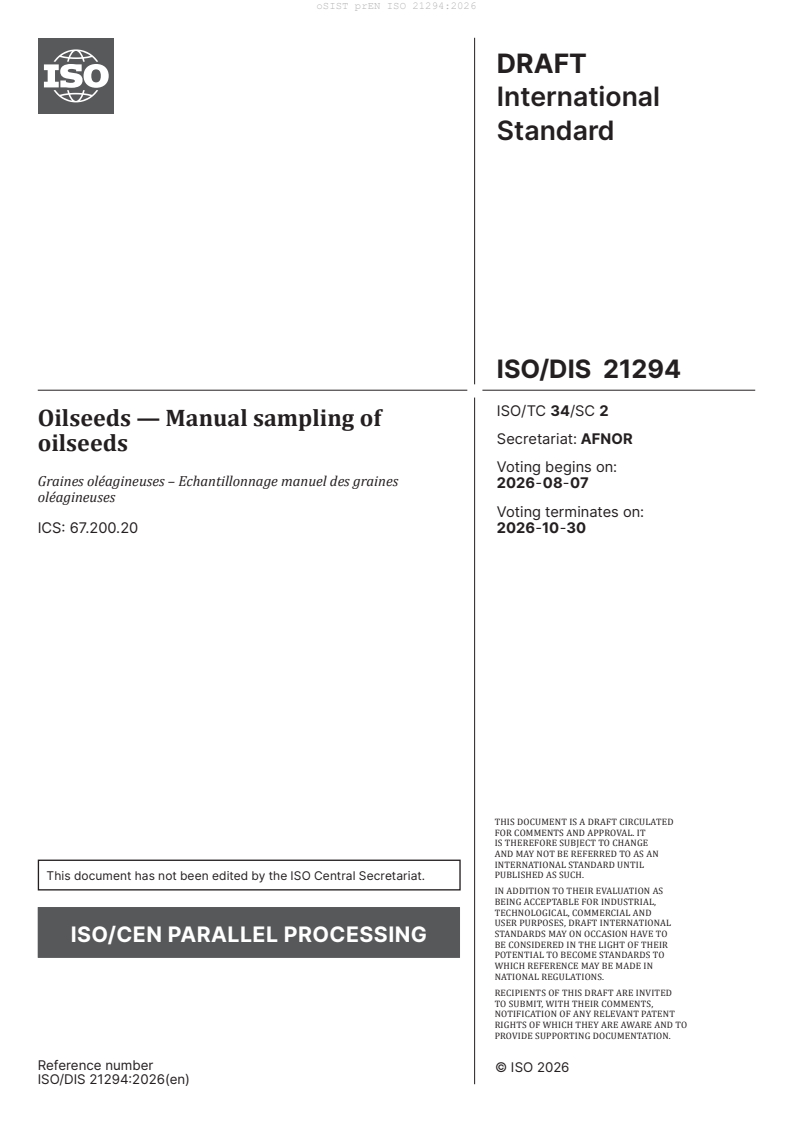
DRAFT
International
Standard
ISO/DIS 21294
ISO/TC 34/SC 2
Oilseeds — Manual sampling of
Secretariat: AFNOR
oilseeds
Voting begins on:
Graines oléagineuses – Echantillonnage manuel des graines
2026-08-07
oléagineuses
Voting terminates on:
ICS: 67.200.20 2026-10-30
THIS DOCUMENT IS A DRAFT CIRCULATED
FOR COMMENTS AND APPROVAL. IT
IS THEREFORE SUBJECT TO CHANGE
AND MAY NOT BE REFERRED TO AS AN
INTERNATIONAL STANDARD UNTIL
PUBLISHED AS SUCH.
This document has not been edited by the ISO Central Secretariat.
IN ADDITION TO THEIR EVALUATION AS
BEING ACCEPTABLE FOR INDUSTRIAL,
TECHNOLOGICAL, COMMERCIAL AND
USER PURPOSES, DRAFT INTERNATIONAL
STANDARDS MAY ON OCCASION HAVE TO
ISO/CEN PARALLEL PROCESSING
BE CONSIDERED IN THE LIGHT OF THEIR
POTENTIAL TO BECOME STANDARDS TO
WHICH REFERENCE MAY BE MADE IN
NATIONAL REGULATIONS.
RECIPIENTS OF THIS DRAFT ARE INVITED
TO SUBMIT, WITH THEIR COMMENTS,
NOTIFICATION OF ANY RELEVANT PATENT
RIGHTS OF WHICH THEY ARE AWARE AND TO
PROVIDE SUPPORTING DOCUMENTATION.
Reference number
ISO/DIS 21294:2026(en)
DRAFT
ISO/DIS 21294:2026(en)
International
Standard
ISO/DIS 21294
ISO/TC 34/SC 2
Oilseeds — Manual sampling of
Secretariat: AFNOR
oilseeds
Voting begins on:
Graines oléagineuses – Echantillonnage manuel des graines
2026-08-07
oléagineuses
Voting terminates on:
ICS: 67.200.20 2026-10-30
THIS DOCUMENT IS A DRAFT CIRCULATED
FOR COMMENTS AND APPROVAL. IT
IS THEREFORE SUBJECT TO CHANGE
AND MAY NOT BE REFERRED TO AS AN
INTERNATIONAL STANDARD UNTIL
PUBLISHED AS SUCH.
This document has not been edited by the ISO Central Secretariat.
IN ADDITION TO THEIR EVALUATION AS
BEING ACCEPTABLE FOR INDUSTRIAL,
© ISO 2026
TECHNOLOGICAL, COMMERCIAL AND
USER PURPOSES, DRAFT INTERNATIONAL
All rights reserved. Unless otherwise specified, or required in the context of its implementation, no part of this publication may
STANDARDS MAY ON OCCASION HAVE TO
ISO/CEN PARALLEL PROCESSING
be reproduced or utilized otherwise in any form or by any means, electronic or mechanical, including photocopying, or posting on
BE CONSIDERED IN THE LIGHT OF THEIR
the internet or an intranet, without prior written permission. Permission can be requested from either ISO at the address below
POTENTIAL TO BECOME STANDARDS TO
WHICH REFERENCE MAY BE MADE IN
or ISO’s member body in the country of the requester.
NATIONAL REGULATIONS.
ISO copyright office
RECIPIENTS OF THIS DRAFT ARE INVITED
CP 401 • Ch. de Blandonnet 8
TO SUBMIT, WITH THEIR COMMENTS,
CH-1214 Vernier, Geneva
NOTIFICATION OF ANY RELEVANT PATENT
Phone: +41 22 749 01 11
RIGHTS OF WHICH THEY ARE AWARE AND TO
PROVIDE SUPPORTING DOCUMENTATION.
Email: copyright@iso.org
Website: www.iso.org
Published in Switzerland Reference number
ISO/DIS 21294:2026(en)
ii
ISO/DIS 21294:2026(en)
Contents Page
Foreword .iv
Introduction .v
1 Scope . 1
2 Normative references . 1
3 Terms and definitions . 1
4 Principles . 2
4.1 Representative samples .2
4.2 Oilseeds sampling .2
5 Equipment and devices . 3
6 Time and place of sampling and limitation of the size of lots . 3
6.1 General information.3
6.2 Bulk transfer .3
6.2.1 General .3
6.2.2 Transfer to lorries and wagons .3
6.2.3 Transfer to barges .3
6.2.4 Transfer to silos or warehouses .4
6.3 Lot size: number of laboratory samples .4
7 Method for taking samples . 5
7.1 General information.5
7.2 Number of increments .5
7.2.1 General requirements on taking increments .5
7.2.2 Products in bags .5
7.2.3 Bulk .5
7.2.4 Aggregation of the composite sample .6
7.2.5 Division of the composite sample .6
7.2.6 Sample dividers .7
8 Sample size per lot and for dispatch to the laboratory . 8
9 Packing and labelling of samples . 8
9.1 Packing of samples .8
9.2 Labelling of samples .8
10 Dispatch of samples . 9
11 Sampling report . 9
Annex A (informative) Steps for laboratory samples . 10
Annex B (informative) Instruments used to sample static products .12
iii
ISO/DIS 21294:2026(en)
Foreword
ISO (the International Organization for Standardization) is a worldwide federation of national standards
bodies (ISO member bodies). The work of preparing International Standards is normally carried out through
ISO technical committees. Each member body interested in a subject for which a technical committee
has been established has the right to be represented on that committee. International organizations,
governmental and non-governmental, in liaison with ISO, also take part in the work. ISO collaborates closely
with the International Electrotechnical Commission (IEC) on all matters of electrotechnical standardization.
The procedures used to develop this document and those intended for its further maintenance are described
in the ISO/IEC Directives, Part 1. In particular, the different approval criteria needed for the different types
of ISO documents should be noted. This document was drafted in accordance with the editorial rules of the
ISO/IEC Directives, Part 2 (see www.iso.org/directives).
ISO draws attention to the possibility that the implementation of this document may involve the use of (a)
patent(s). ISO takes no position concerning the evidence, validity or applicability of any claimed patent
rights in respect thereof. As of the date of publication of this document, ISO had not received notice of (a)
patent(s) which may be required to implement this document. However, implementers are cautioned that
this may not represent the latest information, which may be obtained from the patent database available at
www.iso.org/patents. ISO shall not be held responsible for identifying any or all such patent rights.
Any trade name used in this document is information given for the convenience of users and does not
constitute an endorsement.
For an explanation of the voluntary nature of standards, the meaning of ISO specific terms and expressions
related to conformity assessment, as well as information about ISO's adherence to the World Trade
Organization (WTO) principles in the Technical Barriers to Trade (TBT), see www.iso.org/iso/foreword.html.
This document was prepared by Technical Committee ISO/TC 34, Food products, Subcommittee SC 2,
Oleaginous seeds and fruits and oilseed meals.
This second edition cancels and replaces the first edition (ISO 21294:2017), which has been technically
revised.
The main changes are as follows:
— Harmonisation of the terminology with ISO 21295.
Any feedback or questions on this document should be directed to the user’s national standards body. A
complete listing of these bodies can be found at www.iso.org/members.html.
iv
ISO/DIS 21294:2026(en)
Introduction
Most oilseeds are marketed on the basis of the result of analysis of the samples representing lots, and
disputes are invariably settled by reference to these samples. Careless or inaccurate sampling practices
could lead to misunderstandings, delays and unwarranted financial adjustments.
Correct sampling is a difficult process and one that requires the most careful attention. Emphasis cannot
therefore be too strongly laid on the necessity of obtaining a representative sample of oilseeds for analysis.
v
DRAFT International Standard ISO/DIS 21294:2026(en)
Oilseeds — Manual sampling of oilseeds
1 Scope
This document specifies the requirements for manual sampling of oilseeds by manual means or by automated
mechanical means, for the purpose of assessing their quality and condition.
NOTE An example of “condition” is an odour due to a treatment product.
Stockpiles are excluded of the scope of this document.
2 Normative references
The following documents are referred to in the text in such a way that some or all of their content constitutes
requirements of this document. For dated references, only the edition cited applies. For undated references,
the latest edition of the referenced document (including any amendments) applies.
ISO 664, Oilseeds — Reduction of laboratory sample to test sample
3 Terms and definitions
For the purposes of this document, the following terms and definitions apply.
ISO and IEC maintain terminological databases for use in standardization at the following addresses:
— IEC Electropedia: available at https:// www .electropedia .org/
— ISO Online browsing platform: available at https:// www .iso .org/ obp
3.1
manual sampling
sampling by manual means or by automated mechanical means of at least one position within a lot (3.3).
EXAMPLE Hand-scoops, shovels, suitable sampling buckets, automatic suction probes, automatic samplers
(sequenced).
3.2
consignment
quantity of oilseeds dispatched or received at one time and covered by a particular contract or shipping
document
Note 1 to entry: The consignment can be composed of one or more lots or part of a lot.
3.3
lot
stated quantity of the consignment (3.2) which can be sampled in order to determine its quality and condition
Note 1 to entry: The quantity of the lot can be of a mass up to 5 000 t.
3.4
increment sample
quantity of material taken at one time at each individual sampling point (at each individual sampling time
for moving lot) throughout a lot (3.3)
ISO/DIS 21294:2026(en)
3.5
Composite sample
bulk sample
quantity of material representative of the consignment (3.2) or of the lot (3.3) obtained by combining
and blending the increments samples (3.4) of the same size taken from the lot (3.3) of oilseeds during its
transference.
3.6
Bulk
Product distributed in a large unpackaged quantity
Note 1 to entry: “bulk sample” is different of “bulk”.
3.7
homogenization
thorough blending by mechanical or manual means so that any contaminants or foreign materials are
thoroughly distributed throughout the bulk sample or laboratory sample (3.8)
3.8
laboratory sample
representative quantity of oilseeds obtained by unbiased reduction of a composite sample (3.5) using
appropriate methods to obtain a desired quantity intended for laboratory analysis. Analytical data from the
collected samples should be representative of the lot (3.3) as a whole.
4 Principles
4.1 Representative samples
The laboratory samples shall be as representative as possible of the lots from which they are taken. Each
consignment shall be divided, actually or notionally, into lots of 500 t to 5 000 t according to its size. At
least a minimum number of increments sample shall be taken from each lot and homogenized carefully in
order to obtain a composite sample from which laboratory samples may be taken by successive division. A
laboratory sample shall result from the sampling of each lot (see Table 1).
A diagram showing the different steps for laboratory samples is given in Annex A.
4.2 Oilseeds sampling
This document covers both the manual sampling of oilseeds in motion while being transferred and the
manual sampling and automated non-systematic mechanical sampling of static lots. Samples shall be taken
using manual or automatic methods. Where possible, sampling should be performed when the oilseeds are
flowing (e.g. during loading or unloading) so that the constituent parts of the lot have the same probability
of being sampled and comply with the minimum number and mass of in
...