


oSIST prEN ISO 787-9:2026
(Main)General methods of test for pigments and extenders - Part 9: Determination of pH value of an aqueous suspension (ISO/DIS 787-9:2026)
General methods of test for pigments and extenders - Part 9: Determination of pH value of an aqueous suspension (ISO/DIS 787-9:2026)
This document specifies a general method of test for determining the pH value of an aqueous suspension of a sample of pigment or extender.
Allgemeine Prüfverfahren für Pigmente und Füllstoffe - Teil 9: Bestimmung des pH-Wertes einer wässrigen Suspension (ISO/DIS 787-9:2026)
Méthodes générales d'essai des pigments et matières de charge - Partie 9: Détermination du pH d'une suspension aqueuse (ISO/DIS 787-9:2026)
Le présent document spécifie une méthode générale d'essai pour la détermination du pH d'une suspension aqueuse d'un échantillon de pigment ou de matière de charge.
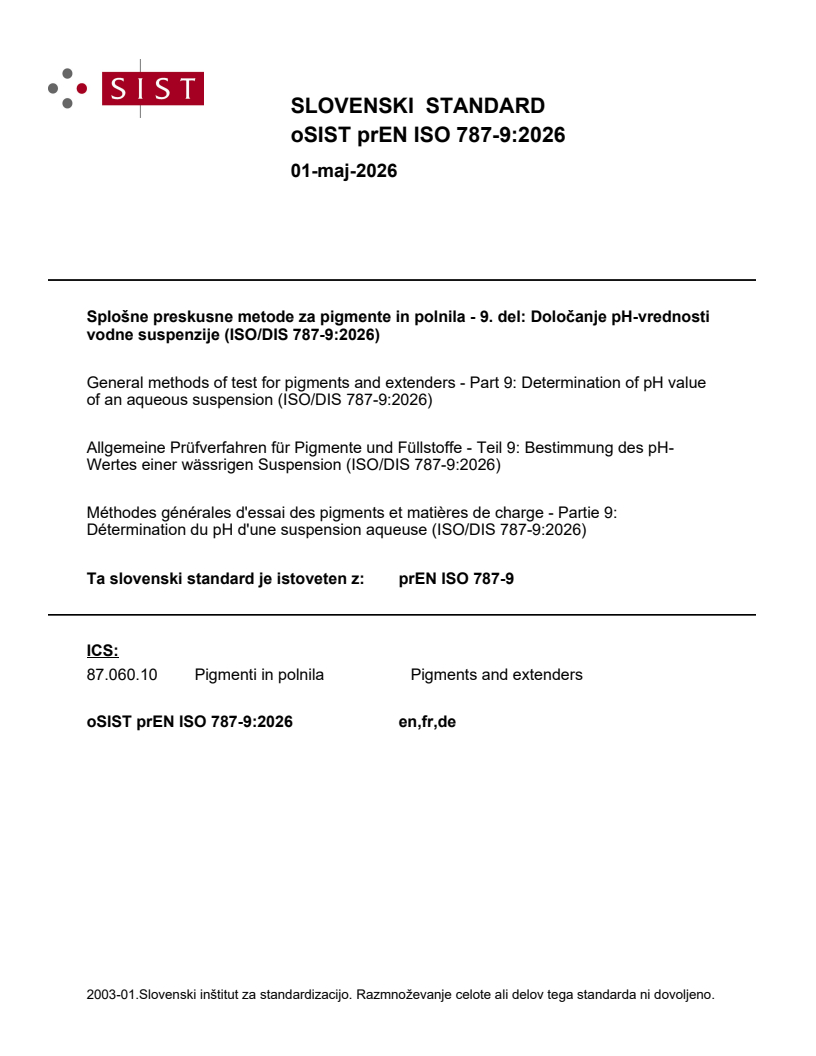
Splošne preskusne metode za pigmente in polnila - 9. del: Določanje pH-vrednosti vodne suspenzije (ISO/DIS 787-9:2026)
Ta dokument določa splošno preskusno metodo za določanje pH vrednosti vodne suspenzije vzorca pigmenta ali polnila.
General Information
- Status
- Not Published
- Public Enquiry End Date
- 01-Jun-2026
- Technical Committee
- PIP - Pigments and extenders
- Current Stage
- 4020 - Public enquire (PE) (Adopted Project)
- Start Date
- 07-Apr-2026
- Due Date
- 25-Aug-2026
Relations
- Effective Date
- 01-May-2026
Overview
oSIST prEN ISO 787-9:2026:2026 is an international draft standard developed by CEN and ISO, titled “General methods of test for pigments and extenders – Part 9: Determination of pH value of an aqueous suspension.” This document provides a standardized method for determining the pH value of an aqueous suspension of pigments or extenders. Consistency in testing equipment and procedures is essential for the reliable assessment of pigments and extenders used in numerous industries, including paints, coatings, plastics, and construction materials.
Understanding the pH value of pigment and extender suspensions is critical, as it directly affects compatibility, stability, and end-use performance in formulations. This standard is aligned with broader quality control and product characterization strategies, supporting manufacturers and laboratories in achieving reproducible and internationally recognized test results.
Key Topics
Scope and Purpose
The standard details the procedure for preparing a suspension of pigment or extender in water (or an optional ion intensity regulating solution) and measuring its pH value with precision.Reagents and Apparatus
- Use of distilled or demineralized water (ISO 3696) with controlled pH and purity
- Optionally, preparation of a 0.1% potassium chloride (KCl) ion intensity regulating solution
- Use of chemically resistant glass containers with clean, unused stoppers
- Employment of a calibrated pH measurement device with at least 0.1 unit accuracy
Sampling and Procedure
- Guidelines for representative sampling following ISO 15528
- Instructions for preparing 5–10% (mass fraction) suspensions
- Steps for mixing, settling, and accurate pH measurement, including the management of wetting agents (e.g., ethanol or methanol) if needed
- Temperature recording and notes on any deviations or anomalies during testing
Reporting Requirements
- Comprehensive test report including sample identification, suspension details, filtering, wetting agents used, result expression, temperature, and any procedural deviations
Applications
The methods outlined in oSIST prEN ISO 787-9:2026:2026 are directly applicable to a variety of commercial and industrial settings where pigments and extenders are used:
Paints and Coatings
Ensuring pigment pH compatibility with binders reduces risks of instability or adverse chemical reactions.Plastics and Polymers
Reliable pH values help optimize pigment dispersion and prevent undesirable changes in polymer matrices.Adhesives, Sealants, and Construction Materials
Accurate pH measurement supports predictability in product interactions and long-term durability.Quality Control in Manufacturing
Laboratories rely on standardized methods to assess incoming raw materials, intermediate batches, and finished products for specification compliance.Research and Product Development
Consistent pH measurements are valuable for characterizing new pigment formulations or modifying existing ones for specialized applications.
Related Standards
Organizations and professionals using oSIST prEN ISO 787-9:2026:2026 may also refer to these related standards for comprehensive pigment and extender testing:
ISO 3696: Water for analytical laboratory use – Specification and test methods
Ensures the adequacy of water quality used in preparing suspensions.ISO 15528: Paints, varnishes, and raw materials for paints and varnishes – Sampling
Addresses the correct procedures for obtaining representative samples.ISO 18451-1: Pigments, dyestuffs, and extenders – Terminology – Part 1: General terms
Provides standard definitions and terminology used throughout the pigment industry.
Moreover, oSIST prEN ISO 787-9:2026:2026 is part of the broader ISO 787 series, which covers general test methods crucial for global trade, compliance, and harmonization within the pigments and extenders sector.
Keywords: ISO 787-9, pigment testing, extender testing, pH value determination, aqueous suspension, paints and coatings standards, laboratory test methods, international standard, CEN, analytical procedures, quality control, pigment industry, industrial pigments, material compatibility.

Frequently Asked Questions
oSIST prEN ISO 787-9:2026 is a draft published by the Slovenian Institute for Standardization (SIST). Its full title is "General methods of test for pigments and extenders - Part 9: Determination of pH value of an aqueous suspension (ISO/DIS 787-9:2026)". This standard covers: This document specifies a general method of test for determining the pH value of an aqueous suspension of a sample of pigment or extender.
This document specifies a general method of test for determining the pH value of an aqueous suspension of a sample of pigment or extender.
oSIST prEN ISO 787-9:2026 is classified under the following ICS (International Classification for Standards) categories: 87.060.10 - Pigments and extenders. The ICS classification helps identify the subject area and facilitates finding related standards.
oSIST prEN ISO 787-9:2026 has the following relationships with other standards: It is inter standard links to SIST EN ISO 787-9:2019. Understanding these relationships helps ensure you are using the most current and applicable version of the standard.
oSIST prEN ISO 787-9:2026 is available in PDF format for immediate download after purchase. The document can be added to your cart and obtained through the secure checkout process. Digital delivery ensures instant access to the complete standard document.
Standards Content (Sample)
SLOVENSKI STANDARD
01-maj-2026
Splošne preskusne metode za pigmente in polnila - 9. del: Določanje pH-vrednosti
vodne suspenzije (ISO/DIS 787-9:2026)
General methods of test for pigments and extenders - Part 9: Determination of pH value
of an aqueous suspension (ISO/DIS 787-9:2026)
Allgemeine Prüfverfahren für Pigmente und Füllstoffe - Teil 9: Bestimmung des pH-
Wertes einer wässrigen Suspension (ISO/DIS 787-9:2026)
Méthodes générales d'essai des pigments et matières de charge - Partie 9:
Détermination du pH d'une suspension aqueuse (ISO/DIS 787-9:2026)
Ta slovenski standard je istoveten z: prEN ISO 787-9
ICS:
87.060.10 Pigmenti in polnila Pigments and extenders
2003-01.Slovenski inštitut za standardizacijo. Razmnoževanje celote ali delov tega standarda ni dovoljeno.
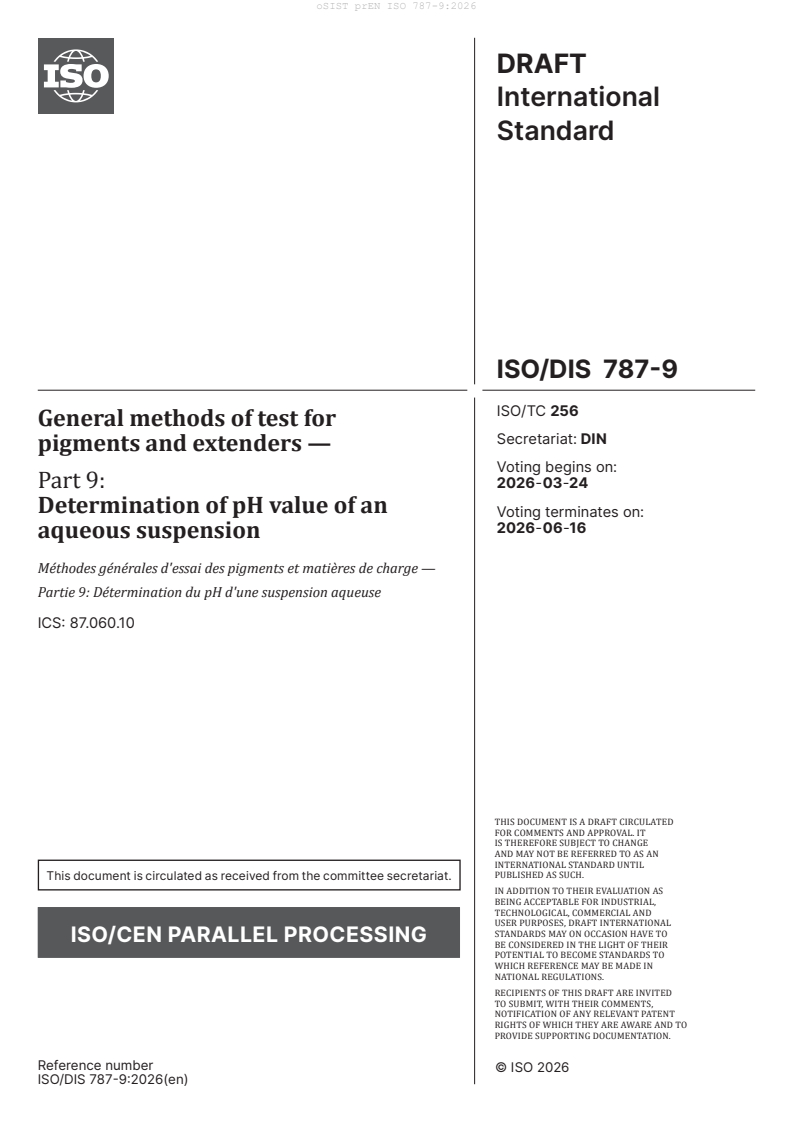
DRAFT
International
Standard
ISO/DIS 787-9
ISO/TC 256
General methods of test for
Secretariat: DIN
pigments and extenders —
Voting begins on:
Part 9: 2026-03-24
Determination of pH value of an
Voting terminates on:
2026-06-16
aqueous suspension
Méthodes générales d'essai des pigments et matières de charge —
Partie 9: Détermination du pH d'une suspension aqueuse
ICS: 87.060.10
THIS DOCUMENT IS A DRAFT CIRCULATED
FOR COMMENTS AND APPROVAL. IT
IS THEREFORE SUBJECT TO CHANGE
AND MAY NOT BE REFERRED TO AS AN
INTERNATIONAL STANDARD UNTIL
PUBLISHED AS SUCH.
This document is circulated as received from the committee secretariat.
IN ADDITION TO THEIR EVALUATION AS
BEING ACCEPTABLE FOR INDUSTRIAL,
TECHNOLOGICAL, COMMERCIAL AND
USER PURPOSES, DRAFT INTERNATIONAL
STANDARDS MAY ON OCCASION HAVE TO
ISO/CEN PARALLEL PROCESSING
BE CONSIDERED IN THE LIGHT OF THEIR
POTENTIAL TO BECOME STANDARDS TO
WHICH REFERENCE MAY BE MADE IN
NATIONAL REGULATIONS.
RECIPIENTS OF THIS DRAFT ARE INVITED
TO SUBMIT, WITH THEIR COMMENTS,
NOTIFICATION OF ANY RELEVANT PATENT
RIGHTS OF WHICH THEY ARE AWARE AND TO
PROVIDE SUPPORTING DOCUMENTATION.
Reference number
ISO/DIS 787-9:2026(en)
DRAFT
ISO/DIS 787-9:2026(en)
International
Standard
ISO/DIS 787-9
ISO/TC 256
General methods of test for
Secretariat: DIN
pigments and extenders —
Voting begins on:
Part 9:
2026-03-24
Determination of pH value of an
Voting terminates on:
2026-06-16
aqueous suspension
Méthodes générales d'essai des pigments et matières de charge —
Partie 9: Détermination du pH d'une suspension aqueuse
ICS: 87.060.10
THIS DOCUMENT IS A DRAFT CIRCULATED
FOR COMMENTS AND APPROVAL. IT
IS THEREFORE SUBJECT TO CHANGE
AND MAY NOT BE REFERRED TO AS AN
INTERNATIONAL STANDARD UNTIL
PUBLISHED AS SUCH.
This document is circulated as received from the committee secretariat.
IN ADDITION TO THEIR EVALUATION AS
BEING ACCEPTABLE FOR INDUSTRIAL,
© ISO 2026
TECHNOLOGICAL, COMMERCIAL AND
USER PURPOSES, DRAFT INTERNATIONAL
All rights reserved. Unless otherwise specified, or required in the context of its implementation, no part of this publication may
STANDARDS MAY ON OCCASION HAVE TO
ISO/CEN PARALLEL PROCESSING
be reproduced or utilized otherwise in any form or by any means, electronic or mechanical, including photocopying, or posting on
BE CONSIDERED IN THE LIGHT OF THEIR
the internet or an intranet, without prior written permission. Permission can be requested from either ISO at the address below
POTENTIAL TO BECOME STANDARDS TO
WHICH REFERENCE MAY BE MADE IN
or ISO’s member body in the country of the requester.
NATIONAL REGULATIONS.
ISO copyright office
RECIPIENTS OF THIS DRAFT ARE INVITED
CP 401 • Ch. de Blandonnet 8
TO SUBMIT, WITH THEIR COMMENTS,
CH-1214 Vernier, Geneva
NOTIFICATION OF ANY RELEVANT PATENT
Phone: +41 22 749 01 11
RIGHTS OF WHICH THEY ARE AWARE AND TO
PROVIDE SUPPORTING DOCUMENTATION.
Email: copyright@iso.org
Website: www.iso.org
Published in Switzerland Reference number
ISO/DIS 787-9:2026(en)
ii
ISO/DIS 787-9:2026(en)
Contents Page
Foreword .iv
1 Scope . 1
2 Normative references . 1
3 Terms and definitions . 1
4 Reagents . 1
5 Apparatus . 2
6 Sampling . 2
7 Procedure . 2
8 Expression of results . 2
9 Test report . 2
iii
ISO/DIS 787-9:2026(en)
Foreword
ISO (the International Organization for Standardization) is a worldwide federation of national standards
bodies (ISO member bodies). The work of preparing International Standards is normally carried out through
ISO technical committees. Each member body interested in a subject for which a technical committee
has been established has the right to be represented on that committee. International organizations,
governmental and non-governmental, in liaison with ISO, also take part in the work. ISO collaborates closely
with the International Electrotechnical Commission (IEC) on all matters of electrotechnical standardization.
The procedures used to develop this document a
...
Questions, Comments and Discussion
Ask us and Technical Secretary will try to provide an answer. You can facilitate discussion about the standard in here.
Loading comments...