


SIST EN 13523-6:2020
(Main)Coil coated metals - Test methods - Part 6: Adhesion after indentation (cupping test)
Coil coated metals - Test methods - Part 6: Adhesion after indentation (cupping test)
This document defines terms of the procedure for determining the adhesion of an organic coating to a metallic substrate after indentation produced by slow deformation.
The resistance to cracking can also be evaluated.
Bandbeschichtete Metalle - Prüfverfahren - Teil 6: Haftfestigkeit nach Eindrücken (Tiefungsprüfung)
Dieses Dokument legt das Verfahren zum Bestimmen der Haftfestigkeit einer organischen Beschichtung auf einem metallischen Substrat nach Eindrücken bei langsamer Verformung fest.
Die Widerstandsfähigkeit gegen Rissbildung kann auch bewertet werden.
Tôles prélaquées - Méthodes d'essai - Partie 6 : Adhérence après indentation (essai d'emboutissage)
Le présent document décrit le mode opératoire de détermination de l’adhérence d’un revêtement organique sur un subjectile métallique après indentation provoquée par déformation lente.
La résistance à la fissuration peut également être évaluée.
Prevlečene kovine, ki se navijajo - Preskusne metode - 6. del: Oprijem po globljenju (preskus elastičnosti)
General Information
- Status
- Published
- Public Enquiry End Date
- 01-Aug-2019
- Publication Date
- 26-Jul-2020
- Technical Committee
- IBLP - Paints and varnishes
- Current Stage
- 6060 - National Implementation/Publication (Adopted Project)
- Start Date
- 18-Jun-2020
- Due Date
- 23-Aug-2020
- Completion Date
- 27-Jul-2020


Relations
- Effective Date
- 01-Sep-2020
- Effective Date
- 09-Feb-2026
- Effective Date
- 28-Jan-2026
- Effective Date
- 28-Jan-2026
- Effective Date
- 28-Jan-2026
- Effective Date
- 28-Jan-2026
- Effective Date
- 28-Jan-2026
- Effective Date
- 28-Jan-2026
- Effective Date
- 28-Jan-2026
- Effective Date
- 28-Jan-2026
Overview
SIST EN 13523-6:2020 is a European standard that specifies the method for determining the adhesion of an organic coating to a metallic substrate after deformation by slow indentation, also known as the cupping test. This standard is part of the broader EN 13523 series, which covers test methods for coil coated metals-materials widely used in automotive, construction, appliance, and packaging industries due to their durability and corrosion resistance.
The cupping test is essential for assessing how well the coating adheres to metal surfaces after being subjected to mechanical deformation. It also allows for evaluation of the coating’s resistance to cracking, a critical performance factor for coil coated products exposed to forming, processing, or impact during their lifecycle.
Key Topics
- Adhesion Testing: The procedure assesses the adhesion strength of organic coatings after an indentation has been formed in the metal by slow deformation. It includes detailed cross-hatching and tape testing steps for coatings of different thicknesses.
- Coating Thickness Considerations: Specific guidance is provided for coatings equal to or greater than 60 µm, and for those less than 60 µm, including different methods for making cuts and evaluating results.
- Ageing and Durability: Optional procedures for artificially ageing samples by immersing them in boiling water are provided, simulating real-world environmental exposure.
- Evaluation of Cracking: Beyond adhesion, the standard enables the assessment of resistance to cracking at the site of indentation, enhancing reliability predictions.
- Reporting Requirements: Clear requirements for recording detailed results and conditions of the test ensure repeatability and traceability.
Applications
The methodologies described in SIST EN 13523-6:2020 are highly relevant for:
- Quality Control in Manufacturing: Ensuring that coil coated metals meet required adhesion and resistance specifications before shipment or further forming.
- Research & Development: Evaluating new coating formulations or application methods to optimize performance under mechanical stress.
- Contract Specifications: Providing a referenced, standardized method for defining coating performance in product specifications, tender documents, or supplier agreements.
- Regulatory Compliance: Meeting industry and market requirements for coated steel and aluminum products used in building, automotive, and household appliance sectors.
The adhesion after indentation (cupping) test helps manufacturers and suppliers validate that coil coated products sustain their protective and decorative functions under typical use conditions, minimizing the risk of premature coating failure.
Related Standards
Several other standards support or extend the scope of SIST EN 13523-6:2020, including:
- EN 13523-0: General Introduction to the test methods for coil coated metals.
- EN 23270 / ISO 3270: Conditioning and testing environments for paints, varnishes, and coated materials.
- EN ISO 1520: The cupping test used as the basis for indentation and deformation.
- EN 13523 Series: Includes other tests for film thickness, gloss, colour difference, hardness, resistance to salt spray, scratching, and more.
- EN 10169: Technical delivery conditions for continuously organic coated (coil coated) steel flat products.
- EN 1396: Specifications for aluminum and aluminum alloy coil coated sheet and strip.
Adopting this standard ensures consistency, comparability, and reliability in assessing the durability and performance of coil coated metals across applications and markets. With clear testing protocols, manufacturers can confidently demonstrate compliance and product quality, supporting both technical integrity and customer satisfaction.
Get Certified
Connect with accredited certification bodies for this standard

DVS-ZERT GmbH
German welding certification society.
CARES (UK Certification Authority for Reinforcing Steels)
UK certification for reinforcing steels and construction.
EWF/IIW (European/International Welding Federation)
International welding personnel certification.
Sponsored listings
Frequently Asked Questions
SIST EN 13523-6:2020 is a standard published by the Slovenian Institute for Standardization (SIST). Its full title is "Coil coated metals - Test methods - Part 6: Adhesion after indentation (cupping test)". This standard covers: This document defines terms of the procedure for determining the adhesion of an organic coating to a metallic substrate after indentation produced by slow deformation. The resistance to cracking can also be evaluated.
This document defines terms of the procedure for determining the adhesion of an organic coating to a metallic substrate after indentation produced by slow deformation. The resistance to cracking can also be evaluated.
SIST EN 13523-6:2020 is classified under the following ICS (International Classification for Standards) categories: 25.220.60 - Organic coatings. The ICS classification helps identify the subject area and facilitates finding related standards.
SIST EN 13523-6:2020 has the following relationships with other standards: It is inter standard links to SIST EN 13523-6:2003, SIST EN 60454-2:2007, SIST EN ISO 1520:2007, SIST EN 23270:1997, SIST EN 13523-0:2021, SIST EN 1396:2015, SIST EN 10169:2011+A1:2012, SIST EN 10169:2022, SIST EN 1090-4:2018, SIST EN 13523-0:2014. Understanding these relationships helps ensure you are using the most current and applicable version of the standard.
SIST EN 13523-6:2020 is available in PDF format for immediate download after purchase. The document can be added to your cart and obtained through the secure checkout process. Digital delivery ensures instant access to the complete standard document.
Standards Content (Sample)
SLOVENSKI STANDARD
01-september-2020
Nadomešča:
SIST EN 13523-6:2003
Prevlečene kovine, ki se navijajo - Preskusne metode - 6. del: Oprijem po
globljenju (preskus elastičnosti)
Coil coated metals - Test methods - Part 6: Adhesion after indentation (cupping test)
Bandbeschichtete Metalle - Prüfverfahren - Teil 6: Haftfestigkeit nach Eindrücken
(Tiefungsprüfung)
Tôles prélaquées - Méthodes d'essai - Partie 6 : Adhérence après indentation (essai
d'emboutissage)
Ta slovenski standard je istoveten z: EN 13523-6:2020
ICS:
25.220.60 Organske prevleke Organic coatings
2003-01.Slovenski inštitut za standardizacijo. Razmnoževanje celote ali delov tega standarda ni dovoljeno.
EN 13523-6
EUROPEAN STANDARD
NORME EUROPÉENNE
June 2020
EUROPÄISCHE NORM
ICS 25.220.60 Supersedes EN 13523-6:2002
English Version
Coil coated metals - Test methods - Part 6: Adhesion after
indentation (cupping test)
Tôles prélaquées - Méthodes d'essai - Partie 6 : Bandbeschichtete Metalle - Prüfverfahren - Teil 6:
Adhérence après indentation (essai d'emboutissage) Haftfestigkeit nach Eindrücken (Tiefungsprüfung)
This European Standard was approved by CEN on 3 May 2020.
CEN members are bound to comply with the CEN/CENELEC Internal Regulations which stipulate the conditions for giving this
European Standard the status of a national standard without any alteration. Up-to-date lists and bibliographical references
concerning such national standards may be obtained on application to the CEN-CENELEC Management Centre or to any CEN
member.
This European Standard exists in three official versions (English, French, German). A version in any other language made by
translation under the responsibility of a CEN member into its own language and notified to the CEN-CENELEC Management
Centre has the same status as the official versions.
CEN members are the national standards bodies of Austria, Belgium, Bulgaria, Croatia, Cyprus, Czech Republic, Denmark, Estonia,
Finland, France, Germany, Greece, Hungary, Iceland, Ireland, Italy, Latvia, Lithuania, Luxembourg, Malta, Netherlands, Norway,
Poland, Portugal, Republic of North Macedonia, Romania, Serbia, Slovakia, Slovenia, Spain, Sweden, Switzerland, Turkey and
United Kingdom.
EUROPEAN COMMITTEE FOR STANDARDIZATION
COMITÉ EUROPÉEN DE NORMALISATION
EUROPÄISCHES KOMITEE FÜR NORMUNG
CEN-CENELEC Management Centre: Rue de la Science 23, B-1040 Brussels
© 2020 CEN All rights of exploitation in any form and by any means reserved Ref. No. EN 13523-6:2020 E
worldwide for CEN national Members.
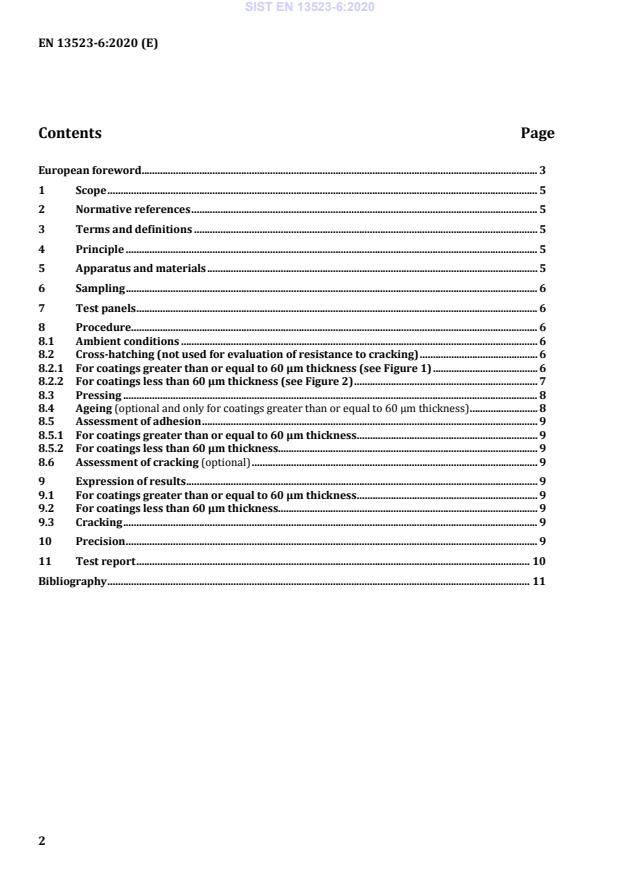
Contents Page
European foreword . 3
1 Scope . 5
2 Normative references . 5
3 Terms and definitions . 5
4 Principle . 5
5 Apparatus and materials . 5
6 Sampling . 6
7 Test panels . 6
8 Procedure. 6
8.1 Ambient conditions . 6
8.2 Cross-hatching (not used for evaluation of resistance to cracking) . 6
8.2.1 For coatings greater than or equal to 60 µm thickness (see Figure 1) . 6
8.2.2 For coatings less than 60 µm thickness (see Figure 2) . 7
8.3 Pressing . 8
8.4 Ageing (optional and only for coatings greater than or equal to 60 µm thickness) . 8
8.5 Assessment of adhesion . 9
8.5.1 For coatings greater than or equal to 60 µm thickness . 9
8.5.2 For coatings less than 60 µm thickness. 9
8.6 Assessment of cracking (optional) . 9
9 Expression of results . 9
9.1 For coatings greater than or equal to 60 µm thickness . 9
9.2 For coatings less than 60 µm thickness. 9
9.3 Cracking . 9
10 Precision . 9
11 Test report . 10
Bibliography . 11
European foreword
This document (EN 13523-6:2020) has been prepared by Technical Committee CEN/TC 139 “Paints and
varnishes”, the secretariat of which is held by DIN.
This European Standard shall be given the status of a national standard, either by publication of an identical
text or by endorsement, at the latest by December 2020, and conflicting national standards shall be
withdrawn at the latest by December 2020.
Attention is drawn to the possibility that some of the elements of this document may be the subject of patent
rights. CEN shall not be held responsible for identifying any or all such patent rights.
This document supersedes EN 13523-6:2002.
The main changes are:
a) the period of ageing has been changed from 1 h to agreement prior to the test (8.4);
b) the time of ageing has been added to the test report;
c) the text has been editorially revised and the normative references have been updated.
The EN 13523 series, Coil coated metals — Test methods, consists of the following parts:
— Part 0: General introduction
— Part 1: Film thickness
— Part 2: Gloss
— Part 3: Colour difference — Instrumental comparison
— Part 4: Pencil hardness
— Part 5: Resistance to rapid deformation (impact test)
— Part 6: Adhesion after indentation (cupping test)
— Part 7: Resistance to cracking on bending (T-bend test)
— Part 8: Resistance to salt spray (fog)
— Part 9: Resistance to water immersion
— Part 10: Resistance to fluorescent UV radiation and water condensation
— Part 11: Resistance to solvents (rubbing test)
— Part 12: Resistance to scratching
— Part 13: Resistance to accelerated ageing by the use of heat
— Part 14: Chalking (Helmen method)
— Part 15: Metamerism
— Part 16: Resistance to abrasion
— Part 17: Adhesion of strippable films
— Part 18: Resistance to staining
— Part 19: Panel design and method of atmospheric exposure testing
— Part 20: Foam adhesion
— Part 21: Evaluation of outdoor exposed panels
— Part 22: Colour difference — Visual comparison
— Part 23: Resistance to humid atmospheres containing sulfur dioxide
— Part 24: Resistance to blocking and pressure marking
— Part 25: Resistance to humidity
— Part 26: Resistance to condensation of water
— Part 27: Resistance to humid poultice (Cataplasm test)
— Part 29: Resistance to environmental soiling (Dirt pick-up and striping)
According to the CEN-CENELEC Internal Regulations, the national standards organisations o
...