


ISO/IEC 11458:1993
(Main)Information technology — Microprocessor systems — VICbus — Inter-crate cable bus
Information technology — Microprocessor systems — VICbus — Inter-crate cable bus
The objectives are to provide a standard cable bus for the interconnection of multiple devices, both backplane bus systems, such as the IEC 821 VMEbus, and stand-alone apparatus; to specify the electrical characteristics of the cable bus; to specify the protocols that precisely define the interaction between devices connected to the VICbus; to specify the mechanisms necessary to construct fault-tolerant, multi-device systems; to provide the necessary definitions, terminology and background information to fully describe the VICbus protocols and other mechanisms.
Technologies de l'information — Systèmes à microprocesseurs — VICbus — Bus à câbles inter-châssis
General Information
Relations
Standards Content (Sample)
lSO/IEC
INTERNATIONAL
STANDARD
First edition
1993-l 2-01
Information technology -
Microprocessor systems -
VlCbus - llnter-crate cable bus
Technologies de /‘information -
Syst&mes a microprocesseurs -
WCbus - Bus a cables inter-chassis
Reference number
ISOA EC 11458: l993( E)
- - 6 ISO/IEC 11458 : 1993
CONTENTS
Page
. . . . . . . . . . . . . . . . . . . . . . . . . . . . . . . . . . . . . . . . . . . . . . . . . . . . . . . . . . . . . . . . . .*.*.
FOREWORD
Clause
1 . . . . . . . . . . . . . . . . . . . . . . . . . . . . . . . . . . . . . . . . . . . . . . . . . . . . . . . . . . . . . . . . . . . . . . . . . . . . . . . . . . . . . . . . . . . . . . . . . . . . . . . . . . . . . . . . . . . . . . . . .
Scope
. . . . . . . . . . . . . . . . . . . . . . . . . . . . . . . . . . . . . . . . . . . . . . . . . . . . . . . . . . . . . . . . .
2 Introduction to the ISO/IEC 11458 VICbus standard
........................................................................................................................
2.1 Objectives
.......................................................................................................
2.2 Standard terminology
.......................................................................................................
2.2.1 Rule
..................................................................................
2.2.2 Recommendation
...........................................................................................
2.2.3 Permission
.........................................................................................
2.2.4 Observation
..........................................................................................................
2.3 Other terminology
............................................................................................................
2.4 Timing diagrams
............................................................................................................................
2.5 Tables
.......................................................................................................
2.6 Data representation
. . . . . . . . . . . . . . . . . . . . . . . . . . . . . . . . . . . . . . . . . . . . . . . . . . . . . . . . . . . . . . . . . . . . . . . . . . . . . . . . . . . . . . . . . . . . . . . . . . . . . . . . . . . . . . . . . . . . .
3 Data transfer bus
3.1 Introduction .
.............................................................................................................
3.2 DTB cycle types
. 12
3.2.1 Direct cycles .
.........................................................................................
3.2.2 Transparent cycles
...................................................................................
3.3 Use of the DTB information lines
........................................................................................
3.3.1 The address phase
..............................................................................................
3.3.2 The data phase
...................................................................
Address / data lines AD31-ADO0
3.3.3
....................................................................................
Control lines CL3CLO
3.3.4
.............................................................................
Identification lines ID4-ID0
3.3.5
..................................................................
3.3.6 Device number signals DN4-DNO
...............................................................................
3.3.7 Address signals A31-A02
.............................................................
3.3.8 Address extension signals AES-AEO
...................................................................
Register select signals RS4-RSO
3.3.9
...............................................................................
Block transfer signal BLT
3.3.10
........................................................................................
3.3.11 Write signal WRITE
......... 16
3.3.12 Byte selection signals LWORD, AOl, ASELO, ASELI, DSELO, DSELI
. 18
....................
Interrupter number signals IN40IN0 .
3.3.13
.........................................................................
Slave response signal SERR
3.3.14
Data signals 031 -DO0 .
3.3.15
..........................................................................................
3.4 Transparent VME-A64 cycle
...............................................................
3.5 Data transfer cycle - bus protocols and timing
......................................................................................
3.5.1 Block transfer cycles
...............................................................................
3.52 Read-modify-write cycles
........................................................................................................
3.6 Compelled protocol
........................................................................................
The address phase
3.6.1
..............................................................................................
3 6.2 The data phase
:
...............................................................................................
3.7 Non-compelled protocols
.................................................................................
3.7.1 Non-compelled 1 (NCl)
.................................................................................
3.7.2 Non-compelled 2 (NC2)
..................................................................................
3.8 Slave participation in DTB cycles
Q ISO/lEC 1993
All rights reserved. No part of this publication may be reproduced or utilized in any form or by any means,
electronic or mechanical, including photocopying and microfilm, without permission in writing from the publisher.
ISOAEC Copyright Office l Case Postale 131 l CH-1211 Gen8ve 20 l Switzerland
Printed in Switzerland
w -
0 ISO/IEC 11458 : 1993
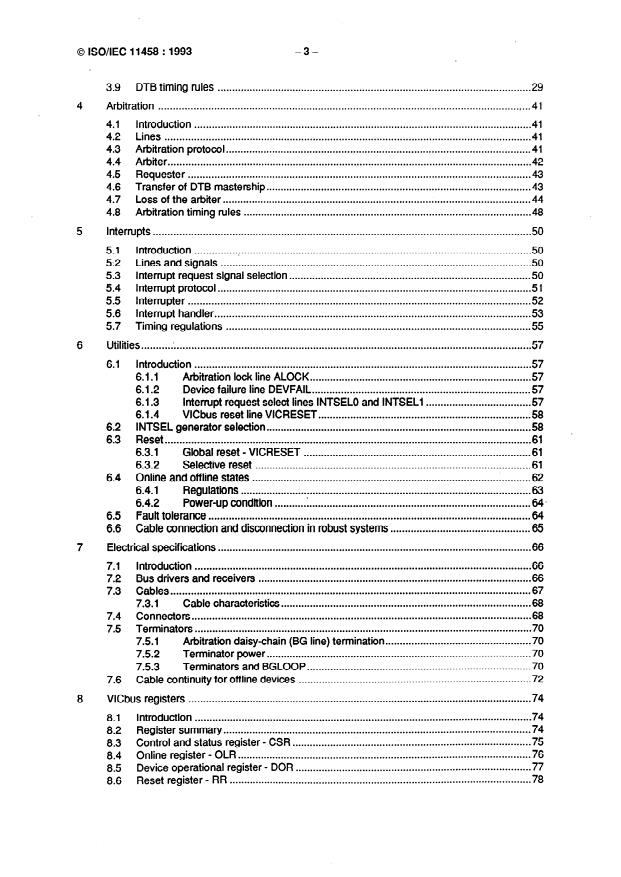
3.9 DTB timing rules . . . . . . . . . . . . . . . . . . . . . . . . . . . . . . . . . . . . . . . . . . . . . . . . . . . . . . . . . . . . . . . . . . . . . . . . . . . . . . . . . . . . . . . . . . . . . . . . . . . . . . . . . . . . 29
" 41
4 Arbitration . . . . . . . . . . . . . . . . . . . . . . . . . . . . . . . . . . . . . . . . . . . . . . . . . . . . . . . . . . . . . . . . . . . . . . . . . . . . . . . . . . . . . . . . . . . . . . . . . . . . . . . . . . . . . . . . . . . . . . . . .
41 Introduction .
412 Lines .
4.3 Arbitration protocol .
4.4 Arbiter .
4.5 Requester . 43
4.6 Transfer of DTB mastership . 43
.......................................................................................................... 44
4.7 Loss of the arbiter
................................................................................................... 48
4.8 Arbitration timing rules
5 Interrupts . . . . . . . . . . . . . . . . . . . . . . . . . . . . . . . . . . . . . . . . . . . . . . . . . . . . . . . . . . . . . . . . . . . . . . . . . . . . . . . . . . . . . . . . . . . . . . . . . . . . . . . . . . . . . . . . . . . . . . . . .
51 . Introduction . 50
5.2 . Lines and signals . ” 50
53 . Interrupt request signal selection . 50
54 . Interrupt protocol . 51
. . 52
55 Interrupter
............................................................................................................. 53
56 . Interrupt handler
57 . Timing regulations .
I
6 Utilities . . . . . . . . . . . . . . . . . . . . . . . . . . . . . . . . . . . . . . . . . . . . . . . . . . . . . . . . . . . . . . . . . . . . . . . . . . . . . . . . . . . . . . . . . . . . . . . . . . . . . . . . . . . . . . . . . . . . . . . . . 57
. . . . . . . . . . . . . . . . . . . . . . . . . . . . . . . . . . . . . . . . . . . . . . . . . . . . . . . . . . . . . . . . . . . . . . . . . . . . . . . . . . . . . . . . . . . . . . . . . . . . . . . . . . . . . . . . . . . . 57
6.1 Introduction
Arbitration lock line ALOCK . . . . . . . . . . . . . . . . . . . . . . . . . . . . . . . . . . . . . . . . . . . . .*. 57
6.1 .l
. . . . . . . . . . . . . . . . . . . . . . . . . . . . . . . . . . . . . . . . . . . . . . . . . . . . . . . . . . . . . . . . . . . . . . . . . . . 57
6.1.2 Device failure line DEVFAIL
. . . . . . . . . . . . . . . . . . . . . . . . . . . . . . . . . . . . 57
6.1.3 Interrupt request select lines INTSELO and INTSELl
6.1.4 VlCbus reset line VICRESET . . . . . . . . . . . . . . . . . . . . . . . . . . . . . . . . . . . . . . . . . . . . . . . . . . . . . . . . . . . . . . . . . . . . . . . . .
6.2 INTSEL generator selection . . . . . . . . . . . . . . . . . . . . . . . . . . . . . . . . . . . . . . . . . . . . . . . . . . . . . . . . . . . . . . . . . . . . . . . . . . . . . . . . . . . . . . . . . . .
6.3 Reset . . . . . . . . . . . . . . . . . . . . . . . . . . . . . . . . . . . . . . . . . . . . . . . . . . . . . . . . . . . . . . . . . . . . . . . . . . . . . . . . .~.
6.3.1 Global reset - VICRESET . . . . . . . . . . . . . . . . . . . . . . . . . . . . . . . . . . . . . . . . . . . . . . . . . . . . . . . . . . . . . . . . . . . . . . . . . . . . . . 61
6.3.2 Selective reset . . . . . . . . . . . . . . . . . . . . . . . . . . . . . . . . . . . . . . . . . . . . . . . . . . . . . . . . . . . . . . . . . . . . . . . . . . . . . . . . . . . . . . . . . . . . . . . 61
Online and offline states . . . . . . . . . . . . . . . . . . . . . . . . . . . . . . . . . . . . . . . . . . . . . . . . . . . . . . . . . . . . . . . . . . . . . . . . . . . . . . . . . . . . . . . . . . . . . . . . 62
6.4
6.4.1 Regulations . . . . . . . . . . . . . . . . . . . . . . . . . . . . . . . . . . . . . . . . . . . . . . . . . . . . . . . . . . . . . . . . . . . . . . . . . . . . . . . . . . . . . . . . . . . . . . . . . . . . 63
,
Power-up condition . . . . . . . . . . . l . . . . . . . . . . . . . . . . . . . . . . . . . . . . . . . . . . . . . . . . . . . . . . . . . . . . . . . . . . . . . . . . . . . . . . . . . . . . . 64
6.4.2
. . . . . . . . . . . . . . . . . . . . . . . . . . . . . . . . . . . . . . . . . . . . . . . . . . . . . . . . . . . . . . . . . . . . . . . . . . . . . . . . . . . . . . . . . . . . . . . . . . . . . . . . . . . . . . . 64
6.5 Fautt tolerance
. . . . . . . . . . . . . . . . . . . . . . . . . . . . . . . . . . . . . . . . . . . . . . . . 65
6.6 Cable connection and disconnection in robust systems
7 Electrical specifications . . . . . . . . . . . . . . . . . . . . . . . . . . . . . . . . . . . . . . . . . . . . . . . . . . . . . . . . . . . . . . . . . . . . . . . . . . . . . . . . . . . . . . . . . . . . . . . . . . . . . . . . . . . .
7.1 Introduction .
7.2 Bus drivers and receivers .
7.3 Cables .
7.3.1 Cable characteristics .
.....................................................................................................................
7.4 Connectors
.................................................................................................................... 70
7.5 Terminators
Arbitration daisy-chain (BG line) termination . 70
7.5.1
Terminator power . 70
7.5.2
............................................................................. 70
7.5.3 Terminators and BGLOOP
7.6 Cable continuity for off line devices .
. . . . . . . . . . . . . . . . . . . . . . . . . . . . . . . . . . . . . . . . . . . . . . . . . . . . . . . . . . . . . . . . . . . . . . . . . . . . . . . . . . . . . . . . . . . . . . . . . . . . . . . . . . . . . . . . . . . . . .
8 VlCbus registers
....................................................................................................................
8.1 Introduction
..........................................................................................................
8.2 Register summary
..................................................................................
8.3 Control and status register - CSR
.....................................................................................................
8.4 Online register - OLR
.................................................................................
8.5 Device operational register - DOR
........................................................................................................
8.6 Reset register - RR
- -
4 0 ISOllEC 11458 : 1993
. . . . . . . . . . . . . . . . . . . . . . . . . . . . . . . . . . . . . . . . . . . . . . . . . . . . . . .-.*. 79
8.7 Transparent register - TR
8.8 Device identification registers - DIR . . . . . . . . . . . . . . . . . . . . . . . . . . . . . . . . . . . . . . . . . . . . . . . . . . . . . . . . . . . . . . . . . . . . . . . . . . . . . . . 80
Annexes
............................. . .................................................. 82
A Interfacing between VMEbus and VlCbus
.................................................................................................................... 82
A.1 Introduction
A.2 Data transfer bus . 83
A.201 Address and data . 83
A.202 VMEbus AM codes . 83
.................................................................................. 83
A-2.3 VlCbus slave response
........................................................................................... 84
A.204 VMEbus RETRY*
................................................................................... 84
A-2.5 VMEbus 064 transfers
A-2.6 . 84
VMEbus address only cycles
A.207 . 84
Block transfers
........................................................................................................................ 86
A.3 Interrupts
A.4 Utilities .
A.401 System failure . 87
A-4.2. System reset . 88
A.5 VMEbus interface functions . 89
................................................................................................................................... 90
Glossary
Summary of lines and signals . 93
Arbitration dead lock . 95
Wired-OR glitch . 96
.............................................................................................. 97
VlCbus electrical cha.racteristics
..................................................................................................... 97
F-1 Electrical termination
................................................................................. 98
F-2 Practical VlCbus implementations
- -
0 ISOAEC 11458 : 1993
Page
Tables
.....................................................................................................
1 VICbus data representation
.............................................................................................................................
2 Direct cycles
...................................................................................................................
3 Transparent cycles
........................................................ 15
4 Use of the address / data, control and identification lines
...........................................................................................................
5 VMEbus byte alignment
.................................................................................................................
6 Byte lane alignment
................................................................................
7 Transparent VME-A64 signal assignment
.........................................................................
8 Summary of slave participation in DTB cycles
.......................................................................................................
9 Master - timing regulations
.........................................................................................................
10 Slave - timing regulations
.......................................................................................................
11 Arbiter - timing regulations
.................................................................................................
12 Requester - timing regulations
...................................................................................................
13 Interrupt request multiplexing
14 IACK byte alignment .
Summary of interrupt protocol actions .
15 .
...................................................................................................
16 Interrupts - timing regulations
.
.....................................................................
17 INTSEL generator selection - timing regulations
............................. 62
18 Summary of the online / offline state of a device following various actions
.............................................
Summary of actions permitted in the three online / off line states
.............................................................................................................................
20 VlCbus lines
..........................................................................................
21 VlCbus connector pin assignments
....................................................................................................................
22 Register summary
...................................................................................................
23 Command and status register
24 Online register .
......................................................................................................
Device operational register
...........................................................................................................................
26 Reset register
.................................................................................................................
27 Transparent register
...................................................................
28 Device identification registers - byte assignments
.....................................................................
29 Device identification register 2 - bit assignments
.....................................................................
30 Device identification register 3 - bit assignments
........................................................................
Al . VMEbus interface control and status functions
- -
0 ISOIIEC II458 : 1993
,
Page
Figures
1 DTB cycle .
..................................................................................................................
2 Compelled protocol
........................................................................................................
3 Non-compelled 1 protocol
........................................................................................................
4 Non-compelled 2 protocol
.......................................................................................................................
5 Compelled cycle
................................................................
6 Compelled cycle last data transfer and end of cycle
..............................................................................
7 NC1 address phase and first data transfer
...................................................................................
NC1 last data transfer and end of cycle
..............................................................................
9 NC2 address phase and first data transfer
...................................................................................
NC2 last data transfer and end of cycle
Arbitration-l .
Arbitration-2 .
Arbitration-3 .
.............................................................................................
14 Interrupt request selection timing
.....................................................................................................
15 INTSEL generator selection
.............................................................................................................
16 Electrical transmission
.
.......................................................................................
17 Bus grant daisy-chain and BGLOOP
.............................................
Bus Grant termination and continuity of lines in robust systems
........................................................................................................
Al Inter-crate block transfers
............................... 87
A2 . DEVFAIL / SYSFAlL* interconnection for a VMEbus to VlCbus interface
.......................................................................
Reset circuit for a VMEbus to VlCbus interface
A3
...............................................................................................
Dl . Arbitration dead-lock resolution
.......................................................................................................................
El . Wired-OR glitch
..................................................................................................................
Fl . VlCbus termination
.................................................................................................
F2 . Device / cable length derating
-70
0 ISOAEC II458 : 1993
Foreword
IS0 (the International Organization for Standardization) and IEC (the International Electrotechnical
Commission) form the specialised system for world-wide standardisation. National bodies that are
members of IS0 or IEC participate in the development of International Standards through technical
committees established by the respective organisation to deal with particular fields of technical
activity. IS0 and IEC technical committees collaborate in fields of mutual interest. Other international
organisations, governmental and non-governmental, in liaison with IS0 and IEC, also take part in the
work.
In the field of information technology, IS0 and IEC have established a joint technical committee,
ISO/IEC JTCI. Draft International Standards adopted by the joint technical committee are circulated
to national bodies for voting. Publication as an International Standard requires approval by at least
75 % of the national bodies casting a vote.
International Standard lSO/IEC 11458 was prepared by Joint technical committee ISO/IEC JTC 1,
Informafr’on technology, SC 26: Microprocessor Systems.
Annex A forms an integral part of ISO/IEC 11458. Annexes B to F are for information only.
- -
8 0 ISO/IEC 11458 : 1993
Information technology - Microprocessor systems -
VICbus - Inter-crate cable bus
The widespread use of high-performance, multi-processor systems based on backplane buses such
as the IEC 821 bus (VMEbus), has inevitably led to the requirement to create multi-crate (subrack,
-chassis, etc.) systems. The VlCbu,s inter-crate cable bus is designed to achieve such assemblies in
a standard way.
VICbus, a multiplexed, multi-master, multi-slave cable bus, connects multiple backplane buses or
stand-alone devices, providing transparent, softwareless interconnection for low latency short data
transactions and fast transmission of data blocks over cables of up to 100 m in length. Address and
data signals, each of 32 bits, together with those necessary for the control of the bus protocols,
signal multiplexing, reset and error reporting are transmitted on twisted-wire pairs using differential
line drivers and receivers. Up to 31 devices are permitted on a single VICbus cable.
VICbus data transfer protocols include both a compelled mode with end-to-end acknowledgement as
well as two, high speed, non-compelled modes for high rate data transfers. The compelled protocols
allow both broadcast (master write) and broadcall (master read) data transfers. One of the non-
compelled protocols allows broadcast transfers, whereas neither permit broadcall operation.
Inter-master arbitration uses an efficient, modified single-level, daisy-chained mechanism. The
interrupt mechanism allows 32 interrupt requests, multiplexed on eight physical lines. The
specification includes system failure reporting, reset and live connection and disconnection, as well
as the specification of control and status registers. Particular attention has been paid to redundancy
-
of operation.
Whilst VlCbus has been derived with multi-crate backplane bus systems in mind, this specificat.ion
does not preclude the design of stand-alone VlCbus devices. A normative annex giving rules and
recommendations for a VMEbus to VlCbus interface has been included, and further, similar annexes
for other backplane bus standards will be added as the need arises.
- e
0 ISO/IEC 11458 : 1993
2 Introduction to the ISOAEC 11458 VlCbus standard
2.1 Objectives
VlCbus is a cable bus intended to be used to connect together multiple devices, particularly
backplane bus systems, efficiently and with the possibility of software transparent operation, to allow
large mutti-crate, multi-processor systems to be constructed.
The objectives of this standard are to:
provide a standard cable bus for the interconnection of multiple devices, both backplane bus
a)
systems, such as the lEC821 VMEbus, and stand-alone apparatus;
specify the electrical characteristics of the cable bus;
b)
specify the protocols that precisely define the interaction between devices connected to the
C)
VICbus;
.
specify the mechanisms necessary to construct fault-tolerant, mutti-device systems;
d)
provide the necessary definitions, terminology and background information to fully describe the
e)
VlCbus protocols and other mechanisms.
2.2 Standard terminology
To avoid ambiguity, and to ensure that it is clear what the requirements for compliance are, many of
the paragraphs in this standard are prefixed with sequentially numbered keywords by clause (N),
known collectively as regulations, thus:
,
RULE cN,n>
RECOMMENDAnON 4N.m
PERMISSION 4N.m
OBSERVA77ON chl,n>
2.3.7 Rule
Rules form the basis of the VlCbus standard, and may be expressed in textual, diagrammatic or
tabular form. They use the imperative form and i’nclude the upper case words SHALL or SHALL
NOT, which are resewed for this purpose only. Rules are printed in italics, thus:
RULE 2.1
Example: rules contain the upper case words SHALL or SHALL NOT.
2.2.2 Recommendation
Recommendations contain information which will be very useful, if not vital, when designing to the
VlCbus standard and designers are encouraged to heed the advice given to ensure the best possible
interpretation of the specification’s requirements.
.
RECOMMENDATION 2.1
Example: recommendations contain very useful information.
-IO- OISO/IEC 11458:1993
2.2.3 Permission
Permissions clarify aspects of the standard where multiple choices might be possible, and indicate
acceptable lines of approach. The upper case word MAY is reserved for this purpose only.
PERMISSION 2.1
Example: permissions help you choose and include the upper case word MAY.
2.2.4 Observation
Observations serve to explain the rationale behind rules and other requirements.
OBSERVATION 2.1
Example: observations explain the rationale of certain requirements.
2.3 Other terminology
All normative terms (that is those having a specified meaning within the context of this document) are
typed in bold font, in general the first time they appear, thus: arbiter. Such terms are explained in the
informative glossary, included as annex B, in addition to any references within the body of the text.
2.4 Timing diagrams
Timing diagrams are drawn such that a high level represents the asserted state (logical 1).
2.5 Tables
The asserted (logical 1) and deasserted (logical 0) states are indicated in tables as “1” and “0”
respectively.
2.6 Data representation
Table 1 shows the labelling and significance of the bytes (groups of eight bits) within the four-byte
location selected by a VlCbus address or by the register select signals.
Table 1 - VlCbus data representation
Least‘signiticant bit
Most significant bit
v
‘I
Byte (1) Byte (2) Byte (3)
Byte (0)
8 7 . . . . . . . . . . . . . . . . . . . . . . . . . . . 0
. . . . . . . . . . . . . . . . . * . . . . . . . . . 24 23 . . . . . . . . . . . . . . . . . . . . l . . . . . . 16 15 . . . . . . . . . . . . . . . . . . . . . . . . . . .
Data bits 31
Al-
0 iSO/iEC 11458 : 1993
3 Data transfer bus
3.1 Introduction
The Data Transfer Bus (DTB) is the means by which data, address, control and status information is
transferred between VlCbus devices. The device containing the current master uses the address
information to select one or more participating slaves and the addresses within them with which it
wishes to exchange data. The control information specifies the direction of data transfer and the
number and position of bytes within the four-byte data bus which are to be transferred.
VICbus devices can be self-contained units, interfaces between VlCbus and a backplane bus such
as VMEbus, or both. Thus the DTB also carries control information which indicates whether the
required slave is within a participating slave device or on a backplane associated with it.
Two types of data transfer protocol are specified for use on the DTB: compelled and
non-compelled. The compelled protocol uses a full handshake which permits the cycle timing to be
controlled by both the master and the participating slave(s) and, if the slave is on a backplane bus,
permits the VlCbus timing, to be interlocked with that of the backplane. The two non-compelled
protocols provide a faster means of transmitting data, by eliminating the round-trip propagation time
of the cable which is inherent in the compelled protocol, however they can only be used to access
slaves within VICbus devices.
The VlCbus arbitration mechanism (specified in clause 4) ensures that only one master may use the
DTB at a time. However, the use of bus drivers with a Wired-OR” capability permits a master to
transmit data to several participating slaves simultaneously (broadcast operation) or to receive data
from several participating slaves simultaneously (broadcall operation) when using the compelled
protocol, or when using one of the non-compelled protocols in the case of broadcast operation.
Additionally, whichever protocol is in use, data transfers may be spied upon (that is read on-the-fly
with no active participation in the transfer protocol by the device concerned).
The DTB consists of two groups of physical lines: the 42 information lines (AD31-ADOO, CL3CL0,
ID&ID0 and SERR) onto which logical signals are multiplexed, and the three timing lines (AS, DS
.
and WAIT) which are not multiplexed and for which the terms “lines” and “signals” can therefore be
used interchangeably.
3.2 DTB cycle types
When initiating a DTB cycle, the master transmits control information indicating the cycle type to be
performed, so defining the following:
the data transfer protocol to be used;
a)
whether the required slave is within the addressed device (direct cycles) or on an associated
W
backplane bus, if the device is an interface (transparent cycles);
whether a data transfer cycle or an interrupt acknowledge cycle is to be performed (the latter-
Cl
is specified in clause 5);
the address width used (32 or 64 bits) on associated VMEbus backplanes;
d)
the byte.alignment used (VMEbus or byte lane aligned (BLA), specified in 3.3.12).
e)
Table 4 details the cycle types in terms of the lines and signals used.
-12- OISOAEC 11458:1993
3.2.1 Direct cycles
Direct cycles access VlCbus slaves within devices rather than those connected to an associated
backplane bus. The RS4-RSO signals (see 3.3.9, below), are used to select one of 32 register
locations (some of which may use the A31-A02 signals for sub-addressing). The allocation of
mandatory and user definable register locations is specified in clause 8.
The three direct cycle types described in this specification are listed in table 2.
RULE 3.1
A device SHALL be capable of responding to direct compelled cycles as a slave.
Table 2 - Direct cycles
P
Protocol Data alignment Application
cycle type
Byte lane Transfers to slaves within devices (that is not on
Direct compelled Compelled
an associated backplane bus) with handshake
control
Transfers to slaves within devices with no
Direct non-compelled 1 Non-compelled Byte lane
handshake control
Direct non-compelled 2 Non-compelled Byte lane Transfers to slaves within devices with no
immediate handshake control; the slave’s
responses being pipelined. The initiai transfer is
the exception, since it is fully handshaken in
order to confirm the existence and capability of
the slave
3.2.2 Transparent cycles
The compelled protocol is used to access slaves connected to the backplane bus associated with an
interface device, and the timing is interlocked with that of the backplane bus. Note that the non-
compelled protocols cannot be used to implement transparent cycles, as this interlock is not
possible.
The three types of transparent cycle described in this specification are listed in table 3.
Table 3 - Transparent cycles
Protoco1 Data alignment Application
cycle type
VMEbus A64 cycles are transmitted over
Transparent Transparent VME-A64 VME-A64 1 1 ) ) Compelled VMEbus
VlCbus and a corresponding A64 cycle is
generated on an associated VMEbus backplane
r
VMEbus A32, A24 or Al6 cycles are transmitted
Compelled VMEbus
Transparent Transparent VME VME
over VlCbus and corresponding cycles are
generated on an associated VMEbus backplane
Compelled Byte lane Cycles are generated on an associated non-
Transparent BlA
VMEbus backplane (intended for future
applications)
l) A64 transfers are described in the proposed revision of the VMEbus specification document known as “VME64”.
-130
0 ISOAEC 11458 : 1993
3.3 Use of the DTB information lines
In order to keep the number of physical lines to a practical number for a cable bus, the DTB
information lines are multiplexed, and a DTB cycle therefore consists of an address phase and a
data phase the latter consisting of one or more data transfers. The structure of a DTB.cycle is
illustrated in figure 1.
The address phase
3.3. I
The address phase is used by the master to:
select the slave device or devices which it requires to participate in the cycle;
a)
specify the cycle type;
b)
transmit an address internal to the slave or slaves.
c)
3.3.2 The data phase
The data phase is used to transmit data to and / or from the selected address within the slave or
slaves. In the case of a block transfer, it transfers data to or from successive addresses.
The multiplexed signals carried by the DTB information lines during the address and data phases are
shown in tables 4,5 and 6, and defined in subclauses 3.3.3 to 3.3.15, inclusive. In some cases the
signal carried by a particular line depends on the cycle type, as well as on the phase of the cycle
(address or data).
---oIIoIIII pmo----m----- p-----------
8 8
b
*rrrrrrmrrr-r m-
Nmm0IIIII-I *rrrrrrrm.rr
-L
+ Data
Oada +
transfer
transfer
- Address +4
Data phase
phase
p- DTBcycle **‘I
.
Figure 1 - DTB cycle
3.3.3 Address /data lines AD31-AD00
The 32 address / data lines (AD31-ADOO) carry address and byte selection signals during the
address phase, and data signals during the data phase.
3.3.4 Control lines CL3-CL0
The four control lines (CL3CLO) carry control signals during both the address and data phases. In
addition, they carry some addressing signals during the address phase of the transparent VME and
VME-A64 cycle types. During the address phase, CL3 and CL2 carry cycle type definition signals,
whilst CL1 and CL0 either carry further cycle type definition signals or addressing signals. During the
-14- OISO/IEC 11458:1993
data phase, all four control lines carry additional protocol and byte selection signals.
Identification lines lD4-ID0
3.3.5
The five identification lines (ID4-IDO) carry device selection and other addressing signals. During the
address phase they carry the device number (or, in the case of an IACK cycle, the interrupter
number) signals. During the data phase they carry address extension signals for transparent cycles,
and register select signals for direct cycles.
3.3.6 Device number signals DN#-DNO
The device number signals carry the highest level of addressing information. They are used by the
master to select the VICbus slave device or devices which it wishes to participate in the cycle.
Device numbers in the range 31-1 select individual devices, whilst device number 0 (zero) selects all
on-line devices capable and willing to participate in broadcast or broadcall operations. Every slave
device is normally equipped with a means (for example a switch or switches) to allow the user to set
the device number by which it will be selected.
RECOMMENDATION 3.1
Equip a slave device with a means whereby a user can set the device number by which it will
.
be selected. Design the device such that the device number can be set and is subsequently
visible at its front panel.
OBSERVATION 3.1
It is the responsibility of the user to ensure that no more than one slave has a particular device
number, if this is undesirable.
RULE 3.2
A cycle canying device number 0 (zero) SHALL indicate a bn>adcast or broadcall cycle.
Address signak A31-A02
3.3.7
The address signals A31-A02 are used to select a four-byte (32 bit) location within selected slave or
.
slaves, except during certain direct cycles when only the register select signals are used for this
purpose. The selection of bytes within a four-byte location is described in 3.3.12.
PERMISSION 3.1
An interface to a backplane bus MAY provide address mapping facilities whereby the user can
program the correspondence between blocks of addresses on VlCbus and blocks of
addresses on the backplane bus.
Address extension signals AES-AEO
3.3.8
The address extension signals AES-AEO are used during transparent cycles to pass extra
addressing information over the VlCbus (for example the VMEbus address modifier signals - see
a
annex A).
3.3.9 Register sekct signals RS4-RSO
The register select signals are used during direct cycles to select one of 32, four-byte register
locations within selected slave or slaves, as specified in clause 8. For most register locations, the
address signals (A31-A02) are not used and, therefore, do not need to be decoded by the slave or
slaves, however, access to facilities within the device, such as banks of memory, may require their .
use.
0 ISOllEC 11458 : 1993 -15-
Table 4 - Use of the address /data, control and Identification lines
NOTE - RSVD
= Reserved for future allocation. All other mnemonics are explained in the
accompanying text.
Address Phase Address / data Contrc bl lines Identification lines
CL2 CL1 CL0 ID4 ID3 ID2 ID1 ID0
Transparent VME-A64 A31-A02 0 0 AES AE4 DN4 DN3 DN2 DNl DNO
I
~ Transparent BLA A31-A02 0 1 0 0 DN4 DN3 DN2 DNl
DNO
I
I
~ Reserved A3 1 -A02 0 1 0 1 RSVD RSVD RSVD RSVD RSVD
I
I
RWWWd A31-A02 0 1 1 0 RSVD RSVD RSVD RSVD
...
Questions, Comments and Discussion
Ask us and Technical Secretary will try to provide an answer. You can facilitate discussion about the standard in here.
Loading comments...