


ISO 6031:2025
(Main)Functional extenders for special application — Nanoscale diamonds for polymer composites
Functional extenders for special application — Nanoscale diamonds for polymer composites
This document specifies requirements and corresponding test methods for nanoscale diamond as a functional additive in polymer composites.
Titre manque
General Information
- Status
- Published
- Publication Date
- 06-Jul-2025
- Technical Committee
- ISO/TC 256 - Pigments, dyestuffs and extenders
- Drafting Committee
- ISO/TC 256 - Pigments, dyestuffs and extenders
- Current Stage
- 6060 - International Standard published
- Start Date
- 07-Jul-2025
- Due Date
- 19-Jul-2025
- Completion Date
- 04-Jul-2025
Overview
ISO 6031:2025 - Functional extenders for special application - Nanoscale diamonds for polymer composites - specifies requirements and corresponding test methods for nanoscale diamonds (nanodiamonds) used as functional additives in polymer composites. The standard covers material classification, designation, sampling, marking and labelling, technical requirements, and the tests required to verify conformity when nanodiamond powders, suspensions or solid nanodispersions are supplied for polymer compounding.
Key topics and technical requirements
- Scope and classification
- Materials are classified by production method (DND - detonation, LND - laser, HPHTND - high-pressure high-temperature) and by surface modification (e.g., hydroxylation, carboxylation, amination).
- Formulations: powder, suspension, or solid nanodispersion; designation includes code, matrix and concentration (e.g., DND-W-10, HPHTND-Ep-5).
- Essential material attributes and test methods
- Appearance (visual) - required for every lot (powder: grey to brown; suspensions: homogeneous without sedimentation).
- Crystallinity - cubic diamond crystal structure (XRD).
- Primary particle size - average ≤ 100 nm (TEM or XRD).
- Chemical composition - total carbon > 80% (IEC TS 62607-4-6); sp3 (diamond) carbon > 25% (XPS).
- Lattice parameter - 0.350 to 0.360 nm (XRD).
- Initial oxidation temperature in air - > 440 °C (TGA) - required on every lot.
- Ash content - ≤ 0.5% (ISO 3262-1).
- Testing frequency: some tests are necessary for every lot (appearance, oxidation temperature), while others are typical (periodic - e.g., every six months or after production changes).
- Designation and labelling
- Standardized naming conventions to ensure clear communication of nanodiamond type, surface functionalization and concentration in dispersions.
Practical applications
- Performance enhancement in polymer composites: improved strength, wear resistance, flexibility, thermal conductivity and stability, and radiation resistance.
- End uses: high-performance plastics, coatings, adhesives, thermal interface materials, and specialty composites in automotive, aerospace, electronics and medical sectors.
- Formulation benefits: surface-modified nanodiamonds help compatibility and dispersion in polymer matrices, reducing aggregation and enabling targeted property improvements.
Who should use ISO 6031:2025
- Nanodiamond manufacturers and suppliers (to specify product conformity and labelling)
- Polymer compounders and composite manufacturers (to select suitable functional extenders)
- Quality control and analytical labs (to apply the required test methods)
- R&D teams developing nanodiamond-enhanced polymers
- Regulators and procurement teams specifying material acceptance criteria
Related standards
Relevant normative references include ISO 9277 (BET surface area), ISO 787-9 (pH of aqueous suspensions), ISO 3262-1 (extender test methods), ISO 4618 (paints and varnishes vocabulary), and IEC/TS methods for carbon analysis and surface chemistry.

Frequently Asked Questions
ISO 6031:2025 is a standard published by the International Organization for Standardization (ISO). Its full title is "Functional extenders for special application — Nanoscale diamonds for polymer composites". This standard covers: This document specifies requirements and corresponding test methods for nanoscale diamond as a functional additive in polymer composites.
This document specifies requirements and corresponding test methods for nanoscale diamond as a functional additive in polymer composites.
ISO 6031:2025 is classified under the following ICS (International Classification for Standards) categories: 87.060.10 - Pigments and extenders. The ICS classification helps identify the subject area and facilitates finding related standards.
ISO 6031:2025 is available in PDF format for immediate download after purchase. The document can be added to your cart and obtained through the secure checkout process. Digital delivery ensures instant access to the complete standard document.
Standards Content (Sample)
International
Standard
ISO 6031
First edition
Functional extenders for special
2025-07
application — Nanoscale diamonds
for polymer composites
Reference number
© ISO 2025
All rights reserved. Unless otherwise specified, or required in the context of its implementation, no part of this publication may
be reproduced or utilized otherwise in any form or by any means, electronic or mechanical, including photocopying, or posting on
the internet or an intranet, without prior written permission. Permission can be requested from either ISO at the address below
or ISO’s member body in the country of the requester.
ISO copyright office
CP 401 • Ch. de Blandonnet 8
CH-1214 Vernier, Geneva
Phone: +41 22 749 01 11
Email: copyright@iso.org
Website: www.iso.org
Published in Switzerland
ii
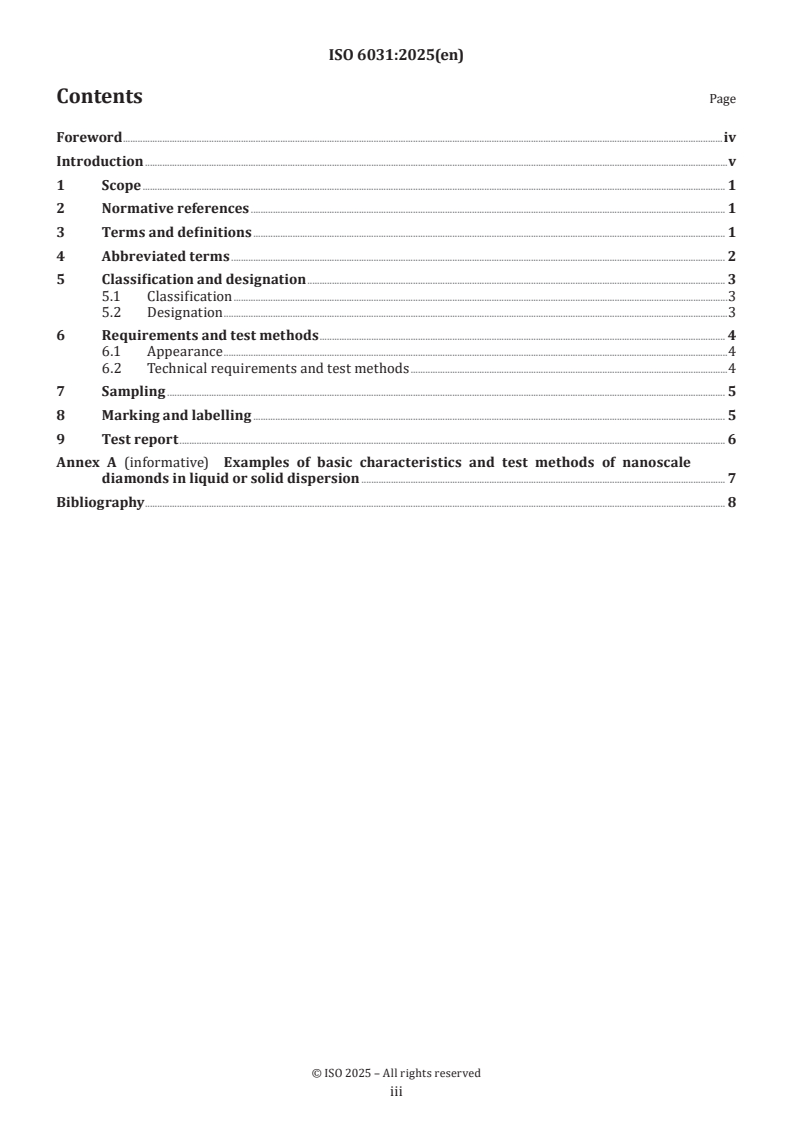
Contents Page
Foreword .iv
Introduction .v
1 Scope . 1
2 Normative references . 1
3 Terms and definitions . 1
4 Abbreviated terms . 2
5 Classification and designation . 3
5.1 Classification .3
5.2 Designation .3
6 Requirements and test methods . 4
6.1 Appearance .4
6.2 Technical requirements and test methods .4
7 Sampling . 5
8 Marking and labelling . 5
9 Test report . 6
Annex A (informative) Examples of basic characteristics and test methods of nanoscale
diamonds in liquid or solid dispersion . 7
Bibliography . 8
iii
Foreword
ISO (the International Organization for Standardization) is a worldwide federation of national standards
bodies (ISO member bodies). The work of preparing International Standards is normally carried out through
ISO technical committees. Each member body interested in a subject for which a technical committee
has been established has the right to be represented on that committee. International organizations,
governmental and non-governmental, in liaison with ISO, also take part in the work. ISO collaborates closely
with the International Electrotechnical Commission (IEC) on all matters of electrotechnical standardization.
The procedures used to develop this document and those intended for its further maintenance are described
in the ISO/IEC Directives, Part 1. In particular, the different approval criteria needed for the different types
of ISO document should be noted. This document was drafted in accordance with the editorial rules of the
ISO/IEC Directives, Part 2 (see www.iso.org/directives).
ISO draws attention to the possibility that the implementation of this document may involve the use of (a)
patent(s). ISO takes no position concerning the evidence, validity or applicability of any claimed patent
rights in respect thereof. As of the date of publication of this document, ISO had not received notice of (a)
patent(s) which may be required to implement this document. However, implementers are cautioned that
this may not represent the latest information, which may be obtained from the patent database available at
www.iso.org/patents. ISO shall not be held responsible for identifying any or all such patent rights.
Any trade name used in this document is information given for the convenience of users and does not
constitute an endorsement.
For an explanation of the voluntary nature of standards, the meaning of ISO specific terms and expressions
related to conformity assessment, as well as information about ISO's adherence to the World Trade
Organization (WTO) principles in the Technical Barriers to Trade (TBT), see www.iso.org/iso/foreword.html.
This document was prepared by Technical Committee ISO/TC 256, Pigments, dyestuffs and extenders.
Any feedback or questions on this document should be directed to the user’s national standards body. A
complete listing of these bodies can be found at www.iso.org/members.html.
iv
Introduction
Diamond is a solid carbon material with a cubic crystal structure, within which each atom is covalently
bonded to four neighbouring atoms forming a regular tetrahedron. This dense packing of carbon atoms
determines the following unique properties of diamond:
— the highest hardness and wear resistance,
— the highest thermal conductivity and high electrical resistivity,
— high refractive index and wide band gap,
— chemical and radiation resistance,
— high biocompatibility.
Nanoscale diamonds, also called nanodiamonds or ultradispersed diamonds, were first discovered in the
Soviet Union in 1963 in a detonation blend obtained by the explosion of a trotyl-hexogen charges in a big,
closed metal detonation chamber in air environment without any additional carbon source. Since then, they
[4][5][6]
have been carefully studied and have become commercially available. At the time of publication of
this document, nanodiamonds are obtained by the detonation of explosives, by laser-induced synthesis from
carbon soot, as well as by crushing and milling microdiamonds. Their main industrial applications include
fine polishing and lapping, antifriction lubrication and electroplating. They are also used as functional
additives to varnishes, paints and adhesives, thermal compounds and other composite materials.
Nanoscale diamonds have an average primary particle size of less than 100 nm. In case of detonation or laser
synthesis, most of them are smaller than 10 nm while their average size usually does not exceed 5 nm. Unlike
ordinary diamonds, a single nanodiamond particle has a complex structure, consisting of an inert diamond
core and a reactive shell of hybrid fullerene-like or amorphous carbon with various functional groups on the
surface (carbonyl, carboxyl, hydroxyl, amine, amide, ether, etc.). Nanodiamonds have a large surface area (up
2 3
to 600 m /g) and a low bulk density (up to 1 g/cm ). They usually aggregate strongly, forming agglomerates
several micrometres in size.
Ready-to-use functional nanodiamond extenders can be supplied in the form of a powder with specially
modified surface that provides disaggregation of nanodiamonds when they are introduced into a specific
production process and mixed. In addition, functional extenders can be supplied in the form of concentrated
dispersions of disaggregated nanodiamonds based on solvents, polymer resins and plastics.
To be used as a functional extender for application in polymer composites, nanoscale diamonds are provided
in powder form or disaggregated and uniformly distributed in a polymer matrix or in a liquid.
Nanoscale diamond uniformly dispersed in polymers can improve polymers in terms of their strength, wear
resistance, flexibility, thermal conductivity, thermal stability, radiation resistance and other functional
properties.
v
International Standard ISO 6031:2025(en)
Functional extenders for special application — Nanoscale
diamonds for polymer composites
1 Scope
This document specifies requirements and corresponding test methods for nanoscale diamond as a
functional additive in polymer composites.
2 Normative references
The following documents are referred to in the text in such a way that some or all of their content constitutes
requirements of this document. For dated references, only the edition cited applies. For undated references,
the latest edition of the referenced document (including any amendments) applies.
ISO 787-9, General methods of test for pigments and extenders — Part 9: Determination of pH value of an
aqueous suspension
ISO 3262-1, Extenders — Specifications and methods of test — Part 1: Introduction and general test methods
ISO 4618, Paints and varnishes — Vocabulary
ISO 9277, Determination of the specific surface area of solids by gas adsorption — BET method
ISO 15528, Paints, varnishes and raw materials for paints and varnishes — Sampling
ISO 18451-1, Pigments, dyestuffs and extenders — Terminology — Part 1: General terms
ISO 80004-1, Nanotechnologies – Vocabulary — Part 1: Core vocabulary
IEC/TS 62607-4-6, Nanomanufacturing — Key control characteristics — Part 4-6: Nano-enabled electrical energy
storage — Determination of carbon content for nano-enabled electrode materials, infrared absorption method
IEC/TS 62607-6-13, Nanomanufacturing — Key control characteristics — Part 6-13: Graphene-based
material — Oxygen functional group content: Boehm titration method
3 Terms and definitions
For the purposes of this document, the terms and definitions given in ISO 4618, ISO 18451-1, ISO 80004-1
and the following apply.
ISO and IEC maintain terminology databases for use in standardization at the following addresses:
— ISO Online browsing platform: available at https:// www .iso .org/ obp
— IEC Electropedia: available at https:// www .electropedia .org/
3.1
nanoscale diamonds
nanodiamonds
engineered carbon nanomaterials with cubic crystalline structure
...
Questions, Comments and Discussion
Ask us and Technical Secretary will try to provide an answer. You can facilitate discussion about the standard in here.
Loading comments...