


ISO 23599:2019
(Main)Assistive products for blind and vision-impaired persons — Tactile walking surface indicators
Assistive products for blind and vision-impaired persons — Tactile walking surface indicators
This document provides product specifications for tactile walking surface indicators (TWSIs) and recommendations for their installation in order to assist in the safe and independent mobility of blind or vision-impaired persons. This document specifies two types of TWSIs: attention patterns and guiding patterns. Both types can be used indoors and outdoors throughout the built environment where there are insufficient cues for wayfinding, or at specific hazards. NOTE Some countries have adopted other designs of TWSIs based on the consolidated findings of science, technology and experience, ensuring that they can be detected and distinguished by most users. This document is not intended to replace requirements and recommendations contained in such national standards, regulations or guidelines.
Produits d'assistance pour personnes aveugles ou visuellement affaiblies — Indicateurs tactiles de surfaces de marche
General Information
- Status
- Published
- Publication Date
- 23-Jan-2019
- Technical Committee
- ISO/TC 173 - Assistive products
- Drafting Committee
- ISO/TC 173 - Assistive products
- Current Stage
- 9093 - International Standard confirmed
- Start Date
- 02-Oct-2025
- Completion Date
- 14-Feb-2026
Relations
- Effective Date
- 06-Jun-2022
- Effective Date
- 23-Jun-2018
Overview
ISO 23599:2019 - Assistive products for blind and vision‑impaired persons - Tactile walking surface indicators (TWSIs) defines product specifications and installation recommendations for tactile walking surface indicators used to support safe, independent mobility. The standard covers both attention patterns (e.g., truncated domes/cones that warn of hazards) and guiding patterns (linear indicators that indicate direction or routes), for use indoors and outdoors across the built environment.
Key topics and technical requirements
ISO 23599:2019 sets out the functional and installation requirements that ensure TWSIs are detectable, durable and safe:
- Types of TWSIs: distinguishes between attention patterns and guiding patterns and their intended uses.
- Design and detectability: raised tactile profiles that are easily detected by long white cane, shoe soles and residual vision.
- Shape and dimensions: product specifications for discrete and integrated units, including effective depth/width requirements (see Clause 5.1).
- Visual contrast and luminance: requirements for visual detectability, including luminance contrast criteria and calculation methods (Annex A covers luminance contrast and Weber’s formula).
- Materials and surface performance: guidance on slip resistance, durability and surface structure to prevent tripping and ensure long‑term detectability.
- Installation principles: recommended placement logic, alignment, continuity, and site‑specific considerations (platforms, crossings, stairs, ramps, kerbs).
- Maintenance and illumination: provisions to maintain minimum luminance contrast and ensure adequate, glare‑free lighting for visibility.
- Accessibility and safety considerations: design to consider mobility‑impaired pedestrians as well as people who are blind or vision‑impaired.
Applications and users
ISO 23599 is practical for professionals involved in accessible design and transportation infrastructure:
- Urban planners, architects and landscape architects specifying accessible routes and sidewalks
- Civil and transport engineers designing stations, platforms and crossings
- Facilities managers and building owners implementing accessibility retrofits
- Manufacturers and suppliers of tactile paving and assistive products
- Accessibility consultants and standards compliance officers
Practical applications include installation of TWSIs at railway platforms, pedestrian crossings, at‑grade kerbs, stairs, ramps, elevators, and wayfinding routes through public buildings and outdoor spaces.
Related standards
ISO 23599:2019 is intended to be used alongside applicable national accessibility standards, building codes and local regulations. It provides an international baseline while acknowledging that some countries adopt different TWSI designs based on local experience and legal requirements.
For designers and specifiers seeking compliance and best practice in tactile wayfinding, ISO 23599:2019 is a core reference for tactile walking surface indicators, accessibility, and inclusive built‑environment design.
Buy Documents

ISO 23599:2019 - Assistive products for blind and vision-impaired persons -- Tactile walking surface indicators


ISO 23599:2019 - Assistive products for blind and vision-impaired persons — Tactile walking surface indicators Released:1/24/2019
Get Certified
Connect with accredited certification bodies for this standard

BSI Group
BSI (British Standards Institution) is the business standards company that helps organizations make excellence a habit.

TÜV Rheinland
TÜV Rheinland is a leading international provider of technical services.

TÜV SÜD
TÜV SÜD is a trusted partner of choice for safety, security and sustainability solutions.
Sponsored listings
Frequently Asked Questions
ISO 23599:2019 is a standard published by the International Organization for Standardization (ISO). Its full title is "Assistive products for blind and vision-impaired persons — Tactile walking surface indicators". This standard covers: This document provides product specifications for tactile walking surface indicators (TWSIs) and recommendations for their installation in order to assist in the safe and independent mobility of blind or vision-impaired persons. This document specifies two types of TWSIs: attention patterns and guiding patterns. Both types can be used indoors and outdoors throughout the built environment where there are insufficient cues for wayfinding, or at specific hazards. NOTE Some countries have adopted other designs of TWSIs based on the consolidated findings of science, technology and experience, ensuring that they can be detected and distinguished by most users. This document is not intended to replace requirements and recommendations contained in such national standards, regulations or guidelines.
This document provides product specifications for tactile walking surface indicators (TWSIs) and recommendations for their installation in order to assist in the safe and independent mobility of blind or vision-impaired persons. This document specifies two types of TWSIs: attention patterns and guiding patterns. Both types can be used indoors and outdoors throughout the built environment where there are insufficient cues for wayfinding, or at specific hazards. NOTE Some countries have adopted other designs of TWSIs based on the consolidated findings of science, technology and experience, ensuring that they can be detected and distinguished by most users. This document is not intended to replace requirements and recommendations contained in such national standards, regulations or guidelines.
ISO 23599:2019 is classified under the following ICS (International Classification for Standards) categories: 11.180.30 - Aids for blind or partially sighted people. The ICS classification helps identify the subject area and facilitates finding related standards.
ISO 23599:2019 has the following relationships with other standards: It is inter standard links to ISO 13304-1:2020, ISO 23599:2012. Understanding these relationships helps ensure you are using the most current and applicable version of the standard.
ISO 23599:2019 is available in PDF format for immediate download after purchase. The document can be added to your cart and obtained through the secure checkout process. Digital delivery ensures instant access to the complete standard document.
Standards Content (Sample)
INTERNATIONAL ISO
STANDARD 23599
Second edition
2019-01
Assistive products for blind and
vision-impaired persons — Tactile
walking surface indicators
Produits d'assistance pour personnes aveugles ou visuellement
affaiblies — Indicateurs tactiles de surfaces de marche
Reference number
©
ISO 2019
© ISO 2019
All rights reserved. Unless otherwise specified, or required in the context of its implementation, no part of this publication may
be reproduced or utilized otherwise in any form or by any means, electronic or mechanical, including photocopying, or posting
on the internet or an intranet, without prior written permission. Permission can be requested from either ISO at the address
below or ISO’s member body in the country of the requester.
ISO copyright office
CP 401 • Ch. de Blandonnet 8
CH-1214 Vernier, Geneva
Phone: +41 22 749 01 11
Fax: +41 22 749 09 47
Email: copyright@iso.org
Website: www.iso.org
Published in Switzerland
ii © ISO 2019 – All rights reserved
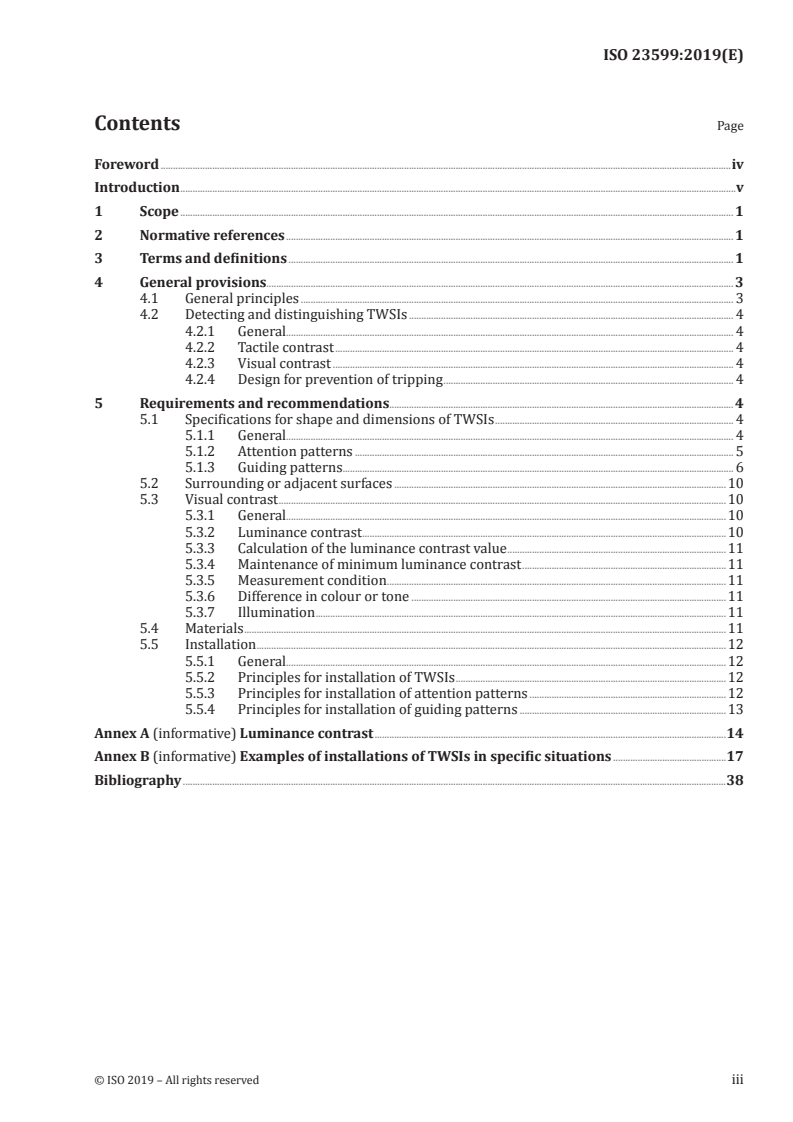
Contents Page
Foreword .iv
Introduction .v
1 Scope . 1
2 Normative references . 1
3 Terms and definitions . 1
4 General provisions. 3
4.1 General principles . 3
4.2 Detecting and distinguishing TWSIs . 4
4.2.1 General. 4
4.2.2 Tactile contrast . 4
4.2.3 Visual contrast . 4
4.2.4 Design for prevention of tripping . 4
5 Requirements and recommendations. 4
5.1 Specifications for shape and dimensions of TWSIs . 4
5.1.1 General. 4
5.1.2 Attention patterns . 5
5.1.3 Guiding patterns . . 6
5.2 Surrounding or adjacent surfaces .10
5.3 Visual contrast .10
5.3.1 General.10
5.3.2 Luminance contrast .10
5.3.3 Calculation of the luminance contrast value .11
5.3.4 Maintenance of minimum luminance contrast .11
5.3.5 Measurement condition .11
5.3.6 Difference in colour or tone .11
5.3.7 Illumination .11
5.4 Materials .11
5.5 Installation .12
5.5.1 General.12
5.5.2 Principles for installation of TWSIs .12
5.5.3 Principles for installation of attention patterns .12
5.5.4 Principles for installation of guiding patterns .13
Annex A (informative) Luminance contrast .14
Annex B (informative) Examples of installations of TWSIs in specific situations .17
Bibliography .38
Foreword
ISO (the International Organization for Standardization) is a worldwide federation of national standards
bodies (ISO member bodies). The work of preparing International Standards is normally carried out
through ISO technical committees. Each member body interested in a subject for which a technical
committee has been established has the right to be represented on that committee. International
organizations, governmental and non-governmental, in liaison with ISO, also take part in the work.
ISO collaborates closely with the International Electrotechnical Commission (IEC) on all matters of
electrotechnical standardization.
The procedures used to develop this document and those intended for its further maintenance are
described in the ISO/IEC Directives, Part 1. In particular, the different approval criteria needed for the
different types of ISO documents should be noted. This document was drafted in accordance with the
editorial rules of the ISO/IEC Directives, Part 2 (see www .iso .org/directives).
Attention is drawn to the possibility that some of the elements of this document may be the subject of
patent rights. ISO shall not be held responsible for identifying any or all such patent rights. Details of
any patent rights identified during the development of the document will be in the Introduction and/or
on the ISO list of patent declarations received (see www .iso .org/patents).
Any trade name used in this document is information given for the convenience of users and does not
constitute an endorsement.
For an explanation of the voluntary nature of standards, the meaning of ISO specific terms and
expressions related to conformity assessment, as well as information about ISO's adherence to the
World Trade Organization (WTO) principles in the Technical Barriers to Trade (TBT) see www .iso
.org/iso/foreword .html.
This document was prepared by Technical Committee ISO/TC 173 Assistive products.
This second edition cancels and replaces the first edition (ISO 23599:2012), of which it constitutes a
minor revision. The changes compared to the previous edition are as follows:
— Correction of Weber’s formula in Table A.1;
— Correction of Reference [18] in the Bibliography.
Any feedback or questions on this document should be directed to the user’s national standards body. A
complete listing of these bodies can be found at www .iso .org/members .html.
iv © ISO 2019 – All rights reserved
Introduction
The purpose of this document is to create requirements for Tactile Walking Surface Indicators (TWSIs)
for blind or vision-impaired persons.
When blind or vision-impaired persons travel alone, they might encounter problems and hazards in
various situations. In order to obtain information for wayfinding, these pedestrians use information
available from the natural and built environment, including tactual, acoustic and visual information.
However, environmental information is not always reliable and it is for this reason that TWSIs perceived
through use of a long white cane, through the soles of shoes and through the use of residual vision have
been developed.
TWSIs were invented in Japan in 1965. They are now used around the world to help blind or vision-
impaired persons travel independently. At present, TWSI patterns and installation methods vary from
country to country. This document aims to provide a basis for a common approach for TWSIs at the
international level, while acknowledging that some differences might be necessary at the local level to
accommodate climatic, geographical, cultural or other issues that might exist.
TWSIs should be designed and installed based on a simple, logical and consistent layout. This will
enable tactile indicators to facilitate not only the independent travel of blind or vision-impaired persons
in places they frequently travel, but also to support their independent travel in places they visit for the
first time.
Currently, there are several forms of TWSIs, but the ability to detect differences in tactile patterns
through the soles of the shoes or the long white cane varies depending on individual differences.
Therefore, the consolidated findings of science, technology and experience were employed to define the
characteristics of TWSIs that can be detected and recognized by potential users. Additionally, in order
to ensure that TWSIs achieve maximum effect in conveying information, it is important that they be
installed in or on a smooth surface where blind or vision-impaired persons can identify them without
interference from an irregular walking surface.
It is also necessary to ensure that TWSIs can be effectively used by vision-impaired persons as well as
people who are blind. For this purpose, TWSIs should be easily detectable through use of residual vision.
This is achieved through visual contrast between TWSIs and the surrounding or adjacent surface.
Visual contrast is influenced primarily by luminance contrast, and secondarily by difference in colour
or tone. In order to have good visibility, it is necessary to have sufficient illumination without glare and
it is important to maintain the visual contrast between TWSIs and the surrounding or adjacent surface.
While TWSIs should be effective for blind or vision-impaired persons, attention should also be paid
to their surface structure and materials in order to ensure that all pedestrians, including those with
impaired mobility, can safely and effectively negotiate them.
TWSIs are installed in public facilities, buildings used by many people, railway stations and on sidewalks
and other walking surfaces. Attention patterns may be installed in the vicinity of pedestrian crossings,
at-grade kerbs, railway platforms, stairs, ramps, escalators, travelators, elevators, etc. Guiding patterns
may be used alone or in combination with attention patterns in order to indicate the walking route
from one place to another.
INTERNATIONAL STANDARD ISO 23599:2019(E)
Assistive products for blind and vision-impaired
persons — Tactile walking surface indicators
1 Scope
This document provides product specifications for tactile walking surface indicators (TWSIs) and
recommendations for their installation in order to assist in the safe and independent mobility of blind
or vision-impaired persons.
This document specifies two types of TWSIs: attention patterns and guiding patterns. Both types can
be used indoors and outdoors throughout the built environment where there are insufficient cues for
wayfinding, or at specific hazards.
NOTE Some countries have adopted other designs of TWSIs based on the consolidated findings of science,
technology and experience, ensuring that they can be detected and distinguished by most users.
This document is not intended to replace requirements and recommendations contained in such
national standards, regulations or guidelines.
2 Normative references
There are no normative references in this document.
3 Terms and definitions
For the purposes of this document, the following terms and definitions apply.
ISO and IEC maintain terminological databases for use in standardization at the following addresses:
— ISO Online browsing platform: available at https: //www .iso .org/obp
— IEC Electropedia: available at http: //www .electropedia .org/
3.1
attention pattern
TWSI (3.16) design, calling attention to a hazard (3.9) only, or to hazards and decision points (3.4)
Note 1 to entry: Attention patterns can be installed in the vicinity of pedestrian crossings, at-grade kerbs (3.2),
railway platforms, stairs, ramps, escalators, travelators, elevators, etc.
3.2
at-grade kerb
flush kerb
kerb whereby the edge of the walkway is at the same level as adjoining vehicular ways
Note 1 to entry: See Figures B.10 and B.11.
3.3
CIE Y value
tristimulus value Y of the CIE 1931 standard colorimetric system for reflecting objects
Note 1 to entry: The CIE Y value equals the percentage value of the luminous reflectance.
Note 2 to entry: Y = 0 denotes the reflectance (3.15) of an absolutely black object (no light is reflected). Y = 100
denotes the reflectance of a perfectly white object (no light is absorbed or transmitted).
3.4
decision point
intersection or change of direction along a path of travel defined by TWSIs (3.16)
3.5
discrete units
individual domes, cones or elongated bars that are embedded into the ground or floor surfaces
3.6
effective depth
distance between the detectable edges of the TWSIs (3.16) when measured in the principal direction
of travel
Note 1 to entry: See Figure 1.
3.7
effective width
distance between the detectable edges of the TWSIs (3.16) when measured perpendicular to the
principal direction of travel
Note 1 to entry: See Figure 1 and Figure 2.
3.8
guiding pattern
TWSI design, indicating a direction of travel or a landmark
Note 1 to entry: Guiding patterns can be used alone or in combination with attention patterns (3.1) in order to
indicate the walking route from one place to another.
3.9
hazard
any area or element in, or adjacent to, a direction of travel, which potentially places people at risk of injury
3.10
illuminance
amount of luminous flux to a surface per unit area
Note 1 to entry: The SI unit for illuminance is lux (lx).
Note 2 to entry: See Reference [6] for further details.
3.11
integrated units
domes, cones or elongated bars on a base surface or plate, incorporated as a single unit
3.12
luminance
amount of light reflected or emitted from a surface in a given direction
Note 1 to entry: The SI unit for luminance is candela per square metre (cd/m ).
Note 2 to entry: See Reference [6] for further details.
3.13
luminance contrast
value of comparison of the luminance (3.12) of two surfaces
2 © ISO 2019 – All rights reserved
3.14
LRV
light reflectance value
proportion of visible light reflected by a surface at all wavelengths and directions when illuminated by
a light source
Note 1 to entry: LRV is also known as the luminance reflectance factor.
Note 2 to entry: LRV is expressed on a scale of 0 to 100, with a value of 0 points for pure black and a value of
100 points for pure white.
3.15
reflectance
ratio of light reflected in a given direction by a surface
Note 1 to entry: See Reference [6] for further details.
3.16
TWSI
tactile walking surface indicator
standardized walking surface used for information by blind or vision-impaired persons
3.17
truncated domes or cones
type of attention pattern (3.1) also referred to as flat-topped domes or cones
4 General provisions
4.1 General principles
Wayfinding and mobility can be achieved through good design of facilities, including clear accessible
paths of travel with built and natural guiding elements, such as edges and surfaces that can be followed
tactually and visually. TWSIs should not be a substitute for poor design.
TWSIs shall be installed where no built or natural guiding elements can be provided.
Though TWSIs are used by blind or vision-impaired persons, the design and installation of TWSIs shall
take into consideration the needs of people with mobility impairments.
All TWSIs shall
— be easily detectable from the surrounding or adjacent surface by raised tactile profiles and visual
contrast,
— maintain detectability throughout their lives,
— be designed to prevent tripping,
— be slip-resistant,
— be used in a logical and sequential manner,
— be installed consistently to enable them to be interpreted by users, and
— be of sufficient depth in the direction of travel to provide adequate detectability and appropriate
response by the users, such as stopping and turning.
Attention TWSIs shall
a) be distinguishable from guiding TWSIs, and
b) extend across the full width of an accessible path of travel and perpendicular to the direction of
travel when approaching a hazard.
4.2 Detecting and distinguishing TWSIs
4.2.1 General
TWSIs shall be easily detectable from the surrounding or adjacent surface by raised tactile profiles and
visual contrast. TWSIs shall be distinguishable from each other.
4.2.2 Tactile contrast
TWSIs shall be detectable by blind or vision-impaired persons through the soles of their shoes and by a
long white cane.
When attention patterns and guiding patterns are combined, blind or vision-impaired persons shall be
able to distinguish clearly between them, identify both and remember the meaning of each one.
Surrounding or adjacent surfaces shall be smooth to enable TWSIs to be detected and distinguished
(see 5.2).
4.2.3 Visual contrast
TWSIs shall be readily detectable and distinguishable from the surrounding or adjacent surfaces by
visually impaired people. Perception of visual contrast is enhanced by high illumination (see 5.3 and
Annex A).
4.2.4 Design for prevention of tripping
Truncated domes or cones and elongated bars shall have bevelled or rounded edges to decrease the
likelihood of tripping and to enhance safety and negotiability for people with mobility impairments.
5 Requirements and recommendations
5.1 Specifications for shape and dimensions of TWSIs
5.1.1 General
TWSIs shall be easily detectable from the surrounding or adjacent surface by raised tactile profiles.
This can be achieved by conforming to the shape and dimensions specified below.
4 © ISO 2019 – All rights reserved
5.1.2 Attention patterns
5.1.2.1 Arrangements
Truncated domes or cones should be arranged in a square grid, parallel or diagonal at 45° to the
principal direction of travel (see Figure 1).
a) Parallel to the principal direction of travel b) Diagonal at 45° to the principal direction
of travel
Key
1 principal direction of travel
s spacing between the centres of adjacent truncated domes or cones
d top diameter of truncated domes or cones
d bottom diameter of truncated domes or cones
h height of truncated domes or cones
b effective width
p effective depth
Figure 1 — Spacing and dimensions of truncated domes or cones
5.1.2.2 Height
The height of truncated domes or cones shall be 4 mm to 5 mm (see Figure 1).
In indoor environments with exceptionally smooth surfaces, the minimum height of 4 mm might be
preferable.
NOTE When truncated domes or cones are surrounded by exceptionally smooth surfaces, such as terrazzo,
plastic or rubber, they can be detected more easily than when they are surrounded by rougher surfaces, such
as brushed concrete, bricks or manufactured pavers. A height that is more than what is necessary for reliable
detection can cause tripping.
5.1.2.3 Diameter
The top diameter of truncated domes or cones shall range from 12 mm to 25 mm, as shown in Table 1,
and the bottom diameter of truncated domes or cones shall be (10 ± 1) mm greater than the top
diameter (see Figure 1).
[32][33]
NOTE Systematic research carried out on truncated domes or cones of various dimensions indicates
that a top diameter of 12 mm is the optimal size for blind or vision-impaired persons to detect and distinguish
through the soles of their shoes. Experiences indicate that the optimal top diameter for other groups within the
community could be greater.
5.1.2.4 Spacing
The spacing refers to the shortest distance between the centres of two adjacent truncated domes or
cones which can be parallel or diagonal at 45° to the direction of travel. The spacing shall be within the
ranges shown in relation to the top diameter in Table 1. The tolerance of the top diameter shall be ±1 mm.
Table 1 — Top diameter and corresponding spacing of truncated domes or cones
Top diameter of truncated
Spacing
domes or cones
mm
mm
12 42 to 61
15 45 to 63
18 48 to 65
20 50 to 68
25 55 to 70
5.1.3 Guiding patterns
5.1.3.1 Arrangements
A guiding pattern shall be constructed of parallel flat-topped elongated bars (see Figure 2) or sinusoidal
ribs (see Figure 3).
NOTE Flat-topped elongated bars are the most commonly used guiding pattern, though sinusoidal rib
patterns are used in geographic areas where snow is common. Sinusoidal patterns are less easily damaged by
snow ploughs than flat-topped bars.
6 © ISO 2019 – All rights reserved
Key
1 principal direction of travel
2 drainage gap between the top of flat-topped elongated bars
b top width of flat-topped elongated bars
b bottom width of flat-topped elongated bars
s spacing between the axes of adjacent flat-topped elongated bars
h height of flat-topped elongated bars
l length of the top of flat-topped elongated bars
l length of the base of flat-topped elongated bars
b effective width
Figure 2 — Spacing and dimensions of flat-topped elongated bars
Key
1 principal direction of travel
r distance between the edge of the pattern and the axis closest to the edge (0,5 × s)
s spacing between the axes of adjacent sinusoidal ribs
h height of sinusoidal ribs
l length of the top of sinusoidal ribs
a
40 mm to 52 mm.
b
4 mm to 5 mm.
c
≥270 mm.
Figure 3 — Spacing and dimensions of sinusoidal ribs
5.1.3.2 Specifications for flat-topped elongated bars
5.1.3.2.1 Height
The height of flat-topped elongated bars shall be 4 mm to 5 mm (see Figure 2).
In indoor environments with exceptionally smooth surfaces, the minimum height of 4 mm might be
preferable.
NOTE When flat-topped elongated bars are surrounded by exceptionally smooth surfaces, such as terrazzo,
plastic or rubber, they can be detected more easily than when they are surrounded by rougher surfaces, such
as brushed concrete, bricks or manufactured pavers. A height that is more than what is necessary for reliable
detection can cause tripping.
8 © ISO 2019 – All rights reserved
5.1.3.2.2 Width
The top width of flat-topped elongated bars shall range from 17 mm to 30 mm, as shown in Table 2. The
bottom width shall be (10 ± 1) mm wider than the top (see Figure 2).
[32][33]
NOTE Systematic research carried out on flat-topped elongated bars of various dimensions indicates
that a top width of 17 mm is the optimal size for blind or vision-impaired persons to detect and distinguish
through the soles of their shoes. Experiences indicate that the optimal top width for other groups within the
community could be greater.
5.1.3.2.3 Spacing
The spacing refers to the distance between the axes of adjacent flat-topped elongated bars. The distance
shall be in relation to the top width, as shown in Table 2. The tolerance of the top width shall be ±1 mm.
Table 2 — Top width and corresponding spacing of axes of flat-topped elongated bars
Top width of flat-topped
Spacing
elongated bars
mm
mm
17 57 to 78
20 60 to 80
25 65 to 83
30 70 to 85
5.1.3.2.4 Length
The top length of flat-topped elongated bars shall be more than 270 mm and the bottom length shall
be (10 ± 1) mm longer than the top. Where there is a risk of water ponding between the flat-topped
elongated bars, a drainage gap of 10 mm to 30 mm shall be provided (see Figure 2).
NOTE It is easier for blind or vision-impaired persons to follow guiding patterns that are as continuous as
possible.
5.1.3.2.5 Continuity
The distance between the ends of flat-topped elongated bars should be no more than 30 mm.
5.1.3.3 Specifications for sinusoidal rib pattern
5.1.3.3.1 Height of wave crests
The difference in level between the wave crest and the wave trough of sinusoidal rib patterns shall be
4 mm to 5 mm (see Figure 3).
In indoor environments with exceptionally smooth surfaces, the minimum height of 4 mm might be
preferable.
NOTE When sinusoidal rib patterns are surrounded by exceptionally smooth surfaces, such as terrazzo,
plastic or rubber, they can be detected more easily than when they are surrounded by rougher surfaces, such
as brushed concrete, bricks or manufactured pavers. A height that is more than what is necessary for reliable
detection can cause tripping.
5.1.3.3.2 Spacing between wave crests
The distance between the axes of two adjacent wave crests of sinusoidal rib patterns shall be 40 mm to
52 mm (see Figure 3).
5.1.3.3.3 Length of sinusoidal ribs
The length of the sinusoidal ribs should be at least 270 mm. Where there is a risk of water ponding
between the sinusoidal bars, a drainage gap of 10 mm to 30 mm shall be provided.
5.2 Surrounding or adjacent surfaces
Surrounding or adjacent surfaces shall be smooth to enable TWSIs to be detected and distinguished.
Gaps between joints should be avoided or shall have a maximum of 10 mm in width and 2 mm in depth.
For paving units with bevelled edges, the width of the gap shall be measured on the top of the paving
units (see Figure 4).
Key
b width of the gaps between joints
p depth of the gaps between joints
a
≤10 mm.
b
≤2 mm.
Figure 4 — Gaps between joints
When more than 6 % of the surrounding or adjacent surface area is covered with gaps, a smooth surface
shall be provided on either side of the TWSIs, extending to a minimum width of 600 mm, to ensure the
required tactile contrast.
EXAMPLE For paving units equal to or less than 200 mm × 200 mm, the gaps would be a maximum of 5,5 mm.
5.3 Visual contrast
5.3.1 General
Visual contrast has two components: luminance contrast and difference in colour. For vision-impaired
persons, luminance contrast is essential. Difference in colour or tone might supplement luminance
contrast.
5.3.2 Luminance contrast
The luminance contrast value between TWSIs and surrounding or adjacent surfaces shall be greater
than 30 % using the Michelson Contrast formula.
When TWSIs are discrete units, luminance contrast should be 50 % or greater.
Where TWSIs are used for hazards, the luminance contrast value should be 50 % or greater.
The reflectance value (CIE Y value) of the lighter surface shall be a minimum of 40 points.
When the required luminance contrast between TWSIs and the surrounding or adjacent surface cannot
be achieved, a continuous adjoining band of appropriate contrast shall be used. The contrasting band
shall have a minimum width of 100 mm.
10 © ISO 2019 – All rights reserved
5.3.3 Calculation of the luminance contrast value
The luminance contrast value (%), shall be calculated using Formula (1), known as Michelson
Contrast, C :
M
LL−
()
C = ×100 (1)
M
LL+
()
where
L is the value of luminance on a lighter surface, expressed in cd/m ;
L is the value of luminance on a darker surface, expressed in cd/m .
When luminance values are not available, but CIE Y values are available, the values Y and Y can be
1 2
substituted for L and L
1 2.
NOTE The CIE Y value is identical to the LRV.
When the CIE Y values or the LRVs of the two surfaces to be compared are known, these values can be
used to determine the luminance contrast. Otherwise, a measurement of luminance or reflectance is
required to determine the luminance contrast. For measurement methods, see A.2.
5.3.4 Maintenance of minimum luminance contrast
The minimum luminance contrast between TWSIs and surrounding or adjacent surfaces shall be
achieved and maintained throughout their life. Deterioration and maintenance shall be considered at
installation.
5.3.5 Measurement condition
Luminance and reflectance values should be measured under stable or controlled lighting conditions
and in dry and wet conditions, as appropriate. For the measurement method, see A.2.
5.3.6 Difference in colour or tone
Difference in colour or tone between TWSIs and surrounding or adjacent surfaces may be used to
increase detectability.
Combinations of red tones and green tones shall be avoided because the most common colour deficiency
is of the red-green type.
NOTE 1 Vision-impaired persons often have deficient colour vision. They can, however, retain luminance
sensitivity even when colour sensitivity is severely decreased.
NOTE 2 Safety yellow, as defined in ISO 3864-1, has the best colour conspicuity (according to research into
[45][48][49]
vision-impaired persons ).
5.3.7 Illumination
TWSIs should be sufficiently illuminated to ensure visual detection by vision-impaired persons.
5.4 Materials
TWSIs shall be made of materials that are durable and slip-resistant.
NOTE Refer to national standards for slip resistance.
5.5 Installation
5.5.1 General
This subclause gives the basic principles and specifications for the installation of TWSIs. Examples are
provided in Annex B.
For safety considerations, minimum depth and width dimensions for installation of TWSIs might need
to be greater than those specified in this document, because greater depth and width dimensions
increase the probability of detection.
When TWSIs are embedded as integrated units, the base of the TWSIs shall be level with the surrounding
or adjacent surface. When integrated units are applied on top of existing surfaces, the maximum height
of the base plate shall not exceed 3 mm and the TWSIs shall have bevelled edges (see Figure 5).
TWSIs shall be fixed to prevent the edge from lifting.
Key
1 base plate of the integrated TWSI units
h height of the base plate
a
≤3 mm.
Figure 5 — Base plate of integrated TWSI surface and its height
5.5.2 Principles for installation of TWSIs
When used as a system to aid orientation and safety, guiding and attention patterns shall be used in
a logical, sequential manner, with beginning and end points, between which intersections, decision
points or hazards are indicated.
The beginning of a system shall be clearly defined and easy to locate in conjunction with built and
natural guiding elements.
TWSIs may also be used individually to indicate hazards or locations.
5.5.3 Principles for installation of attention patterns
The effective depth and width of attention patterns shall be at least 560 mm.
NOTE 1 An exception to this is railway platforms, where national regulations, standards and guidelines
governed by national legislation take precedence.
When an attention pattern is used to indicate a hazard, it shall have a minimum effective depth of
560 mm. Greater depth might be needed for safety, particularly when the attention pattern indicates a
hazard in the direct line of travel.
When an attention pattern is used to indicate a hazard, it shall extend the full width of the hazard, from
each direction from which the hazard can be approached, and should be set back a minimum distance
of 300 mm from the hazard.
Where no set-back is provided, a greater depth of the attention pattern should be used to provide
greater certainty of detection and a longer stopping distance.
NOTE 2 The definition of a hazard can vary by situation and by country.
12 © ISO 2019 – All rights reserved
5.5.4 Principles for installation of guiding patterns
When a guiding pattern is used to designate a path of travel, it shall have a minimum effective width
of 250 mm.
Where a guiding pattern of TWSIs needs to be detected by a person approaching at an angle, it shall
have a minimum effective width of 550 mm.
A minimum clear path of travel of 600 mm shall be provided on both sides of a guiding pattern.
NOTE For wheelchair users, a clear path of travel of 600 mm is not sufficient. Considerations for wheelchair
users are specified in ISO 21542.
Annex A
(informative)
Luminance contrast
A.1 Formula for calculating luminance contrast
Different formulae for calculating luminance contrast are used around the world. In this document,
minimum contrast values are given using the Michelson formula. When other formulae are used,
the equivalent minimum contrast values can be determined in order to achieve the perceived visual
contrast as required in this document. Table A.1 shows comparable minimum contrast values for some
formulae.
Table A.1 — Comparable minimum values
Sapolinski
Michelson Weber
125()YY−
LRV
()LL− ()LL−
12 12
×100 ×100
YY++25
()LL+ L LRV − LRV
1 2
12 1
%
% % LRV = 40 LRV = 50 LRV = 60 Y = 40 Y = 50 Y = 60
1 1 1 1 1 1
Minimum
contrast 30 46 18 23 28 27 28 30
value
Minimum
for dis- 40 57 23 29 34 35 37 39
crete units
Minimum
for haz- 50 67 27 33 40 43 45 48
ards
NOTE L is the measured luminance of a surface and Y is the luminance reflectance. Where L appears in a formula, Y can be
used instead. The required minimum contrast for the Sapolinski formula depends on the reflectance of the lighter surface, Y .
Conversion from the Michelson contrast, C , to the Weber contrast, C is shown in Formula (A.1):
M W
2×C
M
C = (A.1)
W
100+ C
M
where C is the Michelson contrast, on a scale of 1 to 100.
M
Conversion from the Michelson contrast, C , to the Sapolinski contrast, C is shown in Formula (A.2):
M S
10××LC
1 M
C = (A.2)
S
8×+LC +100
1 M
where C is the Michelson contrast, on a scale of 1 to 100.
M
Some countries use the LRV method for expressing visual contrast. The recommended visual
contrast is described as the difference in LRV that is equivalent to the CIE Y value of the TWSI and the
14 © ISO 2019 – All rights reserved
adjacent surface (LRV − LRV ). The instrument required to take LRV measurements is a sphere-type
1 2
spectrophotometer. The general specification details are described in Reference [11].
NOTE The Sapolinski formula is a modification of the Michelson formula (see Reference [9]). This formula
was created to secure appropriate contrast values for human eyes for two adjacent darker surfaces.
A.2 Methods for measuring the parameters required to calculate
luminance contrast
A.2.1 General
Luminance contrast can be determined by measuring the luminance of the TWSI and comparing it with
the luminance of the surrounding or adjacent surface, within a width of 100 mm on both sides of the
TWSI. Alternatively, it can be determined by measuring the reflectance of the TWSI and comparing it to
the reflectance of the surrounding or adjacent surface.
Luminance or reflectance can be measured by one of two major methods, depending on the
measurement instruments:
a) contact type;
b) non-contact type.
All devices should be calibrated to the spectral sensitivity of the human eye, corrected to meet the CIE
photopic curve, V(λ).
All TWSIs and surrounding or adjacent surfaces should be measured under both wet and dry conditions.
When textured or non-uniform surfaces are being measured, multiple measurements should be made
and averaged. When discrete TWSIs are measured, the field of measurement should include only one
TWSI and no surrounding or adjacent surface.
TWSIs and surrounding or adjacent surfaces should be measured under the type of illumination that is
used in the relevant environment.
It is important to read the instruction manual of any instrument used, and to understand and apply the
correct procedure and method of measurement.
A.2.2 Measurement with non-contact-type instruments
Non-contact-type instruments measure the luminance of a small, defined, surface area from some
distance away from the surface being measured. Non-contact-type instruments are usually fixed onto a
tripod stand. The surface area being measured is determined by the angle of the measurement field of
the instrument and the distance of the instrument from the surface being measured.
Non-contact-type instruments have the following advantages:
— measurements can be taken at the typical angles of perception of people who use TWSIs;
— objects with colour or surface irregularities can be accurately measured, provided that the
instrument used has a measurement field wide enough to include such irregularities.
Non-contact-type instruments have the following disadvantages:
— they require stable ambient light conditions for accurate measurement;
— if luminance, L, is used to determine luminance contrast, they require that the two surfaces be
compared and be measured under the same light conditions.
NOTE Measurement with non-contact-type instruments is described in detail in Reference [9].
A.2.3 Measurement with contact-type instruments
Contact-type instruments are put directly on the surface to be measured. They measure the amount of
light emitted by the instrument itself and reflected from the surface being measured. Since only a small
area can be measured at one time, it is important that multiple measurements be made and averaged,
especially when a surface with irregularities is measured.
All contact-type instruments measure under daylight illumination (CIE D65). Most contact-type
instruments can be set to take measurements under other types of illumination.
Contact-type instruments have the following advantages:
— they are independent from environmental lighting conditions, which allows surfaces that have been
measured independently to be compared;
— they are easy to use.
Contact-type instruments have the following disadvantage:
— they provide somewhat unreliable measurements of objects with surface irregularities.
NOTE An example of this method of measurement is given in Reference [11].
16 © ISO 2019 – All rights reserved
Annex B
(informative)
Examples of installations of TWSIs in specific situations
B.1 General
This annex gives examples of installations of TWSIs in specific situations that conform to this document.
Specific designs are developed country by country, taking into consideration the different physical,
climatic and social situations of each country.
This annex includes a selection examples of installation designs that are used in different countries and
which have been adopted in the regulations, standards or guidelines of those countries under national
legislation. Other designs can also conform to the principles and specifications for TWSIs stated in this
document.
B.2 Pedestrian crossings
Any TWSI system for pedestrian crossings adopted by a country should be applied consistently
throughout that country.
When used to indicate a pedestrian crossing, attention patterns should be set back 300 mm from the
edge of the sidewalk with a minimum depth of 560 mm, and should be installed perpendicular to the
direction of travel across the crossing (see Figure B.1). Where no set-back is provided, a greater depth
of the attention pattern should be used to provide greater certainty of detection and a longer stopping
distance.
A guiding pattern or attention pattern can be used to indicate the location of a pedestrian crossing.
A guiding pattern can also be used to indicate the direction of travel at a pedestrian crossing (see
Figure B.1).
TWSIs should be used to help locate the push button control or the tactile walk signal for pedestrian
traffic lights, or both.
When used to indicate a pedestrian crossing that has a pedestrian refuge, attention patterns should
also be provided on the refuge.
Different countries have different designs for installation of TWSIs at pedestrian crossings. Figure B.1
shows the basic design and elements of the TWSI installation at a pedestrian crossing. Other designs
conforming to this document are shown in Figures B.2, B.3, B.4, B.5, B.6, B.7, B.8 and B.9.
Key
1 attention pattern
2 location of the stem (installed at the centre of the effective width of the attention pattern, b )
3 location of the stem (installed at the edge of the effective width of attention pattern, b )
4 sidewalk
5 kerb or at-grade kerb
6 vehicular way
7 pedestrian push button
b effective width of the guiding pattern
p effective depth of the attention pattern
r distance of the set-back from the outer edge of the kerb or at-grade kerb to the edge of attention pattern
a
≥560 mm.
b
≥300 mm.
c
≥550 mm.
NOTE This example shows the basic designs and elements required when installing TWSIs at pedestrian
crossings, based on the principles for
...
INTERNATIONAL ISO
STANDARD 23599
Second edition
2019-01
Assistive products for blind and
vision-impaired persons — Tactile
walking surface indicators
Produits d'assistance pour personnes aveugles ou visuellement
affaiblies — Indicateurs tactiles de surfaces de marche
Reference number
©
ISO 2019
© ISO 2019
All rights reserved. Unless otherwise specified, or required in the context of its implementation, no part of this publication may
be reproduced or utilized otherwise in any form or by any means, electronic or mechanical, including photocopying, or posting
on the internet or an intranet, without prior written permission. Permission can be requested from either ISO at the address
below or ISO’s member body in the country of the requester.
ISO copyright office
CP 401 • Ch. de Blandonnet 8
CH-1214 Vernier, Geneva
Phone: +41 22 749 01 11
Fax: +41 22 749 09 47
Email: copyright@iso.org
Website: www.iso.org
Published in Switzerland
ii © ISO 2019 – All rights reserved
Contents Page
Foreword .iv
Introduction .v
1 Scope . 1
2 Normative references . 1
3 Terms and definitions . 1
4 General provisions. 3
4.1 General principles . 3
4.2 Detecting and distinguishing TWSIs . 4
4.2.1 General. 4
4.2.2 Tactile contrast . 4
4.2.3 Visual contrast . 4
4.2.4 Design for prevention of tripping . 4
5 Requirements and recommendations. 4
5.1 Specifications for shape and dimensions of TWSIs . 4
5.1.1 General. 4
5.1.2 Attention patterns . 5
5.1.3 Guiding patterns . . 6
5.2 Surrounding or adjacent surfaces .10
5.3 Visual contrast .10
5.3.1 General.10
5.3.2 Luminance contrast .10
5.3.3 Calculation of the luminance contrast value .11
5.3.4 Maintenance of minimum luminance contrast .11
5.3.5 Measurement condition .11
5.3.6 Difference in colour or tone .11
5.3.7 Illumination .11
5.4 Materials .11
5.5 Installation .12
5.5.1 General.12
5.5.2 Principles for installation of TWSIs .12
5.5.3 Principles for installation of attention patterns .12
5.5.4 Principles for installation of guiding patterns .13
Annex A (informative) Luminance contrast .14
Annex B (informative) Examples of installations of TWSIs in specific situations .17
Bibliography .38
Foreword
ISO (the International Organization for Standardization) is a worldwide federation of national standards
bodies (ISO member bodies). The work of preparing International Standards is normally carried out
through ISO technical committees. Each member body interested in a subject for which a technical
committee has been established has the right to be represented on that committee. International
organizations, governmental and non-governmental, in liaison with ISO, also take part in the work.
ISO collaborates closely with the International Electrotechnical Commission (IEC) on all matters of
electrotechnical standardization.
The procedures used to develop this document and those intended for its further maintenance are
described in the ISO/IEC Directives, Part 1. In particular, the different approval criteria needed for the
different types of ISO documents should be noted. This document was drafted in accordance with the
editorial rules of the ISO/IEC Directives, Part 2 (see www .iso .org/directives).
Attention is drawn to the possibility that some of the elements of this document may be the subject of
patent rights. ISO shall not be held responsible for identifying any or all such patent rights. Details of
any patent rights identified during the development of the document will be in the Introduction and/or
on the ISO list of patent declarations received (see www .iso .org/patents).
Any trade name used in this document is information given for the convenience of users and does not
constitute an endorsement.
For an explanation of the voluntary nature of standards, the meaning of ISO specific terms and
expressions related to conformity assessment, as well as information about ISO's adherence to the
World Trade Organization (WTO) principles in the Technical Barriers to Trade (TBT) see www .iso
.org/iso/foreword .html.
This document was prepared by Technical Committee ISO/TC 173 Assistive products.
This second edition cancels and replaces the first edition (ISO 23599:2012), of which it constitutes a
minor revision. The changes compared to the previous edition are as follows:
— Correction of Weber’s formula in Table A.1;
— Correction of Reference [18] in the Bibliography.
Any feedback or questions on this document should be directed to the user’s national standards body. A
complete listing of these bodies can be found at www .iso .org/members .html.
iv © ISO 2019 – All rights reserved
Introduction
The purpose of this document is to create requirements for Tactile Walking Surface Indicators (TWSIs)
for blind or vision-impaired persons.
When blind or vision-impaired persons travel alone, they might encounter problems and hazards in
various situations. In order to obtain information for wayfinding, these pedestrians use information
available from the natural and built environment, including tactual, acoustic and visual information.
However, environmental information is not always reliable and it is for this reason that TWSIs perceived
through use of a long white cane, through the soles of shoes and through the use of residual vision have
been developed.
TWSIs were invented in Japan in 1965. They are now used around the world to help blind or vision-
impaired persons travel independently. At present, TWSI patterns and installation methods vary from
country to country. This document aims to provide a basis for a common approach for TWSIs at the
international level, while acknowledging that some differences might be necessary at the local level to
accommodate climatic, geographical, cultural or other issues that might exist.
TWSIs should be designed and installed based on a simple, logical and consistent layout. This will
enable tactile indicators to facilitate not only the independent travel of blind or vision-impaired persons
in places they frequently travel, but also to support their independent travel in places they visit for the
first time.
Currently, there are several forms of TWSIs, but the ability to detect differences in tactile patterns
through the soles of the shoes or the long white cane varies depending on individual differences.
Therefore, the consolidated findings of science, technology and experience were employed to define the
characteristics of TWSIs that can be detected and recognized by potential users. Additionally, in order
to ensure that TWSIs achieve maximum effect in conveying information, it is important that they be
installed in or on a smooth surface where blind or vision-impaired persons can identify them without
interference from an irregular walking surface.
It is also necessary to ensure that TWSIs can be effectively used by vision-impaired persons as well as
people who are blind. For this purpose, TWSIs should be easily detectable through use of residual vision.
This is achieved through visual contrast between TWSIs and the surrounding or adjacent surface.
Visual contrast is influenced primarily by luminance contrast, and secondarily by difference in colour
or tone. In order to have good visibility, it is necessary to have sufficient illumination without glare and
it is important to maintain the visual contrast between TWSIs and the surrounding or adjacent surface.
While TWSIs should be effective for blind or vision-impaired persons, attention should also be paid
to their surface structure and materials in order to ensure that all pedestrians, including those with
impaired mobility, can safely and effectively negotiate them.
TWSIs are installed in public facilities, buildings used by many people, railway stations and on sidewalks
and other walking surfaces. Attention patterns may be installed in the vicinity of pedestrian crossings,
at-grade kerbs, railway platforms, stairs, ramps, escalators, travelators, elevators, etc. Guiding patterns
may be used alone or in combination with attention patterns in order to indicate the walking route
from one place to another.
INTERNATIONAL STANDARD ISO 23599:2019(E)
Assistive products for blind and vision-impaired
persons — Tactile walking surface indicators
1 Scope
This document provides product specifications for tactile walking surface indicators (TWSIs) and
recommendations for their installation in order to assist in the safe and independent mobility of blind
or vision-impaired persons.
This document specifies two types of TWSIs: attention patterns and guiding patterns. Both types can
be used indoors and outdoors throughout the built environment where there are insufficient cues for
wayfinding, or at specific hazards.
NOTE Some countries have adopted other designs of TWSIs based on the consolidated findings of science,
technology and experience, ensuring that they can be detected and distinguished by most users.
This document is not intended to replace requirements and recommendations contained in such
national standards, regulations or guidelines.
2 Normative references
There are no normative references in this document.
3 Terms and definitions
For the purposes of this document, the following terms and definitions apply.
ISO and IEC maintain terminological databases for use in standardization at the following addresses:
— ISO Online browsing platform: available at https: //www .iso .org/obp
— IEC Electropedia: available at http: //www .electropedia .org/
3.1
attention pattern
TWSI (3.16) design, calling attention to a hazard (3.9) only, or to hazards and decision points (3.4)
Note 1 to entry: Attention patterns can be installed in the vicinity of pedestrian crossings, at-grade kerbs (3.2),
railway platforms, stairs, ramps, escalators, travelators, elevators, etc.
3.2
at-grade kerb
flush kerb
kerb whereby the edge of the walkway is at the same level as adjoining vehicular ways
Note 1 to entry: See Figures B.10 and B.11.
3.3
CIE Y value
tristimulus value Y of the CIE 1931 standard colorimetric system for reflecting objects
Note 1 to entry: The CIE Y value equals the percentage value of the luminous reflectance.
Note 2 to entry: Y = 0 denotes the reflectance (3.15) of an absolutely black object (no light is reflected). Y = 100
denotes the reflectance of a perfectly white object (no light is absorbed or transmitted).
3.4
decision point
intersection or change of direction along a path of travel defined by TWSIs (3.16)
3.5
discrete units
individual domes, cones or elongated bars that are embedded into the ground or floor surfaces
3.6
effective depth
distance between the detectable edges of the TWSIs (3.16) when measured in the principal direction
of travel
Note 1 to entry: See Figure 1.
3.7
effective width
distance between the detectable edges of the TWSIs (3.16) when measured perpendicular to the
principal direction of travel
Note 1 to entry: See Figure 1 and Figure 2.
3.8
guiding pattern
TWSI design, indicating a direction of travel or a landmark
Note 1 to entry: Guiding patterns can be used alone or in combination with attention patterns (3.1) in order to
indicate the walking route from one place to another.
3.9
hazard
any area or element in, or adjacent to, a direction of travel, which potentially places people at risk of injury
3.10
illuminance
amount of luminous flux to a surface per unit area
Note 1 to entry: The SI unit for illuminance is lux (lx).
Note 2 to entry: See Reference [6] for further details.
3.11
integrated units
domes, cones or elongated bars on a base surface or plate, incorporated as a single unit
3.12
luminance
amount of light reflected or emitted from a surface in a given direction
Note 1 to entry: The SI unit for luminance is candela per square metre (cd/m ).
Note 2 to entry: See Reference [6] for further details.
3.13
luminance contrast
value of comparison of the luminance (3.12) of two surfaces
2 © ISO 2019 – All rights reserved
3.14
LRV
light reflectance value
proportion of visible light reflected by a surface at all wavelengths and directions when illuminated by
a light source
Note 1 to entry: LRV is also known as the luminance reflectance factor.
Note 2 to entry: LRV is expressed on a scale of 0 to 100, with a value of 0 points for pure black and a value of
100 points for pure white.
3.15
reflectance
ratio of light reflected in a given direction by a surface
Note 1 to entry: See Reference [6] for further details.
3.16
TWSI
tactile walking surface indicator
standardized walking surface used for information by blind or vision-impaired persons
3.17
truncated domes or cones
type of attention pattern (3.1) also referred to as flat-topped domes or cones
4 General provisions
4.1 General principles
Wayfinding and mobility can be achieved through good design of facilities, including clear accessible
paths of travel with built and natural guiding elements, such as edges and surfaces that can be followed
tactually and visually. TWSIs should not be a substitute for poor design.
TWSIs shall be installed where no built or natural guiding elements can be provided.
Though TWSIs are used by blind or vision-impaired persons, the design and installation of TWSIs shall
take into consideration the needs of people with mobility impairments.
All TWSIs shall
— be easily detectable from the surrounding or adjacent surface by raised tactile profiles and visual
contrast,
— maintain detectability throughout their lives,
— be designed to prevent tripping,
— be slip-resistant,
— be used in a logical and sequential manner,
— be installed consistently to enable them to be interpreted by users, and
— be of sufficient depth in the direction of travel to provide adequate detectability and appropriate
response by the users, such as stopping and turning.
Attention TWSIs shall
a) be distinguishable from guiding TWSIs, and
b) extend across the full width of an accessible path of travel and perpendicular to the direction of
travel when approaching a hazard.
4.2 Detecting and distinguishing TWSIs
4.2.1 General
TWSIs shall be easily detectable from the surrounding or adjacent surface by raised tactile profiles and
visual contrast. TWSIs shall be distinguishable from each other.
4.2.2 Tactile contrast
TWSIs shall be detectable by blind or vision-impaired persons through the soles of their shoes and by a
long white cane.
When attention patterns and guiding patterns are combined, blind or vision-impaired persons shall be
able to distinguish clearly between them, identify both and remember the meaning of each one.
Surrounding or adjacent surfaces shall be smooth to enable TWSIs to be detected and distinguished
(see 5.2).
4.2.3 Visual contrast
TWSIs shall be readily detectable and distinguishable from the surrounding or adjacent surfaces by
visually impaired people. Perception of visual contrast is enhanced by high illumination (see 5.3 and
Annex A).
4.2.4 Design for prevention of tripping
Truncated domes or cones and elongated bars shall have bevelled or rounded edges to decrease the
likelihood of tripping and to enhance safety and negotiability for people with mobility impairments.
5 Requirements and recommendations
5.1 Specifications for shape and dimensions of TWSIs
5.1.1 General
TWSIs shall be easily detectable from the surrounding or adjacent surface by raised tactile profiles.
This can be achieved by conforming to the shape and dimensions specified below.
4 © ISO 2019 – All rights reserved
5.1.2 Attention patterns
5.1.2.1 Arrangements
Truncated domes or cones should be arranged in a square grid, parallel or diagonal at 45° to the
principal direction of travel (see Figure 1).
a) Parallel to the principal direction of travel b) Diagonal at 45° to the principal direction
of travel
Key
1 principal direction of travel
s spacing between the centres of adjacent truncated domes or cones
d top diameter of truncated domes or cones
d bottom diameter of truncated domes or cones
h height of truncated domes or cones
b effective width
p effective depth
Figure 1 — Spacing and dimensions of truncated domes or cones
5.1.2.2 Height
The height of truncated domes or cones shall be 4 mm to 5 mm (see Figure 1).
In indoor environments with exceptionally smooth surfaces, the minimum height of 4 mm might be
preferable.
NOTE When truncated domes or cones are surrounded by exceptionally smooth surfaces, such as terrazzo,
plastic or rubber, they can be detected more easily than when they are surrounded by rougher surfaces, such
as brushed concrete, bricks or manufactured pavers. A height that is more than what is necessary for reliable
detection can cause tripping.
5.1.2.3 Diameter
The top diameter of truncated domes or cones shall range from 12 mm to 25 mm, as shown in Table 1,
and the bottom diameter of truncated domes or cones shall be (10 ± 1) mm greater than the top
diameter (see Figure 1).
[32][33]
NOTE Systematic research carried out on truncated domes or cones of various dimensions indicates
that a top diameter of 12 mm is the optimal size for blind or vision-impaired persons to detect and distinguish
through the soles of their shoes. Experiences indicate that the optimal top diameter for other groups within the
community could be greater.
5.1.2.4 Spacing
The spacing refers to the shortest distance between the centres of two adjacent truncated domes or
cones which can be parallel or diagonal at 45° to the direction of travel. The spacing shall be within the
ranges shown in relation to the top diameter in Table 1. The tolerance of the top diameter shall be ±1 mm.
Table 1 — Top diameter and corresponding spacing of truncated domes or cones
Top diameter of truncated
Spacing
domes or cones
mm
mm
12 42 to 61
15 45 to 63
18 48 to 65
20 50 to 68
25 55 to 70
5.1.3 Guiding patterns
5.1.3.1 Arrangements
A guiding pattern shall be constructed of parallel flat-topped elongated bars (see Figure 2) or sinusoidal
ribs (see Figure 3).
NOTE Flat-topped elongated bars are the most commonly used guiding pattern, though sinusoidal rib
patterns are used in geographic areas where snow is common. Sinusoidal patterns are less easily damaged by
snow ploughs than flat-topped bars.
6 © ISO 2019 – All rights reserved
Key
1 principal direction of travel
2 drainage gap between the top of flat-topped elongated bars
b top width of flat-topped elongated bars
b bottom width of flat-topped elongated bars
s spacing between the axes of adjacent flat-topped elongated bars
h height of flat-topped elongated bars
l length of the top of flat-topped elongated bars
l length of the base of flat-topped elongated bars
b effective width
Figure 2 — Spacing and dimensions of flat-topped elongated bars
Key
1 principal direction of travel
r distance between the edge of the pattern and the axis closest to the edge (0,5 × s)
s spacing between the axes of adjacent sinusoidal ribs
h height of sinusoidal ribs
l length of the top of sinusoidal ribs
a
40 mm to 52 mm.
b
4 mm to 5 mm.
c
≥270 mm.
Figure 3 — Spacing and dimensions of sinusoidal ribs
5.1.3.2 Specifications for flat-topped elongated bars
5.1.3.2.1 Height
The height of flat-topped elongated bars shall be 4 mm to 5 mm (see Figure 2).
In indoor environments with exceptionally smooth surfaces, the minimum height of 4 mm might be
preferable.
NOTE When flat-topped elongated bars are surrounded by exceptionally smooth surfaces, such as terrazzo,
plastic or rubber, they can be detected more easily than when they are surrounded by rougher surfaces, such
as brushed concrete, bricks or manufactured pavers. A height that is more than what is necessary for reliable
detection can cause tripping.
8 © ISO 2019 – All rights reserved
5.1.3.2.2 Width
The top width of flat-topped elongated bars shall range from 17 mm to 30 mm, as shown in Table 2. The
bottom width shall be (10 ± 1) mm wider than the top (see Figure 2).
[32][33]
NOTE Systematic research carried out on flat-topped elongated bars of various dimensions indicates
that a top width of 17 mm is the optimal size for blind or vision-impaired persons to detect and distinguish
through the soles of their shoes. Experiences indicate that the optimal top width for other groups within the
community could be greater.
5.1.3.2.3 Spacing
The spacing refers to the distance between the axes of adjacent flat-topped elongated bars. The distance
shall be in relation to the top width, as shown in Table 2. The tolerance of the top width shall be ±1 mm.
Table 2 — Top width and corresponding spacing of axes of flat-topped elongated bars
Top width of flat-topped
Spacing
elongated bars
mm
mm
17 57 to 78
20 60 to 80
25 65 to 83
30 70 to 85
5.1.3.2.4 Length
The top length of flat-topped elongated bars shall be more than 270 mm and the bottom length shall
be (10 ± 1) mm longer than the top. Where there is a risk of water ponding between the flat-topped
elongated bars, a drainage gap of 10 mm to 30 mm shall be provided (see Figure 2).
NOTE It is easier for blind or vision-impaired persons to follow guiding patterns that are as continuous as
possible.
5.1.3.2.5 Continuity
The distance between the ends of flat-topped elongated bars should be no more than 30 mm.
5.1.3.3 Specifications for sinusoidal rib pattern
5.1.3.3.1 Height of wave crests
The difference in level between the wave crest and the wave trough of sinusoidal rib patterns shall be
4 mm to 5 mm (see Figure 3).
In indoor environments with exceptionally smooth surfaces, the minimum height of 4 mm might be
preferable.
NOTE When sinusoidal rib patterns are surrounded by exceptionally smooth surfaces, such as terrazzo,
plastic or rubber, they can be detected more easily than when they are surrounded by rougher surfaces, such
as brushed concrete, bricks or manufactured pavers. A height that is more than what is necessary for reliable
detection can cause tripping.
5.1.3.3.2 Spacing between wave crests
The distance between the axes of two adjacent wave crests of sinusoidal rib patterns shall be 40 mm to
52 mm (see Figure 3).
5.1.3.3.3 Length of sinusoidal ribs
The length of the sinusoidal ribs should be at least 270 mm. Where there is a risk of water ponding
between the sinusoidal bars, a drainage gap of 10 mm to 30 mm shall be provided.
5.2 Surrounding or adjacent surfaces
Surrounding or adjacent surfaces shall be smooth to enable TWSIs to be detected and distinguished.
Gaps between joints should be avoided or shall have a maximum of 10 mm in width and 2 mm in depth.
For paving units with bevelled edges, the width of the gap shall be measured on the top of the paving
units (see Figure 4).
Key
b width of the gaps between joints
p depth of the gaps between joints
a
≤10 mm.
b
≤2 mm.
Figure 4 — Gaps between joints
When more than 6 % of the surrounding or adjacent surface area is covered with gaps, a smooth surface
shall be provided on either side of the TWSIs, extending to a minimum width of 600 mm, to ensure the
required tactile contrast.
EXAMPLE For paving units equal to or less than 200 mm × 200 mm, the gaps would be a maximum of 5,5 mm.
5.3 Visual contrast
5.3.1 General
Visual contrast has two components: luminance contrast and difference in colour. For vision-impaired
persons, luminance contrast is essential. Difference in colour or tone might supplement luminance
contrast.
5.3.2 Luminance contrast
The luminance contrast value between TWSIs and surrounding or adjacent surfaces shall be greater
than 30 % using the Michelson Contrast formula.
When TWSIs are discrete units, luminance contrast should be 50 % or greater.
Where TWSIs are used for hazards, the luminance contrast value should be 50 % or greater.
The reflectance value (CIE Y value) of the lighter surface shall be a minimum of 40 points.
When the required luminance contrast between TWSIs and the surrounding or adjacent surface cannot
be achieved, a continuous adjoining band of appropriate contrast shall be used. The contrasting band
shall have a minimum width of 100 mm.
10 © ISO 2019 – All rights reserved
5.3.3 Calculation of the luminance contrast value
The luminance contrast value (%), shall be calculated using Formula (1), known as Michelson
Contrast, C :
M
LL−
()
C = ×100 (1)
M
LL+
()
where
L is the value of luminance on a lighter surface, expressed in cd/m ;
L is the value of luminance on a darker surface, expressed in cd/m .
When luminance values are not available, but CIE Y values are available, the values Y and Y can be
1 2
substituted for L and L
1 2.
NOTE The CIE Y value is identical to the LRV.
When the CIE Y values or the LRVs of the two surfaces to be compared are known, these values can be
used to determine the luminance contrast. Otherwise, a measurement of luminance or reflectance is
required to determine the luminance contrast. For measurement methods, see A.2.
5.3.4 Maintenance of minimum luminance contrast
The minimum luminance contrast between TWSIs and surrounding or adjacent surfaces shall be
achieved and maintained throughout their life. Deterioration and maintenance shall be considered at
installation.
5.3.5 Measurement condition
Luminance and reflectance values should be measured under stable or controlled lighting conditions
and in dry and wet conditions, as appropriate. For the measurement method, see A.2.
5.3.6 Difference in colour or tone
Difference in colour or tone between TWSIs and surrounding or adjacent surfaces may be used to
increase detectability.
Combinations of red tones and green tones shall be avoided because the most common colour deficiency
is of the red-green type.
NOTE 1 Vision-impaired persons often have deficient colour vision. They can, however, retain luminance
sensitivity even when colour sensitivity is severely decreased.
NOTE 2 Safety yellow, as defined in ISO 3864-1, has the best colour conspicuity (according to research into
[45][48][49]
vision-impaired persons ).
5.3.7 Illumination
TWSIs should be sufficiently illuminated to ensure visual detection by vision-impaired persons.
5.4 Materials
TWSIs shall be made of materials that are durable and slip-resistant.
NOTE Refer to national standards for slip resistance.
5.5 Installation
5.5.1 General
This subclause gives the basic principles and specifications for the installation of TWSIs. Examples are
provided in Annex B.
For safety considerations, minimum depth and width dimensions for installation of TWSIs might need
to be greater than those specified in this document, because greater depth and width dimensions
increase the probability of detection.
When TWSIs are embedded as integrated units, the base of the TWSIs shall be level with the surrounding
or adjacent surface. When integrated units are applied on top of existing surfaces, the maximum height
of the base plate shall not exceed 3 mm and the TWSIs shall have bevelled edges (see Figure 5).
TWSIs shall be fixed to prevent the edge from lifting.
Key
1 base plate of the integrated TWSI units
h height of the base plate
a
≤3 mm.
Figure 5 — Base plate of integrated TWSI surface and its height
5.5.2 Principles for installation of TWSIs
When used as a system to aid orientation and safety, guiding and attention patterns shall be used in
a logical, sequential manner, with beginning and end points, between which intersections, decision
points or hazards are indicated.
The beginning of a system shall be clearly defined and easy to locate in conjunction with built and
natural guiding elements.
TWSIs may also be used individually to indicate hazards or locations.
5.5.3 Principles for installation of attention patterns
The effective depth and width of attention patterns shall be at least 560 mm.
NOTE 1 An exception to this is railway platforms, where national regulations, standards and guidelines
governed by national legislation take precedence.
When an attention pattern is used to indicate a hazard, it shall have a minimum effective depth of
560 mm. Greater depth might be needed for safety, particularly when the attention pattern indicates a
hazard in the direct line of travel.
When an attention pattern is used to indicate a hazard, it shall extend the full width of the hazard, from
each direction from which the hazard can be approached, and should be set back a minimum distance
of 300 mm from the hazard.
Where no set-back is provided, a greater depth of the attention pattern should be used to provide
greater certainty of detection and a longer stopping distance.
NOTE 2 The definition of a hazard can vary by situation and by country.
12 © ISO 2019 – All rights reserved
5.5.4 Principles for installation of guiding patterns
When a guiding pattern is used to designate a path of travel, it shall have a minimum effective width
of 250 mm.
Where a guiding pattern of TWSIs needs to be detected by a person approaching at an angle, it shall
have a minimum effective width of 550 mm.
A minimum clear path of travel of 600 mm shall be provided on both sides of a guiding pattern.
NOTE For wheelchair users, a clear path of travel of 600 mm is not sufficient. Considerations for wheelchair
users are specified in ISO 21542.
Annex A
(informative)
Luminance contrast
A.1 Formula for calculating luminance contrast
Different formulae for calculating luminance contrast are used around the world. In this document,
minimum contrast values are given using the Michelson formula. When other formulae are used,
the equivalent minimum contrast values can be determined in order to achieve the perceived visual
contrast as required in this document. Table A.1 shows comparable minimum contrast values for some
formulae.
Table A.1 — Comparable minimum values
Sapolinski
Michelson Weber
125()YY−
LRV
()LL− ()LL−
12 12
×100 ×100
YY++25
()LL+ L LRV − LRV
1 2
12 1
%
% % LRV = 40 LRV = 50 LRV = 60 Y = 40 Y = 50 Y = 60
1 1 1 1 1 1
Minimum
contrast 30 46 18 23 28 27 28 30
value
Minimum
for dis- 40 57 23 29 34 35 37 39
crete units
Minimum
for haz- 50 67 27 33 40 43 45 48
ards
NOTE L is the measured luminance of a surface and Y is the luminance reflectance. Where L appears in a formula, Y can be
used instead. The required minimum contrast for the Sapolinski formula depends on the reflectance of the lighter surface, Y .
Conversion from the Michelson contrast, C , to the Weber contrast, C is shown in Formula (A.1):
M W
2×C
M
C = (A.1)
W
100+ C
M
where C is the Michelson contrast, on a scale of 1 to 100.
M
Conversion from the Michelson contrast, C , to the Sapolinski contrast, C is shown in Formula (A.2):
M S
10××LC
1 M
C = (A.2)
S
8×+LC +100
1 M
where C is the Michelson contrast, on a scale of 1 to 100.
M
Some countries use the LRV method for expressing visual contrast. The recommended visual
contrast is described as the difference in LRV that is equivalent to the CIE Y value of the TWSI and the
14 © ISO 2019 – All rights reserved
adjacent surface (LRV − LRV ). The instrument required to take LRV measurements is a sphere-type
1 2
spectrophotometer. The general specification details are described in Reference [11].
NOTE The Sapolinski formula is a modification of the Michelson formula (see Reference [9]). This formula
was created to secure appropriate contrast values for human eyes for two adjacent darker surfaces.
A.2 Methods for measuring the parameters required to calculate
luminance contrast
A.2.1 General
Luminance contrast can be determined by measuring the luminance of the TWSI and comparing it with
the luminance of the surrounding or adjacent surface, within a width of 100 mm on both sides of the
TWSI. Alternatively, it can be determined by measuring the reflectance of the TWSI and comparing it to
the reflectance of the surrounding or adjacent surface.
Luminance or reflectance can be measured by one of two major methods, depending on the
measurement instruments:
a) contact type;
b) non-contact type.
All devices should be calibrated to the spectral sensitivity of the human eye, corrected to meet the CIE
photopic curve, V(λ).
All TWSIs and surrounding or adjacent surfaces should be measured under both wet and dry conditions.
When textured or non-uniform surfaces are being measured, multiple measurements should be made
and averaged. When discrete TWSIs are measured, the field of measurement should include only one
TWSI and no surrounding or adjacent surface.
TWSIs and surrounding or adjacent surfaces should be measured under the type of illumination that is
used in the relevant environment.
It is important to read the instruction manual of any instrument used, and to understand and apply the
correct procedure and method of measurement.
A.2.2 Measurement with non-contact-type instruments
Non-contact-type instruments measure the luminance of a small, defined, surface area from some
distance away from the surface being measured. Non-contact-type instruments are usually fixed onto a
tripod stand. The surface area being measured is determined by the angle of the measurement field of
the instrument and the distance of the instrument from the surface being measured.
Non-contact-type instruments have the following advantages:
— measurements can be taken at the typical angles of perception of people who use TWSIs;
— objects with colour or surface irregularities can be accurately measured, provided that the
instrument used has a measurement field wide enough to include such irregularities.
Non-contact-type instruments have the following disadvantages:
— they require stable ambient light conditions for accurate measurement;
— if luminance, L, is used to determine luminance contrast, they require that the two surfaces be
compared and be measured under the same light conditions.
NOTE Measurement with non-contact-type instruments is described in detail in Reference [9].
A.2.3 Measurement with contact-type instruments
Contact-type instruments are put directly on the surface to be measured. They measure the amount of
light emitted by the instrument itself and reflected from the surface being measured. Since only a small
area can be measured at one time, it is important that multiple measurements be made and averaged,
especially when a surface with irregularities is measured.
All contact-type instruments measure under daylight illumination (CIE D65). Most contact-type
instruments can be set to take measurements under other types of illumination.
Contact-type instruments have the following advantages:
— they are independent from environmental lighting conditions, which allows surfaces that have been
measured independently to be compared;
— they are easy to use.
Contact-type instruments have the following disadvantage:
— they provide somewhat unreliable measurements of objects with surface irregularities.
NOTE An example of this method of measurement is given in Reference [11].
16 © ISO 2019 – All rights reserved
Annex B
(informative)
Examples of installations of TWSIs in specific situations
B.1 General
This annex gives examples of installations of TWSIs in specific situations that conform to this document.
Specific designs are developed country by country, taking into consideration the different physical,
climatic and social situations of each country.
This annex includes a selection examples of installation designs that are used in different countries and
which have been adopted in the regulations, standards or guidelines of those countries under national
legislation. Other designs can also conform to the principles and specifications for TWSIs stated in this
document.
B.2 Pedestrian crossings
Any TWSI system for pedestrian crossings adopted by a country should be applied consistently
throughout that country.
When used to indicate a pedestrian crossing, attention patterns should be set back 300 mm from the
edge of the sidewalk with a minimum depth of 560 mm, and should be installed perpendicular to the
direction of travel across the crossing (see Figure B.1). Where no set-back is provided, a greater depth
of the attention pattern should be used to provide greater certainty of detection and a longer stopping
distance.
A guiding pattern or attention pattern can be used to indicate the location of a pedestrian crossing.
A guiding pattern can also be used to indicate the direction of travel at a pedestrian crossing (see
Figure B.1).
TWSIs should be used to help locate the push button control or the tactile walk signal for pedestrian
traffic lights, or both.
When used to indicate a pedestrian crossing that has a pedestrian refuge, attention patterns should
also be provided on the refuge.
Different countries have different designs for installation of TWSIs at pedestrian crossings. Figure B.1
shows the basic design and elements of the TWSI installation at a pedestrian crossing. Other designs
conforming to this document are shown in Figures B.2, B.3, B.4, B.5, B.6, B.7, B.8 and B.9.
Key
1 attention pattern
2 location of the stem (installed at the centre of the effective width of the attention pattern, b )
3 location of the stem (installed at the edge of the effective width of attention pattern, b )
4 sidewalk
5 kerb or at-grade kerb
6 vehicular way
7 pedestrian push button
b effective width of the guiding pattern
p effective depth of the attention pattern
r distance of the set-back from the outer edge of the kerb or at-grade kerb to the edge of attention pattern
a
≥560 mm.
b
≥300 mm.
c
≥550 mm.
NOTE This example shows the basic designs and elements required when installing TWSIs at pedestrian
crossings, based on the principles for
...
Questions, Comments and Discussion
Ask us and Technical Secretary will try to provide an answer. You can facilitate discussion about the standard in here.
Loading comments...