


ISO 3957:2025
(Main)Reaction to fire tests — Parallel panel test method for wall systems — Measurement of heat release and smoke production
Reaction to fire tests — Parallel panel test method for wall systems — Measurement of heat release and smoke production
This document specifies a large-scale fire test method for measuring the heat release rate (HRR) and the smoke-production rate (SPR) of wall systems. The fire scenario covered in this document is representative of severe fires originating in near wall or corner locations of an exterior or interior wall construction. A severe fire scenario is defined that imparts a heat flux on the order of 100 kW/m2 to the wall systems. These include exterior fire scenarios such as dumpster, balcony storage fires, and vehicle fires originating outside buildings. Fires caused by combustible storage inside unsprinklered or inadequately sprinklered occupancies, such as warehouse and manufacturing occupancies, represent a few examples of severe interior fires. This document measures the HRR and SPR in accordance with ISO 24473. This document also provides guidelines for heat release and smoke production performance limits, developed and used for risk evaluation by the insurance industry. The test method is not applicable to scenarios where a fire initiates within an air cavity, if present, of an exterior wall system. The test method does not incorporate a window structure and is therefore not applicable to fire spread hazards resulting from inadequately protected window openings in a post-flashover fire scenario.
Titre manque
General Information
- Status
- Published
- Publication Date
- 30-Jun-2025
- Technical Committee
- ISO/TC 92/SC 1 - Fire initiation and growth
- Drafting Committee
- ISO/TC 92/SC 1/WG 7 - Large and intermediate scale fire test methods
- Current Stage
- 6060 - International Standard published
- Start Date
- 01-Jul-2025
- Due Date
- 03-May-2026
- Completion Date
- 01-Jul-2025
Overview - ISO 3957:2025 (Reaction to fire tests, Parallel panel test)
ISO 3957:2025 specifies a large-scale fire test method - the parallel panel test (PPT) - for measuring the heat release rate (HRR) and smoke-production rate (SPR) of exterior and interior wall systems under severe, near-wall or corner fire scenarios. The method replicates high heat-flux exposures on the order of 100 kW/m² (typical of dumpster, balcony, vehicle fires or unprotected storage fires) and records time-resolved HRR and SPR using an open calorimeter. The test is intended to support fire performance evaluation and insurance risk assessment of wall assemblies.
Key technical topics and requirements
- Test configuration: Two parallel wall assemblies, each 4.9 m (16 ft) high × 1.1 m (3.5 ft) wide, spaced 0.53 m (1.75 ft) apart.
- Fire exposure: A 360 kW propane sand burner provides the target heat flux (≈100 kW/m²) to the lower portion of both panels.
- Calorimetry & measurement: Tests are performed under an ISO 24473-compliant large-scale calorimeter (minimum 3.5 MW capacity) to measure HRR and SPR in accordance with ISO 24473.
- Instrumentation & calibration: Requirements for gas analyzers, propane burner calibration, heat-flux exposure validation and smoke-measurement system performance are specified; data recording and processing protocols are included.
- Optional mass-loss: Installation on a weighing platform for mass-loss data is permitted.
- Safety & limitations:
- Not applicable when fire initiates inside an air cavity of an exterior wall system.
- Does not incorporate window structures; therefore it is not suitable for evaluating fire spread from inadequately protected windows in post‑flashover scenarios.
- Explicit safety guidance for toxic gases, high temperatures, and operator protection is provided.
Practical applications
- Assessing the fire growth potential and smoke hazard of wall assemblies under severe exposures.
- Supporting product development, material selection and detailing for improved fire performance.
- Providing risk-evaluation data used by the insurance industry to set underwriting criteria and performance limits.
- Informing building designers, façade engineers and fire safety professionals about vulnerability of facings, joints and encapsulated materials under high heat flux.
Who should use ISO 3957:2025
- Fire testing laboratories and manufacturers of wall systems and cladding
- Fire safety engineers, façade consultants and building envelope designers
- Insurance risk assessors and loss-prevention specialists
- Regulatory and standards bodies (for guidance and comparative performance data)
Related standards
- ISO 24473 - Open calorimetry: measurement of rate of production of heat and combustion products
- ISO 13943 - Fire safety vocabulary
- ANSI/FM 4880 (16‑ft PPT) - historical large-scale parallel panel method that informed this document
Keywords: ISO 3957, parallel panel test, reaction to fire tests, heat release rate (HRR), smoke-production rate (SPR), wall systems, large-scale fire test, propane sand burner, fire safety testing, insurance risk evaluation.


Get Certified
Connect with accredited certification bodies for this standard

NSF International
Global independent organization facilitating standards development and certification.

CIS Institut d.o.o.
Personal Protective Equipment (PPE) certification body. Notified Body NB-2890 for EU Regulation 2016/425 PPE.

Kiwa BDA Testing
Building and construction product certification.
Sponsored listings
Frequently Asked Questions
ISO 3957:2025 is a standard published by the International Organization for Standardization (ISO). Its full title is "Reaction to fire tests — Parallel panel test method for wall systems — Measurement of heat release and smoke production". This standard covers: This document specifies a large-scale fire test method for measuring the heat release rate (HRR) and the smoke-production rate (SPR) of wall systems. The fire scenario covered in this document is representative of severe fires originating in near wall or corner locations of an exterior or interior wall construction. A severe fire scenario is defined that imparts a heat flux on the order of 100 kW/m2 to the wall systems. These include exterior fire scenarios such as dumpster, balcony storage fires, and vehicle fires originating outside buildings. Fires caused by combustible storage inside unsprinklered or inadequately sprinklered occupancies, such as warehouse and manufacturing occupancies, represent a few examples of severe interior fires. This document measures the HRR and SPR in accordance with ISO 24473. This document also provides guidelines for heat release and smoke production performance limits, developed and used for risk evaluation by the insurance industry. The test method is not applicable to scenarios where a fire initiates within an air cavity, if present, of an exterior wall system. The test method does not incorporate a window structure and is therefore not applicable to fire spread hazards resulting from inadequately protected window openings in a post-flashover fire scenario.
This document specifies a large-scale fire test method for measuring the heat release rate (HRR) and the smoke-production rate (SPR) of wall systems. The fire scenario covered in this document is representative of severe fires originating in near wall or corner locations of an exterior or interior wall construction. A severe fire scenario is defined that imparts a heat flux on the order of 100 kW/m2 to the wall systems. These include exterior fire scenarios such as dumpster, balcony storage fires, and vehicle fires originating outside buildings. Fires caused by combustible storage inside unsprinklered or inadequately sprinklered occupancies, such as warehouse and manufacturing occupancies, represent a few examples of severe interior fires. This document measures the HRR and SPR in accordance with ISO 24473. This document also provides guidelines for heat release and smoke production performance limits, developed and used for risk evaluation by the insurance industry. The test method is not applicable to scenarios where a fire initiates within an air cavity, if present, of an exterior wall system. The test method does not incorporate a window structure and is therefore not applicable to fire spread hazards resulting from inadequately protected window openings in a post-flashover fire scenario.
ISO 3957:2025 is classified under the following ICS (International Classification for Standards) categories: 13.220.99 - Other standards related to protection against fire. The ICS classification helps identify the subject area and facilitates finding related standards.
ISO 3957:2025 is available in PDF format for immediate download after purchase. The document can be added to your cart and obtained through the secure checkout process. Digital delivery ensures instant access to the complete standard document.
Standards Content (Sample)
International
Standard
ISO 3957
First edition
Reaction to fire tests — Parallel
2025-07
panel test method for wall systems
— Measurement of heat release and
smoke production
Reference number
© ISO 2025
All rights reserved. Unless otherwise specified, or required in the context of its implementation, no part of this publication may
be reproduced or utilized otherwise in any form or by any means, electronic or mechanical, including photocopying, or posting on
the internet or an intranet, without prior written permission. Permission can be requested from either ISO at the address below
or ISO’s member body in the country of the requester.
ISO copyright office
CP 401 • Ch. de Blandonnet 8
CH-1214 Vernier, Geneva
Phone: +41 22 749 01 11
Email: copyright@iso.org
Website: www.iso.org
Published in Switzerland
ii
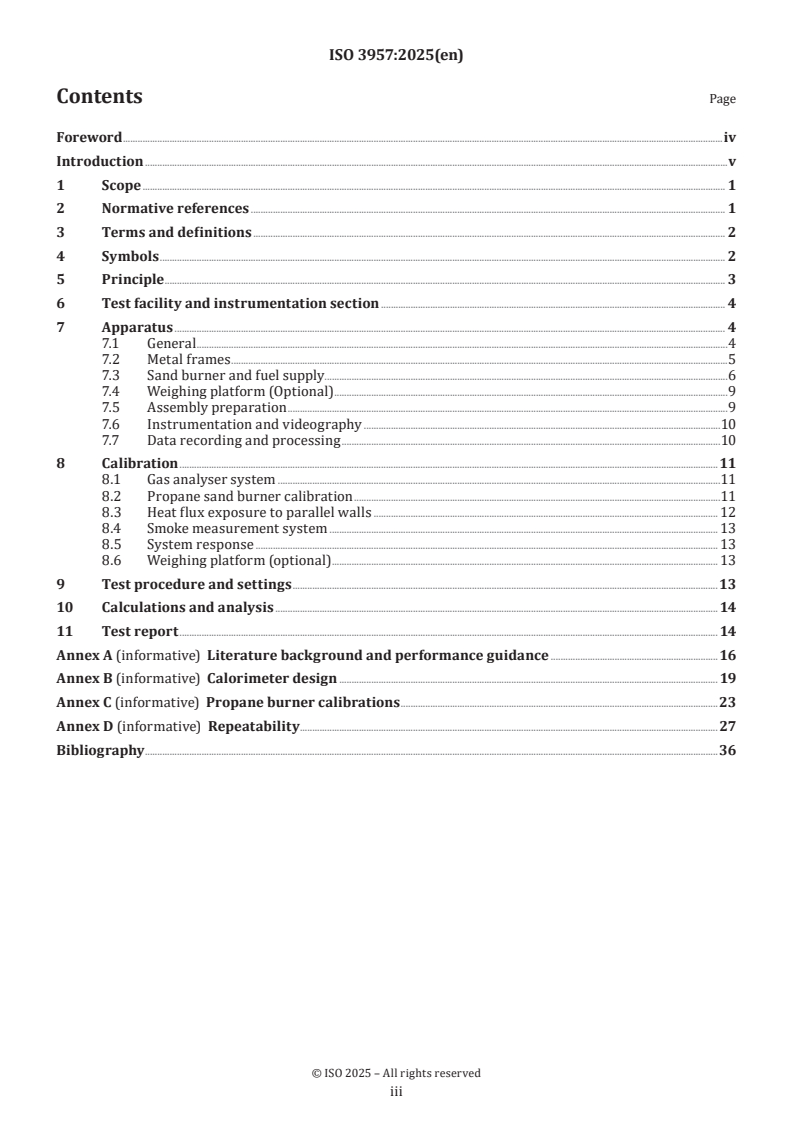
Contents Page
Foreword .iv
Introduction .v
1 Scope . 1
2 Normative references . 1
3 Terms and definitions . 2
4 Symbols . 2
5 Principle . 3
6 Test facility and instrumentation section . 4
7 Apparatus . 4
7.1 General .4
7.2 Metal frames .5
7.3 Sand burner and fuel supply.6
7.4 Weighing platform (Optional) .9
7.5 Assembly preparation .9
7.6 Instrumentation and videography .10
7.7 Data recording and processing .10
8 Calibration .11
8.1 Gas analyser system .11
8.2 Propane sand burner calibration .11
8.3 Heat flux exposure to parallel walls . 12
8.4 Smoke measurement system . 13
8.5 System response . 13
8.6 Weighing platform (optional) . . 13
9 Test procedure and settings .13
10 Calculations and analysis . 14
11 Test report . 14
Annex A (informative) Literature background and performance guidance .16
Annex B (informative) Calorimeter design . 19
Annex C (informative) Propane burner calibrations .23
Annex D (informative) Repeatability .27
Bibliography .36
iii
Foreword
ISO (the International Organization for Standardization) is a worldwide federation of national standards
bodies (ISO member bodies). The work of preparing International Standards is normally carried out through
ISO technical committees. Each member body interested in a subject for which a technical committee
has been established has the right to be represented on that committee. International organizations,
governmental and non-governmental, in liaison with ISO, also take part in the work. ISO collaborates closely
with the International Electrotechnical Commission (IEC) on all matters of electrotechnical standardization.
The procedures used to develop this document and those intended for its further maintenance are described
in the ISO/IEC Directives, Part 1. In particular, the different approval criteria needed for the different types
of ISO document should be noted. This document was drafted in accordance with the editorial rules of the
ISO/IEC Directives, Part 2 (see www.iso.org/directives).
ISO draws attention to the possibility that the implementation of this document may involve the use of (a)
patent(s). ISO takes no position concerning the evidence, validity or applicability of any claimed patent
rights in respect thereof. As of the date of publication of this document, ISO had not received notice of (a)
patent(s) which may be required to implement this document. However, implementers are cautioned that
this may not represent the latest information, which may be obtained from the patent database available at
www.iso.org/patents. ISO shall not be held responsible for identifying any or all such patent rights.
Any trade name used in this document is information given for the convenience of users and does not
constitute an endorsement.
For an explanation of the voluntary nature of standards, the meaning of ISO specific terms and expressions
related to conformity assessment, as well as information about ISO's adherence to the World Trade
Organization (WTO) principles in the Technical Barriers to Trade (TBT), see www.iso.org/iso/foreword.html.
This document was prepared by Technical Committee ISO/TC 92, Fire safety, Subcommittee SC 1, Fire
initiation and growth.
Any feedback or questions on this document should be directed to the user’s national standards body. A
complete listing of these bodies can be found at www.iso.org/members.html.
iv
Introduction
This large-scale fire test standard is developed for the purpose of measuring the heat release rate (HRR) and
the smoke-production rate (SPR) of exterior and interior wall systems, exposed under severe fire scenarios
using a parallel panel setup. Severe fire exposure to an exterior wall system can be either caused by spill
plumes from a window, such as in a post-flashover compartment fire, or an exterior fire source such as in a
dumpster, vehicle, or balcony storage. Some extreme scenarios for an exterior fire include city conflagration
(e.g. after an earthquake) or wildland-urban-interface (WUI) fires. Severe interior wall fires can be caused
by combustible storage located inside a facility, such as warehouse and manufacturing occupancies, close
to the corners of wall system. A common factor of such fire scenarios is the absence or an inadequacy of the
traditional active fire protection safeguards (e.g. sprinklers) leading to unmitigated heat exposures to wall
systems.
A sufficiently high heat flux is required to simulate such fire exposures ― a high heat flux can reveal the
flammability of the encapsulated materials used in the wall systems, as well as the vulnerabilities of facers,
[1]
joints and other components. Literature shows that severe fire exposure to wall systems is in the order
of 100 kW/m . For this purpose, three large-scale fire tests are known to simulate realistically severe fire
exposures of about 100 kW/m , and are used to evaluate the performance of both exterior and interior wall
[2]to[5]
systems . These three large-scale fire tests include the 7,6 m (25-ft) high corner fire test, 15 m (50-ft)
high corner fire test, and 4,9 m (16-ft) high parallel panel test of the ANSI/FM 4880 standard; the latter
is henceforth abbreviated as 16-ft PPT. This document is based on the 16-ft PPT method. The literature
background of the method is provided in Annex A.
The 16-ft PPT setup is placed under a large-scale (minimum 3,5 MW) calorimeter in an indoor facility and
is therefore not affected by outdoor weather conditions. The HRR measured during the tests provides an
objective evaluation to the fire performance of specimens. The test setup is further utilized to evaluate
the smoke hazard of the wall systems used in smoke sensitive occupancies from property insurance
[3]
perspective .
v
International Standard ISO 3957:2025(en)
Reaction to fire tests — Parallel panel test method for
wall systems — Measurement of heat release and smoke
production
WARNING — So that suitable precautions can be taken to safeguard health, the attention of all
concerned in fire tests is drawn to the possibility that toxic or harmful gases can be evolved during
combustion of test specimens.
Suitable respiratory protection shall be worn by those in the test room when the atmosphere in the
test room becomes unacceptable.
The test procedure involves high temperatures and combustion processes, from ignition to a
fully developed fire. Hazards can arise, e.g. burning or ignition of extraneous objects or clothing.
Operators should use full turn out firefighting gear including self-contained breathing apparatus.
Specimens can be difficult to extinguish, particularly those with combustible content burning inside
metallic facings. At least one charged water hose should be available for all tests.
Specimen collapse can occur. All personnel within the test area should remain at a sufficient distance
from the test specimen to avoid injury in case of specimen collapse.
Combustible or sensitive elements that are not part of the test specimen, such as wires, pipes and
gages close to the setup shall be covered with fire protection blankets.
1 Scope
This document specifies a large-scale fire test method for measuring the heat release rate (HRR) and the
smoke-production rate (SPR) of wall systems. The fire scenario covered in this document is representative of
severe fires originating in near wall or corner locations of an exterior or interior wall construction. A severe
fire scenario is defined that imparts a heat flux on the order of 100 kW/m to the wall systems. These include
exterior fire scenarios such as dumpster, balcony storage fires, and vehicle fires originating outside buildings.
Fires caused by combustible storage inside unsprinklered or inadequately sprinklered occupancies, such as
warehouse and manufacturing occupancies, represent a few examples of severe interior fires.
This document measures the HRR and SPR in accordance with ISO 24473. This document also provides
guidelines for heat release and smoke production performance limits, developed and used for risk evaluation
by the insurance industry.
The test method is not applicable to scenarios where a fire initiates within an air cavity, if present, of
an exterior wall system. The test method does not incorporate a window structure and is therefore not
applicable to fire spread hazards resulting from inadequately protected window openings in a post-flashover
fire scenario.
2 Normative references
The following documents are referred to in the text in such a way that some or all of their content constitutes
requirements of this document. For dated references, only the edition cited applies. For undated references,
the latest edition of the referenced document (including any amendments) applies.
ISO 13943, Fire safety — Vocabulary
ISO 24473:2008, Fire tests — Open calorimetry — Measurement of the rate of production of heat and combustion
products for fires of up to 40 MW
3 Terms and definitions
For the purposes of this document, the terms and definitions given in ISO 13943 and the following apply.
ISO and IEC maintain terminology databases for use in standardization at the following addresses:
— ISO Online browsing platform: available at https:// www .iso .org/ obp
— IEC Electropedia: available at https:// www .electropedia .org/
3.1
collapse
development of failure mechanisms in an exterior wall system to a degree involving disintegration and
falling (parts of) structural members
3.2
component
part or element of an exterior wall assembly, including but not limited to, the building panel, foam system,
cladding, joint systems, rails, brackets, sealants, insulation, continuous insulation, fire barrier, thermal
barrier, water resistive barrier
3.3
fire propagation
increase in the exposed surface area of the specimen that is actively involved in flaming combustion
[SOURCE: ISO 12136:2011, 3.4]
3.4
smoke production rate
rate of smoke produced during the fire test
3.5
smoke sensitive occupancy
occupancy which is susceptible to damage due to smoke infiltration or contamination
3.6
smoke yield
ratio of the total mass of smoke released to the total mass of the material vaporized
[SOURCE: ISO 12136:2011, 3.5]
3.7
thermal barrier
material that both limits the transfer of heat and remains in place when exposed to a standard fire exposure
for a specified period of time
4 Symbols
A exhaust duct cross-sectional area m
D
c mass specific heat capacity of a material kJ/g-K
p
ΔH lower heat value of propane kJ/g
C3H8,LHV
K thermal conductivity of a material kW/m-K
M molecular weight of propane g/mol
C3H8
Δp maximum pressure drop in the exhaust duct N/m
max
p standard pressure condition Pa
s
Q target chemical HRR kW
′ chemical HRR per unit width of a material kW/m
Q
Ch
′
Q kW/m
Ch,Max maximum chemical HRR per unit width of a material
Q′ radiative HRR per unit width of a material kW/m
R
q′′
net heat flux to the sample ahead of the pyrolysis zone kW/m
ˆ
R universal gas constant J/mol-K
R coefficient of determination ―
ΔT ignition temperature of the material above ambient K
ig
1/2 -2
λ thermal response parameter of a material kW-s m
T standard temperature condition K
s
v vertical flame spread rate m/s
3
V estimated propane volumetric flow rate m /s
C3H8,est
3
V
maximum exhaust duct flow rate m /s
D,max
y flame height m
f
y pyrolysis zone height m
p
y maximum pyrolysis zone height m
p,Max
α proportionality constant ―
ρ density of a material g/m
ρ exhaust air density kg/m
a
τ ignition time s
ig
χ chemical efficiency of combustion ―
Ch
χ
radiative fraction ―
R
5 Principle
This large-scale fire test method evaluates the HRR and SPR performance of wall systems under a scenario
representing severe fires.
The test consists of two 4,9 m (16,0 ft) high and 1,1 m (3,5 ft) wide wall assemblies parallelly mounted at
0,53 m (1,75 ft) separation. A propane sand burner of 360 kW exposure provides an approximately 100 kW/
m heat flux to the lower portion of both wall assemblies. The test setup is placed under an ISO 24473
compliant large-scale calorimeter (minimum 3,5 MW HRR capacity), to measure time-resolved HRR and SPR
from the wall assemblies during the test. The setup may optionally be installed on a weighing platform to
provide mass loss data during the test.
Guidance on thresholds for HRR and SPR performance criteria, based on the risk evaluation from the
[2][3]
property insurance perspective , is provided in A.3.
6 Test facility and instrumentation section
The test setup shall be located in an indoor facility. The test facility height and scale shall be in accordance
with ISO 24473.
The calorimeter, or fire products collector (FPC), shall be large enough in terms of capacity to conduct, and
accurately measure, up to 3,5 MW HRR during the tests. But, for the safety purposes and to avoid plume
spillage, it is recommended to use an FPC of 5,0 MW. Annex B provides description of a 5,0 MW calorimeter
presently used at a test facility, and an alternative 3,5 MW calorimeter.
The calorimetry instrumentation section of the exhaust duct shall contain gas velocity probes, gas
thermocouples, an absolute pressure transducer, gas sampling probes, a multi-gas analyser system, and
a smoke measurement system that conforms to ISO 24473. A description of these systems used at a test
facility in the US that houses a 5,0 MW calorimeter is provided in Annex B.
7 Apparatus
7.1 General
The test apparatus consists of two 4 900 mm ± 100 mm (16,0 ft) high and 1 100 mm ± 50 mm (3,5 ft) wide
wall assemblies parallelly mounted with the exterior facer of each assembly at 530 mm ± 25 mm (1,75 ft)
separation, as shown in Figure 1. The wall assemblies shall be mounted on two metal frames. Each metal
frame is first covered with a 13 mm ± 1 mm (0,5 in) thick plywood and 25 mm ± 1 mm (1,0 in) thick calcium
silicate (non-combustible) boards before mounting the wall assembly. Alternative base materials other than
plywood are acceptable to back the non-combustible boards. A sand burner of dimensions 1 100 mm ± 50 mm
length × 530 m ± 25 mm width × 460 mm ± 25 mm height (3,5 ft × 1,75 ft × 1,5 ft) is located at the base, with
the long edge of the burner flush with the lower edge of the two wall assemblies.
Dimensions in millimetres
Key
1 angle iron frame
2 13 mm thick plywood
3 25 mm thick non-combustible board
Figure 1 — Schematic of 16-ft PPT apparatus
7.2 Metal frames
All parts of the metal frames shall be constructed from 6,4 mm (0,25 in) ± 0,5 mm thick low carbon (mild)
steel or stainless steel. The schematics of the main structure of metal frames are shown in Figure 2. Each
structure shall be 5 300 mm (17,5 ft) ± 100 mm high to accommodate 4 900 mm (16,0 ft) ± 100 mm high wall
assemblies at the top and a 460 mm ± 25 mm (1,5 ft) high sand burner at the bottom. The width of metal
frames shall be 1 100 mm (3,5 ft) ± 50 mm to accommodate wall specimens and a sand burner of the same
width (see Figure 1). Both metal frames can contain horizontal angle bars welded at every 1 200 mm (4,0 ft)
± 50 mm interval from the top, in order to provide structural rigidity to hold wall assemblies. A
2 400 mm (8,0 ft) ± 100 mm long angle iron bar is located at the base, as shown in Figure 2. The main
structure of metal frames shall be bolted with angle iron frames and floor (or optional weighing platform) to
maintain vertical structural stability. The two metal frames structures can be optionally connected to each
other at the top via horizontal iron bars, in order to ensure a parallel geometry throughout the height of the
structure.
Dimensions in millimetres
Figure 2 — Schematic of the main structures of metal frames: side and front views
7.3 Sand burner and fuel supply
The ignition source is a sand burner measuring 1 100 mm (3,5 ft) ± 50 mm (length) by 530 mm (1,75 ft)
± 25 mm (width). Figure 3 shows isometric and parametric views of an example of a sand burner housing
and its main pipe burner. The sand burner housing shall be 460 mm (1,5 ft) ± 25 mm (height), with
300 mm (1,0 ft) ± 15 mm depth, sufficient to place a pipe burner, screens, stones and sand. A 25 mm (1,0 in)
± 1 mm diameter stainless steel pipe burner is centrally located 51 mm (2,0 in) ± 2 mm above the bottom of
the sand burner.
The perimeter of the pipe burner consists of 104 holes, each of 3,2 mm (1/8 in) ± 0,3 mm diameter, spaced
every 25 mm (1,0 in) ± 1 mm. The pipe burner holes face downwards towards the bottom 51 mm (2,0 in)
± 2 mm hollow space of the sand burner, as shown in Figure 3.
A stainless-steel mesh constructed of 4,8 mm (3/16 in) ± 0,3 mm diameter holes with 33 % open area, or
8,0 mm (5/16 in) ± 0,5 mm staggered centres, is located 51 mm (2,0 in) ± 2 mm above the centre of the
pipe burner; therefore the space between the steel mesh and the bottom of the sand burner is hollow. A
100 mm (4,0 in) ± 5 mm deep layer of stones with a size range of 25 mm (1,0 in) to 38 mm (1,5 in) covers the
stainless-steel mesh followed by a second stainless-steel mesh constructed of 3,6 mm (9/64 in) ± 0,2 mm
diameter holes with 51 % open area, or 4,8 mm (3/16 in) ± 0,5 staggered centres. The second steel mesh is
covered with a 51 mm (2,0 in) ± 2 mm deep second layer of stones with a size range of 6,4 mm (1/4 in) to 13 mm
(1/2 in). The second layer of stones are to be covered by a 30-mesh stainless-steel screen of 0,3 mm (0,012 in)
± 0,01 mm wire size. This steel screen shall be topped with a 51 mm (2,0 in) ± 2 mm deep layer of dry sand
with a diameter of 1,0 mm (0,04 in) ± 0,05 mm, such that it flushes the top of the sand burner.
The 25 mm (1,0 in) ± 1 mm diameter stainless steel pipe burner is connected to a 51 mm (2,0 in) ± 2 mm
inlet pipe via a flow reducer, as shown in Figure 3. The flow reducer can be replaced with standard tee
components if mass flow controllers are used to control the fuel supply and reduce the fuel upstream
pressure fluctuations. The propane gas is supplied to the sand burner via a 51 mm (2,0 in) ± 2 mm diameter
high pressure (3 400 Pa or 500 psi) rated flexible hose connected to the gas flow control panel. An example
schematic of a gas control panel is shown in Figure 4. The output of the sand burner is set by controlling
the propane gas flow rate to the burner with a gas flow control panel. The propane is to be of a grade with
a minimum of 90 % propane content. Annex C discusses the effect of propane grade on burner output and
performance.
The gas control panel example shown in Figure 4 uses mass flow meters along with needle flow control valves.
NOTE Each mass flow meter and control valve pair are recommended to be replaced with an individual mass flow
controller of a similar range that provides a better overall flow stability and control. However, installing mass flow
controllers can be a cost-factor to labs and the example option provided in Figure 4 may be used.
In the example schematic shown in Figure 4, the 51 mm (2,0 in) ± 2 mm main gas supply pipe provides
propane at 140 kPa (20 psi) and is connected to a tee which splits the gas line into two 25 mm (1,0 in)
± 1 mm piping systems. Two flow meters, or preferably controllers, each controlling flow through one of the
25 mm (1,0 in) ± 1 mm piping systems are present. Accuracy of flow meters or controllers shall be ± 0,2 % of
3 -2 3
full scale or better. One flow meter has a range of 0 m /s to 1,0 × 10 m /s (600 LPM) of propane while the
3 -3 3 3
second flow meter has a range of 0 m /s to 4,3 × 10 m /s (260 LPM) of propane. While the 0 m /s to 4,3 ×
-3 3
10 m /s (260 LPM) range flow meter or controller is sufficient to conduct standard propane exposure tests
3 -2 3
at 360 kW, the 0 m /s to 1,0 × 10 m /s range flow meter or controller is optional for conducting calibrations
at higher propane exposure settings. C.3 provides calibration data at multiple propane flow rates, other than
the standard flow rate required for 360 kW HRR exposure. After leaving the control valve, the gas supply is
connected to the intake of the sand burner with a high pressure 3 400 kPa (500 psi) rated flexible hose.
Dimensions in mm
Key
1 burner housing
2 pipe burner
3 burner holes facing down
4 inlet pipe
5 inlet pipe welded to 4-way burner manifold
Figure 3 — Example schematic and view of the sand burner incorporating a stainless steel pipe
burner and flow reducer.
Key
1 51 mm threaded union 7 51 mm to 25 mm welded assembly
2 51 mm x 102 mm threaded nipple 8 25 mm flow control valve
3 51 mm threaded tee 9 19 mm flow control valve
4 51 mm ball valve 10 25 mm pipe
5 51 mm OD and 64 mm long threaded nipples 11 19 mm pipe
3 -2 3
6 51 mm threaded elbow 12 mass flow meter 1 (0 m /s to 1,0 x 10 m /s)
3 -3 3
13 mass flow meter 2 (0 m /s to 4,3 x 10 m /s)
NOTE Piping and connections are made of 304 stainless steel.
Figure 4 — Example schematic of a gas flow control panel (nominal dimensions).
7.4 Weighing platform (Optional)
The optional weighing platform can be of the dimensions 2 400 mm (8,0 ft) ± 100 mm wide by
4 900 mm (16,0 ft) ± 100 mm long, range 0 kg to 2 300 kg (5 000 lb), and ± 1,0 % accuracy of reading. The
platform shall be sufficiently protected from the fire such that the output is unaffected by heat from the fire.
The platform shall be capable of retaining all the liquid and solid products of combustion.
NOTE This can be achieved by covering the platform with a sheet of calcium silicate board or with metal
framework. If necessary, a shallow metal tray, capable of holding the test arrangement, can also be used.
In order to avoid the effect of an up thrust on the measured weight induced by the fire, the ingress of air
below the weigh platform shall be prevented on all four sides by the fitting of low walls (screens).
7.5 Assembly preparation
Full details of the test specimen, including all components, shall be obtained from the manufacturer. These
may include, but are not limited to, the product description, composition, dimensions, manufacturer, model
number, installation guidelines, and safety data sheets. The construction of the test specimens shall be
representative of the manufacturer specified field installation instructions.
In accordance with ISO 24473, wall test specimens with components containing hygroscopic materials shall
be conditioned before the test at 23 ± 2 °C (73 ± 4 °F) indoor ambient temperature and 50 ± 5 % relative
humidity conditions. The duration for conditioning can be decided based on the manufacturer-specified
component curing period.
Optionally, hygroscopic materials can be conditioned at an indoor ambient temperature of 23 ± 5 °C
(73 ± 9 °F) and a relative humidity of 50 ± 15 %. The optional conditioning conditions shall be documented
in the test report.
Two identical wall assemblies of dimensions 4 900 mm (16,0 ft) ± 100 mm high and 1 100 mm (3,5 ft)
± 50 mm wide are constructed on the two metal frames. Each metal frame is laid down horizontal to the
floor and is first covered with a 13 mm (0,5 in) ± 1 mm thick plywood board and a 25 mm (1,0 in) ± 1 mm
thick calcium silicate (non-combustible) board before the mounting of other components of the wall system,
starting with the thermal barrier. Alternative base materials other than plywood are acceptable to back
the non-combustible boards. A central vertical joint shall be present on both parallel panels along the full
height. The vertical joints are typically susceptible to failure in a severe fire scenario and can expose the
insulation encapsulated behind the facer to the fire, thereby leading to pyrolysates escaping via joints and
resulting in vertical fire growth. The exposed edges of the wall systems are covered with 16-gauge stainless
steel covers, such that any vapours or liquids are forced out of the joint seams. The complete wall assemblies
are then erected upright and mounted parallel to each other, with the exterior facer of both walls facing
each other along their long dimension and separated by 530 mm (1,75 ft) ± 25 mm, as shown in Figure 1.
The sand burner of dimensions 1 100 mm ± 50 mm length x 530 mm ± 25 mm width x 460 mm ± 25 mm
height (3,5 ft × 1,75 ft × 1,5 ft) is located at the base of wall panels, with the long edge of the burner flush
with the lower edge of the two wall assemblies. A 25 mm (1,0 in) ± 1 mm thick ceramic wool insulation is
sandwiched between the lower edge of the wall assemblies and the outer rim of the sand burner. The sand
burner provides a constant 360 kW HRR propane exposure to impart approximately 100 kW/m heat flux to
the wall panels.
7.6 Instrumentation and videography
The following instrumentation and photography equipment shall be provided:
a) A timing device, such as stopwatch or clock, with maximum 1 second divisions.
b) A minimum 4,9 m (16 ft) high scale, preferably of a non-combustible composition such as metal or
calcium silicate, shall be placed close to one side of parallel walls and away from the test apparatus. The
scale shall cover the full height of parallel walls.
c) High-definition video cameras with sufficient memory space to record minimum one-hour videos.
Videos shall span the full height and width of setup, along with the 4,9 m high scale. Videos may be
embedded with time, date, and project number stamps.
d) High-definition photography of the test shall be done at regular intervals.
e) Additional water-cooled Gardon-type heat flux meters of 0 to 50 kW/m range may be mounted at
25 mm (1,0 in) ± 1 mm height above one of the 4,9 m (16 ft) high wall assemblies. Heat flux meters may
be flush with the exterior facer and the substrate behind the air cavity (if present) of the setup. The
meters may have an accuracy of at least ±5 % and a repeatability value within ±0,5 %. The cooling water
is maintained in the range 49 °C (120 °F) to 60 °C (140 °F), to stay above the dew point of the combustion
gas environment.
7.7 Data recording and processing
Digitally record the simultaneous outputs from the O , CO, and CO analysers, the weighing platform
2 2
load cell (optional), the measuring section duct and ambient thermocouples, the differential and absolute
pressure transducers, the smoke obscuration system, propane gas flow meters, and any additional gages at
1 s intervals. Time-shift the data for the gas concentrations to account for delays within the gas sampling
lines and respective instrument response times. The data collection system shall be accurate to within ±1 °C
for temperature measurement and ±0,01 % of full-scale instrument output for all other channels. The
system shall be capable of recording data for at least 1 h at 1 s intervals, although test duration typically
is 22 min (see Clause 9 for test procedures). The data shall also be presented in real-time to an operator to
make decisions on termination of a fire hazardous test for life and facility safety.
8 Calibration
8.1 Gas analyser system
Calibrate the O , CO and CO analysers before the first combustion test of the day. Calibrate each analyser for
2 2
measurement of combustion gases by establishing a downscale calibration point and an upscale calibration
point. Perform the upscale calibration with a “span gas” at the upper end of the range that will be used
during actual sample analysis and use a “zero gas” for the downscale calibration point at the lower end of
the analyser range. Use ultra-high purity (99,999 % purity) nitrogen as the “zero gas” reference source for
all analysers. If the O analyser is enabled with a volume fraction range of 16 % to 21 % for measuring
high accuracy of oxygen depletion, then use a calibrated balance of 16 % volume fraction of O in a nitrogen
cylinder to balance for its ‘zero gas’ calibration. First, zero the analysers, and then span each individual
analyser with its appropriate gas for the corresponding range. The gas flow rates to the analysers shall be
same as those pumped during sampling from the exhaust duct during the fire tests. Drift and noise of gas
analysers shall be checked in accordance with ISO 24473.
8.2 Propane sand burner calibration
The chemical HRR from the propane sand burner shall be verified every time the sand in the burner is
replaced. The sand of the burner shall be replaced if the prior test involved falling debris or required water
suppression.
Two 4 900 mm (16,0 ft) ± 100 mm high and 1 100 mm (3,5 ft) ± 50 mm wide inert wall panels shall be
parallelly mounted with the exterior facer of each panel at 530 mm (1,75 ft) ± 25 mm separation, as shown
in Figure 1. The inert wall panels shall be prepared by mounting each metal frame with a 13 mm (0,5 in)
± 1 mm thick plywood board and a 25 mm (1,0 in) ± 1 mm thick calcium silicate (non-combustible) board
atop the plywood. Alternative base materials other than plywood are also acceptable. The sand burner is
located at the base, with the long edge of the burner flush with the lower edge of the two wall panels, as
shown in Figure 1. The usage of inert wall panels during calibration prevents spillage and facilitates the
passage of combustion gases from the base of the setup to the calorimeter hood at the levels of low heat
release.
For burner verification, the flow rate of the propane gas shall be adjusted to provide a 360 kW chemical
HRR exposure for 5 min An optional verification can also be conducted for a higher chemical HRR propane
exposure. Alternative gas burners, flammable liquid pool fires or spray fires, as recommended in the
ISO 24473, will also be acceptable for the optional higher HRR verification. An initial estimate of the propane
flow rate can be calculated based on Formula (1):
ˆ
R
Q T
s
M
C3H8
V = (1)
C3H8,est
ΔHp.
C3H8,est s
where
3
V is the estimate propane volumetric flow rate (m /s),
C3H8,est
is the target HRR (kW),
Q
ˆ
R is the universal gas constant (8,314 J/mol-K),
M is the molecular weight of propane (44,1 g/mol),
C3H8
ΔH
is the lower heat value (LHV) (46,35 kJ/g) of propane,
C3H8,est
T is the standard temperature condition (298,15 K),
s
p is the standard pressure (101 325 Pa) condition.
s
The value derived in the LHS of Formula (1) is an estimate because it requires an accurate molecular weight
and the LHV of the grade (purity) of propane used by the test facility to be known. The flow rate of the
propane is then calibrated by matching the HRR measured by the calorimeter hood to ±10 kW of the desired
value. Steady measurements for up to 5 min are recommended for calculations. Calculation procedures for
the chemical HRR shall conform to ISO 24473:2008, Annex E.
At the calibrated volumetric flow rate setpoint for the 360 kW chemical HRR, the average SPR and the smoke
yield of the propane grade used by the test facility shall be recorded. Calculation procedures for the smoke
measurements shall conform to ISO 24473:2008, Annex E.
The flames from the sand burner while operating at 360 kW shall be uniformly spread atop the burner. Any
stratification of flames atop the sand burner shall be investigated. Stratification of flames can be due to
high moisture of sand or damaged screens within the burner. Low frequency propane flow pulsations can
originate due to inadequate propane supply or low diameter tubing to the sand burner and shall be rectified
before beginning wall system tests.
8.3 Heat flux exposure to parallel walls
The heat fluxes to the parallel walls shall be calibrated after modifications have been made in the sand
burner, propane grade to the sand burner, and the structure of the metal frames. At a minimum, calibration
should be conducted once a year to validate the heat flux to the parallel walls of the setup. For this calibration,
two 4 900 mm (16 ft) ± 100 mm high and 1 100 mm (3,5 ft) ± 50 mm wide inert wall panels shall be parallelly
mounted with the exterior facer of each panel at 530 mm (1,75 ft) ± 25 mm separation as shown in Figure 1,
and similar to that described in 8.2.
Water-cooled Gardon-type total heat flux meters are used for the calibration. Three heat flux meters shall
2 2
be of the range 0 kW/m to 200 kW/m , and shall have an accuracy of at least ±5 % and a repeatability
2 2
value within ±0,5 %. Additionally, five more water-cooled Gardon meters of range 0 kW/m to 100 kW/m
can be optionally used for a more detailed characterization of the heat flux exposure. The cooling water is
maintained in the range 49 °C (120 °F) to 60 °C (140 °F), to stay above the dew point of the combustion gas
environment. Meters shall be calibrated prior to heat flux calibration tests.
NOTE Although Schmidt-Boelter meters are recommended when convective currents are expected to be
significant, Gardon-type meters are required in this document due to commonality with the gages used in calibration
[1][6]
of the 7,6 m (25-ft) and 15 m (50-ft) high corner fire tests .
Water-cooled Gardon-type total heat flux meters shall be installed along the horizontal centreline of, and
2 2
flush with, the exposed side of one inert panel. The 0 kW/m to 200 kW/m range meters are installed at the
heights corresponding to meters #1 to #3 in Table 1 above the burner surface. The remaining optional heat
flux meters are installed at the heights corresponding to meters #4 to #8 above the burner surface.
The propane flow rate is set corresponding to the 360 kW exposure determined during the calibration
described in 8.2. The test shall be run for a minimum of 8 min with propane and only the last 5 min of data
shall be used for the heat flux calibration. The initial 3 min of the test is used to bring the setup to the steady
conditions, including coating of the calcium-silicate panels with spectrally-flat and black soot, and heating
up of the parallel calcium-silicate boards and sand atop the burner to a steady high temperature.
Table 1 shows the heat flux values at each location after taking a 15 s moving average of the last 5 min of
data. Annex C discusses the effect of propane grade on heat flux calibrations. The calibrated heat flux values
for the meters #1, #2, and #3 shall be within ±10 % of that shown in Table 1. Readings for the meters #4 to
#8 can be reported for informational purposes.
C.3 provides similar heat flux calibration data at propane exposures other than that used for the standard
360 kW theoretical HRR, for informational purposes. The range of propane exposures employed in C.3 is
120 kW to 830 kW theoretical HRR.
Table 1 — Total heat flux meter location and the heat flux measured during the steady state
Meter location above burner Heat flux
Gardon heat flux meter
mm kW/m
Meter #1 150 ± 5 (0,5 ft) 110
Meter #2 300 ± 15 (1,0 ft) 110
Meter #3 460 ± 25 (1,5 ft) 100
Meter #4 610 ± 25 (2,0 ft) 80
Meter #5 910 ± 50 (3,0 ft) 60
Meter #6 1 200 ± 50 (4,0 ft) 40
Meter #7 1 500 ± 50 (5,0 ft) 10
Meter #8 2 100 ± 100 (7,0 ft) 10
8.4 Smoke measurement system
Both white-light and laser-based smoke measurement systems can be used, and the calibration shall be in
accordance with ISO 24473.
8.5 System response
The system response, including the "delay time”, the “response time” and the “duct flow time” are calculated
based on the procedures detailed in ISO 24473:2008, Clause 11.
8.6 Weighing platform (optional)
A minimum of once a year, the platform should be calibrated over the range of weight loss expected using
standard weights. The output should be within the expected range of mass loss uncertainty and the
calibration should demonstrate linearity within the equipment limits. On each day of the testing, the load
cell signal should be verified by cross-checking with at least one standard weight.
9 Test procedure and settings
a) The test setup including the sand burner shall be assembled centrally under the calorimeter hood.
b) Instruments in the measurement section of the calorimeter hood, including the gas analysers and the
smoke obscuration system, shall be turned on at least 2 h prior to the test to warm up.
c) The horizontal wind speed measured between the parallel walls shall not exceed 0,5 m/s with
calorimeter hood off, in accordance with ISO 24473.
d) Turn on the calorimeter hood and set the exhaust flow rate to the desired value.
e) Record the initial lab temperature and the relative humidity.
f) The data acquisition system and the video recording devices shall start a minimum 2 min before the
ignition. Start recording the data from test.
g) Digital colour photographs of the test setup shall be taken prior to the test, at maximum 60 s intervals
during the test, and after the smoke has cleared and the test assembly has coo
...
Questions, Comments and Discussion
Ask us and Technical Secretary will try to provide an answer. You can facilitate discussion about the standard in here.
Loading comments...