


ISO 12507:2025
(Main)Paper and pulp — Deinkability test for printed paper product mixtures containing woodfree printed paper
Paper and pulp — Deinkability test for printed paper product mixtures containing woodfree printed paper
This document specifies a basic laboratory test method for deinkability of woodfree printed paper products as a mixture under alkaline conditions by means of single stage flotation deinking and fatty acid-based collector chemistry. The woodfree printed paper product of interest is tested as a mixture containing 10 % by weight of the woodfree printed paper with the balance comprising a mixture of printed wood-containing paper.
Papier et carton — Essai de désencrabilité de mélanges de produits en papier imprimés contenant du papier imprimé sans bois
General Information
- Status
- Published
- Publication Date
- 18-Feb-2025
- Technical Committee
- ISO/TC 6 - Paper, board and pulps
- Drafting Committee
- ISO/TC 6 - Paper, board and pulps
- Current Stage
- 6060 - International Standard published
- Start Date
- 19-Feb-2025
- Due Date
- 10-Mar-2025
- Completion Date
- 19-Feb-2025
Overview
ISO 12507:2025 - Paper and pulp - Deinkability test for printed paper product mixtures containing woodfree printed paper - is a laboratory test method for assessing the deinkability of woodfree printed paper when present as a minor fraction in a mixed printed-paper stream. The method simulates a single-stage alkaline flotation deinking process using fatty acid–based collector chemistry and specifies testing a mixture composed of 10% by weight woodfree printed paper with the balance being printed wood-containing (mechanical-pulp based) paper. The standard is intended to give an indication of how such mixtures will perform under typical alkaline flotation deinking at laboratory scale.
Key technical topics and requirements
- Scope and principle: Simulates ink detachment and removal under standardized alkaline deinking and single-stage flotation conditions; not intended for near-neutral/neutral flotation or additional industrial steps such as washing, bleaching, post-flotation dispersion, or extensive cleaning/screening.
- Sample composition: Tests mixtures containing 10% woodfree printed paper blended with mechanical-pulp based printed papers to reflect common post-consumer streams.
- Equipment and chemicals: Specifies general laboratory equipment, pulping devices, flotation cell examples, and the use of fatty acid-based collectors for flotation chemistry.
- Procedure and sample handling: Covers sampling, identification, removal of non-paper materials, accelerated ageing, pulping, pH control, dilution, flotation, and yield determinations.
- Specimen preparation and analysis: Procedures for preparing filter pads, membrane filters and handsheets; analytical methods include reflectance measurements, filtrate darkening assessment, and dirt particle measurement (scanner-based), plus guidance on moisture and ash determinations.
- Reporting: Defines information to include in the test report and annexes on device examples, filter testing, pH testing for small samples, and threshold/size classification.
Practical applications and users
- Recycling and deinking laboratories validating how a small fraction of woodfree print affects deinkability in mixed streams.
- Paper mills and deinking plants assessing feedstock blends and predicting flotation deinking performance under alkaline conditions.
- Paper manufacturers, converters, and brand owners seeking to understand recyclability and process compatibility of printed products.
- R&D groups developing inks, coatings, or collector chemistries and needing standardized lab-scale comparison methods.
- Standards organizations and procurement/specification teams incorporating deinkability criteria into quality or sustainability scorecards.
Related standards
- ISO 21993 (mentioned as an adjunct method for testing 100% printed articles under alkaline conditions) - use ISO 12507:2025 when the woodfree fraction is a minor component of a mixed stream.
Keywords: ISO 12507:2025, deinkability test, woodfree printed paper, flotation deinking, alkaline deinking, fatty acid collector, paper recycling, laboratory method.
Get Certified
Connect with accredited certification bodies for this standard

Control Union Certifications
Global certification for agriculture and sustainability.

Gozdarski inštitut Slovenije
Slovenian Forestry Institute. Forest management certification support, timber testing.
Sponsored listings
Frequently Asked Questions
ISO 12507:2025 is a standard published by the International Organization for Standardization (ISO). Its full title is "Paper and pulp — Deinkability test for printed paper product mixtures containing woodfree printed paper". This standard covers: This document specifies a basic laboratory test method for deinkability of woodfree printed paper products as a mixture under alkaline conditions by means of single stage flotation deinking and fatty acid-based collector chemistry. The woodfree printed paper product of interest is tested as a mixture containing 10 % by weight of the woodfree printed paper with the balance comprising a mixture of printed wood-containing paper.
This document specifies a basic laboratory test method for deinkability of woodfree printed paper products as a mixture under alkaline conditions by means of single stage flotation deinking and fatty acid-based collector chemistry. The woodfree printed paper product of interest is tested as a mixture containing 10 % by weight of the woodfree printed paper with the balance comprising a mixture of printed wood-containing paper.
ISO 12507:2025 is classified under the following ICS (International Classification for Standards) categories: 85.040 - Pulps; 85.060 - Paper and board; 85.080.01 - Paper products in general. The ICS classification helps identify the subject area and facilitates finding related standards.
ISO 12507:2025 is available in PDF format for immediate download after purchase. The document can be added to your cart and obtained through the secure checkout process. Digital delivery ensures instant access to the complete standard document.
Standards Content (Sample)
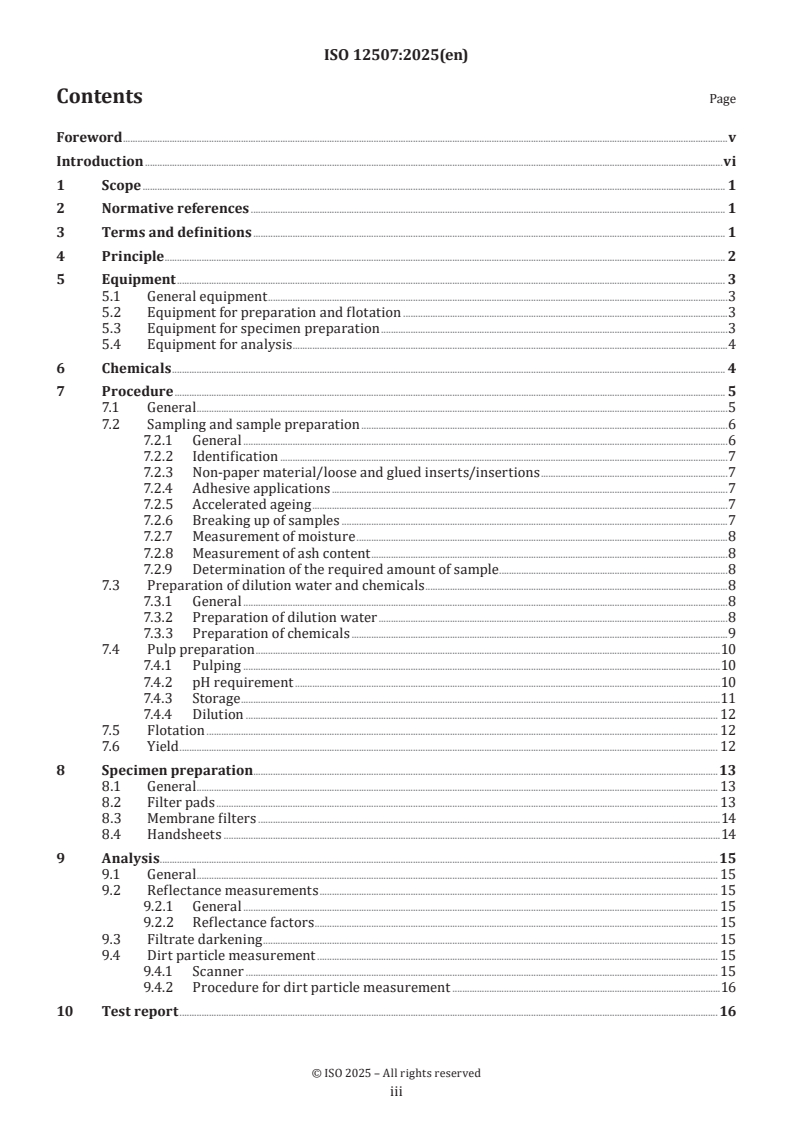
International
Standard
ISO 12507
First edition
Paper and pulp — Deinkability test
2025-02
for printed paper product mixtures
containing woodfree printed paper
Papier et carton — Essai de désencrabilité de mélanges de produits
en papier imprimés contenant du papier imprimé sans bois
Reference number
© ISO 2025
All rights reserved. Unless otherwise specified, or required in the context of its implementation, no part of this publication may
be reproduced or utilized otherwise in any form or by any means, electronic or mechanical, including photocopying, or posting on
the internet or an intranet, without prior written permission. Permission can be requested from either ISO at the address below
or ISO’s member body in the country of the requester.
ISO copyright office
CP 401 • Ch. de Blandonnet 8
CH-1214 Vernier, Geneva
Phone: +41 22 749 01 11
Email: copyright@iso.org
Website: www.iso.org
Published in Switzerland
ii
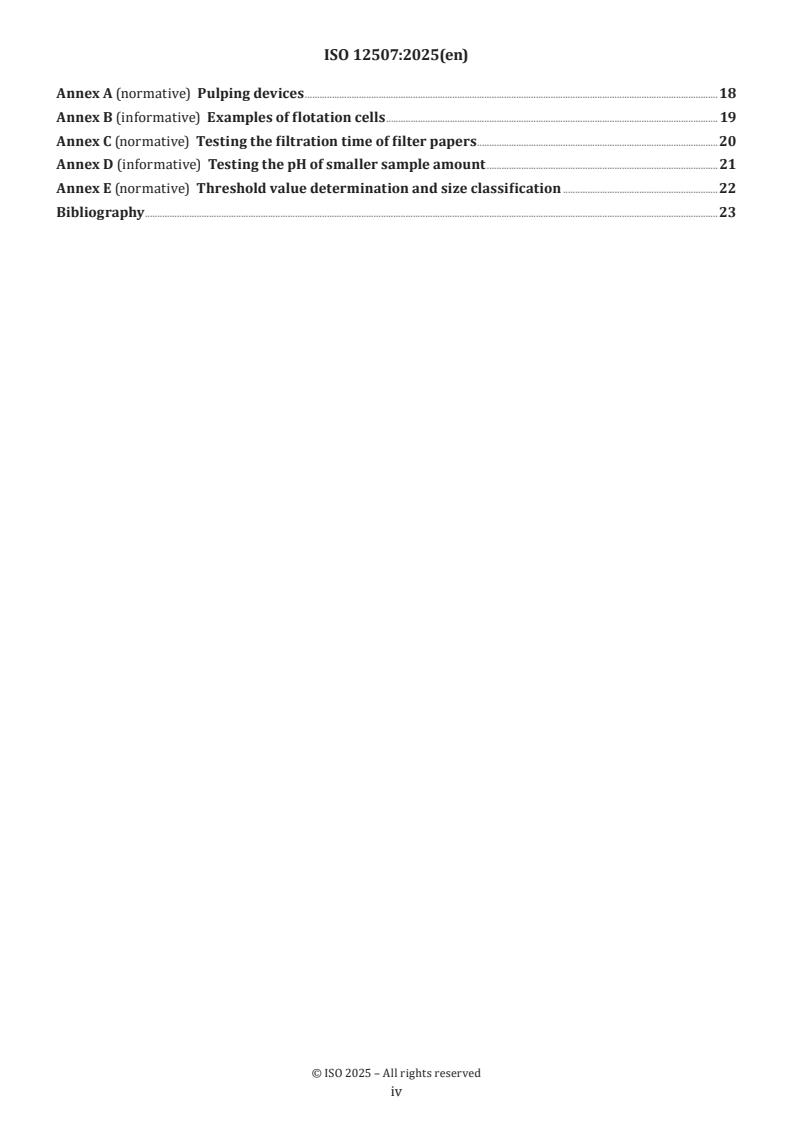
Contents Page
Foreword .v
Introduction .vi
1 Scope . 1
2 Normative references . 1
3 Terms and definitions . 1
4 Principle . 2
5 Equipment . 3
5.1 General equipment .3
5.2 Equipment for preparation and flotation .3
5.3 Equipment for specimen preparation .3
5.4 Equipment for analysis .4
6 Chemicals . 4
7 Procedure . 5
7.1 General .5
7.2 Sampling and sample preparation .6
7.2.1 General .6
7.2.2 Identification .7
7.2.3 Non-paper material/loose and glued inserts/insertions .7
7.2.4 Adhesive applications .7
7.2.5 Accelerated ageing .7
7.2.6 Breaking up of samples .7
7.2.7 Measurement of moisture .8
7.2.8 Measurement of ash content .8
7.2.9 Determination of the required amount of sample .8
7.3 Preparation of dilution water and chemicals .8
7.3.1 General .8
7.3.2 Preparation of dilution water .8
7.3.3 Preparation of chemicals .9
7.4 Pulp preparation .10
7.4.1 Pulping .10
7.4.2 pH requirement .10
7.4.3 Storage .11
7.4.4 Dilution . 12
7.5 Flotation . 12
7.6 Yield . 12
8 Specimen preparation . .13
8.1 General . 13
8.2 Filter pads . 13
8.3 Membrane filters .14
8.4 Handsheets .14
9 Analysis . .15
9.1 General . 15
9.2 Reflectance measurements . 15
9.2.1 General . 15
9.2.2 Reflectance factors . 15
9.3 Filtrate darkening . 15
9.4 Dirt particle measurement . 15
9.4.1 Scanner . 15
9.4.2 Procedure for dirt particle measurement .16
10 Test report .16
iii
Annex A (normative) Pulping devices .18
Annex B (informative) Examples of flotation cells . 19
Annex C (normative) Testing the filtration time of filter papers .20
Annex D (informative) Testing the pH of smaller sample amount .21
Annex E (normative) Threshold value determination and size classification .22
Bibliography .23
iv
Foreword
ISO (the International Organization for Standardization) is a worldwide federation of national standards
bodies (ISO member bodies). The work of preparing International Standards is normally carried out through
ISO technical committees. Each member body interested in a subject for which a technical committee
has been established has the right to be represented on that committee. International organizations,
governmental and non-governmental, in liaison with ISO, also take part in the work. ISO collaborates closely
with the International Electrotechnical Commission (IEC) on all matters of electrotechnical standardization.
The procedures used to develop this document and those intended for its further maintenance are described
in the ISO/IEC Directives, Part 1. In particular, the different approval criteria needed for the different types
of ISO documents should be noted. This document was drafted in accordance with the editorial rules of the
ISO/IEC Directives, Part 2 (see www.iso.org/directives).
ISO draws attention to the possibility that the implementation of this document may involve the use of (a)
patent(s). ISO takes no position concerning the evidence, validity or applicability of any claimed patent
rights in respect thereof. As of the date of publication of this document, ISO had not received notice of (a)
patent(s) which may be required to implement this document. However, implementers are cautioned that
this may not represent the latest information, which may be obtained from the patent database available at
www.iso.org/patents. ISO shall not be held responsible for identifying any or all such patent rights.
Any trade name used in this document is information given for the convenience of users and does not
constitute an endorsement.
For an explanation of the voluntary nature of standards, the meaning of ISO specific terms and expressions
related to conformity assessment, as well as information about ISO's adherence to the World Trade
Organization (WTO) principles in the Technical Barriers to Trade (TBT), see www.iso.org/iso/foreword.html.
This document was prepared by Technical Committee ISO/TC 6, Paper, board and pulps.
Any feedback or questions on this document should be directed to the user’s national standards body. A
complete listing of these bodies can be found at www.iso.org/members.html.
v
Introduction
The types and sources of paper for recycling are manifold. The most significant grades by volume are
packaging products from industry, trade and households, followed by graphic papers from households and
to a lesser extent from offices. These printed papers are blends of a variety of individual products. Typical
blends of graphic paper for recycling recovered from households contain a high content of mechanical-
pulp based fibres and a minor amount of woodfree pulp fibres. Graphic paper for recycling originating
from printing and converting operations is typically rather pure and may contain just one type of paper
(mechanical-pulp based or woodfree). However, paper for recycling from printing and converting, as well
as special grades, constitute only a minor share of the total volume of paper for recycling. Special grades
(e.g. liquid packaging or label stock release liners) often require specific treatments during recycling and/or
repulping.
When the blends of paper for recycling are predominantly mechanical-pulp based offset printed papers, a
simple single-loop alkaline flotation deinking step can sufficiently remove the ink colorants from the paper
fibres. ISO 21993 describes a simplified test method that can be used to predict the deinkability of printed
paper products under alkaline conditions. However, ISO 21993 specifies testing 100 % of a printed paper
product of interest, whether mechanical-pulp based or woodfree, even though the proportion of woodfree
paper in a deinking mill using alkaline conditions is typically small. This can possibly lead to misleading
results in that a poor assessment by ISO 21993, and any related scorecard associated with it, does not
necessarily mean that a particular print product cannot be deinked when present in a mixture of post-
[1]
consumer papers for recycling .
There is currently no test method which looks specifically at the case of woodfree printed paper as a
[2][3][4][5]
small portion of the total blend, where the majority of the paper is mechanical-pulp based fibre .
An alternative test method, which uses a specific mixture of mechanical-pulp based and woodfree printed
paper grades, can help differentiate between inks, printed papers and ink/paper combinations.
As an adjunct to the method in ISO 21993, this document describes a method for testing the deinkability of
woodfree printed papers when incorporated as a small amount in a blend with mechanical pulp based printed
papers. A mixture of woodfree and mechanical pulp based printed papers is more representative of typical
post-consumer recycled paper streams. This approach can also support recycled paper collection from pre-
consumer sources, where the amount of different grades can be controlled in the mill recipe, e.g., if woodfree
printed paper is blended in at a small amount. The method described in this document, which uses a specified
blend of mechanical pulp based and woodfree printed papers, has been developed to simulate the principal
process steps for ink detachment and ink removal under standardised alkaline conditions at a laboratory
scale. It gives an indication on how print product mixtures will perform in an industrial deinking operation
where a high percentage of the printed paper for recycling comprises mechanical pulp-based fibres.
The method described in this document is not designed to model additional or alternative process steps,
such as dispersing, post-flotation, washing and bleaching. Cleaning and screening stages, which are
designed to remove impurities and unwanted materials in the industrial process, are also not included in
this method. An alternative deinking test method with near-neutral or neutral flotation conditions can be
more representative for printed papers consisting of mostly woodfree pulp fibres. However, the near-neutral
or neutral flotation conditions are not within the scope of this document.
vi
International Standard ISO 12507:2025(en)
Paper and pulp — Deinkability test for printed paper product
mixtures containing woodfree printed paper
1 Scope
This document specifies a basic laboratory test method for deinkability of woodfree printed paper products as
a mixture under alkaline conditions by means of single stage flotation deinking and fatty acid-based collector
chemistry. The woodfree printed paper product of interest is tested as a mixture containing 10 % by weight
of the woodfree printed paper with the balance comprising a mixture of printed wood-containing paper.
2 Normative references
The following documents are referred to in the text in such a way that some or all of their content constitutes
requirements of this document. For dated references, only the edition cited applies. For undated references,
the latest edition of the referenced document (including any amendments) applies.
ISO 187, Paper, board and pulps — Standard atmosphere for conditioning and testing and procedure for
monitoring the atmosphere and conditioning of samples
ISO 638 (all parts), Paper, board, pulps and cellulosic nanomaterials — Determination of dry matter content by
oven-drying method
ISO 1762, Paper, board, pulps and cellulose nanomaterials — Determination of residue (ash content) on ignition
at 525 °C
ISO 2469:2024, Paper, board and pulps — Measurement of diffuse radiance factor (diffuse reflectance factor)
ISO 2470-1, Paper, board and pulps — Measurement of diffuse blue reflectance factor — Part 1: Indoor daylight
conditions (ISO brightness)
ISO 3689, Paper and board — Determination of bursting strength after immersion in water
ISO 4119, Pulps — Determination of stock concentration
ISO 5269-1, Pulps — Preparation of laboratory sheets for physical testing — Part 1: Conventional sheet-
former method
ISO 5269-2, Pulps — Preparation of laboratory sheets for physical testing — Part 2: Rapid-Köthen method
ISO 5631-1, Paper and board — Determination of colour by diffuse reflectance — Part 1: Indoor daylight
conditions (C/2°)
ISO 12641-1:2016, Graphic technology — Prepress digital data exchange — Colour targets for input scanner
calibration — Part 1: Colour targets for input scanner calibration
3 Terms and definitions
For the purposes of this document, the following terms and definitions apply.
ISO and IEC maintain terminology databases for use in standardization at the following addresses:
— ISO Online browsing platform: available at https:// www .iso .org/ obp
— IEC Electropedia: available at https:// www .electropedia .org/
3.1
deinked pulp
pulp obtained from printed paper products, and deinked
3.2
un-deinked pulp
pulp obtained from printed paper products, pulped with added deinking chemicals, prior to flotation
3.3
stock concentration
ratio of the oven-dry organic and inorganic mass of material that can be filtered from a stock sample to the
mass of the unfiltered sample
[SOURCE: ISO 4119:1995, 2.2, modified — part of the sentence “when determined as specified in this
International Standard” and Note 1 were removed.]
3.4
fibre concentration
ratio of the oven-dry mass of organic material, that can be filtered from a stock sample to the mass of the
unfiltered sample
Note 1 to entry: Organic material is the total material, less its ash.
Note 2 to entry: The organic material mainly consists of cellulosic fibres and fines.
3.5
fibre yield
ratio of the oven-dry mass of organic material after flotation to the oven-dry mass of organic material before
flotation
Note 1 to entry: Organic material is the total material, reduced by the oven-dry mass of its ash.
Note 2 to entry: The organic material mainly consists of cellulosic fibres and fines.
3.6
rate of filtration
time taken for a defined volume of a test fluid to pass a filter
3.7
mixture of printed wood-containing paper
mix of printed paper products: 50 % newspapers, printed with coldset offset; 25 % magazines on SC paper
and 25 % magazines on LWC paper, both printed with the heatset offset process
Note 1 to entry: This definition is only applicable in the context of this document.
3.8
woodfree paper
freesheet paper
paper having, in principle, only chemical pulp in its fibre composition
Note 1 to entry: This definition can also apply to woodfree board: board having, in principle, only chemical pulp in its
fibre composition.
Note 2 to entry: "chemical pulp" is defined in ISO 4046-4
4 Principle
Printed papers are subjected to accelerated ageing and then pulping followed by flotation deinking under
defined conditions. Pulp samples from each stage are taken and converted to dry state for characterization.
5 Equipment
5.1 General equipment
5.1.1 Drying oven in accordance with the ISO 638 series, capable of maintaining the air temperature at
105 °C ± 2 °C, and suitably ventilated.
5.1.2 Analytical balance up to 150 g with an accuracy of at least 0,001 g.
5.1.3 Balance up to 3 000 g with an accuracy of at least 0,1 g.
5.1.4 Beakers.
5.1.5 Muffle furnace according to ISO 1762.
5.2 Equipment for preparation and flotation
5.2.1 Laboratory pulping device, capable of pulping about 150 g to 500 g of paper products under the
conditions set in 7.4.1. Examples of suitable devices and operating conditions are listed in Annex A.
5.2.2 Temperature-controlled water bath.
5.2.3 Heating plate equipped with magnetic stirrer, or commercially available water heater.
5.2.4 Laboratory flotation deinking cell, (see 7.6 and Annex B) and – if applicable – accessories.
5.2.5 pH meter with an accuracy of 0,1 points.
5.3 Equipment for specimen preparation
5.3.1 Pulp distribution device (volume: 10 l).
5.3.2 Büchner funnel.
5.3.3 Vacuum filtration unit for membrane filtration with 39 mm bottom inner diameter of the funnel.
5.3.4 Vacuum device that can produce a pressure difference ≥ 60 kPa.
5.3.5 Filter paper: Grammage of (84 ± 4) g/m , filtration time for deionized water (20 ± 4) s, tested in
accordance with Annex C and wet burst strength > 30 kPa in accordance with ISO 3689.
NOTE 1 The definition of the filter paper is much stricter than in ISO 3688, because the filtrate is used for further
analysis (filtrate darkening).
1)
NOTE 2 For example, the filter paper Ahlstrom Munktell 1289 meets these requirements.
5.3.6 Cellulose nitrate membrane filter: nominal ⌀ 50 mm, pore ⌀ 0,45 µm, white, without a grid.
1) Ahlstrom Munktell 1289 can be obtained at Ahlstrom Germany GmbH, Bärenstein Plant, Niederschlag 1,
09471 Bärenstein, Germany. This information is given for the convenience of users of this document and does not
constitute an endorsement by ISO of the product named. Equivalent products may be used if they can be shown to lead to
the same results.
5.3.7 Standard sheet former (model: Rapid-Köthen) with dryer, in accordance with ISO 5269-2 or
conventional sheet former in accordance with ISO 5269-1.
5.3.8 Paper cover sheets and carrier boards in accordance with ISO 5269-2.
5.4 Equipment for analysis
5.4.1 Flatbed scanner or camera with the following specifications:
a) optical scan resolution ≥ 600 dpi, equivalent to a pixel size of ≤ 42 μm;
b) colour depth 24 bit;
c) optical density D ≥ 4,0;
MAX
d) with IT8 calibration (*.ICM-File) in accordance with ISO 12641-1 (see also Annex E IT8 7.2 calibration)
and reach a mean grey value of 115 ± 2 for all fields of IT8 colour calibration sheet in accordance with
Annex E.
5.4.2 Image analysis software, such as the ones described in Annex E.
5.4.3 Colour-measuring equipment, which meets the requirements of ISO 2470-1 and ISO 5631-1.
6 Chemicals
2) ®
6.1 Sodium hydroxide (NaOH), pro analysis, CAS Registry Number 1310-73-2.
3 3
6.2 Sodium silicate 1,3 g/cm to 1,4 g/cm (38° Bé to 40° Bé).
6.3 Hydrogen peroxide (H O ), e.g. 35 %.
2 2
3)
6.4 Oleic acid (C H O ), purified, CAS # 112-80-1, with the following specifications:
18 34 2
a) acid number: 198 to 240;
b) iodine number: 92 to 100;
c) linoleic acid (C18:2): max. 18 %;
d) oleic acid (C18:1): min. 72 %;
e) palmitic acid (C16:0): max. 8 %;
f) palmitoleic acid (C16:1): max. 1 %;
g) stearic acid (C18:0): max. 4 %.
6.5 Calcium chloride dihydrate (CaCl · 2 H O), CAS # 10035-04-8.
2 2
6.6 Saturated aluminium sulphate solution – Al (SO ) .
2 4 3
2) CAS Registry Number® is a trademark of the American Chemical Society (ACS). This information is given for the
convenience of users of this document and does not constitute an endorsement by ISO of the product named. Equivalent
products may be used if they can be shown to lead to the same results.
3) Oleic acid can be obtained at VWR Chemicals, oleic acid, purified, article no. 20447.293. This information is given
for the convenience of users of this document and does not constitute an endorsement by ISO of the product named.
Equivalent products may be used if they can be shown to lead to the same results.
NOTE A concentration of 330 g/l is considered as a saturated aluminium sulphate solution.
7 Procedure
7.1 General
This laboratory scale method defines the essential steps of the flotation deinking process: pulping and
flotation. In order to simulate the average age of printed paper recovered from households, an accelerated
ageing step is part of the procedure. The whole laboratory procedure and the accepted chemicals are shown
in Figure 1.
The deinkability is assessed by three main quality parameters of the deinked pulp and one important
process parameter.
Quality parameters:
— luminance;
— pulp shade;
— dirt specks.
Process parameter:
— filtrate darkening.
Key
c fibre concentration
f
c stock concentration
s
t time
T temperature
m mass (oven dry)
od
m mass of the oven-dry printed sample
ps,od
Figure 1 — Procedure for testing deinkability with standard deinking recipe
7.2 Sampling and sample preparation
7.2.1 General
Take a sample which is representative of the printed material to be tested and blend with the mixture of
printed wood-containing paper as follows: 90 % of the mixture of printed wood-containing paper plus
10 % of the printed wood-free sample. The mixture of printed wood-containing paper is defined in 3.7. The
recommended amount of the total mixture is 1 000 g. If available, sample also some unprinted material and
store separately for additional testing. A reference sample which comprises 90 % of the mixture of printed
wood-containing paper and 10 % of unprinted wood-free paper shall also be tested.
NOTE If the same unprinted wood-free paper is not available, an unprinted wood-free paper of similar brightness
can be substituted.
Other ratios of the mixture of printed wood-containing paper to the printed wood-free sample may be used,
but the 90:10 ratio shall be run and reported as outlined in Clause 10. It is recommended to regularly run a
control test which uses 100 % of the mixture of printed wood-containing paper defined in 3.7. The control
test results should be charted over time to monitor for any age- or source-related deviations for the key
metrics that are measured as specified in Clause 7 and Clause 9 of this method.
7.2.2 Identification
Describe, if possible, full details of each printed paper in the printed material to be tested. If available, the
following shall be included:
a) identification of the wood-free printed paper product as to title, publishing company, date of issue,
product category;
b) the print process of the wood-free printed paper, printing and drying/curing parameters and press
settings;
c) the name and exact identification of inks or toner and of varnishes (if applicable) used for the wood-free
printed paper;
d) any pre- or post-treatment applied (if any);
e) the paper grade, manufacturer and brand name, ash content of the wood-free printed paper sample.
Specify whether the printed sample contains inserts and/or supplements.
7.2.3 Non-paper material/loose and glued inserts/insertions
Remove any non-paper material, all inserts, glued-in inserts, stickers, sachets and similar items from the
printed sample.
7.2.4 Adhesive applications
In order to avoid any interference with the test procedure and the results, remove any visible adhesive
material – i.e. adhesives used in inserts, stickers, spines and similar – from the printed sample.
7.2.5 Accelerated ageing
Place the printed sample mixture in a drying oven for accelerated ageing at (60 ± 3) °C for 72 h. Individual
stacks should not contain more than 20 sheets.
NOTE 1 Accelerated ageing is necessary because the age of printed paper products can influence their deinkability.
These accelerated ageing conditions correspond to 3 months to 6 months of natural ageing.
NOTE 2 If the age of the printed product is three months or higher, the accelerated ageing can be omitted. This is to
be noted in the report as a deviation of the procedure.
7.2.6 Breaking up of samples
Tear the accelerated aged, printed mixture sample into pieces of about 2 cm × 2 cm and allow them to
equilibrate with the laboratory environment.
7.2.7 Measurement of moisture
Determine the moisture content of the air-dry sample by testing a portion in accordance with ISO 638-1.
Based on the results obtained, calculate the appropriate air-dry mass of the printed sample which
corresponds to the oven-dry mass prescribed.
7.2.8 Measurement of ash content
Determine the ash content of the printed sample in accordance with ISO 1762. Take special care to take a
representative portion of the sample if it is comprised of different paper grades with different ash contents,
e.g. cover and interior part(s).
7.2.9 Determination of the required amount of sample
The viscosity of a pulp slurry is, among other parameters, dependent on its ash content. Low viscosity due to
high ash content can result in insufficient disintegration of the sample. Therefore, the pulping procedure is
defined with an oven-dry fibre concentration of 12 %. Consequently, the total amount of the printed sample
for the test is not constant but has to be calculated according to its ash content (see 7.2.8) and moisture
content (see 7.2.7).
Determination of the oven-dry sample mass for 200 g (oven-dry) fibre mass is calculated using Formula (1):
100 %
m = ×200 (1)
ps,od
100 %−C
ap, s
where
m is the mass of the oven-dry printed sample in grams (g);
ps,od
C is the ash content of the printed sample expressed as a percentage.
a,ps
Determination of the air-dry sample mass is calculated using Formula (2):
100 %+C
()
mp, s
mm=× (2)
ps,,ad ps od
100 %
where
m is the mass of the air-dry printed sample in grams (g);
ps,ad
m is the mass of the oven-dry printed sample in grams (g);
ps,od
C is the moisture content of the printed sample expressed as a percentage.
m,ps
7.3 Preparation of dilution water and chemicals
7.3.1 General
All chemicals shall be dosed with a relative tolerance not exceeding ±1 %.
7.3.2 Preparation of dilution water
During laboratory treatment of the printed sample (see 7.4 to 7.5), use only deionized water adjusted to a
2+
calcium hardness of 3,21 mmol/l, equivalent to 128 mg Ca /l.
To obtain the desired water hardness, add 472 mg/l calcium chloride dihydrate (CaCl · 2 H O) to deionized
2 2
2+
water. This is equivalent to 128 mg Ca /l.
During pulp preparation and flotation deinking, a constant temperature of (45 ± 2) °C shall be maintained.
The dilution water should therefore be stored in a temperature-controlled water bath. It is also possible to
heat part of the dilution water to a considerably higher temperature by means of a water heater, successively
adding cold dilution water until the desired temperature has been reached.
7.3.3 Preparation of chemicals
It is advisable to prepare the chemicals by mass as volume is affected by temperature. The standard deinking
recipe is given in Table 1.
Table 1 — Standard deinking recipe
Chemical Dosage (related to oven-dry paper)
a
Sodium hydroxide 0,6 % (100 %)
3 3 a
Sodium silicate 1,8 % (1,3 g/cm to 1,4 g/cm )
Hydrogen peroxide 0,7 % (100 %)
Oleic acid 0,8 % (100 %)
a
The dosages of sodium hydroxide and of sodium silicate shall be adapted, if the pH is either too low or too high after pulping
or if it is too low before flotation (see 7.4.2).
Prepare of 2 000 g of deinking solution which will be sufficient for several tests. Dissolve 6 g of sodium
hydroxide in approximately 600 g of deionised water, heat slowly to approximately 60 °C and proceed
by adding 8 g of oleic acid. Stir until the solution is clear, then add 18 g of sodium silicate and fill up with
deionised water to 2 000 g. The formation of soap reduces the alkalinity. 0,114 % of sodium hydroxide is
needed to neutralise the oleic acid.
In addition, prepare 100 g of hydrogen peroxide solution for each test, using deionised cold water.
The required amount of deinking solution and of hydrogen peroxide is dependent on the sample amount used
for pulping and shall be calculated individually. Do not use a deinking solution which is older than one week.
Determine of the required mass of deinking solution using Formula (3):
mm=×2 (3)
ds ps,od
where
m is the required mass of deinking solution in grams (g);
ds
m is the mass of the oven-dry printed sample in grams (g).
ps,od
Determine the required mass of hydrogen peroxide solution is calculated using Formula (4):
mm=×0,007 (4)
HO ps,od
where
m is the mass of hydrogen peroxide calculated with 100 % concentration in grams (g);
HO
m is the mass of the oven-dry printed sample in grams (g).
ps,od
7.4 Pulp preparation
7.4.1 Pulping
The total mass of material – product sample, chemicals, water – is 1 667 g. Therefore, determine the mass of
dilution water using Formula (5):
mm=−1 667 100−− m (5)
dw ds ps,ad
where
m is the mass of dilution water in grams (g);
dw
m is the mass of the air-dry printed sample in grams (g);
ps,ad
m is the mass of deinking solution in grams (g);
ds
1 667 is the total mass of material in pulper in grams (g);
100 is the mass of hydrogen peroxide solution in grams (g).
Preheat the pulper with hot water in order to achieve an initial pulping temperature of (45 ± 2) °C. Discard
the water after the vessel has reached the desired temperature.
In very rare cases, the required volume of the deinking solution can be too high for the required fibre
concentration. In these cases, the amount of water added during the preparation of the deinking solution
should be modified to achieve the required fibre concentration.
Add the prescribed mass of printed sample to the pulper (200 g oven-dry fibres). Add the calculated amount
m of dilution water, heated to the required temperature, to the calculated amount m of deinking solution.
dw ds
Add this deinking liquor into the vessel and run the pulper for a few seconds at low speed. Then stop it,
brush down any scrap of paper from the vessel wall. Repeat this step as often as necessary until the sides of
the vessel remain clean.
After the first stop, add the hydrogen peroxide solution (100 g). The fibre concentration is now 12 %.
Immediately afterwards, pulp the stock in accordance with the instructions in Annex A.
To help maintaining the required temperature and to avoid splashing losses, cover the vessel during pulping,
for example with a suitably sized, tight-fitting plastic lid. In addition, a heating device may be used to
maintain the required temperature.
7.4.2 pH requirement
The following procedure shall first be run on the reference sample which comprises 90 % of the mixture
of printed wood-containing paper and 10 % of unprinted wood-free paper. The same dosages shall then be
applied to the sample which comprises 90 % of the mixture of printed wood-containing paper and 10 % of
the printed wood-free paper. At the end of pulping, measure the pH. For a precise measurement of pH after
pulping it is necessary to create a small amount of filtrate by pressing a pulp sample.
The target pH is 9,5.
Using the standard deinking recipe described in 7.3.3 (Table 1), the permitted range of pH is 9,5 ± 0,5. If
the pH is outside this range, the sample shall be discarded and the test repeated with a modified dosage
of chemicals. If the pH is too low after pulping, the dosage of the sodium hydroxide shall be increased. If
the pH is too high, both sodium hydroxide and sodium silicate dosages shall be reduced by the same factor.
The minimum dosage of sodium hydroxide is 0,2 %.
Beginning with an optional deinking recipe, while not proving to be in the range with the standard deinking
recipe, the accepted pH is 9,5 ± 0,2.
Figure 2 describes the procedure when starting with standard and optional deinking recipe.
Figure 2 — Default and optional procedures with pH requirements and tolerances
Annex D describes a method to pre-test the pH after storage with a smaller sample amount. It gives an
indication whether too low or too high pH have to be expected. The requirements of pH tolerances shall be
fulfilled regardless of the pre-test result.
7.4.3 Storage
Reduce the concentration of the amount of stock required for deinking to 5 % using dilution water (7.3.2), at
a temperature of (45 ± 2) °C, and store it for 60 min in a water bath at (45 ± 2) °C.
The amount of stock needed for the subsequent treatment steps depends on the quantities required for
flotation as well as for the final handsheet and filter pad formation (see 8.2 to 8.4). Minimum stock quantities
of approximately 12 g oven-dry un-deinked pulp and approximately 15 g oven-dry deinked pulp are needed.
Measure the pH at the beginning and end of the storage time. The pH can be measured with reasonable
accuracy in the pulp at storage concentration. However, it is recommended that the pH at the beginning
and end of the storage is measured using filtrate, without fibres in order to increase the accuracy of the
measurement. This filtrate can be generated by pressing a small sieve onto the surface of the pulp. The pH
electrode can then be dipped into the filtrate which forms inside the sieve.
7.4.4 Dilution
After storage the stock samples shall be diluted to a stock concentration of about 1 % to terminate any
relevant chemical reaction before the treatment continues. For dilution of the un-deinked pulp sample, use
tap water. For dilution of the pulp sample to be deinked, use dilution water (7.3.2) with a temperature of
(45 ± 2) °C.
Measure the pH. At flotation concentration it should be equal to or higher than 7,5, provided that the defined
range of the pH after pulping is met. If the pH before the flotation is below 7,5, discard the sample and repeat
the test with a higher dosage of sodium hydroxide.
Start the flotation before preparing the un-deinked pulp specimens.
7.5 Flotation
Heat up the cell with hot water. Pre-heat the cell with hot water close to the process temperature and then
discard the water used for heating and add some of the prepared dilution water (7.3.2) of (45 ± 2) °C to
prevent the “concentrated” pulp from subsequently staying in dead corners. Determine the quantity of
diluted sample required for the flotation cell used (see Annex B) and add it into the flotation cell. Add the
required amount of dilution water to achieve a stock concentration of 0,8 % and proceed according to the
manufacturer's instructions. The starting point for the flotation time is at which the air is introduced.
Parameters for some flotation deinking cells are available in Annex B. Set the flotation time accordingly.
If the cell is not listed in Annex B, set the stock concentration to 0,8 % at the beginning of the flotation, set
the temperature to (45 ± 2) °C and the flotation time to a value when the status of hyper-flotation is reached.
The state of hyper-flotation is defined by a maximum increase of luminance of 0,3 points per minute. This
shall be determined for each cell type by using a mix of printed paper products (50 % newspapers, printed
with coldset offset, 25 % magazines on SC paper and 25 % magazines on LWC paper, both printed with the
heatset offset process) and following the procedures described in this document.
Determine the amount of the oven-dry overflow in accordance with ISO 4119, and use this amount to
calculate the overall yield and the fibre yield of the flotation. If the fibre yield is below 65 %, repeat the test
with a shorter flotation
...
Questions, Comments and Discussion
Ask us and Technical Secretary will try to provide an answer. You can facilitate discussion about the standard in here.
Loading comments...