


ISO/TS 18759:2022
(Main)Document management — Trustworthy storage system (TSS) — Functional and technical requirements
Document management — Trustworthy storage system (TSS) — Functional and technical requirements
This document specifies the functional, technology-neutral requirements for trustworthy storage systems (TSS) that ensure storing and managing electronically stored information (ESI) in a protected and secure fashion during the lifecycle of the information. The TSS as specified in this document is storage technology neutral and accordingly does not specify any specific storage media types or configurations. This document is applicable to all information systems in which users and applications must manage the protection, preservation and security of stored ESI throughout its entire lifecycle to meet organizational and regulatory requirements to enforce: — immutability, authenticity and trustworthiness of the stored ESI; — protection of application managed ESI and other stored ESI against tampering, malicious acts and ransomware; — organizational ESI preservation and retention policies; — protection for unstructured and unmanaged data.
Gestion des documents — Système de stockage fiable (TSS) — Exigences fonctionnelles et techniques
General Information
Standards Content (Sample)
TECHNICAL ISO/TS
SPECIFICATION 18759
First edition
2022-08
Document management —
Trustworthy storage system
(TSS) — Functional and technical
requirements
Gestion des documents — Système de stockage fiable (TSS) —
Exigences fonctionnelles et techniques
Reference number
© ISO 2022
All rights reserved. Unless otherwise specified, or required in the context of its implementation, no part of this publication may
be reproduced or utilized otherwise in any form or by any means, electronic or mechanical, including photocopying, or posting on
the internet or an intranet, without prior written permission. Permission can be requested from either ISO at the address below
or ISO’s member body in the country of the requester.
ISO copyright office
CP 401 • Ch. de Blandonnet 8
CH-1214 Vernier, Geneva
Phone: +41 22 749 01 11
Email: copyright@iso.org
Website: www.iso.org
Published in Switzerland
ii
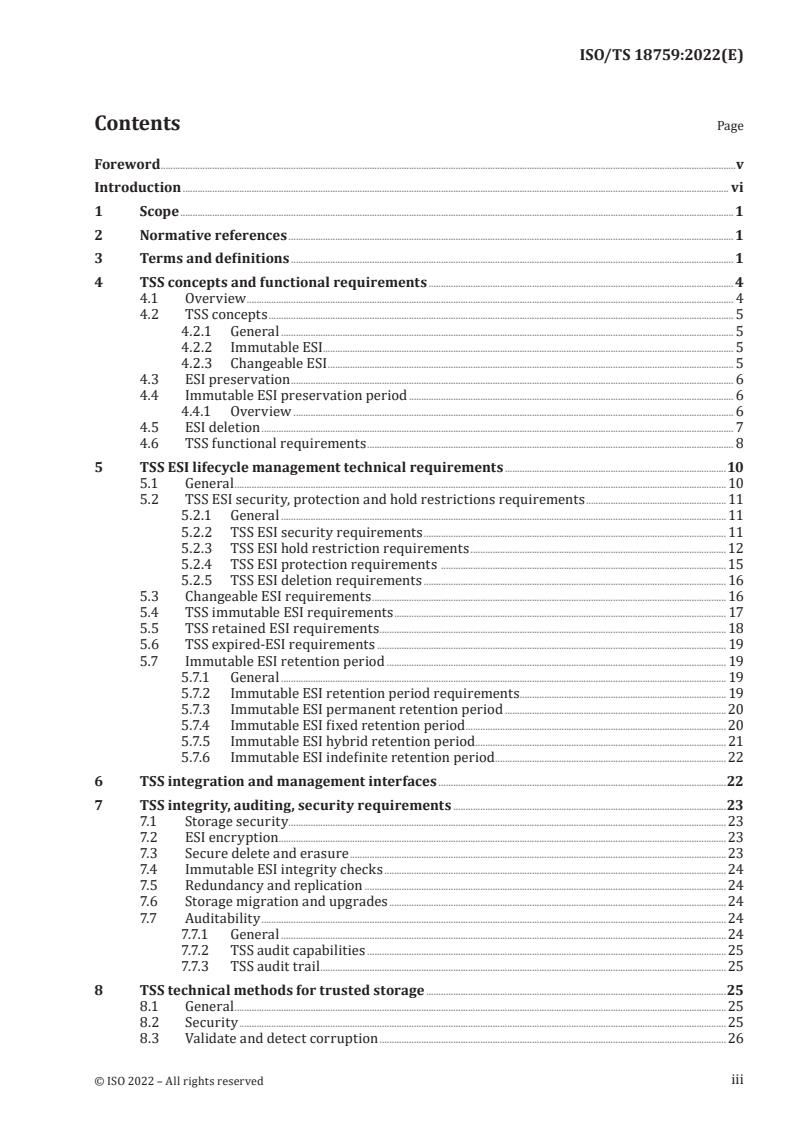
Contents Page
Foreword .v
Introduction . vi
1 S c op e . 1
2 Nor m at i ve r ef er enc e s . 1
3 Terms and definitions . 1
4 T SS concepts and functional requirements . 4
4 .1 O ver v iew . 4
4 . 2 T S S c onc ep t s . 5
4.2.1 General . 5
4.2.2 I mmutable ESI . . 5
4.2.3 C hangeable ESI . 5
4.3 E SI preservation . 6
4.4 I mmutable ESI preservation period . 6
4 .4 .1 O ver v iew . 6
4 . 5 E S I dele t ion . 7
4.6 T SS functional requirements . 8
5 TSS ESI lifecycle management technical requirements .10
5.1 G eneral . 10
5.2 T SS ESI security, protection and hold restrictions requirements . 11
5.2.1 G eneral . 11
5.2.2 TSS ESI security requirements . 11
5.2.3 TSS ESI hold restriction requirements .12
5.2.4 TSS ESI protection requirements . 15
5.2.5 TSS ESI deletion requirements . 16
5.3 C hangeable ESI requirements . 16
5.4 T SS immutable ESI requirements . 17
5.5 T SS retained ESI requirements . . 18
5.6 T SS expired-ESI requirements . 19
5.7 I mmutable ESI retention period . 19
5.7.1 General . 19
5.7.2 Immutable ESI retention period requirements. 19
5.7.3 I mmutable ESI permanent retention period . 20
5.7.4 Immutable ESI fixed retention period . 20
5.7.5 I mmutable ESI hybrid retention period . 21
5.7.6 I mmutable ESI indefinite retention period .22
6 TSS integration and management interfaces .22
7 TSS integrity, auditing, security requirements .23
7.1 S torage security . 23
7.2 E SI encryption . 23
7.3 S ecure delete and erasure .23
7.4 I mmutable ESI integrity checks . 24
7.5 R edundancy and replication . 24
7.6 S torage migration and upgrades . 24
7.7 A uditability . 24
7.7.1 General . 24
7.7.2 TSS audit capabilities .25
7.7.3 T SS audit trail . 25
8 T SS technical methods for trusted storage .25
8.1 General . 25
8.2 S ecurity . 25
8.3 V alidate and detect corruption . 26
iii
8.4 Ransomware protection .26
8 . 5 E r r or c or r e c t ion . 26
8.6 M onitoring, notifications and alerts . 26
8.7 Encryption . 27
8 . 8 Per m i s s ion s . 28
8.9 I ntegrity of storage devices and media .28
9 T SS requirements and mitigating technical methods .28
9.1 M igration of information between media .28
9.2 T echnical obsolescence .28
9.3 D iscovery requests .29
9.4 A ddressing ad hoc deletion requests .29
9.5 E SI degradation . 30
9.6 M alicious actions by employees or outside parties .30
9.7 E SI store errors .30
9.8 T SS hardware controls . 30
9.9 A ccidental or premature deletion of ESI . 31
Bibliography .32
iv
Foreword
ISO (the International Organization for Standardization) is a worldwide federation of national standards
bodies (ISO member bodies). The work of preparing International Standards is normally carried out
through ISO technical committees. Each member body interested in a subject for which a technical
committee has been established has the right to be represented on that committee. International
organizations, governmental and non-governmental, in liaison with ISO, also take part in the work.
ISO collaborates closely with the International Electrotechnical Commission (IEC) on all matters of
electrotechnical standardization.
The procedures used to develop this document and those intended for its further maintenance are
described in the ISO/IEC Directives, Part 1. In particular, the different approval criteria needed for the
different types of ISO documents should be noted. This document was drafted in accordance with the
editorial rules of the ISO/IEC Directives, Part 2 (see www.iso.org/directives).
Attention is drawn to the possibility that some of the elements of this document may be the subject of
patent rights. ISO shall not be held responsible for identifying any or all such patent rights. Details of
any patent rights identified during the development of the document will be in the Introduction and/or
on the ISO list of patent declarations received (see www.iso.org/patents).
Any trade name used in this document is information given for the convenience of users and does not
constitute an endorsement.
For an explanation of the voluntary nature of standards, the meaning of ISO specific terms and
expressions related to conformity assessment, as well as information about ISO's adherence to
the World Trade Organization (WTO) principles in the Technical Barriers to Trade (TBT), see
www.iso.org/iso/foreword.html.
This document was prepared by Technical Committee ISO/TC 171, Document management applications,
Subcommittee SC 2, Document file formats, EDMS systems and authenticity of information.
Any feedback or questions on this document should be directed to the user’s national standards body. A
complete listing of these bodies can be found at www.iso.org/members.html.
v
Introduction
The trustworthy storage system (TSS) provides a secure storage framework to preserve and
protect all types of electronically stored information (ESI) independent of the application and is not
intended to be limited to the use cases of content and records management applications. It provides
a unified tamper-resistant storage repository for the preservation and protection of ESI for various
environments. In a digital world where information is created, authored and captured electronically,
the TSS provides the vital security, protection and preservation of ESI against an ever-growing list of
evolving vulnerabilities including accidental and malicious acts, malware and ransomware as well as
operational and application errors.
Organizations designing and implementing information and content management systems
need guidance on how to select and implement a trustworthy storage system to safeguard the
trustworthiness, reliability, authenticity, integrity and immutability of ESI throughout its entire
lifecycle. A trusted system needs a TSS in order to maintain ESI trustworthiness ensuring chain of
custody, compliance with organizational mandates, legal and regulatory requirements and admissibility
standards, including enforcement of retention requirements and deletion-holds. The TSS also benefits
organizations that do not have a formal records programme or application, but are responsible for
protecting, managing and securing information for their organization.
Readers are advised to use this document taking into account their local jurisdictions and applicable
liabilities, paying special attention to legal, regulatory and other organizational requirements,
obligations and expectations.
vi
TECHNICAL SPECIFICATION ISO/TS 18759:2022(E)
Document management — Trustworthy storage system
(TSS) — Functional and technical requirements
1 S cope
This document specifies the functional, technology-neutral requirements for trustworthy storage
systems (TSS) that ensure storing and managing electronically stored information (ESI) in a protected
and secure fashion during the lifecycle of the information. The TSS as specified in this document is
storage technology neutral and accordingly does not specify any specific storage media types or
configurations.
This document is applicable to all information systems in which users and applications must manage
the protection, preservation and security of stored ESI throughout its entire lifecycle to meet
organizational and regulatory requirements to enforce:
— immutability, authenticity and trustworthiness of the stored ESI;
— protection of application managed ESI and other stored ESI against tampering, malicious acts and
ransomware;
— organizational ESI preservation and retention policies;
— protection for unstructured and unmanaged data.
2 Normat ive references
The following documents are referred to in the text in such a way that some or all of their content
constitutes requirements of this document. For dated references, only the edition cited applies. For
undated references, the latest edition of the referenced document (including any amendments) applies.
ISO 12651-1, Electronic document management — Vocabulary — Part 1: Electronic document imaging
ISO 13008, Information and documentation — Digital records conversion and migration process
ISO 14641, Electronic document management — Design and operation of an information system for the
preservation of electronic documents — Specifications
ISO 15489-1, Information and documentation — Records management — Part 1: Concepts and principles
ISO/TR 15801, Document management — Electronically stored information — Recommendations for
trustworthiness and reliability
ISO 18829, Document management — Assessing ECM/EDRM implementations — Trustworthiness
ISO/TR 22957, Document management — Analysis, selection and implementation of enterprise content
management (ECM) systems
3 Terms and definitions
For the purposes of this document, the terms and definitions given in ISO 12651-1, ISO 14641,
ISO 15489-1 and the following apply.
ISO and IEC maintain terminology databases for use in standardization at the following addresses:
— ISO Online browsing platform: available at https:// www .iso .org/ obp
— IEC Electropedia: available at https:// www .electropedia .org/
3.1
trusted system
information technology system with the capability of managing electronically stored information (ESI)
(3.2) in a trustworthy manner
Note 1 to entry: A trusted system demonstrates authenticity, integrity and availability of ESI over time.
3.2
electronically stored information
ESI
information created, used, edited, modified and stored in digital form
Note 1 to entry: Electronically stored information (ESI) includes documents and records (unstructured and
structured data) created or managed by the organization in the course of business and requiring a computer or
other device for access.
3.2.1
changeable electronically stored information
changeable ESI
writeable ESI
electronically stored information (ESI) (3.2) stored on a trustworthy storage system (TSS) without
any write-once immutable protection, allowing all changes to electronically stored information (ESI)
(contents, size, properties, attributes and checksums)
3.2.2
immutable electronically stored information
immutable ESI
electronically stored information (ESI) on a trustworthy storage system (TSS) with write-once
immutable protection that permanently prevents changes to ESI (contents, size, properties, attributes
and checksums)
3.2.3
immutable ESI preservation period
immutable ESI retention period
period that defines the length of time for which an immutable ESI (electronically stored information)
(3.2.2) in a trustworthy storage system (TSS) is to be preserved, prohibiting its deletion
3.2.4
retained ESI
preservation state of an immutable ESI (electronically stored information) (3.2.2) in a trustworthy
storage system (TSS) that has been assigned a preservation target expiration date and time, which has
not lapsed and is therefore ineligible for deletion
3.2.5
expired ESI
preservation state of an immutable ESI (electronically stored information) (3.2.2) in a trustworthy
storage system (TSS) that has been assigned a preservation target expiration date and time, which has
lapsed and expired and is therefore eligible for deletion
3.2.6
preservation expiration date and time
retention expiration date and time
preservation date and time that the immutable ESI (electronically stored information) (3.2.2) be retained
and preserved at a minimum prohibiting deletion
Note 1 to entry: The immutable ESI (electronically stored information) minimum retention expiration date and
time may be increased but can never be reduced.
3.2.7
preservation target expiration date and time
immutable ESI (electronically stored information) (3.2.2) in a trustworthy storage system (TSS) assigned
preservation target expiration date and time that is used by the TSS to determine eligibility for deletion
Note 1 to entry: The immutable ESI (3.2.2) is eligible for deletion any time after the assigned preservation target
expiration date and time has lapsed, provided that the immutable ESI (3.2.2) does not have a deletion hold (3.3).
The assigned preservation target expiration date and time can never be reduced.
Note 2 to entry: Alternatively, reference preservation target expiration date and time or retention period target
expiration date and time.
3.3
deletion-hold
trustworthy storage system (TSS) preventing the destruction of any specific electronically stored
information (ESI) within a TSS
3.4
access-hold
trustworthy storage system (TSS) preventing the access of any specific electronically stored
information (ESI) within a TSS
3.5
modification-hold
trustworthy storage system (TSS) preventing the modification of any specific changeable electronically
stored information within a TSS
3.6
application
system for collecting, saving, processing, and presenting data by means of a computer
[SOURCE: ISO/IEC/IEEE 24765:2017, 3.167, definition 1]
3.7
legal hold
litigation hold
operation that tags or otherwise cues special access management and destruction suspension for record
[electronically stored information (ESI)] entries deemed relevant, consistent with organization policy
under the legal doctrine of “duty to preserve”, also notifying records ESI owners and other designated
parties of the special data controls on access, retention, and destruction processes
Note 1 to entry: The Add Legal Hold Record ESI Lifecycle Event occurs when an agent causes the system to tag
or otherwise indicate special access management and suspension of ESI entry deletion or destruction, if deemed
relevant to a lawsuit or which are reasonably anticipated to be relevant to fulfil organizational policy under the
legal doctrine of “duty to preserve”.
[SOURCE: ISO/TS 21089:2018(en), 3.82, modified — added electronically stored information (ESI) to
the definition.]
3.8
ransomware
malicious software that infects computer systems, restricts access to the victim’s data and requires a
ransom
[SOURCE: ITU-T X.1215 (01/2019), 7.1]
4 T SS concepts and functional requirements
4.1 Overview
The trustworthy storage system (TSS) in conformity with the technical and functional requirements of
this document provides a storage environment capable of ensuring and maintaining the trustworthiness
and reliability of electronically stored information (ESI) throughout its lifecycle independent of the
application or the underlying storage technology. The primary purpose of a TSS is to protect and
preserve ESI in a manner that reliably ensures security, immutability, integrity and authenticity. The
TSS maintains and safeguards ESI against tampering and corruption in conformity with relevant
laws, regulations and business requirements as well as with international standards associated with
trustworthy storage environments (ISO/TR 15801, ISO/TR 22957, ISO 18829, ISO 14641, ISO 15489-1
and other related standards).
A TSS is the key component of any trusted environment that manages and maintains the trustworthiness
of ESI from creation to deletion. The TSS is designed to enforce provable immutability, integrity,
authenticity, retention, security, privacy, tamper-evident protection, enforcing destruction and access
holds. The TSS allows the deletion of TSS-stored ESI based on determining deletion eligibility.
Using a non-TSS platform leaves the ESI at risk since the integrity and viability of the entire lifecycle
of the ESI cannot be independently secured and protected with provable immutability. There are
fundamental limitations to the extent any individual component of a trusted environment can address
the requirements without employing the immutability protection and the deletion restrictions of a TSS.
Application-defined security controls are limited to the context of operations performed within the
internal components of the application. Modifications to application-managed ESI executed outside the
context of the application-defined security can jeopardize the trustworthiness of the entire solution.
In a non-TSS platform, any privileged user or privileged process may directly modify, encrypt or delete
application-managed ESI bypassing all the security provisions of the application-defined security.
Applications cannot prevent, prohibit, inhibit or detect any changes to application-managed ESI on non-
TSS storage.
For example, malicious users or malware can manipulate, corrupt or destroy the application-managed
ESI without the application’s knowledge by simply bypassing the application and modifying the
application-managed ESI on a non-TSS platform.
To compensate for the application-managed ESI security and protection, the operating system standard
access controls and permissions shall be used. Though deemed a necessity in the context of any trusted
environment, operating system enforced access controls and permissions are limited to enforcing
privileges without taking into consideration the status of the ESI and associated requirements of
a TSS. Without a TSS to protect and safeguard the trustworthiness of ESI, an authenticated process,
a privileged user, rogue administrator or anything executing in their context, whether ransomware,
malicious code, or any accidental act, can destroy, encrypt and modify any application-managed ESI.
In the age of ransomware, malicious and accidental acts, a TSS should be included when implementing
any trusted environment to ensure the trustworthiness of ESI and protection of its authenticity and
immutability against internal and external vulnerabilities and exploits that can compromise ESI in a
non-TSS or application-managed environment.
In many instances, an application can contain many different types of applications within it, or share
ESI with other applications and organizational entities, resulting in a complex schema of controls
on individual ESI. In such situations, the TSS provides an additional level of support to protect the
data beyond the individual controls of the relevant applications. This is important in a collaborative
environment where access can be granted from a variety of methods and from a variety of access roles.
Any application on its own cannot guarantee the authenticity or enforce the retention and deletion-
hold of application-managed ESI unless it is coupled with the TSS for immutable security, protection,
retention and deletion-hold enforcement. A TSS enables organizations to augment their applications
to provide end-to-end protection, preserving ESI integrity and authenticity, chain of custody and
immutability in compliance with governance and regulatory requirements. The combination of a TSS
with any application provides the end-to-end immutability, security and protection of ESI to prevent
external manipulation, eliminating potential exploits and circumventing any possible risks to integrity
and authenticity of the ESI from creation through deletion.
Organizations that implement a TSS should have a defined process to review and evaluate their ESI
before simply committing it to a TSS. Professional experts and analysis tools are available to assist
organizations in identifying the operational state and the appropriate retention policies. Not all
ESI is equal and the guidelines for protecting, preserving and destroying various types of ESI vary.
This document defines the functional requirements, taking into consideration that the underlying
implementations and technologies may differ between various solutions, that should be available to
deploy and use a TSS.
The nature of the ESI in a TSS, whether it is unstructured or structured ESI, is irrelevant to the
fundamental functional control defined within the TSS. The requirements identified in this document
focus on the features and capabilities of the TSS that support compliance with security, preservation
and retention requirements, independent of the source of the ESI or the applications used to access the
information.
4.2 TSS concepts
4.2.1 General
There is a clear line of delineation that shall be defined in terms of the functionality of the TSS and
how it collaborates with applications such as enterprise content management (ECM) and records
management. These applications provide context, reasoning, motives and justification. The principles
that govern the functionality of the TSS are simple and in many cases appear to be primitive in
contrast with the capabilities and context maintained by applications such as records and document
management applications. In the most simplistic concept, the TSS provides a trustworthy repository
that can allow ESI to be created, preserved and destroyed on demand.
The TSS creates a trusted storage environment capable of ensuring and maintaining the trustworthiness
and reliability of the ESI throughout its lifecycle independent of the application or the underlying
storage technology. As a common storage repository, the TSS may support the ability to store both
modifiable and unmodifiable ESI to enable organizations and their applications to maintain and manage
ESI without having to relocate, transfer or migrate the ESI throughout its lifecycle.
The TSS provides the ability to store and manage two distinct types of ESI.
4.2.2 Immutable ESI
At a minimum, the TSS provides the ability to store unmodifiable ESI on a TSS with write-once
immutable protection that permanently prevents changes to ESI (contents, size, properties, attributes
and checksums) for the duration of its existence in the TSS. The TSS also provides the ability to
safeguard the trustworthiness of ESI with provable immutability, integrity and authenticity that can
at some point be assigned retention expiration date and time. The support for the storage of immutable
ESI is a core requirement for any TSS.
4.2.3 Changeable ESI
Optionally, the TSS provides the ability to store generic modifiable ESI on a TSS without any write-once
immutable protection; allowing all changes to ESI (contents, size, properties, attributes and checksums)
for the duration of its existence in the TSS; subject to applicable TSS-defined hold restrictions for
modification, access and deletion. A changeable ESI is eligible to be preserved to become an immutable
ESI. The TSS may support the creation and management of changeable ESI to allow some organizations
to use a common trustworthy repository to manage the lifecycle of all ESI, eliminating the need to
migrate managed ESI between different repositories over its lifecycle. For such TSS environments
that support changeable ESI, the TSS provides additional controls to help manage and secure various
aspects of the changeable ESI lifecycle.
4.3 ESI preservation
The TSS has a basic core requirement to preserve ESI in an immutable and unmodifiable state and only
allow deletion if it expires. The TSS never allows a preserved immutable ESI to become a changeable or
modifiable ESI as shown in Figure 1.
Figure 1 — TSS immutable ESI preservation
From a TSS perspective, once ESI is preserved, it is immutable and can never be modified for the
remainder of its existence within the TSS. The only mechanism available to allow the preserved ESI to
be eligible for deletion is to expire the ESI. It is important to note that the TSS does not automatically
destroy or delete any ESI. The TSS only evaluates the eligibility of the deletion of the ESI when an
authorized and authenticated user or application triggers and attempts a delete operation against the
ESI.
4.4 Immutable ESI pr eservation period
4.4.1 Overview
The immutable ESI preservation period is an assigned period that defines the length of time for
which an immutable ESI in a TSS is to be preserved, during which the immutable ESI is ineligible for
deletion. This period is better known as the retention period which determines the immutable ESI
assigned preservation target expiration date and time. Modifications to this period are governed by the
restrictions associated with the immutable ESI assigned retention period type.
The TSS can allow a stored ESI to be marked as preserved, which renders the ESI unmodifiable as
immutable ESI, prohibiting all modifications to ESI contents and properties and only allowing deletion
once the TSS determines that the stored immutable ESI is expired. The immutable ESI expiration is
assigned by the authorized user and application or by TSS internal policies. The ESI preservation
expiration date and time are key components in enforcing the necessary protection and preservation
requirements that are mandated for stored immutable ESI; to ensure that it cannot be deleted or
destroyed unless expired.
The TSS can simply act as a slave to the application or the designated authorized user, manager
or administrator where it is told to preserve an ESI to prevent deletion. The TSS is only notified to
allow deletion once the immutable ESI is expired by the application or authorized user assigning a
preservation expiration date and time. This enables organizations to implement the ability to notify the
TSS when files are eligible for deletion only after the applicable retention period is satisfied. It enables
the organization to have more flexibility in managing changes to its retention policies.
The TSS is not intended to replace the functionality of ECM or records management applications, which
can determine and associate context, employ reasoning and invoke processes based on motives and
intent.
— The TSS cannot provide the level of context available through a records management or ECM
application and is not intended to derive such context either. The reason and motivation to preserve
any particular ESI as immutable ESI is not specifically known from the TSS perspective. The role
of the TSS is to preserve the integrity and authenticity and enforce immutability to prohibit all
modifications in a manner that safeguards the trustworthiness of stored ESI to address the
requirements of a trusted environment. The applications maintain context and manage the
relationship between individual ESI. The applications can determine the reasons and motives
behind the need to preserve any specific ESI as immutable ESI.
— The TSS is unaware of the motives and reasons why specific ESI is not eligible for deletion. At the TSS
level, it does not know whether there is one single reason or several. The reasons are determined
at the application level. The TSS is designed to prohibit deletion of immutable ESI until the TSS can
independently determine that an assigned preservation target expiration date and time has lapsed.
Any immutable ESI that has not been assigned a preservation target expiration date and time is not
be eligible for deletion. The immutable ESI assigned retention period controls when the immutable
ESI becomes eligible for destruction by an authorized and authenticated application or individual.
— The TSS immutable ESI retention period determines the target preservation (or retention) target
expiration date and time. The assigned retention expiration date and time can never be reduced but
can always be extended. In other words, from a TSS retention perspective, the assigned immutable
ESI retention expiration date and time denotes the retention period.
— The TSS immutable ESI retention may be assigned an indefinite-retention period where an
immutable ESI may be assigned an explicit retention period that determines the immutable ESI
retention expiration at a later date when triggered to do so. This allows organizations to designate
immutable ESI as permanent in the context of applications or processes while maintaining the
flexibility to expire on demand or assigning an explicit retention period to accommodate a change
in their record keeping policies.
— The TSS immutable ESI retention period may be governed by a hybrid retention period that
determines two parameters: the immutable retention expiration date and time and a maximum
retention expiration date and time. In other words, the assigned immutable ESI retention expiration
date and time sets a period of obligatory retention, while the maximum immutable ESI retention
expiration sets a “can keep until” period which is greater than the assigned retention expiration
date and time. This allows organizations to designate immutable ESI as permanent in the context
of applications or processes, while maintaining the flexibility to expire on demand by reducing the
maximum immutable ESI expiration or assigning an explicit retention period to accommodate a
change in their record keeping policies.
— The TSS immutable ESI retention period may assign a never expiration designation, making it
permanently retained and consequently never eligible for deletion and destruction.
— In all cases, the TSS immutable ESI retention enforcement control eligibility for destruction allows
organizations to address and conform to applicable rules, guidelines, regulations and mandates.
4.5 ESI deletion
The TSS supports the ability to delete ESI solely based on the ESI eligibility for the deletion. ESI deletion
is critical in a trustworthy environment and the TSS is responsible for independently determining the
eligibility of deletion of any specific ESI. This allows the TSS to be resilient, eliminating back doors and
other vulnerabilities that can otherwise be exploited in a non-TSS storage environment. In non-TSS
environments, user credentials and other application security measures can simply be bypassed or in
other instances user credentials and authentication may be compromised allowing ESI to be leaked,
encrypted, corrupted or hijacked. The TSS ability to independently validate deletion eligibility of any
ESI provides the failsafe scrutiny and security to prevent the destruction of TSS ESI.
TSS ESI deletion eligibility is governed by the status of the ESI, where immutable ESI is only eligible for
deletion if it is expired, and changeable ESI is by default eligible for deletion. To support the necessary
requirements of various organizational preservation mandates and hold requirements for records
management, ECM and other applications, the TSS provides support for deletion-holds that can prohibit
deletion of otherwise deletion eligible ESI.
The TSS shall not delete ESI, even if it was expired-ESI without any deletion-hold. The TSS role is always
to determine deletion eligibility based on evaluating the preservation status of the ESI and whether
there is a deletion-hold. The TSS either allows or denies the deletion request typically triggered by an
authorized and authenticated user or application.
The TSS provides a deletion-hold mechanism to prevent deletion of any TSS ESI. The deletion-hold
applies to both changeable and immutable ESI whose retention period had lapsed and is now expired.
— For expired ESI, this deletion-hold prevents deletion even though the expired ESI may be otherwise
eligible for deletion, without having to extend the retention expiration date and time.
— For changeable ESI, the deletion-hold can prevent and prohibit the deletion of the ESI indefinitely
until the deletion-hold is removed. This is ideal for environments where there is a need to share
changeable ESI in TSS with multiple applications.
In all situations, the TSS is unaware of the motives since that is outside the context of its knowledge
and influence. The applications internal processes and workflows along with the users, managers and
administrators can determine the reasons, motivation and justification for a deletion-hold. The TSS
only knows that it was told to apply the deletion-hold and enforce it accordingly.
4.6 T SS functional requirements
The TSS provides the necessary safeguards to support and enforce:
— records management immutability and retention concepts and principles as specified in ISO 15489-1;
— tamper-resistant storage and ESI preservation of the trusted system policies and procedures as
defined in ISO/TR 15801 and ISO/TR 22957;
— ESI lifecycle in ECM systems as specified in ISO 18829 and noted in ISO/TR 22957;
— the preservation, validation, authentication, auditability and security concepts and methodologies
identified in both ISO/TR 15801 and ISO/TR 22957;
— the provable immutability and authenticity, retention and deletion-hold, modification-holds, access-
holds, lifecycle management and tamper-evident protection and privacy of ESI throughout its
lifecycl
...
Questions, Comments and Discussion
Ask us and Technical Secretary will try to provide an answer. You can facilitate discussion about the standard in here.