


ISO 21806-3:2020
(Main)Road vehicles — Media Oriented Systems Transport (MOST) — Part 3: Application layer conformance test plan
Road vehicles — Media Oriented Systems Transport (MOST) — Part 3: Application layer conformance test plan
This document specifies the conformance test plan (CTP) for the application layer for MOST, a synchronous time-division-multiplexing network, as specified in ISO 21806-2. This document specifies conformance test cases (CTCs) in the following categories: — device model; — data and basic data types; — registry management; — connection management; — error management; — diagnosis. Interoperability testing is not in the scope of this document.
Véhicules routiers — Système de transport axé sur les médias — Partie 3: Plan d'essais de conformité de la couche d’application
General Information
- Status
- Published
- Publication Date
- 20-Oct-2020
- Technical Committee
- ISO/TC 22/SC 31 - Data communication
- Drafting Committee
- ISO/TC 22/SC 31/WG 3 - In-vehicle networks
- Current Stage
- 9093 - International Standard confirmed
- Start Date
- 27-May-2026
- Completion Date
- 30-May-2026
Buy Documents


ISO 21806-3:2020 - Road vehicles -- Media Oriented Systems Transport (MOST)
ISO 21806-3:2020 - Road vehicles — Media Oriented Systems Transport (MOST) — Part 3: Application layer conformance test plan/21/2020
Overview
ISO 21806-3:2020 specifies the conformance test plan (CTP) for the application layer of Media Oriented Systems Transport (MOST), a synchronous time-division-multiplexing (TDM) network used in automotive multimedia and infotainment systems. The document defines how to structure and execute conformance test cases (CTCs) that verify an implementation of the MOST application layer (as specified in ISO 21806-2) meets the standard’s functional and behavioural requirements. Interoperability testing is explicitly out of scope.
Key technical topics and requirements
ISO 21806-3 organizes and details conformance test cases across core application-layer areas:
- Device model - tests verifying the MOST function block (FBlock) model and device behaviour.
- Data and basic data types - validation of supported types and data handling at the application layer.
- Registry management - conformance of central registry operations (NetworkMaster/NetworkSlave) and registry-related CTCs (including InstID wildcard behaviour).
- Connection management - tests for establishing, maintaining and releasing application-layer connections and streaming resources.
- Error management - test cases for restart behaviour, reaction to network change events and other error scenarios.
- Diagnosis - tests and procedures for diagnostic information and testability (e.g., EnhancedTestability FBlock). Additional structural topics in the standard include test set-up, CTP organisation, timer and deadlock conventions, multi-node device handling, required procedures, and an annex on measurement uncertainty for individual CTCs.
Practical applications and benefits
- Provides a repeatable, standardised framework for conformance testing of MOST application-layer implementations used in automotive infotainment and multimedia devices.
- Enables test tool and test lab development by defining explicit conformance test cases (CTCs) and procedures.
- Helps OEMs and suppliers validate that devices implement MOST FBlocks, registry, connection and error handling correctly - reducing integration risk and time-to-market.
- Supports quality assurance for devices acting as sink/source nodes, power management roles (PowerMaster/PowerSlave), and network master/slave registry roles.
Who should use this standard
- Automotive OEMs and system integrators specifying MOST compliance requirements.
- Component and device suppliers developing MOST-enabled infotainment hardware and software.
- Independent test laboratories and tool vendors implementing conformance test suites.
- Certification bodies and quality teams responsible for compliance verification.
Related standards
- ISO 21806-1:2020 - General information and definitions for MOST
- ISO 21806-2:2020 - MOST application layer specification (normative for this CTP)
- ISO 21806-4:2020 - Transport and network layer for MOST
- ISO/IEC 9646-1:1994 - Conformance testing methodology and framework
Keywords: ISO 21806-3, MOST conformance test plan, Media Oriented Systems Transport, application layer testing, automotive infotainment, FBlock, registry management, conformance test cases.
Buy Documents
ISO 21806-3:2020 - Road vehicles -- Media Oriented Systems Transport (MOST)
ISO 21806-3:2020 - Road vehicles — Media Oriented Systems Transport (MOST) — Part 3: Application layer conformance test plan/21/2020
Get Certified
Connect with accredited certification bodies for this standard

TÜV Rheinland
TÜV Rheinland is a leading international provider of technical services.

TÜV SÜD
TÜV SÜD is a trusted partner of choice for safety, security and sustainability solutions.

DEKRA Certification Inc.
DEKRA US certification services.
Sponsored listings
Frequently Asked Questions
ISO 21806-3:2020 is a standard published by the International Organization for Standardization (ISO). Its full title is "Road vehicles — Media Oriented Systems Transport (MOST) — Part 3: Application layer conformance test plan". This standard covers: This document specifies the conformance test plan (CTP) for the application layer for MOST, a synchronous time-division-multiplexing network, as specified in ISO 21806-2. This document specifies conformance test cases (CTCs) in the following categories: — device model; — data and basic data types; — registry management; — connection management; — error management; — diagnosis. Interoperability testing is not in the scope of this document.
This document specifies the conformance test plan (CTP) for the application layer for MOST, a synchronous time-division-multiplexing network, as specified in ISO 21806-2. This document specifies conformance test cases (CTCs) in the following categories: — device model; — data and basic data types; — registry management; — connection management; — error management; — diagnosis. Interoperability testing is not in the scope of this document.
ISO 21806-3:2020 is classified under the following ICS (International Classification for Standards) categories: 43.040.15 - Car informatics. On board computer systems. The ICS classification helps identify the subject area and facilitates finding related standards.
ISO 21806-3:2020 is available in PDF format for immediate download after purchase. The document can be added to your cart and obtained through the secure checkout process. Digital delivery ensures instant access to the complete standard document.
Standards Content (Sample)
INTERNATIONAL ISO
STANDARD 21806-3
First edition
2020-10
Road vehicles — Media Oriented
Systems Transport (MOST) —
Part 3:
Application layer conformance test
plan
Véhicules routiers — Système de transport axé sur les médias —
Partie 3: Plan d'essais de conformité de la couche d’application
Reference number
©
ISO 2020
© ISO 2020
All rights reserved. Unless otherwise specified, or required in the context of its implementation, no part of this publication may
be reproduced or utilized otherwise in any form or by any means, electronic or mechanical, including photocopying, or posting
on the internet or an intranet, without prior written permission. Permission can be requested from either ISO at the address
below or ISO’s member body in the country of the requester.
ISO copyright office
CP 401 • Ch. de Blandonnet 8
CH-1214 Vernier, Geneva
Phone: +41 22 749 01 11
Email: copyright@iso.org
Website: www.iso.org
Published in Switzerland
ii © ISO 2020 – All rights reserved
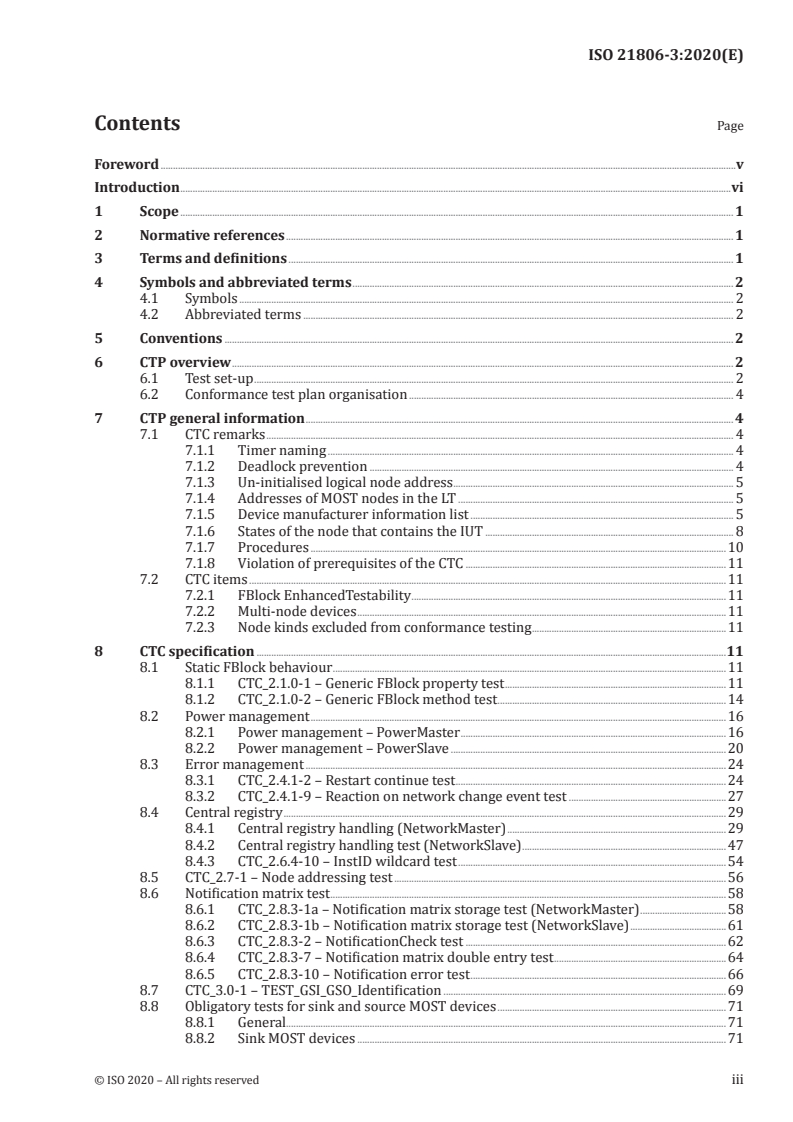
Contents Page
Foreword .v
Introduction .vi
1 Scope . 1
2 Normative references . 1
3 Terms and definitions . 1
4 Symbols and abbreviated terms . 2
4.1 Symbols . 2
4.2 Abbreviated terms . 2
5 Conventions . 2
6 CTP overview . 2
6.1 Test set-up . 2
6.2 Conformance test plan organisation . 4
7 CTP general information . 4
7.1 CTC remarks . 4
7.1.1 Timer naming . 4
7.1.2 Deadlock prevention . 4
7.1.3 Un-initialised logical node address . 5
7.1.4 Addresses of MOST nodes in the LT . 5
7.1.5 Device manufacturer information list . 5
7.1.6 States of the node that contains the IUT . 8
7.1.7 Procedures .10
7.1.8 Violation of prerequisites of the CTC .11
7.2 CTC items .11
7.2.1 FBlock EnhancedTestability .11
7.2.2 Multi-node devices .11
7.2.3 Node kinds excluded from conformance testing .11
8 CTC specification .11
8.1 Static FBlock behaviour .11
8.1.1 CTC_2.1.0-1 – Generic FBlock property test .11
8.1.2 CTC_2.1.0-2 – Generic FBlock method test .14
8.2 Power management .16
8.2.1 Power management – PowerMaster .16
8.2.2 Power management – PowerSlave .20
8.3 Error management .24
8.3.1 CTC_2.4.1-2 – Restart continue test .24
8.3.2 CTC_2.4.1-9 – Reaction on network change event test .27
8.4 Central registry .29
8.4.1 Central registry handling (NetworkMaster) .29
8.4.2 Central registry handling test (NetworkSlave) .47
8.4.3 CTC_2.6.4-10 – InstID wildcard test .54
8.5 CTC_2.7-1 – Node addressing test .56
8.6 Notification matrix test .58
8.6.1 CTC_2.8.3-1a – Notification matrix storage test (NetworkMaster) .58
8.6.2 CTC_2.8.3-1b – Notification matrix storage test (NetworkSlave) .61
8.6.3 CTC_2.8.3-2 – NotificationCheck test .62
8.6.4 CTC_2.8.3-7 – Notification matrix double entry test .64
8.6.5 CTC_2.8.3-10 – Notification error test .66
8.7 CTC_3.0-1 – TEST_GSI_GSO_Identification .69
8.8 Obligatory tests for sink and source MOST devices .71
8.8.1 General.71
8.8.2 Sink MOST devices .71
8.8.3 Source MOST devices .79
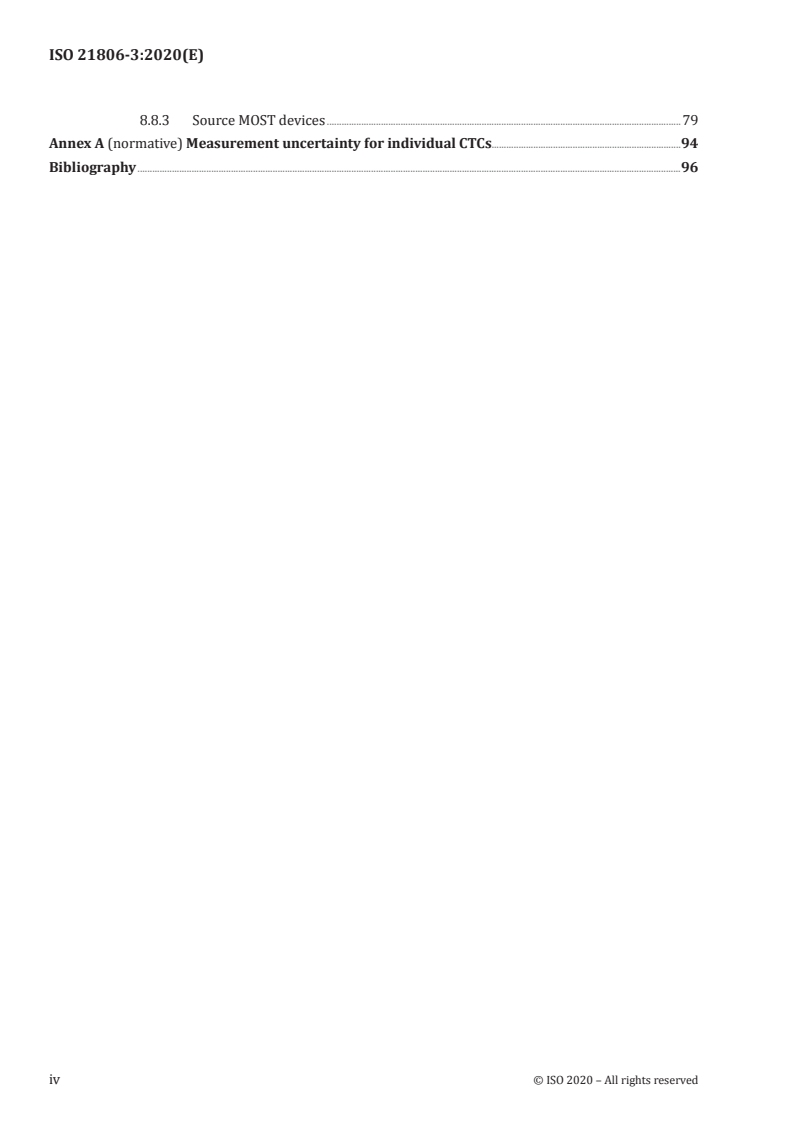
Annex A (normative) Measurement uncertainty for individual CTCs.94
Bibliography .96
iv © ISO 2020 – All rights reserved
Foreword
ISO (the International Organization for Standardization) is a worldwide federation of national standards
bodies (ISO member bodies). The work of preparing International Standards is normally carried out
through ISO technical committees. Each member body interested in a subject for which a technical
committee has been established has the right to be represented on that committee. International
organizations, governmental and non-governmental, in liaison with ISO, also take part in the work.
ISO collaborates closely with the International Electrotechnical Commission (IEC) on all matters of
electrotechnical standardization.
The procedures used to develop this document and those intended for its further maintenance are
described in the ISO/IEC Directives, Part 1. In particular, the different approval criteria needed for the
different types of ISO documents should be noted. This document was drafted in accordance with the
editorial rules of the ISO/IEC Directives, Part 2 (see www .iso .org/ directives).
Attention is drawn to the possibility that some of the elements of this document may be the subject of
patent rights. ISO shall not be held responsible for identifying any or all such patent rights. Details of
any patent rights identified during the development of the document will be in the Introduction and/or
on the ISO list of patent declarations received (see www .iso .org/ patents).
Any trade name used in this document is information given for the convenience of users and does not
constitute an endorsement.
For an explanation of the voluntary nature of standards, the meaning of ISO specific terms and
expressions related to conformity assessment, as well as information about ISO's adherence to the
World Trade Organization (WTO) principles in the Technical Barriers to Trade (TBT), see www .iso .org/
iso/ foreword .html.
This document was prepared by Technical Committee ISO/TC 22, Road vehicles, Subcommittee SC 31,
Data communication.
A list of all parts in the ISO 21806 series can be found on the ISO website.
Any feedback or questions on this document should be directed to the user’s national standards body. A
complete listing of these bodies can be found at www .iso .org/ members .html.
Introduction
The Media Oriented Systems Transport (MOST) communication technology was initially developed at
the end of the 1990s in order to support complex audio applications in cars. The MOST Cooperation was
founded in 1998 with the goal to develop and enable the technology for the automotive industry. Today,
1)
MOST enables the transport of high quality of service (QoS) audio and video together with packet data
and real-time control to support modern automotive multimedia and similar applications. MOST is a
function-oriented communication technology to network a variety of multimedia devices comprising
one or more MOST nodes.
Figure 1 shows a MOST network example.
Figure 1 — MOST network example
The MOST communication technology provides:
— synchronous and isochronous streaming,
— small overhead for administrative communication control,
— a functional and hierarchical system model,
— API standardization through a function block (FBlock) framework,
— free partitioning of functionality to real devices,
— service discovery and notification, and
[2]
— flexibly scalable automotive-ready Ethernet communication according to ISO/IEC/IEEE 8802-3 .
MOST is a synchronous time-division-multiplexing (TDM) network that transports different data types
on separate channels at low latency. MOST supports different bit rates and physical layers. The network
clock is provided with a continuous data signal. ®
1) MOST is the registered trademark of Microchip Technology Inc. This information is given for the convenience
of users of this document and does not constitute an endorsement by ISO.
vi © ISO 2020 – All rights reserved
Within the synchronous base data signal, the content of multiple streaming connections and control
data is transported. For streaming data connections, bandwidth is reserved to avoid interruptions,
collisions, or delays in the transport of the data stream.
MOST specifies mechanisms for sending anisochronous, packet-based data in addition to control data
and streaming data. The transmission of packet-based data is separated from the transmission of
control data and streaming data. None of them interfere with each other.
A MOST network consists of devices that are connected to one common control channel and packet
channel.
In summary, MOST is a network that has mechanisms to transport the various signals and data streams
that occur in multimedia and infotainment systems.
The ISO standards maintenance portal (https:// standards .iso .org/ iso/ ) provides references to MOST
specifications implemented in today's road vehicles because easy access via hyperlinks to these
specifications is necessary. It references documents that are normative or informative for the MOST
versions 4V0, 3V1, 3V0, and 2V5.
The ISO 21806 series has been established in order to specify requirements and recommendations
for implementing the MOST communication technology into multimedia devices and to provide
conformance test plans for implementing related test tools and test procedures.
To achieve this, the ISO 21806 series is based on the open systems interconnection (OSI) basic reference
[1] [3]
model in accordance with ISO/IEC 7498-1 and ISO/IEC 10731 , which structures communication
systems into seven layers as shown in Figure 2. Stream transmission applications use a direct stream
data interface (transparent) to the data link layer.
Figure 2 — The ISO 21806 series reference according to the OSI model
The International Organization for Standardization (ISO) draws attention to the fact that it is claimed
that compliance with this document may involve the use of a patent.
ISO takes no position concerning the evidence, validity and scope of this patent right.
The holder of this patent right has assured ISO that he/she is willing to negotiate licences under
reasonable and non-discriminatory terms and conditions with applicants throughout the world. In
this respect, the statement of the holder of this patent right is registered with ISO. Information may be
obtained from the patent database available at www .iso .org/ patents.
Attention is drawn to the possibility that some of the elements of this document may be the subject of
patent rights other than those in the patent database. ISO shall not be held responsible for identifying
any or all such patent rights.
viii © ISO 2020 – All rights reserved
INTERNATIONAL STANDARD ISO 21806-3:2020(E)
Road vehicles — Media Oriented Systems Transport
(MOST) —
Part 3:
Application layer conformance test plan
1 Scope
This document specifies the conformance test plan (CTP) for the application layer for MOST, a
synchronous time-division-multiplexing network, as specified in ISO 21806-2.
This document specifies conformance test cases (CTCs) in the following categories:
— device model;
— data and basic data types;
— registry management;
— connection management;
— error management;
— diagnosis.
Interoperability testing is not in the scope of this document.
2 Normative references
The following documents are referred to in the text in such a way that some or all of their content
constitutes requirements of this document. For dated references, only the edition cited applies. For
undated references, the latest edition of the referenced document (including any amendments) applies.
ISO/IEC 9646-1:1994, Information technology — Open Systems Interconnection — Conformance testing
methodology and framework — Part 1: General concepts
ISO 21806-1:2020, Road vehicles — Media Oriented Systems Transport (MOST) — Part 1: General
information and definitions
ISO 21806-2:2020, Road vehicles — Media Oriented Systems Transport (MOST) — Part 2: Application layer
ISO 21806-4:2020, Road vehicles — Media Oriented Systems Transport (MOST) — Part 4: Transport layer
and network layer
3 Terms and definitions
For the purposes of this document, the terms and definitions given in ISO 21806-1, ISO 21806-2,
ISO 21806-4, ISO/IEC 9646-1, and the following apply.
ISO and IEC maintain terminological databases for use in standardisation at the following addresses:
— ISO Online browsing platform: available at https:// www .iso .org/ obp
— IEC Electropedia: available at http:// www .electropedia .org/
3.1
REPEAT
pseudo code command for an iteration
3.2
REPEAT END
pseudo code command for ending an iteration
4 Symbols and abbreviated terms
4.1 Symbols
--- empty cell/undefined
4.2 Abbreviated terms
CTC conformance test case
CTP conformance test plan
CR central registry
DR decentral registry
IUT implementation under test
LT lower tester
MPI maximum position information
MSC Message Sequence Chart
NCE network change event
OSI Open Systems Interconnection
UT upper tester
5 Conventions
[3]
This document is based on OSI service conventions as specified in ISO/IEC 10731 and ISO/IEC 9646-1
for conformance test system set-up.
6 CTP overview
6.1 Test set-up
All CTCs are based on the same test set-up with an upper tester (UT) and a lower tester (LT). The LT
contains the lower tester pre-IUT (LT pre-IUT) and the lower tester post-IUT (LT post-IUT).
Figure 3 specifies the test set-up.
2 © ISO 2020 – All rights reserved
Figure 3 — Test set-up
The LT pre-IUT and the LT post-IUT implement the application layer services and the lower layer
services of a MOST node in accordance with the ISO 21806 series. They also contain a listen-only
node in front of the MOST node to log the whole communication. The MOST node is able to operate as
TimingMaster or TimingSlave; alternatively, it can be physically disconnected from the MOST network.
If it is disconnected, the associated LT pre-IUT or LT post-IUT serves as listen-only node.
Every CTC specifies the roles of the LT pre-IUT and the LT post-IUT.
During testing of the MOST device that implements the IUT, avoid over-temperature by following the
manufacturer recommendations regarding cooling.
The power supply of the MOST device that contains the IUT is adjustable and the power consumption
can be monitored by the UT. This is necessary to determine whether a node has entered s_
NetInterface_Sleep.
A MOST device contains one or more nodes, which are connected to an external MOST physical interface.
One of the nodes contains the implementation under test (IUT). All tests and timings, specified by the
CTP, are related to the external MOST physical interface.
Figure 4 shows a MOST device with one node and a MOST device with three internal nodes.
1 external MOST physical interface
2 internal MOST physical interface
Figure 4 — MOST device with one node and MOST device with three nodes
6.2 Conformance test plan organisation
CTCs are independent of one another. Each CTC checks the behaviour of the IUT for requirements stated
in ISO 21806-2. Within CTCs, which require variations of individual parameters, each specified value of
the parameter is iterated.
The measurement uncertainty for each CTC shall be in accordance with Annex A.
7 CTP general information
7.1 CTC remarks
7.1.1 Timer naming
For conformance testing of the IUT, the UT and LT need minimum and maximum timers. The names of
the timers used by this document are based on ISO 21806-2 and ISO 21806-4. To obtain the timer name,
for minimum and maximum, “ ” and “ ” are appended, respectively. Table 1 shows a timer naming
_min _max
definition example for t .
Config
Table 1 — Timer naming example
Name Minimum Typical value Maximum Unit Purpose
value name name value name
t t t t ms Time before ev_Init_Error_
Config Config_min Config Config_max
Shutdown or delay for RBD result.
7.1.2 Deadlock prevention
This document specifies the timeouts t , t , and t to prevent deadlock
DeadLockShort DeadLockMid DeadLockLong
situations during conformance testing. These are the default values:
— t : 1 s;
DeadLockShort
— t : 20 s;
DeadLockMid
— t : 5 min.
DeadLockLong
These timeouts are only relevant for conformance testing and may be extended.
4 © ISO 2020 – All rights reserved
7.1.3 Un-initialised logical node address
The variable uninitialised_node_address is defined as the address of an un-initialised node, which is
specified in ISO 21806-2.
7.1.4 Addresses of MOST nodes in the LT
The address of a MOST node in the LT is the default logical node address corresponding to the node
position.
If this address is in conflict with the address of a node that contains the IUT (e.g. if a supplier uses
static addresses in the dynamic address range), the affected MOST node in the LT shall use a valid free
address.
7.1.5 Device manufacturer information list
This list contains all information that is provided by the device manufacturer for conformance testing.
It also includes remarks and references to corresponding CTCs.
Table 2 shows the device manufacturer information list, which does not include information stored in
FBlock EnhancedTestability.
Table 2 — Device manufacturer information list
Category Item/property Description Reference
to CTC
MOST network IUT in the TimingMaster Determines whether the IUT is part of the All CTCs
configuration TimingMaster.
IUT in the NetworkMaster Determines whether the IUT is part of the All CTCs
NetworkMaster.
IUT in the PowerMaster Determines whether the IUT is part of the All CTCs
PowerMaster.
IUT in the connection --- CTC_3.1-3,
manager CTC_3.1-4,
CTC_3.1-5,
CTC_3.1-6,
CTC_3.2-3,
CTC_3.2-4,
CTC_3.2-5,
CTC_3.2-6,
CTC_3.2-7,
CTC_3.2-8,
CTC_3.2-9,
CTC_3.2-14
Multi-node device If the IUT is part of a MOST device that contains more All CTCs
than one node, the following information is provided:
— number of nodes in the MOST device;
— topology of the MOST device (position
of PowerMaster and TimingMaster/
NetworkMaster);
— position of the node that contains the IUT.
IUT sample frequency If the IUT is not part of the TimingMaster, the LT All CTCs
provides the correct network frame rate (44,1 kHz or
48,0 kHz).
Required value of boundary Value of the boundary descriptor. All CTCs
descriptor (if the
Unless otherwise stated, all CTCs are performed with
TimingMaster is in the LT)
this value of the boundary descriptor.
mi The maximum number of permitted conflicting node CTC_2.6.2-3a
MaxInvalidReg
address registrations by a NetworkSlave.
mi When an invalid InstID registration occurs, the CTC_2.6.2-6
MaxSetNewInstID
NetworkMaster sends a request to the NetworkSlave
for setting a new InstID.
t Time before ev_Init_Error_Shutdown or delay for CTC_2.1.1-6b
Config_max
RBD result.
t Limit for the NetworkMaster to set the central CTC_2.6.2-4a,
ConfigurationAnnounce
registry state. CTC_2.6.2-5
t Time the NetworkMaster waits for all NetworkSlaves CTC_2.6.2-1,
WaitForAnswer_min
to respond. CTC_2.6.2-3b,
t
WaitForAnswer_max
CTC_2.6.2-5
6 © ISO 2020 – All rights reserved
Table 2 (continued)
Category Item/property Description Reference
to CTC
Power Node that contains the IUT Determines whether the node that contains the IUT CTC_2.3.2-3
management supports supports s_NetInterface_Sleep:
s_NetInterface_Sleep
— yes: the MOST device that contains the IUT
reduces its power consumption below threshold
before timeout expires;
— no: the reduction of power consumption is not
detectable.
s_NetInterface_Sleep: Threshold of current for s_NetInterface_Sleep See 7.1.6.
detection
I
NetInterfaceSleep_Threshold
s_NetInterface_Sleep: t CTC_2.3.2-3,
PwrSwitchOffDelay_min
CTC_2.6.4-1
t Specific timeout for s_NetInterface_Sleep; after
PwrSwitchOffDelay_min
the end of network activity, the node that contains
t
PwrSwitchOffDelay_max
the IUT does not enter s_NetInterface_Sleep
(reduced power consumption) before t
PwrSwitchOffDelay_
expires.
min
t
PwrSwitchOffDelay_max
MOST device specific timeout for s_NetInterface_
Sleep; after the end of network activity, the node
that contains the IUT enters s_NetInterface_
Sleep (reduced power consumption) before
t expires.
PwrSwitchOffDelay_max
Wake-up preconditions Preconditions for the node that contains the IUT for See 7.1.6.
wake-up.
Supplemented by information whether the node that
contains the IUT needs additional conditions during
operation (e.g. ignition ON) to stay in
s_NetInterface_Normal_Operation.
Node that contains the IUT is --- CTC_2.4.1-2
capable of waking via network
startup (i.e. switching on its
MOST output)
Delay between connection to Potentially, the UT (see Figure 3) waits for a short All CTCs
power (of the MOST device period of time between connecting the MOST device
that contains the IUT) and that contains the IUT to power and switching on the
the ability of the node that MOST output to wake up the node that contains the
contains the IUT to detect IUT. Otherwise, the node that contains the IUT does
wake-up events not detect a wake-up event.
s_NetInterface_Normal_
This delay covers: See 7.1.6.
Operation:
— NetworkMaster: period of time the node that
CTC_2.6.2-3b
Delay until all FBlocks of contains the IUT needs to add own FBlocks to
the node that contains its central registry after Configuration.
Status(OK);
the IUT are available
after Configuration.
Status(OK) — NetworkSlave: delay between
ev_Init_Ready and availability of application.
(equivalent to t )
WaitForApplication
t Specific limit for the NetworkMaster to start an CTC_2.4.1-9,
WaitBeforeScan
FBlock scan. CTC_2.6.2-5,
CTC_2.6.4-8
Table 2 (continued)
Category Item/property Description Reference
to CTC
Addressing Node that contains the IUT If the node that contains the IUT uses a static logical See 7.1.6.
uses static node address in node address that is in the specified dynamic address
CTC_2.6.4-4
dynamic address range range, the address is provided.
Free address Logical node address that may be used by a MOST CTC_2.6.4-3
node in the LT during testing.
Free FBlock range FBlocks that are not used by the node that contains CTC_2.6.2-4b,
the IUT and which may be used by the UT. CTC_2.6.2-4c
Group address of the node that --- CTC_2.7-1
contains the IUT
General t
Limit for responding to a command that reads a CTC_2.1.0-1,
Property
communication property. CTC_2.1.0-2,
CTC_2.8.3-2,
CTC_2.8.4-3,
CTC_3.0-1,
CTC_3.1-1,
CTC_3.2-1
t Limit for reacting to a Notification.Set message. CTC_2.8.3-1a,
NotificationProperty
CTC_2.8.3-1b,
CTC_2.8.3-7
Physical U At this voltage level, the MOST device that contains All CTCs
IUT_Operating
parameter the IUT operates normally.
(voltage levels)
Unless otherwise stated, all CTCs are performed at
this voltage level.
Messaging Node that contains the IUT The node that contains the IUT is able to send and CTC_2.8.4-2,
supports segmented messages receive segmented messages. CTC_2.8.4-3,
CTC_2.8.4-7,
CTC_2.8.4-8
Sink/Source List of FBlocks, containing sink The list contains all FBlocks reported by NetBlock. CTC_3.0-1
and/or source FBlockIDs.Status.
functionality
MOST devices with sinks: --- CTC_3.1-1,
CTC_3.1-3,
List of all supported sink
CTC_3.1-4,
numbers with ContentType,
CTC_3.1-5,
ContentDescription (data
CTC_3.1-6
type of the parameter) and
TransmissionClass
MOST devices with sources: --- CTC_3.2-1,
CTC_3.2-3,
List of all supported source
CTC_3.2-4,
numbers with ContentType,
CTC_3.2-5,
ContentDescription (data
CTC_3.2-6,
type of the parameter) and
CTC_3.2-7,
TransmissionClass
CTC_3.2-14
MOST devices with sources: --- CTC_3.2-3
BlockWidth and
ConnectionLabel
Node that contains the IUT --- CTC_3.2-14
supports SourceActivity
7.1.6 States of the node that contains the IUT
Table 3 specifies how the NetInterface state s_NetInterface_Normal_Operation is effectuated and
detected in the node that contains the IUT.
8 © ISO 2020 – All rights reserved
Table 3 — Effectuate and detect s_NetInterface_Normal_Operation
Effectuate state Detect state
a) The IUT is contained in a NetworkSlave: a) The IUT is contained in a NetworkSlave:
the node that contains the IUT responds to
— the UT shall start the network;
NetBlock.FBlockIDs.Get.
— wait for the node that contains the IUT to open its bypass
a
(MPI is nominal );
— send
NetworkMaster.Configuration.Status(NotOK);
— perform an FBlock scan (including retries if the address of
the node that contains the IUT is invalid);
— send NetworkMaster.Configuration.Status(OK);
— wait for t .
WaitForApplication
b) The IUT is contained in the NetworkMaster: b) The IUT is contained in the NetworkMaster:
the node that contains the IUT responds to
— the UT shall behave like a NetworkSlave; it shall process and
NetBlock.FBlockIDs.Get.
respond to all requests from the node that contains the IUT
so that the node can enter central registry state OK;
— the UT shall respond to an FBlock scan by the node that
contains the IUT; additionally, the UT shall wait for the node
a
to open its bypass (MPI is nominal ) if the node is part of a
multi-node device;
— finally, the UT shall wait for t .
WaitForApplication
a
The nominal MPI is the total number of nodes in the set-up, based on the IUT manufacturer information and the test equipment.
Table 4 specifies how the NetInterface state s_NetInterface_Sleep is effectuated and detected in the
node that contains the IUT.
Table 4 — Effectuate and detect s_NetInterface_Sleep state
Effectuate state Detect state
Switch off MOST output a) When s_NetInterface_Sleep is detectable the following applies:
— when monitoring power consumption, the current reaches or
drops below I ;
NetInterfaceSleep_Threshold
— if the LT detects network activity when t
PwrSwitchOffDelay_max
expires, the test shall be stopped; the timer shall be started as soon
as the node that contains the IUT switches off the MOST output;
— if the current does not reach or drop below
I within timeout t , the
NetInterfaceSleep_Threshold PwrSwitchOffDelay_max
test shall be stopped.
b) When s_NetInterface_Sleep is not detectable the following
applies:
— when the timeout t expires and if the LT does
PwrSwitchOffDelay_max
not detect network activity, it shall be assumed that the node that
contains the IUT is in s_NetInterface_Sleep, independent of
power consumption;
— if the LT detects network activity when t
PwrSwitchOffDelay_max
expires, the test shall be stopped.
Table 5 specifies how the NetInterface state s_NetInterface_Off is effectuated and detected in the
node that contains the IUT.
Table 5 — Effectuate and detect s_NetInterface_Off state
Effectuate state Detect state
The LT shall switch off the MOST No network activity
output.
7.1.7 Procedures
Table 6 specifies the procedures of the LT.
Table 6 — Procedures of the LT
Purpose Description
Perform wake-up a) If the LT contains the TimingMaster, it shall execute this sequence to perform a
wake-up:
1. switch on the MOST output;
2. wait for network activity (timeout t );
DeadLockShort
3. wait for stable lock (timeout t ).
DeadLockMid
b) If the LT does not contain the TimingMaster, it shall execute this sequence to
perform a wake-up:
1. generate a wake-up event;
2. wait for network activity;
3. switch on the MOST output;
4. wait for stable lock;
5. wait for the lock flag to evaluate to true.
If the LT does not generate a wake-up event and detects network activity, it shall switch
on the MOST output.
In some cases, the node that contains the IUT needs some preconditions for wake-up.
These preconditions are established before testing is started. The preconditions depend
on the device manufacturer.
If EnhancedTestability.AutoWakeup is triggered, the node that contains the IUT does
not enter s_NetInterface_Sleep before creating the corresponding wake-up event.
The node enters s_NetInterface_Off. This state is not detectable by monitoring the
power consumption of the MOST device that contains the IUT. With entering state s_
NetInterface_Off, the node that contains the IUT switches off the MOST output.
Perform shutdown a) If the IUT is part of the PowerMaster, the LT shall execute this sequence to perform
shutdown:
— trigger shutdown by means of FBlock EnhancedTestability;
— if no network activity is detected, the node that contains the IUT has performed
shutdown;
— if t expires after triggering shutdown and the LT still detects network
DeadLockMid
activity, it shall switch off the MOST output.
b) If the IUT is part of a PowerSlave, the LT shall switch off the MOST output to perform
shutdown.
c) If the IUT is part of the PowerMaster, no preconditions are established that prevent
the node that contains the IUT from performing shutdown.
Generate unlock To generate an unlock event of predictable duration, the LT
10 © ISO 2020 – All rights reserved
Table 6 (continued)
Purpose Description
— shall invalidate or delay the preamble at the beginning of at least every third network
frame during the period of unlock (see ISO 21806-6), and
— shall avoid a PLL unlock.
Network change The NCE shall be generated between the TimingMaster and the node that contains the IUT.
event with unlock
Network change The NCE shall be generated between the node that contains the IUT and the TimingMaster.
event without unlock
7.1.8 Violation of prerequisites of the CTC
If the node that contains the IUT does not meet the prerequisites of the CTC (such as network activity,
lock, FBlock scan performed, central registry state OK), the CTC results in "IUT not ok: The IUT does
not meet the prerequisites".
7.2 CTC items
7.2.1 FBlock EnhancedTestability
The FBlock EnhancedTestability is used to trigger sequences that are specified in the CTC.
These are normally triggered by a project specific, sometimes complicated, mechanism. FBlock
EnhancedTestability implements neither notification nor processing messages. The UT shall initialise
FBlock EnhancedTestability every time the s_NetInterface_Normal_Operation state is reached. The
FBlock is only available during s_NetInterface_Normal_Operation. All properties are reset to their
default state when entering s_NetInterface_Normal_Operation, unless otherwise stated. The functions
in this FBlock describe a general interface for starting functionality partly implemented in the
application, partly in the MOST network service. If an application callback returns wrong or unexpected
values, the FBlock sends an error message with ErrorCode 0B (device malfunction).
If the FBlock EnhancedTestability returns errors, the corresponding CTC result is indicated as “IUT
not ok”.
7.2.2 Multi-node devices
A multi-node device is a MOST device with an external MOST physical interface, which is connected to
more than one internal node.
When dealing with devices with several external MOST physical interfaces, each interface shall be
treated as a separate IUT. One of those interfaces may belong to a multi-node device. In a multi-node
device, each node shall be treated individually.
NOTE A MOST device passes conformance testing successfully if all contained IUTs pass all relevant CTCs.
7.2.3 Node kinds excluded from conformance testing
CTCs for remote controlled nodes according to ISO 21806-2 are not in the scope of this document.
8 CTC specification
8.1 Static FBlock behaviour
8.1.1 CTC_2.1.0-1 – Generic FBlock property test
Table 7 specifies the CTC_2.1.0-1 - Generic FBlock property test.
Table 7 — CTC_2.1.0-1 - Generic FBlock property test
Item Content
CTC # – Title CTC_2.1.0-1 - Generic FBlock property test
Purpose This CTC verifies that FBlock communication with properties of the NetBlock, the Network-
Master, sinks, and sources is possible.
This CTC applies to all MOST devices.
Reference ISO 21806-2:2020, 7.6 AL – Operation type (OPType)
Prerequisite The UT shall effectuate s_NetInterface_Normal_Operation in the node that contains the IUT.
Set-up — If the IUT is part of a MOST device that contains the TimingMaster, the LT pre-IUT shall be
a TimingSlave.
— If the IUT is part of a MOST device that does not contain the TimingMaster, the LT pre-IUT
shall be the TimingMaster.
— The LT post-IUT shall be a listen-only node.
Step 1. The UT shall set the FBlockID and InstID to the values of the current test iteration.
2. The UT, using the LT pre-IUT, shall send FBlockID.InstID.FktIDs.Get to the IUT to
retrieve the list of implemented functions of the IUT.
3. The UT, in an outer loop, shall loop through the FktIDs that were returned in the list and
correspond to properties.
4. The UT, in an inner loop, shall loop through the OPTypes (0 to F ).
16 16
5. UT: for every iteration of the loop, the UT, using the LT pre-IUT, shall send FBlockID.
InstID.FktID.OPType to the IUT.
6. The UT shall evaluate the response of the IUT as specified in Table 8.
7. The UT shall shut down the IUT and re-establish the prerequisites for the next test
iteration, after processing all inner and outer loop iterations.
Iteration REPEAT Step 1 to Step 7 with the NetBlock and every available InstID (obtained by
NetBlock.FBlockIDs) of the following FBlocks of the
— IUT: NetworkMaster;
— IUT: FBlocks containing sink functions (identified by CTC TEST_GSI_GSO_identification);
— IUT: FBlocks containing source functions (identified by CTC TEST_GSI_GSO_identification).
REPEAT END.
Expected Step 6: IUT ok: the IUT provides permitted responses as specified in Table 8.
response
Step 6: IUT not ok: the IUT does not respond as expected to the requests to properties.
12 © ISO 2020 – All rights reserved
Table 7 (continued)
Item Content
Remark 1. Responses are only evaluated from actually tested FBlockID, InstID and FktID.
2. Any other message of the node that contains the IUT is ignored during the CTC.
3. The FBlock library determines whether the function is a property or a method.
4. Usually, a MOST device does not implement all functions and OPTypes of the FBlock library;
if implemented, they are expected to behave according to the FBlock library.
5. No range checks are performed.
6. In the case that the OPType test allows “no answer” as permitted response, the observation
time period is 2 × t for properties respectively t for methods.
Property DeadLockMid
7. For the NetBlock, error 03 (function not available) is also a permitted response.
8. All commands (OPType 0 to 8 ) from the node that contains the IUT are ignored for all
16 16
FBlocks.
9. For the NetBlock and the NetworkMaster FBlock, OPTypes 9 to F are not tested.
16 16
Table 8 specifies the OPTypes for CTC_2.1.0-1 - Generic FBlock property test.
Table 8 — OPTypes for CTC_2.1.0-1 - Generic FBlock property test
OPType OPType name and parameters Permitted response
Set — Status;
(without parameter)
— No answer (within 2 × t );
Property
— All errors except 01 , 02 , 03 , 0A , 0C .
16 16 16 16 16
Get — Status;
(without parameter)
— All errors except 01 , 02 , 03 , 0A , 0C .
16 16 16 16 16
SetGet — Status;
(without parameter)
— All errors except 01 , 02 , 03 , 0A , 0C .
16 16 16 16 16
Increment(1) — Status;
— All errors except 01 , 02 , 03 , 0A , 0C .
16 16 16 16 16
Decrement(1) — Status;
— All errors except 01 , 02 , 03 , 0A , 0C .
16 16 16 16 16
16 Not allowed Not allowed
StartResultAck — ErrorAck(SenderHandle 1234 , ErrorCode 04 );
16 16
(SenderHandle 1234 )
— Error(ErrorCode 04 ).
AbortAck — ErrorAck(SenderHandle 1234 , ErrorCode 04 );
16 16
(SenderHandle 1234 )
— Error(ErrorCode 04 ).
StartAck — ErrorAck(SenderHandle 1234 , ErrorCode 04 );
16 16
(SenderHandle 1234 )
— Error(ErrorCode 04 ).
9 ErrorAck
No answer
A ProcessingAck
No answer
B Processing
No answer
C Status
No answer
Table 8 (continued)
OPType OPType name and parameters Permitted response
D ResultAck
No answer
E
Not allowed Not allowed
F Error
No answer
8.1.2 CTC_2.1.0-2 – Generic FBlock method test
Table 9 specifies the CTC_2.1.0-2 - Generic FBlock method test.
Table 9 — CTC_2.1.0-2 - Generic FBlock method test
Item Content
CTC # – Title CTC_2.1.0-2 - Generic FBlock method test
Purpose This CTC verifies that FBlock communication with methods of the NetBlock, the
NetworkMaster, sinks, and sources is possible.
This CTC applies to all MOST devices.
Reference ISO 21806-2:2020, 7.6 AL – Operation type (OPType)
Prerequisite The UT shall effectuate s_NetInterface_Normal_Operation in the node that contains the IUT.
Set-up — If the IUT is part of a MOST device that contain
...
INTERNATIONAL ISO
STANDARD 21806-3
First edition
2020-10
Road vehicles — Media Oriented
Systems Transport (MOST) —
Part 3:
Application layer conformance test
plan
Véhicules routiers — Système de transport axé sur les médias —
Partie 3: Plan d'essais de conformité de la couche d’application
Reference number
©
ISO 2020
© ISO 2020
All rights reserved. Unless otherwise specified, or required in the context of its implementation, no part of this publication may
be reproduced or utilized otherwise in any form or by any means, electronic or mechanical, including photocopying, or posting
on the internet or an intranet, without prior written permission. Permission can be requested from either ISO at the address
below or ISO’s member body in the country of the requester.
ISO copyright office
CP 401 • Ch. de Blandonnet 8
CH-1214 Vernier, Geneva
Phone: +41 22 749 01 11
Email: copyright@iso.org
Website: www.iso.org
Published in Switzerland
ii © ISO 2020 – All rights reserved
Contents Page
Foreword .v
Introduction .vi
1 Scope . 1
2 Normative references . 1
3 Terms and definitions . 1
4 Symbols and abbreviated terms . 2
4.1 Symbols . 2
4.2 Abbreviated terms . 2
5 Conventions . 2
6 CTP overview . 2
6.1 Test set-up . 2
6.2 Conformance test plan organisation . 4
7 CTP general information . 4
7.1 CTC remarks . 4
7.1.1 Timer naming . 4
7.1.2 Deadlock prevention . 4
7.1.3 Un-initialised logical node address . 5
7.1.4 Addresses of MOST nodes in the LT . 5
7.1.5 Device manufacturer information list . 5
7.1.6 States of the node that contains the IUT . 8
7.1.7 Procedures .10
7.1.8 Violation of prerequisites of the CTC .11
7.2 CTC items .11
7.2.1 FBlock EnhancedTestability .11
7.2.2 Multi-node devices .11
7.2.3 Node kinds excluded from conformance testing .11
8 CTC specification .11
8.1 Static FBlock behaviour .11
8.1.1 CTC_2.1.0-1 – Generic FBlock property test .11
8.1.2 CTC_2.1.0-2 – Generic FBlock method test .14
8.2 Power management .16
8.2.1 Power management – PowerMaster .16
8.2.2 Power management – PowerSlave .20
8.3 Error management .24
8.3.1 CTC_2.4.1-2 – Restart continue test .24
8.3.2 CTC_2.4.1-9 – Reaction on network change event test .27
8.4 Central registry .29
8.4.1 Central registry handling (NetworkMaster) .29
8.4.2 Central registry handling test (NetworkSlave) .47
8.4.3 CTC_2.6.4-10 – InstID wildcard test .54
8.5 CTC_2.7-1 – Node addressing test .56
8.6 Notification matrix test .58
8.6.1 CTC_2.8.3-1a – Notification matrix storage test (NetworkMaster) .58
8.6.2 CTC_2.8.3-1b – Notification matrix storage test (NetworkSlave) .61
8.6.3 CTC_2.8.3-2 – NotificationCheck test .62
8.6.4 CTC_2.8.3-7 – Notification matrix double entry test .64
8.6.5 CTC_2.8.3-10 – Notification error test .66
8.7 CTC_3.0-1 – TEST_GSI_GSO_Identification .69
8.8 Obligatory tests for sink and source MOST devices .71
8.8.1 General.71
8.8.2 Sink MOST devices .71
8.8.3 Source MOST devices .79
Annex A (normative) Measurement uncertainty for individual CTCs.94
Bibliography .96
iv © ISO 2020 – All rights reserved
Foreword
ISO (the International Organization for Standardization) is a worldwide federation of national standards
bodies (ISO member bodies). The work of preparing International Standards is normally carried out
through ISO technical committees. Each member body interested in a subject for which a technical
committee has been established has the right to be represented on that committee. International
organizations, governmental and non-governmental, in liaison with ISO, also take part in the work.
ISO collaborates closely with the International Electrotechnical Commission (IEC) on all matters of
electrotechnical standardization.
The procedures used to develop this document and those intended for its further maintenance are
described in the ISO/IEC Directives, Part 1. In particular, the different approval criteria needed for the
different types of ISO documents should be noted. This document was drafted in accordance with the
editorial rules of the ISO/IEC Directives, Part 2 (see www .iso .org/ directives).
Attention is drawn to the possibility that some of the elements of this document may be the subject of
patent rights. ISO shall not be held responsible for identifying any or all such patent rights. Details of
any patent rights identified during the development of the document will be in the Introduction and/or
on the ISO list of patent declarations received (see www .iso .org/ patents).
Any trade name used in this document is information given for the convenience of users and does not
constitute an endorsement.
For an explanation of the voluntary nature of standards, the meaning of ISO specific terms and
expressions related to conformity assessment, as well as information about ISO's adherence to the
World Trade Organization (WTO) principles in the Technical Barriers to Trade (TBT), see www .iso .org/
iso/ foreword .html.
This document was prepared by Technical Committee ISO/TC 22, Road vehicles, Subcommittee SC 31,
Data communication.
A list of all parts in the ISO 21806 series can be found on the ISO website.
Any feedback or questions on this document should be directed to the user’s national standards body. A
complete listing of these bodies can be found at www .iso .org/ members .html.
Introduction
The Media Oriented Systems Transport (MOST) communication technology was initially developed at
the end of the 1990s in order to support complex audio applications in cars. The MOST Cooperation was
founded in 1998 with the goal to develop and enable the technology for the automotive industry. Today,
1)
MOST enables the transport of high quality of service (QoS) audio and video together with packet data
and real-time control to support modern automotive multimedia and similar applications. MOST is a
function-oriented communication technology to network a variety of multimedia devices comprising
one or more MOST nodes.
Figure 1 shows a MOST network example.
Figure 1 — MOST network example
The MOST communication technology provides:
— synchronous and isochronous streaming,
— small overhead for administrative communication control,
— a functional and hierarchical system model,
— API standardization through a function block (FBlock) framework,
— free partitioning of functionality to real devices,
— service discovery and notification, and
[2]
— flexibly scalable automotive-ready Ethernet communication according to ISO/IEC/IEEE 8802-3 .
MOST is a synchronous time-division-multiplexing (TDM) network that transports different data types
on separate channels at low latency. MOST supports different bit rates and physical layers. The network
clock is provided with a continuous data signal. ®
1) MOST is the registered trademark of Microchip Technology Inc. This information is given for the convenience
of users of this document and does not constitute an endorsement by ISO.
vi © ISO 2020 – All rights reserved
Within the synchronous base data signal, the content of multiple streaming connections and control
data is transported. For streaming data connections, bandwidth is reserved to avoid interruptions,
collisions, or delays in the transport of the data stream.
MOST specifies mechanisms for sending anisochronous, packet-based data in addition to control data
and streaming data. The transmission of packet-based data is separated from the transmission of
control data and streaming data. None of them interfere with each other.
A MOST network consists of devices that are connected to one common control channel and packet
channel.
In summary, MOST is a network that has mechanisms to transport the various signals and data streams
that occur in multimedia and infotainment systems.
The ISO standards maintenance portal (https:// standards .iso .org/ iso/ ) provides references to MOST
specifications implemented in today's road vehicles because easy access via hyperlinks to these
specifications is necessary. It references documents that are normative or informative for the MOST
versions 4V0, 3V1, 3V0, and 2V5.
The ISO 21806 series has been established in order to specify requirements and recommendations
for implementing the MOST communication technology into multimedia devices and to provide
conformance test plans for implementing related test tools and test procedures.
To achieve this, the ISO 21806 series is based on the open systems interconnection (OSI) basic reference
[1] [3]
model in accordance with ISO/IEC 7498-1 and ISO/IEC 10731 , which structures communication
systems into seven layers as shown in Figure 2. Stream transmission applications use a direct stream
data interface (transparent) to the data link layer.
Figure 2 — The ISO 21806 series reference according to the OSI model
The International Organization for Standardization (ISO) draws attention to the fact that it is claimed
that compliance with this document may involve the use of a patent.
ISO takes no position concerning the evidence, validity and scope of this patent right.
The holder of this patent right has assured ISO that he/she is willing to negotiate licences under
reasonable and non-discriminatory terms and conditions with applicants throughout the world. In
this respect, the statement of the holder of this patent right is registered with ISO. Information may be
obtained from the patent database available at www .iso .org/ patents.
Attention is drawn to the possibility that some of the elements of this document may be the subject of
patent rights other than those in the patent database. ISO shall not be held responsible for identifying
any or all such patent rights.
viii © ISO 2020 – All rights reserved
INTERNATIONAL STANDARD ISO 21806-3:2020(E)
Road vehicles — Media Oriented Systems Transport
(MOST) —
Part 3:
Application layer conformance test plan
1 Scope
This document specifies the conformance test plan (CTP) for the application layer for MOST, a
synchronous time-division-multiplexing network, as specified in ISO 21806-2.
This document specifies conformance test cases (CTCs) in the following categories:
— device model;
— data and basic data types;
— registry management;
— connection management;
— error management;
— diagnosis.
Interoperability testing is not in the scope of this document.
2 Normative references
The following documents are referred to in the text in such a way that some or all of their content
constitutes requirements of this document. For dated references, only the edition cited applies. For
undated references, the latest edition of the referenced document (including any amendments) applies.
ISO/IEC 9646-1:1994, Information technology — Open Systems Interconnection — Conformance testing
methodology and framework — Part 1: General concepts
ISO 21806-1:2020, Road vehicles — Media Oriented Systems Transport (MOST) — Part 1: General
information and definitions
ISO 21806-2:2020, Road vehicles — Media Oriented Systems Transport (MOST) — Part 2: Application layer
ISO 21806-4:2020, Road vehicles — Media Oriented Systems Transport (MOST) — Part 4: Transport layer
and network layer
3 Terms and definitions
For the purposes of this document, the terms and definitions given in ISO 21806-1, ISO 21806-2,
ISO 21806-4, ISO/IEC 9646-1, and the following apply.
ISO and IEC maintain terminological databases for use in standardisation at the following addresses:
— ISO Online browsing platform: available at https:// www .iso .org/ obp
— IEC Electropedia: available at http:// www .electropedia .org/
3.1
REPEAT
pseudo code command for an iteration
3.2
REPEAT END
pseudo code command for ending an iteration
4 Symbols and abbreviated terms
4.1 Symbols
--- empty cell/undefined
4.2 Abbreviated terms
CTC conformance test case
CTP conformance test plan
CR central registry
DR decentral registry
IUT implementation under test
LT lower tester
MPI maximum position information
MSC Message Sequence Chart
NCE network change event
OSI Open Systems Interconnection
UT upper tester
5 Conventions
[3]
This document is based on OSI service conventions as specified in ISO/IEC 10731 and ISO/IEC 9646-1
for conformance test system set-up.
6 CTP overview
6.1 Test set-up
All CTCs are based on the same test set-up with an upper tester (UT) and a lower tester (LT). The LT
contains the lower tester pre-IUT (LT pre-IUT) and the lower tester post-IUT (LT post-IUT).
Figure 3 specifies the test set-up.
2 © ISO 2020 – All rights reserved
Figure 3 — Test set-up
The LT pre-IUT and the LT post-IUT implement the application layer services and the lower layer
services of a MOST node in accordance with the ISO 21806 series. They also contain a listen-only
node in front of the MOST node to log the whole communication. The MOST node is able to operate as
TimingMaster or TimingSlave; alternatively, it can be physically disconnected from the MOST network.
If it is disconnected, the associated LT pre-IUT or LT post-IUT serves as listen-only node.
Every CTC specifies the roles of the LT pre-IUT and the LT post-IUT.
During testing of the MOST device that implements the IUT, avoid over-temperature by following the
manufacturer recommendations regarding cooling.
The power supply of the MOST device that contains the IUT is adjustable and the power consumption
can be monitored by the UT. This is necessary to determine whether a node has entered s_
NetInterface_Sleep.
A MOST device contains one or more nodes, which are connected to an external MOST physical interface.
One of the nodes contains the implementation under test (IUT). All tests and timings, specified by the
CTP, are related to the external MOST physical interface.
Figure 4 shows a MOST device with one node and a MOST device with three internal nodes.
1 external MOST physical interface
2 internal MOST physical interface
Figure 4 — MOST device with one node and MOST device with three nodes
6.2 Conformance test plan organisation
CTCs are independent of one another. Each CTC checks the behaviour of the IUT for requirements stated
in ISO 21806-2. Within CTCs, which require variations of individual parameters, each specified value of
the parameter is iterated.
The measurement uncertainty for each CTC shall be in accordance with Annex A.
7 CTP general information
7.1 CTC remarks
7.1.1 Timer naming
For conformance testing of the IUT, the UT and LT need minimum and maximum timers. The names of
the timers used by this document are based on ISO 21806-2 and ISO 21806-4. To obtain the timer name,
for minimum and maximum, “ ” and “ ” are appended, respectively. Table 1 shows a timer naming
_min _max
definition example for t .
Config
Table 1 — Timer naming example
Name Minimum Typical value Maximum Unit Purpose
value name name value name
t t t t ms Time before ev_Init_Error_
Config Config_min Config Config_max
Shutdown or delay for RBD result.
7.1.2 Deadlock prevention
This document specifies the timeouts t , t , and t to prevent deadlock
DeadLockShort DeadLockMid DeadLockLong
situations during conformance testing. These are the default values:
— t : 1 s;
DeadLockShort
— t : 20 s;
DeadLockMid
— t : 5 min.
DeadLockLong
These timeouts are only relevant for conformance testing and may be extended.
4 © ISO 2020 – All rights reserved
7.1.3 Un-initialised logical node address
The variable uninitialised_node_address is defined as the address of an un-initialised node, which is
specified in ISO 21806-2.
7.1.4 Addresses of MOST nodes in the LT
The address of a MOST node in the LT is the default logical node address corresponding to the node
position.
If this address is in conflict with the address of a node that contains the IUT (e.g. if a supplier uses
static addresses in the dynamic address range), the affected MOST node in the LT shall use a valid free
address.
7.1.5 Device manufacturer information list
This list contains all information that is provided by the device manufacturer for conformance testing.
It also includes remarks and references to corresponding CTCs.
Table 2 shows the device manufacturer information list, which does not include information stored in
FBlock EnhancedTestability.
Table 2 — Device manufacturer information list
Category Item/property Description Reference
to CTC
MOST network IUT in the TimingMaster Determines whether the IUT is part of the All CTCs
configuration TimingMaster.
IUT in the NetworkMaster Determines whether the IUT is part of the All CTCs
NetworkMaster.
IUT in the PowerMaster Determines whether the IUT is part of the All CTCs
PowerMaster.
IUT in the connection --- CTC_3.1-3,
manager CTC_3.1-4,
CTC_3.1-5,
CTC_3.1-6,
CTC_3.2-3,
CTC_3.2-4,
CTC_3.2-5,
CTC_3.2-6,
CTC_3.2-7,
CTC_3.2-8,
CTC_3.2-9,
CTC_3.2-14
Multi-node device If the IUT is part of a MOST device that contains more All CTCs
than one node, the following information is provided:
— number of nodes in the MOST device;
— topology of the MOST device (position
of PowerMaster and TimingMaster/
NetworkMaster);
— position of the node that contains the IUT.
IUT sample frequency If the IUT is not part of the TimingMaster, the LT All CTCs
provides the correct network frame rate (44,1 kHz or
48,0 kHz).
Required value of boundary Value of the boundary descriptor. All CTCs
descriptor (if the
Unless otherwise stated, all CTCs are performed with
TimingMaster is in the LT)
this value of the boundary descriptor.
mi The maximum number of permitted conflicting node CTC_2.6.2-3a
MaxInvalidReg
address registrations by a NetworkSlave.
mi When an invalid InstID registration occurs, the CTC_2.6.2-6
MaxSetNewInstID
NetworkMaster sends a request to the NetworkSlave
for setting a new InstID.
t Time before ev_Init_Error_Shutdown or delay for CTC_2.1.1-6b
Config_max
RBD result.
t Limit for the NetworkMaster to set the central CTC_2.6.2-4a,
ConfigurationAnnounce
registry state. CTC_2.6.2-5
t Time the NetworkMaster waits for all NetworkSlaves CTC_2.6.2-1,
WaitForAnswer_min
to respond. CTC_2.6.2-3b,
t
WaitForAnswer_max
CTC_2.6.2-5
6 © ISO 2020 – All rights reserved
Table 2 (continued)
Category Item/property Description Reference
to CTC
Power Node that contains the IUT Determines whether the node that contains the IUT CTC_2.3.2-3
management supports supports s_NetInterface_Sleep:
s_NetInterface_Sleep
— yes: the MOST device that contains the IUT
reduces its power consumption below threshold
before timeout expires;
— no: the reduction of power consumption is not
detectable.
s_NetInterface_Sleep: Threshold of current for s_NetInterface_Sleep See 7.1.6.
detection
I
NetInterfaceSleep_Threshold
s_NetInterface_Sleep: t CTC_2.3.2-3,
PwrSwitchOffDelay_min
CTC_2.6.4-1
t Specific timeout for s_NetInterface_Sleep; after
PwrSwitchOffDelay_min
the end of network activity, the node that contains
t
PwrSwitchOffDelay_max
the IUT does not enter s_NetInterface_Sleep
(reduced power consumption) before t
PwrSwitchOffDelay_
expires.
min
t
PwrSwitchOffDelay_max
MOST device specific timeout for s_NetInterface_
Sleep; after the end of network activity, the node
that contains the IUT enters s_NetInterface_
Sleep (reduced power consumption) before
t expires.
PwrSwitchOffDelay_max
Wake-up preconditions Preconditions for the node that contains the IUT for See 7.1.6.
wake-up.
Supplemented by information whether the node that
contains the IUT needs additional conditions during
operation (e.g. ignition ON) to stay in
s_NetInterface_Normal_Operation.
Node that contains the IUT is --- CTC_2.4.1-2
capable of waking via network
startup (i.e. switching on its
MOST output)
Delay between connection to Potentially, the UT (see Figure 3) waits for a short All CTCs
power (of the MOST device period of time between connecting the MOST device
that contains the IUT) and that contains the IUT to power and switching on the
the ability of the node that MOST output to wake up the node that contains the
contains the IUT to detect IUT. Otherwise, the node that contains the IUT does
wake-up events not detect a wake-up event.
s_NetInterface_Normal_
This delay covers: See 7.1.6.
Operation:
— NetworkMaster: period of time the node that
CTC_2.6.2-3b
Delay until all FBlocks of contains the IUT needs to add own FBlocks to
the node that contains its central registry after Configuration.
Status(OK);
the IUT are available
after Configuration.
Status(OK) — NetworkSlave: delay between
ev_Init_Ready and availability of application.
(equivalent to t )
WaitForApplication
t Specific limit for the NetworkMaster to start an CTC_2.4.1-9,
WaitBeforeScan
FBlock scan. CTC_2.6.2-5,
CTC_2.6.4-8
Table 2 (continued)
Category Item/property Description Reference
to CTC
Addressing Node that contains the IUT If the node that contains the IUT uses a static logical See 7.1.6.
uses static node address in node address that is in the specified dynamic address
CTC_2.6.4-4
dynamic address range range, the address is provided.
Free address Logical node address that may be used by a MOST CTC_2.6.4-3
node in the LT during testing.
Free FBlock range FBlocks that are not used by the node that contains CTC_2.6.2-4b,
the IUT and which may be used by the UT. CTC_2.6.2-4c
Group address of the node that --- CTC_2.7-1
contains the IUT
General t
Limit for responding to a command that reads a CTC_2.1.0-1,
Property
communication property. CTC_2.1.0-2,
CTC_2.8.3-2,
CTC_2.8.4-3,
CTC_3.0-1,
CTC_3.1-1,
CTC_3.2-1
t Limit for reacting to a Notification.Set message. CTC_2.8.3-1a,
NotificationProperty
CTC_2.8.3-1b,
CTC_2.8.3-7
Physical U At this voltage level, the MOST device that contains All CTCs
IUT_Operating
parameter the IUT operates normally.
(voltage levels)
Unless otherwise stated, all CTCs are performed at
this voltage level.
Messaging Node that contains the IUT The node that contains the IUT is able to send and CTC_2.8.4-2,
supports segmented messages receive segmented messages. CTC_2.8.4-3,
CTC_2.8.4-7,
CTC_2.8.4-8
Sink/Source List of FBlocks, containing sink The list contains all FBlocks reported by NetBlock. CTC_3.0-1
and/or source FBlockIDs.Status.
functionality
MOST devices with sinks: --- CTC_3.1-1,
CTC_3.1-3,
List of all supported sink
CTC_3.1-4,
numbers with ContentType,
CTC_3.1-5,
ContentDescription (data
CTC_3.1-6
type of the parameter) and
TransmissionClass
MOST devices with sources: --- CTC_3.2-1,
CTC_3.2-3,
List of all supported source
CTC_3.2-4,
numbers with ContentType,
CTC_3.2-5,
ContentDescription (data
CTC_3.2-6,
type of the parameter) and
CTC_3.2-7,
TransmissionClass
CTC_3.2-14
MOST devices with sources: --- CTC_3.2-3
BlockWidth and
ConnectionLabel
Node that contains the IUT --- CTC_3.2-14
supports SourceActivity
7.1.6 States of the node that contains the IUT
Table 3 specifies how the NetInterface state s_NetInterface_Normal_Operation is effectuated and
detected in the node that contains the IUT.
8 © ISO 2020 – All rights reserved
Table 3 — Effectuate and detect s_NetInterface_Normal_Operation
Effectuate state Detect state
a) The IUT is contained in a NetworkSlave: a) The IUT is contained in a NetworkSlave:
the node that contains the IUT responds to
— the UT shall start the network;
NetBlock.FBlockIDs.Get.
— wait for the node that contains the IUT to open its bypass
a
(MPI is nominal );
— send
NetworkMaster.Configuration.Status(NotOK);
— perform an FBlock scan (including retries if the address of
the node that contains the IUT is invalid);
— send NetworkMaster.Configuration.Status(OK);
— wait for t .
WaitForApplication
b) The IUT is contained in the NetworkMaster: b) The IUT is contained in the NetworkMaster:
the node that contains the IUT responds to
— the UT shall behave like a NetworkSlave; it shall process and
NetBlock.FBlockIDs.Get.
respond to all requests from the node that contains the IUT
so that the node can enter central registry state OK;
— the UT shall respond to an FBlock scan by the node that
contains the IUT; additionally, the UT shall wait for the node
a
to open its bypass (MPI is nominal ) if the node is part of a
multi-node device;
— finally, the UT shall wait for t .
WaitForApplication
a
The nominal MPI is the total number of nodes in the set-up, based on the IUT manufacturer information and the test equipment.
Table 4 specifies how the NetInterface state s_NetInterface_Sleep is effectuated and detected in the
node that contains the IUT.
Table 4 — Effectuate and detect s_NetInterface_Sleep state
Effectuate state Detect state
Switch off MOST output a) When s_NetInterface_Sleep is detectable the following applies:
— when monitoring power consumption, the current reaches or
drops below I ;
NetInterfaceSleep_Threshold
— if the LT detects network activity when t
PwrSwitchOffDelay_max
expires, the test shall be stopped; the timer shall be started as soon
as the node that contains the IUT switches off the MOST output;
— if the current does not reach or drop below
I within timeout t , the
NetInterfaceSleep_Threshold PwrSwitchOffDelay_max
test shall be stopped.
b) When s_NetInterface_Sleep is not detectable the following
applies:
— when the timeout t expires and if the LT does
PwrSwitchOffDelay_max
not detect network activity, it shall be assumed that the node that
contains the IUT is in s_NetInterface_Sleep, independent of
power consumption;
— if the LT detects network activity when t
PwrSwitchOffDelay_max
expires, the test shall be stopped.
Table 5 specifies how the NetInterface state s_NetInterface_Off is effectuated and detected in the
node that contains the IUT.
Table 5 — Effectuate and detect s_NetInterface_Off state
Effectuate state Detect state
The LT shall switch off the MOST No network activity
output.
7.1.7 Procedures
Table 6 specifies the procedures of the LT.
Table 6 — Procedures of the LT
Purpose Description
Perform wake-up a) If the LT contains the TimingMaster, it shall execute this sequence to perform a
wake-up:
1. switch on the MOST output;
2. wait for network activity (timeout t );
DeadLockShort
3. wait for stable lock (timeout t ).
DeadLockMid
b) If the LT does not contain the TimingMaster, it shall execute this sequence to
perform a wake-up:
1. generate a wake-up event;
2. wait for network activity;
3. switch on the MOST output;
4. wait for stable lock;
5. wait for the lock flag to evaluate to true.
If the LT does not generate a wake-up event and detects network activity, it shall switch
on the MOST output.
In some cases, the node that contains the IUT needs some preconditions for wake-up.
These preconditions are established before testing is started. The preconditions depend
on the device manufacturer.
If EnhancedTestability.AutoWakeup is triggered, the node that contains the IUT does
not enter s_NetInterface_Sleep before creating the corresponding wake-up event.
The node enters s_NetInterface_Off. This state is not detectable by monitoring the
power consumption of the MOST device that contains the IUT. With entering state s_
NetInterface_Off, the node that contains the IUT switches off the MOST output.
Perform shutdown a) If the IUT is part of the PowerMaster, the LT shall execute this sequence to perform
shutdown:
— trigger shutdown by means of FBlock EnhancedTestability;
— if no network activity is detected, the node that contains the IUT has performed
shutdown;
— if t expires after triggering shutdown and the LT still detects network
DeadLockMid
activity, it shall switch off the MOST output.
b) If the IUT is part of a PowerSlave, the LT shall switch off the MOST output to perform
shutdown.
c) If the IUT is part of the PowerMaster, no preconditions are established that prevent
the node that contains the IUT from performing shutdown.
Generate unlock To generate an unlock event of predictable duration, the LT
10 © ISO 2020 – All rights reserved
Table 6 (continued)
Purpose Description
— shall invalidate or delay the preamble at the beginning of at least every third network
frame during the period of unlock (see ISO 21806-6), and
— shall avoid a PLL unlock.
Network change The NCE shall be generated between the TimingMaster and the node that contains the IUT.
event with unlock
Network change The NCE shall be generated between the node that contains the IUT and the TimingMaster.
event without unlock
7.1.8 Violation of prerequisites of the CTC
If the node that contains the IUT does not meet the prerequisites of the CTC (such as network activity,
lock, FBlock scan performed, central registry state OK), the CTC results in "IUT not ok: The IUT does
not meet the prerequisites".
7.2 CTC items
7.2.1 FBlock EnhancedTestability
The FBlock EnhancedTestability is used to trigger sequences that are specified in the CTC.
These are normally triggered by a project specific, sometimes complicated, mechanism. FBlock
EnhancedTestability implements neither notification nor processing messages. The UT shall initialise
FBlock EnhancedTestability every time the s_NetInterface_Normal_Operation state is reached. The
FBlock is only available during s_NetInterface_Normal_Operation. All properties are reset to their
default state when entering s_NetInterface_Normal_Operation, unless otherwise stated. The functions
in this FBlock describe a general interface for starting functionality partly implemented in the
application, partly in the MOST network service. If an application callback returns wrong or unexpected
values, the FBlock sends an error message with ErrorCode 0B (device malfunction).
If the FBlock EnhancedTestability returns errors, the corresponding CTC result is indicated as “IUT
not ok”.
7.2.2 Multi-node devices
A multi-node device is a MOST device with an external MOST physical interface, which is connected to
more than one internal node.
When dealing with devices with several external MOST physical interfaces, each interface shall be
treated as a separate IUT. One of those interfaces may belong to a multi-node device. In a multi-node
device, each node shall be treated individually.
NOTE A MOST device passes conformance testing successfully if all contained IUTs pass all relevant CTCs.
7.2.3 Node kinds excluded from conformance testing
CTCs for remote controlled nodes according to ISO 21806-2 are not in the scope of this document.
8 CTC specification
8.1 Static FBlock behaviour
8.1.1 CTC_2.1.0-1 – Generic FBlock property test
Table 7 specifies the CTC_2.1.0-1 - Generic FBlock property test.
Table 7 — CTC_2.1.0-1 - Generic FBlock property test
Item Content
CTC # – Title CTC_2.1.0-1 - Generic FBlock property test
Purpose This CTC verifies that FBlock communication with properties of the NetBlock, the Network-
Master, sinks, and sources is possible.
This CTC applies to all MOST devices.
Reference ISO 21806-2:2020, 7.6 AL – Operation type (OPType)
Prerequisite The UT shall effectuate s_NetInterface_Normal_Operation in the node that contains the IUT.
Set-up — If the IUT is part of a MOST device that contains the TimingMaster, the LT pre-IUT shall be
a TimingSlave.
— If the IUT is part of a MOST device that does not contain the TimingMaster, the LT pre-IUT
shall be the TimingMaster.
— The LT post-IUT shall be a listen-only node.
Step 1. The UT shall set the FBlockID and InstID to the values of the current test iteration.
2. The UT, using the LT pre-IUT, shall send FBlockID.InstID.FktIDs.Get to the IUT to
retrieve the list of implemented functions of the IUT.
3. The UT, in an outer loop, shall loop through the FktIDs that were returned in the list and
correspond to properties.
4. The UT, in an inner loop, shall loop through the OPTypes (0 to F ).
16 16
5. UT: for every iteration of the loop, the UT, using the LT pre-IUT, shall send FBlockID.
InstID.FktID.OPType to the IUT.
6. The UT shall evaluate the response of the IUT as specified in Table 8.
7. The UT shall shut down the IUT and re-establish the prerequisites for the next test
iteration, after processing all inner and outer loop iterations.
Iteration REPEAT Step 1 to Step 7 with the NetBlock and every available InstID (obtained by
NetBlock.FBlockIDs) of the following FBlocks of the
— IUT: NetworkMaster;
— IUT: FBlocks containing sink functions (identified by CTC TEST_GSI_GSO_identification);
— IUT: FBlocks containing source functions (identified by CTC TEST_GSI_GSO_identification).
REPEAT END.
Expected Step 6: IUT ok: the IUT provides permitted responses as specified in Table 8.
response
Step 6: IUT not ok: the IUT does not respond as expected to the requests to properties.
12 © ISO 2020 – All rights reserved
Table 7 (continued)
Item Content
Remark 1. Responses are only evaluated from actually tested FBlockID, InstID and FktID.
2. Any other message of the node that contains the IUT is ignored during the CTC.
3. The FBlock library determines whether the function is a property or a method.
4. Usually, a MOST device does not implement all functions and OPTypes of the FBlock library;
if implemented, they are expected to behave according to the FBlock library.
5. No range checks are performed.
6. In the case that the OPType test allows “no answer” as permitted response, the observation
time period is 2 × t for properties respectively t for methods.
Property DeadLockMid
7. For the NetBlock, error 03 (function not available) is also a permitted response.
8. All commands (OPType 0 to 8 ) from the node that contains the IUT are ignored for all
16 16
FBlocks.
9. For the NetBlock and the NetworkMaster FBlock, OPTypes 9 to F are not tested.
16 16
Table 8 specifies the OPTypes for CTC_2.1.0-1 - Generic FBlock property test.
Table 8 — OPTypes for CTC_2.1.0-1 - Generic FBlock property test
OPType OPType name and parameters Permitted response
Set — Status;
(without parameter)
— No answer (within 2 × t );
Property
— All errors except 01 , 02 , 03 , 0A , 0C .
16 16 16 16 16
Get — Status;
(without parameter)
— All errors except 01 , 02 , 03 , 0A , 0C .
16 16 16 16 16
SetGet — Status;
(without parameter)
— All errors except 01 , 02 , 03 , 0A , 0C .
16 16 16 16 16
Increment(1) — Status;
— All errors except 01 , 02 , 03 , 0A , 0C .
16 16 16 16 16
Decrement(1) — Status;
— All errors except 01 , 02 , 03 , 0A , 0C .
16 16 16 16 16
16 Not allowed Not allowed
StartResultAck — ErrorAck(SenderHandle 1234 , ErrorCode 04 );
16 16
(SenderHandle 1234 )
— Error(ErrorCode 04 ).
AbortAck — ErrorAck(SenderHandle 1234 , ErrorCode 04 );
16 16
(SenderHandle 1234 )
— Error(ErrorCode 04 ).
StartAck — ErrorAck(SenderHandle 1234 , ErrorCode 04 );
16 16
(SenderHandle 1234 )
— Error(ErrorCode 04 ).
9 ErrorAck
No answer
A ProcessingAck
No answer
B Processing
No answer
C Status
No answer
Table 8 (continued)
OPType OPType name and parameters Permitted response
D ResultAck
No answer
E
Not allowed Not allowed
F Error
No answer
8.1.2 CTC_2.1.0-2 – Generic FBlock method test
Table 9 specifies the CTC_2.1.0-2 - Generic FBlock method test.
Table 9 — CTC_2.1.0-2 - Generic FBlock method test
Item Content
CTC # – Title CTC_2.1.0-2 - Generic FBlock method test
Purpose This CTC verifies that FBlock communication with methods of the NetBlock, the
NetworkMaster, sinks, and sources is possible.
This CTC applies to all MOST devices.
Reference ISO 21806-2:2020, 7.6 AL – Operation type (OPType)
Prerequisite The UT shall effectuate s_NetInterface_Normal_Operation in the node that contains the IUT.
Set-up — If the IUT is part of a MOST device that contain
...