


ISO 22280-1:2026
(Main)Groundwater remediation for in situ leach uranium mining — Part 1: Determination of remediation targets
General Information
- Abstract
This document sets out the fundamental principles and procedure of determining the groundwater remediation targets for post in situ leach (also referred as in situ recovery) uranium mining. It also delineates the environmental investigation requirements for groundwater remediation, stakeholder identification and engagement, groundwater remediation technical options and their analysis of effectiveness, and considerations for setting and adjusting the groundwater remediation target values. This document is applicable to controlling and mitigating groundwater impact and conducting groundwater remediation for in situ leach uranium mining. It can also serve as a reference for contamination control, mitigation and remediation of groundwater for other in situ leach metal mining projects.
- Status
- Published
- Publication Date
- 08-Sep-2026
- Technical Committee
- ISO/TC 85/SC 5 - Nuclear installations, processes and technologies
- Drafting Committee
- ISO/TC 85/SC 5 - Nuclear installations, processes and technologies
- Current Stage
- 6060 - International Standard published
- Start Date
- 09-Sep-2026
- Due Date
- 06-May-2027
- Completion Date
- 09-Sep-2026

Overview
ISO 22280-1:2026 - Groundwater remediation for in situ leach uranium mining - Part 1: Determination of remediation targets - provides an internationally recognized framework for determining suitable remediation targets following in situ leach (ISL) or in situ recovery (ISR) uranium mining activities. Developed by ISO Technical Committee 85, this standard outlines best practices and procedures to assess, set, and, if necessary, adjust groundwater remediation targets to protect human health, ecological receptors, and the environment. The document also serves as a reference for contamination control and remediation in other in situ leach metal mining projects.
Key Topics
- Remediation Target Determination: Establishment of scientifically justified, site-specific limits for contaminants in post-mining groundwater, tailored to local hydrogeological and environmental contexts.
- Environmental Investigation Requirements: Guidelines for conducting comprehensive groundwater and site assessments, including investigation of groundwater uses, surrounding conditions, background conditions, and contamination sources.
- Stakeholder Engagement: Identification and active involvement of all relevant parties-such as regulatory authorities, local communities, rights holders, NGOs, and investors-throughout the remediation planning process.
- Remediation Technology Options: Recommendations for evaluating and selecting appropriate remediation technologies, considering methods like induced remediation, monitored natural attenuation, and enhanced natural attenuation.
- Setting and Adjusting Target Values: Procedures for determining, optimizing, monitoring, and, when necessary, adjusting remediation targets to reflect technical feasibility, economic conditions, and stakeholder input.
Applications
ISO 22280-1:2026 is essential for:
- Uranium Mine Operators: Ensuring compliance with international standards for groundwater restoration post-ISL/ISR mining and demonstrating environmental and social responsibility.
- Regulatory Agencies: Setting enforceable and practical guidelines for environmental remediation, oversight, and licensing of mining sites.
- Environmental Consultants and Engineers: Designing, managing, and auditing groundwater remediation strategies in alignment with global best practices, particularly for complex mining hydrogeologies.
- Community Stakeholders: Providing a transparent process for participation in remedial decision-making and assurance of public health protection.
- Other Metal Mining Projects: Serving as a reference for contamination control and groundwater remediation following similar in situ leach methods for metals besides uranium.
Key stages where the standard applies:
- Initial environmental baseline and background water quality assessments
- Post-mining site investigations and impact analysis
- Selection, evaluation, and deployment of remediation technologies and techniques
- Ongoing monitoring and review of remedial targets and effectiveness
- Engagement and communication with impacted communities and stakeholders
Related Standards
Adopting ISO 22280-1:2026 can be complemented by referencing:
- ISO 20305: Mine closure and reclamation - Vocabulary
Provides standardized terminology for mine closure and reclamation projects. - ISO 21795-2: Mine closure and reclamation planning - Part 2: Guidance
Offers guidance for mine closure planning, including stakeholder engagement, environmental risk assessment, and technical planning. - National and Regional Groundwater Quality Standards: For example, drinking water and irrigation water quality guidelines relevant to local regulatory frameworks.
- Other parts of the ISO 22280 series: Additional guidance related to specific remediation processes and technical methods for in situ leach mining.
Practical Value
Implementing ISO 22280-1:2026 ensures that groundwater remediation:
- Meets recognized safety, scientific, and adaptability standards
- Minimizes environmental impacts and supports sustainable land and water reuse
- Engages stakeholders transparently and inclusively
- Utilizes effective and feasible remediation technologies
- Aligns with evolving technical and regulatory landscapes, enabling proactive adaptive management
Keywords
groundwater remediation, in situ leach uranium mining, remediation targets, environmental investigation, stakeholder engagement, remediation technology options, groundwater contamination, ISO standards, post-mining water quality, risk assessment, uranium mining best practice
Get Certified
Connect with accredited certification bodies for this standard

DNV
DNV is an independent assurance and risk management provider.

Lloyd's Register
Lloyd's Register is a global professional services organisation specialising in engineering and technology.
DNV Energy Systems
Energy and renewable energy certification.
Sponsored listings
Frequently Asked Questions
ISO 22280-1:2026 is a standard published by the International Organization for Standardization (ISO). Its full title is "Groundwater remediation for in situ leach uranium mining — Part 1: Determination of remediation targets". This standard covers: This document sets out the fundamental principles and procedure of determining the groundwater remediation targets for post in situ leach (also referred as in situ recovery) uranium mining. It also delineates the environmental investigation requirements for groundwater remediation, stakeholder identification and engagement, groundwater remediation technical options and their analysis of effectiveness, and considerations for setting and adjusting the groundwater remediation target values. This document is applicable to controlling and mitigating groundwater impact and conducting groundwater remediation for in situ leach uranium mining. It can also serve as a reference for contamination control, mitigation and remediation of groundwater for other in situ leach metal mining projects.
This document sets out the fundamental principles and procedure of determining the groundwater remediation targets for post in situ leach (also referred as in situ recovery) uranium mining. It also delineates the environmental investigation requirements for groundwater remediation, stakeholder identification and engagement, groundwater remediation technical options and their analysis of effectiveness, and considerations for setting and adjusting the groundwater remediation target values. This document is applicable to controlling and mitigating groundwater impact and conducting groundwater remediation for in situ leach uranium mining. It can also serve as a reference for contamination control, mitigation and remediation of groundwater for other in situ leach metal mining projects.
ISO 22280-1:2026 is classified under the following ICS (International Classification for Standards) categories: 13.060.10 - Water of natural resources; 27.120.30 - Fissile materials and nuclear fuel technology. The ICS classification helps identify the subject area and facilitates finding related standards.
ISO 22280-1:2026 is available in PDF format for immediate download after purchase. The document can be added to your cart and obtained through the secure checkout process. Digital delivery ensures instant access to the complete standard document.
Standards Content (Sample)
International
Standard
ISO 22280-1
First edition
Groundwater remediation for in
2026-09
situ leach uranium mining —
Part 1:
Determination of remediation
targets
Remédiation des eaux souterraines post exploitation minière
d’uranium par lixiviation in situ —
Partie 1: Détermination des cibles de remédiation
Reference number
© ISO 2026
All rights reserved. Unless otherwise specified, or required in the context of its implementation, no part of this publication may
be reproduced or utilized otherwise in any form or by any means, electronic or mechanical, including photocopying, or posting on
the internet or an intranet, without prior written permission. Permission can be requested from either ISO at the address below
or ISO’s member body in the country of the requester.
ISO copyright office
CP 401 • Ch. de Blandonnet 8
CH-1214 Vernier, Geneva
Phone: +41 22 749 01 11
Email: copyright@iso.org
Website: www.iso.org
Published in Switzerland
ii
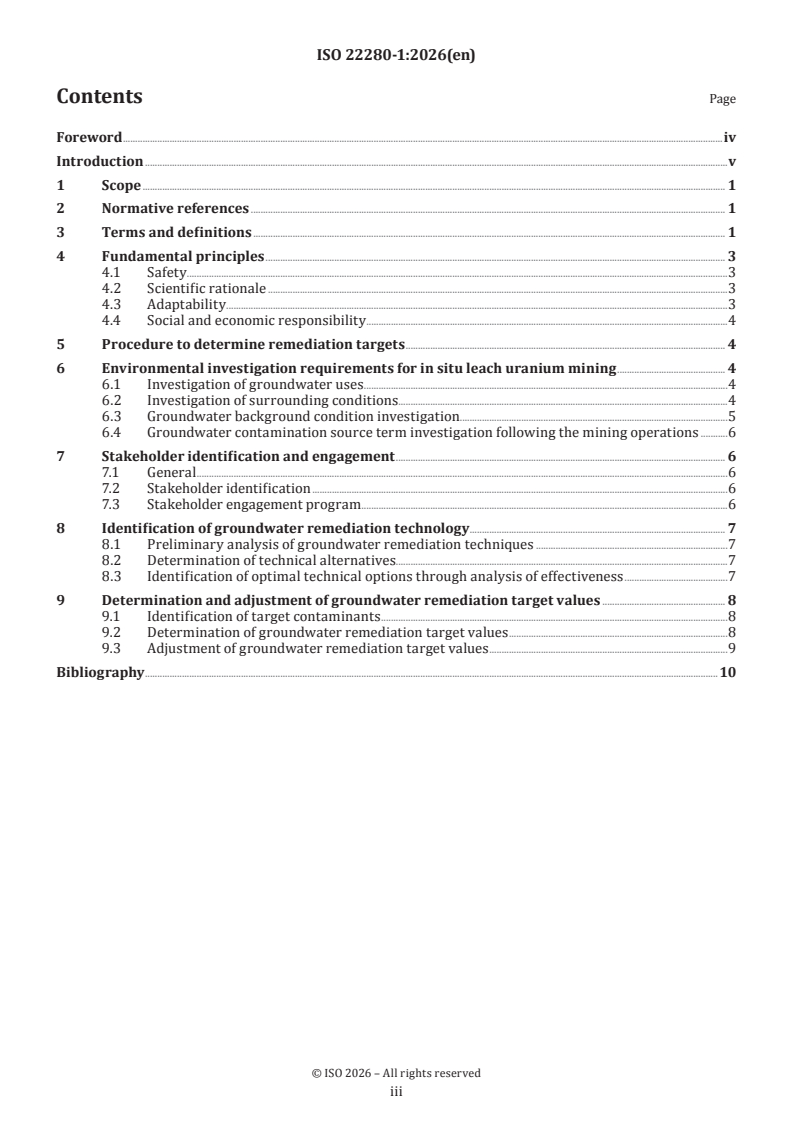
Contents Page
Foreword .iv
Introduction .v
1 Scope . 1
2 Normative references . 1
3 Terms and definitions . 1
4 Fundamental principles . 3
4.1 Safety.3
4.2 Scientific rationale .3
4.3 Adaptability .3
4.4 Social and economic responsibility .4
5 Procedure to determine remediation targets . 4
6 Environmental investigation requirements for in situ leach uranium mining . 4
6.1 Investigation of groundwater uses . .4
6.2 Investigation of surrounding conditions.4
6.3 Groundwater background condition investigation.5
6.4 Groundwater contamination source term investigation following the mining operations .6
7 Stakeholder identification and engagement . 6
7.1 General .6
7.2 Stakeholder identification .6
7.3 Stakeholder engagement program . .6
8 Identification of groundwater remediation technology. 7
8.1 Preliminary analysis of groundwater remediation techniques .7
8.2 Determination of technical alternatives.7
8.3 Identification of optimal technical options through analysis of effectiveness .7
9 Determination and adjustment of groundwater remediation target values . 8
9.1 Identification of target contaminants .8
9.2 Determination of groundwater remediation target values .8
9.3 Adjustment of groundwater remediation target values .9
Bibliography .10
iii
Foreword
ISO (the International Organization for Standardization) is a worldwide federation of national standards
bodies (ISO member bodies). The work of preparing International Standards is normally carried out through
ISO technical committees. Each member body interested in a subject for which a technical committee
has been established has the right to be represented on that committee. International organizations,
governmental and non-governmental, in liaison with ISO, also take part in the work. ISO collaborates closely
with the International Electrotechnical Commission (IEC) on all matters of electrotechnical standardization.
The procedures used to develop this document and those intended for its further maintenance are described
in the ISO/IEC Directives, Part 1. In particular, the different approval criteria needed for the different types
of ISO document should be noted. This document was drafted in accordance with the editorial rules of the
ISO/IEC Directives, Part 2 (see www.iso.org/directives).
ISO draws attention to the possibility that the implementation of this document may involve the use of (a)
patent(s). ISO takes no position concerning the evidence, validity or applicability of any claimed patent
rights in respect thereof. As of the date of publication of this document, ISO had not received notice of (a)
patent(s) which may be required to implement this document. However, implementers are cautioned that
this may not represent the latest information, which may be obtained from the patent database available at
www.iso.org/patents. ISO shall not be held responsible for identifying any or all such patent rights.
Any trade name used in this document is information given for the convenience of users and does not
constitute an endorsement.
For an explanation of the voluntary nature of standards, the meaning of ISO specific terms and expressions
related to conformity assessment, as well as information about ISO's adherence to the World Trade
Organization (WTO) principles in the Technical Barriers to Trade (TBT), see www.iso.org/iso/foreword.html.
This document was prepared by Technical Committee ISO/TC 85, Nuclear energy, nuclear technologies, and
radiological protection, Subcommittee SC 5, Nuclear installations, processes and technologies.
Any feedback or questions on this document should be directed to the user’s national standards body. A
complete listing of these bodies can be found at www.iso.org/members.html.
iv
Introduction
Uranium in situ leach mining has many unique advantages compared to conventional mining technologies,
such as: small investment, short construction period, little production cost, less energy consumption, low
labour intensity, high production efficiency, no tailings and waste rock, and minimal impact on the natural
landscape. Uranium production by in situ leach has ranked first among various uranium mining/milling
[1]to[5]
methods since 2009 , among which the global production of natural uranium produced by in situ leach
[6]
reached approximately 27 773 tU in 2022 , accounting for 56 % of the world's natural uranium production
(49 355 tU).
Groundwater environmental impacts can be substantial due to in situ leach mining and should be considered
[7]
throughout planning, operation and remediation . In the case of Königstein in situ leaching (Germany), a
total of 100 000 t of sulfuric acid was injected with the leaching liquid into the ore deposit. The liquid contains
high contaminant concentrations, for example, expressed as multiples of the drinking water standards:
cadmium 400x, arsenic 280x, nickel 130x, uranium 83x, etc. This liquid presents a hazard to an aquifer that
is of importance for the drinking water supply of the region. Groundwater impact is much larger at the Czech
in situ leaching site of Stráz pod Ralskem: 28,7 million m of contaminated liquid is contained in the leaching
zone, covering an area of 5,74 km . This zone contains a total of 1,5 million tonnes of sulphate, 37,500 t of
ammonium, and others. The contaminated liquid has spread out beyond the leaching zone horizontally and
2 3
vertically, thus contaminating another area of 28 km and a further 235 million m of groundwater.
Decommissioning and environmental remediation are the last steps in the whole process of site selection,
design, operation, and decommissioning of nuclear facilities. Determination of groundwater remediation
[8]to[10]
targets is a key point for in situ leach groundwater remediation . No standards on determination of
groundwater remediation targets for in situ leach uranium have been published at the international level.
This document sets out the fundamental principles of determining the groundwater remediation targets
for post in situ leach (also referred as in situ recovery) uranium mining. This document is one of a set of
International Standards on groundwater remediation for in situ leach uranium mining.
This document is formulated in order to manage the groundwater environment protection of uranium in
situ leaching, ensure human health and ecological receptors safety, and standardize the determination of
groundwater remediation target values for uranium in situ leaching.
This document provides the basic principles and procedures for determining the groundwater remediation
target values for in situ leach uranium mining, including requirements for groundwater environmental
investigation, stakeholder engagement, identification of groundwater remediation technology, and
determination and adjustment of groundwater remediation target values.
v
International Standard ISO 22280-1:2026(en)
Groundwater remediation for in situ leach uranium mining —
Part 1:
Determination of remediation targets
1 Scope
This document sets out the fundamental principles and procedure of determining the groundwater
remediation targets for post in situ leach (also referred as in situ recovery) uranium mining. It also delineates
the environmental investigation requirements for groundwater remediation, stakeholder identification
and engagement, groundwater remediation technical options and their analysis of effectiveness, and
considerations for setting and adjusting the groundwater remediation target values.
This document is applicable to controlling and mitigating groundwater impact and conducting groundwater
remediation for in situ leach uranium mining. It can also serve as a reference for contamination control,
mitigation and remediation of groundwater for other in situ leach metal mining projects.
2 Normative references
The following documents are referred to in the text in such a way that some or all of their content constitutes
requirements of this document. For dated references, only the edition cited applies. For undated references,
the latest edition of the referenced document (including any amendments) applies.
ISO 20305, Mine closure and reclamation — Vocabulary
ISO 21795-2, Mine closure and reclamation planning — Part 2: Guidance
3 Terms and definitions
For the purposes of this document, the terms and definitions given in ISO 20305, ISO 21795-2 and the
following apply.
ISO and IEC maintain terminology databases for use in standardization at the following addresses:
— ISO Online browsing platform: available at https:// www .iso .org/ obp
— IEC Electropedia: available at https:// www .electropedia .org
3.1
groundwater contamination source term
type, concentration and distribution of pollutants in groundwater contaminated area formed by migration
from the in situ leach uranium mining area to the surrounding area
3.2
groundwater remediation
natural or artificial process of degrading, adsorbing, transferring or blocking pollutants in groundwater
through physical, chemical or biological means
Note 1 to entry: This process converts toxic and harmful pollutants into harmless substances, or reduces their
concentration to acceptable levels, or blocks their exposure pathways to meet the established targets.
3.3
induced remediation
physical, chemical or biological processes in the environment induced by humans that act to reduce the
mass, toxicity, mobility, volume or concentration of contaminants
Note 1 to entry: These human-induced enhancements include extraction of contaminated groundwater, injection of
clean water (including clean water produced through treating contaminated groundwater at the ground surface), and
injection of chemical agents or biological agents.
3.4
natural attenuation
naturally occurring physical, chemical or biological processes in the environment that act without human
intervention to reduce the mass, toxicity, mobility, volume or concentration of contaminants
Note 1 to entry: These in situ natural attenuation processes include biodegradation, dispersion, dilution, sorption,
volatilization, radioactive decay, and chemical or biological stabilization, transformation, or destruction.
Note 2 to entry: Monitored natural attenuation (MNA) emphasizes the need for monitoring when natural attenuation
is deemed a suitable mitigation strategy for a site, and thus is increasingly recognized as a standard approach.
3.5
enhanced natural attenuation
physical, chemical or biological processes in the environment that act with human intervention to accelerate
the natural attenuation (3.4) of contaminants
3.6
target contaminant
contaminant of which quantity or concentration in the groundwater has reached or naturally exceeds a level
that has actual or potential adverse effects on human health and ecological receptors
3.7
targets
groundwater remediation (3.2) endpoints where target contaminants (3.6) and their acceptable concentrations
identified through groundwater environmental surveys or risk assessment do not pose direct or potential
risks to human health, ecological receptors, or the environment
Note 1 to entry: It can be determined based on the natural background groundwater quality in the mining area
before mining activities if groundwater is unsuitable for human consumption due to naturally high concentrations of
uranium, radium, heavy metals, and other substances.
3.8
groundwater background concentration
concentration ranges of chemical constituents (e.g. ions, trace elements and isotopes) in groundwater
systems that exist under natural conditions in a geographic area unaffected or minimally influenced by
human activities before mining operation
Note 1 to entry: These values are determined by natural geological, hydrological, and biogeochemical processes,
serving as a baseline to differentiate natural variability from anthropogenic contamination.
3.9
stakeholder
interested party
any individual, group or organization with the potential to affect, or to be affected by, the process or outcome
of mine operation, closure and remediation
Note 1 to entry: It can include internal and external stakeholders such as the host community, regulators, non-
government organizations, and other community groups, as well as future users and investors of the site.
3.10
lixiviant
recirculating leaching solution that is injected into and percolates through an underground ore body with
valuable metals recovered and/or leaching agents added at the ground surface
Note 1 to entry: Leaching agents may include oxidizers, alkaline or acidic reagents, or CO .
3.11
sweeping
groundwater remediation (3.2) process where residual lixiviant (3.10) is extracted through injection and
production wells, while fresh water is allowed to flow into the leaching zone from the outside to dilute and
displace the lixiviant (3.10) trapped in the pore spaces
3.12
extract-treat-reinject recirculation
closed-loop groundwater remediation (3.2) process where contaminated groundwater of aquifer is extracted,
treated to remove contaminants or recover constituents, and subsequently reinjected into the original
aquifer for recirculation
3.13
deep well disposal
process where waste fluid is injected into deep underground aquifers, confining it within geological
formations to isolate it from the biosphere
Note 1 to entry: The depth of deep well disposal typically ranges from approximately 800 m to over 3 000 m, which is
related to the stratigraphic depth of the local groundwater.
3.14
solid-waste disposal
process of collecting, treating, and finally placing solid waste from groundwater remediation (3.2) in
designated facilities
4 Fundamental principles
4.1 Safety
Groundwater remediation targets should be established to prevent adverse effects to human health and
ecological receptors.
4.2 Scientific rationale
Remediation targets are set scientifically and reasonably based on sound science and effectiveness analysis
of groundwater remediation, taking into account the degree and extent of groundwater contamination,
hydrogeological conditions, initial groundwater characteristics, feasibility of groundwater remediation
technology, remediation duration, as well as the impact on human health and environment.
4.3 Adaptability
The groundwater remediation targets should be adapted with the uranium in situ leach processes,
background groundwater quality, original use of groundwater surrounding the in situ leach well field and
processing facilities. The remediation target values should comply with applicable requirements when
existing.
The determination method of these remediation targets is not applicable to groundwater remediation of
non-mining aquifers resulting from accidental spills of in situ leach uranium mining.
4.4 Social and economic responsibility
The determination of groundwater remediation targets for in situ leach uranium mining should take into
account capabilitie
...