


ISO/IEC 18092:2023
(Main)Telecommunications and information exchange between systems — Near Field Communication Interface and Protocol 1 (NFCIP-1)
Telecommunications and information exchange between systems — Near Field Communication Interface and Protocol 1 (NFCIP-1)
This document defines: — communication modes for Near Field Communication Interface and Protocol 1 (NFCIP-1) using inductive coupled devices operating at the centre frequency of 13,56 MHz for interconnection of computer peripherals; — both the active and the passive communication modes of NFCIP-1 to realize a communication network using Near Field Communication (NFC) devices for networked products and for consumer equipment; — a transport protocol including protocol activation and data exchange methods. This document specifies: — modulation schemes; — codings; — bit rates; — frame format of the radio frequency (RF) interface; — initialisation schemes and conditions required for data collision control during initialisation. Information interchange between systems is based on agreement between the interchange parties upon the interchange codes and the data structure.
Télécommunications et échange d'information entre systèmes — Interface et protocole 1 de communication en champ proche (NFCIP-1)
General Information
- Status
- Published
- Publication Date
- 07-Dec-2023
- Current Stage
- 6060 - International Standard published
- Start Date
- 08-Dec-2023
- Due Date
- 12-Nov-2023
- Completion Date
- 08-Dec-2023
Relations
- Effective Date
- 06-Jun-2022
Overview
ISO/IEC 18092:2023 - Near Field Communication Interface and Protocol 1 (NFCIP‑1) defines the interface and transport protocol for short‑range NFC communication using inductively coupled devices at a centre frequency of 13.56 MHz. The third edition updates and harmonizes NFCIP‑1 with NFC Forum digital protocol work and introduces support for NFC security features for the Target role. The standard supports both active and passive communication modes and defines how devices initialize, activate and exchange data over the RF interface.
Key technical topics and requirements
- RF interface at 13.56 MHz: physical RF field parameters, detection and timing requirements.
- Bit rates and timing: supported data rates are 106, 212 and 424 kbit/s (denoted f/128, f/64, f/32).
- Modulation, coding and frame format: specified modulation schemes, coding rules and RF frame structure for reliable data transmission.
- Active and passive communication modes: electrical and protocol differences for devices that generate an RF field (active) or are powered by the field (passive).
- Initialization and anti‑collision: procedures and conditions for device discovery, initialisation, RF collision avoidance (RFCA) and Start‑of‑Device‑Detection (SDD).
- Transport protocol and activation flow: commands and flows for Attribute, Wakeup, Parameter Selection, Data Exchange, chaining (more information), timeout extension and deactivation (Deselect/Release).
- Interchange rules: information interchange relies on prior agreement between parties on interchange codes and data structures.
- Conformance and annexes: CRC calculation (normative) and SAK information (informative).
- Normative references: includes ISO/IEC 13157‑1 (NFC‑SEC), ISO/IEC 14443‑2/3 and ITU‑T V.41.
Practical applications
- Enabling peer‑to‑peer NFC communications between smartphones, tablets and accessories.
- Interconnection of computer peripherals and small consumer devices where short‑range, low‑power wireless links are required.
- Implementing transport and activation flows for NFC‑enabled networked products and consumer electronics.
- Basis for interoperability testing, firmware/firmware stack development and device certification.
Who should use this standard
- NFC chipset and module designers, embedded firmware engineers and hardware designers.
- Mobile OEMs, consumer electronics manufacturers and accessory vendors integrating NFC.
- Standards engineers, interoperability test laboratories and security architects (refer to ISO/IEC 13157‑1 for NFC‑SEC).
- Product teams implementing NFC transport, initialization and collision control logic.
Related standards
- ISO/IEC 13157‑1 (NFC‑SEC), ISO/IEC 14443‑2 and ISO/IEC 14443‑3 (contactless proximity), ITU‑T V.41.
- NFC Forum Digital Protocol and Activity Technical Specifications - harmonization targets for interoperability.
Keywords: ISO/IEC 18092:2023, NFCIP‑1, NFC, near field communication, 13.56 MHz, active mode, passive mode, modulation, bit rates, RF interface, initialization, transport protocol.
Get Certified
Connect with accredited certification bodies for this standard

BSI Group
BSI (British Standards Institution) is the business standards company that helps organizations make excellence a habit.

NYCE
Mexican standards and certification body.
Sponsored listings
Frequently Asked Questions
ISO/IEC 18092:2023 is a standard published by the International Organization for Standardization (ISO). Its full title is "Telecommunications and information exchange between systems — Near Field Communication Interface and Protocol 1 (NFCIP-1)". This standard covers: This document defines: — communication modes for Near Field Communication Interface and Protocol 1 (NFCIP-1) using inductive coupled devices operating at the centre frequency of 13,56 MHz for interconnection of computer peripherals; — both the active and the passive communication modes of NFCIP-1 to realize a communication network using Near Field Communication (NFC) devices for networked products and for consumer equipment; — a transport protocol including protocol activation and data exchange methods. This document specifies: — modulation schemes; — codings; — bit rates; — frame format of the radio frequency (RF) interface; — initialisation schemes and conditions required for data collision control during initialisation. Information interchange between systems is based on agreement between the interchange parties upon the interchange codes and the data structure.
This document defines: — communication modes for Near Field Communication Interface and Protocol 1 (NFCIP-1) using inductive coupled devices operating at the centre frequency of 13,56 MHz for interconnection of computer peripherals; — both the active and the passive communication modes of NFCIP-1 to realize a communication network using Near Field Communication (NFC) devices for networked products and for consumer equipment; — a transport protocol including protocol activation and data exchange methods. This document specifies: — modulation schemes; — codings; — bit rates; — frame format of the radio frequency (RF) interface; — initialisation schemes and conditions required for data collision control during initialisation. Information interchange between systems is based on agreement between the interchange parties upon the interchange codes and the data structure.
ISO/IEC 18092:2023 is classified under the following ICS (International Classification for Standards) categories: 35.100.10 - Physical layer. The ICS classification helps identify the subject area and facilitates finding related standards.
ISO/IEC 18092:2023 has the following relationships with other standards: It is inter standard links to ISO/IEC 18092:2013. Understanding these relationships helps ensure you are using the most current and applicable version of the standard.
ISO/IEC 18092:2023 is available in PDF format for immediate download after purchase. The document can be added to your cart and obtained through the secure checkout process. Digital delivery ensures instant access to the complete standard document.
Standards Content (Sample)
INTERNATIONAL ISO/IEC
STANDARD 18092
Third edition
2023-12
Telecommunications and information
exchange between systems — Near
Field Communication Interface and
Protocol 1 (NFCIP-1)
Télécommunications et échange d'information entre systèmes —
Interface et protocole 1 de communication en champ proche
(NFCIP-1)
Reference number
© ISO/IEC 2023
© ISO/IEC 2023
All rights reserved. Unless otherwise specified, or required in the context of its implementation, no part of this publication may
be reproduced or utilized otherwise in any form or by any means, electronic or mechanical, including photocopying, or posting on
the internet or an intranet, without prior written permission. Permission can be requested from either ISO at the address below
or ISO’s member body in the country of the requester.
ISO copyright office
CP 401 • Ch. de Blandonnet 8
CH-1214 Vernier, Geneva
Phone: +41 22 749 01 11
Email: copyright@iso.org
Website: www.iso.org
Published in Switzerland
ii
© ISO/IEC 2023 – All rights reserved
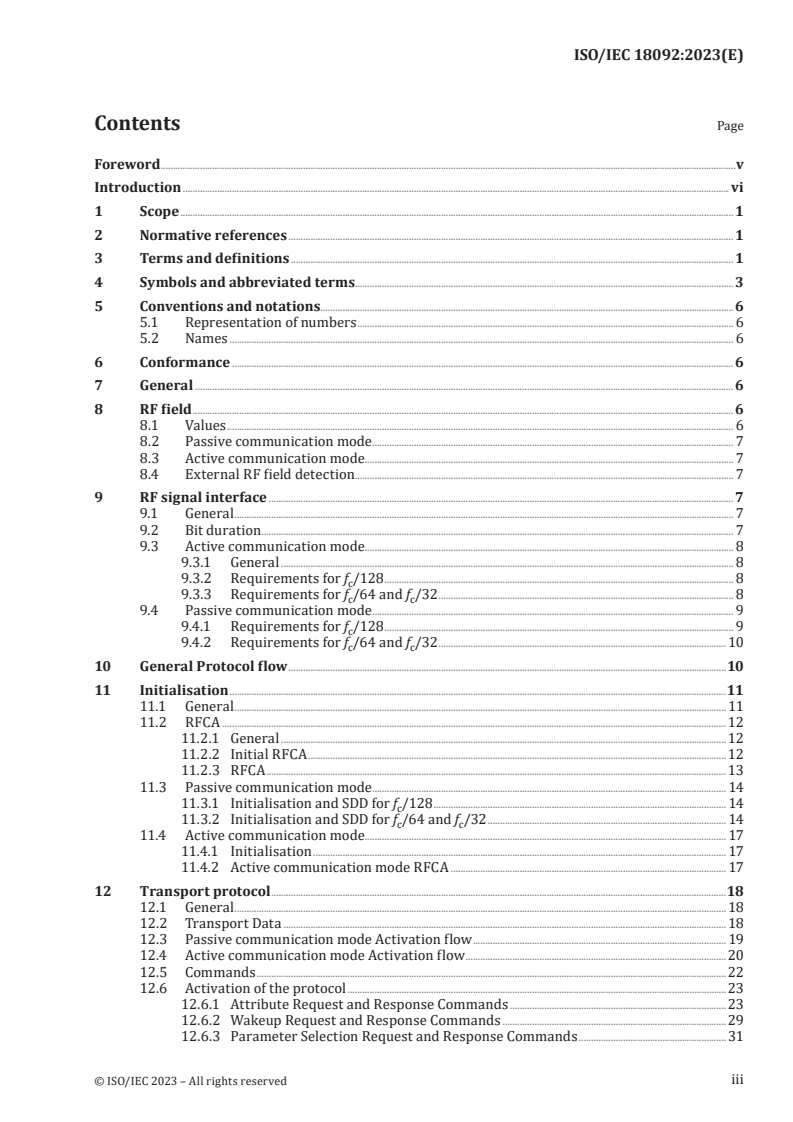
Contents Page
Foreword .v
Introduction . vi
1 Scope . 1
2 Normative references . 1
3 Terms and definitions . 1
4 Symbols and abbreviated terms.3
5 Conventions and notations . .6
5.1 Representation of numbers . 6
5.2 Names . 6
6 Conformance . 6
7 General . 6
8 RF field . 6
8.1 Values . 6
8.2 Passive communication mode . 7
8.3 Active communication mode. 7
8.4 External RF field detection . . 7
9 RF signal interface . 7
9.1 General . 7
9.2 Bit duration . 7
9.3 Active communication mode. 8
9.3.1 General . 8
9.3.2 Requirements for f /128 . 8
c
9.3.3 Requirements for f /64 and f /32 . 8
c c
9.4 Passive communication mode . 9
9.4.1 Requirements for f /128 . 9
c
9.4.2 Requirements for f /64 and f /32 . 10
c c
10 General Protocol flow .10
11 Initialisation .11
11.1 General . 11
11.2 RFCA . 12
11.2.1 General .12
11.2.2 Initial RFCA .12
11.2.3 RFCA . 13
11.3 Passive communication mode . 14
11.3.1 Initialisation and SDD for f /128 . 14
c
11.3.2 Initialisation and SDD for f /64 and f /32 . 14
c c
11.4 Active communication mode. 17
11.4.1 Initialisation . 17
11.4.2 Active communication mode RFCA . 17
12 Transport protocol .18
12.1 General . 18
12.2 Transport Data . 18
12.3 Passive communication mode Activation flow . 19
12.4 Active communication mode Activation flow . 20
12.5 Commands .22
12.6 Activation of the protocol .23
12.6.1 Attribute Request and Response Commands .23
12.6.2 Wakeup Request and Response Commands .29
12.6.3 Parameter Selection Request and Response Commands . 31
iii
© ISO/IEC 2023 – All rights reserved
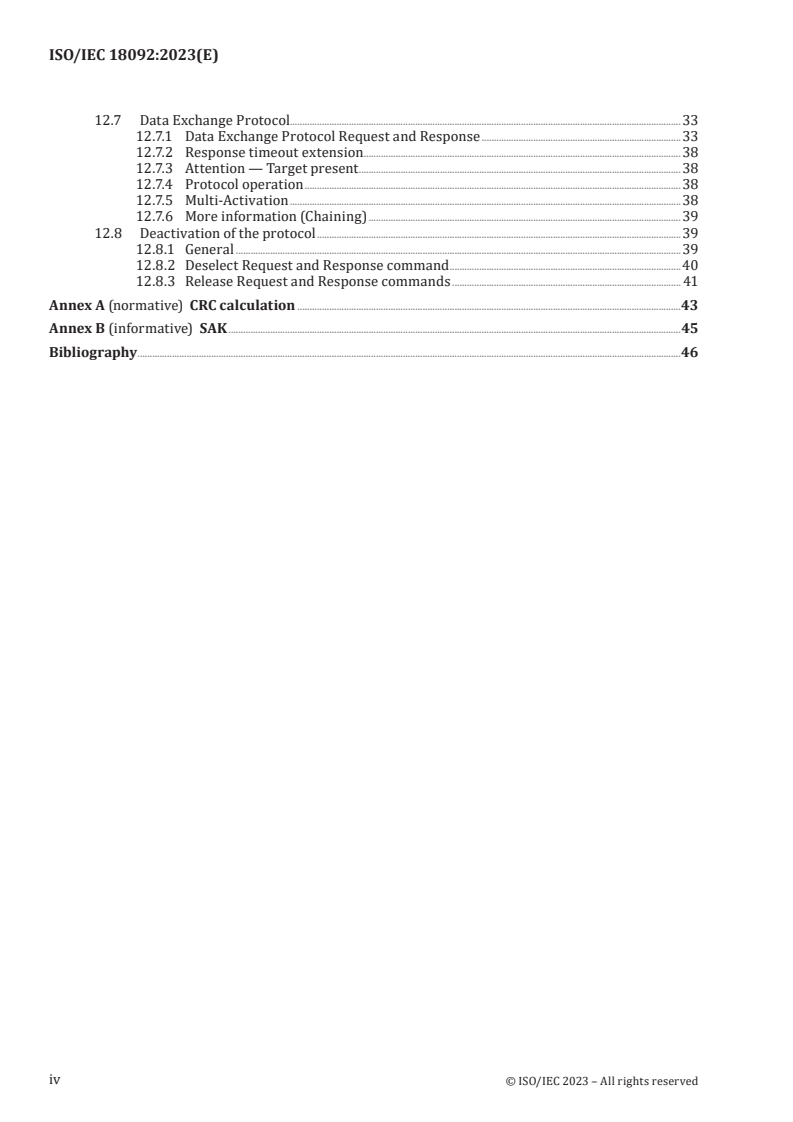
12.7 Data Exchange Protocol . 33
12.7.1 Data Exchange Protocol Request and Response . 33
12.7.2 Response timeout extension .38
12.7.3 Attention — Target present .38
12.7.4 Protocol operation .38
12.7.5 Multi-Activation .38
12.7.6 More information (Chaining) .39
12.8 Deactivation of the protocol .39
12.8.1 General .39
12.8.2 Deselect Request and Response command .40
12.8.3 Release Request and Response commands . 41
Annex A (normative) CRC calculation .43
Annex B (informative) SAK .45
Bibliography .46
iv
© ISO/IEC 2023 – All rights reserved
Foreword
ISO (the International Organization for Standardization) and IEC (the International Electrotechnical
Commission) form the specialized system for worldwide standardization. National bodies that are
members of ISO or IEC participate in the development of International Standards through technical
committees established by the respective organization to deal with particular fields of technical
activity. ISO and IEC technical committees collaborate in fields of mutual interest. Other international
organizations, governmental and non-governmental, in liaison with ISO and IEC, also take part in the
work.
The procedures used to develop this document and those intended for its further maintenance
are described in the ISO/IEC Directives, Part 1. In particular, the different approval criteria
needed for the different types of document should be noted. This document was drafted in
accordance with the editorial rules of the ISO/IEC Directives, Part 2 (see www.iso.org/directives or
www.iec.ch/members_experts/refdocs).
ISO and IEC draw attention to the possibility that the implementation of this document may involve the
use of (a) patent(s). ISO and IEC take no position concerning the evidence, validity or applicability of
any claimed patent rights in respect thereof. As of the date of publication of this document, ISO and IEC
had not received notice of (a) patent(s) which may be required to implement this document. However,
implementers are cautioned that this may not represent the latest information, which may be obtained
from the patent database available at www.iso.org/patents and https://patents.iec.ch. ISO and IEC shall
not be held responsible for identifying any or all such patent rights.
Any trade name used in this document is information given for the convenience of users and does not
constitute an endorsement.
For an explanation of the voluntary nature of standards, the meaning of ISO specific terms and
expressions related to conformity assessment, as well as information about ISO's adherence to
the World Trade Organization (WTO) principles in the Technical Barriers to Trade (TBT) see
www.iso.org/iso/foreword.html. In the IEC, see www.iec.ch/understanding-standards.
This document was prepared by Joint Technical Committee ISO/IEC JTC 1, Information technology,
Subcommittee SC 6, Telecommunications and information exchange between systems.
This third edition cancels and replaces the second edition (ISO/IEC 18092:2013), which has been
technically revised. It also incorporates ISO/IEC 18092:2013/Cor 1:2015.
The main changes are as follows:
— adoption of near field communication (NFC) security standard for the Target;
[2]
— harmonization with the NFC Forum Digital Protocol Technical Specification and Activity Technical
[3]
Specification .
Any feedback or questions on this document should be directed to the user’s national standards
body. A complete listing of these bodies can be found at www.iso.org/members.html and
www.iec.ch/national-committees.
v
© ISO/IEC 2023 – All rights reserved
Introduction
This document specifies the interface and protocol for simple wireless communication between close
coupled devices. These Near Field Communication (NFC) devices communicate with bit rates of 106,
212 and 424 kbit/s ( f /128, f /64 and f /32).
c c c
This allows, but does not specify, applications in network products and consumer equipment.
The first edition of ISO/IEC 18092 was prepared by Ecma International (as ECMA-340) and was
adopted, under a special “fast-track procedure”, by Joint Technical Committee ISO/IEC JTC 1/SC 6
in parallel with its approval by national bodies of ISO and IEC. The second edition of ISO/IEC 18092
was maintained by ISO/IEC JTC 1/SC 6 and Ecma International. This third edition of ISO/IEC 18092 is
maintained by ISO/IEC JTC 1/SC 6 with the goal to be harmonized with the NFC Forum Digital Protocol
[2] [3]
Technical Specification and Activity Technical Specification maintaining backward compatibility,
to enable the NFC security feature and to incorporate clarifications on timings of radio frequency (RF)
field switched off.
vi
© ISO/IEC 2023 – All rights reserved
INTERNATIONAL STANDARD ISO/IEC 18092:2023(E)
Telecommunications and information exchange between
systems — Near Field Communication Interface and
Protocol 1 (NFCIP-1)
1 Scope
This document defines:
— communication modes for Near Field Communication Interface and Protocol 1 (NFCIP-1) using
inductive coupled devices operating at the centre frequency of 13,56 MHz for interconnection of
computer peripherals;
— both the active and the passive communication modes of NFCIP-1 to realize a communication
network using Near Field Communication (NFC) devices for networked products and for consumer
equipment;
— a transport protocol including protocol activation and data exchange methods.
This document specifies:
— modulation schemes;
— codings;
— bit rates;
— frame format of the radio frequency (RF) interface;
— initialisation schemes and conditions required for data collision control during initialisation.
Information interchange between systems is based on agreement between the interchange parties
upon the interchange codes and the data structure.
2 Normative references
The following documents are referred to in the text in such a way that some or all of their content
constitutes requirements of this document. For dated references, only the edition cited applies. For
undated references, the latest edition of the referenced document (including any amendments) applies.
ISO/IEC 13157-1, Information technology — Telecommunications and information exchange between
systems — NFC Security — Part 1: NFC-SEC NFCIP-1 security services and protocol
ISO/IEC 14443-2:2020, Cards and security devices for personal identification — Contactless proximity
objects — Part 2: Radio frequency power and signal interface
ISO/IEC 14443-3:2018, Cards and security devices for personal identification — Contactless proximity
objects — Part 3: Initialization and anticollision
ITU-T V.41:1988, Code-independent error-control system
3 Terms and definitions
For the purposes of this document, the terms and definitions given in ISO/IEC 14443-2 and
ISO/IEC 14443-3, and the following apply.
© ISO/IEC 2023 – All rights reserved
ISO and IEC maintain terminology databases for use in standardization at the following addresses:
— ISO Online browsing platform: available at https:// www .iso .org/ obp
— IEC Electropedia: available at https:// www .electropedia .org/
3.1
active communication mode
mode in which both the Initiator (3.5) and the Target (3.16) use their own radio frequency (RF) field to
enable the communication
3.2
collision
transmission by two or more Targets (3.16) or Initiators (3.5) during the same time period (3.17), such
that the Initiator or the Target is unable to distinguish from which Target the data originated
3.3
frame
sequence of data bits and optional error detection bits, with frame delimiters at start and end
3.4
H
Threshold
threshold value to detect an external radio frequency (RF) field
3.5
Initiator
entity that generates the radio frequency (RF) field and starts the Near Field Communication Interface
and Protocol (NFCIP-1) communication
3.6
load modulation
process of amplitude modulating a radio frequency (RF) field by varying the properties of a resonant
circuit placed within the RF field
3.7
lsb first
least significant bit first
least significant bit first, indicating a serial data transmission system that sends lsb before all other bits
3.8
Manchester bit encoding
method of bit coding whereby a logic level during a bit duration is represented by a sequence of two
defined physical states of a communication medium
3.9
modulation index
signal amplitude ratio of the modulation to the level of the unmodulated carrier, calculated by:
[1 − b] / [1 + b]
where b is the ratio between the modulated amplitude and the initial signal amplitude
3.10
msb first
most significant bit first
serial data transmission system that sends the msb before all other bits
3.11
NFCIP-1 device
entity supporting the active communication mode (3.1) and the passive communication mode (3.13)
© ISO/IEC 2023 – All rights reserved
3.12
NFC identifier
NFCIDn (n = 1, 2 or 3)
number used by the Single Device Detection (3.15) sequence for both the Active communication mode
(3.1) and the Passive communication mode (3.13)
3.13
passive communication mode
mode when the Initiator (3.5) is generating the radio frequency (RF) field and the Target (3.16) responds
to an Initiator command in a load modulation scheme
3.14
RF Collision Avoidance
RFCA
method to detect the presence of a radio frequency (RF) field based on the carrier frequency
3.15
Single Device Detection
SDD
algorithm used by the Initiator (3.5) to detect one out of several Targets (3.16) in its radio frequency
(RF) field
3.16
Target
entity that responds to Initiator (3.5) command either using load modulation scheme (radio frequency
(RF) field generated by Initiator) or using modulation of self-generated RF field
3.17
time period
number of slots used for RF Collision Avoidance (3.14)
3.18
time slot
method of preparing a time window when a Target (3.16) answers, and assigning and identifying two or
more logic channels
4 Symbols and abbreviated terms
The abbreviated terms in ISO/IEC 14443-2 and ISO/IEC 14443-3, and the following apply.
ATR Attribute
ATR_REQ Attribute Request
ATR_RES Attribute Response
BRi receiving bit duration supported by Initiator
BRt receiving bit duration supported by Target
BSi sending bit duration supported by Initiator
BSt sending bit duration supported by Target
CMD command
CRC cyclic redundancy check
D divisor
© ISO/IEC 2023 – All rights reserved
DEP Data Exchange Protocol
DEP_REQ Data Exchange Protocol Request
DEP_RES Data Exchange Protocol Response
DIDi Initiator Device ID
DIDt Target Device ID
DRi Data rate Received by Initiator
DRt Data rate Received by Target
DSi Data rate Sent by Initiator
DSL Deselect
DSL_REQ Deselect Request
DSL_RES Deselect Response
DSt Data rate Send by Target
etu elementary time unit
f frequency of operating field (carrier frequency)
c
G(x) generator polynomial for CRC generation
Gi optional information field for Initiator
Gt optional information field for Target
HLTA HaLT command, Type A
H maximum field strength of the Initiator antenna field
max
H minimum field strength of the Initiator antenna field
min
H threshold value to detect an external radio frequency (RF) field
Threshold
ID identification number
LEN maximum frame size
MAX
LRi length reduction of Initiator
LRt length reduction of Target
lsb least significant bit
lsb first least significant bit first
MI Multiple Information link for Data Exchange Protocol
msb most significant bit
NAD Node Address
NFCID1 UID for SDD in Passive communication mode at f /128
c
© ISO/IEC 2023 – All rights reserved
NFCID2 ID for SDD in Passive communication mode at f /64 and fc/32
c
NFCID3 random ID for transport protocol activation
NFC-SEC NFCIP-1 Security Services and Protocol (specified in ISO/IEC 13157-1)
PA preamble
PCD Proximity Coupling Device
pdu protocol data unit
PFB control information for transaction
PICC proximity card or object
PNI Packet Number Information
PPi Protocol Parameters used by Initiator
PPt Protocol Parameters used by Target
PSL Parameter Selection
PSL_REQ Parameter Selection Request
PSL_RES Parameter Selection Response
RF Radio Frequency
RFCA RF Collision Avoidance
RFU Reserved for Future Use
RLS Release
RLS_REQ Release Request
RLS_RES Release Response
t Response Waiting Time
RW
SAK Select AcKnowledge
SB Start Byte for data exchange protocol at f /128
c
SDD Single Device Detection (anticollision)
SYNC synchronisation pattern
TO Time Out
UID Unique Identifier
WT Waiting Time
WUP Wakeup
WUPA Wake UP command, Type A
WUP_REQ Wakeup Request
© ISO/IEC 2023 – All rights reserved
WUP_RES Wakeup Response
5 Conventions and notations
5.1 Representation of numbers
The following conventions and notations apply in this document unless otherwise stated:
— Letters and digits in single quotation marks represent numbers in hexadecimal notation.
— The setting of bits is denoted by ZERO or ONE.
— Numbers in binary notation and bit patterns are represented by strings of digits 0 and 1 shown with
the most significant bit to the left. Within such strings, X may be used to indicate that the setting of
a bit is not specified within the string, e.g. (XXXX)b.
5.2 Names
The names of basic elements, e.g. specific fields, are written with a capital initial letter.
6 Conformance
A system implementing the active and the passive communication mode shall be in conformance with
this document if it meets all the mandatory requirements specified herein.
7 General
NFCIP-1 Targets and Initiators shall implement both the active and the passive communication modes.
In the active communication mode, both the Initiator and the Target use their own RF field to
communicate. The Initiator starts the NFCIP-1 transaction, which consists of initialisation, protocol
activation, data exchange and optional device deactivation. The Target responds to an Initiator
command in the active communication mode by modulating its own RF field.
In the passive communication mode, the Initiator generates the RF field and starts the transaction.
The Target responds to an Initiator command in the passive communication mode by modulating the
Initiators’ RF field, which is referred to as load modulation.
This document specifies requirements for modulation, bit rates and bit coding. In addition, it specifies
requirements for the start of communication, the end of communication, the bit and byte representation,
the framing and error detection, the single device detection (SDD), the protocol activation and
parameter selection and the data exchange and deactivation of NFCIP-1 devices.
Initiators and Targets exchange commands, responses and data in alternating or half duplex
communication.
NFCIP-1 devices are capable to start transactions at bit rates of f /128, f /64 and f /32. Initiators select
c c c
one of those bit rates to start a transaction and they may change the bit rate using the parameter
selection during a transaction.
The mode (active or passive) shall not be changed during a transaction.
8 RF field
8.1 Values
f is 13,56 MHz.
c
© ISO/IEC 2023 – All rights reserved
H is 1,5 A/m (rms).
min
H is 7,5 A/m (rms).
max
H is 0,187 5 A/m (rms).
Threshold
8.2 Passive communication mode
The Initiator shall generate field strength of at least H and not exceeding H at manufacturer
min min
specified positions (i.e. operating volume) under un-modulated conditions.
The Target shall operate continuously between H and H .
min max
8.3 Active communication mode
An Initiator and a Target shall alternately generate an RF field of at least H and not exceeding H at
min max
manufacturer specified positions (i.e. operating volume) under un-modulated conditions.
8.4 External RF field detection
NFCIP-1 devices shall detect external RF fields at f with field strength higher than H .
c Threshold
9 RF signal interface
9.1 General
This clause specifies bit duration and RF signal interface requirements for active and passive
communication modes.
NOTE Active and passive communication modes have also been adopted by NFC Forum, as shown in
Reference [2] and [3].
9.2 Bit duration
One etu equals 128/(D × f ), where the values of the divisor D depend on the bit rate and communication
c
mode, see Table 1.
Table 1 — Divisor D
Communication mode bit rate Divisor D
Active or Passive f /128 (~106 kbit/s) 1
c
Active or Passive f /64 (~212 kbit/s) 2
c
Active or Passive f /32 (~424 kbit/s) 4
c
Active f /16 (~848 kbit/s) 8
c
Active f /8 (~1 695 kbit/s) 16
c
Active f /4 (~3 390 kbit/s) 32
c
Active f /2 (~6 780 kbit/s) 64
c
NOTE 1 The Initiator selects the communication mode (either Active or Passive) and bit rate ( f /128, f /64 or
c c
f /32 specified by the following clauses).
c
NOTE 2 This document does not specify the modulation and the bit coding beyond the bit rate of f /32.
c
© ISO/IEC 2023 – All rights reserved
9.3 Active communication mode
9.3.1 General
Targets and Initiators shall conform with the following specifications for both communication
directions, i.e. Initiator to Target and Target to Initiator.
9.3.2 Requirements for f /128
c
9.3.2.1 Bit rate
The bit rate for the transmission during initialisation and SDD shall be f /128.
c
9.3.2.2 Modulation
The modulation shall be in accordance with ISO/IEC 14443-2:2020, 8.1.2 for a bit rate of f /128. During
c
transmission, both the Initiator and the Target shall conform to PCD values. During reception, both the
Initiator and the Target shall conform to PICC values.
9.3.2.3 Bit representation and coding
The bit representation and coding shall be in accordance with ISO/IEC 14443-2:2020, 8.1.3 for a bit rate
of f /128.
c
9.3.2.4 Byte transmission
Initiators and targets shall transmit bytes with the lsb first.
9.3.3 Requirements for f /64 and f /32
c c
9.3.3.1 Bit rates
The bit rates for the transmission during initialisation and SDD shall respectively be f /64 or f /32.
c c
9.3.3.2 Modulation
The modulation shall be in accordance with ISO/IEC 14443-2:2020, 9.1.2 for the bit rate of f /64
c
and f /32. During transmission, both the Initiator and the Target shall apply the PCD values. During
c
reception, both the Initiator and the Target shall apply the PICC values.
The Target should accept a modulation index range from 8 % to 30 % to operate with Initiators using a
modulation index higher than 14 % for backward compatibility.
9.3.3.3 Bit representation and coding
Manchester bit encoding shall be employed as illustrated in Figure 1 and Figure 2.
Bit coding format is Manchester with logic levels defined as:
— Logic “ZERO”: The first half of the bit duration is carrier low field amplitude, and the second half of
the bit duration shall be carrier high field amplitude (no modulation applied).
— Logic “ONE”: The first half of the bit duration is carrier high field amplitude (no modulation applied),
and the second half of the bit duration shall be carrier low field amplitude.
Reverse polarity in amplitude shall be permitted. Polarity shall be detected from the SYNC.
© ISO/IEC 2023 – All rights reserved
Figure 1 — Manchester bit encoding (obverse amplitude)
Figure 2 — Manchester bit encoding (reverse amplitude)
9.3.3.4 Byte transmission
Initiators and Targets shall transmit bytes with the msb first.
9.4 Passive communication mode
9.4.1 Requirements for f /128
c
9.4.1.1 Initiator to Target requirements
See 9.3.2.
9.4.1.2 Target to Initiator requirements
9.4.1.2.1 Bit rate
See 9.3.2.1.
9.4.1.2.2 Modulation
The modulation shall be in accordance with ISO/IEC 14443-2:2020, 8.2.2.
9.4.1.2.3 Subcarrier Frequency
The subcarrier frequency shall be in accordance with ISO/IEC 14443-2:2020, 8.2.3 for a bit rate of
f /128.
c
9.4.1.2.4 Subcarrier modulation
The subcarrier modulation shall be in accordance with ISO/IEC 14443-2:2020, 8.2.4 for a bit rate of
f /128.
c
9.4.1.2.5 Bit representation and coding
The bit representation and coding shall be in accordance with ISO/IEC 14443-2:2020, 8.2.6 for a bit rate
of f /128.
c
© ISO/IEC 2023 – All rights reserved
9.4.1.2.6 Byte transmission
Initiators and Targets shall transmit bytes with the lsb first.
9.4.2 Requirements for f /64 and f /32
c c
9.4.2.1 Initiator to Target requirements
9.4.2.1.1 Bit rate
See 9.3.3.1.
9.4.2.1.2 Modulation
The modulation shall be in accordance with ISO/IEC 14443-2:2020, 9.1.2 for the bit rate of f /64 and
c
f /32. During transmission, the Initiator shall apply the PCD values.
c
9.4.2.1.3 Bit representation and coding
See 9.3.3.3.
9.4.2.1.4 Byte transmission
See 9.3.3.4.
9.4.2.2 Target to Initiator requirements
9.4.2.2.1 Bit rate
See 9.3.3.1.
9.4.2.2.2 Modulation
The Target shall be capable of communication to the Initiator via an inductive coupling area by using
load modulation applied at f of the Initiator’s RF field with the PICC load modulation amplitude value
c
specified in ISO/IEC 14443-2:2020, 8.2.2. The Initiator shall be able to receive a signal with load
modulation amplitude as specified for the PCD reception in ISO/IEC 14443-2:2020, 8.2.5.
9.4.2.2.3 Bit representation and coding
See 9.3.3.3.
9.4.2.2.4 Byte transmission
See 9.3.3.4.
10 General Protocol flow
The General Protocol flow between NFCIP-1 devices shall be conducted through the following
consecutive operations:
— Any NFCIP-1 device shall be in Target mode initially and not generate an RF field and shall wait for
a command from an Initiator.
— The NFCIP-1 device may switch to Initiator mode and select either active or passive communication
mode and bit rate.
© ISO/IEC 2023 – All rights reserved
— Initiators shall test for external RF field presence and shall not activate their RF field if an external
RF field is detected. See 8.4.
— If an external RF field is not detected, the Initiator shall activate its own RF field for the activation
of Target.
— Exchange commands and responses in the same communication mode and the bit rate.
Figure 3 shows the general initialisation and SDD flow for the active and the passive communication
mode at different bit rates.
The General Protocol flow describes the flow to initialise and select the Targets either in the Passive
communication mode or in the active communication mode using one of the bit rates. RFCA is described
in 11.2. The passive communication mode is described in 11.3. The initialisation and SDD for the bit
rate of f /128 is described in 11.3.1, initialisation and SDD for bit rates of f /64 and f /32 is described in
c c c
11.3.2. The active communication mode is described in 11.3.
The Activation of the Protocol is described in 12.5. The Parameter Selection is described in 12.6.3. The
Data Exchange Protocol is described in 12.6. The Deactivation is described in 12.7.
11 Initialisation
11.1 General
This clause describes the initialisation and collision detection protocol for Targets in the active and
the passive communication mode. The Initiator shall detect a collision that occurs when at least two
Targets simultaneously transmit bit patterns with one or more bit positions where they transmit
complementary values.
Figure 3 shows the general initialisation and SDD flow for the active and the passive communication
mode at different bit rates.
© ISO/IEC 2023 – All rights reserved
Figure 3 — General initialisation and SDD flow
11.2 RFCA
11.2.1 General
In order not to disturb any other NFC communication and any current infrastructure running on the
carrier frequency, an Initiator for NFC communication shall not generate its own RF field as long as
another RF field is detected.
11.2.2 Initial RFCA
To start communication with the Target device either in the active or the passive communication mode
an Initiator shall sense continuously for the presence of an external RF field. See 8.4.
If the Initiator detects no RF field within the timeframe t + n × t then the Initiator shall switch its
IDT RFW
RF field on, otherwise it shall restart Initial RFCA. The integer value of n shall be randomly generated.
Figure 4 specifies the timing of the initial RFCA during initialisation.
© ISO/IEC 2023 – All rights reserved
Key
t initial delay time t > 4 096 / f
IDT IDT c
t RF waiting time 512 / f
RFW c
n randomly generated number of time periods for t
RFW
0 ≤ n ≤ 3
t initial guard-time between switching on RF field and start to send command or data frame
IRFG
t > 5 ms
IRFG
Figure 4 — Initial RFCA
The RF field, which is generated by the Initiator, shall be switched off in the active communication mode.
The RF field, which is generated by the Initiator, shall not be switched off in the passive communication
mode.
11.2.3 RFCA
To avoid collision by simultaneous responding of more than one Target in the active communication
mode during activation, Targets shall perform response RFCA as specified in Figure 5.
Key
t active delay time, sense time between RF off Initiator/Target and Target/Initiator
ADT
(768/f ≤ t ≤ 2 559/f )
c ADT c
t RF waiting time. (512/f )
RFW c
n randomly generated number of time periods for t (0 ≤ n ≤ 3)
RFW
t active guard time between switching on RF field and start to send command
ARFG
(t > 1 024/f )
ARFG c
Figure 5 — Response RFCA sequence during activation
© ISO/IEC 2023 – All rights reserved
11.3 Passive communication mode
11.3.1 Initialisation and SDD for f /128
c
Initialisation and SDD for f /128 shall conform to ISO/IEC 14443-3:2018, Clause 6 with the coding of
c
SAK as specified in Table 2.
Table 2 — Coding of SAK
bit 8 bit 7 bit 6 bit 5 bit 4 bit 3 bit 2 bit 1 Meaning
x x x x x 1 x x UID not complete, see ISO/IEC 14443-3:2018, Table 9.
x x 1 x x 0 x x UID complete, see ISO/IEC 14443-3:2018, Table 9.
x x 0 x x 0 x x UID complete, see ISO/IEC 14443-3:2018, Table 9.
UID complete, Target compliant with the transport
x 1 x x x 0 x x protocol specified in Clause 12. Attribute Request is
supported.
UID complete, Target not compliant with the
x 0 x x x 0 x x transport protocol specified in Clause 12.
Attribute Request is not supported.
The uid0 shall be set to ‘08’.
If bit 3 is (1)b the Initiator shall ignore any other bit of SAK. If bit 3 is (0)b the Initiator shall interpret
bit 7 and ignore the other bits.
When bit 3 is set to (1)b then the Target should set all other bits of SAK to (0)b.
See Annex B for combination of SAK use in the ISO/IEC 14443 series and this document.
NOTE If bit 6 is (1)b in SAK then device supports protocol as defined in ISO/IEC 14443-4.
11.3.2 Initialisation and SDD for f /64 and f /32
c c
11.3.2.1 Start and end of communication
The start of the Passive communication shall be signalled by the presence of the carrier frequency. The
communication shall start with the preamble sequence of at least 48 bits of Manchester encoded ZERO.
The end of communication shall be forecasted from the Length field of the frame.
After one NFCIP-1 device has finished communication, the other shall delay for a period of at least
8 × 64/f before starting transmission by sending the preamble sequence as shown in Figure 6.
c
Figure 6 — Delay between consecutive frames
11.3.2.2 Frame format
The frame format shall consist of Preamble, SYNC, Length, Payload, and CRC, see Figure 7.
The Preamble shall be 48 bits minimum all logical ZEROs.
© ISO/IEC 2023 – All rights reserved
st nd
The SYNC shall be 2 bytes. The 1 byte of the SYNC shall be ‘B2’ and the 2 byte shall be ‘4D’.
Figure 7 — Frame format
The Length shall be an 8-bit field and it shall be set to the number of bytes to be transmitted in Payload
plus 1. The range of the Length shall be 1 to 255, and other settings are RFU.
NOTE 1 The minimum value for the Length was 2 in the last edition of this document.
[2]
NOTE 2 The range of the Length is harmonized with the NFC Forum Digital Protocol Technical Specification .
The Payload shall consist of n 8-bit-bytes of data where n is indicated by the number of data bytes.
The CRC shall be calculated according to A.3.
11.3.2.3 SDD for f /64 and f /32
c c
The basic technique of the SDD procedure shall be the time slot method. The number of the slot shall be
the integer value beyond zero. The Initiator shall send Polling Requests. The Target shall respond in a
time slot randomly chosen from the range specified by the Initiator. The Initiator shall be able to read
NFCID2 data (see 11.3.2.4) of Target(s) in different time slots.
After obtaining NFCID2 data from Target(s) in the operating field, the Initiator may communicate with
multiple Targets.
Up to 16 time slots may be supported by agreement between the interchange parties. The number of
time slot may be indicated by the value TSN in the Polling Request Frame from the Initiator.
A Target, which is already powered up, responds to the Initiator according to the following rules after
receiving the Polling Request Frame from the Initiator.
— The Target shall generate a random number R in the range 0 to TSN.
— The Target shall wait until the time slot is matched to R, then send the Polling Response Frame and
wait for the next Request. The Target may ignore a Polling Request to reduce instances of collision
of Responses.
The communication between the Initiator and the Target shall be initiated as follows:
— The Target gets power from the operating field generated by the Initiator.
— The Target shall become ready for receiving a Polling Request from the Initiator in maximum 2 sec
from power up.
— The Target shall wait for a Polling Request sent from the Initiator. The Initiator may send a Polling
Request without waiting for the Target to become ready.
— If the Initiator fails to receive Polling Response, then the Initiator may send Polling Request again.
The Initiator of the Passive communication mode shall keep RF power on while executing the SDD
procedure.
The delay t between the end of the Request Frame and the first time slot shall be 512 × 64/f .
d c
The time slot unit t shall be 256 × 64/f .
s c
Figure 8 illustrates an example situation of the SDD by time slot. In this example, 5 Targets are
responding. The Initiator may be able to get the Response information of the Target 2, 4, and 5 excluding
1 and 3. Because a collision has occurred at the time slot 1.
© ISO/IEC 2023 – All rights reserved
The Initiator may repeat the SDD procedure.
Figure 8 — SDD by time slot
11.3.2.4 NFCID2 contents
NFCID2 shall be an 8-byte number for identifying NFCIP-1 devices. The 2-byte prefix code shall be
followed by a 6-byte number in the NFCID2. The prefix code shall define the characteristics for the
6-byte number.
The prefix code and 6-byte number shall be used as specified in Table 3.
Table 3 — NFCID2 contents
Prefix code 6-byte number Meaning
‘01’ ‘FE’ Random number, Indicates Target is compliant with the transport protocol
dynamically generated specified in Clause 12 and Attribute Request is supported.
by the Target
‘02’ ‘FE’ Fixed number,
...
Questions, Comments and Discussion
Ask us and Technical Secretary will try to provide an answer. You can facilitate discussion about the standard in here.
Loading comments...