


ISO/TS 25740-1:2011
(Main)Safety requirements for escalators and moving walks — Part 1: Global essential safety requirements (GESR)
Safety requirements for escalators and moving walks — Part 1: Global essential safety requirements (GESR)
ISO/TS 25740-1:2011: specifies global essential safety requirements (GESRs) for escalators and moving walks, their components and functions, and establishes a system and provides methods for minimizing safety risks that might arise in the course of the operation and use of, or work on, escalators and moving walks. ISO/TS 25740-1:2011 is applicable to escalators and moving walks that are intended to carry persons. ISO/TS 25740-1:2011 does not specifically cover all needs of users with disabilities, nor risks arising from work on escalators and moving walks under construction and during alterations and dismantling, vandalism, and fire in the environment outside the LCU.
Exigences de sécurité des escaliers mécaniques et trottoirs roulants — Partie 1: Exigences essentielles de sécurité globale
General Information
- Status
- Published
- Publication Date
- 20-Jul-2011
- Technical Committee
- ISO/TC 178 - Lifts, escalators and moving walks
- Drafting Committee
- ISO/TC 178/WG 5 - Escalators and moving walks
- Current Stage
- 9093 - International Standard confirmed
- Start Date
- 11-Jun-2026
- Completion Date
- 13-Jun-2026
Overview
ISO/TS 25740-1:2011 specifies Global Essential Safety Requirements (GESR) for escalators and moving walks. As an ISO Technical Specification (first edition, 2011), it defines safety objectives for escalators, moving walks, their components and functions, and provides a system and methods to minimize safety risks during operation, use or work on these units. The document is applicable to equipment intended to carry persons and is intended to support global harmonization of escalator and moving-walk safety while allowing technological innovation.
Key Topics and Requirements
ISO/TS 25740-1 focuses on high‑level safety objectives (what to achieve, not how to achieve it). Major technical topics covered include:
- General approach and methodology for defining and implementing GESRs (Clauses 4–5).
- Risk areas and verification: guidance on applicability, use of GESRs, and conformity assessment.
- Structural and mechanical safety: strength, size, supports, and prevention of falls from travel paths and landings.
- User protection: entrapment prevention between component parts and adjacent surfaces; uncontrolled LCU movement; stopping and collision measures.
- Non-user and maintenance hazards: protection from contact with moving parts, failure modes, working area safety, access/egress for authorized personnel.
- Electrical and environmental hazards: electric shock, electrical equipment, electromagnetic compatibility, effects of earthquakes, hazardous materials, environmental influences, noise and vibration.
- Operational risks: starting procedures, maintenance provisions, illumination of LCUs and landings.
- Annexes provide an overview of GESRs by subsystem and a comparison with the European Machinery Directive (2006/42/EC).
Note: the specification does not comprehensively address all needs of users with disabilities, nor risks during construction, alteration/dismantling, vandalism, or fire outside the LCU environment.
Applications and Who Uses It
ISO/TS 25740-1 is practical for:
- Standards developers creating region‑ or country‑level escalator safety standards.
- Designers and manufacturers of escalators and moving walks seeking globally harmonized safety objectives.
- Installers, maintenance and service organizations implementing safe operation and maintenance regimes.
- Conformity assessment, inspection and testing bodies verifying compliance with global safety requirements.
- Facility owners and project specifiers who require consistent, objective safety benchmarks for people‑moving equipment.
Using GESRs enables innovation while ensuring equivalent levels of safety and can help remove trade barriers.
Related Standards
- ISO/TS 25740-2 (planned) - global essential safety parameters (GESPs) to complement GESRs.
- ISO/TR 14799-1 and ISO/TR 14799-2 - earlier related work referenced in the introduction.
- ISO 14798 - methodology that informed the GESR approach.
- ISO/IEC Guide 51 - principles for basic safety standards.
- European Machinery Directive 2006/42/EC - comparison and compliance guidance included in Annex B.
Keywords: ISO/TS 25740-1:2011, GESR, escalator safety, moving walk safety, global essential safety requirements, escalators and moving walks standard.
Get Certified
Connect with accredited certification bodies for this standard

DIBt (Deutsches Institut für Bautechnik)
German Institute for Building Technology.
DIN CERTCO
DIN Group product certification.

Aboma Certification B.V.
Specialized in construction, metal, and transport sectors.
Sponsored listings
Frequently Asked Questions
ISO/TS 25740-1:2011 is a technical specification published by the International Organization for Standardization (ISO). Its full title is "Safety requirements for escalators and moving walks — Part 1: Global essential safety requirements (GESR)". This standard covers: ISO/TS 25740-1:2011: specifies global essential safety requirements (GESRs) for escalators and moving walks, their components and functions, and establishes a system and provides methods for minimizing safety risks that might arise in the course of the operation and use of, or work on, escalators and moving walks. ISO/TS 25740-1:2011 is applicable to escalators and moving walks that are intended to carry persons. ISO/TS 25740-1:2011 does not specifically cover all needs of users with disabilities, nor risks arising from work on escalators and moving walks under construction and during alterations and dismantling, vandalism, and fire in the environment outside the LCU.
ISO/TS 25740-1:2011: specifies global essential safety requirements (GESRs) for escalators and moving walks, their components and functions, and establishes a system and provides methods for minimizing safety risks that might arise in the course of the operation and use of, or work on, escalators and moving walks. ISO/TS 25740-1:2011 is applicable to escalators and moving walks that are intended to carry persons. ISO/TS 25740-1:2011 does not specifically cover all needs of users with disabilities, nor risks arising from work on escalators and moving walks under construction and during alterations and dismantling, vandalism, and fire in the environment outside the LCU.
ISO/TS 25740-1:2011 is classified under the following ICS (International Classification for Standards) categories: 91.140.90 - Lifts. Escalators. The ICS classification helps identify the subject area and facilitates finding related standards.
ISO/TS 25740-1:2011 is available in PDF format for immediate download after purchase. The document can be added to your cart and obtained through the secure checkout process. Digital delivery ensures instant access to the complete standard document.
Standards Content (Sample)
TECHNICAL ISO/TS
SPECIFICATION 25740-1
First edition
2011-08-01
Safety requirements for escalators and
moving walks —
Part 1:
Global essential safety requirements
(GESR)
Exigences de sécurité des escaliers mécaniques et trottoirs roulants —
Partie 1: Exigences essentielles de sécurité globale
Reference number
©
ISO 2011
© ISO 2011
All rights reserved. Unless otherwise specified, no part of this publication may be reproduced or utilized in any form or by any means,
electronic or mechanical, including photocopying and microfilm, without permission in writing from either ISO at the address below or
ISO's member body in the country of the requester.
ISO copyright office
Case postale 56 CH-1211 Geneva 20
Tel. + 41 22 749 01 11
Fax + 41 22 749 09 47
E-mail copyright@iso.org
Web www.iso.org
Published in Switzerland
ii © ISO 2011 – All rights reserved
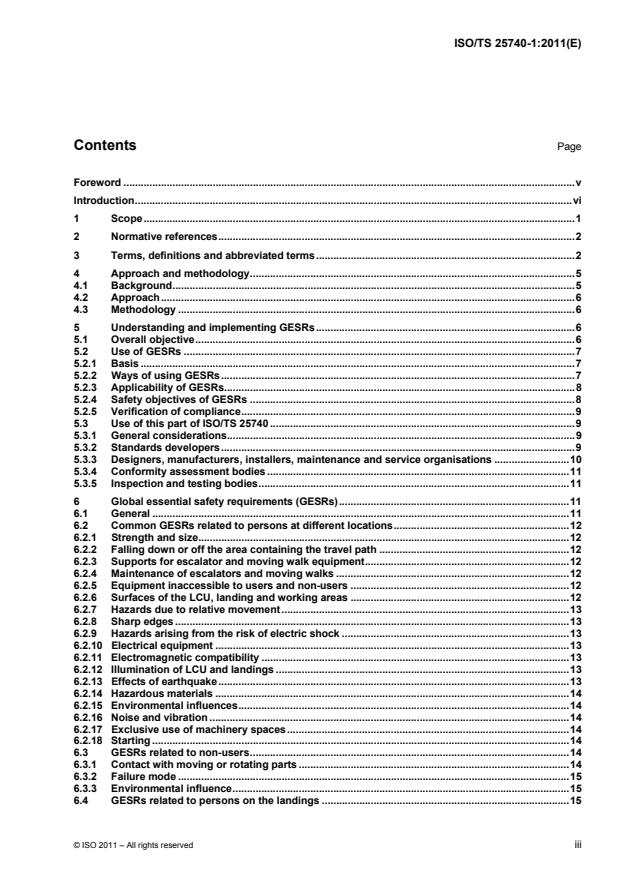
Contents Page
Foreword . v
Introduction . vi
1 Scope . 1
2 Normative references . 2
3 Terms, definitions and abbreviated terms . 2
4 Approach and methodology . 5
4.1 Background . 5
4.2 Approach . 6
4.3 Methodology . 6
5 Understanding and implementing GESRs . 6
5.1 Overall objective . 6
5.2 Use of GESRs . 7
5.2.1 Basis . 7
5.2.2 Ways of using GESRs . 7
5.2.3 Applicability of GESRs . 8
5.2.4 Safety objectives of GESRs . 8
5.2.5 Verification of compliance . 9
5.3 Use of this part of ISO/TS 25740 . 9
5.3.1 General considerations . 9
5.3.2 Standards developers . 9
5.3.3 Designers, manufacturers, installers, maintenance and service organisations . 10
5.3.4 Conformity assessment bodies . 11
5.3.5 Inspection and testing bodies . 11
6 Global essential safety requirements (GESRs) . 11
6.1 General . 11
6.2 Common GESRs related to persons at different locations . 12
6.2.1 Strength and size . 12
6.2.2 Falling down or off the area containing the travel path . 12
6.2.3 Supports for escalator and moving walk equipment . 12
6.2.4 Maintenance of escalators and moving walks . 12
6.2.5 Equipment inaccessible to users and non-users . 12
6.2.6 Surfaces of the LCU, landing and working areas . 12
6.2.7 Hazards due to relative movement . 13
6.2.8 Sharp edges . 13
6.2.9 Hazards arising from the risk of electric shock . 13
6.2.10 Electrical equipment . 13
6.2.11 Electromagnetic compatibility . 13
6.2.12 Illumination of LCU and landings . 13
6.2.13 Effects of earthquake . 13
6.2.14 Hazardous materials . 14
6.2.15 Environmental influences . 14
6.2.16 Noise and vibration . 14
6.2.17 Exclusive use of machinery spaces . 14
6.2.18 Starting . 14
6.3 GESRs related to non-users . 14
6.3.1 Contact with moving or rotating parts . 14
6.3.2 Failure mode . 15
6.3.3 Environmental influence . 15
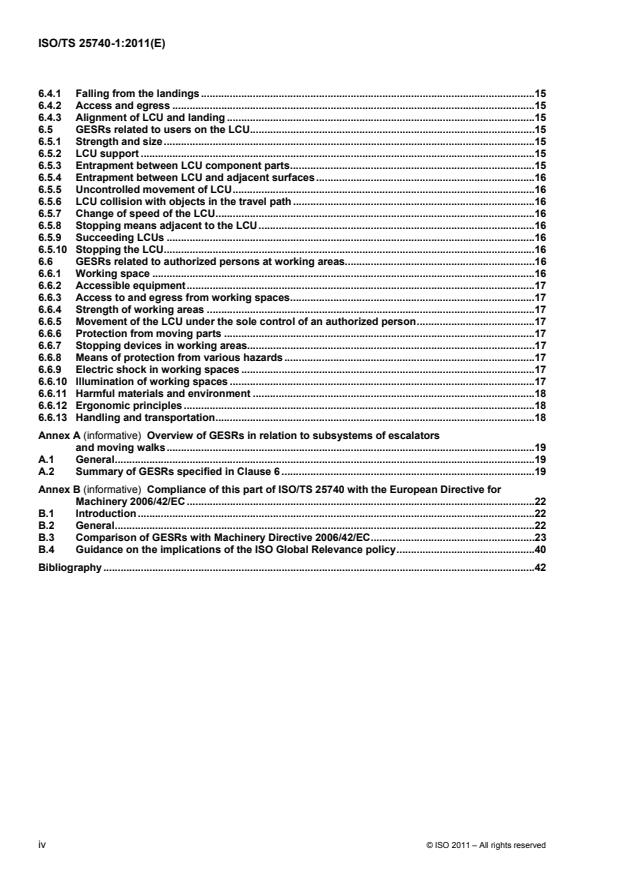
6.4 GESRs related to persons on the landings . 15
6.4.1 Falling from the landings .15
6.4.2 Access and egress .15
6.4.3 Alignment of LCU and landing .15
6.5 GESRs related to users on the LCU .15
6.5.1 Strength and size .15
6.5.2 LCU support .15
6.5.3 Entrapment between LCU component parts .15
6.5.4 Entrapment between LCU and adjacent surfaces .16
6.5.5 Uncontrolled movement of LCU .16
6.5.6 LCU collision with objects in the travel path .16
6.5.7 Change of speed of the LCU .16
6.5.8 Stopping means adjacent to the LCU .16
6.5.9 Succeeding LCUs .16
6.5.10 Stopping the LCU .16
6.6 GESRs related to authorized persons at working areas.16
6.6.1 Working space .16
6.6.2 Accessible equipment .17
6.6.3 Access to and egress from working spaces .17
6.6.4 Strength of working areas .17
6.6.5 Movement of the LCU under the sole control of an authorized person .17
6.6.6 Protection from moving parts .17
6.6.7 Stopping devices in working areas .17
6.6.8 Means of protection from various hazards .17
6.6.9 Electric shock in working spaces .17
6.6.10 Illumination of working spaces .17
6.6.11 Harmful materials and environment .18
6.6.12 Ergonomic principles .18
6.6.13 Handling and transportation .18
Annex A (informative) Overview of GESRs in relation to subsystems of escalators
and moving walks .19
A.1 General .19
A.2 Summary of GESRs specified in Clause 6 .19
Annex B (informative) Compliance of this part of ISO/TS 25740 with the European Directive for
Machinery 2006/42/EC .22
B.1 Introduction .22
B.2 General .22
B.3 Comparison of GESRs with Machinery Directive 2006/42/EC .23
B.4 Guidance on the implications of the ISO Global Relevance policy .40
Bibliography .42
iv © ISO 2011 – All rights reserved
Foreword
ISO (the International Organization for Standardization) is a worldwide federation of national standards bodies
(ISO member bodies). The work of preparing International Standards is normally carried out through ISO
technical committees. Each member body interested in a subject for which a technical committee has been
established has the right to be represented on that committee. International organizations, governmental and
non-governmental, in liaison with ISO, also take part in the work. ISO collaborates closely with the
International Electrotechnical Commission (IEC) on all matters of electrotechnical standardization.
International Standards are drafted in accordance with the rules given in the ISO/IEC Directives, Part 2.
The main task of technical committees is to prepare International Standards. Draft International Standards
adopted by the technical committees are circulated to the member bodies for voting. Publication as an
International Standard requires approval by at least 75 % of the member bodies casting a vote.
In other circumstances, particularly when there is an urgent market requirement for such documents, a
technical committee may decide to publish other types of normative document:
— an ISO Publicly Available Specification (ISO/PAS) represents an agreement between technical experts in
an ISO working group and is accepted for publication if it is approved by more than 50 % of the members of
the parent committee casting a vote;
— an ISO Technical Specification (ISO/TS) represents an agreement between the members of a technical
committee and is accepted for publication if it is approved by 2/3 of the members of the committee casting a
vote.
An ISO/PAS or ISO/TS is reviewed after three years in order to decide whether it will be confirmed for a
further three years, revised to become an International Standard, or withdrawn. If the ISO/PAS or ISO/TS is
confirmed, it is reviewed again after a further three years, at which time it must either be transformed into an
International Standard or be withdrawn.
Attention is drawn to the possibility that some of the elements of this document may be the subject of patent
rights. ISO shall not be held responsible for identifying any or all such patent rights.
ISO/TS 25740-1 was prepared by Technical Committee ISO/TC 178, Lifts, escalators and moving walks.
ISO/TS 25740 consists of the following parts, under the general title Safety requirements for escalators and
moving walks:
Part 1: Global essential safety requirements (GESR)
Future parts will address safety parameters for escalators and moving walks.
Introduction
After the publication of ISO/TR 14799-1 and ISO/TR 14799-2, discrepancies were noted in the safety
standards for escalators and moving walks. A need for the establishment of global essential safety
requirements (GESR) for escalators and moving walks was identified, which resulted in the publication of
ISO 14798. This methodology was a critical tool in the development of this Technical Specification on safety
requirements for escalators and moving walks.
The objective of this Technical Specification is to:
a) define a common global level of safety for all people using, or associated with, escalators and moving
walks;
b) facilitate innovation of escalators and moving walks not designed according to existing local, national or
regional safety standards, while maintaining equal levels of safety (if such innovations become state of
the art, they can then be integrated into the detailed local safety standard at a later date);
c) remove trade barriers.
NOTE ISO/TS 25740-2 will contain global essential safety parameters (GESPs) for escalators and moving walks that
should further assist in the use and implementation of the GESRs specified in this part of ISO/TS 25740.
Clause 4 gives the approach and methodology used in the development of this part of ISO/TS 25740.
Clause 5 gives instructions for the use and implementation of GESRs. The GESRs are given in Clause 6.
Each GESR specifies a safety objective, i.e. what is to be achieved rather than how to do it, in order to allow
innovation and development of future technologies.
Annex A gives an overview of GESRs in relation to subsystems of escalators and moving walks. Annex B
demonstrates compliance of this document with the European Directive for Machinery 2006/42/EC.
This part of ISO/TS 25740 is a basic safety standard according to the principles given in ISO/IEC Guide 51.
vi © ISO 2011 – All rights reserved
TECHNICAL SPECIFICATION ISO/TS 25740-1:2011(E)
Safety requirements for escalators and moving walks —
Part 1:
Global essential safety requirements (GESR)
1 Scope
This part of ISO/TS 25740:
specifies global essential safety requirements (GESRs) for escalators and moving walks, their
components and functions, and
establishes a system and provides methods for minimizing safety risks that might arise in the course of
the operation and use of, or work on, escalators and moving walks.
NOTE See Clause 5 regarding the use and application of this part of ISO/TS 25740.
This part of ISO/TS 25740 is applicable to escalators and moving walks that are intended to carry persons.
The escalators and moving walks to which this part of ISO/TS 25740 applies can:
a) be located in any permanent and fixed structure or building;
b) have any
1) rated load, size of load carrying unit (LCU) and speed, and
2) travel height;
c) be affected by fire in the environment of the LCU and weather conditions;
d) be misused.
This part of ISO/TS 25740 does not specifically cover:
1)
all needs of users with disabilities ;
risks arising from work on escalators and moving walks under construction or during alterations and
dismantling; vandalism; fire in the environment outside the LCU.
1) Although the GESRs specified in this part of ISO/TS 25740 have been identified and evaluated by risk assessment,
not all disabilities or combinations of such disabilities of users have necessarily been addressed.
2 Normative references
The following referenced documents are indispensable for the application of this document. For dated
references, only the edition cited applies. For undated references, the latest edition of the referenced
document (including any amendments) applies.
ISO/IEC Guide 51:1999, Safety aspects — Guidelines for their inclusion in standards
ISO 14798, Lifts (elevators), escalators and moving walks — Risk assessment and reduction methodology
3 Terms, definitions and abbreviated terms
For the purposes of this document, the following terms and definitions apply.
3.1
authorized person
suitably trained person with authorization to access restricted areas of escalators and moving walks
(e.g. machinery spaces, separate machine rooms) and to work there for the purpose of inspection, testing and
maintenance
3.2
cause
circumstance, condition, event or action that in a hazardous situation contributes to the production of an effect
[ISO 14798:2009, definition 2.1]
3.3
control
system that governs the starting, acceleration, speed, deceleration and/or stopping of the LCU
3.4
corrective action
action taken to reduce risk
3.5
electromagnetic compatibility
EMC
degree of immunity to incident electromagnetic radiation and level of emitted electromagnetic radiation of
electrical apparatus
3.6
ESR
essential safety requirement
requirement intended to eliminate or sufficiently mitigate the risk of harm to users, non-users, and authorized
persons using or associated with escalators and moving walks
3.7
GESR
global essential safety requirement
globally agreed upon essential safety requirement
3.8
harm
physical injury or damage to the health of people, or damage to property or the environment
[ISO/IEC Guide 51:1999, definition 3.3]
2 © ISO 2011 – All rights reserved
3.9
harmful event
occurrence in which a hazardous situation results in harm
[ISO/IEC Guide 51:1999, definition 3.4]
3.10
hazard
potential source of harm
NOTE The term “hazard” can be qualified in order to define its origin or the nature of the expected harm (e.g. electric
shock hazard, crushing hazard, cutting hazard, toxic hazard, fire hazard, drowning hazard).
[ISO/IEC Guide 51:1999, definition 3.5]
3.11
hazardous situation
circumstance in which people, property or the environment are exposed to one or more hazards
[ISO/IEC Guide 51:1999, definition 3.6]
3.12
enclosure of the travel path
structural elements which isolate the travel path from all other areas or space
3.13
incident
effect
event or occurrence, which can, but does not necessarily, create a risk of harm, including possible risks due to
shearing, crushing, falling, impact, trapping, fire, electric shock, exposure to weather etc.
3.14
landing
floor, balcony or platform used to receive and discharge persons from the LCU
3.15
escalator
power-driven, inclined, continuous moving stairway, including guards adjacent to the travel path, used for
raising or lowering persons in which the user carrying surface of the LCU (e.g. steps) remains horizontal
3.16
moving walk
power-driven installation for the conveyance of persons, including guards adjacent to the travel path, in which
the user carrying surface of the LCU remains parallel to its direction of motion and is uninterrupted
(e.g. pallets, belt)
3.17
LCU
load carrying unit
step, pallet or belt designed to carry persons for the purpose of transportation
3.18
machinery
escalator or moving walk machine(s) mechanisms and associated equipment
3.19
maintenance
process of examination, lubrication, cleaning, adjustments, repair and replacement of parts of escalators and
moving walks to ensure the safe and intended functioning of escalators and moving walks and its components
after the completion of the installation and throughout its life cycle
3.20
non-user
person in the vicinity of an escalator or moving walk who is not intending to access or use it
3.21
protective measure
means used to reduce risk
[ISO 14798:2009, definition 2.8]
NOTE 1 Protective measures include risk reduction by inherently safe design, protective devices, personal protective
equipment, information for use and installation, and training.
NOTE 2 See also definition for “corrective actions” in 3.4.
3.22
rated load
load that the escalator or moving walk is designed to move
3.23
relative movement
situation where a component of an escalator or moving walk moves in the vicinity of other components of
escalators or moving walks that are stationary, or that move at a different speed or in a different direction; also
a situation where a component of an escalator or moving walk moves in the vicinity of a structure where
persons might be present
EXAMPLE Building floor surrounding the escalator or moving walk.
3.24
risk
combination of the probability of occurrence of harm and the severity of that harm
[ISO/IEC Guide 51:1999, definition 3.2]
3.25
risk analysis
systematic use of available information to identify hazards and to estimate the risk
[ISO/IEC Guide 51:1999, definition 3.10]
NOTE This method aims at systematically identifying and assessing hazards, evaluating risks and recommending
risk reduction measures.
3.26
risk assessment
overall process comprising a risk analysis and a risk evaluation
[ISO/IEC Guide 51:1999, definition 3.12]
3.27
risk evaluation
consideration of the risk analysis results to determine if the risk reduction is required
[ISO 14798:2009, definition 2.13]
4 © ISO 2011 – All rights reserved
3.28
severity
qualitative measure of the worst possible incident (effect) that could be caused by a specific hazard
3.29
transportation
process whereby persons step onto a moving LCU, which then travels from one landing to another landing,
where the person exits the LCU
3.30
travel path
path and related space within which the LCU travels between the landings
3.31
uncontrolled movement
situation where
LCU moves when the escalator or moving walk was to remain stationary, or
LCU travels at a speed that is out of control of the means designed and intended to control the LCU
speed during operation.
EXAMPLE 1 LCU starts to move, due to failure of, or breakdown in, escalator or moving walk components, such as
speed control, drive or brake system.
EXAMPLE 2 The LCU speed exceeds its designed speed or does not decelerate or stop as intended, due to failure of,
or breakdown in, components of an escalator or moving walk, such as speed control, drive or brake system.
3.32
user
person using the escalator or moving walk for the purpose of transportation
3.33
working area or space
area or space defined for use by authorized persons to perform maintenance, inspection or testing of an
escalator or moving walk
4 Approach and methodology
4.1 Background
4.1.1 ISO 9589 specifies the building dimensions necessary to permit installation of escalators and moving
walks.
4.1.2 In order to facilitate further standardization of escalator and moving walk installations and components,
ISO/TC 178 carried out extensive comparison of regional and national safety standards and codes for
escalators and moving walks. The results were published in ISO/TR 14799. This Technical Report gave
directions for possible harmonization of several specific design and safety related rules in the regional and
national standards. No agreement among the experts could be reached for global harmonization of most rules,
mainly for the following reasons:
a) the compared standards and codes were based on different assumptions and experience, written at
different stages of industry development, without using a consistent methodology and procedures as
recommended in ISO/IEC Guide 51;
b) they were written in prescriptive rather than performance language.
4.1.3 It further became clear that prescriptive standards not only continuously lag behind the development
of escalator and moving walk technologies and the state of the art, but present impediments to the progress
and innovation of industry. Differences in regional and national safety requirements affecting the designs of
escalators or moving walks also pose barriers to free trade. Therefore, a new approach in the development of
standards for escalators and moving walks affecting safety shall be taken.
4.2 Approach
4.2.1 This Technical Specification has been developed as a product safety standard. See 7.1 of
ISO/IEC Guide 51 for the definition of the term “product safety standard”.
4.2.2 The intention was to develop essential safety requirements (ESRs) for escalators and moving walks.
In broad terms, the escalator or moving walk is defined as a power-driven unit, including guards adjacent to
the travel path, which carries persons from one landing to another, without any design constraints such as
those that are usually specified in the regional or national escalator and moving walk standards.
Consequently, a load carrying unit (LCU) of an escalator or moving walk in this document is not necessarily a
platform with fully enclosed sides. The space in which the LCU travels is not necessarily fully enclosed as may
be defined in national standards.
4.2.3 By taking this approach and by using the systematic risk analysis and assessment process in
accordance with ISO 14798, it was possible to establish ESRs for escalators and moving walks without
imposing restrictions on the designs of, or materials and technologies used in, the escalators or moving walks.
NOTE The types of escalator and moving walk covered in this part of ISO/TS 25740 are described in the Scope.
4.3 Methodology
Following the risk analysis and assessment process set out in ISO/IEC Guide 51 and the methodology
specified in ISO 14798, the working group
a) identified all safety risk scenarios, including hazardous situations, harmful events (cause), effect and
harm, that could arise in all stages and conditions of the operation and use of escalators and moving
walks;
b) estimated and evaluated the risk;
c) formulated ESRs when the risks required mitigation.
NOTE Table 1 gives examples of risk scenarios related to several GESRs.
5 Understanding and implementing GESRs
5.1 Overall objective
5.1.1 This part of ISO/TS 25740 may be used on its own, independently from future publications in this
series, as an effective method of providing safety on escalators and moving walks.
5.1.2 Clause 6 contains a complete set of safety objectives for escalators and moving walks in the form of
global essential safety requirements (GESRs), which shall be taken into consideration when mitigating safety
risks that escalators and moving walks can present.
5.1.3 The objectives of the GESRs in Clause 6 are to:
a) introduce a universal approach to identifying and mitigating potential safety risks on new designs of
components for escalators and moving walks that use new technologies, materials or concepts that are
not adequately addressed in existing standards;
b) stimulate harmonization of existing safety standards for escalators and moving walks.
6 © ISO 2011 – All rights reserved
Table 1 — Examples of risk scenarios related to GESRs
Applicable GESR
Example risk scenarios Proposed solution
(see Clause 6)
Users are on a moving LCU; a user extends hand or protrudes foot Prevent exposure to 6.2.7 Hazards due to
out beyond the LCU perimeters; the hand or foot is engaged with shearing, crushing or relative movement
external escalator objects and becomes sheared, crushed or cut. abrasion hazards when
Users and non-users shall
travelling on the LCU.
be protected from the effects
of falling, shearing, crushing
Users are preparing to enter or exit the LCU. People are crushed and Prevent exposure to
sheared or destabilized, possibly resulting in an injury if the person shearing, crushing or or abrasion, or other injuries
due to:
falls. abrasion hazards when
entering/exiting the LCU.
a) movement of the LCU
and other components
Non-users are at the floor area in the vicinity of the escalator entrance Prevent exposure to
moving in concert with
or at the floor around the LCU travel path. Persons can fall, or extend shearing, crushing or
the LCU relative to
hand or protrude foot towards, and engage, the moving LCU or any abrasion hazards when
stationary objects;
other escalator equipment; hand or foot is sheared, crushed or cut. located at the floor area in
the vicinity of an operating
b) relative movement of the
escalator or moving walk.
escalator or moving walk
component parts.
There are no balustrades between the LCU travel path and floors Wherever there is risk of 6.2.2 Falling down or off
surrounding the travel path. If a person leans over the LCU the person people falling down or off the the area containing the
can fall down. LCU, adequate guards travel path
should be provided on the
Means shall be provided to
sides.
prevent users, non-users
If guards or balustrades are provided but have no adequate strength,
and authorized persons from
a person could lean against such guards or balustrades, break
falling down or off the area
through them and fall down.
containing the travel path of
the LCU and related
equipment.
5.1.4 The objectives of the GESRs contained in this part of ISO/TS 25740 shall be followed. Changes in the
state of the art shall not adversely affect the required level of safety.
5.1.5 A GESR states only the safety objective, or what outcomes are required, not how to accomplish that
objective. Therefore, in order to achieve the safety objective of a GESR, appropriate design of components
and functions of escalators and moving walks shall be selected and their compliance with the GESR shall be
verified. In other words, the ability of the selected components or functions to eliminate or sufficiently mitigate
the safety risks shall be demonstrated.
5.2 Use of GESRs
5.2.1 Basis
Each GESR specified in Clause 6 was established after performing the risk assessment of one or more risk
scenarios that can result in harm to persons (see Table 1). Consequently, when assessing safety of an
escalator or moving walk or its components or function, all risk scenarios shall be analysed and applicable
GESRs shall be identified.
NOTE Risk assessment was carried out in accordance with the principles of ISO 14798.
5.2.2 Ways of using GESRs
With respect to a specific task affecting safety of escalators and moving walks, such as designing an escalator
or moving walk, or their components, GESRs can be used in two ways:
one can begin with the risk analysis of risk scenarios related to the task in order to identify the applicable
GESRs as in 5.2.2.2, or
one can begin with a review of all GESRs in order to identify those that could be applicable to the task, as
in 5.2.2.3.
NOTE In addition to designing, tasks could include installing or servicing of, or writing design-prescriptive safety
standards for escalators and moving walks or components thereof.
5.2.2.2 When designing an escalator or moving walk or its components, a review of the design should be
made in which all possible risk scenarios are formulated. This is done by applying risk analysis and
assessment in order to find out which, if any, GESRs are applicable to the design. All possible risk scenarios
that could occur during operation and use should be considered, as well as during the maintenance or
inspection of the escalator or moving walk.
The risk scenarios shall include specification of all possible hazardous situations, combined with all possible
harmful events (causes), effects and possible levels of harm. The risk analysis of a scenario shall be followed
by the process of risk estimation and evaluation in accordance with the methodology specified in ISO 14798.
As long as a risk is assessed as not acceptable, the designer shall continue to improve the design or
implement other protective measures until the applicable GESR has been fully complied with.
EXAMPLE By following this process, risk scenarios similar to those in the first three examples in Table 1 could be
formulated and it could be concluded that there is a possibility of injury to persons exposed to shearing, crushing or
abrasion hazards. The assessment of the risk will indicate that the risk needs further mitigation, which can be achieved by
changing the design or by implementing other protective measures in order to comply with 6.2.7.
NOTE 1 For practical use of GESRs, see 5.3.
NOTE 2 Rationales for GESRs are given in Clause 6, following each GESR. They should assist in the understanding of
the intent and use of GESRs.
5.2.2.3 The process can start with a review of GESRs specified in Clause 6. In this case, one considers
the design or actual installation of the escalator or moving walk or its components with the intention of
identifying those GESRs that can be applicable to the design, installation or component. Compliance with
each identified GESR shall be assessed. If compliance is not self-evident, risk analysis and assessment shall
be completed to demonstrate compliance.
EXAMPLE In the case of the GESR in 6.2.7 in Table 1, the design or installation of an escalator or moving walk
would be observed to find out whether any person travelling on the LCU, entering or exiting the LCU, being around the
travel path of the escalator or moving walk, or being in any similar situation could be exposed to shearing, crushing,
abrasion or a similar hazard that could cause harm.
5.2.3 Applicability of GESRs
When analysing the safety of the design of an escalator or moving walk or a component, or when writing a
design prescriptive requirement or standard, the applicability of all GESRs should be determined. Only
systematic descriptions of all possible risk scenarios, combined with the risk assessment of all scenarios
(see ISO 14798), determines applicability of individual GESRs.
NOTE The GESR in 6.2.13, related to the effects of earthquakes on escalators and moving walks is an example of
GESRs that are not applicable to every escalator or moving walk.
5.2.4 Safety objectives of GESRs
5.2.4.1 GESRs are not “corrective actions” or “protective measures” as defined in ISO 14798. A GESR
states only the safety objective; it does not specify how to achieve the objective. Therefore, when designing
an escalator or moving walk, appropriate components and functions shall be selected in terms of size,
dimensions, strength, force, energy, material, acceleration, reliability of performance of safety related parts,
etc., as applicable. Also, their ability to eliminate or sufficiently mitigate risks in order to achieve compliance
with the objective specified in the GESR shall be established.
8 © ISO 2011 – All rights reserved
EXAMPLE In the case of the first three examples in Table 1, in order to eliminate or mitigate the risks to persons on
the LCU, in the landing area and in the area around the LCU travel path, as described in the example, one would have to
determine
the provision of a minimum height balustrade on the sides of the LCU;
the maximum size of perforations (openings) in the balustrade and guards, if any;
the maximum permissible force, speed, kinetic energy, if any, on the person.
NOTE There are additional GESRs applicable to the balustrades on LCU sides (see 6.2.2) and LCU travel paths, in
relation to the risk of persons falling into the travel path from the LCU.
5.2.4.2 When assessing the risk on an escalator or moving walk, it is recommended that the escalator or
moving walk be divided into subsystems and all risk scenarios be formulated and all risks be assessed in
relation to one subsystem at a time. However, one GESR can be applicable to more than one subsystem
(see Annex A).
5.2.5 Verification of compliance
In order to establish the ability of a selected component or function of an escalator or moving walk to eliminate
or sufficiently mitigate a risk, as required in 5.2.4, risk analysis in accordance with ISO 14798 shall be carried
out.
Furthermore, a component can be assessed as being able to eliminate or sufficiently mitigate a risk, but the
same component can create a new hazard, or the component can incorporate elements that could fail and
make the protective function of the whole component void. For that reason, the reliability of components, built-
in elements and functions to perform as intended shall be established through the risk analysis and
assessment process.
EXAMPLE A failure of a solid state or software element in the LCU speed-control components, which are provided
for compliance with the GESR in 6.5.5, can make the component non-functional, allowing the LCU to move out of control.
5.3 Use of this part of ISO/TS 25740
5.3.1 General considerations
This part of ISO/TS 25740 provides a uniform process for assessing the safety of escalators and moving
walks. The GESRs are intended for use by:
a) developers of safety or safety-related standards for escalators and moving walks (this can be a product
safety standard or a product standard containing safety aspects as defined in ISO/IEC Guide 51:1999,
7.1);
b) designers of escalators and moving walks, manufacturers and installers, and maintenance and service
organizations;
c) independent third-party conformity assessment bodies (if any);
A
d) inspection and testing bodies and similar organisations.
5.3.2 Standards developers
5.3.2.1 Standards developers, e.g. Technical Committees, should use GESRs when:
a) reviewing, updating or revising existing standards;
b) formulating new standards, including those related to new innovative designs and concepts of escalators
and moving walks or their components not previously covered in published standards.
5.3.2.2 When reviewing, updating or revising existing standards, standards developers should refer to the
applicable GESRs to verify that the existing standards provide sufficient rules to ensure full compliance with
the safety objectives in the GESRs.
5.3.2.3 New standards relating to the safety of escalators or moving walks can be performance-type
(goal-oriented) or design-prescriptive type standards. In either case, each GESR should be considered,
adopted or referenced and used as a basis when specifying safety requirements.
EXAMPLE The GESR in 6.5.2 states “means shall be provided to support the fully loaded LCUs”. Based on this
GESR, which addresses the means supporting the LCU (e.g. supporting structure and building supports), standards
developers should:
in the case of performance-type standards, establish more specific performance requirements for the LCU support
means, such as the minimum working life, resistance to environmental conditions, inspection criteria;
in the case of a design-prescriptive-type standard, specify design requirements, such as the minimum number and
type of supports, minimum safety factor, maximum deflection requirements.
5.3.3 Designers, manufacturers, installers, maintenance and service organisations
5.3.3.1 Escalator and moving walk components and functions
Escalator and moving walk components and functions should be designed, manufactured, installed, adjusted
and maintained in accordance with:
a) locally adopted standards for escalators and moving walks or other applicable standards intended to meet
the protection level required by the GESRs,
b) this part of ISO/TS 25740, in which case the selected components and
...