


ISO 1467:2024
(Main)General purpose push-pull single-pole circuit-breakers for aircraft — Performance requirements
General purpose push-pull single-pole circuit-breakers for aircraft — Performance requirements
This document specifies the performance requirements for push-pull single-pole trip-free circuit-breakers having an inverse time/current characteristic, of normal ratings up to and including 35 A, for use in nominal 28 V d.c. and/or 115 V single-phase 400 Hz a.c. line to neutral circuits.
Disjoncteurs unipolaires à bouton-poussoir d'usage courant utilisés à bord des aéronefs — Caractéristiques
General Information
Relations
Standards Content (Sample)
International
Standard
ISO 1467
Second edition
General purpose push-pull single-
2024-04
pole circuit-breakers for aircraft —
Performance requirements
Disjoncteurs unipolaires à bouton-poussoir d'usage courant
utilisés à bord des aéronefs — Caractéristiques
Reference number
© ISO 2024
All rights reserved. Unless otherwise specified, or required in the context of its implementation, no part of this publication may
be reproduced or utilized otherwise in any form or by any means, electronic or mechanical, including photocopying, or posting on
the internet or an intranet, without prior written permission. Permission can be requested from either ISO at the address below
or ISO’s member body in the country of the requester.
ISO copyright office
CP 401 • Ch. de Blandonnet 8
CH-1214 Vernier, Geneva
Phone: +41 22 749 01 11
Email: copyright@iso.org
Website: www.iso.org
Published in Switzerland
ii
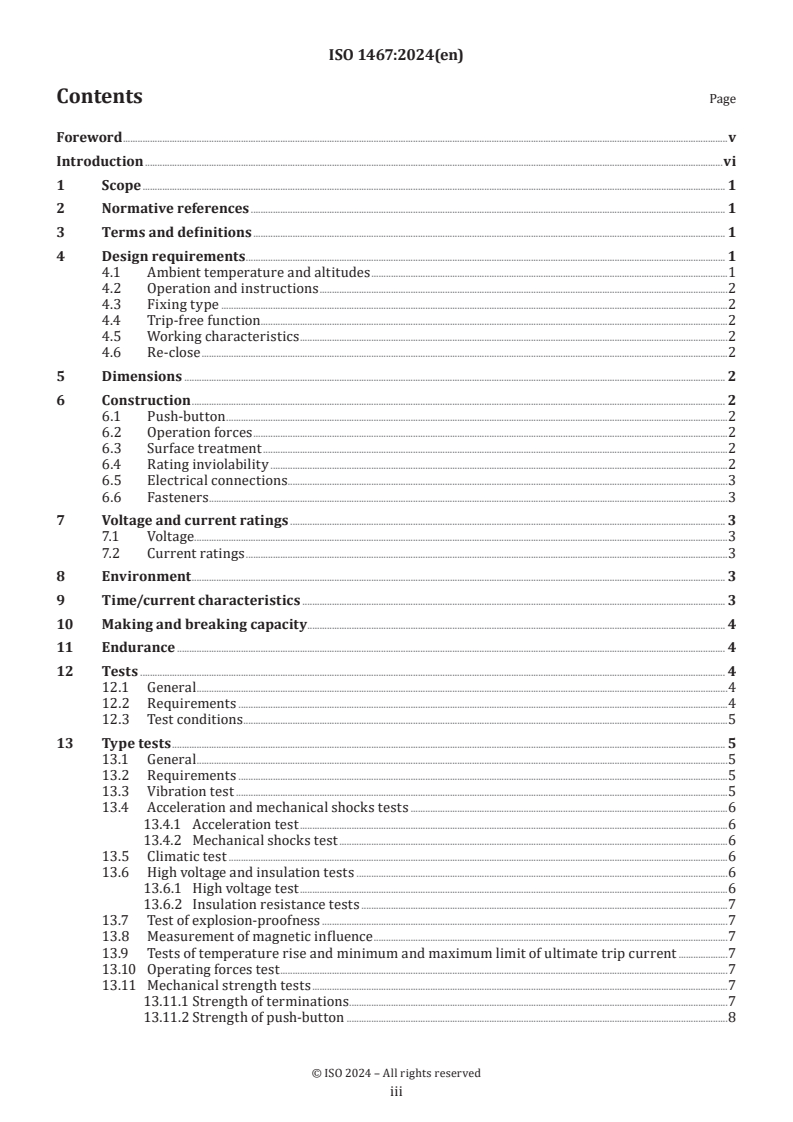
Contents Page
Foreword .v
Introduction .vi
1 Scope . 1
2 Normative references . 1
3 Terms and definitions . 1
4 Design requirements . 1
4.1 Ambient temperature and altitudes .1
4.2 Operation and instructions .2
4.3 Fixing type .2
4.4 Trip-free function.2
4.5 Working characteristics .2
4.6 Re-close .2
5 Dimensions . 2
6 Construction . 2
6.1 Push-button .2
6.2 Operation forces .2
6.3 Surface treatment .2
6.4 Rating inviolability .2
6.5 Electrical connections.3
6.6 Fasteners .3
7 Voltage and current ratings . 3
7.1 Voltage .3
7.2 Current ratings .3
8 Environment . 3
9 Time/current characteristics . 3
10 Making and breaking capacity . 4
11 Endurance . 4
12 Tests . 4
12.1 General .4
12.2 Requirements .4
12.3 Test conditions .5
13 Type tests . 5
13.1 General .5
13.2 Requirements .5
13.3 Vibration test .5
13.4 Acceleration and mechanical shocks tests .6
13.4.1 Acceleration test .6
13.4.2 Mechanical shocks test .6
13.5 Climatic test .6
13.6 High voltage and insulation tests .6
13.6.1 High voltage test .6
13.6.2 Insulation resistance tests .7
13.7 Test of explosion-proofness .7
13.8 Measurement of magnetic influence .7
13.9 Tests of temperature rise and minimum and maximum limit of ultimate trip current .7
13.10 Operating forces test .7
13.11 Mechanical strength tests .7
13.11.1 Strength of terminations . . .7
13.11.2 Strength of push-button .8
iii
13.11.3 Strength of panel mounting bush .8
13.11.4 Tests .8
13.12 Test of calibration of overload trip .8
13.12.1 General .8
13.12.2 Additional requirements .8
13.13 Overload and re-closure test .8
13.13.1 General .8
13.13.2 Requirement .9
13.13.3 Tests .9
13.14 Endurance tests .9
13.14.1 General .9
13.14.2 D.c. test conditions .9
13.14.3 A.c. test conditions .9
13.14.4 Requirements .9
13.14.5 Tests .10
13.15 Making and breaking capacity tests .10
13.15.1 General .10
13.15.2 D.c. test conditions .11
13.15.3 A.c test conditions . 12
13.15.4 Tests . 12
13.16 Test of self re-closing at low temperature . 12
14 Production tests .12
14.1 Calibration tests . 12
14.1.1 General . 12
14.1.2 Voltage drop tests . 12
14.1.3 Time/current characteristics tests . 12
14.1.4 Tests . 12
14.1.5 Holding current test . 13
14.1.6 Tests . 13
14.2 High voltage and insulation tests . 13
15 Quality tests .13
15.1 Selection of samples . 13
15.2 Tests of minimum and maximum limit of ultimate trip current . 13
15.3 Operating force test . 13
15.4 Test of calibration of overload trip . 13
15.5 Vibration test . 13
15.6 Strip examination and report . 13
16 Declarations .13
17 Marking . . 14
17.1 General .14
17.2 Rated current marking . . .14
iv
Foreword
ISO (the International Organization for Standardization) is a worldwide federation of national standards
bodies (ISO member bodies). The work of preparing International Standards is normally carried out through
ISO technical committees. Each member body interested in a subject for which a technical committee
has been established has the right to be represented on that committee. International organizations,
governmental and non-governmental, in liaison with ISO, also take part in the work. ISO collaborates closely
with the International Electrotechnical Commission (IEC) on all matters of electrotechnical standardization.
The procedures used to develop this document and those intended for its further maintenance are described
in the ISO/IEC Directives, Part 1. In particular, the different approval criteria needed for the different types
of ISO document should be noted. This document was drafted in accordance with the editorial rules of the
ISO/IEC Directives, Part 2 (see www.iso.org/directives).
ISO draws attention to the possibility that the implementation of this document may involve the use of (a)
patent(s). ISO takes no position concerning the evidence, validity or applicability of any claimed patent
rights in respect thereof. As of the date of publication of this document, ISO had not received notice of (a)
patent(s) which may be required to implement this document. However, implementers are cautioned that
this may not represent the latest information, which may be obtained from the patent database available at
www.iso.org/patents. ISO shall not be held responsible for identifying any or all such patent rights.
Any trade name used in this document is information given for the convenience of users and does not
constitute an endorsement.
For an explanation of the voluntary nature of standards, the meaning of ISO specific terms and expressions
related to conformity assessment, as well as information about ISO's adherence to the World Trade
Organization (WTO) principles in the Technical Barriers to Trade (TBT), see www.iso.org/iso/foreword.html.
This document was prepared by Technical Committee ISO/TC 20, Aircraft and space vehicles, Subcommittee
SC 1, Aerospace electrical requirements.
This second edition cancels and replaces the first edition (ISO 1467:1973), which has been technically
revised.
The main changes are as follows:
— ambient temperature and altitudes have been updated;
— operation forces have been updated;
— current ratings have been updated;
— time/current characteristics have been updated;
— acceleration and shocks test have been updated;
— high voltage and insulation tests have been updated;
— tests of temperature rise and minimum and maximum limit of ultimate trip current have been updated;
— operating forces test have been updated;
— mechanical strength tests have been updated;
— overload and re-closure test have been updated;
— endurance tests have been updated.
Any feedback or questions on this document should be directed to the user’s national standards body. A
complete listing of these bodies can be found at www.iso.org/members.html.
v
Introduction
This document provides performance requirements of the general purpose push-pull single-pole circuit-
breakers normal ratings up to and including 35 A for aircraft.
The purpose of this document are as follows.
a) To standardize the requirements for push-pull single-pole trip-free circuit-breakers normal ratings up
to and including 35 A that are physically and environmentally diversified.
b) To provide the applicable document for push-pull single-pole trip-free circuit-breakers.
In order to satisfy the purpose of this document, requirements such as those for physical, environmental
and individual items are specified in accordance with the detail requirements that are issued individually.
vi
International Standard ISO 1467:2024(en)
General purpose push-pull single-pole circuit-breakers for
aircraft — Performance requirements
1 Scope
This document specifies the performance requirements for push-pull single-pole trip-free circuit-breakers
having an inverse time/current characteristic, of normal ratings up to and including 35 A, for use in nominal
28 V d.c. and/or 115 V single-phase 400 Hz a.c. line to neutral circuits.
2 Normative references
The following documents are referred to in the text in such a way that some or all of their content constitutes
requirements of this document. For dated references, only the edition cited applies. For undated references,
the latest edition of the referenced document (including any amendments) applies.
ISO 2635, Aircraft — Conductors for general purpose aircraft electrical cables and aerospace applications —
Dimensions and characteristics
ISO 530, Aircraft — General purpose push-pull single-pole circuit-breakers — Dimensions
ISO 1540, Aerospace — Characteristics of aircraft electrical systems
ISO 7137, Aircraft — Environmental conditions and test procedures for airborne equipment
3 Terms and definitions
For the purposes of this document, the following terms and definitions apply.
ISO and IEC maintain terminology databases for use in standardization at the following addresses:
— ISO Online browsing platform: available at https:// www .iso .org/ obp
— IEC Electropedia: available at https:// www .electropedia .org/
3.1
push-pull single-pole circuit-breaker
circuit-breaker with a single button to trip and reset the breaker, by pushing to make and pulling to break
3.2
trip-free circuit-breaker
circuit-breaker so designed that holding the push-button in the closed position does not override the tripping
mechanism and does not permit subsequent closure of the contacts, until the push-button has been returned
to the open position and the tripping mechanism has reset
4 Design requirements
4.1 Ambient temperature and altitudes
The circuit-breaker shall be suitable for use at specified ambient temperatures and altitudes. There are
two temperature ranges: −55 °C to +70 °C or −55 °C to +125 °C; and the maximum altitude according to the
product standard shall not be less than 22 000 m.
4.2 Operation and instructions
The circuit-breaker shall be operated by a single button, perpendicular to the plane of the mounting panel,
pushed to make and pulled to break the circuit. The portion of the button visible when the circuit-breaker is
in the closed position shall be black. A white band on the button shall be exposed when the circuit-breaker is
in the open position.
4.3 Fixing type
The circuit-breaker shall be suitable for through-panel mounting, preferably by single-hole fixing, and shall
operate satisfactorily when mounted in any attitude.
4.4 Trip-free function
The circuit-breaker shall be trip-free and shall incorporate an automatic over-current tripping device.
4.5 Working characteristics
At the values of current stated in Clause 9, the circuit-breaker contacts shall open automatically within the
time limits stated and the manual operating device shall move to the open or off position.
4.6 Re-close
The circuit-breaker shall be so designed that, after tripping on overload, it cannot re-close automatically.
5 Dimensions
The envelope and fixing dimensions for the circuit-breakers should conform to ISO 530.
6 Construction
6.1 Push-button
The push-button shall be insulated from all current-carrying parts and shall not remain in an intermediate
position or give a false indication.
6.2 Operation forces
The circuit-breaker shall be so
...
Questions, Comments and Discussion
Ask us and Technical Secretary will try to provide an answer. You can facilitate discussion about the standard in here.
Loading comments...