


ISO 13628-10:2005
(Main)Petroleum and natural gas industries — Design and operation of subsea production systems — Part 10: Specification for bonded flexible pipe
Petroleum and natural gas industries — Design and operation of subsea production systems — Part 10: Specification for bonded flexible pipe
ISO 13628-10:2005 defines the technical requirements for safe, dimensionally and functionally interchangeable bonded flexible pipes that are designed and manufactured to uniform standards and criteria. Minimum requirements are specified for the design, material selection, manufacture, testing, marking and packaging of bonded flexible pipes, with reference to existing codes and standards where applicable. ISO 13628-10:2005 applies to bonded flexible pipe assemblies, consisting of segments of flexible pipe body with end fittings attached to both ends. ISO 13628-10:2005 applies to pipes with a design pressure greater than or equal to 1,5 MPa (15 bar). ISO 13628-10:2005 can be used for lower design pressure pipes, though the requirements of these pipes have not been specifically addressed. ISO 13628-10:2005 does not cover flexible pipes of unbonded structure nor to flexible pipe ancillary components and does not apply to flexible pipes for use in choke and kill line applications.. ISO 13628-10:2005 can be applied to flexible pipes that include non-metallic reinforcing layers, though no effort was made to address the specific and unique technological aspects of this product, and to a bonded construction pipe that includes a material or layer construction that is covered in ISO 13628-2. ISO 13628-10:2005 can be applied to flexible pipes for pile hammer, gas flare, water supply and jetting applications, though no effort was made to address the specific and unique technological aspects relating to each of these requirements.
Industries du pétrole et du gaz naturel — Conception et exploitation des systèmes de production immergés — Partie 10: Spécification pour canalisations flexibles composites
L'ISO 13628-10:2005 définit les exigences techniques applicables à des canalisations flexibles composites, sûres, interchangeables du point de vue dimensionnel et fonctionnel, qui sont conçues et fabriquées selon des normes et des critères uniformes. Elle spécifie des exigences minimales relatives à la conception, au choix des matériaux, à la fabrication, aux essais, au marquage et au conditionnement des canalisations flexibles composites, en faisant référence, le cas échéant, à des codes et normes existants. L'ISO 13628-10:2005 s'applique aux assemblages de canalisations flexibles composites constitués de tronçons de corps de canalisations flexibles munis de pièces d'extrémité fixées aux deux extrémités. L'ISO 13628-10:2005 s'applique aux canalisations dont la pression de calcul est supérieure ou égale à 1,5 MPa (15 bar). Elle peut être utilisée pour des canalisations ayant une pression de calcul plus faible, même si les exigences correspondantes n'ont pas été spécifiquement traitées. L'ISO 13628-10:2005 ne concerne pas les canalisations flexibles à structure non collée ni les canalisations flexibles destinées à être utilisées dans les applications de lignes de duse. L'ISO 13628-10:2005 peut être appliquée aux canalisations flexibles qui comprennent des couches de renforcement non métalliques, même si aucun effort n'a été entrepris pour traiter les aspects technologiques particuliers et uniques de ces produits, et aux canalisations composites qui comprennent un matériau ou une structure de couche couverte par l'ISO 13628-2. L'ISO 13628-10:2005 peut être appliquée à des canalisations flexibles utilisées pour des applications de marteau batteur, de torchère, d'alimentation en eau et d'ensouillage au jet, même si aucun effort n'a été entrepris pour traiter les aspects technologiques spécifiques et uniques correspondant à chacune de leurs exigences.
General Information
- Status
- Published
- Publication Date
- 02-Oct-2005
- Technical Committee
- ISO/TC 67/SC 4 - Drilling and production equipment
- Drafting Committee
- ISO/TC 67/SC 4/WG 6 - Subsea equipment
- Current Stage
- 9599 - Withdrawal of International Standard
- Start Date
- 08-Dec-2025
- Completion Date
- 12-Feb-2026
Relations
- Effective Date
- 09-Feb-2026
- Effective Date
- 09-Feb-2026
Overview
ISO 13628-10:2005 - "Petroleum and natural gas industries - Design and operation of subsea production systems - Part 10: Specification for bonded flexible pipe" defines minimum technical requirements for bonded flexible pipe used in subsea production systems. The standard sets out requirements for safe, dimensionally and functionally interchangeable bonded flexible pipe assemblies (pipe body segments with end fittings) with a design pressure ≥ 1.5 MPa (15 bar). It focuses on design, material selection, manufacture, testing, marking and packaging, and references existing codes where applicable.
Key topics and technical requirements
- Scope and product definition: Applies to bonded (composite) flexible pipes only - it does not cover unbonded flexible pipes (see ISO 13628-2) or ancillary components.
- Design requirements: Functional and structural design parameters, loads and load effects, and system-level design to ensure interchangeability and safe operation.
- Materials and qualification: Minimum material requirements, qualification and quality assurance processes for metallic and polymeric layers; can be applied to pipes with non‑metallic reinforcement (no specific technological details are addressed).
- Manufacturing: Processes including carcass preparation, elastomer winding, reinforcement layers, curing and special processes, plus manufacturing tolerances and repair procedures.
- Testing and acceptance: Factory Acceptance Tests (FATs) such as hydrostatic pressure tests, electrical continuity/resistance tests, vacuum and kerosene tests, and dimensional/gauge checks.
- Documentation, marking and packaging: Design reports, as‑built documentation, manufacturing quality plans, operation manuals, marking and packaging requirements for traceability and safe handling.
- Limitations & exclusions: Not intended for choke and kill lines; can be used for lower pressure pipes or for applications like risers, flowlines, jumpers, loading/discharge hoses, pile hammer or flare lines, but special technological aspects for those uses are not specifically addressed.
Practical applications
- Use for subsea flowlines, risers, jumpers, offshore loading and discharge hoses in oil & gas production (sweet and sour services, export and injection).
- Suitable for static and dynamic flexible pipe installations where bonded construction is preferred.
- Intended to provide a consistent basis for procurement, manufacturing and inspection of bonded flexible pipe assemblies.
Who should use this standard
- Subsea engineers, pipeline designers and integrity specialists
- Flexible pipe manufacturers and QA/QC teams
- Procurement and equipment specification authors for offshore projects
- Testing and inspection providers performing factory acceptance tests
Related standards
- ISO 13628-2 (unbonded flexible pipe systems)
- API RP 17B (guidelines on flexible pipes and ancillary components)
- API Spec 17K (inspiration/source for this ISO part)
ISO 13628-10:2005 - Petroleum and natural gas industries -- Design and operation of subsea production systems
ISO 13628-10:2005 - Industries du pétrole et du gaz naturel -- Conception et exploitation des systemes de production immergés
Get Certified
Connect with accredited certification bodies for this standard

ABS Quality Evaluations Inc.
American Bureau of Shipping quality certification.

Element Materials Technology
Materials testing and product certification.

ABS Group Brazil
ABS Group certification services in Brazil.
Sponsored listings
Frequently Asked Questions
ISO 13628-10:2005 is a standard published by the International Organization for Standardization (ISO). Its full title is "Petroleum and natural gas industries — Design and operation of subsea production systems — Part 10: Specification for bonded flexible pipe". This standard covers: ISO 13628-10:2005 defines the technical requirements for safe, dimensionally and functionally interchangeable bonded flexible pipes that are designed and manufactured to uniform standards and criteria. Minimum requirements are specified for the design, material selection, manufacture, testing, marking and packaging of bonded flexible pipes, with reference to existing codes and standards where applicable. ISO 13628-10:2005 applies to bonded flexible pipe assemblies, consisting of segments of flexible pipe body with end fittings attached to both ends. ISO 13628-10:2005 applies to pipes with a design pressure greater than or equal to 1,5 MPa (15 bar). ISO 13628-10:2005 can be used for lower design pressure pipes, though the requirements of these pipes have not been specifically addressed. ISO 13628-10:2005 does not cover flexible pipes of unbonded structure nor to flexible pipe ancillary components and does not apply to flexible pipes for use in choke and kill line applications.. ISO 13628-10:2005 can be applied to flexible pipes that include non-metallic reinforcing layers, though no effort was made to address the specific and unique technological aspects of this product, and to a bonded construction pipe that includes a material or layer construction that is covered in ISO 13628-2. ISO 13628-10:2005 can be applied to flexible pipes for pile hammer, gas flare, water supply and jetting applications, though no effort was made to address the specific and unique technological aspects relating to each of these requirements.
ISO 13628-10:2005 defines the technical requirements for safe, dimensionally and functionally interchangeable bonded flexible pipes that are designed and manufactured to uniform standards and criteria. Minimum requirements are specified for the design, material selection, manufacture, testing, marking and packaging of bonded flexible pipes, with reference to existing codes and standards where applicable. ISO 13628-10:2005 applies to bonded flexible pipe assemblies, consisting of segments of flexible pipe body with end fittings attached to both ends. ISO 13628-10:2005 applies to pipes with a design pressure greater than or equal to 1,5 MPa (15 bar). ISO 13628-10:2005 can be used for lower design pressure pipes, though the requirements of these pipes have not been specifically addressed. ISO 13628-10:2005 does not cover flexible pipes of unbonded structure nor to flexible pipe ancillary components and does not apply to flexible pipes for use in choke and kill line applications.. ISO 13628-10:2005 can be applied to flexible pipes that include non-metallic reinforcing layers, though no effort was made to address the specific and unique technological aspects of this product, and to a bonded construction pipe that includes a material or layer construction that is covered in ISO 13628-2. ISO 13628-10:2005 can be applied to flexible pipes for pile hammer, gas flare, water supply and jetting applications, though no effort was made to address the specific and unique technological aspects relating to each of these requirements.
ISO 13628-10:2005 is classified under the following ICS (International Classification for Standards) categories: 75.180.10 - Exploratory, drilling and extraction equipment. The ICS classification helps identify the subject area and facilitates finding related standards.
ISO 13628-10:2005 has the following relationships with other standards: It is inter standard links to EN ISO 13628-11:2008, EN ISO 23936-2:2011. Understanding these relationships helps ensure you are using the most current and applicable version of the standard.
ISO 13628-10:2005 is available in PDF format for immediate download after purchase. The document can be added to your cart and obtained through the secure checkout process. Digital delivery ensures instant access to the complete standard document.
Standards Content (Sample)
INTERNATIONAL ISO
STANDARD 13628-10
First edition
2005-10-01
Petroleum and natural gas industries —
Design and operation of subsea
production systems —
Part 10:
Specification for bonded flexible pipe
Industries du pétrole et du gaz naturel — Conception et exploitation des
systèmes de production immergés —
Partie 10: Spécification pour canalisations flexibles composites
Reference number
©
ISO 2005
PDF disclaimer
This PDF file may contain embedded typefaces. In accordance with Adobe's licensing policy, this file may be printed or viewed but
shall not be edited unless the typefaces which are embedded are licensed to and installed on the computer performing the editing. In
downloading this file, parties accept therein the responsibility of not infringing Adobe's licensing policy. The ISO Central Secretariat
accepts no liability in this area.
Adobe is a trademark of Adobe Systems Incorporated.
Details of the software products used to create this PDF file can be found in the General Info relative to the file; the PDF-creation
parameters were optimized for printing. Every care has been taken to ensure that the file is suitable for use by ISO member bodies. In
the unlikely event that a problem relating to it is found, please inform the Central Secretariat at the address given below.
© ISO 2005
All rights reserved. Unless otherwise specified, no part of this publication may be reproduced or utilized in any form or by any means,
electronic or mechanical, including photocopying and microfilm, without permission in writing from either ISO at the address below or
ISO's member body in the country of the requester.
ISO copyright office
Case postale 56 • CH-1211 Geneva 20
Tel. + 41 22 749 01 11
Fax + 41 22 749 09 47
E-mail copyright@iso.org
Web www.iso.org
Published in Switzerland
ii © ISO 2005 – All rights reserved
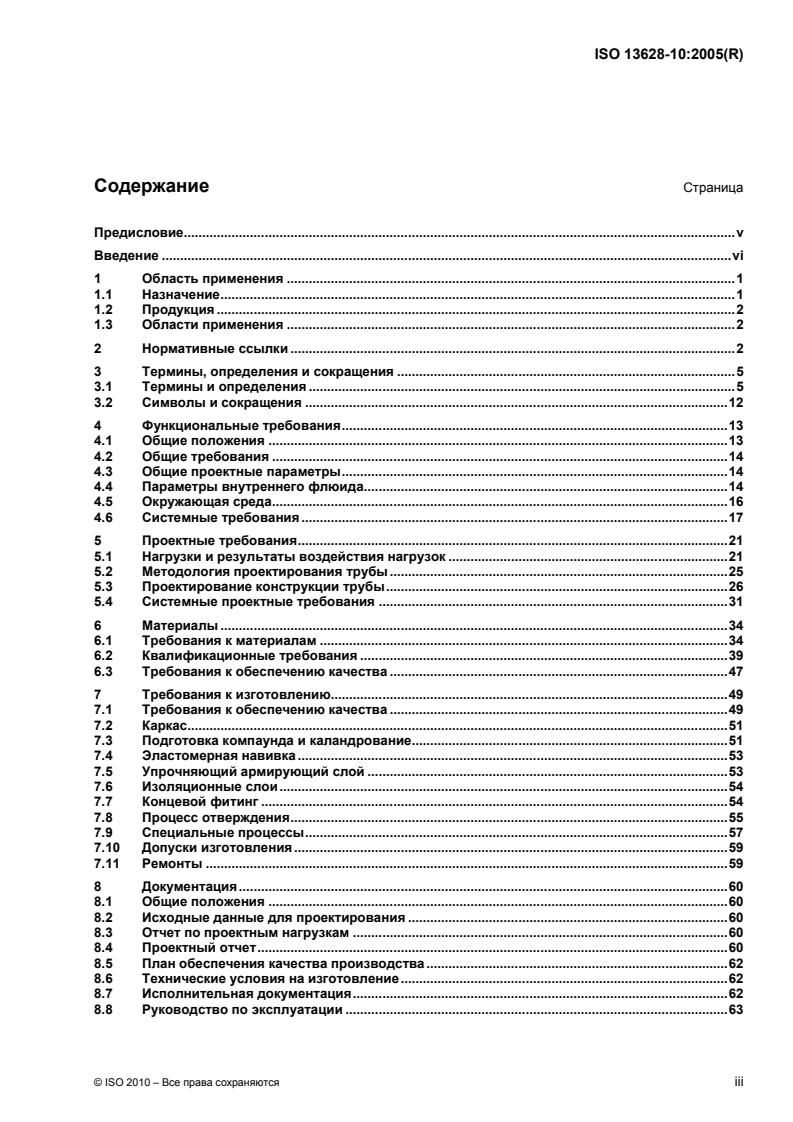
Contents Page
Foreword. v
Introduction . vi
1 Scope . 1
1.1 Purpose. 1
1.2 Products . 2
1.3 Applications . 2
2 Normative references . 2
3 Terms, definitions and abbreviations. 5
3.1 Terms and definitions. 5
3.2 Symbols and abbreviations . 10
4 Functional requirements. 11
4.1 General. 11
4.2 Overall requirements. 11
4.3 General design parameters . 12
4.4 Internal fluid parameters. 12
4.5 External environment . 14
4.6 System requirements . 14
5 Design requirements . 17
5.1 Loads and load effects. 17
5.2 Pipe design methodology . 20
5.3 Pipe structure design . 21
5.4 System design requirements. 26
6 Materials . 29
6.1 Material requirements. 29
6.2 Qualification requirements . 33
6.3 Quality assurance requirements . 39
7 Manufacturing requirements . 41
7.1 Quality assurance requirements . 41
7.2 Carcass . 42
7.3 Preparation of compound and calendering . 43
7.4 Elastomer winding. 44
7.5 Reinforcement armour layer. 45
7.6 Insulation layers. 45
7.7 End fitting . 45
7.8 Curing process. 47
7.9 Special processes. 48
7.10 Manufacturing tolerances . 50
7.11 Repairs. 50
8 Documentation. 51
8.1 General. 51
8.2 Design premise . 51
8.3 Design load report . 51
8.4 Design report. 51
8.5 Manufacturing quality plan . 52
8.6 Fabrication specification . 52
8.7 As-built documentation. 52
8.8 Operation manual . 53
9 Factory acceptance tests . 54
9.1 General . 54
9.2 Gauge test. 55
9.3 Hydrostatic pressure test. 55
9.4 Electrical continuity and resistance tests . 56
9.5 Kerosene test. 56
9.6 Vacuum test. 56
10 Marking and packaging . 57
10.1 Marking. 57
10.2 Packaging . 57
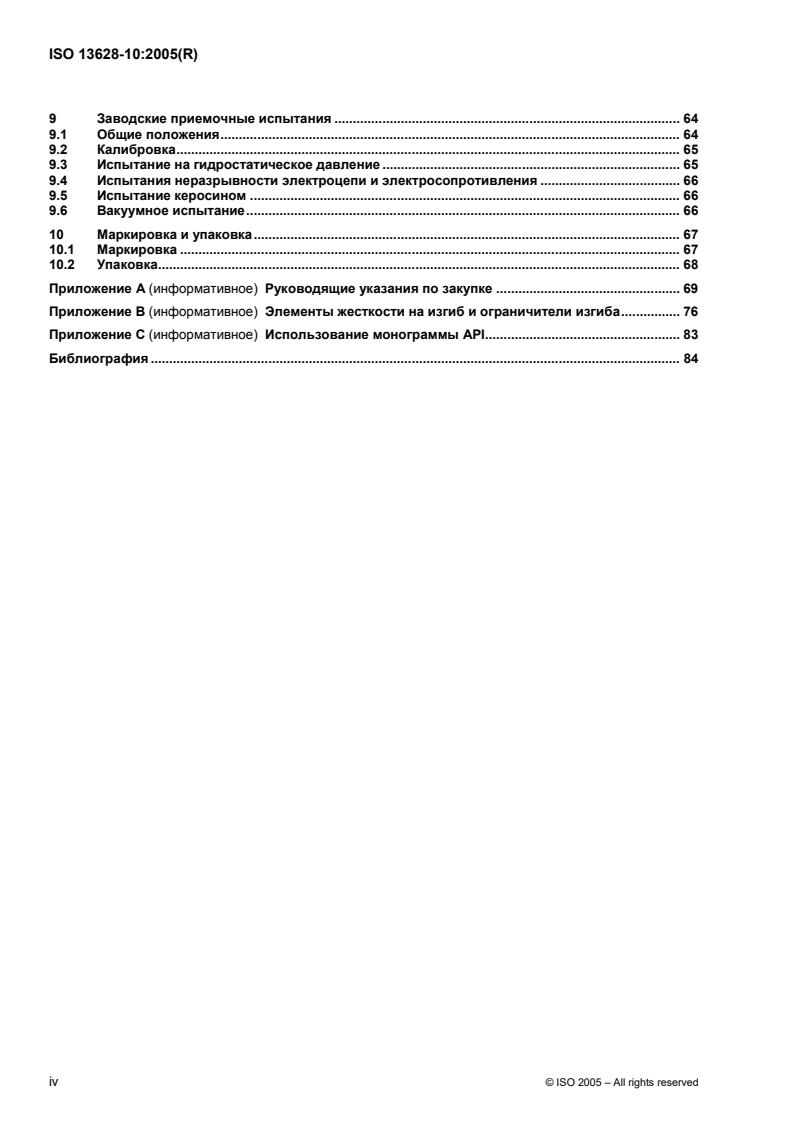
Annex A (informative) Purchasing guidelines . 59
Annex B (informative) Bend stiffeners and bend restrictors . 66
Annex C (informative) Use of the API Monogram. 71
Bibliography . 72
iv © ISO 2005 – All rights reserved
Foreword
ISO (the International Organization for Standardization) is a worldwide federation of national standards bodies
(ISO member bodies). The work of preparing International Standards is normally carried out through ISO
technical committees. Each member body interested in a subject for which a technical committee has been
established has the right to be represented on that committee. International organizations, governmental and
non-governmental, in liaison with ISO, also take part in the work. ISO collaborates closely with the
International Electrotechnical Commission (IEC) on all matters of electrotechnical standardization.
International Standards are drafted in accordance with the rules given in the ISO/IEC Directives, Part 2.
The main task of technical committees is to prepare International Standards. Draft International Standards
adopted by the technical committees are circulated to the member bodies for voting. Publication as an
International Standard requires approval by at least 75 % of the member bodies casting a vote.
Attention is drawn to the possibility that some of the elements of this document may be the subject of patent
rights. ISO shall not be held responsible for identifying any or all such patent rights.
ISO 13628-10 was prepared by Technical Committee ISO/TC 67, Materials, equipment and offshore
structures for petroleum, petrochemical and natural gas industries, Subcommittee SC 4, Drilling and
production equipment.
ISO 13628 consists of the following parts, under the general title Petroleum and natural gas industries —
Design and operation of subsea production systems:
⎯ Part 1: General requirements and recommendations
⎯ Part 2: Unbonded flexible pipe systems for subsea and marine applications
⎯ Part 3: Through flowline (TFL) systems
⎯ Part 4: Subsea wellhead and tree equipment
⎯ Part 5: Subsea umbilicals
⎯ Part 6: Subsea production control systems
⎯ Part 7: Completion/workover riser systems
⎯ Part 8: Remotely Operated Vehicle (ROV) interfaces on subsea production systems
⎯ Part 9: Remotely Operated Tool (ROT) intervention system
⎯ Part 10: Specification for bonded flexible pipe
⎯ Part 11: Flexible pipe systems for subsea and marine riser applications
The following part is under preparation:
⎯ Part 12: Dynamic production risers
Introduction
This part of ISO 13628 has been based on API Spec 17K, First Edition, September 2001.
Users of this International Standard should be aware that further or differing requirements might be needed for
individual applications. This International Standard is not intended to inhibit a vendor from offering, or the
purchaser from accepting, alternative equipment or engineering solutions for the individual application. This
may be particularly applicable where there is innovative or developing technology. Where an alternative is
offered, the vendor should identify any variations from this International Standard and provide details.
vi © ISO 2005 – All rights reserved
INTERNATIONAL STANDARD ISO 13628-10:2005(E)
Petroleum and natural gas industries — Design and operation
of subsea production systems —
Part 10:
Specification for bonded flexible pipe
1 Scope
1.1 Purpose
1.1.1 This part of ISO 13628 defines the technical requirements for safe, dimensionally and functionally
interchangeable bonded flexible pipes that are designed and manufactured to uniform standards and criteria.
See Figure 1 for explanatory figure on typical bonded flexible pipe.
1.1.2 Minimum requirements are specified for the design, material selection, manufacture, testing, marking
and packaging of bonded flexible pipes, with reference to existing codes and standards where applicable. See
API RP 17B for guidelines on the use of flexible pipes and ancillary components.
Key
1 outer wrap 5 reinforcement layer
2 cover 6 breaker layer
3 breaker layer 7 liner
4 cushion layer 8 carcass
Figure 1 — Typical bonded flexible pipe
1.2 Products
1.2.1 This part of ISO 13628 applies to bonded flexible pipe assemblies, consisting of segments of flexible
pipe body with end fittings attached to both ends. This part of ISO 13628 does not cover flexible pipes of
unbonded structure. See ISO 13628-2 for guidance on unbonded flexible pipes.
[10]
NOTE For the purposes of this provision, API Spec 17J is equivalent to ISO 13628-2.
1.2.2 This part of ISO 13628 does not apply to flexible pipe ancillary components. Guidelines for ancillary
components are given in API RP 17B.
1.2.3 This part of ISO 13628 can be applied to flexible pipes that include non-metallic reinforcing layers,
though no effort was made to address the specific and unique technological aspects of this product.
1.2.4 This part of ISO 13628 can be applied to a bonded construction pipe that includes a material or layer
construction that is covered in ISO 13628-2.
[10]
NOTE For the purposes of this provision, API Spec 17J is equivalent to ISO 13628-2.
1.3 Applications
1.3.1 The applications addressed by this part of ISO 13628 are sweet and sour service production,
including export and injection applications. Production products include oil, gas, water and injection chemicals.
This part of ISO 13628 applies to both static and dynamic flexible pipes used as flowlines, risers, jumpers and
offshore loading and discharge hoses. This part of ISO 13628 applies to pipes with a design pressure greater
than or equal to 1,5 MPa (15 bar). This part of ISO 13628 can be used for lower design pressure pipes,
[30]
though the requirements of these pipes have not been specifically addressed. Reference OCIMF for
guidelines on these pipes.
1.3.2 This part of ISO 13628 does not apply to flexible pipes for use in choke and kill line applications. See
API Spec 16C for guidance on choke and kill line applications. This part of ISO 13628 can be applied to
flexible pipes for pile hammer, gas flare, water supply and jetting applications, though no effort was made to
address the specific and unique technological aspects relating to each of these requirements.
2 Normative references
The following referenced documents are indispensable for the application of this document. For dated
references, only the edition cited applies. For undated references, the latest edition of the referenced
document (including any amendments) applies.
ISO 34-2, Rubber, vulcanized or thermoplastic — Determination of tear strength — Part 2: Small (Delft) test
pieces
ISO 37, Rubber, vulcanized or thermoplastic — Determination of tensile stress-strain properties
ISO 75 (all parts), Plastics — Determination of temperature of deflection under load
ISO 812, Rubber, vulcanized — Determination of low-temperature brittleness
ISO 868, Plastics and ebonite — Determination of indentation hardness by means of a durometer (Shore
hardness)
ISO 1431-1:2004, Rubber, vulcanized or thermoplastic — Resistance to ozone cracking — Part 1: Static and
dynamic strain testing
ISO 1817, Rubber, vulcanized — Determination of the effect of liquids
2 © ISO 2005 – All rights reserved
ISO 2781, Rubber, vulcanized — Determination of density
ISO 4647:1982, Rubber, vulcanized — Determination of static adhesion to textile cord — H-pull test
ISO 4649, Rubber, vulcanized or thermoplastic — Determination of abrasion resistance using a rotating
cylindrical drum device
ISO 6506-1, Metallic materials — Brinell hardness test — Part 1: Test method
ISO 6508-1, Metallic materials — Rockwell hardness test — Part 1: Test method (scales A, B, C, D, E, F, G, H,
K, N, T)
ISO 6892, Metallic materials — Tensile testing at ambient temperature
ISO 10423, Petroleum and natural gas industries — Drilling and production equipment — Wellhead and
christmas tree equipment
ISO 10474, Steel and steel products — Inspection documents
ISO 13628-4, Petroleum and natural gas industries — Design and operation of subsea production systems —
Part 4: Subsea wellhead and tree equipment
ISO 13665, Seamless and welded steel tubes for pressure purposes — Magnetic particle inspection of the
tube body for the detection of surface imperfections
ISO 15156 (all parts), Petroleum and natural gas industries — Materials for use in H S-containing
environments in oil and gas production
ISO 16120-1, Non-alloy steel wire rod for conversion to wire — Part 1: General requirements
API RP 17B, Recommended Practice for Flexible Pipe
1)
API Standard 1104, Welding of Pipelines and Related Facilities
2)
ASME Section IX, Boiler & Pressure Vessel Code, Welding and Brazing Qualifications
3)
ASTM A29/A29M:2005, Standard Specification for Steel Bars, Carbon and Alloy, Hot-Wrought — General
Requirements for
ASTM A182/A182M:2005, Standard Specification for Forged or Rolled Alloy-Steel Pipe Flanges, Forged
Fittings, and Valves and Parts for High Temperature Service
ASTM A388, Standard Practice for Ultrasonic Examination of Heavy Steel Forgings
ASTM A668/A668M:2004, Standard Specification for Steel Forgings, Carbon and Alloy, for General Industrial
Use
ASTM A751, Standard Test Methods, Practices, and Terminology for Chemical Analysis of Steel Products
ASTM C177, Standard Test Method for Steady-State Heat Flux Measurements and Thermal Transmission
Properties by Means of the Guarded-Hot-Plate Apparatus
1) American Petroleum Institute, 1220 L St NW, Washington DC 20005, USA.
2) American Society of Mechanical Engineers.
3) American Society for Testing and Materials.
ASTM D256, Standard Test Methods for Determining the Izod Pendulum Impact Resistance of Plastics
ASTM D395, Standard Test Methods for Rubber Property — Compression Set
ASTM D412, Standard Test Methods for Vulcanized Rubber and Thermoplastic Rubbers and Thermoplastic
Elastomers — Tension
ASTM D413, Standard Test Methods for Rubber Property — Adhesion to Flexible Substrate
ASTM D570, Standard Test Method for Water Absorption of Plastics
ASTM D664, Standard Test Method for Acid Number of Petroleum Products by Potentiometric Titration
ASTM D695, Standard Test Method for Compressive Properties of Rigid Plastics
ASTM D746, Standard Test Method for Brittleness Temperature of Plastics and Elastomers by Impact
ASTM D974, Standard Test Method for Acid and Base Number by Color-Indicator Titration
ASTM D1418, Standard Practice for Rubber and Rubber Lattices — Nomenclature
ASTM D2084, Standard Test Method for Rubber Property — Vulcanization Using Oscillating Disk Cure Meter
ASTM D2583, Standard Test Method for Indentation Hardness of Rigid Plastics by Means of a Barcol
Impressor
ASTM D5028, Standard Test Method for Curing Properties of Pultrusion Resins by Thermal Analysis
ASTM E92, Standard Test Method for Vickers Hardness of Metallic Materials
ASTM E94, Standard Guide for Radiographic Examination
ASTM E165, Standard Test method for Liquid Penetrant Examination
ASTM E328, Standard Test Methods for Stress Relaxation Tests for Materials and Structures
ASTM E428, Standard Practice for Fabrication and Control of Steel Reference Blocks Used in Ultrasonic
Examination
ASTM E1356, Standard Test Method for Assignment of the Glass Transition Temperatures by Differential
Scanning Calorimetry
ASTM G48, Standard Test Method for Pitting and Crevice Corrosion Resistance of Stainless Steels and
Related Alloys by Use of Ferric Chloride Solution
ISO 36, Rubber, vulcanized or thermoplastic — Determination of adhesion to textile fabrics
4)
DNV Fire Test, DNV Classification Note 6.1 Test (Fire Test)
5)
DIN 53505, Shore A and Shore D hardness testing of rubber
DIN 53516, Testing of rubber and elastomers; determination of abrasion resistance
6)
EN 287-1, Qualification test of welders — Fusion welding — Part 1: Steels
4) Det Norske Veritase.
5) Deutsches Institut für Normung e.V.
6) European Committee for Standardization.
4 © ISO 2005 – All rights reserved
EN 288-1, Specification and approval of welding procedures for metallic materials — Part 1: General rules for
fusion welding
EN 288-2, Specification and approval of welding procedures for metallic materials — Part 2: Welding
procedure specification for arc welding
EN 288-3, Specification and approval of welding procedures for metallic materials — Part 3: Welding
procedure tests for the arc welding of steels
EN 10204, Metallic products — Types of inspection documents
Lloyds Fire Test, Lloyds Register of Shipping, Fire Testing Memorandum ICE/Fire OSG 1000/499
NACE TM0177, Laboratory Testing of Metals for Resistance to Sulfide Stress Cracking and Stress Corrosion
Cracking in H S Environments
3 Terms, definitions and abbreviations
3.1 Terms and definitions
For the purposes of this document, the following terms and definitions apply.
3.1.1
ancillary components
components used to control the flexible pipe behaviour, such as buoyancy aids and fire hoods/boxes
3.1.2
API Monogram
registered mark of the American Petroleum Institute
3.1.3
bellmouth
part of a guide tube, formed in the shape of a bellmouth, and designed to prevent overbending of the flexible
pipe
3.1.4
bend limiter
any device used to restrict bending of the flexible pipe
NOTE Bend limiters include bend restrictors, bend stiffeners and bellmouths.
3.1.5
bend radius
radius of curvature of the flexible pipe measured from the pipe centreline
NOTE Storage and operating minimum bend radii are defined in 5.3.1.6 and 5.3.1.7.
3.1.6
bend restrictor
mechanical device that functions as a mechanical stop and limits the local radius of curvature of the flexible
pipe to a minimum value
3.1.7
bend stiffener
ancillary conically shaped component, which locally supports the pipe to limit bending stresses and curvature
of the pipe to acceptable levels
NOTE Bend stiffeners can be either attached to an end fitting or a support structure where the flexible pipe passes
through the bend stiffener.
3.1.8
bending stiffness
analogous to the structural stiffness of a rigid beam or pipe (modulus of elasticity times the second area
moment of inertia), except that it can vary to a large extent with temperature and pressure
NOTE It is often quantified as the product of an applied bending moment times the resultant bend radius of the pipe.
3.1.9
bonded pipe
flexible pipe where the steel reinforcement is integrated and bonded to a vulcanized elastomeric material
NOTE Textile material is included in the structure to obtain additional structural reinforcement or to separate
elastomeric layers.
3.1.10
breaker
textile layer impregnated with rubber included in various layers in the pipe cross-section to give additional
strength to the pipe, to aid in reducing propagation of cuts in the pipe and to aid the manufacturing process
NOTE This layer can be incorporated into either or all of the cover, reinforcing layer and liner.
3.1.11
cable
series of round wires of steel or fabric (circular cross-section) spirally wound (stranded) together and used for
structurally reinforcing the pipe
NOTE Cable wires for flexible pipes are usually brass or copper coated to promote chemical bonding of the
elastomer to the wires.
3.1.12
calendering
process of passing elastomer compound between rollers to produce smooth sheets of elastomer
NOTE This process is also used to cover reinforcing cables and textiles with elastomer to form sheets for winding
onto pipes.
3.1.13
carcass
interlocked metallic construction that can be used as the innermost layer to prevent, totally or partially,
collapse of the pipe due to pipe decompression, external pressure, reinforcement layer pressure and
mechanical crushing loads
NOTE It can be used externally to protect the external surface of the pipe.
3.1.14
choke and kill line
flexible pipe jumper located between choke manifold and blow-out preventer
3.1.15
compound
mix of elastomer material and various additives immediately prior to the curing process
3.1.16
connector
device used to provide a leak-tight structural connection between the end fitting and adjacent piping
NOTE Connectors include bolted flanges, clamped hubs and proprietary connectors. They can be designed for
diver-assisted makeup or for diverless operation using either mechanical or hydraulic apparatus.
6 © ISO 2005 – All rights reserved
3.1.17
cover
layer of elastomer between the reinforcing layer and the external environment (or external carcass if provided)
used to protect the pipe against penetration of seawater and other external environments, corrosion, abrasion
and mechanical damage
3.1.18
crossover
flexible flowline crossing another pipe already laid on the seabed
NOTE The underlying pipe may be a steel pipe or another flexible pipe. It may be required to support the overlying
pipe to prevent overbending or crushing of the new or existing pipes.
3.1.19
curing
process of changing irreversibly, usually at elevated temperatures, the properties of a thermosetting resin or
an elastomer compound by chemical reaction
NOTE Cure can be accomplished by the addition of curing (cross-linking) agents, with or without heat and pressure.
3.1.20
design pressure
minimum or maximum pressure, inclusive of operating pressure, surge pressure including shut-in pressure
where applicable, vacuum conditions and static pressure head
3.1.21
dynamic application
service in which flexible pipe is exposed to cyclically varying loads and deflections during normal operation
NOTE The pipe is specially constructed to withstand a large number of bending/tensile/torsional cycles.
3.1.22
elastomer
material that substantially recovers its original shape and size at room temperature after removal of a
deforming force; material that shows a reversible elasticity up to a very high strain level (~ 100 %)
3.1.23
embedding compound
elastomeric compound in which the steel reinforcing cables are embedded
NOTE The compound assures bonding between the steel cables and surrounding layers.
3.1.24
end fitting
mechanical device which forms the transition between the flexible pipe body and the connector
NOTE The different pipe layers are terminated in the end fitting in such a way as to transfer the load between the
flexible pipe and the connector.
3.1.25
flexible flowline
flexible pipe, wholly or in part, resting on the seafloor or buried below the seafloor, and used in a static
application
NOTE The term flowline is used in this document as a generic term for flexible flowlines.
3.1.26
flexible pipe
assembly of a pipe body and end fittings
NOTE The pipe body comprises a composite of layered materials that form a pressure-containing conduit. The pipe
structure allows large deflections without a significant increase in bending stresses. Normally, the pipe body is built up as
a composite structure comprising metallic and elastomer layers. The term pipe is used in this document as a generic term
for flexible pipe.
3.1.27
flexible riser
flexible pipe connecting a platform/buoy/ship to a flowline, seafloor installation or another platform
NOTE The riser can be freely suspended (free catenary), restrained to some extent (buoys, chains), totally restrained
or enclosed in a tube (I- or J-tube).
3.1.28
floating loading and discharge hose
flexible pipe with integral buoyancy or clamped-on buoyancy modules so as to enable the buoyancy pipe to
float on the water surface
3.1.29
gas service
service conditions with a gas content, i.e. gas applications or live crude containing gas
3.1.30
independent verification agent
independent party or group, selected by the manufacturer, that can verify the indicated methodologies or
performance, based on the technical literature, analyses, test results, and other information provided by the
manufacturer
NOTE The agent is also called upon to witness some measurements and tests related to material qualification.
3.1.31
insulation layer
additional layer added to the flexible pipe to increase the thermal insulation properties
NOTE The layer is usually located between the outer reinforcement layer and the cover.
3.1.32
jumper
short flexible pipe used in subsea and topside, static or dynamic applications, e.g. turret jumpers and drag
chain jumpers
3.1.33
lay angle
angle between the axis of a spiral wound element (e.g. cables of reinforcing layer) and a line parallel to the
longitudinal axis of the flexible pipe
3.1.34
liner
layer of elastomer in contact with the internal fluid which ensures internal fluid integrity
3.1.35
loading and discharge hose
flexible pipe jumper used in the loading and offloading of tankers in both static and dynamic applications
3.1.36
piggyback
two pipes attached at regular intervals with clamps
NOTE Either or both of the pipes can be flexibles.
3.1.37
quality
conformance to specified requirements
8 © ISO 2005 – All rights reserved
3.1.38
quality assurance
those planned, systematic corrective and preventive actions which are required to ensure that materials,
products or services will meet specified requirements
3.1.39
quality control
inspection, test or examination to ensure that materials, products or services conform to specified
requirements
3.1.40
quality programme
established documented system to ensure quality
3.1.41
reinforcing layer
structural layer with a specific lay angle, typically around 55°, which consists of helically wound cables
embedded in elastomer, and is used to sustain, totally or partially, tensile loads and internal pressure
3.1.42
rough bore
flexible pipe with a steel strip carcass as the innermost layer
3.1.43
service life
period of time during which the flexible pipe fulfils all performance requirements
3.1.44
smooth bore
flexible pipe with an elastomer layer as the innermost layer
3.1.45
sour service
service conditions with a H S content exceeding the minimum specified by ISO 15156 at the design pressure
NOTE For the purposes of this provision, NACE MR0175 is equivalent to ISO 15156.
3.1.46
static application
flexible pipes not exposed to significant cyclically varying loads or deflections during normal operations
3.1.47
sweet service
service conditions which have a H S content less than that specified by ISO 15156 at the design pressure
NOTE For the purposes of this provision, NACE MR0175 is equivalent to ISO 15156.
3.1.48
tensile strength
tensile strength of elastomeric materials in this part of ISO 13628 is defined in accordance with ISO 37
NOTE For the purposes of this provision, ASTM D638 is equivalent to ISO 37.
3.1.49
torsional balance
pipe characteristic that is achieved by designing the structural layers in the pipe, such that axial and pressure
loads do not induce significant twist or torsional loads in the pipe
3.1.50
ultimate strength
ultimate strength in this part of ISO 13628 is defined in accordance with ISO 6892
NOTE For the purposes of this provision, ASTM A370 is equivalent to ISO 6892.
3.1.51
unbonded pipe
pipe construction consists of separate unbonded polymeric and metallic layers, which allows relative
movement between layers
3.1.52
visual examination
examination of parts and equipment for visible defects in material and workmanship
3.1.53
yield strength
yield strength in this standard for steel materials is defined as 0,2 % yield offset strength, as specified in
ISO 6892
NOTE For the purposes of this provision, ASTM A370 is equivalent to ISO 6892.
3.1.54
vulcanization
process of cross-linking the elastomer chains to reduce the plasticity of the elastomer
NOTE Otherwise referred to as “curing”.
3.2 Symbols and abbreviations
The following symbols and abbreviations are used in this document:
DSC Differential scanning calorimetry
FAT Factory acceptance test
GA General arrangement
HIC Hydrogen-induced cracking
HV Hardness on Vickers Scale
ID Internal diameter
MBR Minimum bend radius
MPI Magnetic particle inspection
NDE Non-destructive examination
ODR Oscillating disk rheometer
RAO Response amplitude operator
S-N Curves showing stress range vs. number of cycles
SSC Sulfide stress cracking
TAN Titrated acid number
TFL Through flowline
10 © ISO 2005 – All rights reserved
(1)
UNS Unified National Standard
(2)
UNS Unified Numbering System
UV Ultraviolet
σ Material yield stress
y
σ Material ultimate stress
u
4 Functional requirements
4.1 General
4.1.1 The purchaser shall specify the functional requirements for the flexible pipe. The purchasing
guidelines in Annex A give a sample format for the specification of the functional requirements.
4.1.2 Functional requirements not specifically required by the purchaser which may affect the design,
materials, manufacturing and testing of the pipe shall be specified by the manufacturer.
4.1.3 Regulatory authority functional requirements that may affect the design, materials, manufacturing and
testing of the pipe shall be specified by the purchaser.
4.1.4 If the purchaser does not specify a requirement, and 4.1.2 does not apply, the manufacturer may
assume that there is no requirement.
4.1.5 If a purchaser wishes to use this part of ISO 13628 for the procurement of pipes with non-metallic
reinforcing layers, that purchaser should prepare a supplemental specification with requirements for the
manufacturer to meet in demonstrating by analysis and tests that the level of safety during the service life is
not less than that given by this part of ISO 13628 for metallic reinforced pipes.
4.1.6 If a purchaser wishes to purchase pipe that includes a material or layer construction that is covered in
ISO 13628-2, that purchaser should prepare a supplemental specification with requirements for the
manufacturer to meet in demonstrating by analysis and tests that the levels of safety are not less than those
required by ISO 13628-2 and this part of ISO 13628.
4.2 Overall requirements
4.2.1 Flexible pipe
The minimum overall functional requirements of the flexible pipe that shall be demonstrated by the
manufacturer are as follows.
a) The pipe shall provide a leak-tight conduit.
b) The pipe shall be capable of withstanding all design loads and load combinations defined herein.
c) The pipe shall perform its function for the specified service life.
d) The flexible pipe materials shall be compatible with the environment to which the material is exposed.
e) The flexible pipe materials shall conform to the corrosion control requirements specified herein.
4.2.2 End fitting
The manufacturer shall demonstrate that the end fitting, as a minimum, meets the same functional
requirements as the flexible pipe. If relevant, this shall be demonstrated by the following.
a) The end fitting shall provide a structural interface between the pipe and the support structure.
b) The end fittings shall provide a structural interface between the flexible pipe and bend-limiting devices,
including bend stiffeners, bend restrictors and bellmouths, such that the bend limiting devices meet their
functional requirements.
4.3 General design parameters
The purchaser shall specify any project-specific design requirements, which may include the requirements of
4.4 to 4.6 and the following:
a) nominal internal diameter;
b) length and tolerances of flexible pipe, including end fittings;
c) service life;
d) regulatory authority requirements.
4.4 Internal fluid parameters
4.4.1 General
The purchaser shall specify the internal fluid parameters for the application. The parameters listed in Table 1
should be specified. When known, the minimum, normal and maximum conditions should be specified for the
internal fluid parameters of Table 1. Expected variations in the internal fluid parameters over the service life
should be specified.
Table 1 — Internal fluid parameters
Parameter Comment
Internal pressure See 4.4.2
Temperature See 4.4.3
Fluid composition See 4.4.4
Service definition Sweet or sour in accordance with 4.4.4 (a)
Fluid/flow description Fluid type and flow regime
Flow rate parameters Flow rates, fluid density, viscosity, minimum inlet
pressure and required outlet pressure
Thermal parameters Fluid heat capacity
4.4.2 Internal pressure
The following internal pressures shall be specified:
a) maximum design pressure;
b) minimum design pressure.
12 © ISO 2005 – All rights reserved
The following internal pressures should be specified:
⎯ operating pressure or pressure profile through service life;
⎯ factory and field test pressure requirements of governing and/or certifying authorities.
4.4.3 Temperature
4.4.3.1 The following temperatures shall be specified:
a) design minimum temperatures;
b) design maximum temperatures.
The operating temperature or temperature profile through service life should be specified.
4.4.3.2 The design minimum and maximum temperatures are the minimum and maximum temperatures
that can be experienced by the flexible pipe throughout the service life. These design temperatures may be
specified on the basis of the following minimum set of considerations:
a) operating temperatures;
b) upset temperatures (number and range of cycles);
c) gas cooling effects (time/temperature curve);
d) fluid thermal characteristics;
e) flow characteristics;
f) storage, transport and installation conditions.
4.4.4 Fluid composition
The purchaser should specify produced fluids (composition of individual phases), injected fluids, and continual
and occasional chemical treatments (dosages, exposure times, concentrations and frequency). This should be
specified for all phases including storage, transport and installation conditions. In the specification of the
internal fluid composition, the following should be defined:
a) all parameters which define service conditions, including partial pressure of H S and CO , pH of aqueous
2 2
phase, TAN (as specified in ASTM D664 or ASTM D974) and water content (produced water, seawater
and free water);
b) gases, including oxygen, hydrogen, methane and nitrogen;
c) liquids, including oil composition and alcohols;
d) aromatic components;
e) corrosive agents, including bacteria, chlorides, organic acids and sulfur-bearing compounds;
f) injected chemical products, including alcohols, and inhibitors for corrosion, hydrate, paraffin, scale and
wax;
g) solids, including sand, precipitates, scale, hydrates, wax and biofilm.
4.5 External environment
The purchaser should specify the project external environmental parameters. The parameters listed in Table 2
should be considered. The design water depth shall be the maximum water depth to which the pipe section
may be exposed.
Table 2 — External environment parameters
Parameter Comment
Location Geographical data for the installation location
Water depth Design water depth, variations over pipe location and tidal variations
Seawater data Density, pH value, and minimum and maximum temperatures
Air temperature Minimum and maximum during storage, installation and operation
Ozone exposure Length of pipe exposed during operation and storage conditions
Description, shear strength or angle of internal friction, friction coefficients, seabed
Soil data
scour, sand waves and variations along pipe route
Marine growth Maximum values and variations along length
Ice Maximum ice accumulation, or drifting icebergs and ice floes
Sunlight exposure Length of pipe exposed during operation and storage conditions
As a function of water depth, direction and return period, and including the known
Current data
effects of local current phenomena
In terms of significant and maximum waves, associated periods, wave spectra,
Wave data spreading functions and scatter diagrams, as a function of direction and return
period
Wind data As a function of direction, height above water level and return period
4.6 System requirements
4.6.1 Mi
...
NORME ISO
INTERNATIONALE 13628-10
Première édition
2005-10-01
Industries du pétrole et du gaz naturel —
Conception et exploitation des systèmes
de production immergés —
Partie 10:
Spécification pour canalisations flexibles
composites
Petroleum and natural gas industries — Design and operation of
subsea production systems —
Part 10: Specification for bonded flexible pipe
Numéro de référence
©
ISO 2005
PDF – Exonération de responsabilité
Le présent fichier PDF peut contenir des polices de caractères intégrées. Conformément aux conditions de licence d'Adobe, ce fichier
peut être imprimé ou visualisé, mais ne doit pas être modifié à moins que l'ordinateur employé à cet effet ne bénéficie d'une licence
autorisant l'utilisation de ces polices et que celles-ci y soient installées. Lors du téléchargement de ce fichier, les parties concernées
acceptent de fait la responsabilité de ne pas enfreindre les conditions de licence d'Adobe. Le Secrétariat central de l'ISO décline toute
responsabilité en la matière.
Adobe est une marque déposée d'Adobe Systems Incorporated.
Les détails relatifs aux produits logiciels utilisés pour la création du présent fichier PDF sont disponibles dans la rubrique General Info
du fichier; les paramètres de création PDF ont été optimisés pour l'impression. Toutes les mesures ont été prises pour garantir
l'exploitation de ce fichier par les comités membres de l'ISO. Dans le cas peu probable où surviendrait un problème d'utilisation,
veuillez en informer le Secrétariat central à l'adresse donnée ci-dessous.
DOCUMENT PROTÉGÉ PAR COPYRIGHT
© ISO 2005
Droits de reproduction réservés. Sauf prescription différente, aucune partie de cette publication ne peut être reproduite ni utilisée sous
quelque forme que ce soit et par aucun procédé, électronique ou mécanique, y compris la photocopie et les microfilms, sans l'accord écrit
de l'ISO à l'adresse ci-après ou du comité membre de l'ISO dans le pays du demandeur.
ISO copyright office
Case postale 56 • CH-1211 Geneva 20
Tel. + 41 22 749 01 11
Fax + 41 22 749 09 47
E-mail copyright@iso.org
Web www.iso.org
Version française parue en 2010
Publié en Suisse
ii © ISO 2005 – Tous droits réservés
Sommaire Page
Avant-propos .v
Introduction.vi
1 Domaine d'application .1
1.1 Objet.1
1.2 Produits .2
1.3 Applications .2
2 Références normatives.2
3 Termes, définitions et abréviations .5
3.1 Termes et définitions .5
3.2 Symboles et abréviations .11
4 Exigences relatives au fonctionnement.12
4.1 Généralités .12
4.2 Exigences globales .12
4.3 Paramètres généraux de conception .13
4.4 Paramètres relatifs aux fluides internes .13
4.5 Environnement extérieur .15
4.6 Exigences système .15
5 Exigences de conception .19
5.1 Charges et effets de charges .19
5.2 Méthodologie de conception des canalisations .22
5.3 Conception de la structure de la canalisation.23
5.4 Exigences relatives à la conception du système.28
6 Matériaux.32
6.1 Exigences relatives aux matériaux.32
6.2 Exigences de qualification .36
6.3 Exigences d'assurance de la qualité.44
7 Exigences de fabrication .46
7.1 Exigences d'assurance de la qualité.46
7.2 Carcasse.47
7.3 Préparation de la composition et calandrage.48
7.4 Enroulement de l'élastomère .49
7.5 Couche d'armature de renforcement.50
7.6 Couches d'isolation.50
7.7 Raccord d'extrémité .50
7.8 Procédé de durcissement.52
7.9 Procédés spéciaux.53
7.10 Tolérances de fabrication.55
7.11 Réparations.55
8 Documentation .56
8.1 Généralités .56
8.2 Principes de conception.56
8.3 Rapport des charges de calcul .56
8.4 Rapport de conception .57
8.5 Plan qualité de fabrication.58
8.6 Spécification de fabrication.58
8.7 Documentation conforme à l'exécution .58
8.8 Manuel d'exploitation.59
9 Essais de réception en usine .60
9.1 Généralités .60
9.2 Essai dimensionnel .61
9.3 Essai de pression hydrostatique .61
9.4 Essais de continuité et de résistance électrique.62
9.5 Essai au kérosène.62
9.6 Essai de tenue au vide .62
10 Marquage et conditionnement.63
10.1 Marquage.63
10.2 Emballage .64
Annexe A (informative) Lignes directrices d'achat.65
Annexe B (informative) Raidisseurs anti-courbure et limiteurs de courbure .72
Annexe C (informative) Utilisation du monogramme API .77
Bibliographie .78
iv © ISO 2005 – Tous droits réservés
Avant-propos
L'ISO (Organisation internationale de normalisation) est une fédération mondiale d'organismes nationaux de
normalisation (comités membres de l'ISO). L'élaboration des Normes internationales est en général confiée
aux comités techniques de l'ISO. Chaque comité membre intéressé par une étude a le droit de faire partie du
comité technique créé à cet effet. Les organisations internationales, gouvernementales et non
gouvernementales, en liaison avec l'ISO participent également aux travaux. L'ISO collabore étroitement avec
la Commission électrotechnique internationale (CEI) en ce qui concerne la normalisation électrotechnique.
Les Normes internationales sont rédigées conformément aux règles données dans les Directives ISO/CEI,
Partie 2.
La tâche principale des comités techniques est d'élaborer les Normes internationales. Les projets de Normes
internationales adoptés par les comités techniques sont soumis aux comités membres pour vote. Leur
publication comme Normes internationales requiert l'approbation de 75 % au moins des comités membres
votants.
L'attention est appelée sur le fait que certains des éléments du présent document peuvent faire l'objet de
droits de propriété intellectuelle ou de droits analogues. L'ISO ne saurait être tenue pour responsable de ne
pas avoir identifié de tels droits de propriété et averti de leur existence.
L'ISO 13628-10 a été élaborée par le comité technique ISO/TC 67, Matériel, équipement et structures en mer
pour les industries pétrolière, pétrochimique et du gaz naturel, sous-comité SC 4, Équipement de forage et de
production.
L'ISO 13628 comprend les parties suivantes, présentées sous le titre général Industries du pétrole et du gaz
naturel — Conception et exploitation des systèmes de production immergés:
⎯ Partie 1: Exigences générales et recommandations
⎯ Partie 2: Systèmes de canalisations flexibles non collées pour applications sous-marines et en milieu
marin
⎯ Partie 3: Systèmes d'injection TFL
⎯ Partie 4: Equipements immergés de tête de puits et tête de production
⎯ Partie 5: Faisceaux de câbles immergés
⎯ Partie 6: Commandes pour équipements immergés
⎯ Partie 7: Systèmes de liaison surface/fond de mer pour complétion/reconditionnement
⎯ Partie 8: Véhicules commandés à distance pour l'interface avec les matériels immergés
⎯ Partie 9: Système d'intervention utilisant des dispositifs à commande à distance (ROT)
⎯ Partie 10: Spécification pour canalisations flexibles composites
⎯ Partie 11: Systèmes de canalisations flexibles pour applications sous-marines et en milieu marin de
liaisons fond-surface
La partie suivante est en cours d'élaboration:
⎯ Partie 12: Colonnes montantes en production dynamique
Introduction
La présente partie de l’ISO 13628 est basée sur l'API Spec 17K, première édition, septembre 2001.
Il convient que les utilisateurs de la présente Norme internationale soient conscients que des exigences
supplémentaires ou différentes pourraient être nécessaires pour des applications particulières. La présente
Norme internationale n'est pas destinée à interdire à un vendeur d'offrir, ou à l'acheteur d'accepter, des
équipements ou des solutions techniques de remplacement pour une application particulière. Cela peut
'
notamment sappliquer dans le cas de technologies innovantes ou en cours de développement. Lorsqu'une
alternative est proposée, il convient que le vendeur identifie tous les écarts par rapport à la présente Norme
internationale et en fournisse les détails.
vi © ISO 2005 – Tous droits réservés
NORME INTERNATIONALE ISO 13628-10:2005(F)
Industries du pétrole et du gaz naturel — Conception et
exploitation des systèmes de production immergés —
Partie 10:
Spécification pour canalisations flexibles composites
1 Domaine d'application
1.1 Objet
1.1.1 La présente partie de l'ISO 13628 définit les exigences techniques applicables à des canalisations
flexibles composites, sûres, interchangeables du point de vue dimensionnel et fonctionnel, qui sont conçues
et fabriquées selon des normes et des critères uniformes. Voir la Figure 1 qui présente un exemple type de
canalisation flexible composite.
1.1.2 Elle spécifie des exigences minimales relatives à la conception, au choix des matériaux, à la
fabrication, aux essais, au marquage et au conditionnement des canalisations flexibles composites, en faisant
référence, le cas échéant, à des codes et normes existants. Voir l'API RP 17B qui fournit des lignes
directrices relatives à l'utilisation des canalisations flexibles et éléments auxiliaires.
Légende
1 Enveloppe extérieure 5 Couche de renforcement
2 Protecteur 6 Nappe sommet
3 Nappe sommet 7 Revêtement intérieur
4 Couche d'amortissement 8 Carcasse
Figure 1 — Exemple de canalisation flexible composite
1.2 Produits
1.2.1 La présente partie de l'ISO 13628 s'applique aux assemblages de canalisations flexibles composites
constitués de tronçons de corps de canalisations flexibles munis de pièces d'extrémité fixées aux deux
extrémités. La présente partie de l'ISO 13628 ne concerne pas les canalisations flexibles à structure non
collée. L'ISO 13628-2 fournit les indications applicables aux canalisations flexibles non collées.
[10]
NOTE Pour les besoins de la présente disposition, l'API Spec 17J est équivalente à l'ISO 13628-2.
1.2.2 La présente partie de l'ISO 13628 ne s'applique pas aux éléments auxiliaires de canalisations
flexibles. L'API RP 17B fournit des lignes directrices pour les éléments auxiliaires.
1.2.3 La présente partie de l'ISO 13628 peut être appliquée aux canalisations flexibles qui comprennent
des couches de renforcement non métalliques, même si aucun effort n'a été entrepris pour traiter les aspects
technologiques particuliers et uniques de ces produits.
1.2.4 La présente partie de l'ISO 13628 peut être appliquée à une canalisation composite qui comprend un
matériau ou une structure de couche couverte par l'ISO 13628-2.
[10]
NOTE Pour les besoins de la présente disposition, l'API Spec 17J est équivalente à l'ISO 13628-2.
1.3 Applications
1.3.1 La présente partie de l'ISO 13628 couvre des applications de production de fluides non corrosifs et
corrosifs, y compris les applications d'exportation et d'injection. Les produits utilisés comprennent l'huile, le
gaz, l'eau et les produits chimiques d'injection. La présente partie de l'ISO 13628 s'applique aux systèmes de
canalisations flexibles composites statiques et dynamiques utilisées comme conduites sous-marines, liaisons
fond-surface et manchettes de raccordement ainsi qu'aux flexibles de systèmes de chargement et de
déchargement en mer. La présente partie de l'ISO 13628 s'applique aux canalisations dont la pression de
calcul est supérieure ou égale à 1,5 MPa (15 bar). La présente partie de l'ISO 13628 peut être utilisée pour
des canalisations ayant une pression de calcul plus faible, même si les exigences correspondantes n'ont pas
[30]
été spécifiquement traitées. Pour des lignes directrices concernant ces canalisations, voir l'OCIMF .
1.3.2 La présente partie de l'ISO 13628 ne couvre pas les canalisations flexibles destinées à être utilisées
dans les applications de lignes de duse. L'API Spec 16C donne des indications pour les applications de lignes
de duses. La présente partie de l'ISO 13628 peut être appliquée à des canalisations flexibles utilisées pour
des applications de marteau batteur, de torchère, d'alimentation en eau et d'ensouillage au jet, même si
aucun effort n'a été entrepris pour traiter les aspects technologiques spécifiques et uniques correspondant à
chacune de leurs exigences.
2 Références normatives
Les documents de référence suivants sont indispensables à l'application du présent document. Pour les
références datées, seule l'édition citée s'applique. Pour les références non datées, la dernière édition du
document référencé (y compris les amendements) s'applique.
ISO 34-2, Caoutchouc vulcanisé ou thermoplastique — Détermination de la résistance au déchirement —
Partie 2: Petites éprouvettes (éprouvettes de Delft)
ISO 37, Caoutchouc vulcanisé ou thermoplastique — Détermination des caractéristiques de contrainte-
déformation en traction
ISO 75 (toutes les parties), Plastiques — Détermination de la température de fléchissement sous charge
ISO 812, Caoutchouc vulcanisé — Détermination de la fragilité à basse température
2 © ISO 2005 – Tous droits réservés
ISO 868, Plastiques et ébonite — Détermination de la dureté par pénétration au moyen d'un duromètre
(dureté Shore)
ISO 1431-1:2004, Caoutchouc vulcanisé ou thermoplastique — Résistance au craquelage par l'ozone —
Partie 1: Essais sous allongement statique et dynamique
ISO 1817, Caoutchouc vulcanisé — Détermination de l'action des liquides
ISO 2781, Caoutchouc vulcanisé — Détermination de la masse volumique
ISO 4647:1982, Caoutchouc vulcanisé — Détermination de l'adhérence statique au câblé textile — Essai
d'arrachement en H
ISO 4649, Caoutchouc vulcanisé ou thermoplastique — Détermination de la résistance à l'abrasion à l'aide
d'un dispositif à tambour tournant
ISO 6506-1, Matériaux métalliques — Essai de dureté Brinell — Partie 1: Méthode d'essai
ISO 6508-1, Matériaux métalliques — Essai de dureté Rockwell — Partie 1: Méthode d'essai (échelles A, B,
C, D, E, F, G, H, K, N, T)
ISO 6892, Matériaux métalliques — Essai de traction à température ambiante
ISO 10423, Industries du pétrole et du gaz naturel — Équipements de forage et de production — Équipement
pour têtes de puits et arbre de Noël
ISO 10474, Aciers et produits sidérurgiques — Documents de contrôle
ISO 13628-4, Industries du pétrole et du gaz naturel — Conception et fonctionnement des systèmes de
production immergés — Partie 4: Équipements immergés de tête de puits et tête de production
ISO 13665, Tubes en acier sans soudure et soudés pour service sous pression — Contrôle par
magnétoscopie du corps des tubes pour la détection des imperfections de surface
ISO 15156 (toutes les parties), Industries du pétrole et du gaz naturel — Matériaux pour utilisation en
présence de H S dans la production de pétrole et de gaz naturel
ISO 16120-1, Fil-machine en acier non allié destiné à la fabrication de fils — Partie 1: Exigences générales
API RP 17B, Recommended Practice for Flexible Pipe
1)
API Standard 1104, Welding of Pipelines and Related Facilities
2)
ASME Section IX, Boiler & Pressure Vessel Code, Welding and Brazing Qualifications
3)
ASTM A29/A29M:2005, Standard Specification for Steel Bars, Carbon and Alloy, Hot-Wrought — General
Requirements for
ASTM A182/A182M:2005, Standard Specification for Forged or Rolled Alloy-Steel Pipe Flanges, Forged
Fittings, and Valves and Parts for High Temperature Service
ASTM A388, Standard Practice for Ultrasonic Examination of Heavy Steel Forgings
1) American Petroleum Institute, 1220 L St NW, Washington DC 20005, USA.
2) American Society of Mechanical Engineers.
3) American Society for Testing and Materials.
ASTM A668/A668M:2004, Standard Specification for Steel Forgings, Carbon and Alloy, for General Industrial
Use
ASTM A751, Standard Test Methods, Practices, and Terminology for Chemical Analysis of Steel Products
ASTM C177, Standard Test Method for Steady-State Heat Flux Measurements and Thermal Transmission
Properties by Means of the Guarded-Hot-Plate Apparatus
ASTM D256, Standard Test Methods for Determining the Izod Pendulum Impact Resistance of Plastics
ASTM D395, Standard Test Methods for Rubber Property — Compression Set
ASTM D412, Standard Test Methods for Vulcanized Rubber and Thermoplastic Rubbers and Thermoplastic
Elastomers — Tension
ASTM D413, Standard Test Methods for Rubber Property — Adhesion to Flexible Substrate
ASTM D570, Standard Test Method for Water Absorption of Plastics
ASTM D664, Standard Test Method for Acid Number of Petroleum Products by Potentiometric Titration
ASTM D695, Standard Test Method for Compressive Properties of Rigid Plastics
ASTM D746, Standard Test Method for Brittleness Temperature of Plastics and Elastomers by Impact
ASTM D974, Standard Test Method for Acid and Base Number by Color-Indicator Titration
ASTM D1418, Standard Practice for Rubber and Rubber Lattices — Nomenclature
ASTM D2084, Standard Test Method for Rubber Property — Vulcanization Using Oscillating Disk Cure Meter
ASTM D2583, Standard Test Method for Indentation Hardness of Rigid Plastics by Means of a Barcol
Impressor
ASTM D5028, Standard Test Method for Curing Properties of Pultrusion Resins by Thermal Analysis
ASTM E92, Standard Test Method for Vickers Hardness of Metallic Materials
ASTM E94, Standard Guide for Radiographic Examination
ASTM E165, Standard Test method for Liquid Penetrant Examination
ASTM E328, Standard Test Methods for Stress Relaxation Tests for Materials and Structures
ASTM E428, Standard Practice for Fabrication and Control of Steel Reference Blocks Used in Ultrasonic
Examination
ASTM E1356, Standard Test Method for Assignment of the Glass Transition Temperatures by Differential
Scanning Calorimetry
ASTM G48, Standard Test Method for Pitting and Crevice Corrosion Resistance of Stainless Steels and
Related Alloys by Use of Ferric Chloride Solution
ISO 36, Caoutchouc vulcanisé ou thermoplastique — Détermination de l'adhérence aux tissus
4)
DNV Fire Test, DNV Classification Note 6.1 Test (Fire Test)
4) Det Norske Veritas.
4 © ISO 2005 – Tous droits réservés
5)
DIN 53505, Shore A and Shore D hardness testing of rubber
DIN 53516, Testing of rubber and elastomers; determination of abrasion resistance
6)
EN 287-1, Épreuve de qualification des soudeurs — Soudage par fusion — Partie 1: Aciers
EN 288-1, Descriptif et qualification d'un mode opératoire de soudage pour les matériaux métalliques —
Partie 1: Règles générales; soudage par fusion
EN 288-2, Descriptif et qualification d'un mode opératoire de soudage pour les matériaux métalliques —
Partie 2: Descriptif d'un mode opératoire de soudage pour le soudage à l'arc
EN 288-3, Descriptif et qualification d'un mode opératoire de soudage pour les matériaux métalliques —
Partie 3: Épreuve de qualification d'un mode opératoire de soudage à l'arc sur acier
EN 10204, Produits métalliques — Types de documents de contrôle
Lloyds Fire Test, Lloyds Register of Shipping, Fire Testing Memorandum ICE/Fire OSG 1000/499
NACE TM0177, Laboratory Testing of Metals for Resistance to Sulfide Stress Cracking and Stress Corrosion
Cracking in H S Environments
3 Termes, définitions et abréviations
3.1 Termes et définitions
Pour les besoins du présent document, les termes et définitions suivants s'appliquent.
3.1.1
éléments auxiliaires
organes utilisés pour maîtriser le comportement de la canalisation flexible, tels que des dispositifs d'aide à la
flottabilité et des capots/enceintes de protection contre le feu
3.1.2
API (monogramme)
marque déposée de l'American Petroleum Institute
3.1.3
évasement
partie d'un guide tube, en forme de tulipe (évasement) et conçu pour prévenir une flexion excessive de la
canalisation flexible
3.1.4
limiteur de courbure
tout dispositif utilisé pour restreindre la flexion d'une canalisation flexible
NOTE Les limiteurs de courbure comprennent les réducteurs de courbure, les raidisseurs anti-courbure et les
évasements.
3.1.5
rayon de courbure
rayon utilisé pour incurver la canalisation flexible, mesuré sur l'axe de la canalisation
NOTE Les rayons minimaux de courbure en stockage et en service sont définis en 5.3.1.6 et 5.3.1.7.
5) Deutsches Institut für Normung e.V.
6) Comité européen de normalisation.
3.1.6
réducteur de courbure
dispositif mécanique fonctionnant comme une butée mécanique pour maintenir à une valeur minimale le
rayon local d'incurvation de la canalisation flexible
3.1.7
raidisseur anti-courbure
élément auxiliaire de forme conique qui soutient localement la canalisation afin de maintenir les contraintes de
flexion et la courbure de la canalisation à des niveaux acceptables
NOTE Les raidisseurs anti-courbure peuvent être fixés soit à une pièce d'extrémité, soit à une structure portante par
laquelle la canalisation flexible traverse le raidisseur anti-courbure.
3.1.8
rigidité en flexion
analogue à la rigidité structurelle d'une poutre ou d'un tube rigide (module d'élasticité multiplié par le moment
d'inertie de la section transversale), à l'exception du fait qu'elle peut varier dans une large mesure en fonction
de la température et de la pression
NOTE Elle est souvent quantifiée comme étant le produit d'un moment de flexion appliqué multiplié par le rayon de
courbure résultant de la canalisation.
3.1.9
canalisation composite
canalisation flexible dont l'armature en acier est intégrée et collée à un matériau élastomère vulcanisé
NOTE Un matériau textile est inclus à la structure pour obtenir un renfort structurel supplémentaire ou pour séparer
les couches élastomères.
3.1.10
nappe sommet
couche textile imprégnée de caoutchouc, incluse dans les diverses couches de la section de la canalisation
pour lui apporter une résistance supplémentaire, afin de réduire la propagation de coupures et pour apporter
une aide au procédé de fabrication
NOTE Cette couche peut être intégrée à l'une ou à toutes les autres couches: du protecteur, de la couche de
renforcement et du revêtement intérieur.
3.1.11
câblé
ensemble de fils ronds en acier ou en textile (de section circulaire) enroulés en spirale (toronnés) et utilisés
pour renforcer structurellement la canalisation
NOTE Les fils utilisés pour les canalisations flexibles sont généralement en laiton ou en cuivre, revêtus de manière à
favoriser la liaison chimique entre l'élastomère et les fils.
3.1.12
calandrage
procédé qui consiste à faire passer une composition élastomère entre des rouleaux afin de produire des
feuilles d'élastomère lisses
NOTE Ce procédé est également utilisé pour couvrir les câblés de renforcement et les textiles d'élastomère afin de
constituer des feuilles qui seront enroulées sur les canalisations.
3.1.13
carcasse
construction métallique imbriquée qui peut être utilisée comme couche la plus à l'intérieur afin de prévenir, en
totalité ou en partie, l'écrasement de la canalisation, du fait d'une décompression de la canalisation, de la
pression extérieure, de la pression de la couche de renforcement et des charges mécaniques d'écrasement
NOTE Elle peut être utilisée comme élément extérieur pour protéger la surface externe de la canalisation.
6 © ISO 2005 – Tous droits réservés
3.1.14
ligne de duse
manchette de raccordement de canalisation flexible placée entre le collecteur de duses et l'obturateur anti-
éruption
3.1.15
composition
mélange d'un matériau élastomère et de divers additifs immédiatement avant le procédé de durcissement
3.1.16
connecteur
dispositif utilisé pour assurer un raccordement structurel et étanche aux fuites entre la pièce d'extrémité et la
canalisation adjacente
NOTE Les connecteurs incluent les brides boulonnées, les moyeux à pince et des connecteurs propriétaires
particuliers. Ils peuvent être conçus pour serrage assisté par plongeur ou pour un fonctionnement sans l'intervention de
plongeur, au moyen d'appareils mécaniques ou hydrauliques.
3.1.17
protecteur
couche d'élastomère entre la couche de renforcement et l'environnement extérieur (ou la carcasse extérieure,
le cas échéant) utilisée pour protéger la canalisation contre la pénétration d'eau de mer et d'autres milieux
extérieurs ainsi que contre la corrosion, l'abrasion et les dommages mécaniques
3.1.18
croisement
conduite sous-marine flexible croisant une autre canalisation déjà posée sur le fond marin
NOTE La conduite sous-jacente peut être une canalisation en acier ou une autre canalisation flexible. Il peut être
nécessaire de soutenir la canalisation sus-jacente afin d'éviter une flexion excessive ou l'écrasement de l'une des
canalisations.
3.1.19
durcissement
processus de modification irréversible, en général à des températures élevées, des propriétés d'une résine
thermodurcissable ou d'une composition élastomère par réaction chimique
NOTE La vulcanisation peut être réalisée par ajout d'agents catalyseurs (réticulation), avec ou sans apport de
chaleur et de pression.
3.1.20
pression de calcul
pression minimale ou maximale, y compris la pression de service, les à-coups de pression comprenant le cas
échéant la pression de fermeture, les conditions de dépression et la pression statique
3.1.21
application dynamique
service dans lequel la canalisation flexible est exposée à des charges et à des fléchissements à variation
cyclique en utilisation normale
NOTE La canalisation est spécialement construite pour supporter un grand nombre de cycles de
flexion/traction/torsion.
3.1.22
élastomère
matériau qui récupère substantiellement sa forme et ses dimensions initiales à température ambiante, une
fois retirée la contrainte qui lui imprime sa déformation; matériau qui présente des caractéristiques d'élasticité
réversibles jusqu'à un niveau extrêmement élevé de déformation (~ 100 %)
3.1.23
composition d'enrobage
composition élastomère dans laquelle sont enrobés les câblés de renforcement en acier
NOTE La composition assure l'adhérence entre le câblé en acier et les couches environnantes.
3.1.24
pièce d'extrémité
dispositif mécanique qui constitue la transition entre le corps de la canalisation flexible et le connecteur
NOTE Les différentes couches de la canalisation se terminent dans la pièce d'extrémité de manière à transférer la
charge entre la canalisation flexible et le connecteur.
3.1.25
conduite sous-marine flexible
canalisation flexible, en totalité ou en partie, reposant sur le fond marin ou enterrée sous le fond marin et
utilisée dans une application statique
NOTE Le terme conduite sous-marine est utilisé génériquement dans le présent document pour désigner des
conduites sous-marines flexibles.
3.1.26
canalisation flexible
assemblage d'un corps de canalisation et de pièces d'extrémité
NOTE Le corps de la canalisation est en matériaux composites en couches, constituant un conduit soumis à une
pression interne. La structure de la canalisation permet d'importants fléchissements sans augmentation significative des
contraintes de flexion. En général, le corps de canalisation est une structure en matériau composite constituée de
couches de métal et d'élastomère. Le terme canalisation est utilisé génériquement dans le présent document pour
désigner des canalisations flexibles.
3.1.27
liaison fond-surface flexible
canalisation flexible reliant une plate-forme, une bouée ou un navire à une conduite sous-marine, à une
installation sur le fond marin ou à une autre plate-forme
NOTE La liaison fond-surface peut être librement suspendue (libre, en caténaire), retenue dans une certaine mesure
(bouées, chaînes), totalement maintenue ou enfermée dans un tube (tubes en I ou en J).
3.1.28
flexible flottant de chargement et de déchargement
canalisation flexible à modules de flottabilité incorporés ou montés par serrage lui permettant de flotter à la
surface de l'eau
3.1.29
service de gaz
conditions de service associées à une teneur en gaz, c'est-à-dire applications de gaz ou d'huile vive
contenant du gaz
3.1.30
contrôleur indépendant
entité ou groupe indépendant, choisi par le fabricant, capable de vérifier les méthodologies indiquées ou les
performances déclarées sur la base de la documentation technique, d'analyses et de résultats d'essai ainsi
que sur la base d'autres informations fournies par le fabricant
NOTE Il est également demandé au contrôleur d'assister à certaines opérations de mesure et d'essai relatives à la
qualification du matériel.
8 © ISO 2005 – Tous droits réservés
3.1.31
couche d'isolation
couche supplémentaire ajoutée à la canalisation flexible pour augmenter ses propriétés d'isolation thermique
NOTE La couche est en général placée entre la couche de renforcement et le protecteur.
3.1.32
manchette de raccordement
courte canalisation flexible utilisée pour des applications statiques ou dynamiques, par exemple pour le
raccordement de tourelles et de chaînes d'attelage
3.1.33
angle de commettage
angle constitué par l'axe d'un élément enroulé en spirale (par exemple, le câblé de la couche de
renforcement) et une ligne parallèle à l'axe longitudinal de la canalisation flexible
3.1.34
revêtement intérieur
couche d'élastomère en contact avec le fluide interne et qui en assure l'intégrité
3.1.35
flexible de chargement et de déchargement
manchette de raccordement d'une canalisation flexible utilisée pour le chargement et le déchargement de
navires citernes dans les applications tant statiques que dynamiques
3.1.36
jumelage
deux canalisations attachées ensemble à intervalles réguliers au moyen de colliers de serrage
NOTE L'une ou les deux canalisations peuvent être flexibles.
3.1.37
qualité
conformité à des exigences spécifiées
3.1.38
assurance de la qualité
actions planifiées, systématiques, tant correctives que préventives, nécessaires pour s'assurer que des
matériaux, des produits ou des services satisferont à des exigences spécifiées
3.1.39
contrôle qualité
contrôle, essai ou examen permettant de s'assurer que des matériaux, des produits ou des services sont
conformes à des exigences spécifiées
3.1.40
programme qualité
système établi et documenté pour assurer la qualité
3.1.41
couche de renforcement
couche structurelle, posée à un angle de commettage spécifique, généralement aux alentours de 55°,
constituée d'un câblé à enroulement hélicoïdal enrobé dans de l'élastomère et utilisée pour soutenir, en
totalité ou en partie, les efforts de traction et la pression interne
3.1.42
paroi intérieure rugueuse, à
canalisation flexible dont la couche la plus technique est constituée d'une carcasse en feuillards d'acier
3.1.43
durée de vie
période de temps au cours de laquelle la canalisation flexible répond à toutes les exigences de performance
3.1.44
paroi intérieure lisse, à
canalisation flexible dont la couche la plus technique est constituée d'une couche d'élastomère
3.1.45
service corrosif,
service acide
conditions de service dont la teneur en H S, à la pression de calcul, est supérieure au minimum spécifié par la
norme ISO 15156
NOTE Pour les besoins de la présente disposition, la NACE MR0175 est équivalente à l'ISO 15156.
3.1.46
application statique
canalisations flexibles non soumises, en utilisation normale, à des charges ou à des fléchissements
significatifs à variations cycliques
3.1.47
service non corrosif,
service doux
conditions de service dont la teneur en H S, à la pression de calcul, est inférieure au minimum spécifié par la
norme ISO 15156
NOTE Pour les besoins de la présente disposition, la NACE MR0175 est équivalente à l'ISO 15156.
3.1.48
résistance à la traction
dans la présente partie de l'ISO 13628, la résistance à la traction des matériaux élastomères est telle que
définie dans l'ISO 37
NOTE Pour les besoins de la présente disposition, l'ASTM D638 est équivalente à l'ISO 37.
3.1.49
équilibre en torsion
caractéristique d'une canalisation obtenue en concevant les couches structurelles de la canalisation de façon
à ce que les charges axiales et de pression n'induisent pas d'efforts significatifs de vrillage ou de torsion dans
la canalisation
3.1.50
limite de rupture
dans la présente partie de l'ISO 13628, la limite de rupture est telle que définie dans l'ISO 6892
NOTE Pour les besoins de la présente disposition, l'ASTM A370 est équivalente à l'ISO 6892.
3.1.51
canalisation non collée
construction de canalisation constituée de couches polymères et métalliques séparées non collées qui permet
un mouvement relatif entre les couches
3.1.52
examen visuel
examen des pièces et des équipements afin de déceler les défauts visibles des matériaux et la qualité
d'exécution
10 © ISO 2005 – Tous droits réservés
3.1.53
limite d'élasticité
dans la présente norme, la limite d'élasticité des matériaux en acier, définie comme étant égale à 0,2 % de
limite d'élasticité au seuil conventionnel d'écoulement, telle que spécifiée dans l'ISO 6892
NOTE Pour les besoins de la présente disposition, l'ASTM A370 est équivalente à l'ISO 6892.
3.1.54
vulcanisation
processus de réticulation des chaînes élastomères destiné à réduire la plasticité de l'élastomère
NOTE Egalement appelé «durcissement».
3.2 Symboles et abréviations
Les symboles et abréviations suivants sont utilisés dans le présent document:
DSC analyse calorimétrique différentielle (differential scanning calorimetry)
FAT essai de réception en usine (factory acceptance test)
GA agencement général (general arrangement)
HIC fissuration par l'hydrogène (hydrogen-induced cracking)
HV échelle de dureté Vickers (hardness on Vickers scale)
DI diamètre intérieur
MBR rayon de courbure minimal (minimum bend radius)
MPI contrôle par magnétoscopie (magnetic particle inspection)
END essai(s) (ou examen(s)) non destructif(s)
ODR rhéomètre à disque oscillant (oscillating disk rheometer)
RAO opérateur d'amplitude de réponse (response amplitude operator)
S-N courbes présentant l'étendue de variation des contraintes (stress) en fonction du nombre de cycles
SSC fissuration par corrosion acide sous tension (sulfide stress cracking)
TAN indice d'acidité totale (titrée) (titrated acid number)
TFL intervention d'outils à travers la conduite (through flowline)
(1)
UNS filetage de norme Unified National (Unified National Standard)
(2)
UNS système de numérotation unifié (Unified Numbering System)
UV ultraviolet(s)
σ limite apparente d'élasticité du matériau
y
σ contrainte de rupture du matériau
u
4 Exigences relatives au fonctionnement
4.1 Généralités
4.1.1 L'acheteur doit spécifier les exigences fonctionnelles pour la canalisation flexible. Les lignes
directrices d'achat en Annexe A donnent un exemple de format pour la spécification des exigences
fonctionnelles.
4.1.2 Les exigences fonctionnelles qui ne sont pas spécifiquement demandées par l'acheteur et qui sont
susceptibles d'affecter la conception, les matériaux, la fabrication et les essais de la canalisation doivent être
spécifiées par le fabricant.
4.1.3 Les exigences fonctionnelles des organismes de réglementation qui sont susceptibles d'affecter la
conception, les matériaux, la fabrication et les essais de la canalisation doivent être spécifiées par l'acheteur.
4.1.4 Si l'acheteur omet de spécifier une exigence, et si le paragraphe 4.1.2 ne s'applique pas, le fabricant
peut supposer que ladite exigence n'existe pas.
4.1.5 Si un acheteur souhaite utiliser la présente partie de l'ISO 13628 pour l'acquisition de canalisations
munies de couches de renforcement non métalliques, il convient que ledit acheteur rédige une spécification
complémentaire indiquant les exigences que le fabricant doit remplir en démontrant, au moyen d'analyses et
d'essais, que le niveau de sécurité au cours de la durée de vie utile n'est pas inférieur à celui indiqué dans la
présente partie de l'ISO 13628 pour des canalisations à renforcement métallique.
4.1.6 Si l'acheteur souhaite acquérir des canalisations qui comportent une structure de matériau ou de
couche couverte par l'ISO 13628-2, il convient que ledit acheteur rédige une spécification complémentaire
indiquant les exigences que le fabricant doit remplir en démontrant, au moyen d'analyses et d'essais, que les
niveaux de sécurité ne sont pas inférieurs à ceux exigés par l'ISO 13628-2, ainsi que par la présente partie de
l'ISO 13628.
4.2 Exigences globales
4.2.1 Canalisation flexible
Le fabricant doit au minimum démontrer les exigences fonction
...
МЕЖДУНАРОДНЫЙ ISO
СТАНДАРТ 13628-10
Первое издание
2005-10-01
Нефтяная и газовая промышленность.
Проектирование и эксплуатация
систем подводной добычи.
Часть 10.
Технические условия на гибкую трубу
многослойной структуры
со связующими слоями
Petroleum and natural gas industries — Design and operation of
subsea production systems
Part 10: Specification for bonded flexible pipe
Ответственность за подготовку русской версии несет GOST R
(Российская Федерация) в соответствии со статьей 18.1 Устава ISO
Ссылочный номер
©
ISO 2005
Отказ от ответственности при работе в PDF
Настоящий файл PDF может содержать интегрированные шрифты. В соответствии с условиями лицензирования, принятыми
фирмой Adobe, этот файл можно распечатать или смотреть на экране, но его нельзя изменить, пока не будет получена
лицензия на установку интегрированных шрифтов в компьютере, на котором ведется редактирование. В случае загрузки
настоящего файла заинтересованные стороны принимают на себя ответственность за соблюдение лицензионных условий
фирмы Adobe. Центральный секретариат ISO не несет никакой ответственности в этом отношении.
Adobe - торговый знак фирмы Adobe Systems Incorporated.
Подробности, относящиеся к программным продуктам, использованным для создания настоящего файла PDF, можно найти в
рубрике General Info файла; параметры создания PDF были оптимизированы для печати. Были приняты во внимание все
меры предосторожности с тем, чтобы обеспечить пригодность настоящего файла для использования комитетами-членами
ISO. В редких случаях возникновения проблемы, связанной со сказанным выше, просьба проинформировать Центральный
секретариат по адресу, приведенному ниже.
© ISO 2005
Все права сохраняются. Если не указано иное, никакую часть настоящей публикации нельзя копировать или использовать в
какой-либо форме или каким-либо электронным или механическим способом, включая фотокопии и микрофильмы, без
предварительного письменного согласия ISO, которое должно быть получено после запроса о разрешении, направленного по
адресу, приведенному ниже, или в комитет-член ISO в стране запрашивающей стороны.
Управление охраны авторских прав ИСО
Case postale 56 • CH-1211 Geneva 20
Tel. + 41 22 749 01 11
Fax + 41 22 749 09 47
E-mail copyright@iso.org
Web www.iso.org
Опубликовано в Швейцарии
ii © ISO 2010 – Все права сохраняются
Содержание Страница
Предисловие. v
Введение . vi
1 Область применения . 1
1.1 Назначение . 1
1.2 Продукция . 2
1.3 Области применения . 2
2 Нормативные ссылки . 2
3 Термины, определения и сокращения . 5
3.1 Термины и определения . 5
3.2 Символы и сокращения . 12
4 Функциональные требования . 13
4.1 Общие положения . 13
4.2 Общие требования . 14
4.3 Общие проектные параметры . 14
4.4 Параметры внутреннего флюида. 14
4.5 Окружающая среда. 16
4.6 Системные требования . 17
5 Проектные требования . 21
5.1 Нагрузки и результаты воздействия нагрузок . 21
5.2 Методология проектирования трубы . 25
5.3 Проектирование конструкции трубы . 26
5.4 Системные проектные требования . 31
6 Материалы . 34
6.1 Требования к материалам . 34
6.2 Квалификационные требования . 39
6.3 Требования к обеспечению качества . 47
7 Требования к изготовлению. 49
7.1 Требования к обеспечению качества . 49
7.2 Каркас . 51
7.3 Подготовка компаунда и каландрование. 51
7.4 Эластомерная навивка . 53
7.5 Упрочняющий армирующий слой . 53
7.6 Изоляционные слои . 54
7.7 Концевой фитинг . 54
7.8 Процесс отверждения . 55
7.9 Специальные процессы . 57
7.10 Допуски изготовления . 59
7.11 Ремонты . 59
8 Документация . 60
8.1 Общие положения . 60
8.2 Исходные данные для проектирования . 60
8.3 Отчет по проектным нагрузкам . 60
8.4 Проектный отчет . 60
8.5 План обеспечения качества производства . 62
8.6 Технические условия на изготовление . 62
8.7 Исполнительная документация . 62
8.8 Руководство по эксплуатации . 63
9 Заводские приемочные испытания . 64
9.1 Общие положения . 64
9.2 Калибровка . 65
9.3 Испытание на гидростатическое давление . 65
9.4 Испытания неразрывности электроцепи и электросопротивления . 66
9.5 Испытание керосином . 66
9.6 Вакуумное испытание . 66
10 Маркировка и упаковка . 67
10.1 Маркировка . 67
10.2 Упаковка . 68
Приложение А (информативное) Руководящие указания по закупке . 69
Приложение В (информативное) Элементы жесткости на изгиб и ограничители изгиба . 76
Приложение С (информативное) Использование монограммы API . 83
Библиография . 84
iv © ISO 2005 – All rights reserved
Предисловие
Международная организация по стандартизации (ISO) является всемирной федерацией национальных
организаций по стандартизации (стандартизующих органов членов ISO). Подготовка международных
стандартов обычно проводится в технических комитетах ISO. Каждый стандартизующий орган,
заинтересованный в области, для которой был создан технический комитет, имеет право участвовать в
деятельности этого комитета. В этой работе также участвуют международные, правительственные и
неправительственные организации, имеющие соответствующие соглашения о сотрудничестве с ISO.
ISO тесно сотрудничает с Международной электротехнической комиссией (IEC) по всем вопросам
стандартизации в электротехнике.
Международные стандарты разрабатываются в соответствии с правилами, приведенными в
Директивах ISO/IEC, Часть 2.
Основной задачей технических комитетов является подготовка международных стандартов. Проекты
международных стандартов, принятые техническими комитетами, рассылаются стандартизующим
органам членам ISO для голосования. Публикация в качестве международного стандарта требует его
утверждения не менее 75 % стандартизующих органов членов ISO, участвующих в голосовании.
Необходимо иметь в виду, что некоторые элементы настоящего документа могут быть объектом
патентного права. ISO не берет на себя ответственность за идентификацию какого-либо отдельного
или всех таких патентных прав.
ISO 13628-10 был подготовлен Техническим комитетом ISO/TC 67, Материалы, оборудование и
морские конструкции для нефтяной, нефтехимической и газовой промышленности, Подкомитетом
SC 4, Буровое и эксплуатационное оборудование.
ISO 13628 состоит из следующих частей под общим названием Нефтяная и газовая промышленность.
Проектирование и эксплуатация систем подводной добычи:
Часть 1: Общие требования и рекомендации
Часть 2: Гибкие трубные системы многослойной структуры без связующих слоёв для
подводного и морского применения
Часть 3: Системы проходных выкидных трубопроводов (TFL)
Часть 4: Подводное оборудование устья скважины и устьевой елки
Часть 5: Подводные управляющие шлангокабели
Часть 6: Подводные системы контроля добычи
Часть 7: Райзерные системы для заканчивания/ремонта скважин
Часть 8: Сопряжения дистанционно управляемых устройств (ROV) в системах подводной
добычи
Часть 9: Системы дистанционно управляемых инструментов (ROT) для работ на скважине
Часть 10: Технические условия на гибкую трубу многослойной структуры со связующими
слоями
Часть 11: Гибкие трубные системы для подводного и морского применения
Следующие части находятся в разработке:
Часть 12: Динамические эксплуатационные райзеры
Введение
Настоящая часть ISO 13628 разработана на базе API Spec 17K, первое издание, сентябрь 2001.
Пользователям настоящего международного стандарта следует учитывать, что в конкретных условиях
применения могут возникать дополнительные или отличающиеся требования. Настоящий
международный стандарт не ставит целью установить ограничения для продавца при предложении
или для потребителя по использованию альтернативного оборудования или инженерных решений для
конкретных условий применения. Это имеет особое значение в случае совершенствования продукции
или применения инновационных технологий. В случае предложения альтернативного решения
продавцу следует указать все отличия от настоящего международного стандарта и дать их подробное
описание.
vi © ISO 2005 – All rights reserved
МЕЖДУНАРОДНЫЙ СТАНДАРТ ISO 13628-10:2005(R)
Нефтяная и газовая промышленность. Проектирование и
эксплуатация систем подводной добычи.
Часть 10:
Технические условия на гибкую трубу многослойной
структуры со связующими слоями
1 Область применения
1.1 Назначение
1.1.1 Настоящая часть ISO 13628 определяет технические требования к безопасности, размерной и
функциональной взаимозаменяемости гибких труб многослойной структуры со связующими слоями,
которые проектируются и изготавливаются в соответствии с унифицированными стандартами и
критериями. См. Рисунок 1, иллюстрирующий типовую гибкую трубу многослойной структуры со
связующими слоями.
1.1.2 Указаны минимальные требования по проектированию, выбору материалов, изготовлению,
испытанию, маркировке и упаковке гибких труб многослойной структуры со связующими слоями со
ссылками на действующие нормы и стандарты, где применимо. Руководство по использованию гибких
труб и вспомогательных компонентов см. в API RP 17B.
Обозначение
1 наружная обмотка 5 армирующий слой
2 оболочка 6 разделительный слой
3 разделительный слой 7 внутренняя оболочка
4 амортизирующий слой 8 каркас
Рисунок 1 — Типовая гибкая труба многослойной структуры со связующими слоями
1.2 Продукция
1.2.1 Настоящая часть ISO 13628 применима к сборкам гибких труб многослойной структуры со
связующими слоями, содержащих сегменты тела гибкой трубы с концевыми фитингами,
закрепленными на обоих концах. Настоящая часть ISO 13628 не относится к гибким трубам
многослойной структуры без связующих слоёв. Руководящие указания для многослойных гибких труб
без связующих слоёв см. в ISO 13628-2.
[10]
ПРИМЕЧАНИЕ В контексте настоящего положения API Spec 17J является эквивалентом ISO 13628-2.
1.2.2 Настоящая часть ISO 13628 не применима к вспомогательным компонентам гибких труб.
Рекомендации, относящиеся к элементам вспомогательных компонентов, приведены в API RP 17B.
1.2.3 Настоящая часть ISO 13628 может быть применима к гибким трубам, содержащим
неметаллические армирующие слои, хотя здесь не рассматриваются специальные технологические
аспекты этой продукции.
1.2.4 Настоящая часть ISO 13628 может быть применима к трубе многослойной конструкции со
связующими слоями, которая включает материалы или конструкцию слоёв, рассматриваемые в
ISO 13628-2.
[10]
ПРИМЕЧАНИЕ В контексте настоящего положения API Spec 17J является эквивалентом ISO 13628-2.
1.3 Области применения
1.3.1 К областям применения, рассматриваемым в настоящей части ISO 13628, относятся добыча
без присутствия и в присутствии сернистых соединений, включая применение для отвода и
нагнетания. Добываемые продукты включают в себя нефть, газ, воду и нагнетаемые химические
реагенты. Настоящая часть ISO 13628 применима к статическим и динамическим гибким трубам,
используемым в качестве выкидных трубопроводов, райзеров, трубных соединителей и морских
наливных и нагнетательных шлангов. Настоящая часть ISO 13628 применима к трубам, рассчитанным
на проектное давление, большее или равное 1,5 МПа (15 бар). Настоящая часть ISO 13628 может
использоваться для труб, рассчитанные на меньшее давление, хотя здесь не рассматриваются
[30]
требования к этим трубам. Руководящие указания для этих труб см. в OCIMF .
1.3.2 Настоящая часть ISO 13628 не применима к гибким трубам для использования в качестве
устьевой обвязки для дросселирования и глушения скважины. Руководящие указания по устьевой
обвязке для дросселирования и глушения скважины см. в API Spec 16C. Настоящая часть ISO 13628
может применяться для гибких труб свайных молотов, газовых факельных установок, подачи воды и
гидромониторов, хотя здесь не рассматриваются специальные технологические аспекты, относящиеся
к каждому из этих требований.
2 Нормативные ссылки
Следующие ссылочные документы являются обязательными для применения настоящего документа.
Для ссылок с твердой идентификацией применяется только указанное издание. Для ссылок со
скользящей идентификацией применяется самое последнее издание нормативного документа, на
который дается ссылка (включая любые дополнения).
ISO 34-2, Каучук, вулканизированный или термопластичный. Сопротивление раздиру.
Часть 2. Малые образцы для испытаний (по Дельфту)
ISO 37, Каучук, вулканизированный или термопластичный. Определение деформационно-
прочностных свойств при растяжении
ISO 75 (все части), Пластмассы. Определение температуры прогиба под нагрузкой
2 © ISO 2010 – Все права сохраняются
ISO 812, Каучук вулканизированный. Определение низкотемпературной хрупкости
ISO 868, Пластмассы и эбонит. Определение твёрдости на вдавливание дюрометром (твёрдость
по Шору)
ISO 1431-1:2004, Каучук, вулканизированный или термопластичный. Сопротивление озонному
растрескиванию. Часть 1. Статическое и динамическое деформационное испытание
ISO 1817, Каучук вулканизированный. Определение влияния жидкостей
ISO 2781, Каучук вулканизированный. Определение плотности
ISO 4647:1982, Каучук вулканизированный. Определение статического сцепления кордной ткани.
Испытание на растяжение Н
ISO 4649, Каучук, вулканизированный или термопластичный. Определение сопротивления
истиранию с применением вращающегося цилиндрического барабана
ISO 6506-1, Материалы металлические. Определение твердости по Бринеллю. Часть 1. Метод
измерения
ISO 6508-1, Материалы металлические. Измерение твердости по Роквеллу. Часть 1. Метод
измерения (шкалы A, B, C, D, E, F, G, H, K, N, T)
ISO 6892, Материалы металлические. Испытание на растяжение при температуре окружающей
среды
ISO 10423, Нефтяная и газовая промышленность. Буровое и эксплуатационное оборудование.
Оборудование устья скважины и устьевой елки
ISO 10474, Сталь и стальные изделия. Документы приемочного контроля
ISO 13628-4, Нефтяная и газовая промышленность. Проектирование и эксплуатация систем
подводной добычи. Часть 4. Подводное оборудование устья скважины и устьевой елки
ISO 13665, Трубы стальные напорные бесшовные и сварные. Контроль тела трубы
магнитопорошковым методом для обнаружения поверхностных дефектов
ISO 15156 (все части), Нефтяная и газовая промышленность. Материалы для использования в
средах, содержащих H S, при добыче нефти и газа
ISO 16120-1, Катанка из нелегированной стали для производства проволоки. Часть 1. Общие
требования
API RP 17B, Практические рекомендации для гибких труб
1)
API Standard 1104, Сварка трубопроводов и соответствующее оборудование
2)
Section IX, Правила для котлов и сосудов под давлением, Квалификация сварки и пайки
ASME
3 )
ASTM A29/A29M:2005, Стандартные технические условия на стальные углеродистые и
легированные, горячедеформированные прутки. Общие требования
1) American Petroleum Institute, 1220 L St NW, Washington DC 20005, USA.
2) American Society of Mechanical Engineers.
3) American Society for Testing and Materials.
ASTM A182/A182M:2005, Стандартные технические условия на кованые или катаные фланцы,
кованые фитинги, трубопроводную арматуру и детали для работы в условиях высоких
температур
ASTM A388, Практические рекомендации по ультразвуковому неразрушающему контролю крупных
стальных поковок
ASTM A668/A668M:2004, Стандартные технические условия на поковки из углеродистой и
легированной стали для общего промышленного применения
ASTM A751, Стандартные методы испытаний, рекомендации и терминология для химического
анализа изделий из стали
ASTM C177, Стандартный метод испытаний для измерений установившегося режима теплоты
размягчения и характеристик теплопередачи с помощью метода изолированных горячих плит
ASTM D256, Стандартные методы определения ударной вязкости пластмасс по Изоду с
использованием прибора с маятниковым копром
ASTM D395, Стандартные методы испытаний свойств каучука. Усадка при сжатии
ASTM D412, Стандартные методы испытаний вулканизованного каучука, термопластичного
каучука и термоэластопластов. Растяжение
ASTM D413, Стандартные методы испытаний свойств каучука. Адгезия к гибкому субстрату
ASTM D570, Стандартный метод испытания пластмасс на водопоглощение
ASTM D664, Стандартный метод определения кислотного числа нефтепродуктов с помощью
потенциометрического титрования
ASTM D695, Стандартный метод испытаний характеристик на сжатие жестких пластмасс
ASTM D746, Стандартный метод испытания ударом температуры хрупкости пластмасс и
эластомеров
ASTM D974, Стандартный метод определения кислотного и щелочного числа с помощью
индикаторного титрования
ASTM D1418, Общепринятая практика для каучуков и латексов. Терминология
ASTM D2084, Стандартный метод испытания свойств каучука. Вулканизация с использованием
измерителя отверждения с качающимся диском
ASTM D2583, Стандартный метод измерения твердости вдавливанием для жестких пластиков с
использованием твердомера Баркола
ASTM D5028, Стандартный метод испытания свойств отверждения одноосно ориентированных
волокнистых смол методом термоанализа
ASTM E92, Стандартный метод контроля твердости металлических материалов по Виккерсу
ASTM E94, Стандартное руководство по радиографическому контролю
ASTM E165, Стандартный метод испытания при контроле проникающей жидкостью
ASTM E328, Стандартные методы испытаний на релаксацию напряжения материалов и
конструкций
4 © ISO 2010 – Все права сохраняются
ASTM E428, Общепринятая практика изготовления и контроля эталонных блоков для
ультразвуковой дефектоскопии
ASTM E1356, Стандартный метод испытания для установления температуры стеклования с
помощью дифференциальной сканирующей калориметрии
ASTM G48, Стандартные методы испытания на стойкость к питтинговой и щелевой коррозии
нержавеющих сталей и соответствующих сплавов при использовании раствора хлорида окисного
железа
ISO 36, Каучук, вулканизованный или термопластичный. Определение прочности сцепления с
кордовой тканью
4 )
DNV Испытание на огнестойкость, Классификационный протокол DNV 6.1 (Испытание на
огнестойкость)
5)
DIN 53505, Определение твёрдости каучука по Shore A и Shore D
DIN 53516, Испытание каучука и эластомеров; определение абразивной стойкости
6)
EN 287-1, Квалификационное испытание сварщиков. Сварка плавлением. Часть 1. Стали
EN 288-1, Технические условия и квалификация сварочных процессов для металлических
материалов. Часть 1. Общие правила сварки плавлением
EN 288-2, Технические условия и квалификация сварочных процессов для металлических
материалов. Часть 2. Операционная карта дуговой сварки
EN 288-3, Технические условия и квалификация сварочных процессов для металлических
материалов. Часть 3. Квалификационные испытания сварочной процедуры для дуговой сварки
стали
EN 10204, Металлические изделия. Типы документов приемочного контроля
Испытание на огнестойкость по Ллойдзу, Судовой регистр Ллойдз. Меморандум испытания на
огнестойкость ICE/Fire OSG 1000/499
NACE TM0177, Лабораторные испытания стойкости металлов к сульфидному растрескиванию под
напряжением и коррозионному растрескиванию под напряжением в H S-содержащих средах
3 Термины, определения и сокращения
3.1 Термины и определения
В настоящем документе используются следующие термины и определения.
3.1.1
вспомогательные компоненты
ancillary components
компоненты, используемые для управления поведением гибких труб, такие как модули плавучести и
противопожарные колпаки/коробки
4) Det Norske Veritase.
5) Deutsches Institut für Normung e.V.
6) European Committee for Standardization.
3.1.2
монограмма API
API Monogram
зарегистрированный знак Американского нефтяного института (American Petroleum Institute)
3.1.3
раструб
bellmouth
часть направляющей трубы в форме раструба, предназначенная для предупреждения перегибов
гибкой трубы
3.1.4
устройство ограничения изгиба
bend limiter
любое устройство, используемое для ограничения изгиба гибкой трубы
ПРИМЕЧАНИЕ К устройствам ограничения изгиба относятся ограничители изгиба, элементы жёсткости на
изгиб и раструбы.
3.1.5
радиус изгиба
bend radius
радиус изгиба гибкой трубы, измеренный от осевой линии трубы
ПРИМЕЧАНИЕ Минимальные радиусы изгиба при хранении и эксплуатации определены в 5.3.1.6 и 5.3.1.7.
3.1.6
ограничитель изгиба
bend restrictor
механическое устройство, которое функционирует как механический стопор и ограничивает локальный
радиус изгиба гибкой трубы до его минимального значения
3.1.7
элемент жёсткости на изгиб
bend stiffener
вспомогательный компонент конической формы, который локально поддерживает трубу для
ограничения напряжений изгиба и искривления трубы до приемлемых уровней
ПРИМЕЧАНИЕ Элементы жёсткости на изгиб могут быть закреплены на концевом фитинге или на опорной
конструкции, где гибкая труба проходит через элемент жесткости на изгиб.
3.1.8
жёсткость на изгиб
bending stiffness
аналог жёсткости конструкции жёсткой балки или трубы (модуль упругости, умноженный на момент
инерции поперечного сечения), за исключением того, что она может изменяться в широких пределах в
зависимости от температуры и давления
ПРИМЕЧАНИЕ Она часто количественно оценивается как результат умножения приложенного изгибающего
момента на полученный радиус изгиба трубы.
3.1.9
гибкая труба многослойной структуры со связующими слоями
bonded pipe
гибкая труба, в которой стальная арматура интегрирована и связана с вулканизированным
эластомерным материалом
ПРИМЕЧАНИЕ Текстильный материал включен в конструкцию для получения дополнительного структурного
армирования или разделения эластомерных слоев.
6 © ISO 2010 – Все права сохраняются
3.1.10
разделительный слой
breaker
текстильный слой импрегнированный резиной, включаемый в различные слои поперечного сечения
трубы для предания ей дополнительной прочности, уменьшения проникновения надрезов и
облегчения процесса изготовления
ПРИМЕЧАНИЕ Этот слой может включаться в наружную оболочку, армирующие слои и внутреннюю оболочку
или в некоторые из них.
3.1.11
скрутка
cable
пучок круглых стальных проволок или тканевых нитей (круглого поперечного сечения), спирально
скрученных (свитых) вместе и используемых для конструкционного армирования трубы
ПРИМЕЧАНИЕ Проволоки скруток для гибких труб обычно покрываются латунью или медью для обеспечения
химической связи между эластомером и проволокой.
3.1.12
каландрирование
calendering
процесс пропускания эластомерного компаунда между каландровочными валками для обеспечения
ровных листов эластомера
ПРИМЕЧАНИЕ Этот процесс также используется для покрытия армирующих скруток и текстильных материалов
эластомеров для образования листов для намотки на трубы.
3.1.13
каркас
carcass
взаимосвязанная металлическая конструкция, которая может использоваться в качестве первого
внутреннего слоя для предупреждения полного или частичного смятия трубы из-за сброса давления,
действия наружного давления, давления армирующей оболочки при натяжении и механической
раздавливающей нагрузки
ПРИМЕЧАНИЕ Каркас может использоваться снаружи для защиты внешней поверхности трубы.
3.1.14
устьевая обвязка для дросселирования и глушения скважины
choke and kill line
гибкий трубный соединитель между дроссельным манифольдом и противовыбросовым превентором
3.1.15
компаунд
compound
смесь эластомерного материала и различных добавок непосредственно перед процессом отверждения
3.1.16
соединитель
connector
устройство, используемое для обеспечения герметичного конструкционного соединения между
концевым фитингом и сопряженным трубопроводом
ПРИМЕЧАНИЕ Соединители включают болтовые фланцы, хомутовые бугели и фирменные соединители. Они
могут быть предназначены для сборки с помощью водолазных работ или без, используя механическую или
гидравлическую аппаратуру.
3.1.17
наружная оболочка
cover
слой эластомера между армирующим слоем и внешней окружающей средой (или внешним каркасом,
если предусматривается), используемый для защиты трубы от проникновения морской воды и другой
внешней окружающей среды, коррозии, абразионного и механического повреждения
3.1.18
пересечение
crossover
пересечение гибкого выкидного трубопровода с другой трубой, проложенной на морском дне
ПРИМЕЧАНИЕ Проложенная труба может быть стальной или другой гибкой трубой. Может потребоваться
создание опоры для верхней пересекающей трубы для предупреждения чрезмерного перегиба или сдавливания
новых или уже имеющихся труб.
3.1.19
отверждение
curing
процесс необратимого изменения, обычно при повышенных температурах, свойств
термоотверждающейся смолы или эластомерного компаунда в процессе химической реакции
ПРИМЕЧАНИЕ Отверждение может сопровождаться добавлением отверждающих (образующих трёхмерную
структуру) реагентов под действием тепла и давления или без такового.
3.1.20
проектное давление
design pressure
минимальное или максимальное давление, учитывающее рабочее давление, пиковое давление,
включая давление закрытия, где применимо, условия вакуума и статическое давление напора
3.1.21
динамическое применение
dynamic application
условия, при которых гибкая труба подвергается воздействию изменяющихся во времени нагрузок и
прогибов в процессе нормальной работы
ПРИМЕЧАНИЕ Труба специально проектируется для выдерживания значительного количества циклов
изгиба/растяжения/кручения.
3.1.22
эластомер
elastomer
материал, который в значительной степени восстанавливает свою первоначальную форму и размер
при комнатной температуре после снятия деформирующей нагрузки; материал, который показывает
реверсивную эластичность при очень высоком уровне деформации (~ 100 %)
3.1.23
заливочный компаунд
embedding compound
эластомерный компаунд, которым заливаются стальные армирующие скрутки
ПРИМЕЧАНИЕ Компаунд обеспечивает связь между стальными скрутками и прилегающими слоями.
3.1.24
концевой фитинг
end fitting
механическое устройство, формирующее переход между телом гибкой трубы и соединителем
ПРИМЕЧАНИЕ Различные трубные слои заканчиваются в концевом фитинге таким образом, чтобы передавать
нагрузки между гибкой трубой и соединителем.
8 © ISO 2010 – Все права сохраняются
3.1.25
гибкий выкидной трубопровод
flexible flowline
гибкая труба, частично или полностью расположенная на морском дне или заглубленная ниже
морского дна и используемая в статическом применении
ПРИМЕЧАНИЕ В настоящем документе термин выкидной трубопровод используется как общий термин для
гибких выкидных трубопроводов.
3.1.26
гибкая труба
flexible pipe
компоновка тела трубы и концевых фитингов
ПРИМЕЧАНИЕ Тело трубы состоит из композиции слоистых материалов, которые образуют контур,
работающий под давлением. Конструкция трубы позволяет большие отклонения без значительного увеличения
изгибающих напряжений. Обычно тело трубы формируется как композитная конструкция, состоящая из
металлических и эластомерных слоев. В настоящем документе термин труба используется как общий термин для
гибких труб.
3.1.27
гибкий райзер
flexible riser
гибкая труба, соединяющая платформу/плавучий модуль/судно с выкидным трубопроводом,
установкой на морском дне или другой платформой
ПРИМЕЧАНИЕ Райзер может быть свободно подвешен (свободно провисающий), закреплен в нескольких
точках (модули плавучести, цепи), закреплен по всей длине или заключаться в трубу (I- или J-труба).
3.1.28
плавающий наливной и нагнетательный шланг
floating loading and discharge hose
гибкая труба со встроенной плавучестью или закрепленной механически на плавучих модулях так, что
позволяет плавающей трубе держаться на поверхности воды
3.1.29
работа с газом
gas service
условия работы в присутствии газа, т.е. при работе с газом или газированной нефтью
3.1.30
независимый агент по верификации
independent verification agent
независимая компания или группа, выбранная изготовителем, которая имеет право верифицировать
указанные методологии или эксплуатационные характеристики, основываясь на технической
литературе, анализах, результатах испытаний и другой информации, представляемой изготовителем
ПРИМЕЧАНИЕ Агент вызывается также для освидетельствования определенных измерений и испытаний,
относящихся к квалификации материала.
3.1.31
изоляционный слой
insulation layer
дополнительный слой, добавляемый к гибкой трубе для увеличения теплоизоляционных свойств
ПРИМЕЧАНИЕ Слой обычно размещается между наружным армирующим слоем и наружной оболочкой.
3.1.32
трубный соединитель
jumper
короткая гибкая труба, применяемая под водой и на поверхности, в статических и динамических
условиях, например, поворотные трубные соединители и трубные соединители тяговых цепей
3.1.33
угол навивки
lay angle
угол между осью спирально наматываемого элемента (например, скрутки армирующего слоя) и
линией, параллельной продольной оси гибкой трубы
3.1.34
внутренняя оболочка
liner
слой эластомера, работающий в контакте с внутренним флюидом, который обеспечивает сохранность
внутреннего флюида
3.1.35
наливной и нагнетательный шланг
loading and discharge hose
гибкий трубный соединитель, используемый при загрузке и разгрузке танкеров при статических и
динамических условиях
3.1.36
связка
piggyback
две трубы, скрепляемые хомутами, с равными интервалами
ПРИМЕЧАНИЕ Одна или обе трубы могут быть гибкими.
3.1.37
качество
quality
соответствие заданным требованиям
3.1.38
обеспечение качества
quality assurance
запланированные систематические и предупредительные действия, необходимые для обеспечения
соответствия материалов, продукции и услуг заданным требованиям
3.1.39
управление качеством
quality control
инспекция, испытание или контроль для обеспечения соответствия материалов, продукции и услуг
заданным требованиям
3.1.40
программа качества
quality programme
установленная документально оформленная система обеспечения качества
3.1.41
армирующий слой
reinforcing layer
структурный слой с заданным углом навивки, обычно около 55°, который содержит спирально
намотанные скрутки, залитые эластомером, и используется для удерживания, полностью или частично,
растягивающих нагрузок и внутреннего давления
10 © ISO 2010 – Все права сохраняются
3.1.42
негладкоствольный канал
rough bore
гибкая труба с каркасом в качестве первого внутреннего слоя
3.1.43
срок службы
service life
период времени, в течение которого гибкая труба соответствует всем требованиям к рабочим
характеристикам
3.1.44
гладкоствольный канал
smooth bore
гибкая труба с эластомерным слоем в качестве первого внутреннего слоя
3.1.45
работа в присутствии сернистых соединений
sour service
условия работы с содержанием H S при проектном давлении выше минимума, установленного в
ISO 15156
ПРИМЕЧАНИЕ В контексте настоящего положения NACE MR0175 является эквивалентом ISO 15156.
3.1.46
статическое применение
static application
отсутствие воздействия на гибкие трубы значительных циклически изменяющихся нагрузок или
изгибов при нормальных условиях эксплуатации
3.1.47
работа при отсутствии сернистых соединений
sweet service
условия работы с содержанием H S при проектном давлении ниже установленного в ISO 15156
ПРИМЕЧАНИЕ В контексте настоящего положения NACE MR0175 является эквивалентом ISO 15156.
3.1.48
прочность на растяжение
tensile strength
прочность на растяжение эластомерных материалов в настоящей части ISO 13628 определяется в
соответствии с ISO 37
ПРИМЕЧАНИЕ В контексте настоящего положения ASTM D638 является эквивалентом ISO 37.
3.1.49
балансировка на кручение
torsional balance
характеристика трубы, которая достигается размещением структурных слоев в трубе таким образом,
чтобы осевые нагрузки и давление не создавали значительного закручивания или крутящих нагрузок в
трубе
3.1.50
предел прочности
ultimate strength
предел прочности в настоящей части ISO 13628 определяется в соответствии с ISO 6892
ПРИМЕЧАНИЕ В контексте настоящего положения ASTM А370 является эквивалентом ISO 6892.
3.1.51
труба многослойной структуры без связующих слоев
unbonded pipe
конструкция трубы, состоящая из отдельных несвязанных полимерных и металлических слоев,
которые допускают относительное перемещение между слоями
3.1.52
визуальный контроль
visual examination
контроль деталей или оборудования на наличие видимых дефектов материала или изготовления
3.1.53
предел текучести
yield strength
предел текучести в настоящем стандарте для стальных материалов определяется как условный
предел текучести с допуском на величину пластической деформации при нагружении 0,2 %, как
указано в ISO 6892
ПРИМЕЧАНИЕ В контексте настоящего положения ASTM А370 является эквивалентом ISO 6892.
3.1.54
вулканизация
vulcanization
процесс образования трёхмерной структуры эластомерных связей, при котором уменьшается
пластичность эластомера
ПРИМЕЧАНИЕ Также определяется как “отверждение”.
3.2 Символы и сокращения
В настоящем документе используются следующие символы и сокращения:
DSC Дифференциальная сканирующая калориметрия
Differential scanning calorimetry
FAT Заводское приёмочное испытание
Factory acceptance test
GA Общая компоновка
General arrangement
HIC Водородное растрескивание
Hydrogen-induced cracking
HV Твёрдость по шкале Виккерса
Hardness on Vickers Scale
ID Внутренний диаметр
Internal diameter
MBR Минимальный радиус искривления
Minimum bend radius
MPI Магнитопорошковая дефектоскопия
Magnetic particle inspection
NDE Неразрушающий контроль
Non-destructive examination
ODR Вискозиметр с колеблющимся диском
Oscillating disk rheometer
12 © ISO 2010 – Все права сохраняются
RAO Оператор амплитудной характеристики
Response amplitude operator
S-N Кривые зависимости амплитуды напряжений от количества циклов
Curves showing stress range vs. number of cycles
SSC Сульфидное растрескивание под напряжением
Sulfide stress cracking
TAN Титруемое кислотное число
Titrated acid number
TFL Проходной выкидной трубопровод
Through flowline
(1)
UNS Унифицированный национальный стандарт
Unified National Standard
(2)
UNS Единая система нумерации
Unified Numbering System
UV Ультрафиолет
Ultraviolet
σ Предел текучести материала
y
Material yield stress
σ Предел прочности материала
u
Material ultimate stress
4 Функциональные требования
4.1 Общие положения
4.1.1 Покупатель должен указывать свои функциональные требования для гибкой трубы. В
руководящих указаниях по закупкам Приложения А дается примерный формат для технических
условий по функциональным требованиям.
4.1.2 Изготовитель должен указать функциональные требования, специально не запрашиваемые
покупателем, но которые могут влиять на конструкцию, материалы, изготовление и испытание трубы.
4.1.3 Покупатель должен указать функциональные требования регулирующих органов, которые
могут влиять на конструкцию, материалы, изготовление и испытание трубы.
4.1.4 Если покупатель не указывает требования и 4.1.2 не применимо, то изготовитель может
допустить, что требования отсутствуют.
4.1.5 Если покупатель хочет использовать настоящую часть ISO 13628 для заказа труб с
неметаллическими армирующими слоями, то ему следует подготовить дополнительные технические
условия с требованиями к изготовителю для их удовлетворения, подтверждая результатами анализов
и испытаний, что уровень безопасности в течение срока службы будет не меньше, чем определено в
настоящей части ISO 13628 для труб с металлическим армированием.
4.1.6 Если покупатель хочет приобрести трубу, которая содержит материал или конструкцию слоёв,
которые рассматриваются в ISO 13628-2, то покупателю следует подготовить дополнительные
технические условия с требованиями к изготовителю для их удовлетворения, подтверждая
результатами анализов и испытаний, что уровень безопасности в течение срока службы будет не
меньше, чем это требуется в ISO 13628-2 и в настоящей части ISO 13628.
4.2 Общие требования
4.2.1 Гибкая труба
Минимальными общими функциональными требованиями к гибкой трубе, которые должны быть
подтверждены изготовителем, являются следующие.
a) Труба должна представлять собой герметичный контур.
b) Труба должна быть способна выдерживать все проектные нагрузки и комбинации нагрузок,
определенные в настоящем документе.
c) Труба должна выполнять свои функции в течение заданного срока эксплуатации.
d) Материалы гибкой трубы должны быть совместимы с окружающей средой, воздействию которой
эти материалы будет подвержены.
e) Материалы гибкой трубы должны соответствовать требованиям защиты коррозии, указанным в
настоящем документе.
4.2.2 Концевой фитинг
Изготовитель должен показать, что концевой фитинг, как минимум, отвечает тем же функциональным
требованиям, что и гибкая труба. Если это так, то должно быть подтвержден
...
Questions, Comments and Discussion
Ask us and Technical Secretary will try to provide an answer. You can facilitate discussion about the standard in here.
Loading comments...