


ISO/IEC 21836:2020
(Main)Information technology — Data centres — Server energy effectiveness metric
Information technology — Data centres — Server energy effectiveness metric
This document specifies a measurement method to assess and report the energy effectiveness of a computer server. This document does not set any pass/fail criteria for servers.
Technologies de l'information — Centres de données — Grandeurs de mesure de l'efficacité énergétique des serveurs
General Information
- Status
- Published
- Publication Date
- 24-Aug-2020
- Technical Committee
- ISO/IEC JTC 1/SC 39 - Sustainability, IT and data centres
- Drafting Committee
- ISO/IEC JTC 1/SC 39/WG 1 - Resource Efficient Data Centres
- Current Stage
- 9093 - International Standard confirmed
- Start Date
- 03-Dec-2025
- Completion Date
- 12-Feb-2026
Overview
ISO/IEC 21836:2020 - "Information technology - Data centres - Server energy effectiveness metric" defines a standardized measurement method to assess and report the energy effectiveness of computer servers. Prepared by ISO/IEC JTC 1/SC 39 (Sustainability, IT & Data Centres), the standard establishes the Server Energy Effectiveness Metric (SEEM). It relies on the widely adopted SPEC SERT™ (SERTv2) test suite where applicable and provides requirements for alternate “implementer‑specified” metrics when SERT is not suitable. ISO/IEC 21836:2020 is a testing and reporting standard; it does not set pass/fail thresholds for servers.
Key topics and technical requirements
- SEEM definition and scope: Measurement method to quantify server energy effectiveness across designs and configurations.
- Applicability: Criteria for using SERTv2 versus creating implementer‑specified metrics.
- Measurement and calculation procedures: Detailed steps for determining SEEM (active and idle states), including power supply considerations and metric derivation.
- Implementation steps: Guidance for deploying SEEM and SERTv2 test processes.
- Server testing requirements:
- Test configuration and environmental conditions
- Power analyser calibration and power measurement requirements
- Idle state power test method and variance specifications
- Software and hardware testing variance controls
- Product family and special configuration testing rules
- Documentation and reporting: Required implementation documentation, SEEM end‑user documentation, and server category definitions for reporting results.
- Change control: Minor update acceptance testing and component/version management.
- Normative annexes: Pre‑approved CPU architectures, operating systems, JVMs, power analysers and temperature sensors, and deployed power assessment guidance.
Practical applications and who uses this standard
ISO/IEC 21836:2020 is useful for organizations involved in server energy benchmarking, procurement, and sustainability programs:
- Server vendors and OEMs: Validate energy performance during design verification and product documentation.
- Data centre operators and IT managers: Compare server designs for energy efficiency before procurement and deployment.
- Testing laboratories and third‑party certifiers: Implement standardized test methods (SERTv2 or implementer‑specified) and report reproducible SEEM results.
- Governments and regulatory bodies: Adopt a harmonized testing and reporting framework for energy efficiency programs without prescribing pass/fail limits.
- Sustainability teams and procurement officers: Use SEEM data to inform lifecycle energy assessments and purchasing decisions.
Related standards and keywords
ISO/IEC 21836 complements the ISO/IEC 30134 series (data centre energy KPIs). Relevant search keywords: ISO/IEC 21836:2020, SEEM, SERTv2, server energy effectiveness, data centre energy efficiency, server power measurement, energy benchmarking, server procurement, conformance verification.



Get Certified
Connect with accredited certification bodies for this standard

BSI Group
BSI (British Standards Institution) is the business standards company that helps organizations make excellence a habit.

NYCE
Mexican standards and certification body.
Sponsored listings
Frequently Asked Questions
ISO/IEC 21836:2020 is a standard published by the International Organization for Standardization (ISO). Its full title is "Information technology — Data centres — Server energy effectiveness metric". This standard covers: This document specifies a measurement method to assess and report the energy effectiveness of a computer server. This document does not set any pass/fail criteria for servers.
This document specifies a measurement method to assess and report the energy effectiveness of a computer server. This document does not set any pass/fail criteria for servers.
ISO/IEC 21836:2020 is classified under the following ICS (International Classification for Standards) categories: 35.020 - Information technology (IT) in general. The ICS classification helps identify the subject area and facilitates finding related standards.
ISO/IEC 21836:2020 is available in PDF format for immediate download after purchase. The document can be added to your cart and obtained through the secure checkout process. Digital delivery ensures instant access to the complete standard document.
Standards Content (Sample)
INTERNATIONAL ISO/IEC
STANDARD 21836
First edition
2020-08
Information technology — Data centres
— Server energy effectiveness metric
Technologies de l'information — Centres de données — Grandeurs de
mesure de l'efficacité énergétique des serveurs
Reference number
©
ISO/IEC 2020
© ISO/IEC 2020
All rights reserved. Unless otherwise specified, or required in the context of its implementation, no part of this publication may
be reproduced or utilized otherwise in any form or by any means, electronic or mechanical, including photocopying, or posting
on the internet or an intranet, without prior written permission. Permission can be requested from either ISO at the address
below or ISO’s member body in the country of the requester.
ISO copyright office
CP 401 • Ch. de Blandonnet 8
CH-1214 Vernier, Geneva
Phone: +41 22 749 01 11
Email: copyright@iso.org
Website: www.iso.org
Published in Switzerland
ii © ISO/IEC 2020 – All rights reserved
Contents Page
Foreword .v
Introduction .vi
1 Scope . 1
2 Normative references . 1
3 Terms, definitions and abbreviated terms . 1
3.1 Terms and definitions . 1
3.2 Abbreviated terms . 9
4 Applicability of Server Energy Effectiveness Metric (SEEM) .10
4.1 General .10
4.2 Applicability of SERTv2 .10
4.3 Determination of applicability for an “implementer-specified” metric .11
5 Determination of Server Energy Effectiveness Metric (SEEM) .11
5.1 General .11
5.2 Power supply requirements .12
5.3 SERTv2 active state energy effectiveness metric .12
5.4 Determination of “implementer-specified” metrics .14
5.4.1 General.14
5.4.2 “Implementer-specified” active state metrics .14
5.4.3 “Implementer-specified” idle state metric .15
6 SEEM implementation .16
6.1 General .16
6.2 Implementation steps for SEEM .16
6.3 Implementation steps for SERTv2 .16
6.4 Implementation steps for “implementer-specified” metrics .16
6.5 Threshold selection . .17
7 Server testing .18
7.1 Configuration .18
7.2 Environment .18
7.3 Power analyser calibration requirement .18
7.4 Power requirements.18
7.5 SEEM idle state power test method .19
7.6 Testing Variance .19
7.6.1 General.19
7.6.2 Software Testing Variance Specification .20
7.6.3 SEEM Hardware Testing Variance Specification .20
7.7 Technical support .20
7.7.1 Technical support requirements .20
7.7.2 SPEC SERTv2 technical support .20
7.8 Server product family and special configuration testing .21
7.8.1 General.21
7.8.2 Single configuration testing .22
7.8.3 SERTv2 product family and special configurations .22
7.8.4 Product family and special configurations for “implementer-specified” metrics 24
7.9 “Implementer-specified” metric creation testing .24
7.9.1 General.24
7.9.2 Functionality and reproducibility testing .24
7.9.3 Real-world energy savings testing .26
8 Reporting SEEM .26
8.1 Server categories .26
8.1.1 General.26
8.1.2 SERTv2 server category definitions .26
© ISO/IEC 2020 – All rights reserved iii
8.1.3 “Implementer-specified” metric server categories .29
8.2 Documentation .29
8.2.1 General.29
8.2.2 Implementation documentation .29
8.2.3 SEEM end user documentation .30
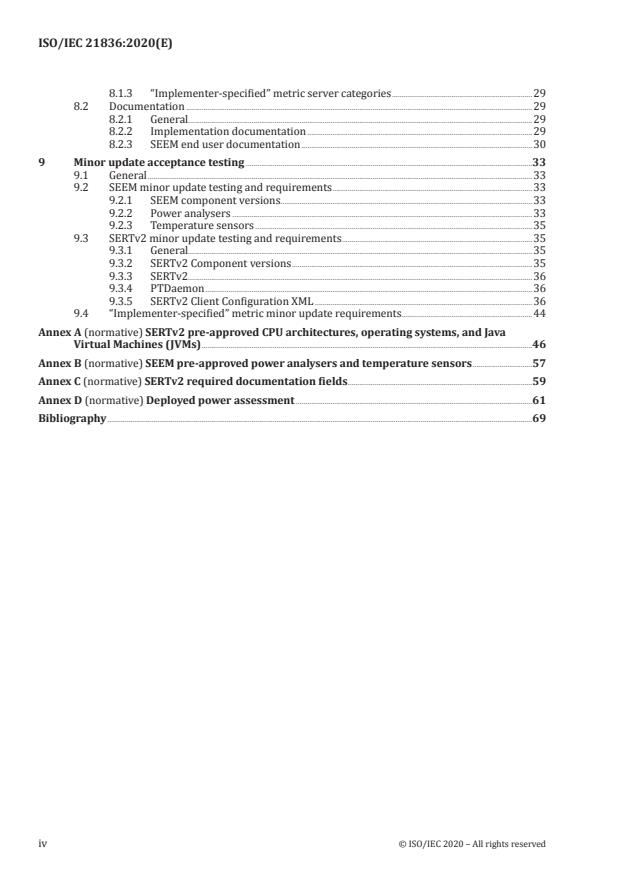
9 Minor update acceptance testing .33
9.1 General .33
9.2 SEEM minor update testing and requirements .33
9.2.1 SEEM component versions . .33
9.2.2 Power analysers .33
9.2.3 Temperature sensors .35
9.3 SERTv2 minor update testing and requirements .35
9.3.1 General.35
9.3.2 SERTv2 Component versions .35
9.3.3 SERTv2 .36
9.3.4 PTDaemon .36
9.3.5 SERTv2 Client Configuration XML .36
9.4 “Implementer-specified” metric minor update requirements . .44
Annex A (normative) SERTv2 pre-approved CPU architectures, operating systems, and Java
Virtual Machines (JVMs) .46
Annex B (normative) SEEM pre-approved power analysers and temperature sensors .57
Annex C (normative) SERTv2 required documentation fields .59
Annex D (normative) Deployed power assessment .61
Bibliography .69
iv © ISO/IEC 2020 – All rights reserved
Foreword
ISO (the International Organization for Standardization) and IEC (the International Electrotechnical
Commission) form the specialized system for worldwide standardization. National bodies that
are members of ISO or IEC participate in the development of International Standards through
technical committees established by the respective organization to deal with particular fields of
technical activity. ISO and IEC technical committees collaborate in fields of mutual interest. Other
international organizations, governmental and non-governmental, in liaison with ISO and IEC, also
take part in the work.
The procedures used to develop this document and those intended for its further maintenance are
described in the ISO/IEC Directives, Part 1. In particular, the different approval criteria needed for
the different types of document should be noted. This document was drafted in accordance with the
editorial rules of the ISO/IEC Directives, Part 2 (see www .iso .org/ directives).
Attention is drawn to the possibility that some of the elements of this document may be the subject
of patent rights. ISO and IEC shall not be held responsible for identifying any or all such patent
rights. Details of any patent rights identified during the development of the document will be in the
Introduction and/or on the ISO list of patent declarations received (see www .iso .org/ patents) or the IEC
list of patent declarations received (see http:// patents .iec .ch).
Any trade name used in this document is information given for the convenience of users and does not
constitute an endorsement.
For an explanation of the voluntary nature of standards, the meaning of ISO specific terms and
expressions related to conformity assessment, as well as information about ISO's adherence to the
World Trade Organization (WTO) principles in the Technical Barriers to Trade (TBT), see www .iso .org/
iso/ foreword .html.
This document was prepared by Joint Technical Committee ISO/IEC JTC 1, Information technology,
Subcommittee SC 39, Sustainability, IT & Data Centres.
Any feedback or questions on this document should be directed to the user’s national standards body. A
complete listing of these bodies can be found at www .iso .org/ members .html.
© ISO/IEC 2020 – All rights reserved v
Introduction
The global economy is now totally reliant on information and communication technologies (ICT) and the
associated generation, transmission, dissemination, computation and storage of digital data. While the
internet backbone carries the traffic, it is data centres which find themselves at the nodes and hubs of a
wide variety of both private enterprise and shared/collocation facilities. With the large and continually
increasing data capacity demands placed on data centres worldwide, efficient use of data centre energy
is an extremely important strategy for managing environmental, cost, electrical grid capacity and other
impacts.
The ISO/IEC 30134 series specifies data centre energy effectiveness key performance indicators (KPI)
to help data centre operators measure and improve specific aspects of data centre energy effectiveness.
ISO/IEC 30134-4 in particular defines a method to measure the peak capacity and utilization of
servers operating in a data centre using operator selected benchmarks. However, it does not provide
a method for comparing individual server energy effectiveness across data centres, and as stated
in ISO/IEC 30134-4, “should not be used to set regulations for a data centre or individual server”.
There is stakeholder demand for an international standard to measure the energy effectiveness of
servers before procurement and installation, particularly for use in worldwide server energy
effectiveness regulations and programmes.
This document provides a server energy effectiveness metric (SEEM) to measure and report the
energy effectiveness of specific server designs and configurations. This document will be useful to
stakeholders, including vendors, users and governments, from the design verification testing phase
all the way through conformance verification, procurement and operation. Organizations that wish to
establish conformance or reporting programmes will find that the test methods and scoring specified
in this document will save them significant time and effort in implementing such programmes.
Standardization across such programmes will allow vendors to comply to stakeholder requirements
more quickly and efficiently.
For applicable servers, this document builds upon the widely adopted Server Efficiency Rating
1) ® 2)
Tool (SERT™) suite developed by the Standard Performance Evaluation Corporation (SPEC )
benchmark consortium, as the energy effectiveness metric and test method. For servers where SERT
is not applicable, this document provides requirements for the creation of alternate server energy
effectiveness metrics, referred to as “implementer-specified” metrics.
1) SERT is a trademark of the Standard Performance Evaluation Corporation. This information is given for the
convenience of users of this document. References to SERT do not constitute an endorsement by ISO/IEC.
2) SPEC is a trademark of the Standard Performance Evaluation Corporation. This information is given for the
convenience of users of this document. References to SPEC do not constitute an endorsement by ISO/IEC.
vi © ISO/IEC 2020 – All rights reserved
INTERNATIONAL STANDARD ISO/IEC 21836:2020(E)
Information technology — Data centres — Server energy
effectiveness metric
1 Scope
This document specifies a measurement method to assess and report the energy effectiveness of a
computer server. This document does not set any pass/fail criteria for servers.
2 Normative references
There are no normative references in this document.
3 Terms, definitions and abbreviated terms
For the purposes of this document, the following terms and definitions apply.
ISO and IEC maintain terminological databases for use in standardization at the following addresses:
— ISO Online browsing platform: available at https:// www .iso .org/ obp
— IEC Electropedia: available at http:// www .electropedia .org/
3.1 Terms and definitions
3.1.1
64-bit CPU
CPU (3.1.12) which has data path widths, memory (3.1.34) addressing, registers, and other architectural
features which are 64-bits wide
3.1.2
active state
operational state in which the server (3.1.49) is carrying out data processing
Note 1 to entry: an example is data retrieval from memory (3.1.34), cache, or storage while awaiting further input
over the network.
3.1.3
auxiliary processing accelerator
additional compute device installed in the computer server (3.1.49) that handles parallelized workloads
(3.1.60) in conjunction with the CPU (3.1.12)
3.1.4
blade chassis
enclosure that contains shared resources for the operation of blade servers (3.1.5), blade storage (3.1.6),
and other blade form-factor devices
Note 1 to entry: Shared resources provided by a chassis may include power supplies, data storage and hardware
for DC power distribution, thermal management, system management and network services.
© ISO/IEC 2020 – All rights reserved 1
3.1.5
blade server
server (3.1.49) that is designed for use in a blade chassis (3.1.4)
Note 1 to entry: A blade server is a high-density device that functions as an independent server (3.1.49) and
includes at least one processor (3.1.40) and system memory (3.1.54), but is dependent upon shared blade chassis
(3.1.4) resources (e.g. power supplies, cooling) for operation.
3.1.6
blade storage
storage device that is designed for use in a blade chassis (3.1.4) that is dependent upon shared blade
chassis (3.1.4) resources, like power supplies or cooling, for operation
3.1.7
buffered memory
circuitry between the server’s memory (3.1.34) and memory controller to either increase memory
capacity, increase bandwidth, and/or reduce the electrical load on the memory controller
3.1.8
coefficient of determination
statistic used to determine the strength of a fit between a mathematical model and a set of observed
data values
[SOURCE: ISO 15551-1:2015, 3.26, modified — Note 1 to entry has been removed.]
3.1.9
coefficient of variation
CV
standard deviation divided by the mean
[SOURCE: ISO 3534-1:2006, 2.38, modified — Note 1 to entry has been removed.]
3.1.10
configuration
interrelated functional and physical characteristics of a product defined in product configuration
information
Note 1 to entry: This document employs the following configurations: low-end (3.1.33), high-end (3.1.25) and
typical.
Note 2 to entry: For server (3.1.49) products, a configuration is one of many possible combinations of components
including CPU (3.1.12), storage devices, memory (3.1.34) size, and capacity and input/output devices for a single
server (3.1.49) product within a larger product family. There are a large number of possible configurations within
a product family.
[SOURCE: ISO 17599:2015, 3.15, modified — Notes 1 and Note 2 to entry have been added.]
3.1.11
core
component of a processor (3.1.40) which can independently receive instructions and takes actions or
performs calculations in response
3.1.12
CPU
central processing element with functions for interpreting and executing instructions
Note 1 to entry: In this document, cache memory (3.1.34) is included with the CPU.
Note 2 to entry: This document uses the terms CPU and processor (3.1.40) interchangeably.
[SOURCE: ISO/IEC 14576:1999, 2.1.9, modified — Note 1 and Note 2 to entry have been added.]
2 © ISO/IEC 2020 – All rights reserved
3.1.13
CPU architecture
CPU (3.1.12) design with significant similarities to other CPU architectures within the same CPU
architecture class (3.1.14)
Note 1 to entry: CPU architectures are used to create CPU models (3.1.15) which are often released in a similar
timeframe.
Note 2 to entry: Examples of different CPU architectures in the same CPU architecture class (3.1.14) are
® ®
Intel Haswell, Intel Broadwell, and Intel Skylake, or separately, AMD Bulldozer, AMD Piledriver, and AMD
3)
Steamroller .
3.1.14
CPU architecture class
group of one or more CPU architectures (3.1.13) which share the same instruction set architecture and
in which newer architecture designs are derived from previous architecture designs
Note 1 to entry: Within a CPU architecture class, the initial CPU architecture (3.1.13) is, for the most part, a new
design, and subsequent CPU architectures (3.1.13) are derived from preceding CPU architectures (3.1.13).
® ®3
Note 2 to entry: Examples of different CPU architecture classes are ARM v8-A and AMD EPYC .
Note 3 to entry: In certain cases, software programmes need to be recompiled for use with different CPU
architecture classes.
3.1.15
CPU model
specific CPU (3.1.12) that is sold in the marketplace
Note 1 to entry: All CPU (3.1.12) of the same model share the same technical characteristics, such as core (3.1.11)
frequencies and core counts, and can be used interchangeably.
Note 2 to entry: Examples of different CPU models are AMD EYPC 7601, AMD EYPC 7251 and Intel Xeon
Platinum 8180 .
3.1.16
CPU nominal frequency
CPU core clock frequency, which is the main frequency used in naming, marketing and selling the CPU
(3.1.12)
3.1.17
data averaging interval
for a power analyser (3.1.38), the time period over which all samples captured by the high-speed
sampling electronics of the analyser are averaged to provide a set of measured data
3.1.18
double data rate
DDR
computer bus characteristic of transferring data on the rising and falling edges of the clock signal,
resulting in twice the data bandwidth at a specific clock frequency, versus a single data rate bus
3.1.19
end user
person or persons who will ultimately be using the system for its intended purpose
Note 1 to entry: For the purposes of this document, the end user refers to a SEEM end user, which is the entity
applying for certification of a server (3.1.49) model to a SEEM conformant regulation or programme. For example,
if server manufacturer A was submitting a server model to ENERGY STAR for certification, server manufacturer
A would be the end user.
3) AMD and EPYC are trademarks of Advanced Micro Devices, Intel is a trademark of the Intel Corporation and ARM
is a trademark of Arm Limited. This information is given for the convenience of users of this document. References
to AMD, EPYC, Intel and ARM do not constitute an endorsement by ISO/IEC.
© ISO/IEC 2020 – All rights reserved 3
[SOURCE: ISO/IEC 19770-5:2015, 3.13, modified — Note 1 to entry removed, new Note 1 to entry added.]
3.1.20
energy effectiveness
measure of the amount of data processing performed for a given amount of energy consumed
Note 1 to entry: For the purposes of this document, energy effectiveness is equivalent to the term energy
efficiency as used in server (3.1.49) compliance regulations and programmes.
3.1.21
expansion auxiliary processing accelerator
expansion APA
auxiliary processing accelerator that is an add-in card installed in a general-purpose add-in
expansion slot.
Note 1 to entry: An expansion APA add-in card may include one or more APAs and/or separate, dedicated
removable switches.
EXAMPLE A GPGPU installed in a PCI-e slot.
3.1.22
fully fault tolerant server
computer server (3.1.49) that is designed with complete hardware redundancy, in which every
computing component is replicated between two nodes running identical and concurrent workloads
(3.1.60)
Note 1 to entry: A fully fault tolerant server uses two systems to simultaneously and repetitively run a single
workload for continuous availability in a mission critical application.
Note 2 to entry: An example of a fault tolerant server ; if one node fails or needs repair, the second node can run
the workload alone to avoid downtime.
3.1.23
hardware threads
in a CPU core (3.1.11), the number of fully independent instruction streams which can be executed
through SMT
3.1.24
high-performance computing system
HPC system
HPC server
computing system which is designed, marketed, sold, and optimized to execute highly parallel
applications for high performance, deep learning, or artificial intelligence applications
Note 1 to entry: HPC systems consist of multiple clustered servers (3.1.49, primarily for increased computational
capability, high speed inter-processing interconnects, large and high bandwidth memory (3.1.34) capability and
often accelerators such as GPGPUs or FPGAs.
Note 2 to entry: HPC systems may be purposely built or assembled from more commonly available computer
servers.
3.1.25
high-end configuration
server (3.1.49) equipped with a specific selection of high-performance components, which is required
to be tested as part of measuring a server product family (3.1.51)
4 © ISO/IEC 2020 – All rights reserved
3.1.26
idle state
operational mode in which the OS and other software have completed loading, the server (3.1.49) is
capable of completing workload (3.1.60) transactions, but no active state (3.1.2) workload transactions
are requested or pending by the system
Note 1 to entry: In the idle state, the server (3.1.49) is operational, but not performing any useful data processing.
Note 2 to entry: For systems where Advanced Configuration and Power Interface (ACPI) has been implemented,
idle state is the ACPI G0 global state and S0 sleep state.
3.1.27
idle state power
average server (3.1.49) power, in watts, when in idle state (3.1.26)
Note 1 to entry: SERT (3.1.46) provides a standard way to measure the idle state power of a server, which is
included with the result output, and is in addition to power measurement while the server (3.1.44) is actively
performing data processing.
3.1.28
implementer
entity that transforms specified designs into their physical realization
Note 1 to entry: For the purposes of this document, implementer is the entity which creates a selection or
procurement program based on SEEM.
[SOURCE: IEC 62279:2015, 3.1.15, modified — Note 1 to entry added.]
3.1.29
integrated auxiliary processing accelerator
auxiliary processing accelerator that is integrated into the motherboard or CPU (3.1.12) package
3.1.30
large network equipment
network product which contains more than 11 network ports with a total line rate throughput of
12 Gb/s or more
3.1.31
large server
resilient/scalable server (3.1.49) which ships as a pre-integrated/pre-tested system housed in one or
more full frames or racks and that includes a high connectivity I/O subsystem with a minimum of 32
dedicated I/O slots
3.1.32
load level
percentage of data processing relative to the maximum a server (3.1.49) can execute
Note 1 to entry: Load levels are typically used by benchmark designers to simulate situations where a system is
receiving fewer data processing requests than it can execute.
Note 2 to entry: Load level is not necessarily the same as CPU (3.1.12) utilization.
3.1.33
low-end configuration
server (3.1.49) configuration which includes a specific selection of entry level components, which is
required to be tested as part of measuring a server product family (3.1.51)
© ISO/IEC 2020 – All rights reserved 5
3.1.34
memory
any device associated with a computer that is used to store information such as programmes or data, in
a digital form
Note 1 to entry: For the purposes of this document, the terms memory and system memory (3.1.54) are used to
refer to memory DIMMs in servers (3.1.49) which provide temporary, fast data storage.
Note 2 to entry: At the time of drafting this document, memory DIMMs are the predominate type of memory
modules used in servers. In this document, the term memory DIMM is used to refer to a server’s memory modules
and is not intended to exclude future types of memory modules or imply that statements referring to memory
DIMMs would not apply to other types of memory modules.
[SOURCE: ISO 1213-1:1993, 11.3.32, modified, — Notes 1 and 2 to entry added.]
3.1.35
memory channel
independent interface in a computer which facilitates the communication of data between a core’s
(3.1.11) memory controller and installed memory DIMMs
Note 1 to entry: Modern computer servers (3.1.43) usually have a number of memory channels connected to
different CPUs (3.1.12) or cores (3.1.11).
3.1.36
multi-node server
server (3.1.49) that is designed with two or more independent server nodes that share a single enclosure
and one or more power supplies
Note 1 to entry: Power is distributed to all nodes through shared power supplies and nodes in a multi-node server
are not designed to be hot-swappable.
3.1.37
normalized
dividing a set of numeric values by one or more numeric value(s)
Note 1 to entry: In this standard normalization is performed for two purposes. One, to adjust benchmark
measurement results to a common numeric scale to ease comparability and combination. Two, dividing
benchmark results by an arbitrary constant to enable sharing of results while obfuscating the actual value of
benchmark results.
3.1.38
power analyser
device used to measure energy consumption of a system under test
3.1.39
PTDaemon
software tool to interface with and control a power analyser (3.1.38) or temperature sensor during
measurement intervals, providing an interface between the supported power analysers and SERT
(3.1.46)
Note 1 to entry: The PTDaemon software allows for automatic power and thermal data collection throughout a
test run and is the source of the detailed power data in the SERT result summary.
3.1.40
processor
in a computer, functional unit that interprets and executes instructions
Note 1 to entry: the processor is the CPU (3.1.12) of the computer server (3.1.49). A typical CPU is a physical
package to be installed on the server motherboard via a socket (3.1.52) or direct solder attachment. The CPU
package may include one or more processor cores (3.1.11).
Note 2 to entry: This document uses the term processor and CPU interchangeably.
6 © ISO/IEC 2020 – All rights reserved
[SOURCE: ISO/IEC 2382:2015, 2122866, Note 1 and Note 2 to entry added.]
3.1.41
programmable load
test equipment or instrument which emulates DC or AC resistance loads normally required to perform
functional tests of a system under test
3.1.42
quantum computer
use of quantum phenomena for computational purposes
3.1.43
rack server
computer server (3.1.49) that is designed for deployment in a standard 19-inch data centre rack as
defined by EIA-310, IEC 60297, or DIN 41494
3.1.44
redundant power supply
additional power supply added to a server (3.1.49) which can fully power the server if the main power
supply fails
Note 1 to entry: During normal operation, redundant power supplies can be configured to either provide power
to the server concurrently with the main power supply, or remain on standby and only provide power in the
event the main power supply fails.
3.1.45
resilient server
computer server (3.1.49) designed with extensive reliability, availability, serviceability, and scalability
features integrated in the micro architecture of the system, CPU (3.1.12) and chipset
3.1.46
Server Efficiency Rating Tool
SERT
performance and power software measurement tool created by the SPEC benchmark standards
consortium
Note 1 to entry: SERT was specifically designed for use in government sponsored server (3.1.49) energy efficiency
programmes.
Note 2 to entry: SERT has components that run on the system under test and a controller system, and interfaces
with a power analyser (3.1.38) connected between the electrical socket (3.1.52) and server power supply.
Note 3 to entry: Detailed performance and power data is collected while running server worklets (3.1.59) at
different load levels (3.1.32), and these measurements are combined into an overall weighted server energy
efficiency score.
3.1.47
SERT Client Configuration XML
file which contains the required worklet (3.1.59) settings for each supported OS, JVM, and CPU
architecture (3.1.13) in SERT (3.1.46)
Note 1 to entry: Ensuring proper JVM tuning parameters specific to each supported OS, JVM, and CPU architecture
is an important element for accurate comparisons across disparate server (3.1.49) platforms.
3.1.48
SERT Run and Reporting Rules
set of requirements established to ensure accurate, reproducible, and comparable measurements
across servers (3.1.49) when running SERT (3.1.46)
© ISO/IEC 2020 – All rights reserved 7
3.1.49
server
physical system unit (Host) composed of CPUs (3.1.12), Memory (3.1.34), Storage, PSUs, Fans, and I/O
that provides computational services to workstations, to personal computers or to other functional
units in a network
Note 1 to entry: Servers provide services and manage networked resources for client devices and are sold
through enterprise channels for use in data centres or office/corporate environments. They are primarily
accessed via network connections, instead of directly connected user input devices such as a keyboard or mouse.
Servers are designed for and listed as supporting one or more computer enterprise operating systems (OS) and/
or hypervisors. They are targeted to run user-installed applications, typically enterprise in nature, and provide
support for error-correcting code (ECC) and/or buffered memory (3.1.7) (including both buffered dual in-line
memory modules [DIMMs] and buffered on board [BOB] configurations [3.1.10]). Servers are designed such that
all processors (3.1.36) have access to shared system memory (3.1.54) and are visible to a single OS or hypervisor.
Note 2 to entry: For the purpose of determining which types of computing systems are considered servers in this
document, both the definition of servers and Note 1 to entry apply.
Note 3 to entry: Services may be dedicated services or shared services.
3.1.50
server appliance
computer server (3.1.49) that is bundled with a pre-installed OS and application software that is used to
perform a dedicated function or set of tightly coupled functions
3.1.51
server product family
group of computer servers sharing one chassis and motherboard which often contains a large number
of possible hardware and software configurations (3.1.10)
3.1.52
socket
server interface designed for the installation of a processor (3.1.36)
3.1.53
storage product
fully functional storage system that supplies data retention services to other devices attached directly
or through a network
Note 1 to entry: A storage server can run on more than one non-vendor specific software which is designed
to support storage system connectivity, COM deployments and virtualized storage environments arrayed in a
software defined storage network.
3.1.54
system memory
volatile data storage which is accessible and shared by all of the cores (3.1.11) of a computer
3.1.55
threshold
level or numeric value at which a change occurs
Note 1 to entry: In this document, this term refers to a numeric result of a test metric which an implementer
(3.1.28) determines is required to pass a programme or regulation.
3.1.56
tower server
a computer server (3.1.49) designed for use in a standalone, non-rack mountable chassis
8 © ISO/IEC 2020 – All rights reserved
3.1.57
variance
measure of the spread of a statistical distribution
Note 1 to entry: For the purposes of this standard, variance is used to refer to the change in benchmark results
between two different runs of the benchmark.
[SOURCE: ISO/IEC 19795-1:2006, 4.8.1, modified — original notes and symbol removed, Note 1 to entry
has been added.]
3.1.58
version
particular form or variation of a resource that differs from other instantiations of the resource in at
least one aspect or item of information
Note 1 to entry: The version number(s) or letter(s) before the first decimal point or space is called the major
version and any portion of the version which is not the major version is called the minor version.
EXAMPLE In the version designated as “v1.2.3,” the major version identification is “1”, and the minor version
identification is “2.3”.
[SOURCE: ISO 24619:2011, 3.1.9, modified — original notes removed, Note 1 and Note 2 to entry have
been added.]
3.1.59
worklet
parts of a workload (3.1.60) consisting of specific code sequences which are executed during testing
3.1.60
workload
group of worklets (3.1.59) which share common attributes and are combined into an overall result
Note 1 to entry: SERT (3.1.46) includes CPU (3.1.12), Memory (3.1.34), and Storage workloads.
Note 2 to entry: A product family has common family attributes, which are a set of features common to all
models/configurations (3.1.10) that are in the family.
3.2 Abbreviated terms
AC alternating current
ACPI advanced configuration and power interface
BIOS basic input/output system
COM capacity optimization management
DC direct current
DIMM dual inline memory module
ECC error-correcting code
EXP exponential function
FPGA field programmable gate array
GB Gigabytes
GPGPU general purpose graphics processing unit
© ISO/IEC 2020 – All rights reserved 9
GUI graphical user interface
HDD hard disk drive
I/O input/output
JVM Java virtual machine
LN natural logarithm
MB Megabytes
OS operating system
PCI-e peripheral component interconnect express
PSU power supply unit
RAS reliability, availability, and serviceability
RMS root mean square
SSD solid state drive
SEEM sever energy effectiveness metric
SMT simultaneous multi-threading
SPEC server performance evaluation corporation
SUT system under test
XML extensible mark-up language
4 Applicability of Server Energy Effectiveness Metric (SEEM)
4.1 General
SEEM applies to all computer servers, as defined in 3.1.49. However, the SERTv2 metric (defined in
Clause 5) only applies to the types of servers where it properly functions and accurately assesses server
energy effectiveness.
For servers to which SERTv2 does not apply, an implementer of this document may develop an alternate
test methodology (see 5.4).
4.2 Applicability of SERTv2
SERTv2 shall apply to all servers except those listed in this subclause, where it either was not designed
to function or does not properly assess the server’s energy effectiveness.
SERTv2 was not designed to function on servers which:
1) only support installation of less than 8 GB of system memory,
2) only support installation of system memory less than SERTv2 Minimum System Memory Size [see
Formula (4)],
3) do not include a 64-bit CPU,
4) contain more than 4 CPU sockets (per blade for blade servers and per node for multi-node servers),
10 © ISO/IEC 2020 – All rights reserved
5) contain a CPU from a CPU architecture class which is not supported by the SERTv2 test method,
6) do not support balanced and evenly distributed memory population (same number and type of
DIMMs per memory channel and per CPU),
7) are only sold with a DC power supply, or
8) are quantum computers.
SERTv2 does not properly assess the energy effectiveness of servers which:
1) ship with one or more integrated APA,
2) are high-performance computing systems,
3) are fully fault tolerant servers,
4) are large servers,
5) are server appliances,
6) are storage products,
7) are blade storage products, or
8) are large network equipment.
4.3 Determination of applicability for an “implementer-specified” metric
For all “implementer-specified” metrics (as described in 5.4), the implementer shall specify to which
types of servers the metric applies, in accordance with all of the following requirements:
1) SEEM metrics are on
...
Questions, Comments and Discussion
Ask us and Technical Secretary will try to provide an answer. You can facilitate discussion about the standard in here.
Loading comments...