


ISO 20904:2020
(Main)Hard coal — Sampling of slurries
Hard coal — Sampling of slurries
This document sets out the basic methods for sampling fine coal, coal rejects or tailings of nominal top size The procedures described in this document primarily apply to sampling of coal that is transported in moving streams as a slurry. These streams can fall freely or be confined in pipes, launders, chutes, spirals or similar channels. Sampling of slurries in stationary situations, such as a settled or even a well-stirred slurry in a tank, holding vessel or dam, is not recommended and is not covered in this Document. This document describes procedures that are designed to provide samples representative of the slurry solids and particle size distribution of the slurry under examination. After draining the slurry sample of fluid and measuring the fluid volume, damp samples of the contained solids in the slurry are available for drying (if required) and measurement of one or more characteristics in an unbiased manner and with a known degree of precision. The characteristics are measured by chemical analysis or physical testing or both. The sampling methods described are applicable to slurries that require inspection to verify compliance with product specifications, determination of the value of a characteristic as a basis for settlement between trading partners or estimation of a set of average characteristics and variances that describes a system or procedure. Provided flow rates are not too high, the reference method against which other sampling procedures are compared is one where the entire stream is diverted into a vessel for a specified time or volume interval. This method corresponds to the stopped-belt method described in ISO 13909-2.
Houille — Échantillonnage des schlamms
General Information
- Status
- Published
- Publication Date
- 27-Feb-2020
- Technical Committee
- ISO/TC 27/SC 4 - Sampling
- Drafting Committee
- ISO/TC 27/SC 4 - Sampling
- Current Stage
- 9092 - International Standard to be revised
- Start Date
- 02-Feb-2026
- Completion Date
- 12-Feb-2026
Relations
- Effective Date
- 03-Feb-2018
Overview
ISO 20904:2020 - Hard coal - Sampling of slurries defines standardized methods for obtaining representative samples of fine hard coal, rejects or tailings (nominal top size < 4 mm) when mixed with water to form a slurry. Published in 2020 (second edition), the standard focuses on sampling from moving streams - falling streams or flows confined in pipes, launders, chutes, spirals and similar channels. It explicitly excludes sampling of stationary slurries (settled or stirred in tanks/dams) and high-solids pastes. The procedures aim to produce damp solid samples (after fluid drainage and fluid volume measurement) suitable for drying, chemical analysis and physical testing with known precision and minimized bias.
Key topics and technical requirements
ISO 20904:2020 covers practical and statistical aspects of slurry sampling to ensure representativity and traceability. Major technical topics include:
- Principles of sampling: guidance on representativity, sources of sampling error and error minimization.
- Sampling schemes: time-based, stratified random and sub-lot approaches to construct lot and sub‑lot samples.
- Mechanical and manual sampling methods: design and operation of cutters and sampler devices for moving streams, plus manual implement guidance.
- Increment mass and number: requirements for primary increment mass, number of increments per lot/sub-lot and avoidance of bias.
- Precision and variance: definitions and calculation of sampling variance, preparation and overall variance, and procedures for routine checking.
- Sample preparation, division and reduction: mills and division methods to obtain test and analysis sub-samples.
- Packing and marking: requirements for sample handling, labelling and chain-of-custody.
- Annex material: informative examples of correct and incorrect sampling devices and a normative annex on manual sampling implements.
- Reference method: diverting the entire stream into a vessel for a defined interval (corresponding to the stopped-belt method in ISO 13909-2) is identified as the benchmark where flow rates permit.
Practical applications and users
ISO 20904:2020 is intended for organizations and professionals involved in coal handling and quality control, including:
- Mining companies and coal preparation plants conducting routine quality sampling of slurries.
- Laboratory analysts requiring representative samples for chemical and physical testing.
- Quality assurance and compliance teams verifying product specifications.
- Trading partners and auditors using samples as the basis for settlement or contract verification.
- Equipment manufacturers and site engineers designing mechanical sampling systems.
Using ISO 20904 helps reduce sampling bias, quantify sampling precision, and produce legally and commercially defensible samples for analysis and dispute resolution.
Related standards
- ISO 13909-2 (stopped-belt sampling method reference)
- ISO 1213-1 / ISO 1213-2 (vocabulary for solid mineral fuels and sampling/testing terms)
Keywords: ISO 20904:2020, slurry sampling, hard coal sampling, coal slurries, sampling methods, representative sample, sampling variance, mechanical sampling, manual sampling.



Get Certified
Connect with accredited certification bodies for this standard

Bureau Veritas Chile
Bureau Veritas certification services in Chile.
Bureau Veritas Peru
Bureau Veritas certification services in Peru.
BVQI Peru
Bureau Veritas certification in Peru.
Sponsored listings
Frequently Asked Questions
ISO 20904:2020 is a standard published by the International Organization for Standardization (ISO). Its full title is "Hard coal — Sampling of slurries". This standard covers: This document sets out the basic methods for sampling fine coal, coal rejects or tailings of nominal top size The procedures described in this document primarily apply to sampling of coal that is transported in moving streams as a slurry. These streams can fall freely or be confined in pipes, launders, chutes, spirals or similar channels. Sampling of slurries in stationary situations, such as a settled or even a well-stirred slurry in a tank, holding vessel or dam, is not recommended and is not covered in this Document. This document describes procedures that are designed to provide samples representative of the slurry solids and particle size distribution of the slurry under examination. After draining the slurry sample of fluid and measuring the fluid volume, damp samples of the contained solids in the slurry are available for drying (if required) and measurement of one or more characteristics in an unbiased manner and with a known degree of precision. The characteristics are measured by chemical analysis or physical testing or both. The sampling methods described are applicable to slurries that require inspection to verify compliance with product specifications, determination of the value of a characteristic as a basis for settlement between trading partners or estimation of a set of average characteristics and variances that describes a system or procedure. Provided flow rates are not too high, the reference method against which other sampling procedures are compared is one where the entire stream is diverted into a vessel for a specified time or volume interval. This method corresponds to the stopped-belt method described in ISO 13909-2.
This document sets out the basic methods for sampling fine coal, coal rejects or tailings of nominal top size The procedures described in this document primarily apply to sampling of coal that is transported in moving streams as a slurry. These streams can fall freely or be confined in pipes, launders, chutes, spirals or similar channels. Sampling of slurries in stationary situations, such as a settled or even a well-stirred slurry in a tank, holding vessel or dam, is not recommended and is not covered in this Document. This document describes procedures that are designed to provide samples representative of the slurry solids and particle size distribution of the slurry under examination. After draining the slurry sample of fluid and measuring the fluid volume, damp samples of the contained solids in the slurry are available for drying (if required) and measurement of one or more characteristics in an unbiased manner and with a known degree of precision. The characteristics are measured by chemical analysis or physical testing or both. The sampling methods described are applicable to slurries that require inspection to verify compliance with product specifications, determination of the value of a characteristic as a basis for settlement between trading partners or estimation of a set of average characteristics and variances that describes a system or procedure. Provided flow rates are not too high, the reference method against which other sampling procedures are compared is one where the entire stream is diverted into a vessel for a specified time or volume interval. This method corresponds to the stopped-belt method described in ISO 13909-2.
ISO 20904:2020 is classified under the following ICS (International Classification for Standards) categories: 73.040 - Coals. The ICS classification helps identify the subject area and facilitates finding related standards.
ISO 20904:2020 has the following relationships with other standards: It is inter standard links to ISO 20904:2006. Understanding these relationships helps ensure you are using the most current and applicable version of the standard.
ISO 20904:2020 is available in PDF format for immediate download after purchase. The document can be added to your cart and obtained through the secure checkout process. Digital delivery ensures instant access to the complete standard document.
Standards Content (Sample)
INTERNATIONAL ISO
STANDARD 20904
Second edition
2020-02
Hard coal — Sampling of slurries
Houille — Échantillonnage des schlamms
Reference number
©
ISO 2020
© ISO 2020
All rights reserved. Unless otherwise specified, or required in the context of its implementation, no part of this publication may
be reproduced or utilized otherwise in any form or by any means, electronic or mechanical, including photocopying, or posting
on the internet or an intranet, without prior written permission. Permission can be requested from either ISO at the address
below or ISO’s member body in the country of the requester.
ISO copyright office
CP 401 • Ch. de Blandonnet 8
CH-1214 Vernier, Geneva
Phone: +41 22 749 01 11
Fax: +41 22 749 09 47
Email: copyright@iso.org
Website: www.iso.org
Published in Switzerland
ii © ISO 2020 – All rights reserved
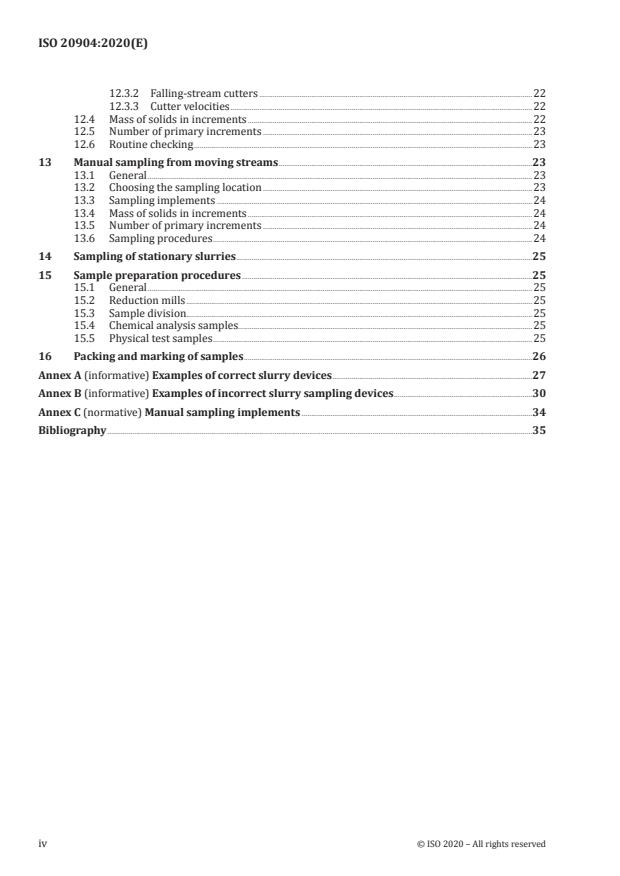
Contents Page
Foreword .v
1 Scope . 1
2 Normative references . 1
3 Terms and definitions . 1
4 Principles of sampling slurries . 2
4.1 General . 2
4.2 Sampling errors . 3
4.2.1 General. 3
4.2.2 Preparation error . 4
4.2.3 Delimitation and extraction errors . 4
4.2.4 Weighting error, E . 5
W
4.2.5 Periodic quality fluctuation error, E . 6
Q3
4.3 Sampling and overall variance . 6
4.3.1 Sampling variance. 6
4.3.2 Overall variance . 6
5 Sampling schemes . 7
6 Minimization of bias and unbiased increment mass .13
6.1 Minimizing bias .13
6.2 Volume of increment for falling stream samplers to avoid bias .14
6.3 Volume of increment for manual sampling to avoid bias .14
7 Precision of sampling and determination of increment variance .15
7.1 Overall precision .15
7.2 Primary increment variance .15
7.3 Preparation and testing variance .16
8 Number of sub-lots and number of increments per sub-lot .16
9 Minimum mass of solids in lot and sub-lot samples .17
9.1 General .17
9.2 Minimum mass of solids in lot samples .17
9.3 Minimum mass of solids in sub-lot samples .17
9.4 Minimum mass of solids in lot and sub-lot samples after size reduction .17
10 Time-basis sampling .18
10.1 General .18
10.2 Sampling interval .18
10.3 Cutters .18
10.4 Taking of increments .18
10.5 Constitution of lot or sub-lot samples .19
10.6 Division of increments and sub-lot samples .19
10.7 Division of lot samples .19
10.8 Number of cuts for division .19
11 Stratified random sampling within fixed time intervals.19
12 Mechanical sampling from moving streams .20
12.1 General .20
12.2 Design of the sampling system .20
12.2.1 Safety of operators .20
12.2.2 Location of sample cutters .20
12.2.3 Provision for duplicate sampling .20
12.2.4 System for checking the precision and bias.20
12.2.5 Minimizing bias .21
12.3 Slurry sample cutters .22
12.3.1 General.22
12.3.2 Falling-stream cutters .22
12.3.3 Cutter velocities .22
12.4 Mass of solids in increments .22
12.5 Number of primary increments .23
12.6 Routine checking .23
13 Manual sampling from moving streams .23
13.1 General .23
13.2 Choosing the sampling location .23
13.3 Sampling implements .24
13.4 Mass of solids in increments .24
13.5 Number of primary increments .24
13.6 Sampling procedures .24
14 Sampling of stationary slurries .25
15 Sample preparation procedures .25
15.1 General .25
15.2 Reduction mills .25
15.3 Sample division.25
15.4 Chemical analysis samples . .25
15.5 Physical test samples .25
16 Packing and marking of samples .26
Annex A (informative) Examples of correct slurry devices .27
Annex B (informative) Examples of incorrect slurry sampling devices .30
Annex C (normative) Manual sampling implements .34
Bibliography .35
iv © ISO 2020 – All rights reserved
Foreword
ISO (the International Organization for Standardization) is a worldwide federation of national standards
bodies (ISO member bodies). The work of preparing International Standards is normally carried out
through ISO technical committees. Each member body interested in a subject for which a technical
committee has been established has the right to be represented on that committee. International
organizations, governmental and non-governmental, in liaison with ISO, also take part in the work.
ISO collaborates closely with the International Electrotechnical Commission (IEC) on all matters of
electrotechnical standardization.
The procedures used to develop this document and those intended for its further maintenance are
described in the ISO/IEC Directives, Part 1. In particular, the different approval criteria needed for the
different types of ISO documents should be noted. This document was drafted in accordance with the
editorial rules of the ISO/IEC Directives, Part 2 (see www .iso .org/ directives).
Attention is drawn to the possibility that some of the elements of this document may be the subject of
patent rights. ISO shall not be held responsible for identifying any or all such patent rights. Details of
any patent rights identified during the development of the document will be in the Introduction and/or
on the ISO list of patent declarations received (see www .iso .org/ patents).
Any trade name used in this document is information given for the convenience of users and does not
constitute an endorsement.
For an explanation of the voluntary nature of standards, the meaning of ISO specific terms and
expressions related to conformity assessment, as well as information about ISO's adherence to the
World Trade Organization (WTO) principles in the Technical Barriers to Trade (TBT), see www .iso .org/
iso/ foreword .html.
This document was prepared by Technical Committee ISO/TC 27, Solid mineral fuels, Subcommittee
SC 4, Sampling.
This second edition cancels and replaces the first edition (ISO 20904:2006), of which it constitutes a
minor revision. The changes compared to the previous edition are as follows:
— an amendment to Figure 6 b) to read ― incorrect;
— correction to Figure 7 b).
Any feedback or questions on this document should be directed to the user’s national standards body. A
complete listing of these bodies can be found at www .iso .org/ members .html.
INTERNATIONAL STANDARD ISO 20904:2020(E)
Hard coal — Sampling of slurries
1 Scope
This document sets out the basic methods for sampling fine coal, coal rejects or tailings of nominal top
size <4 mm that is mixed with water to form a slurry. At very high ratios of fine solids to water when the
material assumes a soft plastic form, the mixture is correctly termed a paste. Sampling of pastes is not
covered in this document.
The procedures described in this document primarily apply to sampling of coal that is transported
in moving streams as a slurry. These streams can fall freely or be confined in pipes, launders, chutes,
spirals or similar channels. Sampling of slurries in stationary situations, such as a settled or even a well-
stirred slurry in a tank, holding vessel or dam, is not recommended and is not covered in this Document.
This document describes procedures that are designed to provide samples representative of the slurry
solids and particle size distribution of the slurry under examination. After draining the slurry sample of
fluid and measuring the fluid volume, damp samples of the contained solids in the slurry are available
for drying (if required) and measurement of one or more characteristics in an unbiased manner and
with a known degree of precision. The characteristics are measured by chemical analysis or physical
testing or both.
The sampling methods described are applicable to slurries that require inspection to verify compliance
with product specifications, determination of the value of a characteristic as a basis for settlement
between trading partners or estimation of a set of average characteristics and variances that describes
a system or procedure.
Provided flow rates are not too high, the reference method against which other sampling procedures
are compared is one where the entire stream is diverted into a vessel for a specified time or volume
interval. This method corresponds to the stopped-belt method described in ISO 13909-2.
2 Normative references
The following documents are referred to in the text in such a way that some or all of their content
constitutes requirements of this document. For dated references, only the edition cited applies. For
undated references, the latest edition of the referenced document (including any amendments) applies.
ISO 1213-1, Solid mineral fuels — Vocabulary — Part 1: Terms relating to coal preparation
ISO 1213-2, Solid mineral fuels — Vocabulary — Part 2: Terms relating to sampling, testing and analysis
ISO 13909-1, Hard coal and coke — Mechanical sampling — Part 1: General introduction
ISO 13909-4, Hard coal and coke — Mechanical sampling — Part 4: Coal — Preparation of test samples
ISO 13909-8, Hard coal and coke — Mechanical sampling — Part 8: Methods of testing for bias
3 Terms and definitions
For the purpose of this document, the terms and definitions given in ISO 1213-1, ISO 1213-2 and
ISO 13909-1 apply.
ISO and IEC maintain terminological databases for use in standardization at the following addresses:
— ISO Online browsing platform: available at https:// www .iso .org/ obp
— IEC Electropedia: available at http:// www .electropedia .org/
4 Principles of sampling slurries
4.1 General
For the purposes of this document, a slurry is defined as fine coal, coal rejects or tailings of nominal top
size <4 mm that is mixed with water, which is frequently used as a convenient form to transport coal,
rejects or tailings though plant circuits by means of pumps and pipelines and under gravity in launders
or chutes or through long distances in slurry pipelines. Tailings from wet plants are also discharged as
a slurry through pipelines to the tailings dam. In many of these operations, collection of increments at
selected sample points is required for evaluation of the coal or rejects in the slurry.
A lot or sub-lot sample is constituted from a set of unbiased primary increments from a lot or sub-
lot. The sample container is weighed immediately after collection and combination of increments to
avoid water loss by evaporation or spillage. Weighing is necessary to determine the mass percentage
of solids in the lot or sub-lot sample. The lot or sub-lot sample can then be filtered, dried and weighed.
Alternatively, the lot or sub-lot sample may be sealed in plastic bags after filtering for transport and
drying at a later stage.
Except for samples for which their characteristics are determined directly on the slurry, test samples
are prepared from lot or sub-lot samples after filtering and drying. Test portions may then be taken
from the test sample and analysed using an appropriate and properly calibrated analytical method or
test procedure under specified conditions.
The objective of the measurement chain is to determine the characteristic of interest in an unbiased
manner with an acceptable and affordable degree of precision. The general sampling theory, which is
based on the additive property of variances, can be used to determine how the variances of sampling,
sample preparation and chemical analysis or physical testing propagate and hence determine the total
variance for the measurement chain. This sampling theory can also be used to optimize mechanical
sampling systems and manual sampling methods.
If a sampling scheme is to provide representative samples, it is necessary that all parts of the slurry
in the lot have an equal opportunity of being selected and appearing in the lot sample for testing. Any
deviation from this basic requirement can result in an unacceptable loss of accuracy. A sampling scheme
having incorrect selection techniques, i.e. with non-uniform selection probabilities, cannot be relied
upon to provide representative samples.
Sampling of slurries should preferably be carried out by systematic sampling on a time basis (see
Clause 10). If the slurry flow rate and the coal-solids concentration vary with time, the slurry volume
and the dry solids mass for each increment will vary accordingly. It is necessary to show that no
systematic error (bias) is introduced by periodic variation in quality or quantity where the proposed
sampling interval is approximately equal to a multiple of the period of variation in quantity or quality.
Otherwise, stratified random sampling should be used (see Clause 11).
Best practice for sampling slurries is to mechanically cut freely falling streams (see Clause 12), with a
complete cross-section of the stream being taken during the traverse of the cutter. Access to freely falling
streams can sometimes be engineered at the end of pipes or by incorporating steps or weirs in launders
and chutes. If samples are not collected in this manner, non-uniform concentration of coal solids in the
slurry due to segregation and stratification of the solids can lead to bias in the sample that is collected.
Slurry flow in pipes can be homogenous with very fine particles dispersed uniformly in turbulent
suspension along the length and across the diameter of the pipe. However, more commonly, the slurry in
a pipe has significant particle-concentration gradients across the pipe and there can be concentration
fluctuations along the length of the pipe. These common conditions are called heterogeneous flow.
Examples of such flow are full-pipe flow of a heterogeneous suspension or partial-pipe flow of a fine
suspension above a slower moving or even stationary bed of coarser particles in the slurry.
For heterogeneous flow, bias is likely to occur where a tapping is made into the slurry pipe to locate
either a flush-fitting sample take-off pipe or a sample tube projecting into the slurry stream for
extraction of samples. The bias is caused by non-uniform concentration profiles in the pipe and the
2 © ISO 2020 – All rights reserved
different trajectories followed by particles of different masses due to their inertia, resulting in larger or
denser particles being preferentially rejected from or included in the sample.
In slurry channels such as launders, heterogeneous flow is almost always present, and this non-
uniformity in particle concentration is usually preserved in the discharge over a weir or step. However,
sampling at a weir or step allows complete access to the full width and breadth of the stream, thereby
enabling all parts of the slurry stream to be collected with equal probability.
Sampling of slurries in stationary situations, such as a settled or even a well-stirred slurry in a tank,
holding vessel or dam is not recommended, because it is virtually impossible to ensure that all parts
of the slurry in the lot have an equal opportunity of being selected and appearing in the lot sample for
testing. Instead, sampling should be carried out from moving streams as the tank, vessel or dam is
filled or emptied.
4.2 Sampling errors
4.2.1 General
The processes of sampling, sample preparation and measurement are experimental procedures, and
each procedure has its own uncertainty appearing as variations in the final results. When the average
of these variations is close to zero, they are called random errors. More serious variations contributing
to the uncertainty of results are systematic errors, which have averages biased away from zero. There
are also human errors that introduce variations due to departures from prescribed procedures for
which statistical analysis procedures are not applicable.
The characteristics of the solids component of a slurry can be determined by extracting samples from
the slurry stream, preparing test samples and measuring the required quality characteristics. The total
[5][6]
sampling error, E , can be expressed as the sum of a number of independent components . Such a
T
simple additive combination is not possible if the components are correlated. The total sampling error,
E , expressed as a sum of its components, is given by Formula (1):
T
EE=+EE++EE++EE+ (1)
TQ1Q2Q3W DE P
where
E is short-range quality fluctuation error associated with short-range variations in quality of
Q1
the solids component of the slurry;
E is long-range quality fluctuation error associated with long-range variations in quality of the
Q2
solids component of the slurry;
E is periodic quality fluctuation error associated with periodic variations in quality of the solids
Q3
component of the slurry;
E is weighting error associated with variations in slurry flow rate;
W
E is increment delimitation error introduced by incorrect increment delimitation;
D
E is increment extraction error introduced by incorrect increment extraction from the slurry;
E
E is the preparation error introduced by departures (usually unintentional) from correct prac-
P
tices, e.g. during constitution of the lot sample, draining and filtering away the water, and
transportation and drying of the sample.
The short-range quality fluctuation error consists of two components, as shown by Formula (2):
EE=+E (2)
Ql FG
where
E is the fundamental error due to variation in quality between particles;
F
E is the segregation and grouping error.
G
The fundamental error results from the composition heterogeneity of the lot, i.e. the heterogeneity that
is inherent to the composition of each particle making up the solids component of the lot. The greater
the differences in the compositions of particles, the greater the composition heterogeneity and the
higher the fundamental error variance. The fundamental error can never be completely eliminated.
It is an inherent error resulting from the variation in composition of the particles in the slurry being
sampled.
The segregation and grouping error results from the distribution heterogeneity of the sampled
[6]
material . The distribution heterogeneity of a lot is the heterogeneity arising from the manner in
which particles are distributed in the slurry. It can be reduced by taking more increments, but it can
never be completely eliminated.
A number of the components of the total sampling error, namely E , E and E , can be minimized or
D E P
reduced to an acceptable level by correct design of the sampling procedure.
4.2.2 Preparation error
In this context, the preparation error, E , includes errors associated with non-selective sample
P
preparation operations that should not change mass, such as sample transfer, flocculation, draining
and filtering, drying, crushing, grinding or mixing. It does not include errors associated with sample
division. Preparation errors include sample contamination, loss of sample material, alteration of the
chemical or physical composition of the sample, operator mistakes, fraud or sabotage. These errors
can be made negligible by correct design of the sample plant and by staff training. For example, cross-
stream slurry cutters should have caps to prevent entry of splashes when the cutter is in the parked
position and it is necessary to take care during filtering to avoid loss of fines that are still suspended in
the water to be discarded.
4.2.3 Delimitation and extraction errors
Delimitation and extraction errors arise from incorrect sample cutter design and operation. The
increment delimitation error, E , results from an incorrect geometry of the volume delimiting the
D
slurry increment (see Figure 1), and this can be due to both design and operation faults. Because of
the incorrect shape of the slurry increment volume, sampling with non-uniform selection probabilities
results. The average of E is often non-zero, which makes it a source of sampling bias. The delimitation
D
error can be made negligible if all parts of the stream cross-section are diverted by the sample cutter
for the same length of time.
Sampling from moving slurry streams usually involves methods that fall into three broad operational
categories as follows:
[6]
a) taking the whole stream part of the time with a cross-stream cutter as shown in Figure 1 a) , usually
when the slurry falls from a pipe or over a weir or step. Cuts 1 and 2 show correct sampling with the
cutter diverting all parts of the stream for the same length of time. Cuts 3, 4 and 5 show incorrect
sampling where the cutter diverts different parts of the stream for different lengths of time;
[6]
b) taking part of the stream all of the time as shown in Figure 1 b) with an in-stream point sampler
or probe within a pipe or channel, which is always incorrect;
[6]
c) taking part of the stream part of the time as shown in Figure 1 c) , also with an in-stream point
sampler or probe within a pipe or channel, which is always incorrect.
4 © ISO 2020 – All rights reserved
a) Taking all of the stream part of the time
b) Taking part of the stream all of the time (always incorrect)
c) Taking part of the stream part of the time (always incorrect)
a
Correct.
b
Incorrect.
Figure 1 — Plan view of slurry volumes diverted by sample cutters
The increment extraction error, E , results from incorrect extraction of the slurry increment. The
E
extraction is said to be correct if, and only if, all particles in the slurry that have their centre of gravity
inside the boundaries of the correctly delimited increment are extracted. The average of E is often non-
E
zero, which makes it a source of sampling bias. The extraction error can be made negligible by ensuring
that the slurry increment is completely extracted from the stream without any particulate material
being lost from the cutter due to splashes. It is necessary that the depth and capacity of the cutter be
sufficient to avoid slurry reflux from the cutter aperture, resulting in loss of part of the extracted slurry
increment.
4.2.4 Weighting error, E
W
The weighting error is an error component arising from the selection model underlying Formula (1).
In the model, the time-dependent flow rate of the solids in the slurry stream is a weighting function
applied to the corresponding time-dependent quality characteristic over time, which gives the
weighted-average quality characteristic of the solids component of the lot. The weighting error results
from the application of incorrect weights to the quality characteristics. The best solution to reducing
the weighting error is to stabilize the flow rate. As a general rule, the weighting error is negligible
for variations in flow rate of up to 10 % relative and acceptable for variations in flow rate up to 20 %
relative.
4.2.5 Periodic quality fluctuation error, E
Q3
Periodic quality fluctuation errors result from periodic variations in quality generated by some
equipment used for slurry processing and transportation, e.g. grinding and screening circuits, splitters
and pumps. The presence of periodic variations can be detected by determining the variogram (see
ISO 13909-7). While in most cases variogram values can be fitted with a simple linear or quadratic
function, if periodic behaviour (characterized by regularly spaced maxima and minima) is observed,
the fitting function can include a sine-wave term with a period and amplitude to be determined as
[5]
parameters of the fit . In such cases, stratified random sampling should be carried out as discussed in
Clause 11. The alternative is to significantly reduce the source of periodic variations in quality, which
can require plant redesign.
4.3 Sampling and overall variance
4.3.1 Sampling variance
Assume that the weighting, E , increment delimitation, E , increment extraction, E , and preparation
W D E
errors, E , described in 4.2.2, 4.2.3 and 4.2.4 have been eliminated or reduced to insignificant values by
P
careful design and sampling practice. In addition, assume that periodic variations in quality have been
eliminated and that the flow rate has been regulated. The sampling error in Formula (1) then reduces to
the form of Formula (3):
EE=+E (3)
TQ1Q2
Hence, the sampling variance, V , is given by Formula (4):
S
VV=+V (4)
SEQE12Q
The short-range quality fluctuation variance, V , arises from the different internal composition of
EQ1
increments taken at the shortest possible interval apart. This is a local or random variance due to the
particulate nature of the solids in the slurry.
The long-range quality fluctuation variance, V , arises from the continuous trends in quality that
EQ2
occur while sampling a slurry and is usually space- and time-dependent. This component is often the
combination of a number of trends generated by diverse causes.
4.3.2 Overall variance
The experimental estimate of overall variance is denoted by V . It is comprised of three components,
SPT
namely the estimated variance of sampling, the estimated variance of sample preparation and the
estimated variance of testing, as given in Formula (5):
VV=+VV+ (5)
SPTS PT
where
V is the estimated sampling variance;
S
V is the estimated sample preparation variance;
P
V is the estimated measurement variance.
T
6 © ISO 2020 – All rights reserved
Methods for obtaining estimates V , V , V and V can be found in ISO 13909-7.
S P T SPT
NOTE The distinction between “sampling” and “sample preparation” is not always clear. For the purposes of
this document, “sampling” stages denote those stages of sampling and sample division that take place within the
sampling plant where slurry increments are extracted and where drainage of clear water is carried out after the
contained solids of the sample settle. On the other hand, “sample preparation” stages denote those stages that
take place away from the sampling plant, typically in the plant laboratory.
Sample preparation stages may include additional drainage, filtering and drying of samples before size
reduction, sample division and preparation of test samples for measurement. The principles of sampling
given in 4.2 apply to sample preparation stages as well as to the sampling stages.
Where a very precise result is required and the sampling variance has been minimized, consideration
has to be given to increasing the number of sample preparations and measurements to reduce these
components of the overall variance. This is achieved by the following:
a) carrying out multiple determinations on the contained solids in the lot sample;
b) analysing the contained solids in individual increments;
c) dividing the slurry lot into a number of sub-lots or part-lots and analysing the contained solids in a
sample from each sub-lot.
The overall variance in each case is then given by one of the following equations:
— where a single lot sample is constituted from a lot and r replicate determinations on the contained
solids are carried out on the lot sample, by Formula (6):
V
T
VV=+V + (6)
SPTS P
r
— where m sub-lot samples are prepared, each constituted from the contained solids of an equal
number of increments, and r replicate determinations are carried out on each sub-lot sample, by
Formula (7):
V
T
V +
P
r
VV=+ (7)
SPTS
m
— where all n increments are prepared and a single determination is carried out on the contained
solids of each increment, by Formula (8):
V V
PT
VV=+ + (8)
SPTS
n n
5 Sampling schemes
Most sampling operations are routine and are carried out to determine the average quality characteristics
of a lot as well as variations in quality characteristics between sub-lots and lots for monitoring and
controlling quality. In establishing a sampling scheme for routine sampling so that the required precision
for a lot can be obtained, it is necessary to carry out the following sequence of steps. This sequence
includes experimental procedures that are non-routine and carried out infrequently, e.g. determining
increment variance in step e), particularly when a significant change has occurred to the slurry source
or to the sampling equipment. The procedure is as given in the following steps a) through i).
a) Define the purpose for which the samples are being taken. Sampling for commercial transactions
is usually the main purpose of International Standards for sampling. However, the procedures
described in this document are equally applicable to monitoring plant performance, process control
and metallurgical accounting.
b) Define the lot by specifying the duration of slurry flow, e.g. one day of operation.
c) Identify the quality characteristics to be measured and specify the overall precision (combined
precision of sampling, sample preparation and measurement) required for each quality
characteristic. If the required precision results in impractical numbers of increments and sub-lots,
it can be necessary to adopt a poorer precision.
d) Ascertain the nominal top size and particle density of the solids in the slurry for determining the
minimum volume of slurry increment and the minimum mass of the solids in the lot sample (see
Clauses 6 and 9).
e) Check the procedures and equipment for taking slurry increments to minimize bias (see Clause 6).
f) Determine the variability of the coal and the variance of preparation and testing for the quality
characteristics under consideration (see Clause 7).
g) Determine the number of sub-lots and the number of increments per sub-lot required to attain the
desired precision (see Clause 8).
h) Determine the sampling interval in minutes for time-basis systematic sampling (see Clause 10) or
stratified random sampling within fixed time intervals (see Clause 11).
i) Take slurry increments at the intervals determined in step h) during the whole period of handling
the lot.
During sampling operations, sub-lot samples may be combined to constitute a single lot sample for
analysis (see Figure 2). Alternatively, increments taken from sub-lots may be used to constitute sub-lot
samples for analysis, which also improves the overall precision of the measured quality characteristics
of the lot (see Figure 3). Other reasons for separate preparation and analysis of sub-lot samples are
— for convenience of materials handling;
— to provide progressive information on the quality of the lot;
— to provide reference or reserve samples after division.
Each increment may also be analysed separately (see Figure 4) to determine the increment variance
of quality characteristics of the lot. In addition, it is recommended that the precision achieved in
practice should be checked on an ongoing basis by duplicate sampling where alternate increments are
diverted to lot samples A and B (see Figure 5) from which two test samples are prepared and analysed.
A substantial number of sample pairs (preferably at least 20) is required to obtain a reliable estimate of
precision.
In most situations, it is not necessary to crush or pulverise the solids in the slurry increment to allow
further division, since most slurries contain only fine particles. However, if the particles are coarse
and particle-size reduction is required to allow further division, it is necessary to re-determine the
minimum sample mass for the lot using the new nominal top size of the crushed solids (see Clause 9).
The initial design of a sampling scheme for a new plant or a slurry with unfamiliar characteristics
should, wherever possible, be based on experience with similar handling plants and material types.
Alternatively, a substantial number of increments, e.g. 100, can be taken and used to determine the
quality variation of the contained solids, but the precision of sampling cannot be determined a priori.
Sampling of slurries in stationary situations, such as a settled or even a well-stirred slurry in a tank,
holding vessel or dam, is not recommended and is not covered in this document.
8 © ISO 2020 – All rights reserved
Figure 2 — Example of a sampling plan where a single lot sample is constituted for analysis
Figure 3 — Example of a sampling plan with each sub-lot sample analysed separately
10 © ISO 2020 – All rights reserved
Figure 4 — Example of a sampling plan with each increment analysed separately
Figure 5 — Example of a duplicate sampling plan for routine analysis or determination of
overall precision
12 © ISO 2020 – All rights reserved
6 Minimization of bias and unbiased increment mass
6.1 Minimizing bias
Minimization of bias in sampling and sample preparation is vitally important. Unlike precision, which
can be improved by collecting more slurry increments, preparing more test samples or assaying more
test portions, bias cannot be reduced by replication. Consequently, sources of bias should be minimized
or eliminated at the outset by correct design
...
Questions, Comments and Discussion
Ask us and Technical Secretary will try to provide an answer. You can facilitate discussion about the standard in here.
Loading comments...