


ISO/IEC 4396-3:2023
(Main)Telecommunications and information exchange between systems — Recursive inter-network architecture — Part 3: Common distributed application protocol
Telecommunications and information exchange between systems — Recursive inter-network architecture — Part 3: Common distributed application protocol
This document provides the common distributed application protocol (CDAP) specification. CDAP enables distributed applications to deal with communications at an object level, rather than forcing applications to explicitly deal with serialization and input/output operations. CDAP provides the application protocol component of a distributed application facility (DAF). CDAP provides a straightforward and unifying approach to sharing data over a network without having to create specialized protocols. This document provides: — an overview of CDAP; — the specification of CDAP; — a description of policies, in the specific sense introduced in the text; — notes on the context of CDAP.
Télécommunications et échange d'information entre systèmes — Architecture récursive inter-réseaux — Partie 3: Protocole pour les applications distribuées CDAP
General Information
- Status
- Published
- Publication Date
- 04-Dec-2023
- Current Stage
- 6060 - International Standard published
- Start Date
- 05-Dec-2023
- Due Date
- 11-May-2024
- Completion Date
- 05-Dec-2023
Overview
ISO/IEC 4396-3:2023 specifies the Common Distributed Application Protocol (CDAP) as part of the Recursive Inter-Network Architecture (RINA) work. CDAP defines an application-level protocol that lets distributed applications communicate at an object level rather than handling low-level serialization and I/O operations. The standard provides the CDAP specification, an overview of its object-oriented messaging model, policy concepts, and notes on context and implementation (DAF, RIB daemon model). Annexes include concrete syntaxes for Google Protocol Buffers (GPB) and JSON.
Key Technical Topics and Requirements
- Object model and object classes: definition of objects, properties, names (ObjName/ObjID), shorthand aliases and object versioning.
- Application entities (AEs) and connections: lifecycle and establishment of application connections, plus the Application Connection State Vector (ACSV) to track state.
- CDAP messages and methods: standardized message structure, opcodes, InvokeID, ObjValue, result/resultReason, scope and filter, and flags to support CREATE, READ, WRITE, START/STOP and related operations.
- Message encoding and concrete syntaxes: specification of encoding approaches and informative annexes for GPB and JSON formats.
- Policies and standardization: a comprehensive policy framework (e.g., authentication, object naming, error handling, ordering, visibility, types and methods) that implementers can adopt or override to ensure interoperability.
- API and validation: notes on the CDAP application programming interface (API) and validation rules for operations and values.
- Contextual guidance: discussion of the RIB daemon model and distributed application patterns within the Recursive Inter-Network Architecture.
Practical Applications and Who Uses This Standard
CDAP is intended for architects, protocol designers, and software engineers building distributed systems that require a uniform object-level communication layer. Typical use cases include:
- Network control and management in telecom and cloud networking where RINA principles are applied.
- Distributed application facilities (DAFs) and middleware that expose object-based interfaces across endpoints.
- IoT platforms and edge systems that benefit from standardized object models and compact encodings (GPB/JSON).
- Interoperability projects requiring policy-driven behavior, authentication, and versioned object schemas.
Adopting ISO/IEC 4396-3:2023 helps reduce the need for bespoke protocols by providing a unifying protocol for object exchange, method invocation, and state management.
Related Standards
- Other parts of the ISO/IEC 4396 series covering the Recursive Inter-Network Architecture (RINA) family.
- Informative annexes in this document: GPB (Google Protocol Buffers) and JSON concrete syntaxes for CDAP message encoding.
Keywords: ISO/IEC 4396-3:2023, CDAP, Common Distributed Application Protocol, RINA, distributed applications, object model, ACSV, message encoding, GPB, JSON, DAF, RIB.

Get Certified
Connect with accredited certification bodies for this standard

BSI Group
BSI (British Standards Institution) is the business standards company that helps organizations make excellence a habit.

NYCE
Mexican standards and certification body.
Sponsored listings
Frequently Asked Questions
ISO/IEC 4396-3:2023 is a standard published by the International Organization for Standardization (ISO). Its full title is "Telecommunications and information exchange between systems — Recursive inter-network architecture — Part 3: Common distributed application protocol". This standard covers: This document provides the common distributed application protocol (CDAP) specification. CDAP enables distributed applications to deal with communications at an object level, rather than forcing applications to explicitly deal with serialization and input/output operations. CDAP provides the application protocol component of a distributed application facility (DAF). CDAP provides a straightforward and unifying approach to sharing data over a network without having to create specialized protocols. This document provides: — an overview of CDAP; — the specification of CDAP; — a description of policies, in the specific sense introduced in the text; — notes on the context of CDAP.
This document provides the common distributed application protocol (CDAP) specification. CDAP enables distributed applications to deal with communications at an object level, rather than forcing applications to explicitly deal with serialization and input/output operations. CDAP provides the application protocol component of a distributed application facility (DAF). CDAP provides a straightforward and unifying approach to sharing data over a network without having to create specialized protocols. This document provides: — an overview of CDAP; — the specification of CDAP; — a description of policies, in the specific sense introduced in the text; — notes on the context of CDAP.
ISO/IEC 4396-3:2023 is classified under the following ICS (International Classification for Standards) categories: 35.100.30 - Network layer. The ICS classification helps identify the subject area and facilitates finding related standards.
ISO/IEC 4396-3:2023 is available in PDF format for immediate download after purchase. The document can be added to your cart and obtained through the secure checkout process. Digital delivery ensures instant access to the complete standard document.
Standards Content (Sample)
INTERNATIONAL ISO/IEC
STANDARD 4396-3
First edition
2023-12
Telecommunications and
information exchange between
systems — Recursive inter-network
architecture —
Part 3:
Common distributed application
protocol
Télécommunications et échange d'information entre systèmes —
Architecture récursive inter-réseaux —
Partie 3: Protocole pour les applications distribuées CDAP
Reference number
© ISO/IEC 2023
© ISO/IEC 2023
All rights reserved. Unless otherwise specified, or required in the context of its implementation, no part of this publication may
be reproduced or utilized otherwise in any form or by any means, electronic or mechanical, including photocopying, or posting on
the internet or an intranet, without prior written permission. Permission can be requested from either ISO at the address below
or ISO’s member body in the country of the requester.
ISO copyright office
CP 401 • Ch. de Blandonnet 8
CH-1214 Vernier, Geneva
Phone: +41 22 749 01 11
Email: copyright@iso.org
Website: www.iso.org
Published in Switzerland
ii
© ISO/IEC 2023 – All rights reserved
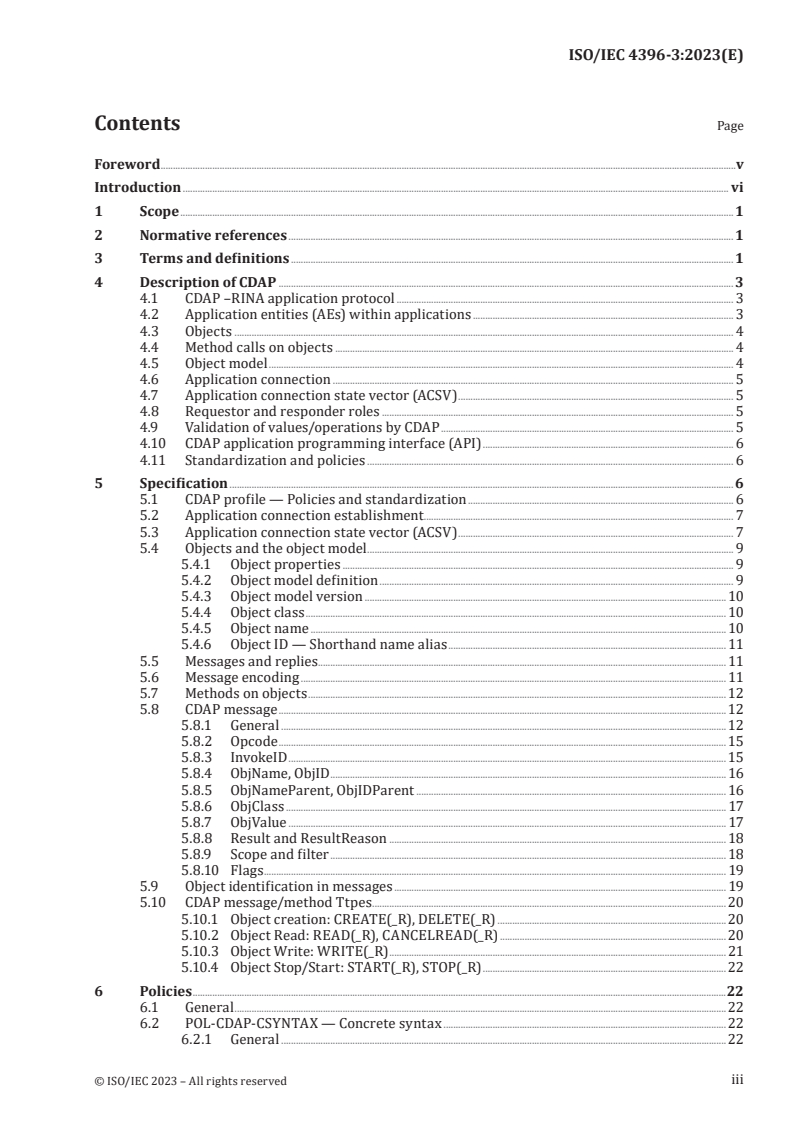
Contents Page
Foreword .v
Introduction . vi
1 Scope . 1
2 Normative references . 1
3 Terms and definitions . 1
4 Description of CDAP . 3
4.1 CDAP –RINA application protocol . 3
4.2 Application entities (AEs) within applications . 3
4.3 Objects . 4
4.4 Method calls on objects . 4
4.5 Object model . 4
4.6 Application connection . 5
4.7 Application connection state vector (ACSV) . 5
4.8 Requestor and responder roles . 5
4.9 Validation of values/operations by CDAP . 5
4.10 CDAP application programming interface (API) . 6
4.11 Standardization and policies . 6
5 Specification . 6
5.1 CDAP profile — Policies and standardization . 6
5.2 Application connection establishment . 7
5.3 Application connection state vector (ACSV) . 7
5.4 Objects and the object model . 9
5.4.1 Object properties . 9
5.4.2 Object model definition . 9
5.4.3 Object model version . 10
5.4.4 Object class . 10
5.4.5 Object name . 10
5.4.6 Object ID — Shorthand name alias . 11
5.5 Messages and replies . . 11
5.6 Message encoding . 11
5.7 Methods on objects . 12
5.8 CDAP message .12
5.8.1 General .12
5.8.2 Opcode . 15
5.8.3 InvokeID . 15
5.8.4 ObjName, ObjID . 16
5.8.5 ObjNameParent, ObjIDParent . 16
5.8.6 ObjClass . 17
5.8.7 ObjValue . 17
5.8.8 Result and ResultReason . 18
5.8.9 Scope and filter . 18
5.8.10 Flags . 19
5.9 Object identification in messages . 19
5.10 CDAP message/method Ttpes . 20
5.10.1 Object creation: CREATE(_R), DELETE(_R) . 20
5.10.2 Object Read: READ(_R), CANCELREAD(_R) . 20
5.10.3 Object Write: WRITE(_R) . 21
5.10.4 Object Stop/Start: START(_R), STOP(_R) .22
6 Policies .22
6.1 General .22
6.2 POL-CDAP-CSYNTAX — Concrete syntax . 22
6.2.1 General .22
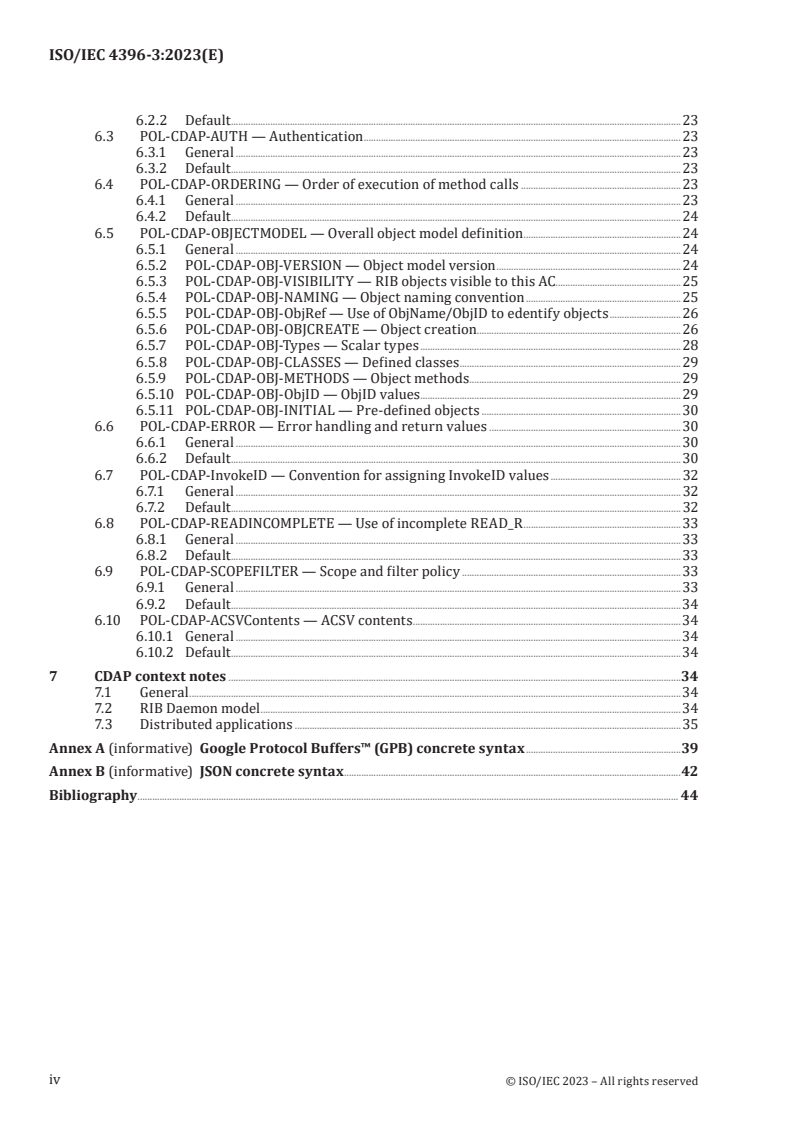
iii
© ISO/IEC 2023 – All rights reserved
6.2.2 Default . .23
6.3 POL-CDAP-AUTH — Authentication . 23
6.3.1 General .23
6.3.2 Default . .23
6.4 POL-CDAP-ORDERING — Order of execution of method calls . 23
6.4.1 General .23
6.4.2 Default . . 24
6.5 POL-CDAP-OBJECTMODEL — Overall object model definition . 24
6.5.1 General . 24
6.5.2 POL-CDAP-OBJ-VERSION — Object model version . 24
6.5.3 POL-CDAP-OBJ-VISIBILITY — RIB objects visible to this AC.25
6.5.4 POL-CDAP-OBJ-NAMING — Object naming convention . 25
6.5.5 POL-CDAP-OBJ-ObjRef — Use of ObjName/ObjID to edentify objects .26
6.5.6 POL-CDAP-OBJ-OBJCREATE — Object creation. 26
6.5.7 POL-CDAP-OBJ-Types — Scalar types .28
6.5.8 POL-CDAP-OBJ-CLASSES — Defined classes .29
6.5.9 POL-CDAP-OBJ-METHODS — Object methods . .29
6.5.10 POL-CDAP-OBJ-ObjID — ObjID values .29
6.5.11 POL-CDAP-OBJ-INITIAL — Pre-defined objects .30
6.6 POL-CDAP-ERROR — Error handling and return values .30
6.6.1 General .30
6.6.2 Default . .30
6.7 POL-CDAP-InvokeID — Convention for assigning InvokeID values . 32
6.7.1 General . 32
6.7.2 Default . . 32
6.8 POL-CDAP-READINCOMPLETE — Use of incomplete READ_R . 33
6.8.1 General . 33
6.8.2 Default . . 33
6.9 POL-CDAP-SCOPEFILTER — Scope and filter policy . 33
6.9.1 General . 33
6.9.2 Default . .34
6.10 POL-CDAP-ACSVContents — ACSV contents .34
6.10.1 General .34
6.10.2 Default . .34
7 CDAP context notes .34
7.1 General .34
7.2 RIB Daemon model .34
7.3 Distributed applications . 35
Annex A (informative) Google Protocol Buffers™ (GPB) concrete syntax .39
Annex B (informative) JSON concrete syntax .42
Bibliography . 44
iv
© ISO/IEC 2023 – All rights reserved
Foreword
ISO (the International Organization for Standardization) and IEC (the International Electrotechnical
Commission) form the specialized system for worldwide standardization. National bodies that are
members of ISO or IEC participate in the development of International Standards through technical
committees established by the respective organization to deal with particular fields of technical
activity. ISO and IEC technical committees collaborate in fields of mutual interest. Other international
organizations, governmental and non-governmental, in liaison with ISO and IEC, also take part in the
work.
The procedures used to develop this document and those intended for its further maintenance
are described in the ISO/IEC Directives, Part 1. In particular, the different approval criteria
needed for the different types of document should be noted. This document was drafted in
accordance with the editorial rules of the ISO/IEC Directives, Part 2 (see www.iso.org/directives or
www.iec.ch/members_experts/refdocs).
ISO and IEC draw attention to the possibility that the implementation of this document may involve
the use of (a) patent(s). ISO and IEC take no position concerning the evidence, validity or applicability
of any claimed patent rights in respect thereof. As of the date of publication of this document, ISO and
IEC had received notice of (a) patent(s) which may be required to implement this document. However,
implementers are cautioned that this may not represent the latest information, which may be obtained
from the patent database available at www.iso.org/patents and https://patents.iec.ch. ISO and IEC shall
not be held responsible for identifying any or all such patent rights.
Any trade name used in this document is information given for the convenience of users and does not
constitute an endorsement.
For an explanation of the voluntary nature of standards, the meaning of ISO specific terms and
expressions related to conformity assessment, as well as information about ISO's adherence to
the World Trade Organization (WTO) principles in the Technical Barriers to Trade (TBT) see
www.iso.org/iso/foreword.html. In the IEC, see www.iec.ch/understanding-standards.
This document was prepared by Joint Technical Committee ISO/IEC JTC 1, Information technology,
Subcommittee SC 6 Telecommunications and information exchange between systems.
A list of all parts in the ISO/IEC 4396 series can be found on the ISO and IEC websites.
Any feedback or questions on this document should be directed to the user’s national standards
body. A complete listing of these bodies can be found at www.iso.org/members.html and
www.iec.ch/national-committees.
v
© ISO/IEC 2023 – All rights reserved
Introduction
The common distributed application protocol (CDAP) is used by communicating recursive inter-network
architecture (RINA) applications to exchange application-specific data and effect remote actions. CDAP
implements the protocol messages and state machines to allow the two endpoints of a communication
flow to exchange read/write, start/stop, and create/delete method invocations on remote “objects”.
The semantics of those objects and operations are opaque to the CDAP protocol itself. Because CDAP
is not specific to RINA, it can be used by any distributed application that needs to share information or
initiate state changes with another application over a network. CDAP is used in the RINA architecture
by applications, and specifically by inter-process communication (IPC) Processes, which are specialized
applications that cooperate to create a Distributed IPC Facility (DIF) that provides network transport
to other applications.
vi
© ISO/IEC 2023 – All rights reserved
INTERNATIONAL STANDARD ISO/IEC 4396-3:2023(E)
Telecommunications and information exchange between
systems — Recursive inter-network architecture —
Part 3:
Common distributed application protocol
1 Scope
This document provides the common distributed application protocol (CDAP) specification. CDAP
enables distributed applications to deal with communications at an object level, rather than forcing
applications to explicitly deal with serialization and input/output operations. CDAP provides
the application protocol component of a distributed application facility (DAF). CDAP provides a
straightforward and unifying approach to sharing data over a network without having to create
specialized protocols.
This document provides:
— an overview of CDAP;
— the specification of CDAP;
— a description of policies, in the specific sense introduced in the text;
— notes on the context of CDAP.
2 Normative references
The following documents are referred to in the text in such a way that some or all of their content
constitutes requirements of this document. For dated references, only the edition cited applies. For
undated references, the latest edition of the referenced document (including any amendments) applies.
ISO/IEC 4396-1, Telecommunications and information exchange between systems – Recursive Inter-
Network Architecture — Part 1: RINA Reference Model
3 Terms and definitions
For the purposes of this document, the terms and definitions given in ISO/IEC 4396-1, and the following
apply.
ISO and IEC maintain terminology databases for use in standardization at the following addresses:
— ISO Online browsing platform: available at https:// www .iso .org/ obp
— IEC Electropedia: available at https:// www .electropedia .org/
3.1
application object model
common distributed application protocol (CDAP) object model used in the application connection (AC)
data transfer phase.
Note 1 to entry: If an AE is capable of supporting multiple object models, this selects the one to be used for this
AC. If not, the requested object model value should match that of the sole implemented model.
© ISO/IEC 2023 – All rights reserved
3.2
CDAP message encoding rules
encoding of bits sent for all CDAP messages in an application connection
Note 1 to entry: The concrete syntax to be used for the AC is determined by the Common Application Connection
Establishment Phase (CACEP) and provided to the CDAP data phase in the application connection state vector
(ACSV).
3.3
CDAP policy
CDAP implementation option where something can be done in multiple ways, and no single choice is
mandated
Note 1 to entry: CDAP implementers should make a choice of how to implement every CDAP policy; recommended
policies are provided in this document.
3.4
CDAP profile
specific and complete definition of all the policies in CDAP and the object model that should be
implemented as described in order to create a conforming, compatible implementation
3.5
CDAP syntax version
abstract syntax
integer that indicates version of abstract syntax used
3.6
method call
request for the recipient application-entity (AE) to make a call to a method (function) specific to an
object
3.7
object
named conceptual data entity residing within the resource information base (RIB) view made available
to an application connection (AC) by the application
Note 1 to entry: Objects have a class (type), a name and possibly an interchangeable ObjectID (OID), and a value.
The object [in an unspecified way, as object/class models and inheritance are unspecified by common distributed
application protocol (CDAP)] provides a set of methods (functions) that correspond to the CDAP message types,
which can become the targets of method calls on that object during the data transfer phase of the AC.
3.8
object method
method (function) associated with an object that will be invoked by receipt of a corresponding CDAP
message
3.9
object model
entire set of objects available to an application connection (AC) and their collective relationships and
behavioursNote 1 to entry: The object model to be used for an AC is selected by the Application
Object Model variable set during the Common Application Connection Establishment Phase (CACEP).
3.10
object model version
specific named object model used for an application connection
Note 1 to entry: Common distributed application protocol (CDAP) does not dictate the form of Object Model
Version names/values; values are mutually agreed-upon by a priori application agreement, determined by
Common Application Connection Establishment Phase (CACEP), and possibly made available in the application
connection state vector (ACSV) for use by objects.
© ISO/IEC 2023 – All rights reserved
3.11
policy point
place to optimize or configure a common distributed application protocol (CDAP) implementation to
perform some operation
Note 1 to entry: Policy points have the form POL-CDAP-x.
4 Description of CDAP
4.1 CDAP –RINA application protocol
The word “application” is used in this document in a general sense. Independent application programs,
individual instances of a distributed program, or even independent threads of a single process execution
can be considered to be “applications” if they communicate via CDAP. In typical RINA usage, the
“applications” are Application Entities (AEs) residing within two instances of a Distributed Application
Process connected by a RINA flow.
The objects that CDAP operates upon are mutually-agreed-upon representations of the exposed data
and entities between two communicating applications. CDAP does not assume that the applications
share any directly-accessible memory, so CDAP is an example of a Remote Procedure Call protocol.
RINA refers to the set of these known objects as a Resource Information Base (RIB), a virtual database
of objects that the two applications are mutually aware of and able to address via CDAP.
CDAP does not assume that the RIB exposes the entire state of either application, or that the objects
manipulated by CDAP map 1:1 onto actual state variables or entities; CDAP simply communicates
requested operations on objects that the communicating applications choose to expose. The objects
can actually be virtual objects synthesized for external presentation or to generate side effects; they
can be considered to be “projections” or “views” of implementation objects, created for convenience
or abstraction purposes. While a hierarchical tree-based organization is often used to unambiguously
name and locate objects in a RIB, CDAP itself imposes no particular structure.
CDAP borrows from Common Management Information Protocol (CMIP) a straightforward standards-
defined protocol and shares many properties with other remote-method-invocation based protocols
such as the Bell Labs Plan 9 “file protocol”. While known concepts are employed to benefit from
the experience of prior implementations, the design of CDAP explicitly takes into account that
implementations will be done in multiple languages and on various platforms of widely different scales,
so some lowest-common-denominator choices have been adopted, and many details have been left
undefined in the base protocol to allow tailoring CDAP implementations for their end use.
CDAP does not define a single implementation specification, but is rather a framework in which
specific application, communication, and scale requirements can be met while still providing higher-
level application code with a consistent set of operations and behaviors. CDAP does this by providing a
core set of mechanisms with a variable set of policies that allow but encapsulate and limit the desired
variability. Specific instances of the set of variable aspects of the protocol, e.g. message encoding syntax,
that are characterized in this specification as policies, can be standardized to ensure interoperability
of different implementations. This document provides default policies as examples; in the absence of
problems with these defaults for a specific usage, it is recommended that CDAP implementations adopt
them to promote reuse and prevent unnecessary divergence.
4.2 Application entities (AEs) within applications
RINA defines an AE as a portion of an application that performs some distinct function. An AE
communicates with one or more compatible AEs in other applications to accomplish a specific function
of the application. For example, one AE in an application can deal with database access, another with
authentication, and another with reporting and management, each of which operates over and needs
access to a specific, and potentially distinct, set of remote data that is relevant to its function.
© ISO/IEC 2023 – All rights reserved
Within each communicating application, there will be one or more AE that performs a particular
purpose of communication, with a corresponding set of objects that have state, a usage protocol
(i.e. legal sequences of operations on the objects), and specific semantics. In practice, AEs may be
implemented via sub-routine libraries, threads, objects, or some other processing model, but the AE
concept is present whether explicit or implicit.
Application connections are created between an AE instance of one application and a corresponding,
compatible AE instance of another application. Applications may implement any number of AEs, and
those may conduct any number of application connections, with any number of other applications.
From a security standpoint, it is important to restrict the access permissions of an AE to only those
RIB objects relevant to its operation. While CDAP does not itself implement that separation, it provides
applications with the information needed to do so.
4.3 Objects
All modern programming languages can implement the concept of an object that encapsulates data
and a set of operations upon it. Properties, e.g. fundamental types, inheritance, extensibility, safety
properties, aggregation capabilities, are richer in some languages than others. CDAP implements a
bare-minimum model that can interface with virtually any existing object-oriented implementation
approach. In the CDAP model, the AEs that are communicating with one another via an application
connection share an object model that has a defined set of objects, object classes, and naming structure
for the objects. Each object implements a specific set of method (function) calls that operate on the
object.
4.4 Method calls on objects
CDAP messages each encode a method call, with arguments, that represents a request for a remote
AE to perform that method call on one of its objects. A CDAP protocol implementation provides the
mechanisms for a sequence of steps that include encoding the desired method call and its arguments
into a message, sending the message over the RINA flow, decoding it, presenting the method call to the
addressed object, possibly returning a result message, and completing the original method call. A goal of
CDAP is to allow doing this sequence of steps in a common way, enabling a standardized programming
API, in the face of different policies for, e.g. encoding syntax, implementation language, object models.
4.5 Object model
CDAP encodes read/write/start/stop/create/delete method calls on a set of objects that is specific to
an application connection. A meaningful CDAP exchange requires that the applications agree fully upon
the set of objects that can be addressed and their exposed properties, operations, and semantics. In
this document, the "object model" is used to refer to the entire definition of the set of objects, including
their class, their data description, their names and naming conventions, their interrelationships, their
methods, their usage pattern, and their behaviors such as side-effects. An application connection is
associated with a specific object model, determined when the application connection is established.
An application can implement and expose, through its AEs, as many object models as appropriate to its
purpose.
The underlying application data exposed in an object model as an “object” can actually be organized
differently than it is presented to the other AE in the object model. These “virtual” objects may represent
application data that needs to be aggregated, selected, computed, or iterated over in order to satisfy the
semantics of a requested CDAP operation on the target virtual object. Any such operation is performed
by the methods of the (virtual) objects that are exposed, not by CDAP.
Since objects and their semantics generally evolve with time, the Common Application Connection
Establishment Phase (CACEP) protocol that is used to establish an application connection allows
specifying at connection establishment time a “version” of the object model that will be used for the
duration of that application connection. This makes it possible for an application to discover a potential
incompatibility between the object model being used by the other application, and/or to have a
vocabulary of multiple object model versions to use, and to choose the correct one to use for a particular
© ISO/IEC 2023 – All rights reserved
application connection depending on its partner application. This is especially useful during transition
periods when an object model is being revised, and updated versions of applications that understand
the new model are not yet fully propagated.
There is no CDAP-defined object model or set of objects that all applications using CDAP should
implement. Object models are not part of CDAP itself.
4.6 Application connection
Application cooperation requires the applications to agree upon the syntax of the CDAP messages
(CDAP can be encoded in multiple ways) and the object model, and further, to agree upon the privileges
that each application grants to the other with respect to its own objects, based on identity, capabilities,
or other security mechanism. An application connection operates within an establishment process, the
CACEP, that authenticates the applications, determines the message syntax and object model to use, and
provides these parameters for use in an application connection, prior to the data transfer phase where
CDAP messages are exchanged, and operations are performed on objects.
4.7 Application connection state vector (ACSV)
The CACEP, either by message exchange, defaults, or other mutually-agreed-upon method (the specifics
are policies of the applications and of CACEP, and are completely opaque to CDAP), determines the
values of key application connection parameters before handing off operation on the flow to the data
transfer phase. This information is provided to the CDAP implementation via an Application Connection
State Vector (ACSV), which CDAP will consult when needed as it interprets messages. While the ACSV
is not exchanged via CDAP messages and is therefore not specifically defined by the CDAP protocol, the
contents are relevant to some policies, especially CACEP, which should provide some of the contents of
the ACSV, and to some objects, e.g. those that should perform access permission or object model checks.
Therefore, the ACSV is defined as a visible CDAP concept to ensure that the requirements that it places
on CACEP and CDAP policies have a place to be made explicit.
4.8 Requestor and responder roles
Many interactions between two applications are asymmetric, such as a classic client/server exchange,
but CDAP builds in no such constraint. The CDAP protocol is symmetric, in the sense that either side
may make method calls via CDAP messages on objects of the other side, without regard to which side
initiated the application connection. In this document, when the initiator of a message if referred to as
the “requestor”, and the recipient of the message that (optionally) generates a reply as the “responder”,
it is in the context of a specific message exchange, not the original flow or application connection
establishment. The application AEs can have a specific role in the application connection and behave
asymmetrically, but it is not relevant to CDAP operations.
4.9 Validation of values/operations by CDAP
The CDAP protocol provides the mechanism for communicating method calls with values, but has
no inherent understanding of the semantics of objects or the meaning of the object fields and values.
Those remain the responsibility of the applications and their object models and the policies they use.
However, CDAP messages themselves have encoding and consistency requirements. Messages are
parsed, generated, and have common operations performed on them (such as tracking replies) using
mechanisms common to any object model, and many errors in forming or parsing CDAP messages
are detected by those mechanisms of CDAP itself. Other semantic correctness requirements on the
operations carried by CDAP messages, e.g. the range of a field value in a READ or WRITE message,
are enforced by object methods; in such cases, CDAP mechanisms (such as sending a log message or
even abandoning the application connection) may be invoked by objects to request CDAP mechanism
assistance to respond to these errors.
To enhance the ability of objects to respond to and validate application connection specific parameters
such as authentication, CDAP passes application connection parameters provided in the ACSV to
object method operations for their examination. It is the responsibility of the method implementations
© ISO/IEC 2023 – All rights reserved
to validate the parameters extracted from a message, to restrict access to objects as necessary, and
to generate and present appropriate views of objects, in accordance to the application connection
parameters in the ACSV. For example, in many applications CACEP will have established credentials that
may then be used to validate access permissions (CDAP’s only role in this is to provide the credentials,
via the ACSV, to objects for use in that access validation). In practice, such common actions should be
factored out and performed by mechanisms outside the actual object method implementations. This
is especially important for security-related operations such as access permission validation, to avoid
introducing a defect opportunity into every object that is expected to perform a security check.
4.10 CDAP application programming interface (API)
This document does not specify an API for generating requests or receiving replies during the CDAP
data phase. It only defines the messages that are created and consumed by such interfaces. The CDAP
programming API is an application implementation choice. In fact, CDAP and object operations can
be implicit in data operations on a RIB, with no explicit CDAP API provided. However, since all CDAP
implementations have a common set of mechanisms, a common API that operates across multiple CDAP
variations is straightforward to create.
4.11 Standardization and policies
The purpose of standardization of a protocol is to enable interoperability. This is achieved by intentionally
limiting flexibility, typically by choosing a specific, usually single, way that implementations should
encode communications, define the semantics of communication exchanges, and define all aspects
and behaviors of the objects being communicated about. When a protocol is intended for a specific
application, freezing options and making optimized trade-off choices is both possible and necessary.
However, the CDAP protocol is intended to apply to a broad range of applications, so rather than
narrowing it to a specific range by setting all details in concrete a priori, this specification provides a
framework that allows defining a variety of optimized fit-for-purpose CDAP protocol implementations.
In many parts of this document an implementation choice is designated as being a policy and a name
for the policy is provided to aid in defining and documenting specific CDAP implementations. While
there is flexibility provided in message encoding and other aspects of CDAP itself, the vast majority
of variability and policy decisions involve the object model (the specific objects being manipulated
via CDAP and their behaviors), which by their nature are application-specific. When a complete set
of policies has been specified for a specific CDAP usage, including the object model, that specification
combined with this specification defines a CDAP Profile. Two AEs that implement the same CDAP Profile
can communicate meaningfully. Two AEs that implement different CDAP Profiles, in general, cannot.
In order to reduce unnecessary divergence among implementations, many suggested default policy
choices are provided. In the absence of a compelling reason (e.g. highly-constrained resources or a
pre-existing standard that constrains some aspect of the application), these default policy choices are
recommended to be adopted. This topic is discussed further in 5.1.
5 Specification
5.1 CDAP profile — Policies and standardization
CDAP provides applications with a fixed set of methods, corresponding 1:1 to CDAP message types, to
effect operations on remote objects via exchange of messages. In this document common properties
of all CDAP implementations such as these are referred to as the mechanisms of the protocol. The
mechanisms for exchange of CDAP operations are defined in this document, but the bit-level encoding
of messages and the naming, values, types, and semantics and behaviors of the objects do not have
a mandated single definition. These designed-in variability points are identified in this subclause
as named policies that may vary, and are specified in detail in that context, when CDAP is used for a
specific application. Policies can be selected to optimize a CDAP implementation for (e.g. size, speed,
readability, flexibility, reuse, compatibility), to best serve the application needs.
© ISO/IEC 2023 – All rights reserved
When defining an interoperability standard for applications that use CDAP, a CDAP Profile is defined
and mandated as part of that standard. For every named CDAP policy point described in this document,
a CDAP Profile specifies the policy that compliant applications will use. To encourage commonality
acros
...
Questions, Comments and Discussion
Ask us and Technical Secretary will try to provide an answer. You can facilitate discussion about the standard in here.
Loading comments...