


ISO/IEC 9646-4:1991
(Main)Information technology — Open Systems Interconnection — Conformance testing methodology and framework — Part 4: Test realization
Information technology — Open Systems Interconnection — Conformance testing methodology and framework — Part 4: Test realization
Technologies de l'information — Interconnexion de systèmes ouverts — Essais de conformité — Méthodologie générale et procédures — Partie 4: Réalisation des outils de test
General Information
- Status
- Withdrawn
- Publication Date
- 10-Jul-1991
- Withdrawal Date
- 10-Jul-1991
- Technical Committee
- ISO/IEC JTC 1 - Information technology
- Drafting Committee
- ISO/IEC JTC 1 - Information technology
- Current Stage
- 9599 - Withdrawal of International Standard
- Start Date
- 22-Dec-1994
- Completion Date
- 12-Feb-2026
Relations
- Effective Date
- 15-Apr-2008
ISO/IEC 9646-4:1991 - Information technology -- Open Systems Interconnection -- Conformance testing methodology and framework
ISO/IEC 9646-4:1991 - Technologies de l'information -- Interconnexion de systemes ouverts -- Essais de conformité -- Méthodologie générale et procédures
Get Certified
Connect with accredited certification bodies for this standard

BSI Group
BSI (British Standards Institution) is the business standards company that helps organizations make excellence a habit.

NYCE
Mexican standards and certification body.
Sponsored listings
Frequently Asked Questions
ISO/IEC 9646-4:1991 is a standard published by the International Organization for Standardization (ISO). Its full title is "Information technology — Open Systems Interconnection — Conformance testing methodology and framework — Part 4: Test realization". This standard covers: Information technology — Open Systems Interconnection — Conformance testing methodology and framework — Part 4: Test realization
Information technology — Open Systems Interconnection — Conformance testing methodology and framework — Part 4: Test realization
ISO/IEC 9646-4:1991 is classified under the following ICS (International Classification for Standards) categories: 35.100.01 - Open systems interconnection in general. The ICS classification helps identify the subject area and facilitates finding related standards.
ISO/IEC 9646-4:1991 has the following relationships with other standards: It is inter standard links to ISO/IEC 9646-4:1994. Understanding these relationships helps ensure you are using the most current and applicable version of the standard.
ISO/IEC 9646-4:1991 is available in PDF format for immediate download after purchase. The document can be added to your cart and obtained through the secure checkout process. Digital delivery ensures instant access to the complete standard document.
Standards Content (Sample)
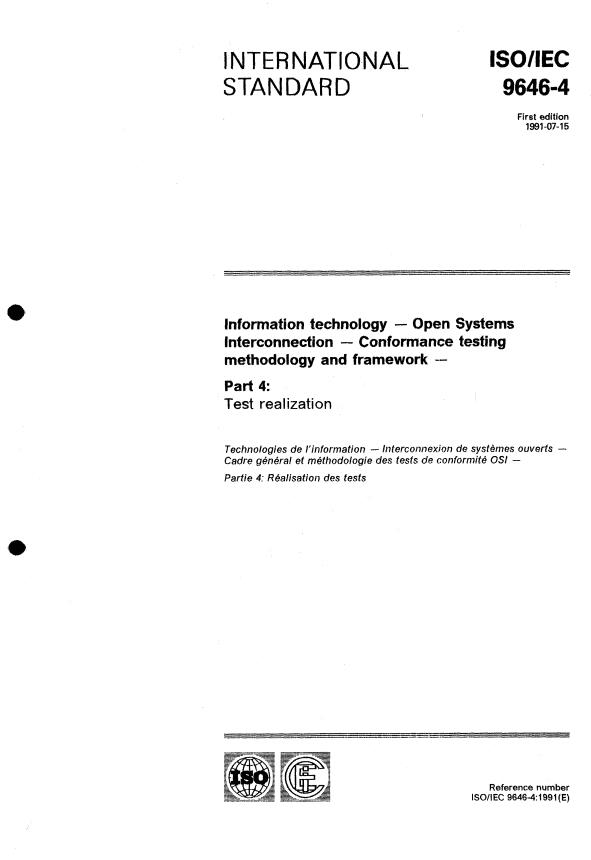
ISO/IEC
1 NTER NATIONAL
STANDARD
First edition
1991-07-15
information technology - Open Systems
Interconnection - Conformance testing
methodology and framework --
Part 4:
Test realization
Technologies de l'information - Iii terconnexion de systémes ouverfs -
Cadre général et méthodologie des fesfs de conformité OS1 -
Partie 4: Réalisation des tests
- --- _--.---
Reference number
__ __- ISOllEC 964641991 (E)
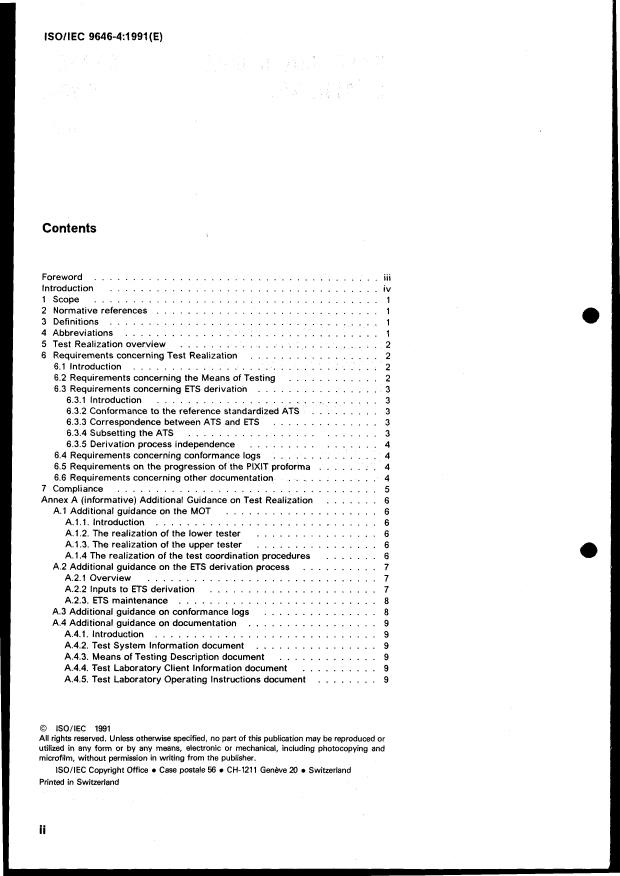
Foreword . iii
Introduction . iv
1 Scope . 1
2 Normative references . 1
3 Definitions . 1
4 Abbreviations . 1
5 Test Realization overview . 2
6 Requirements concerning Test Realization . 2
6.1 Introduction .
6.2 Requirements concerning the Means of Testing . 2
6.3 Requirements concerning ETS derivation . 3
6.3.1 Introduction . 3
6.3.2 Conformance to the reference standardized ATS . 3
6.3.3 Correspondence between ATS and ETS . 3
6.3.4 Subsetting the ATS . 3
~ 6.3.5 Derivation process independence . 4
I 6.4 Requirements concerning conformance logs . 4
6.5 Requirements on the progression of the PlXlT proforma . 4
6.6 Requirements concerning other documentation . 4
7 Compliance . 5
Annex A (informative) Additional Guidance on Test Realization . 6
A.l Additional guidance on the MOT . 6
A.l.l. Introduction . 6
A.1.2. The realization of the lower tester . 6
A.1.3. The realization of the upper tester . 6
A.1.4 The realization of the test coordination procedures . 6
A.2 Additional guidance on the ETS derivation process . 7
A.2.1 Overview . 7
A.2.2 Inputs to ETS derivation . 7
A.2.3. ETS maintenance . 8
A.3 Additional guidance on conformance logs . 8
A.4 Additional guidance on documentation . 9
A.4.1. Introduction . 9
A.4.2. Test System Information document . 9
A.4.3. Means of Testing Description document . 9
A.4.4. Test Laboratory Client Information document . 9
A.4.5. Test Laboratory Operating Instructions document . 9
O ISO/IEC 1991
All rights reserved . Unless otherwise specified. no part of this publication may be reproduced or
utilized in any form or by any means. electronic or mechanical. including photocopying and
microfilm. without permission in writing from the publisher .
ISO/IEC Copyright Office 0 Case postale 56 0 CH-I211 Genève 2û 0 Switzerland
Printed in Switzerland
ii
ISOllEC 9646-4:1991(E)
Foreword
IS0 (the International Organization for Standardization) and IEC (the
International Electrotechnical Commission) form the specialized system
for worldwide standardization. National bodies that are members of IS0
or IEC participate in the development of International Standards through
technical committees established by the respective organization to deal
with particular fields of technical activity. IS0 and IEC technical coin-
mittees collaborate in fields of mutual interest Other international or-
IS0
ganizations, governmental and non-governmental, in liaison with
and IEC, also take part in the work.
In the field of information technology, IS0 and IEC have established a
joint technical Committee, ISO/IEC JTC 1. Draft International Standards
adopted by the joint technical committee are circulated to national bod-
ies for voting. Publication as an International Standard requires ap-
proval by at least 75 Oh of the national bodies casting a vote.
International Standard ISO/IEC 9646-4 was prepared by Joint Technical
Committee ISO/IEC JTC 1, lnformafion technology.
ISO/IEC 9646 consists of the following parts, under the general title ln-
formafion technology - Open Systems Interconnection - Conformance
testing methodology and framework:
- Part 1: General concepts
- Part 2: Abstract test suite specification
- Part 3: The Tree and Tabular Combined Notation (TTCN)
- Part 4: Test realization
- Part 5: Requirements on test laboratories and clients for the con-
formance assessment process
Annex A of this part of ISO/IEC 9646 is for information only
iii
ISOllEC 9646-4~1991 (E)
Introduction
ISO/IEC 9646-1 and ISO/IEC 9646-2 define a general methodology for testing the
conformance of implementations to OS1 protocol specifications and/or transfer
syntaxes issued as International Standards or CCllT Recommendations; these
parts also put requirements on the production of OS1 conformance testing
standards and standardized Abstract Test Suites (standardized ATS).
ISO/IEC 9646-3 defines a standardized test notation, the Tree and Tabular Com-
bined Notation (TTCN), for the specification of a standardized Abstract Test
Suite.
Once OS1 conformance testing standards and standardized Abstract Test Suites
are available, the test results obtained by different test laboratories should be
comparable, if they base their test operations on the same reference standard-
ized ATS.
ISOllEC 9646-5 puts requirements on the conformance assessment process, so
that test results can be compared with those of other test laboratories, and can
have a wide acceptance.
This part of ISOAEC 9646 concentrates on the intermediate stage, namely, Test
Realization. Before the test preparation can begin, a Means of Testing the
Implementation Under Test (IUT) has to be made available.
Test Realizers are those organizations which take responsibility for providi.ig
such a Means of Testing (MOT).
ISOAEC 9646-4 places requirements on Test Realization, to ensure that the exe-
cution of test cases reflects the behaviour specified in the reference standard-
ized Abstract Test Suite. In this way, the purpose of the standardized ATS is
achieved.
This part of ISOAEC 9646 is also to be published by CCITT as Recommendation
X.293( 1991 ).
INTERNATIONAL STANDARD ISO/IEC 9646-4:1991 (E)
Information technology - Open Systems Interconnection -
conformance testing methodology and framework -
Part 4:
Test realization
ology and Framework - Part 2: Abstract test suite Specifi-
1 Scope
cation.
(See also CCllT Recommendation X.291(1991)).
This part of ISO/IEC 9646 specifies requirements and
gives guidance concerning the realization of a means of
- Open Systems
ISO/IEC 9646-3:-1, Information technology
testing IUTs, in conformance with a reference OS1 stand-
Interconnection - Conformance Testing Methodology and
ardized ATS, specified in compliance with ISO/IEC 9646-2.
Framework - Part 3: The Tree and Tabu/ar Combined
Notation (TTCN).
NOTE - This implies the use of standardized abstract test suites
as defined in ISOiIEC 9646-1 1991, 3.6.31.
ISO/IEC 9646-5: 199 1, Information technology - Open
Systems Interconnection - Conformance Testing Method-
These requirements are limited to those aspects of a
ology and Framework - Part 5: Requirements on test labo-
means of testing which can be mapped on to the abstract
ratories and clients for the Conformance Assessment
testing functions defined in ISO/IEC 9646-1, or which are
Process.
essential to a proper use of the standardized ATS. Such
(See also CClTT Recommendation X.294(1991)).
aspects might include a facility to produce conformance
logs, or the progression of the PlXlT proforma. Further
implementation details of test systems and upper testers
3 Definitions
are outside the scope of this part of ISO/IEC 9646.
For the purposes of this part of ISO/IEC 9646, all the defi-
Acceptance and installation of means of testing are
nitions given in ISOllEC 9646-1 apply.
outside the scope of this part of ISO/IEC 9646.
4 Abbreviations
For the purpose of this part of ISO/IEC 9646, the following
2 Normative references
abbreviations given in ISO/IEC 9646-1:1991, clause 4,
apply:
The following standards contain provisions which, through
reference in this text, constitute provisions of this part of
ASP : abstract service primitive.
ISO/IEC 9646. At the time of publication, the editions
indicated were valid. All standards are subject to
ATS : abstract test suite.
revision, and parties to agreements based on this part of
ISO/IEC 9646 are encouraged to investigate the possi-
BIT : basic interconnection test.
bility of applying the most recent editions of the stand-
ards indicated below. Members of IEC and IS0 maintain
ETS : executable test suite.
registers of currently valid International Standards.
IUT : implementation under test.
IS0 7498: 1984, Information processing systems - Open
Systems Interconnection - Basic Reference Model.
MOT : means of testing.
(See also CClTT Recommendation X.200).
OS1 : open systems interconnection.
- Open
ISO/IEC 9646-1 :1991, Information technology
Systems Interconnection - Conformance Testing Method-
PATS : parameterized abstract test suite.
ology and Framework - Part I: General concepts.
(See also CClïT Recommendation X.290(1991)).
PCO : point of control and observation.
ISO/I EC 9646-2: 1991, Information technology - Open
PDU : protocol data unit.
Systems Interconnection - Conformance Testing Method-
1) To be published.
ISOllEC 9646-4:199
PETS : parameterized executable test suite. b) SETS : Selected Executable Test Suites;
c) PATS : Parameterized Abstract Test Suites;
PICS : protocol implementation conformance statement.
d) PETS : Parameterized Executable Test Suites.
PlXlT : protocol implementation extra information for
5.5 Among these various forms, only the Abstract Test
testing.
Suites are necessarily tangible.
SATS : selected abstract test suite.
Some MOT may generate the PETS automatically from
SETS : selected executable test suite. the reference standardized ATS (given the PICS and
PIXIT) at the moment the test cases are actually run.
SUT : system under test. Such a Means of Testing does not exhibit an ETS, nor a
SETS, nor a PETS, in a tangible form.
TTCN : tree and tabular combined notation.
Nevertheless, what is executed is always a Para-
meterized Executable Test Suite.
5 Test Realization overview
5.1 Test Realization is the process of producing a Means
of Testing (MOT) IUTs for conformance to OS1 protocol
specifications, based on a conformance testing standard 6 Requirements concerning Test
and its ATS.
Realization
5.2 The MOT is a combination of equipment and proce-
6.1 Introduction
dures that can perform
a) the derivation;
The requirements concerning Test Realization address
b) the selection;
a) the MOT as a whole;
c) the parameterization; and
b) the derivation process, from abstract to executable
test cases;
d) the execution
c) facilities for producing a conformance log;
of the test cases, in conformance with the reference
standardized ATS, and can produce a conformance log.
d) progression of the PlXlT proforma;
e) other documentation.
5.3 In the derivation process, the abstract test cases of
the reference standardized ATS are converted, so as to
be executable on a test system.
6.2 Requirements concerning the Means of
Testing
In the selection process, the appropriate test cases for
the IUT are selected, according to the provisions of the
6.2.1 The Means of Testing an OS1 protocol implementa-
PICS and the PIXIT.
tion shall be provided in the context of a single standard
Abstract Test Suite, in compliance with ISOllEC 9646-2.
In the parameterization process, the parameters in the
The Test Realizer shall use only the version of the ATS
selected test cases are given appropriate values,
specification which has the highest standardization status
according to the provisions of the PlXlT (and possibly of
(e.g. DIS rather than DP or CD).
the PICS).
The MOT shall provide
The MOT is then used in the conformance assessment
a) a realization of the lower tester;
process of an IUT, resulting in the production of a con-
formance log.
b) the specification of the upper tester, insofar as it is
required by the abstract test method;
The output of the derivation process is called an "Execut-
c) the realization of the upper tester for the Local test
able Test Suite" (ETS). It consists of executable test
method;
cases.
d) optionally, the realization of the upper tester for the
5.4 Intermediate forms of test suites may or may not be
Coordinated and Distributed test methods;
created, depending upon when the derivation process
e) the specification of the test coordination procedures
occurs.
in accordance with the requirements specified in the
standardized ATS;
Such intermediate forms are known as
f) the realization of the test coordination procedures
a) SATS : Selected Abstract Test Suites;
within the test system for the Local test method;
ISOIIEC 9646-4:1991(€)
g) the realization of the Test Management Protocol 6.3.2 Conformance to the reference standardized
within the lower tester for the Coordinated test method.
ATS
(See ISO/IEC 9646-1:1991, 7.4, and ISOllEC 9646-2:1991, An ETS shall be derived from a single reference stand-
12.3). ardized ATS.
6.2.2 The MOT shall include either the executable test For an ETS to conform to the reference standardized
cases derived from the test cases of the reference stand- ATS, it shall comply with the requirements stated in 6.3.3
ardized ATS, or a means of deriving them. to 6.3.5 below. It shall also conform to the requirements
stated in the reference standardized ATS itself, and in the
The MOT shall be realized in compliance with the seman- other parts of the multi-part conformance testing
tics of the test notation chosen in the reference standard- standard, if applicable (e.g. TMP).
ized ATS.
6.3.3 Correspondence between ATS and ETS
The MOT shall provide a means of selecting and
parameterizing the test cases (whether they are at the
Each executable test case shall be the realization of a
abstract level or at the executable level), according to
single Abstract Test Case, and shall be selectable for
the appropriate PICS and PlXlT information provided with
execution on an individual basis. All sequences of test
an IUT (see ISO/IEC 9646-51991, 7.3 and 7.4).
events comprising an abstract test case shall be capable
of being realized in the executable test case.
6.2.3 The MOT shall provide a facility for selecting the
capability or behaviour test cases mentioned in the list of
The test purpose and verdict assignments of each
Basic Interconnection Tests (BIT list), if such a list is
Abstract Test Case shall be maintained in the corre-
specified in the reference standardized ATS, and shall
sponding executable test case.
provide a facility for running them initially altogether,
before the capability and behaviour tests.
The MOT shall not perform checking on the validity of
PDU parameters received from the IUT in addition to that
The MOT shall also provide a facility for omitting those
which is defined in the Abstract Test Case. Any further
list from the set of test
test cases indicated in the BIT
checking which the test system might be capable of per-
cases selected for the capability and behaviour tests.
forming is outside the scope of this standard and shall
not contribute to the verdict assignment for each test
6.2.4 The MOT shall include the capability of executing
case.
the parameterized executable test cases which result
from the derivation, selection and parameterization proc-
Test group relationships defined in the reference stand-
esses.
ardized ATS shall be maintained in the ETS. Each test
group composed of a named set of test cases in the ref-
6.2.5 The Test Realizer shall provide a statement of con-
erence ATS shall be represented in the ETS as a named
formance of the MOT to the reference standardized ATS,
set of executable test cases.
indicating any subset of the ATS that is not supported
(see 6.3.4).
The standardized ATS includes a mapping of the abstract
test case(s) to the PICS and partial PlXlT proforma
The Test Realizer shall identify all restrictions for test
entries (see ISOAEC 9646-2:1991, clause 15). This
execution required by the MOT beyond those stated in
mapping shall be maintained in the ETS.
the reference standardized ATS (e.g. limiting value
ranges provided in the PIXIT).
6.3.4 Subseîting the ATS
NOTE - The Test Realizer should note the requirements for a
The ETS derivation process generally results in the deri-
Comprehensive testing service stated in the standardized ATS.
vation of all abstract test cases of the reference stand-
The Test Realizer may wish to develop an MOT for each of the
ardized ATS. However, it may be acceptable to derive an
required abstract test methods in order that a test laboratory
ETS for certain subsets of the ATS. If a subset is created,
may provide a comprehensive testing service.
the exclusion of a set of test cases shall be consistent
with the test selection process for an IUT, with respect to
6.2.6 The MOT shall provide a facility for generating a
the mapping between the PICS (and PIXIT) proforma
conformance log (see 6.4).
entries and the test cases in the ATS.
6.3 Requirements concerning ETS derivation
NOTE - This means that the test cases which are mandatory for
all IUTs would always be included in the subset, but the Test
Realizer can choose not to realize particular sets of test cases
6.3.1 Introduction
which are optional or conditional and therefore will not be
required to test particular classes of IUTs.
Requirements in 6.3 shall apply to all Executable Test
Suites, including SETS or PETS, whether tangible or not.
ISOllEC 9646-4A991 (E)
Thus the subset of the reference standardized ATS which f) an indication of the result for each test case; this will
is realized shall be equivalent to one or more of the be verdict assignment, abstract or executable test case
potential SATS. error, or abnormal test case termination;
g) a time stamp or ordering sequence for all test
6.3.5 Derivation process independence
events logged by the lower tester in the order that they
are observed;
In the MOT, the derivation process shall lead to the same
h) any additional information required by the refeirence
PETS being executed for a given IUT, regardless of when
standardized ATS.
the derivation process occurs relative to the selection
and parameterization processes.
NOTE 1 - An example of h) above is when an abstract test case
written in TTCN specifies that preliminary result information (in
NOTE - See A.2.1, figure A.l
the verdict column) or labels (in the label column) shall be
recorded in the conformance log if the corresponding test event
The application of the selection and parameterization
occurs.
processes for a particular IUT is the responsibility of the
...
ISO/CEI
NORME
I NTE R NATIONALE
9646-4
Première édition
1991 -07-1 5
Technologies de l’information - Interconnexion
de systèmes ouverts - Essais de conformité -
Méthodologie générale et procédures -
Partie 4:
Réalisation des outils de test
Information technology - Open Systems Interconnection -
Conformance testing methodology and framework -
Part 4: Test realization
ISO/CEI 9646-4 : 1991 (FI
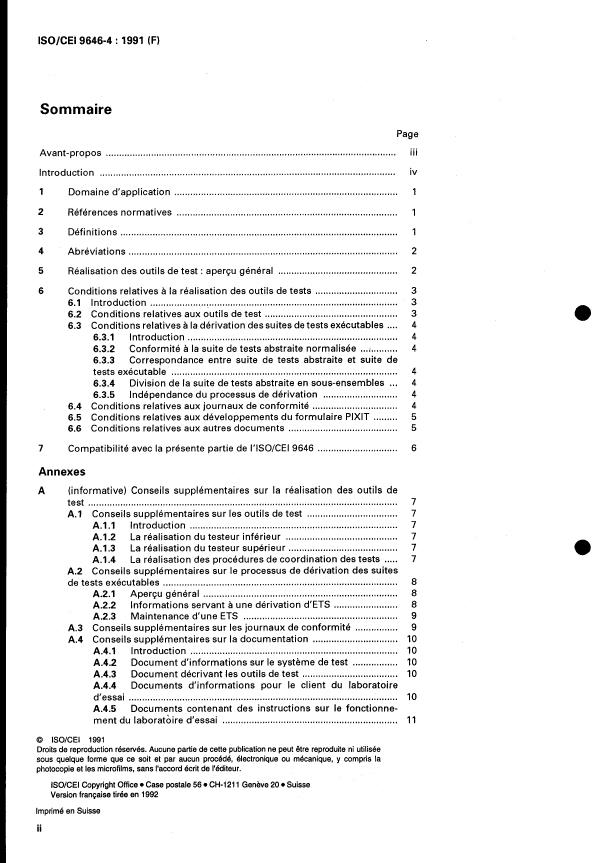
Sommaire
Page
Avant-propos . iii
Introduction . iv
1 Domaine d'application . 1
2 Références normatives . 1
3 Définitions . 1
4 Abréviations . 2
5 Réalisation des outils de test : aperçu général . 2
6 Conditions relatives à la réalisation des outils de tests . 3
6.1 Introduction . 3
6.2 Conditions relatives aux outils de test . 3
6.3 Conditions relatives à la dérivation des suites de tests exécutables . 4
6.3.1 Introduction . 4
6.3.2 Conformité à la suite de tests abstraite normalisée . 4
6.3.3 Correspondance entre suite de tests abstraite et suite de
tests exécutable . 4
6.3.4 Division de la suite de tests abstraite en sous-ensembles .
6.3.5 Indépendance du processus de dérivation . 4
6.4 Conditions relatives aux journaux de conformité . 4
6.5 Conditions relatives aux développements du formulaire PlXlT . 5
6.6 Conditions relatives aux autres documents .
7 Compatibilité avec la présente partie de I'ISO/CEI 9646 . 6
Annexes
(informative) Conseils supplémentaires sur la réalisation des outils de
A
test .
A.l Conseils supplémentaires sur les outils de test .
A.l.l Introduction .
A.1.2 La réalisation du testeur inférieur .
A.1.3 La réalisation du testeur supérieur .
A.1.4 La réalisation des procédures de coordination des tests .
A.2 Conseils supplémentaires sur le processus de dérivation des suites
de tests exécuta bles . 8
A.2.1 Aperçu général .
A.2.2 Informations servant à une dérivation d'ETS . 8
A.2.3 Maintenance d'une ETS . 9
A.3 Conseils supplémentaires sur les journaux de conformité . 9
A.4 Conseils supplémentaires sur la documentation . 10
A.4.1 Introduction . 10
A.4.2 Document d'informations sur le système de test .
A.4.3 Document décrivant les outils de test .
A.4.4 Documents d'informations pour le client du laboratoire
d'essai . 10
A.4.5 Documents contenant des instructions sur le fonctionne-
ment du laboratoire d'essai . 11
O ISOICEI 1991
Droits de reproduction réservés . Aucune partie de cette publication ne peut être reproduite ni utilisée
sous quelque forme que ce soit et par aucun procédé. électronique ou mécanique. y compris la
photocopie et les microfilms. sans l'accord écrit de l'éditeur .
iSO/CEI Copyright Office Case postale 56 CH-121 1 Genève 20 Suisse
Version française tirée en 1992
imprimé en Suisse
ii
ISO/CEI 9646-4 : 1991 (F)
Avant-propos
L'ISO (Organisation internationale de normalisation) et la CE1 (Commission électro-
technique internationale) forment ensemble un système consacré à la normalisa-
tion internationale considérée comme un tout. Les organismes nationaux membres
de I'ISO ou de la CE1 participent au développement de Normes internationales par
l'intermédiaire des comités techniques créés par l'organisation concernée afin de
s'occuper des différents domaines particulier de l'activité technique. Les comités
techniques de I'ISO et de la CE1 collaborent dans des domaines d'intérêt commun.
D'autes organisations internationales, gouvernementales ou non gouvernementa-
I'ISO et la CE1 participent également aux travaux.
les, en liaison avec
Dans le domaine des technologies de l'information, 1'1S0 et la CE1 ont créé un
comité technique mixte, I'ISO/CEI JTC 1. Les projets de Normes internationales
adoptés par le comité technique mixte sont soumis aux organismes nationaux pour
approbation, avant leur acceptation comme Normes internationales. Les Normes
internationales sont approuvées conformément aux procédures qui requièrent I'ap-
probation de 75 % au moins des organismes nationaux votants.
La Norme internationale ISO/CEI 9646-4 a été élaborée par le comité technique
mixte ISO/CEI JTC 1, Technologies de l'information.
L'ISO/CEI 9646 comprend les parties suivantes, présentées sous le titre général
Technologies de l'information - Interconnexion de systèmes ouverts - Essais de
conformité - Méthodologie générale et procédures :
- Partie 1 : Concepts généraux
- Partie 2 : Spécification des suites de tests abstraites
- Partie 3 : Notation combinée arborescente et tabulaire (TTCN)
- Partie 4 : Réalisation des outils de test
- Partie 5 : Responsabilités des laboratoires d'essai et de leurs clients au cours
du processus d'évaluation de conformité
L'Annexe A de la présente partie de I'ISO/CEI 9646 est donnée uniquement à titre
d'information.
iii
ISO/CEI 9646-4 : 1991 (FI
Introduction
L’ISO/CEI 9646-1 et I’ISOKEI 9646-2 définissent une méthodologie générale pour
tester la conformité des réalisations aux spécifications de protocoles OS1 et/ou de
syntaxe de transfert publiées comme Normes internationales ou comme Recom-
du CCITT ; ces deux parties spécifient aussi des conditions relatives au
mandations
OS1 et des suites de tests abstrai-
développement des normes d’essai de conformité
tes normalisées.
L‘ISO/CEI 9646-3 définit une notation de test normalisée, la notation combinée arbo-
rescente et tabulaire (TTCN), pouvant servir à spécifier une suite de tests abstraite
normalisée.
Les normes de conformité OS1 et les suites de tests abstraites normalisées étant
disponibles, les résultats obtenus par différents laboratoires d’essai devraient être
comparables s’ils utilisent les mêmes suites de tests abstraites normalisées comme
base de leurs essais.
L‘ISO/CEI 9646-5 spécifie des conditions relatives au processus d‘évaluation de
conformité pour que les résultats de test puissent être comparés ef acceptés par
tous.
La présente partie de I’ISO/CEI 9646 s’intéresse à l‘étape intermédiaire, la réalisation
d’outils de test, Avant que débute la phase de préparation des essais, des outils de
test de la réalisation à tester doivent être disponibles.
Dans la présente partie de I‘ISO/CEI 9646, on appelle ((réalisateurs d‘outils de tests))
les organisations qui prennent la responsabilité de fournir des outils de test.
La présente partie de I’ISO/CEI 9646 spécifie des conditions relatives à la réalisation
des outils de test pour garantir que l‘exécution des tests élémentaires reflète le
comportement spécifié dans la suite de tests abstraite normalisée de référence.
L’objectif de la suite de tests abstraite normalisée est atteint de cette manière.
La présente partie de I’ISO/CEI 9646 est également publiée par le CClTT : Recom-
mandation X.293 (1991).
iv
NORME INTERNATIONALE
ISO/CEI 9646-4 : 1991 (FI
Technologies de l’information - Interconnexion de systèmes
ouverts - Essais de conformité - Méthodologie générale et
procédures -
Partie 4:
Réalisation des outils de test
Les membres de la CE1 et de I’ISO possèdent le regis-
1 Domaine d‘application
tre des Normes internationales en vigueur à un
moment donné.
La présente partie de I‘ISO/CEI 9646 spécifie les
conditions de mise en œuvre des outils de test d‘une
IS0 7498: 1984, Systèmes de traitement de l’informa-
réalisation à tester, conformément avec une suite de
tion - Interconnexion de systèmes ouverts -
tests abstraite normalisée, cette dernière ayant été
Modèle de référence de base.
spécifiée en compatibilité avec I’ISO/CEI 9646-2. La
(Voir aussi Recommandation CCITT X.200.)
présente partie de I’ISO/CEI 9646 donne également
des conseils sur la mise en œuvre des outils de test.
ISO/CEI 9646-1 :1991, Technologies de l‘information
- Interconnexion de systèmes ouverts - Essais de
NOTE - Ceci implique l‘utilisation de suites de tests abstrai-
conformité - Méthodologie générale et procédures
tes normalisées, telles que définies en 3.6.31 de I’ISO/CEI
- Partie 1 : Concepts généraux.
9646- 1 : 1 99 1.
[Voir aussi Recommandation CCITT X.290 (1991).1
Ces conditions ne couvrent que les aspects des outils
Technologies de /‘information
ISO/CEI 9646-2:1991,
de test qui peuvent être mis en correspondance avec
- Interconnexion de systèmes ouverts - Essais de
des fonctions de test abstraites définies dans
conformité - Méthodologie générale et procédures -
I‘ISO/CEI 9646-1 ou qui sont essentiels à un usage
Partie 2 : Spécification des suites de tests abstraites.
adéquat de la suite de tests abstraite normalisée. Ceci
[Voir aussi Recommandation CCITT X.291 (1991).1
comprend une facilité de production de journaux de
conformité ou le développement du formulaire PIXIT.
ISO/CEI 9646-3:- I), Technologies de l’information -
Les autres aspects de mise en œuvre des systèmes
Interconnexion de systèmes ouverts - Essais de
de test et des testeurs supérieurs sont hors du
conformité - Méthodologie générale et procédures
domaine d‘application de la présente partie de
- Partie 3 : Notation combinée arborescente et tabu-
I’ISO/CEI 9646.
laire (TTCN).
La réception et l‘installation des outils de test sont
ISO/CEI 9646-5: 1991, Technologies de l’information
hors du domaine d’application de la présente partie
- Interconnexion de systèmes ouverts - Essais de
de I‘ISO/CEI 9646.
conformité - Méthodologie générale et procédures
- Partie 5 : Responsabilités des laboratoires d’essai
et de leurs clients au cours du processus d’évaluation
2 Références normatives
de conformité.
[Voir aussi Recommandation CCITT X.294 (1991).1
Les normes suivantes contiennent des dispositions
qui, par suite de la référence qui est en faite, consti-
tuent des dispositions valables pour la présente par-
3 Définitions
tie de I’ISO/CEI 9646. Au moment de la publication, les
éditions indiquées étaient er1 vigueur. Toute norme est
Pour les besoins de la présente partie de I’ISO/CEI
sujette à révision et les parties prenantes des accords
9646, toutes les définitions données dans I’ISO/CEI
fondés sur la présente partie de I’ISO/CEI 9646 sont
9646-1 s‘appliquent.
invitées à rechercher la possibilité d’appliquer les édi-
tions les plus récentes des normes indiquées ci-après.
1) À publier.
iSO/CEi 9646-4 : 1991 (F)
4 Abréviations 5 Réalisation des outils de tests : aperçu
général
La présente partie de I'ISO/CEI 9646 utilise les abré-
viations suivantes, définies à l'article 4 de I'ISO/CEI
5.1 La réalisation d'outils de test, destinés à être uti-
9646-1:1991 :
lisés au cours d'essais de conformité d'une IUT à une
spécification de protocLie, doit se conformer à la
NOTE - Les abréviations utilisées sont celles de la version
norme d'essai de conformité du protocole et à une
anglaise. Dans le present article, on donne la forme de ces
ATS qui en fait partie.
abréviations développée en français. La forme anglaise est
à la compréhension.
indiquée entre parenthèses pour aider
5.2 Les outils de test combinent des équipements et
ASP primitive de service abstrait
des procédures qui peuvent exécuter les fonctions
(abstract service primitive)
suivantes :
suite de tests abstraite
ATS
a) la dérivation ;
(abstract test suite)
b) la sélection ;
BIT essai d'interconnexion de base
c) la paramétrisation ; et
(basic interconnection test)
d) l'exécution
suite de tests exécutable
ETS
(executable test suite)
de tests élémentaires, conformément à I'ATS norma-
IUT réalisation à tester
lisée de référence ; ces outils de test permettent éga-
(implementation under test)
lement de produire un journal de conformité.
MOT outils de test
5.3 Au cours du processus de dérivation, les tests
(means of testing)
élémentaires de I'ATS normalisée sont convertis,
os1 interconnexion de systèmes ouverts
pour être exécutables dans un système de test.
(open systems interconnect ion)
Au cours du processus de sélection, les tests élémen-
PATS suite de tests abstraite paramétrée
taires appropriés à l'IUT sont sélectionnés, en accord
(parameterized abstract test suite)
avec ce qui est stipulé dans le PICS et le PIXIT.
PCO point de contrôle et d'observation
Au cours du processus de paramétrisation, des
(point of control and observation)
valeurs appropriées sont attribuées aux paramètres
des tests élémentaires sélectionnés, en accord avec
PDU unité de données de protocole
ce qui est stipulé dans le PIXIT (et, peut-être, dans le
(protocol data unit)
PICS).
PETS suite de tests exécutable paramétrée
L'outil de test met en œuvre ces fonctions pour exé-
(parameterized executable test suite)
cuter la suite de tests pendant un essai de conformité,
le résultat étant la production d'un journal de confor-
PICS déclaration de conformité d'une mise en
mité,
œuvre de protocole
(protocol implementation conformance
Le résultat du processus de dérivation est appelé
statement)
((suite de tests exécutable)) (ETS). Elle est composée
de tests élémentaires exécutables.
PIXIT informations complémentaires nécessaires
aux essais de conformité
(protocol implementation extra information
5.4 Des formes intermédiaires de suites de tests
for testing)
peuvent être produites, suivant le moment auquel se
déroule le processus de dérivation.
SATS suite de tests abstraite sélectionnée
(selected abstract test suite)
Ces formes intermédiaires sont
SUT système à tester
a) SATS : suites de tests abstraites sélectionnées ;
(system under test)
b) SETS : suites de tests exécutables sélectionnées ;
notation combinée arborescente et tabulaire
TTCN
(tree and tabular combined notation) c) PATS : suites de tests abstraites paramétrées ;
d) PETS : suites de tests exécutables paramétrées.
ISO/CEI 9646-4 : 1991 (FI
f) la réalisation des procédures de coordination des
5.5 Parmi ces formes, seules les suites de tests abs-
tests, dans le système de test, pour la méthode de
traites sont obligatoirement tangibles.
test locale ;
Certains outils de test génèrent automatiquement les
g) la réalisation du protocole de gestion de tests
PETS à partir de I'ATS normalisée de référence (étant
dans le testeur inférieur, pour la méthode de test
donné le PICS et le PIXIT) au moment où les tests élé-
coordonnée
mentaires sont réellement exécutés. Ces outils de
test ne produisent pas d'ETS, ni de SETS, ni de PETS
sous une forme tangible.
(Voir ISO/CEI 9646-1:1991,7.4 et ISO/CEI 9646-2:
1991, 12.3).
Néammoins, c'est toujours, par convention, une suite
de tests exécutable paramétrée qui est exécutée.
6.2.2 Les outils de test doivent comporter soit les
tests élémentaires exécutables dérivés des tests élé-
mentaires de I'ATS normalisée de référence, soit un
6 Conditions relatives à la réalisation des moyen de les dériver.
outils de test
Les outils de test doivent être réalisés en compatibi-
lité avec la sémantique de la notation de test choisie
6.1 Introduction
dans I'ATS normalisée de référence.
Les conditions relatives à la réalisation des outils de
Les outils de test doivent permettre de sélectionner et
test concernent
de paramétrer les tests élémentaires (qu'ils soient
abstraits ou exécutables), en accord avec les informa-
a) les outils de test, dans leur ensemble ;
tions appropriées du PICS et du PIXIT fournis avec
une IUT (voir ISO/CEI 9646-5:1991,7.3 et 7.4).
b) le processus de dérivation, à partir de tests élé-
mentaires abstraits vers des tests élémentaires exé-
6.2.3 Les outils de test doivent permettre de sélec-
cutables ;
tionner les tests élémentaires de capacités et de com-
c) des facilités de production d'un journal de
portement mentionnés dans la liste des tests
conformité ;
d'interconnexion de base (liste de BIT), si cette liste
est spécifiée dans I'ATS normalisée de référence ; ils
d) le développement du formulaire PIXIT ;
doivent aussi permettre d'exécuter ces tests tous
ensembles, en premier lieu, avant les tests de capa-
e) d'autres documents.
cité et de comportement.
6.2 Conditions relatives aux outils de test
doivent aussi permettre que les
Les outils de test
tests élémentaires indiqués dans la liste de BIT ne
6.2.1 Les outils de test d'une mise en œuvre de pro-
soient pas pris en compte dans l'ensemble des tests
tocole OS1 doivent être fournis dans le contexte d'une
sélectionnés pour les tests de capacités et de com-
seule suite de tests abstraite, en compatibilité avec
portement.
I'ISO/CEI 9646-2. Le réalisateur des outils de test ne
doit utiliser que la version de la spécification d'ATS
6.2.4 Les outils de test doivent fournir une capacité
qui a le statut normatif le plus élevé [par exemple :
d'exécution des tests élémentaires exécutables para-
DIS (projet de Norme internationale) plutôt que CD
métrés résultant du processus de dérivation, de
(projet de comité)].
sélection et de paramétrisation.
Les outils de test doivent fournir
6.2.5 Le réalisateur des outils de test doit fournir une
déclaration de conformité des outils de test à I'ATS
a) une réalisation du testeur inférieur ;
normalisée de référence, en indiquant toute partie de
b) la spécification du testeur supérieur, dans la
I'ATS qui n'est pas prise en charge (voir 6.3.4).
mesure où il est exigé par la méthode de test abs-
Le réalisateur des outils de test doit identifier toutes
traite ;
les restrictions à l'exécution des tests imposées par les
c) la réalisation du testeur supérieur pour la
outils de test et qui s'ajoutent à celles établies dans
méthode de test locale ;
I'ATS normalisée de référence (par exemple : restric-
tion sur les plages de valeurs fournies dans le PIXIT).
d) en option, la réalisa' ln du testeur supérieur
pour la méthode de test coordonnée et pour la
NOTE - Les réalisateurs d'outils de test devront prendre en
méthode de test répartie ;
considération les besoins d'un service d'essai complet
I'ATS normalisée. Les réalisateurs d'outils de
exprimé dans
e) la spécification des procédures de coordination
test peuvent souhaiter développer des outils de test pour cha-
des tests en accord avec les conditions spécifiées
cune des méthodes de tests abstraites reconnues, pour qu'un
dans I'ATS normalisée ;
laboratoire d'essai soit en mesure de fournir un service d'es-
sai complet.
ISO/CEI 9646-4 : 1991 (F)
6.2.6 Les outils de test doivent fournir une facilité de 6.3.4 Division de la suite de tests abstraite en
sous-ensembles
produciton d'un journal de conformité (voir 6.4).
En général, le processus de dérivation d'une ETS a
6.3 Conditions relatives à la dérivation des sui-
pour résultat de convertir tous les tests élémentaires
tes de tests exécutables (ETS)
exécutables de I'ATS normalisée de référence.
Cependant, une ETS pLrlt être dérivée de sous-en-
6.3.1 Introduction
sembles de I'ATS. Si un sous-ensemble est créé, l'ex-
clusion d'un ensemble de tests élémentaires doit être
Les conditions spécifiées en 6.3 s'appliquent à toutes
cohérente avec le processus de sélection de tests
les suites de tests exécutables, y compris les SETS ou
pour une IUT, en ce qui concerne la mise en corres-
les PETS, qu'elles soient tangibles ou non.
pondance des entrées des formulaires PICS (et PIXIT)
avec les tests élémentaires de I'ATS.
6.3.2 Conformité à la suite de tests abstraite norma-
lisée
NOTE - Ceci signifie que les tests élémentaires obligatoires
pour toutes les IUT feront toujours partie du sous-ensemble
Une ETS doit être dérivée d'une seule ATS normali-
mais le réalisateur des outils de test peut decider de ne pas
sée de référence.
exécuter certains ensembles de tests élémentaires optionnels
ou conditionnels qui ne sont donc pas exiges pour toutes les
Pour qu'une ETS soit conforme à I'ATS normalisée de
IUT.
référence, elle doit remplir les conditions spécifiées
en 6.3.3, 6.3.4 et 6.3.5, ainsi que les conditions spéci-
Ainsi le sous-ensemble de I'ATS normalisée de réfé-
fiées dans I'ATS normalisée de référence et dans les
rence qui est exécuté équivaut à une ou plusieurs
autres parties de la norme d'essai de conformité, le
SATS possibles.
cas échéant (par exemple : la partie consacrée au pro-
tocole de gestion de tests).
6.3.5 Indépendance du processus de dérivation
6.3.3 Correspondance entre suite de tests abstraite
Dans les outils de test, le processus de dérivation doit
et suite de tests exécutable
aboutir à la même PETS à exécuter pour une IUT don-
née quel que soit le moment où le processus de déri-
Chaque test élémentaire exécutable doit être la réali-
vation a lieu par rapport aux processus de sélection
sation d'un seul test élémentaire abstrait et doit pou-
et de paramétrisation.
voir être sélectionné en vue d'être exécuté
individuellement. Toutes les séquences d'événe-
NOTE -Voir figure A.1.
ments de test comprenant un test élémentaire abs-
trait doivent pouvoir être réalisées dans le test
L'application des processus de sélection et de para-
élémentaire exécutable.
métrisation au cours de la phase de préparation des
tests relève du laboratoire d'essai.
Le but du test et les attributions de verdict de chaque
test élémentaire abstrait doivent être conservés dans
6.4 Conditions relatives aux journaux de confor-
le test élémentaire exécutable correspondant.
mité
Les outils de test ne doivent pas effectuer de contrôle
Comme spécifié en 6.2, les outils de test doivent four-
de la validité des paramètres de PDU reçus de l'IUT,
nir une facilité de production d'un journal de confor-
autres que ceux définis dans le test élémentaire abs-
mité.
trait. Tout autre contrôle que pourrait effectuer le sys-
tème de test est hors du domaine d'application de la
Un journal
...
Questions, Comments and Discussion
Ask us and Technical Secretary will try to provide an answer. You can facilitate discussion about the standard in here.
Loading comments...