


ISO 3222:1998
(Main)Aerospace — Nuts, anchor, self-locking, fixed, closed corner, reduced series, with counterbore, with MJ threads, classifications: 1 100 MPa (at ambient temperature)/235 degrees C, 1 100 MPa (at ambient temperature)/315 degrees C and 1 100 MPa (at ambient temperature)/425 degrees C — Dimensions
Aerospace — Nuts, anchor, self-locking, fixed, closed corner, reduced series, with counterbore, with MJ threads, classifications: 1 100 MPa (at ambient temperature)/235 degrees C, 1 100 MPa (at ambient temperature)/315 degrees C and 1 100 MPa (at ambient temperature)/425 degrees C — Dimensions
This International Standard specifies the dimensions of self-locking, fixed, closed corner anchor nuts, reduced series, with counterbore, with MJ threads, of classifications: 1 100 MPa 1)/235 °C 2), 1 100 MPa 1)/315 °C 2) and 1 100 MPa 1)/425 °C 2). This International Standard is only applicable for the compilation of aerospace product standards.
Aéronautique et espace — Écrous à river, à freinage interne, fixes, d'angle, série réduite, avec chambrage, à filetage MJ, classifications: 1 100 MPa (à température ambiante)/235 degrés C, 1 100 MPa (à température ambiante)/315 degrés C et 1 100 MPa (à température ambiante)/425 degrés C — Dimensions
La présente Norme internationale spécifie les dimensions des écrous à river, à freinage interne, fixes, d'angle, série réduite, avec chambrage, à filetage MJ, de classifications: 1 100 MPa1)/235 °C2), 1 100 MPa1)/315 °C2) et 1 100 MPa1)/425 °C2). La présente Norme internationale est applicable uniquement à l'élaboration de normes de produit destinées aux constructions aérospatiales.
General Information
- Status
- Published
- Publication Date
- 25-Nov-1998
- Technical Committee
- ISO/TC 20/SC 4 - Aerospace fastener systems
- Drafting Committee
- ISO/TC 20/SC 4 - Aerospace fastener systems
- Current Stage
- 9093 - International Standard confirmed
- Start Date
- 19-Oct-2021
- Completion Date
- 12-Feb-2026
Relations
- Effective Date
- 15-Apr-2008
Overview
ISO 3222:1998 is an international standard established by the International Organization for Standardization (ISO) that specifies the precise dimensions for a specific type of aerospace fastener-self-locking, fixed, closed corner anchor nuts with MJ threads. This standard focuses on the reduced series nuts featuring a counterbore design, applicable to critical aerospace applications. It addresses nuts classified by their tensile strength of 1,100 MPa at ambient temperature across three maximum operating temperature classifications: 235 °C, 315 °C, and 425 °C.
Developed by ISO Technical Committee ISO/TC 20/SC 4, responsible for aerospace fastener systems, ISO 3222:1998 is intended exclusively for compiling aerospace product standards ensuring consistent quality and interchangeability in aircraft and space vehicle assemblies.
Key Topics
- Self-Locking Anchor Nuts: The nuts covered are fixed, self-locking with a closed corner to improve performance in aerospace fastening systems.
- MJ Threads: These nuts utilize MJ thread profiles, a specific aerospace thread type defined in ISO 5855-2 to ensure compatibility with aerospace bolts.
- Reduced Series Nuts: Dimensions are minimized for weight savings without compromising strength or safety.
- Counterbore Design: Featuring a counterbore for precise bolt accommodation and assembly integrity.
- Classifications by Strength and Temperature:
- 1,100 MPa at ambient / 235 °C max operating temperature
- 1,100 MPa at ambient / 315 °C max operating temperature
- 1,100 MPa at ambient / 425 °C max operating temperature
- Form and Position Tolerances: Tolerances conform to ISO 8788 to maintain dimensional accuracy and ensure interchangeability.
- Surface Coating Considerations: Dimensions apply after any surface coatings but prior to lubricant application - critical for durability and performance.
- Metallic Cap Attachment: Optional metallic caps must stay attached at maximum temperature, as specified in ISO 5858 test conditions.
Applications
ISO 3222:1998 nuts are essential fasteners in aerospace engineering, particularly where reliable, high-strength connections must endure high temperatures without degradation. Key applications include:
- Aircraft Structures: Securing components where vibration resistance and high tensile strength are vital.
- Space Vehicles: Fastening systems exposed to elevated temperature extremes during launch and operation.
- Engine Assemblies: Where counterbore, self-locking nuts provide integrity under thermal stress.
- Aerospace Manufacturing: Standardizing nut dimensions enables manufacturers to produce compatible parts that meet rigorous aerospace regulations.
- Maintenance and Repair: Facilitating the replacement of worn or damaged fasteners with certified parts ensuring safety and performance.
The specified dimensions and classifications optimize the nuts’ mechanical performance while reducing weight-an essential factor in aerospace design.
Related Standards
ISO 3222:1998 references several key standards for comprehensive aerospace fastener specifications:
- ISO 5855-2:1988 – Aerospace MJ Threads: Sets limit dimensions for bolts and nuts using MJ thread profiles.
- ISO 5858:1991 – Aerospace Self-Locking Nuts: Specifies procurement requirements including maximum operating temperatures up to 425 °C.
- ISO 8788:1987 – Aerospace Fasteners: Defines tolerances of form and position to guarantee fastener consistency.
These standards collectively ensure that aerospace fasteners meet stringent requirements for safety, durability, and interchangeability in extreme environments.
Keywords: aerospace nuts, self-locking nuts, anchor nuts, MJ threads, aerospace fasteners standard, ISO 3222, aerospace manufacturing, counterbore nuts, high temperature fasteners, aerospace fastener dimensions, aerospace product standards, aerospace assembly components.

ISO 3222:1998 - Aerospace -- Nuts, anchor, self-locking, fixed, closed corner, reduced series, with counterbore, with MJ threads, classifications: 1 100 MPa (at ambient temperature)/235 degrees C, 1 100 MPa (at ambient temperature)/315 degrees C and 1 100 MPa (at ambient temperature)/425 degrees C -- Dimensions

ISO 3222:1998 - Aéronautique et espace -- Écrous a river, a freinage interne, fixes, d'angle, série réduite, avec chambrage, a filetage MJ, classifications: 1 100 MPa (a température ambiante)/235 degrés C, 1 100 MPa (a température ambiante)/315 degrés C et 1 100 MPa (a température ambiante)/425 degrés C -- Dimensions
Get Certified
Connect with accredited certification bodies for this standard

DEKRA North America
DEKRA certification services in North America.

Eagle Registrations Inc.
American certification body for aerospace and defense.

Element Materials Technology
Materials testing and product certification.
Sponsored listings
Frequently Asked Questions
ISO 3222:1998 is a standard published by the International Organization for Standardization (ISO). Its full title is "Aerospace — Nuts, anchor, self-locking, fixed, closed corner, reduced series, with counterbore, with MJ threads, classifications: 1 100 MPa (at ambient temperature)/235 degrees C, 1 100 MPa (at ambient temperature)/315 degrees C and 1 100 MPa (at ambient temperature)/425 degrees C — Dimensions". This standard covers: This International Standard specifies the dimensions of self-locking, fixed, closed corner anchor nuts, reduced series, with counterbore, with MJ threads, of classifications: 1 100 MPa 1)/235 °C 2), 1 100 MPa 1)/315 °C 2) and 1 100 MPa 1)/425 °C 2). This International Standard is only applicable for the compilation of aerospace product standards.
This International Standard specifies the dimensions of self-locking, fixed, closed corner anchor nuts, reduced series, with counterbore, with MJ threads, of classifications: 1 100 MPa 1)/235 °C 2), 1 100 MPa 1)/315 °C 2) and 1 100 MPa 1)/425 °C 2). This International Standard is only applicable for the compilation of aerospace product standards.
ISO 3222:1998 is classified under the following ICS (International Classification for Standards) categories: 49.030.30 - Nuts. The ICS classification helps identify the subject area and facilitates finding related standards.
ISO 3222:1998 has the following relationships with other standards: It is inter standard links to ISO 3222:1989. Understanding these relationships helps ensure you are using the most current and applicable version of the standard.
ISO 3222:1998 is available in PDF format for immediate download after purchase. The document can be added to your cart and obtained through the secure checkout process. Digital delivery ensures instant access to the complete standard document.
Standards Content (Sample)
INTERNATIONAL ISO
STANDARD 3222
Second edition
1998-11-15
Aerospace — Nuts, anchor, self-locking,
fixed, closed corner, reduced series, with
counterbore, with MJ threads,
classifications: 1 100 MPa (at ambient
temperature)/235 °C, 1 100 MPa (at ambient
temperature)/315 °C and 1 100 MPa (at
ambient temperature)/425 °C — Dimensions
Aéronautique et espace — Écrous à river, à freinage interne, fixes, d’angle,
série réduite, avec chambrage, à filetage MJ, classifications: 1 100 MPa (à
température ambiante)/235 °C, 1 100 MPa (à température ambiante)/315 °C
et 1 100 MPa (à température ambiante)/425 °C — Dimensions
A
Reference number
Foreword
ISO (the International Organization for Standardization) is a worldwide
federation of national standards bodies (ISO member bodies). The work of
preparing International Standards is normally carried out through ISO
technical committees. Each member body interested in a subject for which
a technical committee has been established has the right to be represented
on that committee. International organizations, governmental and non-
governmental, in liaison with ISO, also take part in the work. ISO
collaborates closely with the International Electrotechnical Commission
(IEC) on all matters of electrotechnical standardization.
International Standards are drafted in accordance with the rules given in
the ISO/IEC Directives, Part 3.
Draft International Standards adopted by the technical committees are
circulated to the member bodies for voting. Publication as an International
Standard requires approval by at least 75 % of the member bodies casting
a vote.
International Standard ISO 3222 was prepared by Technical Committee
ISO/TC 20, Aircraft and space vehicles, Subcommittee SC 4, Aerospace
fastener systems.
This second edition cancels and replaces the first edition (ISO 3222:1989),
which has been technically revised.
© ISO 1998
All rights reserved. Unless otherwise specified, no part of this publication may be reproduced
or utilized in any form or by any means, electronic or mechanical, including photocopying and
microfilm, without permission in writing from the publisher.
International Organization for Standardization
Case postale 56 • CH-1211 Genève 20 • Switzerland
Internet iso@iso.ch
Printed in Switzerland
ii
©
ISO ISO 3222:1998(E)
Introduction
The dimensions specified in this International Standard have been
determined to allow production of a part which will satisfy the requirements
of the procurement specification ISO 5858.
iii
©
INTERNATIONAL STANDARD ISO ISO 3222:1998(E)
Aerospace — Nuts, anchor, self-locking, fixed, closed corner,
reduced series, with counterbore, with MJ threads, classifications:
1 100 MPa (at ambient temperature)/235 °C, 1 100 MPa (at ambient
temperature)/315 °C and 1 100 MPa (at ambient
temperature)/425 °C — Dimensions
1 Scope
This International Standard specifies the dimensions of self-locking, fixed, closed corner anchor nuts, reduced
1) 2) 1) 2)
series, with counterbore, with MJ threads, of classifications: 1 100 MPa /235 °C , 1 100 MPa /315 °C and
1) 2)
1 100 MPa /
...
NORME ISO
INTERNATIONALE 3222
Deuxième édition
1998-11-15
Aéronautique et espace — Écrous à river,
à freinage interne, fixes, d’angle, série
réduite, avec chambrage, à filetage MJ,
classifications: 1 100 MPa (à température
ambiante)/235 °C, 1 100 MPa (à température
ambiante)/315 °C et 1 100 MPa
(à température ambiante)/425 °C —
Dimensions
Aerospace — Nuts, anchor, self-locking, fixed, closed corner, reduced
series, with counterbore, with MJ threads, classifications: 1 100 MPa (at
ambient temperature)/235 °C, 1 100 MPa (at ambient temperature)/315 °C
and 1 100 MPa (at ambient temperature)/425 °C — Dimensions
A
Numéro de référence
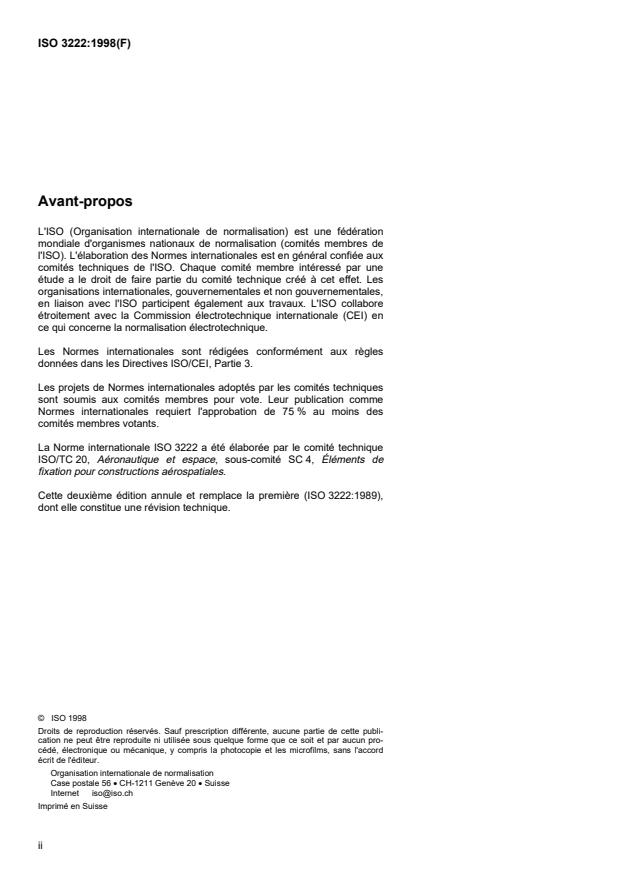
Avant-propos
L'ISO (Organisation internationale de normalisation) est une fédération
mondiale d'organismes nationaux de normalisation (comités membres de
l'ISO). L'élaboration des Normes internationales est en général confiée aux
comités techniques de l'ISO. Chaque comité membre intéressé par une
étude a le droit de faire partie du comité technique créé à cet effet. Les
organisations internationales, gouvernementales et non gouvernementales,
en liaison avec l'ISO participent également aux travaux. L'ISO collabore
étroitement avec la Commission électrotechnique internationale (CEI) en
ce qui concerne la normalisation électrotechnique.
Les Normes internationales sont rédigées conformément aux règles
données dans les Directives ISO/CEI, Partie 3.
Les projets de Normes internationales adoptés par les comités techniques
sont soumis aux comités membres pour vote. Leur publication comme
Normes internationales requiert l'approbation de 75 % au moins des
comités membres votants.
La Norme internationale ISO 3222 a été élaborée par le comité technique
ISO/TC 20, Aéronautique et espace, sous-comité SC 4, Éléments de
fixation pour constructions aérospatiales.
Cette deuxième édition annule et remplace la première (ISO 3222:1989),
dont elle constitue une révision technique.
© ISO 1998
Droits de reproduction réservés. Sauf prescription différente, aucune partie de cette publi-
cation ne peut être reproduite ni utilisée sous quelque forme que ce soit et par aucun pro-
cédé, électronique ou mécanique, y compris la photocopie et les microfilms, sans l'accord
écrit de l'éditeur.
Organisation internationale de normalisation
Case postale 56 • CH-1211 Genève 20 • Suisse
Internet iso@iso.ch
Imprimé en Suisse
ii
©
ISO ISO 3222:1998(F)
Introduction
Les dimensions spécifiées dans la présente Norme internationale ont été
définies pour permettre la production d'une pièce satisfaisant aux exigences de
la spécification d'approvisionnement ISO 5858.
iii
©
NORME INTERNATIONALE ISO ISO 3222:1998(F)
Aéronautique et espace — Écrous à river, à freinage interne, fixes,
d’angle, série réduite, avec chambrage, à filetage MJ,
classifications: 1 100 MPa (à température ambiante)/235 °C,
1 100 MPa (à température ambiante)/315 °C et 1 100 MPa
(à température ambiante)/425 °C — Dimensions
1 Domaine d'application
La présente Norme internationale spécifie les dimensions des écrous à river, à freinage interne, fixes,
1) 2)
d’angle, série réduite, avec chambrage, à filetage MJ, de classifications: 1 100 MPa /235 °C ,
1) 2) 1) 2)
1 100 MPa /315 °C et 1 100 MPa /425 °C .
La présente Norme internationale est applicable uniquement à l'élaboration de normes de produit destinées a
...
Questions, Comments and Discussion
Ask us and Technical Secretary will try to provide an answer. You can facilitate discussion about the standard in here.
Loading comments...