


ISO/IEC 9594-2:2020/Amd 2:2025
(Amendment)Information technology — Open systems interconnection — Part 2: The Directory: Models — Amendment 2: Miscellaneous enhancements
Information technology — Open systems interconnection — Part 2: The Directory: Models — Amendment 2: Miscellaneous enhancements
Technologies de l'information — Interconnexion de systèmes ouverts (OSI) — Partie 2: Titre manque — Amendement 2: Titre manque
General Information
- Status
- Published
- Publication Date
- 15-May-2025
- Drafting Committee
- ISO/IEC JTC 1/SC 6/WG 10 - Directory, ASN.1 and Registration
- Current Stage
- 6060 - International Standard published
- Start Date
- 16-May-2025
- Due Date
- 21-Jun-2025
- Completion Date
- 16-May-2025
Relations
- Effective Date
- 23-Dec-2023
Overview
ISO/IEC 9594-2:2020/Amd 2:2025 is Amendment 2 to Part 2 of the ISO/IEC 9594 series (ITU‑T X.501) - "Information technology - Open Systems Interconnection - The Directory: Models". This amendment provides miscellaneous enhancements focused on reorganizing ASN.1 definitions to better separate cybersecurity ASN.1 modules from directory ASN.1 modules and to document common, reusable definitions in a single module called UsefulDefinitions.
Key topics
- ASN.1 module reorganization
- Several ASN.1 symbols and data types were moved from the InformationFramework module into a new UsefulDefinitions module to reduce cross‑module dependencies.
- The amendment adds explanatory notes in multiple clauses (for example, clauses 5, 8.2, 8.4, 8.8, 9.2, 9.3, 13.3.3, 13.4.8, 13.5.2, 13.7.3, 13.9.2, 13.12) documenting these moves.
- Annex A replacement
- Annex A is replaced with a new "Useful definitions and object identifier usage" annex that clarifies the purpose of the UsefulDefinitions module and documents object identifier usage and module grouping.
- Separation of module groups
- The amendment defines two logical groups: a cybersecurity group (e.g., modules related to X.509 / ISO/IEC 9594‑8 and X.510 / ISO/IEC 9594‑11) and a directory group (the other directory modules). The UsefulDefinitions module can be imported by both groups to avoid duplication.
- Interoperability and implementation guidance
- Text updates and notes are added throughout the specification to guide implementers on where ASN.1 symbols are now defined and how to import them.
Practical applications
- Software vendors and architects implementing X.500 directory services and related protocols will use this amendment to:
- Resolve ASN.1 import issues and reduce duplication across modules.
- Ensure consistent use of common ASN.1 types (e.g., names, RDNs, attribute types) across directory and security-related modules.
- PKI and cybersecurity teams (implementing X.509 and related standards) benefit from clearer separation between security ASN.1 modules and directory ASN.1 modules, simplifying module dependencies.
- Standards bodies and implementers integrating directory services with security protocols will use the UsefulDefinitions module to centralize shared definitions.
Related standards
- ISO/IEC 9594 series (X.500 family)
- ITU‑T X.501 (Directory: Models)
- ITU‑T X.509 / ISO/IEC 9594‑8 (Public Key Infrastructure)
- ITU‑T X.510 / ISO/IEC 9594‑11 (Directory services)
This amendment improves maintainability and interoperability of ASN.1 module definitions across directory and cybersecurity contexts, making it relevant for directory implementers, PKI engineers, and standards maintainers working with ISO/IEC 9594 (X.500) and related ITU‑T recommendations.
Get Certified
Connect with accredited certification bodies for this standard

BSI Group
BSI (British Standards Institution) is the business standards company that helps organizations make excellence a habit.

NYCE
Mexican standards and certification body.
Sponsored listings
Frequently Asked Questions
ISO/IEC 9594-2:2020/Amd 2:2025 is a standard published by the International Organization for Standardization (ISO). Its full title is "Information technology — Open systems interconnection — Part 2: The Directory: Models — Amendment 2: Miscellaneous enhancements". This standard covers: Information technology — Open systems interconnection — Part 2: The Directory: Models — Amendment 2: Miscellaneous enhancements
Information technology — Open systems interconnection — Part 2: The Directory: Models — Amendment 2: Miscellaneous enhancements
ISO/IEC 9594-2:2020/Amd 2:2025 is classified under the following ICS (International Classification for Standards) categories: 35.100.70 - Application layer. The ICS classification helps identify the subject area and facilitates finding related standards.
ISO/IEC 9594-2:2020/Amd 2:2025 has the following relationships with other standards: It is inter standard links to ISO/IEC 9594-2:2020. Understanding these relationships helps ensure you are using the most current and applicable version of the standard.
ISO/IEC 9594-2:2020/Amd 2:2025 is available in PDF format for immediate download after purchase. The document can be added to your cart and obtained through the secure checkout process. Digital delivery ensures instant access to the complete standard document.
Standards Content (Sample)
International
Standard
ISO/IEC 9594-2
Ninth edition
Information technology — Open
2020-11
systems interconnection —
AMENDMENT 2
Part 2:
2025-05
The Directory: Models
AMENDMENT 2: Miscellaneous
enhancements
Reference number
ISO/IEC 9594-2:2020/Amd. 2:2025(en) © ISO/IEC 2025
ISO/IEC 9594-2:2020/Amd. 2:2025(en)
© ISO/IEC 2025
All rights reserved. Unless otherwise specified, or required in the context of its implementation, no part of this publication may
be reproduced or utilized otherwise in any form or by any means, electronic or mechanical, including photocopying, or posting on
the internet or an intranet, without prior written permission. Permission can be requested from either ISO at the address below
or ISO’s member body in the country of the requester.
ISO copyright office
CP 401 • Ch. de Blandonnet 8
CH-1214 Vernier, Geneva
Phone: +41 22 749 01 11
Email: copyright@iso.org
Website: www.iso.org
Published in Switzerland
© ISO/IEC 2025 – All rights reserved
ii
ISO/IEC 9594-2:2020/Amd. 2:2025(en)
Foreword
ISO (the International Organization for Standardization) and IEC (the International Electrotechnical
Commission) form the specialized system for worldwide standardization. National bodies that are
members of ISO or IEC participate in the development of International Standards through technical
committees established by the respective organization to deal with particular fields of technical activity.
ISO and IEC technical committees collaborate in fields of mutual interest. Other international
organizations, governmental and non-governmental, in liaison with ISO and IEC, also take part in the
work.
The procedures used to develop this document and those intended for its further maintenance are
described in the ISO/IEC Directives, Part 1. In particular, the different approval criteria needed for the
different types of document should be noted.
ISO and IEC draw attention to the possibility that the implementation of this document may involve the
use of (a) patent(s). ISO and IEC take no position concerning the evidence, validity or applicability of any
claimed patent rights in respect thereof. As of the date of publication of this document, ISO and IEC had
not received notice of (a) patent(s) which may be required to implement this document. However,
implementers are cautioned that this may not represent the latest information, which may be obtained
from the patent database available at www.iso.org/patents and https://patents.iec.ch. ISO and IEC shall
not be held responsible for identifying any or all such patent rights.
Any trade name used in this document is information given for the convenience of users and does not
constitute an endorsement.
For an explanation of the voluntary nature of standards, the meaning of ISO specific terms and
expressions related to conformity assessment, as well as information about ISO's adherence to the
World Trade Organization (WTO) principles in the Technical Barriers to Trade (TBT)
see www.iso.org/iso/foreword.html. In the IEC, see www.iec.ch/understanding-standards.
This document was prepared by ITU-T as ITU-T X.501 (2019) Amd. 2 (10/2024) and drafted in
accordance with its editorial rules, in collaboration with Joint Technical Committee ISO/IEC JTC 1,
Information technology, Subcommittee SC 6, Telecommunications and information exchange between
systems.
A list of all parts in the ISO/IEC 9594 series can be found on the ISO and IEC websites.
Any feedback or questions on this document should be directed to the user’s national standards body.
A complete listing of these bodies can be found at www.iso.org/members.html and
www.iec.ch/national-committees.
Rec. ITU-T X.501 (2019) Amd. 2 (10/2024)
© ISO/IEC 2025 – All rights reserved
iii
ISO/IEC 9594-2:2020/Amd. 2:2025(en)
INTERNATIONAL STANDARD ISO/IEC 9594-2
RECOMMENDATION ITU-T X.501
Information technology – Open Systems Interconnection – The Directory: Models
Amendment 2
Miscellaneous enhancements
Summary
Recommendation ITU-T X.501 (2019) | International Standard ISO/IEC 9594-2:2020, Amendment 2 introduces text
updates to facilitate separation between cybersecurity ASN.1 modules and directory ASN.1 modules.
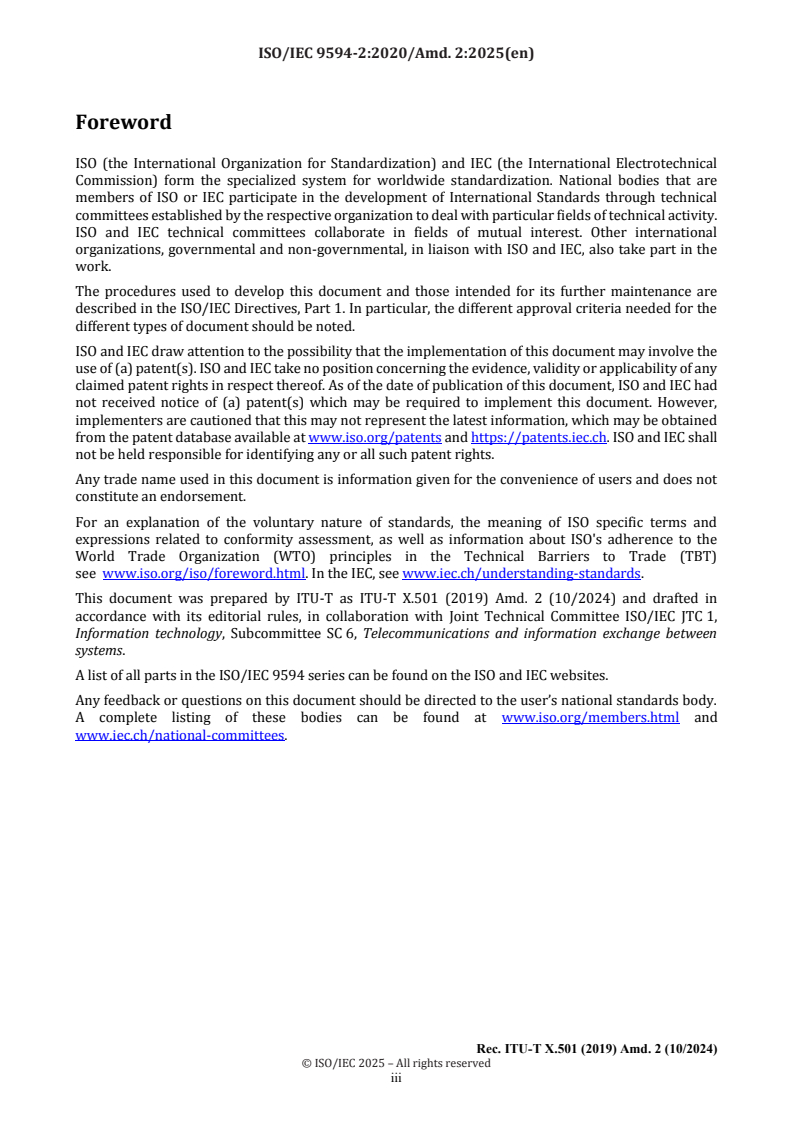
History
Edition Recommendation Approval Study Group Unique ID
1.0 ITU-T X.501 1988-11-25 11.1002/1000/2997
2.0 ITU-T X.501 1993-11-16 7 11.1002/1000/2998
3.0 ITU-T X.501 1997-08-09 7 11.1002/1000/4122
3.1 ITU-T X.501 (1997) Technical Cor. 1 2000-03-31 7 11.1002/1000/5031
3.2 ITU-T X.501 (1997) Amd. 1 2000-03-31 7 11.1002/1000/5030
3.3 ITU-T X.501 (1997) Technical Cor. 2 2001-02-02 7 11.1002/1000/5308
3.4 ITU-T X.501 (1997) Technical Cor. 3 2005-05-14 17 11.1002/1000/8499
4.0 ITU-T X.501 2001-02-02 7 11.1002/1000/5310
4.1 ITU-T X.501 (2001) Technical Cor. 1 2005-05-14 17 11.1002/1000/8500
4.2 ITU-T X.501 (2001) Technical Cor. 2 2005-11-29 17 11.1002/1000/8634
4.3 ITU-T X.501 (2001) Cor. 3 2008-05-29 17 11.1002/1000/9431
5.0 ITU-T X.501 2005-08-29 17 11.1002/1000/8489
5.1 ITU-T X.501 (2005) Cor. 1 2008-05-29 17 11.1002/1000/9432
5.2 ITU-T X.501 (2005) Cor. 2 2008-11-13 17 11.1002/1000/9589
5.3 ITU-T X.501 (2005) Cor. 3 2011-02-13 17 11.1002/1000/11040
5.4 ITU-T X.501 (2005) Cor. 4 2012-04-13 17 11.1002/1000/11575
6.0 ITU-T X.501 2008-11-13 17 11.1002/1000/9588
6.1 ITU-T X.501 (2008) Cor. 1 2011-02-13 17 11.1002/1000/11041
6.2 ITU-T X.501 (2008) Cor. 2 2012-04-13 17 11.1002/1000/11576
6.3 ITU-T X.501 (2008) Cor. 3 2012-10-14 17 11.1002/1000/11734
7.0 ITU-T X.501 2012-10-14 17 11.1002/1000/11733
8.0 ITU-T X.501 2016-10-14 17 11.1002/1000/13030
9.0 ITU-T X.501 2019-10-14 17 11.1002/1000/14032
9.1 ITU-T X.501 (2019) Amd. 1 2021-10-14 17 11.1002/1000/14790
9.2 ITU-T X.501 (2019) Amd. 2 2024-10-29 17 11.1002/1000/16171
To access the Recommendation, type the URL https://handle.itu.int/ in the address field of your web browser, followed by the
Recommendation's unique ID.
Rec. ITU-T X.501 (2019) Amd. 2 (10/2024)
© ISO/IEC 2025 – All rights reserved
iv
ISO/IEC 9594-2:2020/Amd. 2:2025(en)
FOREWORD
The International Telecommunication Union (ITU) is the United Nations specialized agency in the field of
telecommunications, and information and communication technologies (ICTs). The ITU Telecommunication
Standardization Sector (ITU-T) is a permanent organ of ITU. ITU-T is responsible for studying technical,
operating and tariff questions and issuing Recommendations on them with a view to standardizing
telecommunications on a worldwide basis.
The World Telecommunication Standardization Assembly (WTSA), which meets every four years, establishes
the topics for study by the ITU-T study groups which, in turn, produce Recommendations on these topics.
The approval of ITU-T Recommendations is covered by the procedure laid down in WTSA Resolution 1.
In some areas of information technology which fall within ITU-T's purview, the necessary standards are
prepared on a collaborative basis with ISO and IEC.
NOTE
In this Recommendation, the expression "Administration" is used for conciseness to indicate both a
telecommunication administration and a recognized operating agency.
Compliance with this Recommendation is voluntary. However, the Recommendation may contain certain
mandatory provisions (to ensure, e.g., interoperability or applicability) and compliance with the
Recommendation is achieved when all of these mandatory provisions are met. The words "shall" or some other
obligatory language such as "must" and the negative equivalents are used to express requirements. The use of
such words does not suggest that compliance with the Recommendation is required of any party.
INTELLECTUAL PROPERTY RIGHTS
ITU draws attention to the possibility that the practice or implementation of this Recommendation may involve
the use of a claimed Intellectual Property Right. ITU takes no position concerning the evidence, validity or
applicability of claimed Intellectual Property Rights, whether asserted by ITU members or others outside of
the Recommendation development process.
As of the date of approval of this Recommendation, ITU had not received notice of intellectual property,
protected by patents/software copyrights, which may be required to implement this Recommendation.
However, implementers are cautioned that this may not represent the latest information and are therefore
strongly urged to consult the appropriate ITU-T databases available via the ITU-T website at
https://www.itu.int/ITU-T/ipr/.
ITU 2025
All rights reserved. No part of this publication may be reproduced, by any means whatsoever, without the prior
written permission of ITU.
Rec. ITU-T X.501 (2019) Amd. 2 (10/2024)
© ISO/IEC 2025 – All rights reserved
v
ISO/IEC 9594-2:2020/Amd. 2:2025(en)
CONTENTS
Page
1) Clause 5 . 1
2) Clause 8.2 . 1
3) Clause 8.4 . 1
4) Clause 8.8 . 1
5) Clause 9.2 . 1
6) Clause 9.3 . 1
7) Clause 13.3.3 . 1
8) Clause 13.4.8 . 2
9) Clause 13.5.2 . 2
10) Clause 13.7.3 . 2
11) Clause 13.9.2 . 2
12) Clause 13.12 . 2
13) Annex A . 2
14) Annex B . 14
15) Annex C . 28
16) Annex D . 29
17) Annex E . 30
18) Annex F . 30
19) Annex G . 31
20) Annex H . 32
21) Annex I . 33
Rec. ITU-T X.501 (2019) Amd. 2 (10/2024)
© ISO/IEC 2025 – All rights reserved
vi
ISO/IEC 9594-2:2020/Amd. 2:2025(en)
INTERNATIONAL STANDARD
ITU-T RECOMMENDATION
Information technology – Open Systems Interconnection – The Directory: Models
Amendment 2
Miscellaneous enhancements
1) Clause 5
Add the following new paragraph at the end of clause 5:
As described in Annex A, some ASN.1 symbols have been moved from the InformationFramework module (Annex B)
to the UsefulDefinitions module (Annex A). However, in the main body of text the locations of the specifications
for these ASN.1 symbols are not changed as they still are logical parts of the information framework as they are present
in the InformationFramework module by being imported from the UsefulDefinitions module.
2) Clause 8.2
In clause 8.2 after the ASN.1 specification for Attribute, add:
NOTE 3 – This parameterized data type was moved from the InformationFramework module to the
UsefulDefinitions module after the ninth edition of this Directory Specification.
3) Clause 8.4
In clause 8.4 after the ASN.1 specification for AttributeType, add:
NOTE – This data type was moved from the InformationFramework module to the UsefulDefinitions module after
the ninth edition of this Directory Specification.
4) Clause 8.8
In clause 8.8 after the ASN.1 specification for Context, add:
NOTE 2 – This data type was moved from the InformationFramework module to the UsefulDefinitions module after
the ninth edition of this Directory Specification.
Renumber other NOTEs in clause 8.8 as required.
5) Clause 9.2
In clause 9.2 after the ASN.1 specification for Name and DomainName, add:
NOTE 2 – The Name and DomainName data types were moved from the InformationFramework module to the
UsefulDefinitions module after the ninth edition of this Directory Specification.
In clause 9.2 after the ASN.1 specification for DistinguishedName, add:
NOTE 4 – The RDNSequence and DistinguishedName data types were moved from the InformationFramework
module to the UsefulDefinitions module after the ninth edition of this Directory Specification.
Renumber other NOTEs in clause 9.2 as required.
6) Clause 9.3
In clause 9.3 after the ASN.1 specification for AttributeTypeAndValue, add:
NOTE 2 – The RelativeDistinguishedName and AttributeTypeAndValue data types were moved from the
InformationFramework module to the UsefulDefinitions module after the ninth edition of this Directory
Specification.
Renumber other NOTEs in clause 9.3 as required.
7) Clause 13.3.3
In clause 13.3.3 after the ASN.1 specification for ObjectClassKind, add:
NOTE 1 – The OBJECT-CLASS information object class and the ObjectClassKind data type were moved from the
InformationFramework module to the UsefulDefinitions module after the ninth edition of this Directory
Specification.
In clause 13.3.3 after the ASN.1 specification for top, add:
Rec. ITU-T X.501 (2019) Amd. 2 (10/2024)
© ISO/IEC 2025 – All rights reserved
ISO/IEC 9594-2:2020/Amd. 2:2025(en)
NOTE 3 – The top object class and the definition of the id-oc-top object identifier were moved from the
InformationFramework module to the UsefulDefinitions module after the ninth edition of this Directory
Specification.
Renumber the NOTEs in clause 13.3.3 as required.
8) Clause 13.4.8
In clause 13.4.8 after the ASN.1 specification for AttributeUsage, add:
NOTE 1 – The ATTRIBUTE information object class and the AttributeUsage data type were moved from the
InformationFramework module to the UsefulDefinitions module after the ninth edition of this Directory
Specification.
In clause 13.4.8 after the ASN.1 specification for objectClass, add:
NOTE 2 – The objectClass attribute type and the id-at-objectClass object identifier definition were moved from the
InformationFramework module to the UsefulDefinitions module after the ninth edition of this Directory
Specification.
Renumber other NOTEs in clause 13.4.8 as required.
9) Clause 13.5.2
In clause 13.5.2 after the ASN.1 specification for MATCHING-RULE, add:
NOTE 1 – This information object class was moved from the InformationFramework module to the
UsefulDefinitions module after the ninth edition of this Directory Specification.
In clause 13.5.2 after the ASN.1 specification for objectIdentifierMatch, add:
NOTE 4 – The objectIdentifierMatch matching rule and the definition of id-mr-objectIdentifierMatch object
identifier were moved from the InformationFramework module to the UsefulDefinitions module after the ninth
edition of this Directory Specification.
Renumber the NOTEs in clause 13.5.2 as required.
10) Clause 13.7.3
In clause 13.7.3 after the ASN.1 specification for NAME-FORM, add:
NOTE – This information object class was moved from the InformationFramework module to the UsefulDefinitions
module after the ninth edition of this Directory Specification.
11) Clause 13.9.2
In clause 13.9.2 after the ASN.1 specification for CONTEXT, add:
NOTE 1 – This information object class was moved from the InformationFramework module to the
UsefulDefinitions module after the ninth edition of this Directory Specification.
Renumber other NOTEs in clause 13.9.2 as required.
12) Clause 13.12
In clause 13.12 after the ASN.1 specification for SYNTAX-NAME, add:
NOTE – This information object class was moved from the InformationFramework module to the UsefulDefinitions
module after the ninth edition of this Directory Specification.
13) Annex A
Replace Annex A with:
Annex A
Useful definitions and object identifier usage
(This annex forms an integral part of this Recommendation | International Standard.)
It is desirable to have ASN.1 modules defined by the ITU-T X.500 series of Recommendations | ISO/IEC 9594-all parts
split into two groups:
Rec. ITU-T X.501 (2019) Amd. 2 (10/2024)
© ISO/IEC 2025 – All rights reserved
ISO/IEC 9594-2:2020/Amd. 2:2025(en)
a) The cybersecurity group consisting of modules that relates to cyber security. Currently, ASN.1 modules
defined in Rec. ITU-T X.509 | ISO/IEC 9594-8 and Rec. ITU-T X.510 | ISO/IEC 9594-11 belong to that
group together with a few more.
b) The directory group consisting of all the current modules except those defined by Rec. ITU-T X.510 |
ISO/IEC 9594-11 and later parts related to cybersecurity.
Some modules are members of both groups.
The modules of the cyber security group import ASN.1 items from modules in the directory group, especially from module
item defined by Rec. ITU-T X.501 | ISO/IEC 9594-2 and Rec. ITU-T X.520 | ISO/IEC 9594-6. Including those modules
also in the cybersecurity group causes complications due a compounding effect. Instead, such ASN.1 items are moved to
the module defined by this annex and by making that module part of both groups allows both groups to import ASN.1
items from that module avoiding duplication of specifications.
This annex also documents the upper arcs of the object identifier subtree in which all the object identifiers assigned in the
Directory Specifications reside.
The resulting ASN.1 module is called UsefulDefinitions.
UsefulDefinitions {joint-iso-itu-t ds(5) module(1) usefulDefinitions(0) 10}
DEFINITIONS ::=
BEGIN
-- EXPORTS All
/*
The types and values defined in this module are exported for use in the other
ASN.1
modules contained within the Directory Specifications and within the X.500
cybersecurity soecifications. It mau also be used by other applications which will
use
them to access Directory services or cybersecurity services. Other applications
may use them for their own purposes, but this will not constrain extensions and
modifications needed to maintain or improve the Directory and cybersecurity
services
Several types and values that are part of the Directory specificationhave been
moved from
the formal ASN.1 modules into this module also to be used by the cybersecurity
modules.
The specification in the main text of the affected Directory specification parts
are
left unchanged.
*/
/*
The following ASN.1 specifications within the InformationFramework module from
Rec. ITU-T X.501 | ISO/IEC 9594-2 have been moved into this module
*/
Attribute {ATTRIBUTE:SupportedAttributes} ::= SEQUENCE {
type ATTRIBUTE.&id({SupportedAttributes}),
values SET SIZE (0.MAX) OF
ATTRIBUTE.&Type({SupportedAttributes}{@type}),
valuesWithContext SET SIZE (1.MAX) OF SEQUENCE {
value ATTRIBUTE.&Type({SupportedAttributes}{@type}),
contextList SET SIZE (1.MAX) OF Context,
...} OPTIONAL,
... }
AttributeType ::= ATTRIBUTE.&id
Context ::= SEQUENCE {
contextType CONTEXT.&id({SupportedContexts}),
Rec. ITU-T X.501 (2019) Amd. 2 (10/2024)
© ISO/IEC 2025 – All rights reserved
ISO/IEC 9594-2:2020/Amd. 2:2025(en)
contextValues
SET SIZE (1.MAX) OF CONTEXT.&Type({SupportedContexts}{@contextType}),
fallback BOOLEAN DEFAULT FALSE,
... }
SupportedAttributes ATTRIBUTE ::= {.}
SupportedContexts CONTEXT ::= {.}
-- Naming
Name ::= CHOICE {
rdnSequence RDNSequence,
dnsName DomainName,
oid OBJECT IDENTIFIER }
DomainName ::= UTF8String (CONSTRAINED BY {
-- Conforms to the format of an (internationalized) domain name. -- })
RDNSequence ::= SEQUENCE OF RelativeDistinguishedName
RelativeDistinguishedName ::= SET SIZE (1.MAX) OF AttributeTypeAndValue
DistinguishedName ::= RDNSequence
AttributeTypeAndValue ::= SEQUENCE {
type ATTRIBUTE.&id ({SupportedAttributes}),
value ATTRIBUTE.&Type ({SupportedAttributes}{@type}),
... }
OBJECT-CLASS ::= CLASS {
&Superclasses OBJECT-CLASS OPTIONAL,
&kind ObjectClassKind DEFAULT structural,
&MandatoryAttributes ATTRIBUTE OPTIONAL,
&OptionalAttributes ATTRIBUTE OPTIONAL,
&ldapName SEQUENCE SIZE(1.MAX) OF UTF8String OPTIONAL,
&ldapDesc UTF8String OPTIONAL,
&id OBJECT IDENTIFIER UNIQUE }
WITH SYNTAX {
[SUBCLASS OF &Superclasses]
[KIND &kind]
[MUST CONTAIN &MandatoryAttributes]
[MAY CONTAIN &OptionalAttributes]
[LDAP-NAME &ldapName]
[LDAP-DESC &ldapDesc]
ID &id }
ObjectClassKind ::= ENUMERATED {
abstract (0),
structural (1),
auxiliary (2)}
top OBJECT-CLASS ::= {
KIND abstract
MUST CONTAIN {objectClass}
LDAP-NAME {"top"}
ID id-oc-top }
id-oc-top OBJECT IDENTIFIER ::= {id-oc 0}
-- Information object classes from Information Framework
Rec. ITU-T X.501 (2019) Amd. 2 (10/2024)
© ISO/IEC 2025 – All rights reserved
ISO/IEC 9594-2:2020/Amd. 2:2025(en)
ATTRIBUTE ::= CLASS {
&derivation ATTRIBUTE OPTIONAL,
&Type OPTIONAL, -- either &Type or &derivation required
&equality-match MATCHING-RULE OPTIONAL,
&ordering-match MATCHING-RULE OPTIONAL,
&substrings-match MATCHING-RULE OPTIONAL,
&single-valued BOOLEAN DEFAULT FALSE,
&collective BOOLEAN DEFAULT FALSE,
&dummy BOOLEAN DEFAULT FALSE,
-- operational extensions
&no-user-modification BOOLEAN DEFAULT FALSE,
&usage AttributeUsage DEFAULT userApplications,
&ldapSyntax SYNTAX-NAME.&id OPTIONAL,
&ldapName SEQUENCE SIZE(1.MAX) OF UTF8String OPTIONAL,
&ldapDesc UTF8String OPTIONAL,
&obsolete BOOLEAN DEFAULT FALSE,
&id OBJECT IDENTIFIER UNIQUE }
WITH SYNTAX {
[SUBTYPE OF &derivation]
[WITH SYNTAX &Type]
[EQUALITY MATCHING RULE &equality-match]
[ORDERING MATCHING RULE &ordering-match]
[SUBSTRINGS MATCHING RULE &substrings-match]
[SINGLE VALUE &single-valued]
[COLLECTIVE &collective]
[DUMMY &dummy]
[NO USER MODIFICATION &no-user-modification]
[USAGE &usage]
[LDAP-SYNTAX &ldapSyntax]
[LDAP-NAME &ldapName]
[LDAP-DESC &ldapDesc]
[OBSOLETE &obsolete]
ID &id }
AttributeUsage ::= ENUMERATED {
userApplications (0),
directoryOperation (1),
distributedOperation (2),
dSAOperation (3),
... }
objectClass ATTRIBUTE ::= {
WITH SYNTAX OBJECT IDENTIFIER
EQUALITY MATCHING RULE objectIdentifierMatch
LDAP-SYNTAX oid.&id
LDAP-NAME {"objectClass"}
ID id-at-objectClass }
id-at-objectClass OBJECT IDENTIFIER ::= {id-at 0}
-- MATCHING-RULE information object class specification
MATCHING-RULE ::= CLASS {
&ParentMatchingRules MATCHING-RULE OPTIONAL,
&AssertionType OPTIONAL,
&uniqueMatchIndicator ATTRIBUTE OPTIONAL,
&ldapSyntax SYNTAX-NAME.&id OPTIONAL,
&ldapName SEQUENCE SIZE(1.MAX) OF UTF8String OPTIONAL,
&ldapDesc UTF8String OPTIONAL,
&id OBJECT IDENTIFIER UNIQUE }
WITH SYNTAX {
[PARENT &ParentMatchingRules]
Rec. ITU-T X.501 (2019) Amd. 2 (10/2024)
© ISO/IEC 2025 – All rights reserved
ISO/IEC 9594-2:2020/Amd. 2:2025(en)
[SYNTAX &AssertionType]
[UNIQUE-MATCH-INDICATOR &uniqueMatchIndicator]
[LDAP-SYNTAX &ldapSyntax]
[LDAP-NAME &ldapName]
[LDAP-DESC &ldapDesc]
ID &id }
objectIdentifierMatch MATCHING-RULE ::= {
SYNTAX OBJECT IDENTIFIER
LDAP-SYNTAX oid.&id
LDAP-NAME {"objectIdentifierMatch"}
ID id-mr-objectIdentifierMatch }
id-mr-objectIdentifierMatch OBJECT IDENTIFIER ::= {id-mr 0}
NAME-FORM ::= CLASS {
&namedObjectClass OBJECT-CLASS,
&MandatoryAttributes ATTRIBUTE,
&OptionalAttributes ATTRIBUTE OPTIONAL,
&ldapName SEQUENCE SIZE(1.MAX) OF UTF8String OPTIONAL,
&ldapDesc UTF8String OPTIONAL,
&id OBJECT IDENTIFIER UNIQUE }
WITH SYNTAX {
NAMES &namedObjectClass
WITH ATTRIBUTES &MandatoryAttributes
[AND OPTIONALLY &OptionalAttributes]
[LDAP-NAME &ldapName]
[LDAP-DESC &ldapDesc]
ID &id }
CONTEXT ::= CLASS {
&Type,
&defaultValue &Type OPTIONAL,
&Assertion OPTIONAL,
&absentMatch BOOLEAN DEFAULT TRUE,
&id OBJECT IDENTIFIER UNIQUE }
WITH SYNTAX {
WITH SYNTAX &Type
[DEFAULT-VALUE &defaultValue]
[ASSERTED AS &Assertion]
[ABSENT-MATCH &absentMatch]
ID &id }
SYNTAX-NAME ::= CLASS {
&ldapDesc UTF8String,
&Type OPTIONAL,
&id OBJECT IDENTIFIER UNIQUE }
WITH SYNTAX {
LDAP-DESC &ldapDesc
[DIRECTORY SYNTAX &Type]
ID &id }
/*
The following ASN.1 specifications within the SelectedAttributeTypes module from
Rec. ITU-T X.520 | ISO/IEC 9594-6 have been moved into this module
*/
UnboundedDirectoryString ::= CHOICE {
teletexString TeletexString(SIZE (1.MAX)),
printableString PrintableString(SIZE (1.MAX)),
bmpString BMPString(SIZE (1.MAX)),
universalString UniversalString(SIZE (1.MAX)),
Rec. ITU-T X.501 (2019) Amd. 2 (10/2024)
© ISO/IEC 2025 – All rights reserved
ISO/IEC 9594-2:2020/Amd. 2:2025(en)
uTF8String UTF8String(SIZE (1.MAX)) }
name ATTRIBUTE ::= {
WITH SYNTAX UnboundedDirectoryString
EQUALITY MATCHING RULE caseIgnoreMatch
SUBSTRINGS MATCHING RULE caseIgnoreSubstringsMatch
LDAP-SYNTAX directoryString.&id
LDAP-NAME {"name"}
ID id-at-name }
id-at-name OBJECT IDENTIFIER ::= {id-at 41}
commonName ATTRIBUTE ::= {
SUBTYPE OF name
WITH SYNTAX UnboundedDirectoryString
LDAP-SYNTAX directoryString.&id
LDAP-NAME {"cn", "commonName"}
ID id-at-commonName }
id-at-commonName OBJECT IDENTIFIER ::= {id-at 3}
dnsName ATTRIBUTE ::= {
WITH SYNTAX DomainName
EQUALITY MATCHING RULE dnsNameMatch
LDAP-SYNTAX dnsString.&id
LDAP-NAME {"DNS name"}
ID id-at-dnsName }
id-at-dnsName OBJECT IDENTIFIER ::= {id-at 100}
dnsNameMatch MATCHING-RULE ::= {
SYNTAX DomainName
LDAP-SYNTAX dnsString.&id
LDAP-NAME {"dnsNameMatch"}
ID id-mr-dnsNameMatch }
id-mr-dnsNameMatch OBJECT IDENTIFIER ::= {id-mr 74}
dnsString SYNTAX-NAME ::= {
LDAP-DESC "DNS Name String"
DIRECTORY SYNTAX DomainName
ID id-asx-dnsString }
id-asx-dnsString OBJECT IDENTIFIER ::= {id-asx 9}
objectIdentifier ATTRIBUTE ::= {
WITH SYNTAX OBJECT IDENTIFIER
EQUALITY MATCHING RULE objectIdentifierMatch
SINGLE VALUE TRUE
LDAP-SYNTAX oid.&id
LDAP-NAME {"Object Identifier"}
ID id-at-objectIdentifier }
id-at-objectIdentifier OBJECT IDENTIFIER ::= {id-at 106}
PresentationAddress ::= SEQUENCE {
pSelector [0] OCTET STRING OPTIONAL,
sSelector [1] OCTET STRING OPTIONAL,
tSelector [2] OCTET STRING OPTIONAL,
nAddresses [3] SET SIZE (1.MAX) OF OCTET STRING,
... }
Rec. ITU-T X.501 (2019) Amd. 2 (10/2024)
© ISO/IEC 2025 – All rights reserved
ISO/IEC 9594-2:2020/Amd. 2:2025(en)
caseIgnoreMatch MATCHING-RULE ::= {
SYNTAX UnboundedDirectoryString
LDAP-SYNTAX directoryString.&id
LDAP-NAME {"caseIgnoreMatch"}
ID id-mr-caseIgnoreMatch }
id-mr-caseIgnoreMatch OBJECT IDENTIFIER ::= {id-mr 2}
caseIgnoreSubstringsMatch MATCHING-RULE ::= {
SYNTAX SubstringAssertion
LDAP-SYNTAX substringAssertion.&id
LDAP-NAME {"caseIgnoreSubstringsMatch"}
ID id-mr-caseIgnoreSubstringsMatch }
SubstringAssertion ::= SEQUENCE OF CHOICE {
initial [0] UnboundedDirectoryString,
any [1] UnboundedDirectoryString,
final [2] UnboundedDirectoryString,
-- at most one initial and one final component
control Attribute{{SupportedAttributes}},
-- Use-d to specify interpretation of the following items
... }
id-mr-caseIgnoreSubstringsMatch OBJECT IDENTIFIER ::= {id-mr 4}
integerMatch MATCHING-RULE ::= {
SYNTAX INTEGER
LDAP-SYNTAX integer.&id
LDAP-NAME {"integerMatch"}
ID id-mr-integerMatch }
id-mr-integerMatch OBJECT IDENTIFIER ::= {id-mr 14}
octetStringMatch MATCHING-RULE ::= {
SYNTAX OCTET STRING
LDAP-SYNTAX octetString.&id
LDAP-NAME {"octetStringMatch"}
ID id-mr-octetStringMatch }
id-mr-octetStringMatch OBJECT IDENTIFIER ::= {id-mr 17}
-- Copy of Syntax Names from Selected attribute types
directoryString SYNTAX-NAME ::= {
LDAP-DESC "Directory String"
DIRECTORY SYNTAX UnboundedDirectoryString
ID id-lsx-directoryString }
id-lsx-directoryString OBJECT IDENTIFIER ::= {id-lsx 15}
integer SYNTAX-NAME ::= {
LDAP-DESC "INTEGER"
DIRECTORY SYNTAX INTEGER
ID id-lsx-integer }
id-lsx-integer OBJECT IDENTIFIER ::= {id-lsx 27}
oid SYNTAX-NAME ::= {
LDAP-DESC "OID"
DIRECTORY SYNTAX OBJECT IDENTIFIER
ID id-lsx-oid }
Rec. ITU-T X.501 (2019) Amd. 2 (10/2024)
© ISO/IEC 2025 – All rights reserved
ISO/IEC 9594-2:2020/Amd. 2:2025(en)
id-lsx-oid OBJECT IDENTIFIER ::= {id-lsx 38}
octetString SYNTAX-NAME ::= {
LDAP-DESC "Octet String"
DIRECTORY SYNTAX OCTET STRING
ID id-lsx-octetString }
id-lsx-octetString OBJECT IDENTIFIER ::= {id-lsx 40}
substringAssertion SYNTAX-NAME ::= {
LDAP-DESC "Substring Assertion"
DIRECTORY SYNTAX SubstringAssertion
ID id-lsx-substringAssertion }
id-lsx-substringAssertion OBJECT IDENTIFIER ::= {id-lsx 58}
TimeSpecification ::= SEQUENCE {
time CHOICE {
absolute SEQUENCE {
startTime [0] GeneralizedTime OPTIONAL,
endTime [1] GeneralizedTime OPTIONAL,
... },
periodic SET SIZE (1.MAX) OF Period},
notThisTime BOOLEAN DEFAULT FALSE,
timeZone TimeZone OPTIONAL,
... }
Period ::= SEQUENCE {
timesOfDay [0] SET SIZE (1.MAX) OF DayTimeBand OPTIONAL,
days [1] CHOICE {
intDay SET OF INTEGER,
bitDay BIT STRING {
sunday (0),
monday (1),
tuesday (2),
wednesday (3),
thursday (4),
friday (5),
saturday (6)},
dayOf XDayOf,
...} OPTIONAL,
weeks [2] CHOICE {
allWeeks NULL,
intWeek SET OF INTEGER,
bitWeek BIT STRING {
week1 (0),
week2 (1),
week3 (2),
week4 (3),
week5 (4)},
... } OPTIONAL,
months [3] CHOICE {
allMonths NULL,
intMonth SET OF INTEGER,
bitMonth BIT STRING {
january (0),
february (1),
march (2),
april (3),
may (4),
june (5),
Rec. ITU-T X.501 (2019) Amd. 2 (10/2024)
© ISO/IEC 2025 – All rights reserved
ISO/IEC 9594-2:2020/Amd. 2:2025(en)
july (6),
august (7),
september (8),
october (9),
november (10),
december (11)},
...} OPTIONAL,
years [4] SET OF INTEGER(1000.MAX) OPTIONAL,
... }
XDayOf ::= CHOICE {
first [1] NamedDay,
second [2] NamedDay,
third [3] NamedDay,
fourth [4] NamedDay,
fifth [5] NamedDay }
NamedDay ::= CHOICE {
intNamedDays ENUMERATED {
sunday (1),
monday (2),
tuesday (3),
wednesday (4),
thursday (5),
friday (6),
saturday (7)},
bitNamedDays BIT STRING {
sunday (0),
monday (1),
tuesday (2),
wednesday (3),
thursday (4),
friday (5),
saturday (6)} }
DayTimeBand ::= SEQUENCE {
startDayTime [0] DayTime DEFAULT {hour 0},
endDayTime [1] DayTime DEFAULT {hour 23, minute 59, second 59},
... }
DayTime ::= SEQUENCE {
hour [0] INTEGER(0.23),
minute [1] INTEGER(0.59) DEFAULT 0,
second [2] INTEGER(0.59) DEFAULT 0,
... }
TimeZone ::= INTEGER(-12.12)
ID ::= OBJECT IDENTIFIER
ds ID ::= {joint-iso-itu-t ds(5)}
-- The following definition is for ASN.1 definitions moved from
-- Rec. ITU-T X.660 | ISO/IEC 9834-1:
id ID ::= {joint-iso-itu-t registration-procedures(17) module(1) directory-
defs(2)}
-- The following defition is for ASN.1 definitions of LDAP schema
internet ID ::= {iso(1) identified-organization(3) dod(6) internet(1)}
ldap-dir ID ::= {internet directory(1)}
Rec. ITU-T X.501 (2019) Amd. 2 (10/2024)
© ISO/IEC 2025 – All rights reserved
ISO/IEC 9594-2:2020/Amd. 2:2025(en)
intSecurity ID ::= {internet security(5)}
ldap-enterprise ID ::= {internet private(4) enterprise(1)}
ldap-x509 ID ::= {ldap-dir x509(15)}
ldap-openLDAP ID ::= {ldap-enterprise openLDAP(4203) ldap(1)}
openLDAP-attributes ID ::= {ldap-openLDAP attributeType(3)}
openLDAP-controls ID ::= {ldap-openLDAP controls(10)}
ldap-wall ID ::= {ldap-enterprise wahl(1466)}
ldap-dynExt ID ::= {ldap-wall 101 119}
ldap-attr ID ::= {ldap-wall 101 120}
ldap-match ID ::= {ldap-wall 109 114}
ldap-syntax ID ::= {ldap-wall 115 121 1}
cosine ID ::= {itu-t(0) data(9) pss(2342) ucl(19200300) pilot(100)}
cosineAttr ID ::= {cosine pilotAttributeType(1)}
-- categories of information object
module ID ::= {ds 1}
serviceElement ID ::= {ds 2}
applicationContext ID ::= {ds 3}
attributeType ID ::= {ds 4}
attributeSyntaxVendor ID ::= {ds 5}
-- This arc will not be used by these Directory Specifications
objectClass-oid ID ::= {ds 6}
-- attributeSet ID ::= {ds 7}
-- algorithm ID ::= {ds 8}
abstractSyntax ID ::= {ds 9}
-- object ID ::= {ds 10}
-- port ID ::= {ds 11}
dsaOperationalAttribute ID ::= {ds 12}
matchingRule ID ::= {ds 13}
knowledgeMatchingRule ID ::= {ds 14}
nameForm ID ::= {ds 15}
group ID ::= {ds 16}
subentry ID ::= {ds 17}
operationalAttributeType ID ::= {ds 18}
operationalBinding ID ::= {ds 19}
schemaObjectClass ID ::= {ds 20}
schemaOperationalAttribute ID ::= {ds 21}
administrativeRoles ID ::= {ds 23}
accessControlAttribute ID ::= {ds 24}
--rosObject ID ::= {ds 25}
--contract ID ::= {ds 26}
--package ID ::= {ds 27}
accessControlSchemes ID ::= {ds 28}
certificateExtension ID ::= {ds 29}
managementObject ID ::= {ds 30}
attributeValueContext ID ::= {ds 31}
-- securityExchange ID ::= {ds 32}
idmProtocol ID ::= {ds 33}
problem ID ::= {ds 34}
notification ID ::= {ds 35}
matchingRestriction ID ::= {ds 36} -- None are currently
defined
controlAttributeType ID ::= {ds 37}
keyPurposes ID ::= {ds 38}
passwordQuality ID ::= {ds 39}
attributeSyntax ID ::= {ds 40}
avRestriction ID ::= {ds 41}
cmsContentType ID ::= {ds 42}
wrapperProtocolType ID ::= {ds 43}
algorithm ID ::= {ds 44}
Rec. ITU-T X.501 (2019) Amd. 2 (10/2024)
© ISO/IEC 2025 – All rights reserved
ISO/IEC 9594-2:2020/Amd. 2:2025(en)
/*
-- modules
usefulDefinitions ID ::= {module usefulDefinitions(0) x}
informationFramework ID ::= {module informationFramework(1)
x}
directoryAbstractService ID ::= {module directoryAbstractService(2)
8}
distributedOperations ID ::= {module distributedOperations(3)
8}
-- protocolObjectIdentifiers ID ::= {module protocolObjectIdentifiers(4)
8}
selectedAttributeTypes ID ::= {module selectedAttributeTypes(5)
8}
selectedObjectClasses ID ::= {module selectedObjectClasses(6)
8}
authenticationFramework ID ::= {module authenticationFramework(7)
8}
algorithmObjectIdentifiers ID ::= {module algorithmObjectIdentifiers(8)
8}
directoryObjectIdentifiers ID ::= {module directoryObjectIdentifiers(9)
8}
-- upperBounds ID ::= {module upperBounds(10) 8}
-- dap ID ::= {module dap(11) 8}
-- dsp ID ::= {module dsp(12) 8}
distributedDirectoryOIDs ID ::= {module distributedDirectoryOIDs(13)
8}
directoryShadowOIDs ID ::= {module directoryShadowOIDs(14)
8}
directoryShadowAbstractService ID ::= {module
directoryShadowAbstractService(15) 8}
-- disp ID ::= {module disp(16) 7}
-- dop ID ::= {module dop(17) 7}
opBindingManagement ID ::= {module opBindingManagement(18)
8}
opBindingOIDs ID ::= {module opBindingOIDs(19) 8}
hierarchicalOperationalBindings ID ::= {module
hierarchicalOperationalBindings(20) 8}
dsaOperationalAttributeTypes ID ::= {module
dsaOperationalAttributeTypes(22)
8}
schemaAdministration ID ::= {module schemaAdministration(23)
8}
basicAccessControl ID ::= {module basicAccessControl(24) 8}
directoryOperationalBindingTypes ID ::= {module
directoryOperationalBindingTypes(25) 8}
certificateExtensions ID ::= {module certificateExtensions(26)
8}
directoryManagement ID ::= {module directoryManagement(27)
8}
enhancedSecurity ID ::= {module enhancedSecurity(28) 8}
-- directorySecurityExchanges ID ::= {module
-- directorySecurityExchanges (29)
8}
iDMProtocolSpecification ID ::= {module iDMProtocolSpecification(30)
8}
directoryIDMProtocols ID ::= {module directoryIDMProtocols(31)
8}
Rec. ITU-T X.501 (2019) Amd. 2 (10/2024)
© ISO/IEC 2025 – All rights reserved
ISO/IEC 9594-2:2020/Amd. 2:2025(en)
attributeCertificateDefinitions ID ::= {module
attributeCertificateDefinitions(32) 8}
serviceAdministration ID ::= {module serviceAdministration(33)
8}
ldapAttributes ID ::= {module ldapAttributes(34) 8}
commonProtocolSpecification ID ::= {module
commonProtocolSpecification(35)
8}
oSIProtocolSpecification ID ::= {module oSIProtocolSpecification(36)
8}
directoryOSIProtocols ID ::= {module directoryOSIProtocols(37)
8}
ldapSystemSchema ID ::= {module ldapSystemSchema(38) 8}
passwordPolicy ID ::= {module passwordPolicy(39) x}
pkiPmiExternalDataTypes ID ::= {module pkiPmiExternalDataTypes(40)
x}
extensionAttributes ID ::= {module extensionAttributes(41)
xx}
-- X.510
cryptoTools ID ::= {module cryptoTools(42) x}
wrapper ID ::= {module wrapper(43) x}
avlManagement ID ::= {module avlManagement(44) x}
caSubsription ID ::= {module caSubsription (45) x}
trustBrokerProtocol ID ::= {module trustBrokerProtocol(46)
x}
protProtocols ID ::= {module protProtocols(47) x}
genAlgo ID ::= {module genAlgo(48) x}
-- X509
supportedIn
...
Questions, Comments and Discussion
Ask us and Technical Secretary will try to provide an answer. You can facilitate discussion about the standard in here.
Loading comments...