


ISO 16674:2025
(Main)Corrosion control engineering life cycle of power transmission and transformation systems — General requirements
Corrosion control engineering life cycle of power transmission and transformation systems — General requirements
This document specifies the general requirements for various factors in the corrosion control engineering throughout the life cycle of equipment and devices of power transmission and transformation systems. This document is applicable to the corrosion control engineering of power transmission and transformation systems.
Titre manque
General Information
- Status
- Published
- Publication Date
- 09-Jun-2025
- Technical Committee
- ISO/TC 156/SC 1 - Corrosion control engineering life cycle
- Drafting Committee
- ISO/TC 156/SC 1 - Corrosion control engineering life cycle
- Current Stage
- 6060 - International Standard published
- Start Date
- 10-Jun-2025
- Due Date
- 02-Mar-2026
- Completion Date
- 10-Jun-2025
Overview
ISO 16674:2025 - Corrosion control engineering life cycle of power transmission and transformation systems specifies general requirements for managing corrosion across the entire life cycle of equipment and devices used in power transmission and transformation systems. It covers stages from target setting, design and material selection through manufacturing, installation, operation, maintenance, life extension and final disposal. The standard aims to ensure safe, economical, long‑lasting and environmentally responsible power infrastructure.
Key topics and technical requirements
- Life‑cycle approach: Addresses corrosion control at every stage - design, development, manufacturing, transportation, storage, construction, commissioning, testing, operation, maintenance, repair, life extension and scrap.
- Corrosion source identification: Requires procedures and dynamic monitoring to identify atmospheric, soil/groundwater and operational sources (e.g., stray currents, thermal effects, electromagnetic influences).
- Corrosivity mapping and databases: Recommends corrosivity classification maps (atmospheric, soil) and a corrosion source database to support design and decision making.
- Materials selection: Sets principles and steps for selecting materials based on corrosion resistance, mechanical and electrical properties, manufacturability, maintenance suitability, cost and environmental impact. Supports lab or field verification where needed.
- Design and protection measures: Promotes coordinated design choices and protective strategies (coatings, metallic coatings, cathodic protection, hot‑dip galvanizing, concrete protection) tailored to accessibility and inspectability.
- Management system and organization: Advises establishing a corrosion control management system and defined responsibilities for owners, technical teams, operations and maintenance.
- Monitoring, testing and records: Emphasizes automatic/intelligent data acquisition, regular inspection/testing, and comprehensive documentation for continuous improvement and assessment.
- Principles: Integrity, systematicity, mutual coordination and optimization across all factors.
Applications and practical value
- Helps utilities, transmission system operators and substation owners reduce downtime, extend asset life and optimize maintenance costs.
- Guides design engineers and material specialists in choosing corrosion‑resistant conductors, fittings, towers, grounding electrodes and substation equipment.
- Supports maintenance teams in implementing inspection regimes, cathodic protection and repair/retrofit strategies.
- Enables project managers and asset owners to build corrosion databases, corrosivity maps and lifecycle cost/benefit assessments.
Who should use this standard
- Power utilities, grid operators and asset managers
- Design and consulting engineers for transmission lines and substations
- Materials engineers, corrosion specialists and maintenance planners
- Contractors involved in manufacturing, installation and commissioning
Related standards
- ISO 12944 (protective coatings)
- ISO 12696 (cathodic protection)
- ISO 14657 (hot‑dip galvanizing design)
ISO 16674:2025 provides a structured, life‑cycle framework for corrosion control engineering tailored to power transmission and transformation systems, improving reliability, safety and cost‑effectiveness.


Get Certified
Connect with accredited certification bodies for this standard

Element Materials Technology
Materials testing and product certification.

Inštitut za kovinske materiale in tehnologije
Institute of Metals and Technology. Materials testing, metallurgical analysis, NDT.
Sponsored listings
Frequently Asked Questions
ISO 16674:2025 is a standard published by the International Organization for Standardization (ISO). Its full title is "Corrosion control engineering life cycle of power transmission and transformation systems — General requirements". This standard covers: This document specifies the general requirements for various factors in the corrosion control engineering throughout the life cycle of equipment and devices of power transmission and transformation systems. This document is applicable to the corrosion control engineering of power transmission and transformation systems.
This document specifies the general requirements for various factors in the corrosion control engineering throughout the life cycle of equipment and devices of power transmission and transformation systems. This document is applicable to the corrosion control engineering of power transmission and transformation systems.
ISO 16674:2025 is classified under the following ICS (International Classification for Standards) categories: 77.060 - Corrosion of metals. The ICS classification helps identify the subject area and facilitates finding related standards.
ISO 16674:2025 is available in PDF format for immediate download after purchase. The document can be added to your cart and obtained through the secure checkout process. Digital delivery ensures instant access to the complete standard document.
Standards Content (Sample)
International
Standard
ISO 16674
First edition
Corrosion control engineering life
2025-06
cycle of power transmission and
transformation systems — General
requirements
Reference number
© ISO 2025
All rights reserved. Unless otherwise specified, or required in the context of its implementation, no part of this publication may
be reproduced or utilized otherwise in any form or by any means, electronic or mechanical, including photocopying, or posting on
the internet or an intranet, without prior written permission. Permission can be requested from either ISO at the address below
or ISO’s member body in the country of the requester.
ISO copyright office
CP 401 • Ch. de Blandonnet 8
CH-1214 Vernier, Geneva
Phone: +41 22 749 01 11
Email: copyright@iso.org
Website: www.iso.org
Published in Switzerland
ii
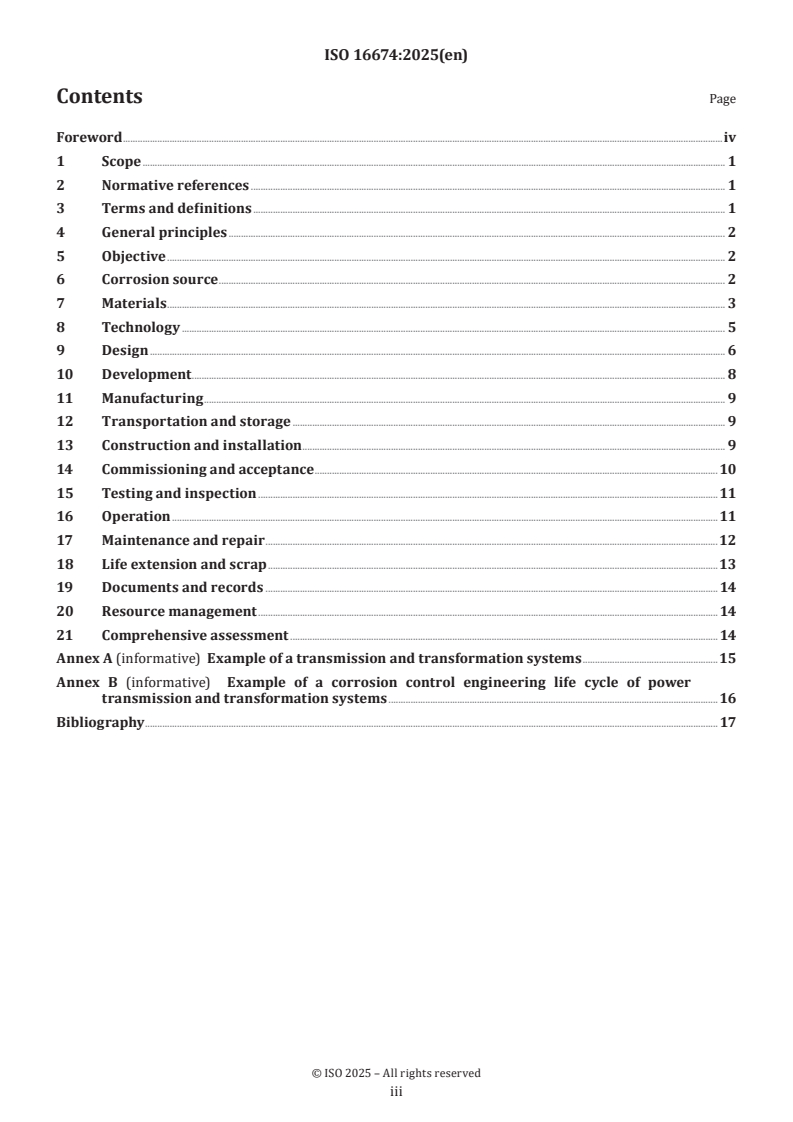
Contents Page
Foreword .iv
1 Scope . 1
2 Normative references . 1
3 Terms and definitions . 1
4 General principles . 2
5 Objective . 2
6 Corrosion source . 2
7 Materials . 3
8 Technology . 5
9 Design . 6
10 Development . 8
11 Manufacturing . 9
12 Transportation and storage . 9
13 Construction and installation . 9
14 Commissioning and acceptance . 10
15 Testing and inspection .11
16 Operation .11
17 Maintenance and repair .12
18 Life extension and scrap .13
19 Documents and records . 14
20 Resource management . 14
21 Comprehensive assessment . 14
Annex A (informative) Example of a transmission and transformation systems .15
Annex B (informative) Example of a corrosion control engineering life cycle of power
transmission and transformation systems .16
Bibliography . 17
iii
Foreword
ISO (the International Organization for Standardization) is a worldwide federation of national standards
bodies (ISO member bodies). The work of preparing International Standards is normally carried out through
ISO technical committees. Each member body interested in a subject for which a technical committee
has been established has the right to be represented on that committee. International organizations,
governmental and non-governmental, in liaison with ISO, also take part in the work. ISO collaborates closely
with the International Electrotechnical Commission (IEC) on all matters of electrotechnical standardization.
The procedures used to develop this document and those intended for its further maintenance are described
in the ISO/IEC Directives, Part 1. In particular, the different approval criteria needed for the different types
of ISO document should be noted. This document was drafted in accordance with the editorial rules of the
ISO/IEC Directives, Part 2 (see www.iso.org/directives).
ISO draws attention to the possibility that the implementation of this document may involve the use of (a)
patent(s). ISO takes no position concerning the evidence, validity or applicability of any claimed patent
rights in respect thereof. As of the date of publication of this document, ISO had not received notice of (a)
patent(s) which may be required to implement this document. However, implementers are cautioned that
this may not represent the latest information, which may be obtained from the patent database available at
www.iso.org/patents. ISO shall not be held responsible for identifying any or all such patent rights.
Any trade name used in this document is information given for the convenience of users and does not
constitute an endorsement.
For an explanation of the voluntary nature of standards, the meaning of ISO specific terms and expressions
related to conformity assessment, as well as information about ISO’s adherence to the World Trade
Organization (WTO) principles in the Technical Barriers to Trade (TBT), see www.iso.org/iso/foreword.html.
This document was prepared by Technical Committee ISO/TC 156, Corrosion of metals and alloys,
Subcommittee SC 1, Corrosion control engineering life cycle.
Any feedback or questions on this document should be directed to the user’s national standards body. A
complete listing of these bodies can be found at www.iso.org/members.html.
iv
International Standard ISO 16674:2025(en)
Corrosion control engineering life cycle of power
transmission and transformation systems — General
requirements
1 Scope
This document specifies the general requirements for various factors in the corrosion control engineering
throughout the life cycle of equipment and devices of power transmission and transformation systems.
This document is applicable to the corrosion control engineering of power transmission and transformation
systems.
2 Normative references
There are no normative references in this document.
3 Terms and definitions
For the purposes of this document, the following terms and definitions apply.
ISO and IEC maintain terminology databases for use in standardization at the following addresses:
— ISO Online browsing platform: available at https:// www .iso .org/ obp
— IEC Electropedia: available at https:// www .electropedia .org/
3.1
power transmission and transformation systems
combination of all devices and equipment for transmission and transformation in power systems
3.2
corrosion control engineering life cycle of power transmission and transformation systems
entire process of corrosion control engineering for power transmission and transformation systems (3.1) from
target setting to disposal and scrapping
3.3
life extension
measures taken to extend the service life of corrosion control engineering
3.4
corrosion database
collection dedicated to storing and managing data and information related to corrosion
3.5
map of corrosivity classification
maps that describe the corrosivity categories of specific environments towards metal materials in a certain
region during a given period
EXAMPLE 1 Atmospheric corrosivity classification maps.
EXAMPLE 2 Soil corrosivity classification maps.
4 General principles
4.1 This document specifies all factors in the corrosion control engineering life cycle of power transmission
and transformation systems. This includes the objectives, corrosion sources, materials, technology, design,
development, manufacturing, transportation and storage, construction and installation, testing and
inspection, operation, maintenance and repair, life extension and scrap, documents and records, resource
management, comprehensive assessment.
4.2 The transmission and transformation systems specified in this document include devices and
equipment that realize the functions of power transmission and transformation (as shown in Annex A). The
transmission system mainly includes overhead transmission lines, towers, grounding devices and auxiliary
equipment such as fittings. The transformation system mainly includes substations, converter stations,
primarily comprising transformers, switchgear, grounding devices, support structures and other ancillary
equipment.
4.3 The principles of integrity, systematicity, mutual coordination and optimization should be met
among the requirements of all the factors specified in the corrosion control engineering life cycle of power
transmission and transformation systems.
4.4 The corrosion control management system (as shown in Annex B) should be established to achieve
comprehensive control and continuous improvement of corrosion in transmission and transformation system.
4.5 The corrosion control management organization should be established. This includes the owner,
technical management team, operation team, maintenance team and the responsibilities and authorities of
personnel should be clearly defined.
5 Objective
5.1 The overall objectives of this document are to effectively control corrosion in power transmission and
transformation systems, eliminate or reduce corrosion damage, ensure these systems are safe, economical
and long lasting and protect the environment.
5.2 These objectives should be broken down into all factors or components in the life cycle of a transmission
and transformation system. Implementation should be dynamically evaluated and adjusted to ensure that
the overall objective is implemented.
6 Corrosion source
6.1 The procedure for investigating, identifying and analysing corrosion sources of the life cycle of
power transformation and transmission systems should be established. According to this procedure, the
corresponding corrosion sources should be comprehensively, accurately and specifically determined.
6.2 The corrosion sources of power transformation and transmission systems are as follows:
a) Internal corrosion sources in the atmospheric environment for above-ground equipment in power
transmission lines, substations and converter stations include water, oxygen and atmospheric
pollutants. External corrosion sources include temperature, rainfall, light exposure, wind speed, wind
direction and other factors.
b) Internal corrosion sources for grounding materials in power transmission lines, pole and tower
foundations, underground cables and buried equipment of substations and converter stations include
soil and groundwater. External corrosion sources include stray currents.
c) New corrosion sources during the operation of power transmission and transformation systems include
electric and magnetic fields that can cause or promote corrosion, high temperature caused by current,
destructive detection of coatings, improper operation and maintenance, wear and aging.
6.3 It is recommended to establish a corrosion source database for the corrosion sources involved at
different stages of the corrosion control engineering of the power transmission and transformation systems
life cycle. This includes:
— dynamic monitoring of the corrosion rate;
— regular formation of maps of corrosivity classification, such as atmospheric and soil maps, in the
operation area of the power transmission and transformation systems.
This forms the basis for the corrosion control design of the power transmission and transformation systems.
6.4 Automatic and intelligent data acquisition, transmission and statistics and analysis methods should
be adopted to investigate and identify corrosion sources in power transmission systems.
7 Materials
7.1 For corrosion control engineering of power transmission and transformation systems, it is
recommended to develop appropriate material selection schemes based on the requirements of various
factors throughout the life cycle of corrosion control engineering, following the principles of integrity,
mutual coordination and systematic optimization.
7.2 To make sure materials have a long service life, recommendations regarding the following items
should be comprehensively considered when selecting materials for the corrosion control engineering of
power transmission and transformation systems:
— corrosion resistance;
— mechanical properties;
— electrical properties;
— processing and transportation convenience;
— installation and maintenance suitability;
— economic viability;
— green environmental protection.
7.3 The materials with corresponding corrosion resistance should be selected for equipment that
is difficult to inspect, maintain and replace. Their corrosion resistance should meet the operation and
maintenance requirements of the power transmission and transformation systems.
7.4 The following steps shall be taken when selecting the materials:
a) Determine the corrosion source and corrosion category of the materials used in various system.
b) Consult relevant standards and manuals to select materials that meet corrosion resistance requirements.
c) Evaluate the corrosion resistance of the material.
7.5 Materials should be selected based on their performance and comparison with similar materials.
Material selection should be supported by laboratory simulation test or field test, if there is no similar
performance or application.
7.6 The selection of materials should be reviewed and evaluated.
7.7 It is recommended to select materials that are resistant to the corresponding corrosion sources for
corrosion control engineering of power transmission and transformation systems. Selection rules are as
follows:
a) Material selection for transmission lines includes:
1) Power lines should be differentiated according to 7.2. The range of material selection includes steel
core wire, aluminium-clad steel core wire, aluminium wire, aluminium alloy wire, steel-reinforced
aluminium wire, corrosion-resistant steel core aluminium wire, steel-reinforced aluminium alloy
wire, corrosion-resistant steel core aluminium alloy wire, aluminium alloy core aluminium wire,
aluminium-clad steel core aluminium wire, aluminium-clad steel core aluminium alloy wire and
anticorrosive aluminium-clad steel core aluminium alloy wire.
2) Materials with good corrosion resistance and aging resistance should be selected for electric power
fittings, such as carbon steel, cast iron and aluminium alloy materials with metal coating.
3) Carbon steel or low alloy steel can be selected to manufacture transmission tower. According
to the design requirements to select the corresponding specifications and grades, the surface of
transmission towers and accessories can be protected individually or collaboratively by applying
suitable types and thicknesses of metallic coatings or organic coatings, following the guidelines
provided in ISO 12944-5.
4) When the transmission tower foundation is built of concrete or reinforced concrete structure,
depending on the corrosivity of the soil and groundwater in the area, one or more technical measures
(e.g. adding a steel rust inhibitor, concrete protective layer, concrete protective coating, cathodic
protection, hot dip galvanized steel bar) can be taken for individual or collaborative protection. To
implement cathodic protection, see ISO 12696. To design structures using hot-dip galvanized steel,
see ISO 14657.
5) Materials selected for transmission line grounding devices should have excellent heat stability,
corrosion resistance and electrical conductivity. Suitable materials include copper, galvanized steel,
aluminium, graphite grounding electrodes and polymer composite grounding electrodes.
b) The materials selected for substation and converter station include:
1) For outdoor equipment (e.g. protective covers, equipment housings, enclosures, fasteners), it is
recommended to manufacture them using hot-dip galvanized steel, aluminium alloy, stainless
steel or other corrosion-resistant materials. The surface of aluminium alloy should be anodized
and sealed for additional protection. To predict the service life of a given hot-dip galvanized layer
thickness, see ISO 14713-1 and ISO 9224.
2) When the atmospheric corrosivity category is classified as C1, C2 or C3 according to ISO 9223, the
shaft pins of the isolating switch transmission component should be made of aluminium bronze,
stainless steel or other corrosion resistant materials. For higher corrosivity category, such as C4 or
C5, stainless steel shaft pins are recommended.
3) It is recommended to use hot-dip galvanized carbon steel material or stainless steel for mechanical
springs.
4) According to the required operating current, the active contact part of the main electrical circuit
should be silver plated or other anti-corrosion measures should be taken to reduce contact
resistance. The thickness of silver plating and other measures should be appropriate for the service
life of the mechanical design.
5) It is recommended to use 5 and 6 series aluminium alloys for shaft components, with anodization
and sealing treatment. 2 series and 7 series aluminium alloy should not be used in high chloride ion
environments. Brass and composite materials should be used for bushings.
6) The secondary components in the room or box should be coated with metal layers according to
different requirements, such as nickel plating or tin plating.
c) Material selection for common materials includes:
1) When carbon steel parts are protected by hot-dip plating with zinc, the expected service life of the
zinc coating is proportional to its thickness in a particular environment, as specified in ISO 1461.
Other metal coatings may be used if they provide the same level of protection and durability as
specified in ISO 1461. If the above requirements cannot meet the durability requirements, stainless
steel or other corrosion-resistant materials may be used.
2) Fasteners with a size smaller than or equal to M12 should be made of stainless-steel bolts or other
corrosion-resistant materials.
3) When the corrosivity category is higher than C5, the organic or inorganic zinc-rich primer should
be covered with epoxy intermediate paint and the top paint should be covered with high weather
resistant coatings.
4) For outdoor environments, it is recommended to select topcoats with aging resistance performance
not lower than acrylic or polyurethane-based topcoats. When there are higher requirements for the
coating's wear resistance, durability and impermeability, glass flake-type topcoats are suitable.
7.8 New materials should be tested and verified by professionally qualified institutions in accordance
with the requirements of corresponding standards and norms.
7.9 A database on the corrosion of materials should be established for the power transmission and
transformation systems. The materials should be regularly monitored to track and manage corrosion. This
means the materials can be maintained and replaced as necessary to extend their service life and to ensure
that they meet the requirements of the project.
8 Technology
8.1 To implement corrosion control engineering so that power transmission and transformation systems
have long service lives, corrosion control technology that can resist the sources of corrosion should be
selected and coordinated according to the principles of integrity, systematism, mutual coordination and
optimization.
8.2 The selection of technology should be based on the corresponding standards and norms. In cases
where standards and norms are not clearly stipulated, specific performance, supporting test data or
engineering cases should inform selection.
8.3 The selection of technology should be comprehensively evaluated and coordinated according to the
corresponding technical standards or norms. The general principles include:
a) The safety of corrosion control technologies, including for equipment, systems, people, the environment.
b) Corrosion control technology should be scientific, economical and environmentally friendly.
c) The selected corrosion control technology should meet the operating requirements, be durable and
ensure the easy maintenance of the equipment and system under different working conditions.
d) The failure risk and hazard of corrosion control technology can be evaluated and the consequences can
be managed.
8.4 Corrosion control techniques for the manufacturing of equipment for power transmission and
transformation systems include:
a) Manufacturing technologies of corrosion-resistant materials, such as the development, design and
application of aluminium and aluminium alloy, zinc and zinc alloy, stainless steel, copper and copper alloy.
b) Protection technologies utilizing non-metallic coating layers, such as the development, design and
application of organic or inorganic coatings, rubber, plastic and other non-metallic coating materials.
c) Protection technologies utilizing metallic and alloy coating layers, such as the development, design
and application of hot dip galvanizing with metals such as zinc, aluminium and magnesium as well as
electroplating with metals like zinc, tin, nickel, silver and their alloys.
d) Surface conversion film technology, such as the development, design and application of various
passivation film, phosphating film and other surface conversion film protection technology.
e) Electrochemical protection technology, such as sacrificial anode protection technology and impressed
current protection technology.
f) Other protection technology, such as structural optimization design and improving corrosion sources
or environmental conditions.
8.5 The corrosion control technologies should undergo a rigorous process of review and evaluation.
8.6 The corresponding corrosion control technology database of power transmission and transformation
systems should be established and improved to realize digitalization and intelligentization.
9 Design
9.1 When designing power transmission and substation systems, the factors and corresponding
risks associated with life cycle corrosion control engineering should be fully considered. The system
corrosion control design should be carried out according to standards and norms. This includes corrosion
source identification, material selection, corrosion detection and corrosion control technology design
optimization. Additionally, corrosion control requirements should be proposed for subsequent stages
such as manufacturing, storage, transportation, installation, commissioning, operation, maintenance and
decommissioning.
9.2 When designing corrosion control for power transmission and transformation systems, appropriate
materials should be selected according to 7.7 and appropriate anti-corrosion technology should be selected
according to 8.4. The specific corrosion source characteristics of each device and piece of equipment should
be considered to design targeted anti-corrosion measures. Design requirements include:
a) General design requirements for corrosion control engineering of transmission and transformation
systems include:
1) Meet the overall objectives of safety, economy, long-term operation and environmental sustainability.
2) Consider the dynamic characteristics of corrosion sources in different regions for power
transmission and transformation systems, as well as experience in the manufacturing, installation,
commissioning, operation and decommissioning stages of such systems.
3) Consider the accessibility and convenience of detection and maintenance during operation, as well
as dismantling during decommissioning.
4) Allow for appropriate margins of safety of power transmission and transformation systems to
ensure their reliability throughout the service life.
5) Design and select materials and technologies based on the characteristics of corrosion sources and
the service life requirements.
6) Strengthen protection for areas that pose risks to personal safety and are difficult to maintain, as
well as for critical load-bearing structures and components.
7) Avoid use alkali resistant such as alkyd primers and zinc-rich primers on the surface of zinc,
aluminium
...
Questions, Comments and Discussion
Ask us and Technical Secretary will try to provide an answer. You can facilitate discussion about the standard in here.
Loading comments...