


ISO 24071:2022
(Main)Aircraft — Auto-transformer rectifier units (ATRUs) — General requirements
Aircraft — Auto-transformer rectifier units (ATRUs) — General requirements
This document specifies the general requirements and test methods for auto-transformer rectifier units (ATRUs) for use in aircraft electrical systems. This document is mainly applicable to ATRUs of 18-pulse and 24-pulse types.
Aéronefs — Autotransformateurs-redresseurs (ATRU) — Exigences générales
General Information
Standards Content (Sample)
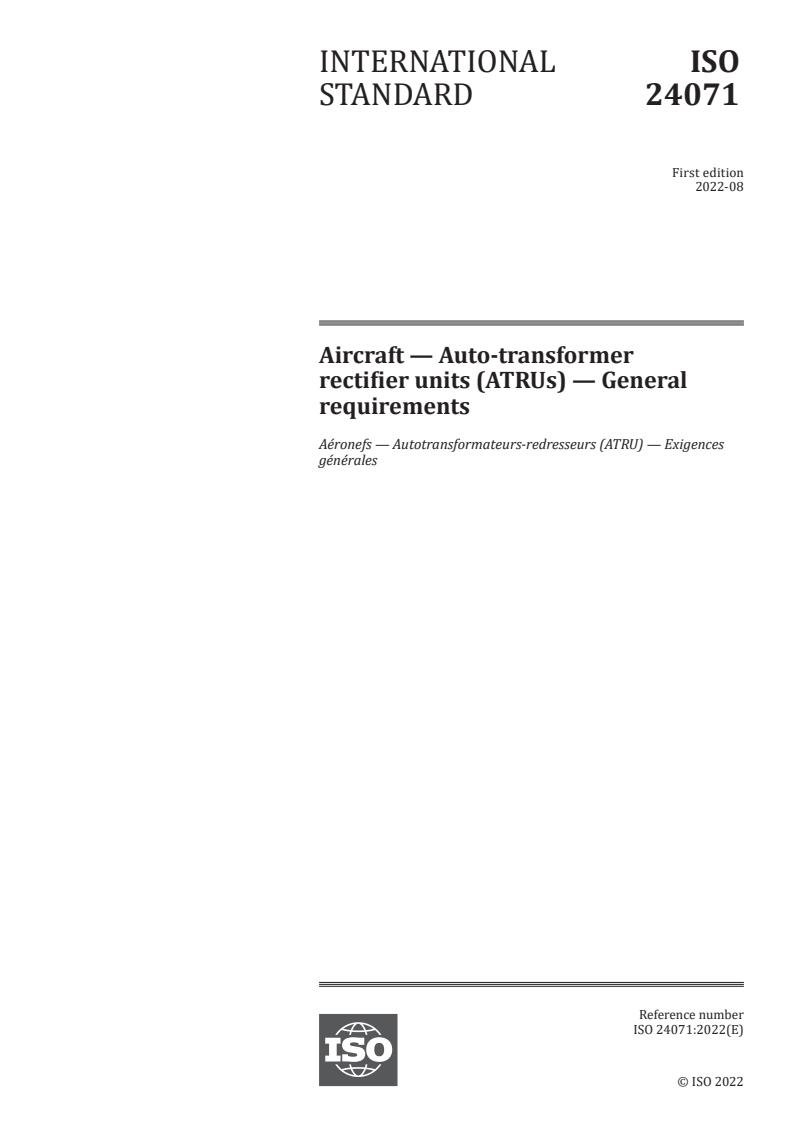
INTERNATIONAL ISO
STANDARD 24071
First edition
2022-08
Aircraft — Auto-transformer
rectifier units (ATRUs) — General
requirements
Aéronefs — Autotransformateurs-redresseurs (ATRU) — Exigences
générales
Reference number
© ISO 2022
All rights reserved. Unless otherwise specified, or required in the context of its implementation, no part of this publication may
be reproduced or utilized otherwise in any form or by any means, electronic or mechanical, including photocopying, or posting on
the internet or an intranet, without prior written permission. Permission can be requested from either ISO at the address below
or ISO’s member body in the country of the requester.
ISO copyright office
CP 401 • Ch. de Blandonnet 8
CH-1214 Vernier, Geneva
Phone: +41 22 749 01 11
Email: copyright@iso.org
Website: www.iso.org
Published in Switzerland
ii
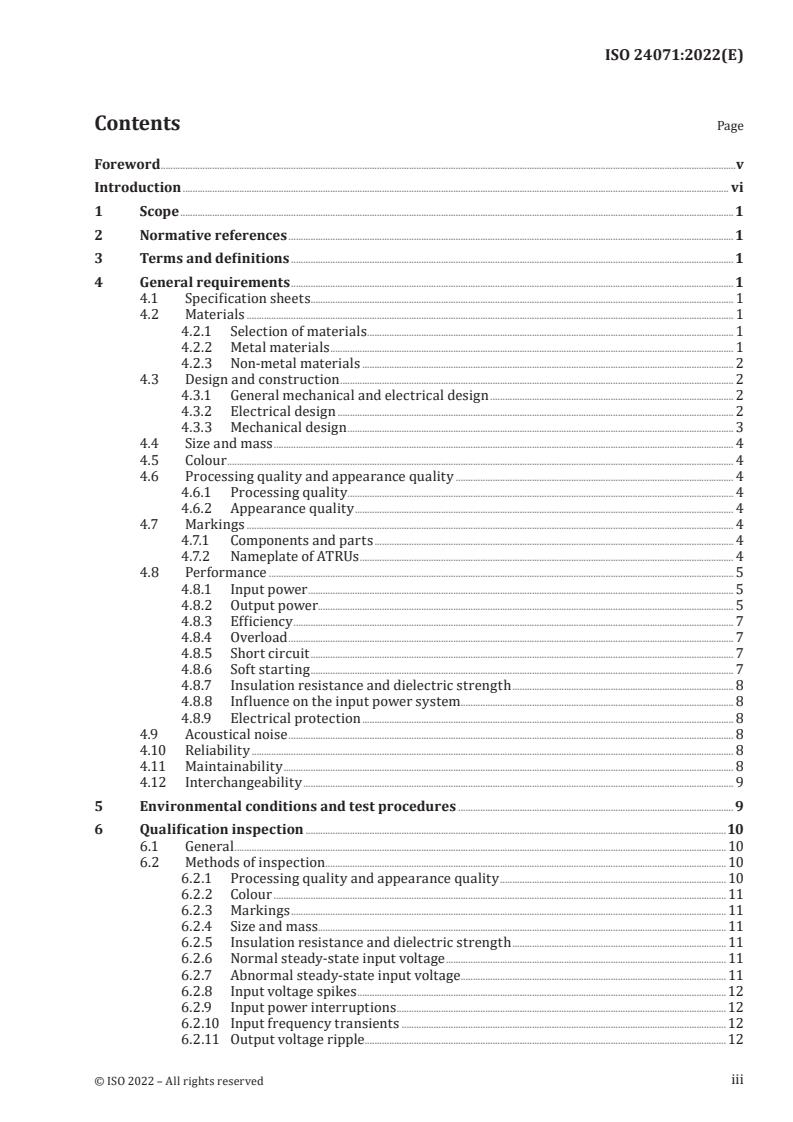
Contents Page
Foreword .v
Introduction . vi
1 S c op e . 1
2 N ormative references . 1
3 T erms and definitions . 1
4 G eneral requirements . 1
4.1 Specification sheets . . 1
4.2 M aterials . 1
4.2.1 S election of materials . 1
4.2.2 M etal materials . 1
4.2.3 N on-metal materials . 2
4.3 D esign and construction . 2
4.3.1 General mechanical and electrical design . 2
4.3.2 E lectrical design . 2
4.3.3 Mechanical design . 3
4.4 S ize and mass . 4
4 . 5 C olou r . 4
4.6 P rocessing quality and appearance quality . 4
4.6.1 Processing quality . . 4
4.6.2 A ppearance quality . 4
4.7 M arkings . 4
4.7.1 C omponents and parts . 4
4.7.2 N ameplate of ATRUs . 4
4.8 Performance . 5
4 . 8 .1 I nput p ower . 5
4 . 8 . 2 O ut put p ower . 5
4.8.3 Efficiency . 7
4.8.4 Overload . 7
4 . 8 . 5 S hor t c i r c u it . 7
4.8.6 Soft starting . 7
4.8.7 Insulation resistance and dielectric strength . 8
4.8.8 I nfluence on the input power system. 8
4.8.9 E lectrical protection . 8
4.9 A coustical noise . 8
4.10 R eliability . 8
4.11 M aintainability . 8
4.12 Interchangeability . 9
5 E nvironmental conditions and test procedures . 9
6 Qualification inspection .10
6.1 General . 10
6.2 M ethods of inspection . 10
6.2.1 P rocessing quality and appearance quality . 10
6 . 2 . 2 C olou r . 11
6.2.3 M arkings . 11
6.2.4 S ize and mass. 11
6.2.5 I nsulation resistance and dielectric strength . 11
6.2.6 N ormal steady-state input voltage . 11
6.2.7 A bnormal steady-state input voltage . 11
6.2.8 I nput voltage spikes .12
6.2.9 I nput power interruptions .12
6.2.10 I nput frequency transients .12
6.2.11 Output voltage ripple .12
iii
6.2.12 Output voltage frequency characteristics .12
6.2.13 Output voltage distortion factor .12
6.2.14 Output voltage transients.12
6.2.15 Output power interruptions. 13
6.2.16 Efficiency . 13
6.2.17 Overload .13
6 . 2 .18 S hor t c i r c u it . 13
6.2.19 Soft starting . 13
6.2.20 Influence on the input power system. 13
6.2.21 E lectrical protection . 13
6.2.22 A coustical noise . . 13
6.2.23 Reliability . 13
6.2.24 Maintainability . 14
6.2.25 Interchangeability . 14
iv
Foreword
ISO (the International Organization for Standardization) is a worldwide federation of national standards
bodies (ISO member bodies). The work of preparing International Standards is normally carried out
through ISO technical committees. Each member body interested in a subject for which a technical
committee has been established has the right to be represented on that committee. International
organizations, governmental and non-governmental, in liaison with ISO, also take part in the work.
ISO collaborates closely with the International Electrotechnical Commission (IEC) on all matters of
electrotechnical standardization.
The procedures used to develop this document and those intended for its further maintenance are
described in the ISO/IEC Directives, Part 1. In particular, the different approval criteria needed for the
different types of ISO documents should be noted. This document was drafted in accordance with the
editorial rules of the ISO/IEC Directives, Part 2 (see www.iso.org/directives).
Attention is drawn to the possibility that some of the elements of this document may be the subject of
patent rights. ISO shall not be held responsible for identifying any or all such patent rights. Details of
any patent rights identified during the development of the document will be in the Introduction and/or
on the ISO list of patent declarations received (see www.iso.org/patents).
Any trade name used in this document is information given for the convenience of users and does not
constitute an endorsement.
For an explanation of the voluntary nature of standards, the meaning of ISO specific terms and
expressions related to conformity assessment, as well as information about ISO’s adherence to
the World Trade Organization (WTO) principles in the Technical Barriers to Trade (TBT), see
www.iso.org/iso/foreword.html.
This document was prepared by Technical Committee ISO/TC 20, Aircraft and space vehicles,
Subcommittee SC 1, Aerospace electrical requirements.
Any feedback or questions on this document should be directed to the user’s national standards body. A
complete listing of these bodies can be found at www.iso.org/members.html.
v
Introduction
This document provides general requirements for auto-transformer rectifier units (ATRUs) installed in
aircrafts.
ATRUs can convert electrical power from alternating current (AC) to direct current (DC) by using
multipulse phase shifting auto-transformers to provide cancellation of certain harmonic currents.
ATRUs have been shown to be the most cost-effective harmonic solution in aviation industry with
minimum mass, simpler structure and higher reliability, compared with conventional harmonic
suppression devices. ATRUs are emerging among aircraft application, especially in more electrical
aircraft and all electrical aircraft power supply system.
There are no International Standards on ATRUs, and standardization is needed for aircraft electrical
systems. This document provides the basis for manufacturers and users that develop and utilize ATRUs
installed in aircrafts.
vi
INTERNATIONAL STANDARD ISO 24071:2022(E)
Aircraft — Auto-transformer rectifier units (ATRUs) —
General requirements
1 S cope
This document specifies the general requirements and test methods for auto-transformer rectifier
units (ATRUs) for use in aircraft electrical systems.
This document is mainly applicable to ATRUs of 18-pulse and 24-pulse types.
2 Normat ive references
The following documents are referred to in the text in such a way that some or all of their content
constitutes requirements of this document. For dated references, only the edition cited applies. For
undated references, the latest edition of the referenced document (including any amendments) applies.
ISO 1540:2006, Aerospace — Characteristics of aircraft electrical systems
ISO 7137:1995, Aircraft — Environmental conditions and test procedures for airborne equipment
3 T erms and definitions
For the purposes of this document, the terms and definitions given in ISO 1540 and ISO 7137 apply.
ISO and IEC maintain terminology databases for use in standardization at the following addresses:
— ISO Online browsing platform: available at https:// www .iso .org/ obp
— IEC Electropedia: available at https:// www .electropedia .org/
4 Gener al requirements
4.1 Specification sheet s
The individual item requirements shall be as specified in an applicable specification sheet. In the event
of any conflict between the requirements of this document and the specification sheet, the latter shall
govern.
4.2 Mat erials
4.2.1 Selection of materials
The materials used shall enable the ATRU to meet all of the operational and environmental performance
requirements of this document and the applicable specification sheet.
The materials used shall pass the requested certification in accordance with the applicable specification
sheet.
4.2.2 Metal materials
All metals used in ATRUs construction shall be processed and protected to resist corrosion. The use of
magnesium is prohibited unless specifically approved for each application by the qualifying activity.
Dissimilar metals should not be used in intimate contact with each other. If really necessary to be
used in contact with each other, dissimilar metals shall be protected against electrolytic corrosion in
accordance with the applicable specification sheet.
4.2.3 Non-metal materials
Non-metal materials, including plastics, ceramics, fabrics, and protective finishes, shall:
— be moisture-resistant;
— be fungus-proofing;
— be resistant for salt spray environment;
— be flame-resistant;
— not support combustion;
— be non-toxic when exposed to flame as well as when used under all operating and environmental
conditions herein.
4.3 Design and c onstruction
4.3.1 General mechanical and electrical design
The ATRU shall be constructed with parts and materials to provide the specified performance,
reliability and service life under all environmental and operating conditions specified herein. Dielectrics
used for electrical isolation shall be adequate to prevent breakdown under all specified environmental
conditions for the life of the equipment.
4.3.2 Electrical design
4.3.2.1 Derating design
Derating shall be implemented for the ATRU design by reducing the level of stress for components used
in the ATRU, including electrical, thermal and mechanical stresses on components.
4.3.2.2 Electric connections
Electric connections of the ATRU, including terminals, connectors and wires, shall be designed to give
protection against short-circuit, reverse polarity, incorrect installation, electrical contact with people
or other unrelated conductors, and to conform with the following requirements.
a) Electrical wiring shall be neat and stable, meeting the requirements of the applicable specification
sheet.
b) Where terminals are used for connection to the ATRU, they shall be of the stud-type and shall be so
designed that the current is conducted by means of surface-to-surface contact, and not through the
stud threads. All studs shall be steel and corrosion-resistant.
c) The mark and preventative measures of incorrect wiring shall be provided in electrical connection
of the ATRU.
d) Grounding shall be designed to metallic shell surfaces of the ATRU according to the requirements of
the applicable specification sheet.
e) The equipment structure shall not be used as a current path except for electromagnetic (radio
noise) shielding.
f) The terminal block shall be so designed that it can be removed and replaced on the ATRU without
the necessity of rebrazing or soldering. Barriers affording a positive separation of leads and
terminals shall be provided on the terminal block. Durable, reusable and non-conductive terminal
covers shall be provided. Terminal designations shall be durably, legibly and prominently marked
on the terminal block.
4.3.2.3 Adjustments
No adjustments or alignments shall be required during installation or during the life of the ATRU.
4.3.2.4 Static dischar ge protection and control
The ATRU shall be designed to provide static discharge protection for electronic devices during
assembly and handling. Static discharge protection and control shall conform to the applicable
specification sheet.
4.3.3 Mechanical design
4.3.3.1 S crew thread standard
Screw threads of mechanical connections and fasteners in the ATRU shall conform to the requirements
of the applicable specification sheet.
4.3.3.2 Loosening pr evention
Effective anti-loosening measures should be taken for fasteners, such as stud bolts and nuts, used in the
ATRU.
4.3.3.3 V entilation openings
All ventilation openings shall be designed to prevent passage of foreign objects. Their structural form
and size shall conform to the requirements of the applicable specification sheet.
4.3.3.4 Oper ating position
The ATRU shall operate in any position, unless otherwise specified in the applicable specification sheet.
4.3.3.5 Assembl y and disassembly
The ATRU shall be assembled and disassembled with bolts and nuts, unless otherwise specified in the
applicable specification sheet.
4.3.3.6 C ooling
4.3.3.6.1 Natur al cooling
The ATRU is cooled by modular h
...
Questions, Comments and Discussion
Ask us and Technical Secretary will try to provide an answer. You can facilitate discussion about the standard in here.
Loading comments...