


ISO/TR 8713:2019
(Main)Electrically propelled road vehicles — Vocabulary
Electrically propelled road vehicles — Vocabulary
This document establishes a vocabulary of terms and the related definitions used in ISO/TC 22/SC 37 standards.
Véhicules routiers électriques — Vocabulaire
General Information
- Status
- Published
- Publication Date
- 31-Mar-2019
- Technical Committee
- ISO/TC 22/SC 37 - Electrically propelled vehicles
- Drafting Committee
- ISO/TC 22/SC 37 - Electrically propelled vehicles
- Current Stage
- 9093 - International Standard confirmed
- Start Date
- 17-Jan-2025
- Completion Date
- 14-Feb-2026
Relations
- Effective Date
- 28-May-2016
Overview
ISO/TR 8713:2019 - Electrically Propelled Road Vehicles - Vocabulary is an internationally recognized terminology standard published by ISO. Developed by Technical Committee ISO/TC 22/SC 37, this technical report defines and harmonizes the vocabulary related to electrically propelled road vehicles. By establishing uniform terms and definitions, ISO/TR 8713:2019 supports clear communication and consistent interpretation across ISO standards in the field of electric mobility, including hybrid vehicles, battery systems, charging technologies, and safety aspects. This vocabulary is essential for manufacturers, regulatory bodies, researchers, and anyone involved in the development and implementation of electric vehicle (EV) technologies.
Key Topics
ISO/TR 8713:2019 covers a comprehensive range of concepts central to electrically propelled road vehicles and their sub-systems, including:
Vehicle Types and Configurations
- Electrically propelled vehicles (EVs)
- Hybrid electric vehicles (HEVs), plug-in hybrid vehicles (PHEVs), and fuel cell vehicles (FCVs)
- Vehicle classifications by use (bus, truck, etc.)
Electric Propulsion Components
- Battery systems, battery packs, and battery control units (BCU)
- Electric drives, energy storage devices, fuel cell systems
Charging and Energy Transfer
- Supply equipment, charging modes and cases
- Wireless power transfer (MF-WPT) systems and components
- Communication between vehicles and charging infrastructure (EVCC, SECC)
Safety and Protection
- Basic and double insulation, direct and indirect contact
- Isolation resistance, fault protection, equipotential bonding
- Hazardous live parts and protection measures
Performance and Measurement
- Acceleration, hill starting ability, maximum speed
- Energy efficiency, energy density, charge balance
- Test methods and relevant measurement parameters
Applications
The ISO/TR 8713:2019 standard is used extensively across the international EV industry for:
- Standardization Alignment: Ensuring that all ISO/TC 22/SC 37 standards and related documents use consistent terminology, reducing ambiguity and supporting regulatory compliance.
- Product Development: Guiding automotive engineers and designers in specifying components, system interfaces, and safety features for electric vehicles and related infrastructure.
- Documentation & Communication: Assisting manufacturers, suppliers, and policymakers in preparing manuals, technical documents, and regulatory submissions using harmonized vocabulary.
- Testing & Certification: Supporting laboratories and conformity assessment bodies with clear definitions for tests and evaluation criteria.
- Research & Education: Facilitating academic research and technical training in electric vehicle technologies through the use of standardized terms.
- International Trade: Removing language barriers and enabling seamless global collaboration and market access for EV products.
Related Standards
ISO/TR 8713:2019 is used in conjunction with, and refers to, numerous ISO and IEC standards to cover the full scope of electrically propelled vehicle technology. Notable related standards include:
- ISO 6469 series – Safety specifications for electric vehicles
- ISO 12405 series – Testing of lithium-ion traction battery packs and systems
- ISO 17409 – Requirements for electric and hybrid vehicle conductive charging
- ISO 23274 series – Measurement methods for energy consumption of hybrid vehicles
- ISO/PAS 19363 – Safety requirements for wireless power transfer
- IEC 61980 series – Wireless charging systems for electric vehicles
- ISO 20653 – Degree of protection (IP code)
- ISO 15118 – Vehicle to grid communication interface
Key Benefits
- Consistency: Promotes a unified understanding of terms, leading to clarity in global standards, technical documents, and commercial agreements.
- Efficiency: Accelerates product development and compliance processes by providing a definitive reference for terminology.
- Safety: Ensures that all stakeholders share a common language for critical safety concepts and practices in electric mobility.
Follow ISO/TR 8713:2019 to ensure your work in the field of electric vehicles aligns with the latest international vocabulary standards.
Buy Documents


ISO/TR 8713:2019 - Electrically propelled road vehicles -- Vocabulary
ISO/TR 8713:2019 - Electrically propelled road vehicles — Vocabulary/1/2019
Get Certified
Connect with accredited certification bodies for this standard

TÜV Rheinland
TÜV Rheinland is a leading international provider of technical services.

TÜV SÜD
TÜV SÜD is a trusted partner of choice for safety, security and sustainability solutions.

DEKRA Certification Inc.
DEKRA US certification services.
Sponsored listings
Frequently Asked Questions
ISO/TR 8713:2019 is a technical report published by the International Organization for Standardization (ISO). Its full title is "Electrically propelled road vehicles — Vocabulary". This standard covers: This document establishes a vocabulary of terms and the related definitions used in ISO/TC 22/SC 37 standards.
This document establishes a vocabulary of terms and the related definitions used in ISO/TC 22/SC 37 standards.
ISO/TR 8713:2019 is classified under the following ICS (International Classification for Standards) categories: 01.040.43 - Road vehicle engineering (Vocabularies); 43.120 - Electric road vehicles. The ICS classification helps identify the subject area and facilitates finding related standards.
ISO/TR 8713:2019 has the following relationships with other standards: It is inter standard links to ISO/TR 8713:2012. Understanding these relationships helps ensure you are using the most current and applicable version of the standard.
ISO/TR 8713:2019 is available in PDF format for immediate download after purchase. The document can be added to your cart and obtained through the secure checkout process. Digital delivery ensures instant access to the complete standard document.
Standards Content (Sample)
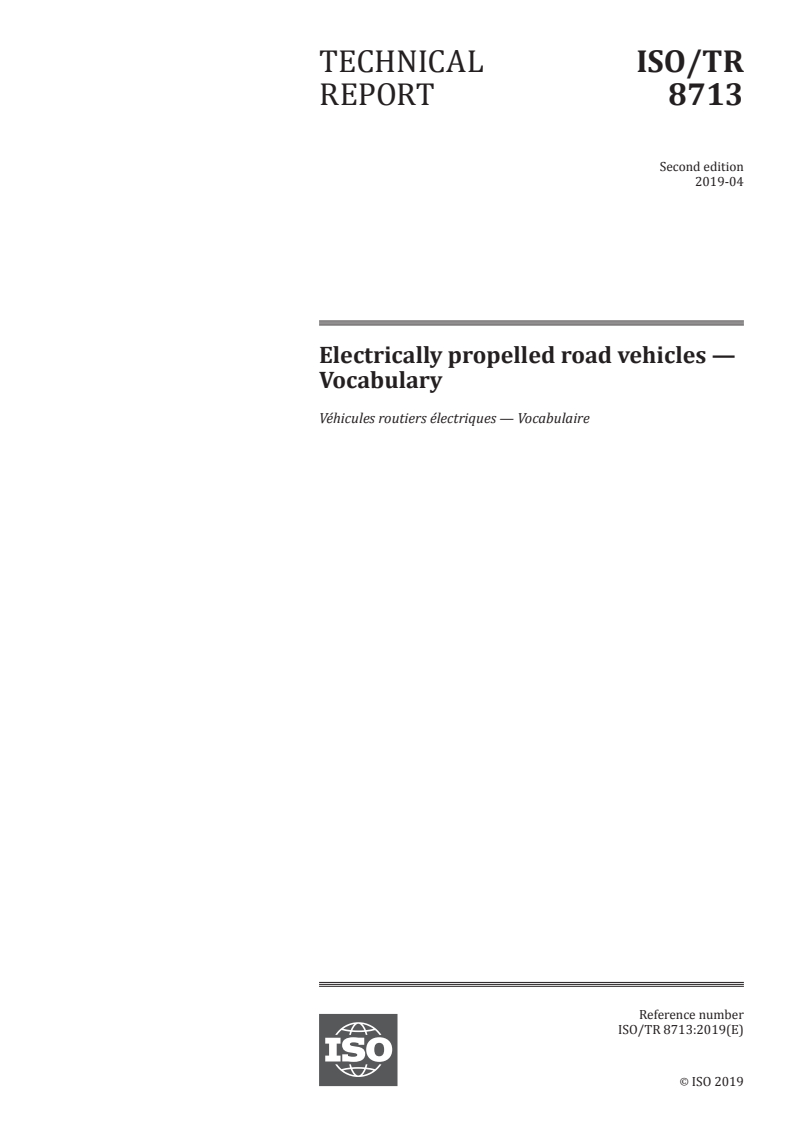
TECHNICAL ISO/TR
REPORT 8713
Second edition
2019-04
Electrically propelled road vehicles —
Vocabulary
Véhicules routiers électriques — Vocabulaire
Reference number
©
ISO 2019
© ISO 2019
All rights reserved. Unless otherwise specified, or required in the context of its implementation, no part of this publication may
be reproduced or utilized otherwise in any form or by any means, electronic or mechanical, including photocopying, or posting
on the internet or an intranet, without prior written permission. Permission can be requested from either ISO at the address
below or ISO’s member body in the country of the requester.
ISO copyright office
CP 401 • Ch. de Blandonnet 8
CH-1214 Vernier, Geneva
Phone: +41 22 749 01 11
Fax: +41 22 749 09 47
Email: copyright@iso.org
Website: www.iso.org
Published in Switzerland
ii © ISO 2019 – All rights reserved
Contents Page
Foreword .iv
Introduction .v
1 Scope . 1
2 Normative references . 1
3 Terms and definitions . 1
4 Abbreviations.25
Annex A (informative) Topic specific list .27
Bibliography .37
Foreword
ISO (the International Organization for Standardization) is a worldwide federation of national standards
bodies (ISO member bodies). The work of preparing International Standards is normally carried out
through ISO technical committees. Each member body interested in a subject for which a technical
committee has been established has the right to be represented on that committee. International
organizations, governmental and non-governmental, in liaison with ISO, also take part in the work.
ISO collaborates closely with the International Electrotechnical Commission (IEC) on all matters of
electrotechnical standardization.
The procedures used to develop this document and those intended for its further maintenance are
described in the ISO/IEC Directives, Part 1. In particular, the different approval criteria needed for the
different types of ISO documents should be noted. This document was drafted in accordance with the
editorial rules of the ISO/IEC Directives, Part 2 (see www .iso .org/directives).
Attention is drawn to the possibility that some of the elements of this document may be the subject of
patent rights. ISO shall not be held responsible for identifying any or all such patent rights. Details of
any patent rights identified during the development of the document will be in the Introduction and/or
on the ISO list of patent declarations received (see www .iso .org/patents).
Any trade name used in this document is information given for the convenience of users and does not
constitute an endorsement.
For an explanation of the voluntary nature of standards, the meaning of ISO specific terms and
expressions related to conformity assessment, as well as information about ISO's adherence to the
World Trade Organization (WTO) principles in the Technical Barriers to Trade (TBT) see www .iso
.org/iso/foreword .html.
This document was prepared by Technical Committee ISO/TC 22 Road vehicles, Subcommittee SC 37
Electrically propelled road vehicles.
This edition of ISO/TR 8713 cancels and replaces the first edition (ISO 8713:2012), which has been
technically revised and includes the following main changes:
— addition of all terms and definitions from ISO/TC 22/SC 37 standards;
— addition of source information for terms/definitions not developed in ISO/TC 22/SC 37;
— provision of information on standards using the relevant term and defining a master;
— adaptation of structure to the ISO/IEC Directives Part 2, 2016 edition;
— provision of a list of abbreviations used in this document.
Any feedback or questions on this document should be directed to the user’s national standards body. A
complete listing of these bodies can be found at www .iso .org/members .html.
iv © ISO 2019 – All rights reserved
Introduction
This document establishes a vocabulary of terms and the related definitions used in ISO standards for
electrically propelled road vehicles.
It provides support for the development of new standards and for the review of existing standards.
This document lists terms as defined in ISO/TC 22/SC 37 publications. For each term, the master
publication is assigned based on an ISO/TC 22/SC 37 decision. Other publications of ISO TC 22/SC 37
may contain definitions for those terms as well. This document replicates the definition for the term
from the master publication without any change. The master publication and the other publications are
listed with each term.
ISO/TC 22/SC 37 decided that project leaders of projects using the term should align themselves with
the content of the definition under the leadership of the project leader from the master publication.
ISO/TC 22/SC 37 prioritizes a consistent use of definitions for terms.
The terms and definitions are listed in alphabetical order. A topic specific list is given in Annex A.
TECHNICAL REPORT ISO/TR 8713:2019(E)
Electrically propelled road vehicles — Vocabulary
1 Scope
This document establishes a vocabulary of terms and the related definitions used in ISO/TC 22/SC 37
standards.
2 Normative references
There are no normative references in this document.
3 Terms and definitions
ISO and IEC maintain terminological databases for use in standardization at the following addresses:
— IEC Electropedia available at http: //www .electropedia .org/
— ISO Online browsing platform: available at https: //www .iso .org/obp
3.1
acceleration ability (v1 to v2)
shortest time required to accelerate the vehicle from speed v1 to speed v2
Note 1 to entry: Master publication in ISO/TC 22/SC 37: ISO 8715:2001.
3.2
alignment
relative position of primary to secondary device
Note 1 to entry: Master publication in ISO/TC 22/SC 37: ISO/PAS 19363:2017.
3.3
alignment check
confirmation that the primary and secondary devices are properly positioned relative to each other
Note 1 to entry: Proper positioning is done to assure sufficient system functionality (e.g. system efficiency, EMF/
EMC limits, safety requirements etc.).
[SOURCE: IEC 61980-2]
Note 2 to entry: Master publication in ISO/TC 22/SC 37: ISO/PAS 19363:2017.
3.4
applicable driving test
ADT
single driving test schedule which is specified for each region
EXAMPLE Chassis dynamometer test cycle for light-duty vehicles in Japan (JC08), New European Driving
Cycle (NEDC), Urban Dynamometer Driving Schedule (UDDS).
Note 1 to entry: Master publication in ISO/TC 22/SC 37: ISO 23274-2:2012, also defined in ISO 23274-1:2013 and
ISO 23828:2013.
3.5
auxiliary electric system
vehicle system, other than for vehicle propulsion, that operates on electric energy
Note 1 to entry: Master publication in ISO/TC 22/SC 37: ISO 6469-3:2018, also defined in ISO 6469-2:2018 and
ISO 6469-4:2015.
3.6
balance of electric circuit
remaining section of an electric circuit when all electric power sources that are energized (RESS and
fuel cell stacks) are disconnected
Note 1 to entry: Master publication in ISO/TC 22/SC 37: ISO 6469-3:2018, also defined in ISO 17409:2015.
3.7
basic insulation
insulation of hazardous live parts which provides basic protection
Note 1 to entry: This concept does not apply to insulation used exclusively for functional purposes.
Note 2 to entry: Where insulation is not provided by solid insulation only, it is complemented with protective
barriers or protective enclosures to prevent access to live parts in order to achieve basic protection.
[SOURCE: IEC 60050-195:1998, 195-06-06, modified — “hazardous-live-parts” written as “hazardous
live parts”]
Note 3 to entry: Master publication in ISO/TC 22/SC 37: ISO 6469-3:2018, also defined in ISO 17409:2015 and
ISO/PAS 19363:2017.
3.8
basic protection
protection against electric shock under fault-free conditions
[SOURCE: IEC 60050-195:1998, 195-06-01]
Note 1 to entry: Master publication in ISO/TC 22/SC 37: ISO 6469-3:2018.
3.9
battery control unit
BCU
electronic device that controls, manages, detects or calculates electric and thermal functions of
the battery system and that provides communication between the battery system and other vehicle
controllers
Note 1 to entry: Master publication in ISO/TC 22/SC 37: ISO 12405-4:2018.
3.10
battery pack
energy storage device that includes cells or cell assemblies normally connected with cell electronics,
power supply circuits and overcurrent shut-off device, including electrical interconnections, interfaces
for external systems
Note 1 to entry: Examples of external systems are cooling, voltage class B, auxiliary voltage class A and
communication.
Note 2 to entry: Master publication in ISO/TC 22/SC 37: ISO 12405-4:2018.
3.11
battery system
energy storage device that includes cells or cell assemblies or battery pack(s) as well as electrical
circuits and electronics
Note 1 to entry: Battery system components can also be distributed in different devices within the vehicle.
2 © ISO 2019 – All rights reserved
Note 2 to entry: Examples of electronics are the BCU and contactors.
Note 3 to entry: Master publication in ISO/TC 22/SC 37: ISO 12405-4:2018, also defined in ISO/PAS 19363:2017.
3.12
bus
vehicle designed and constructed for the carriage of passengers, comprising more than eight seats in
addition to the driver's seat, and having a maximum mass exceeding 5 t
1)
Note 1 to entry: Master publication in ISO/TC 22/SC 37: ISO 6469-1:— .
3.13
capacity
total number of ampere-hours that can be withdrawn from a fully charged RESS under specified
conditions
2)
Note 1 to entry: Master publication in ISO/TC 22/SC 37: ISO 6469-1:— , also defined in ISO 12405-4:2018.
3.14
case A
connection of an EV to the a.c. supply network (mains) utilizing a supply cable and plug permanently
attached to the EV
Note 1 to entry: Master publication in ISO/TC 22/SC 37: ISO 17409:2015, also defined in ISO 6469-2:2018.
3.15
case B
connection of an EV to the a.c. supply network (mains) utilizing a detachable cable assembly with a
vehicle connector and a.c. EV supply equipment
Note 1 to entry: Master publication in ISO/TC 22/SC 37: ISO 17409:2015, also defined in ISO 6469-2:2018.
3.16
case C
connection of an EV to the a.c. supply network (mains) utilizing a supply cable and vehicle connector
permanently attached to the EV supply equipment
Note 1 to entry: Only case C is applicable for mode 4 (see IEC 61851–1).
Note 2 to entry: Master publication in ISO/TC 22/SC 37: ISO 17409:2015, also defined in ISO 6469-2:2018.
3.17
cell electronics
electronic device that collects and possibly monitors thermal or electric data of cells or cell assemblies
and contains electronics for cell balancing, if necessary
Note 1 to entry: The cell electronics can include a cell controller. The functionality of cell balancing can be
controlled by the cell electronics or by the BCU.
Note 2 to entry: Master publication in ISO/TC 22/SC 37: ISO 12405-4:2018.
3.18
charge balance of RESS
change of charge in RESS during fuel consumption measurement
Note 1 to entry: Normally expressed in ampere hours (Ah).
Note 2 to entry: Master publication in ISO/TC 22/SC 37: ISO 23274-2:2012, also defined in ISO 23274-1:2013,
ISO 23828:2013 and ISO/TR 11955.
1) Under preparation. Stage at the time of publication: ISO/FDIS 6469-1:2019.
2) Under preparation. Stage at the time of publication: ISO/FDIS 6469-1:2019.
3.19
charge-depleting state
CD state
operating mode of a HEV with ICE in which the vehicle runs by consuming mainly the electric energy
from the stationary external power source or along with the fuel energy simultaneously or sequentially
until CS state
Note 1 to entry: Master publication in ISO/TC 22/SC 37: ISO 23274-2:2012.
3.20
charger
power converter at the vehicle power supply circuit which supplies electric power, e.g. for charging a RESS
Note 1 to entry: Master publication in ISO/TC 22/SC 37: ISO 17409:2015.
3.21
charge-sustaining state
CS state
operating mode where the HEV runs by consuming the fuel energy while sustaining the electric energy
of the RESS
Note 1 to entry: Master publication in ISO/TC 22/SC 37: ISO 23274-2:2012.
3.22
clearance
shortest distance in air between two conductive parts
Note 1 to entry: This distance applies only to parts that are exposed to the atmosphere and not to parts which
are isolated or covered with coating compound.
[SOURCE: IEC 60664-1:2007, 3.2]
3)
Note 2 to entry: Master publication in ISO/TC 22/SC 37: ISO 6469-3:2018, also defined in ISO 6469-1:— .
3.23
complete vehicle kerb mass
mass of the vehicle including batteries, without occupants but with fuel, cooling liquid, window washer
fluid, lubricating oil, tools and spare wheel, on-board charger, portable charger or part of it, if provided
as standard equipment by the vehicle manufacturer
[SOURCE: ISO 1176]
Note 1 to entry: Master publication in ISO/TC 22/SC 37: ISO 8715:2001, also defined in ISO 8714:2002.
3.24
component operating status
describes the general functional behaviour of components which depend directly on the voltage in
voltage class B electric circuit
Note 1 to entry: Master publication in ISO/TC 22/SC 37: ISO/PAS 19295:2016.
3.25
conductive part
part which can carry electric current
[SOURCE: IEC 60050-195:1998, 195-01-06]
4)
Note 1 to entry: Master publication in ISO/TC 22/SC 37: ISO 6469-3:2018, also defined in ISO 6469-1:— ,
ISO 6469-4:2015 and ISO 17409:2015.
3) Under preparation. Stage at the time of publication: ISO/FDIS 6469-1:2019.
4) Under preparation. Stage at the time of publication: ISO/FDIS 6469-1:2019.
4 © ISO 2019 – All rights reserved
3.26
conductively connected circuit
two electric circuits considered conductively connected unless they are separated by at least basic
insulation
Note 1 to entry: Master publication in ISO/TC 22/SC 37: ISO 6469-3:2018.
3.27
control pilot circuit
circuit designed for the transmission of signals and/or communication between an EV and an EV supply
equipment
Note 1 to entry: Master publication in ISO/TC 22/SC 37: ISO 17409:2015.
3.28
control pilot conductor
insulated conductor incorporated in an EV cable assembly that creates, together with the protective
conductor, the control pilot circuit
Note 1 to entry: Master publication in ISO/TC 22/SC 37: ISO 17409:2015.
3.29
control pilot function
functionality used to monitor and control the interaction between the electric vehicle and the supply
equipment
Note 1 to entry: Master publication in ISO/TC 22/SC 37: ISO 17409:2015.
3.30
coulomb efficiency
Ah efficiency
efficiency of the battery, based on electricity (in coulomb) for a specified charge/discharge procedure,
expressed by output electricity divided by input electricity
Note 1 to entry: Master publication in ISO/TC 22/SC 37: ISO/TR 11955.
3.31
customer
party that is interested in using voltage class B component or system
Note 1 to entry: Master publication in ISO/TC 22/SC 37: ISO/PAS 19295:2016.
party that is interested in using the RESS or RESS subsystem and therefore, orders or performs the test
EXAMPLE A vehicle manufacturer.
5)
Note 2 to entry: Master publication in ISO/TC 22/SC 37: ISO 6469-1:— .
3.32
creepage distance
shortest distance along the surface of a solid insulating material between two conductive parts
[SOURCE: IEC 60050-151:2001/AMD1: 2013, 151-15-50]
6)
Note 1 to entry: Master publication in ISO/TC 22/SC 37: ISO 6469-3:2018, also defined in ISO 6469-1:— .
5) Under preparation. Stage at the time of publication: ISO/FDIS 6469-1:2019.
6) Under preparation. Stage at the time of publication: ISO/FDIS 6469-1:2019.
3.33
d.c. EV charging station
EV supply equipment intended to supply d.c. current to an EV
Note 1 to entry: Master publication in ISO/TC 22/SC 37: ISO 17409:2015.
3.34
degree of protection
IP
protection provided by an enclosure against access, foreign objects and/or water and verified by
standardized test methods in accordance with ISO 20653
[SOURCE: ISO 20653, modified — “in accordance with ISO 20653” added]
Note 1 to entry: Master publication in ISO/TC 22/SC 37: ISO 6469-3:2018.
3.35
direct contact
electric contact of persons or animals with live parts
[SOURCE: IEC 60050-195:1998, 195-06-03]
Note 1 to entry: Master publication in ISO/TC 22/SC 37: ISO 6469-3:2018, also defined in ISO 6469-4:2015 and
ISO 17409:2015.
3.36
displacement power factor
power factor due to the phase shift between voltage and current at the fundamental line frequency
Note 1 to entry: Master publication in ISO/TC 22/SC 37: ISO 17409:2015.
3.37
distortion power factor
th
product of the displacement power factor and the total harmonic distortion up to the 40 harmonics of
the load current
Note 1 to entry: Master publication in ISO/TC 22/SC 37: ISO 17409:2015.
3.38
double insulation
insulation comprising both basic insulation and supplementary insulation
[SOURCE: IEC 60050-195:1998, 195-06-08]
Note 1 to entry: Master publication in ISO/TC 22/SC 37: ISO 6469-3:2018, also defined in ISO/PAS 19363:2017
and ISO 17409:2015.
3.39
driving-enabled mode
operating mode in which the vehicle can be moved by its own propulsion system by one action
Note 1 to entry: Examples for this action are: pressure to the accelerator pedal, activation of an equivalent
control, release of the brake system.
Note 2 to entry: Master publication in ISO/TC 22/SC 37: ISO 6469-2:2018.
3.40
dynamic loaded radius (tyre)
effective radius of a tyre when it is deformed by the mass of the vehicle loaded to its test mass
Note 1 to entry: Master publication in ISO/TC 22/SC 37: ISO 8715:2001.
6 © ISO 2019 – All rights reserved
3.41
electric chassis
conductive parts of a vehicle that are electrically connected and whose potential is taken as reference
7)
Note 1 to entry: Master publication in ISO/TC 22/SC 37: ISO 6469-3:2018, also defined in ISO 6469-1:— ,
ISO 6469-4:2015 and ISO 17409:2015.
3.42
electric circuit
entire set of interconnected live parts through which electrical current is designed to flow under
normal operating conditions
Note 1 to entry: Master publication in ISO/TC 22/SC 37: ISO/PAS 19295:2016.
3.43
electric drive
combination of an electric traction motor, power electronics and their associated controls for the
conversion of electric to mechanical power and vice versa
8)
Note 1 to entry: Master publication in ISO/TC 22/SC 37: ISO 6469-3:2018, also defined in ISO 6469-1:— ,
ISO 6469-2:2018, ISO 6469-4:2015 and ISO 12405-4:2018.
3.44
electric propulsion system maximum working voltage
highest value of d.c. voltage that can occur in an electric propulsion system under any normal operating
conditions according to the customer's specifications, disregarding transients
Note 1 to entry: Master publication in ISO/TC 22/SC 37: ISO/PAS 19295:2016.
3.45
electric shock
physiological effect resulting from an electric current through a human body or animal body
[SOURCE: IEC 60050-195:1998, 195-01-04]
Note 1 to entry: Master publication in ISO/TC 22/SC 37: ISO 6469-3:2018, also defined in ISO 6469-4:2015,
ISO 17409:2015 and ISO/PAS 19363:2017.
3.46
electrically propelled vehicle
EV
vehicle with one or more electric drive(s) for vehicle propulsion
9)
Note 1 to entry: Master publication in ISO/TC 22/SC 37: ISO 6469-3:2018, also defined in ISO 6469-1:— ,
ISO 6469-2:2018, ISO 6469-4:2015, ISO 12405-4:2018, ISO/PAS 19363:2017 and ISO 17409:2015
3.47
energized
qualifies a conductive part having an electric potential difference with respect to a relevant reference
[SOURCE: IEC 60050-151:2001/AMD1: 2013, 151-15-58, modified — Note deleted]
Note 1 to entry: Master publication in ISO/TC 22/SC 37: ISO 6469-3:2018.
7) Under preparation. Stage at the time of publication: ISO/FDIS 6469-1:2019.
8) Under preparation. Stage at the time of publication: ISO/FDIS 6469-1:2019.
9) Under preparation. Stage at the time of publication: ISO/FDIS 6469-1:2019.
3.48
energy balance of RESS
ΔE
RESS
change of RESS energy state during an applicable driving test
Note 1 to entry: Normally expressed in watt hours (Wh).
Note 2 to entry: For practical use, the energy balance of RESS is approximated by multiplying the charge balance
of battery in ampere hours (Ah) by the nominal voltage in volts (V).
Note 3 to entry: Master publication in ISO/TC 22/SC 37: ISO 23274-2:2012, also defined in ISO 23274-1:2013,
ISO 23828:2013 and ISO/TR 11955.
3.49
energy density
amount of stored energy related to the battery pack or system volume
Note 1 to entry: The battery pack or system includes the cooling system, if any, to the point of a reversible
attachment of the coolant lines or air ducts, respectively.
Note 2 to entry: Energy density is expressed in watt hours per litre (Wh/l).
Note 3 to entry: Master publication in ISO/TC 22/SC 37: ISO 12405-4:2018.
3.50
energy efficiency
Wh efficiency
efficiency of the battery, based on energy for a specified charge/discharge procedure, expressed by
output energy divided by input energy
Note 1 to entry: Master publication in ISO/TC 22/SC 37: ISO/TR 11955.
3.51
energy round trip efficiency
ratio of the net d.c. energy delivered by a DUT during a discharge test to the total d.c. energy required to
restore the initial SOC by a standard charge
Note 1 to entry: The net d.c. energy is expressed as watt hours (Wh) discharge and the total d.c. energy is
expressed as watt hours (Wh) charge.
Note 2 to entry: Master publication in ISO/TC 22/SC 37: ISO 12405-4:2018.
3.52
equipotential bonding
provision of electric connections between conductive parts, intended to achieve equipotentiality
[SOURCE: IEC 60050-195:1998, 195-01-10]
Note 1 to entry: Master publication in ISO/TC 22/SC 37: ISO 6469-3:2018.
3.53
EV communication controller
EVCC
embedded system, within the vehicle, that implements the communication between the vehicle and the
SECC in order to support specific functions
Note 1 to entry: Such specific functions could be e.g. controlling input and output channels, encryption, or data
transfer between vehicle and SECC.
[SOURCE: ISO 15118-1]
Note 2 to entry: Master publication in ISO/TC 22/SC 37: ISO/PAS 19363:2017.
8 © ISO 2019 – All rights reserved
3.54
EV device
on-board component assembly comprising the secondary device, the EV power electronics and all on-
board communication controllers, as well as the electrical and mechanical connections between the
assemblies
Note 1 to entry: Ancillary systems used for supporting the operation of MF-WPT are also included (e.g.
positioning).
Note 2 to entry: The hardware packaging of the assemblies is up to the discretion of the manufacturer.
Note 3 to entry: Master publication in ISO/TC 22/SC 37: ISO/PAS 19363:2017.
3.55
EV power circuit
EVPC
electrical component assembly that includes the secondary device and EV power electronics as well as
the mechanical connections between the components
Note 1 to entry: EVPC is here defined specifically for MF-WPT systems.
Note 2 to entry: Master publication in ISO/TC 22/SC 37: ISO/PAS 19363:2017.
3.56
EV power electronics
on-board component that converts the power and frequency needed for the output from the EVPC
Note 1 to entry: Master publication in ISO/TC 22/SC 37: ISO/PAS 19363:2017.
3.57
EV supply equipment
equipment or combined equipment providing dedicated functions for an electric power supply from
a fixed installation to an EV for the purpose of charging for all dedicated charging modes and cases of
connection
Note 1 to entry: Master publication in ISO/TC 22/SC 37: ISO 17409:2015.
3.58
EVPC power class
power class of an EVPC defined according to the MF-WPT input power class of the supply device it is
designed to operate
Note 1 to entry: The power delivered to the EV device will be less than that maximum MF-WPT input power to
the MF-WPT system due to losses e.g. in the supply power electronics and eddy currents in the MF-WPT shield or
the vehicle underbody.
Note 2 to entry: Master publication in ISO/TC 22/SC 37: ISO/PAS 19363:2017.
3.59
explosion
sudden release of energy sufficient to cause pressure waves and/or projectiles that may cause structural
and/or physical damage to the surrounding area
10)
Note 1 to entry: Master publication in ISO/TC 22/SC 37: ISO 6469-1:— .
10) Under preparation. Stage at the time of publication: ISO/FDIS 6469-1:2019.
3.60
exposed conductive part
conductive part of equipment which can be touched and which is not normally live, but which can
become live when basic insulation fails
Note 1 to entry: A conductive part of electrical equipment which can become live only through contact with an
exposed conductive part which has become live, is not considered to be an exposed conductive part itself.
[SOURCE: IEC 61140:2016, 3.6, modified — “exposed conductive part” replaces “exposed-conductive-part]
Note 2 to entry: Master publication in ISO/TC 22/SC 37: ISO 6469-3:2018, also defined in ISO 6469-4:2015 and
ISO 17409:2015.
3.61
external electric power supply
electric power source that is not part of the vehicle for supplying electric energy to an EV using an EV
supply equipment
Note 1 to entry: Master publication in ISO/TC 22/SC 37: ISO 17409:2015.
3.62
externally chargeable HEV
HEV with a rechargeable energy storage system (RESS) that is intended to be charged from an external
electric energy source
Note 1 to entry: External charge for conditioning of the RESS is not included.
Note 2 to entry: Externally chargeable HEVs are known as plug-in HEVs (PHEVs).
Note 3 to entry: Master publication in ISO/TC 22/SC 37: ISO 23274-2:2012.
3.63
fault protection
protection against electric shock under single-fault conditions
[SOURCE: IEC 60050-195:1998, 195-06-02]
Note 1 to entry: Master publication in ISO/TC 22/SC 37: ISO 6469-3:2018.
3.64
fine positioning
relative movement of the secondary device in relation to the primary device with the goal of reaching
optimal alignment
Note 1 to entry: Master publication in ISO/TC 22/SC 37: ISO/PAS 19363:2017.
3.65
flammable electrolyte
electrolyte having a flash point of not more than 93 °C
Note 1 to entry: The determination of flash point is based on ISO 2592.
11)
Note 2 to entry: Master publication in ISO/TC 22/SC 37: ISO 6469-1:— .
3.66
foreign object
any object that is not an attached part of the vehicle or the MF-WPT system
[SOURCE: IEC 61980-1]
Note 1 to entry: Master publication in ISO/TC 22/SC 37: ISO/PAS 19363:2017.
11) Under preparation. Stage at the time of publication: ISO/FDIS 6469-1:2019.
10 © ISO 2019 – All rights reserved
3.67
fuel cell hybrid electric vehicle operation mode
FCHEV operation mode
mode of an FCHEV in which both RESS and fuel cell system are used sequentially or simultaneously for
vehicle propulsion
Note 1 to entry: The fuel cell system can also charge the RESS during propulsion or standstill.
Note 2 to entry: Master publication in ISO/TC 22/SC 37: ISO/TR 11954:2008.
3.68
fuel cell hybrid electric vehicle
FCHEV
electrically propelled vehicle with a RESS and a fuel cell system as power sources for vehicle propulsion
Note 1 to entry: Master publication in ISO/TC 22/SC 37: ISO 23828:2013.
3.69
fuel cell stack
assembly of two or more fuel cells that are electrically connected
Note 1 to entry: Master publication in ISO/TC 22/SC 37: ISO 6469-3:2018, also defined in ISO 6469-2:2018.
3.70
fuel cell system
system, typically containing the following subsystems: fuel cell stack, air processing, fuel processing,
thermal management, water management, and their control
Note 1 to entry: Master publication in ISO/TC 22/SC 37: ISO 6469-3:2018, also defined in ISO 6469-2:2018.
3.71
fuel cell vehicle
FCV
electrically propelled vehicle with a fuel cell system as the power source for vehicle propulsion
Note 1 to entry: A FCV may also have a RESS or another power source for vehicle propulsion.
Note 2 to entry: Master publication in ISO/TC 22/SC 37: ISO 6469-2:2018, also defined in ISO 23828:2013.
3.72
grid
electric power source that is not part of the vehicle for supplying electric energy to an EV using a supply
power circuit
Note 1 to entry: Master publication in ISO/TC 22/SC 37: ISO/PAS 19363:2017.
3.73
hazard
potential source of harm
Note 1 to entry: Master publication in ISO/TC 22/SC 37: ISO 17409:2015.
3.74
hazardous live part
live part which, under certain conditions, can give a harmful electric shock
Note 1 to entry: For guidance on harmful physiological effects see IEC 61140.
[SOURCE: IEC 60050-195:1998, 195-06-05, modified — “hazardous live part” replaces “hazardous-live-
part” and Note 1 to entry added.]
Note 2 to entry: Master publication in ISO/TC 22/SC 37: ISO 6469-3:2018.
3.75
heavy-duty truck
vehicle designed and constructed for the carriage of goods and having a maximum mass exceeding 12 t
12)
Note 1 to entry: Master publication in ISO/TC 22/SC 37: ISO 6469-1:— .
3.76
high-energy application
characteristic of device or application, for which the numerical ratio between maximum allowed electric
power output and electric energy output at a 1C discharge rate at RT for a battery pack or system is
typically lower than 10
Note 1 to entry: Typically high-energy battery packs and systems are designed for applications in BEVs and PHEVs.
Note 2 to entry: The allowed electric power output is expressed as power in watts (W) and the electric energy
output is expressed as energy in watt hours (Wh).
Note 3 to entry: Master publication in ISO/TC 22/SC 37: ISO 12405-4:2018.
3.77
high-power application
characteristic of device or application, for which the numerical ratio between maximum allowed electric
power output and electric energy output at a 1C discharge rate at RT for a battery pack or system is
typically equal to or higher than 10
Note 1 to entry: Typically high-power battery packs and systems are designed for applications in HEVs and FCVs.
Note 2 to entry: The allowed electric power output is expressed as power in watts (W) and the electric energy
output is expressed as energy in watt hours (Wh).
Note 3 to entry: Master publication in ISO/TC 22/SC 37: ISO 12405-4:2018.
3.78
hill starting ability
maximum slope on which the vehicle can start moving over a minimum distance of 10 m
Note 1 to entry: Master publication in ISO/TC 22/SC 37: ISO 8715:2001.
3.79
hybrid-electric vehicle
HEV
vehicle with both a rechargeable energy storage system (RESS) and a fuelled power source for
propulsion
EXAMPLE Internal combustion engine or fuel cell systems are typical types of fuelled power sources.
Note 1 to entry: Master publication in ISO/TC 22/SC 37: ISO 23274-1:2013, also defined in ISO 23274-2:2012.
3.80
insulation resistance
isolation resistance
resistance between live parts of an electric circuit and the electric chassis as well as other electric
circuits which are insulated from this electric circuit
13)
Note 1 to entry: Master publication in ISO/TC 22/SC 37: ISO 6469-3:2018, also defined in ISO 6469-1:— ,
ISO 6469-4:2015 and ISO 17409:2015.
12) Under preparation. Stage at the time of publication: ISO/FDIS 6469-1:2019.
13) Under preparation. Stage at the time of publication: ISO/FDIS 6469-1:2019.
12 © ISO 2019 – All rights reserved
3.81
isolation resistance monitoring system
system that periodically or continuously monitors the isolation resistance between live parts and the
electric chassis
14)
Note 1 to entry: Master publication in ISO/TC 22/SC 37: ISO 6469-3:2018, also defined in ISO 6469-1:— .
3.82
leakage
escape of liquid or gas out of DUT except for venting
15)
Note 1 to entry: Master publication in ISO/TC 22/SC 37: ISO 6469-1:— .
3.83
line conductor
conductor which is electrically energized in normal operation and capable of contributing to the
transmission or distribution of electric energy
Note 1 to entry: Master publication in ISO/TC 22/SC 37: ISO 6469-4:2015.
3.84
live conductor
conductor which is energized in normal operation and capable of contributing to the
transmission or distribution of electric energy
Note 1 to entry: Master publication in ISO/TC 22/SC 37: ISO 17409:2015.
3.85
live part
conductor or conductive part intended to be energized in normal use, but by convention not the
electric chassis
[SOURCE: IEC 60050-195:1998, 195-02-19, modified — “including a neutral conductor” and Note 1 to
entry deleted and "a PEN conductor or PEM conductor or PEL conductor" replaced by "the electric
chassis"]
16)
Note 1 to entry: Master publication in ISO/TC 22/SC 37: ISO 6469-3:2018, also defined in ISO 6469-1:— ,
ISO 6469-4:2015 and ISO 17409:2015.
3.86
magnetic field wireless power transfer
MF-WPT
wireless transfer of energy from a power source to an electrical load via a magnetic field
[SOURCE: IEC 61980-3]
Note 1 to entry: Master publication in ISO/TC 22/SC 37: ISO/PAS 19363:2017.
3.87
maximum design total mass
maximum vehicle mass as specified by the vehicle manufacturer
[SOURCE: ISO 1176]
Note 1 to entry: Master publication in ISO/TC 22/SC 37: ISO 8715:2001.
14) Under preparation. Stage at the time of publication: ISO/FDIS 6469-1:2019.
15) Under preparation. Stage at the time of publication: ISO/FDIS 6469-1:2019.
16) Under preparation. Stage at the time of publication: ISO/FDIS 6469-1:2019.
3.88
maximum operating temperature
maximum value of the ambient temperature at which the systems/components can be operated
continuously
17)
Note 1 to entry: Master publication in ISO/TC 22/SC 37: ISO 6469-1:— .
3.89
maximum speed
highest average speed that the vehicle can maintain throughout a specified test
Note 1 to entry: Master publication in ISO/TC 22/SC 37: ISO 8715:2001.
3.90
maximum thirty minutes speed
v30
highest average speed which the vehicle can maintain over 30 min
Note 1 to entry: For the relevant test procedure, see 9.1.
Note 2 to entry: Master publication in ISO/TC 22/SC 37: ISO 8715:2001.
3.91
maximum working voltage
highest value of AC voltage (rms) or of DC voltage that can occur under any normal operating conditions
according to the manufacturer's specifications, disregarding transients and ripple
Note 1 to entry: Master publication in ISO/TC 22/SC 37: ISO 6469-3:2018, also defined in ISO/PAS 19295:2016,
18)
ISO 6469-1:— , ISO 6469-2:2018, ISO 6469-4:2015, ISO 17409:2015 and ISO 12405-4:2018.
3.92
medium-duty truck
vehicle designed and constructed for the carriage of goods and having a maximum mass exceeding 3,5
t but not exceeding 12 t
19)
Note 1 to entry: Master publication in ISO/TC 22/SC 37: ISO 6469-1:— .
3.93
message
data in a specified format
EXAMPLE A message contains data in a specified format that describes e.g. a request or a reply.
Note 1 to entry: A message contains zero or more parameters.
[SOURCE: IEC 61980-2]
Note 2 to entry: Master publication in ISO/TC 22/SC 37: ISO/PAS 19363:2017.
17) Under preparation. Stage at the time of publication: ISO/FDIS 6469-1:2019.
18) Under preparation. Stage at the time of publication: ISO/FDIS 6469-1:2019.
19) Under preparation. Stage at the time of publication: ISO/FDIS 6469-1:2019.
14 © ISO 2019 – All rights reserved
3.94
MF-WPT input power class
power class of a supply device of MF-WPT systems defined from the perspective of the maximum power
drawn from the grid in order to drive the supply device
20)
Note 1 to entry: IEC 61980-3 will specify the MF-WPT input power classes, current status of discussions: for
MF-WPT1 the maximum input power is ≤3,7 kW, for MF-WPT2 the maximum input power is >3,7 kW and ≤7,7 kW,
for MF-WPT3 the maximum input power is >7,7 kW and ≤11 kW, for MF-WPT4 the maximum input power is >11
kW and ≤22 kW, for MF-WPT5 the maximum input power is >22 kW. For this PAS MF-WPT1 to MF-WPT4 are
under consideration.
Note 2 to entry: Master publication in ISO/TC 22/SC 37: ISO/PAS 19363:2017.
3.95
MF-WPT system
system consisting of primary device, supply power electronics, supply equipment communication
controller, (the supply device), secondary device, EV power electronics and electric vehicle
communication controller (the EV device), including wiring, housing and covers used to transfer energy
using magnetic fields
[SOURCE: IEC 61980-3]
Note 1 to entry: Master publication in ISO/TC 22/SC 37: ISO/PAS 19363:2017.
3.96
midi bus
vehicle designed and constructed for the carriage of passengers, comprising more than eight seats in
addition to the driver's seat, and having a maximum mass not exceeding 5 t
21)
Note 1 to entry: Master publication in ISO/TC 22/SC 37: ISO 6469-1:— .
3.97
mode 1
connection of the EV to the a.c. supply network (mains) utilizing a cable and plug, that is not fitted with
any supplementary pilot or auxiliary contacts, and connects to a standard socket-outlet
Note 1 to entry: Master publication in ISO/TC 22/SC 37: ISO 17409:2015.
3.98
mode 2
connection of the EV to the a.c. supply network (mains) utilizing a cable and plug connected to a
standard socket-outlet, with a control pilot function and system for personal protection against electric
shock placed between the EV and the socket outlet
Note 1 to entry: Master publication in ISO/TC 22/SC 37: ISO 17409:2015.
3.99
mode 3
connection of the EV utilizing EV supply equipment permanently connected to the a.c. supply network
(mains) and where the control pilot function extends to control equipment in the EV supply equipment
Note 1 to entry: Mode 3 includes the use of cable assembly not permanently connected to the a.c supply network
(case A and case B).
Note 2 to entry: Master publication in ISO/TC 22/SC 37: ISO 17409:2015.
20) Under preparation.
21) Under preparation. Stage at the time of publication: ISO/FDIS 6469-1:2019.
3.100
mode 4
connection of the EV to the a.c. or d.c. supply network (mains) utilizing a d.c. EV supply equipment or
d.c. EV charging station using a control pilot function
Note 1 to entry: Master publication in ISO/TC 22/SC 37: ISO 17409:2015.
3.101
non-externally chargeable HEV
HEV with a rechargeable energy storage system (RESS) that is not intended to be charged from an
external electric energy source
Note 1 to entry: Master publication in ISO/TC 22/SC 37: ISO 23274-1:2013, also defined in ISO 23274-2:2012.
3.102
non-isolated d.c. EV charging station
d.c. EV charging station with d.c. circuit on output side which is not electrically separated by at least
basic isolation from the supply system
Note 1 to entry: Master publication in ISO/TC 22/SC 37: ISO 17409:2015.
3.103
optimal alignment
alignment with the most efficient power transfer
Note 1 to entry: Master publication in ISO/TC 22/SC 37: ISO/PAS 19363:2017.
3.104
overcurrent protection
protection intended to operate when the current is in excess of a predetermined value
[SOURCE: IEC 60050-195:1998, 448-14-26]
Note 1 to entry: Master publication in ISO/TC 22/SC 37: ISO 6469-3:2018.
3.105
overload protection
protection intended to operate in the event of overload on the protected section
[SOURCE: IEC 60050-195:1998, 448-14-31]
Note 1 to entry: Master publication in ISO/TC 22/SC 37: ISO 6469-3:2018.
3.106
pairing
process by which an EV is correlated with the unique dedicated primary device at which it is located
and from which power will be transferred
Note 1 to entry: Master publication in ISO/TC 22/SC 37: ISO/PAS 19363:2017.
3.107
plug
accessory having contacts designed to engage with the contacts of a socket-outlet, also incorporating
means for the electrical connection and mechanical retention of flexible cables or cords
Note 1 to entry: Master publication in ISO/TC 22/SC 37: ISO 17409:2015.
3.108
potential equalisation
electric connections of exposed conductive parts of the electric equipment to minimize differences in
potential between these parts
Note 1 to entry: Master publication in ISO/TC 22/SC 37: ISO 6469-4:2015.
16 © ISO 2019 – All rights reserved
3.109
primary device
device external to the EV that is the source of the MF-WPT, including all housings and covers
Note 1 to entry: When the EV is receiving power the primary device acts as the source of the power to be
transferred.
Note 2 to entry: Master publication in ISO/TC 22/SC 37: ISO/PAS 19363:2017.
3.110
propulsion system
combination of power source and powertrain for vehicle propulsion
Note 1 to entry: Master publication in ISO/TC 22/SC 37: ISO 6469-2:2018.
3.111
protection area
volume in and around the vehicle that has homogeneous protection target requirements
Note 1 to entry: Master publication in ISO/TC 22/SC 37: ISO/PAS 19363:2017.
3.112
protective barrier
part providing protection against direct contact from any usual direction of access
[SOURCE: IEC 60050-195:1998, 195-06-15, modified — optional prefix “(electrically)” removed]
Note 1 to entry: Master publication in ISO/TC 22/SC 37: ISO 6469-3:2018, also defined as "barrier" in
ISO 17409:2015 and ISO 6469-4:2015.
3.113
protective conductor
PE
conductor provided for purposes of safety, for example protection against electric shock
Note 1 to entry: Master publication in ISO/TC 22/SC 37: ISO 17409:2015.
3.114
protective enclosure
electrical enclosure surrounding internal parts of equipment to prevent access to hazardous live parts
from any direction
[SOURCE: IEC 60050-195:1998, 195-06-14, modified — optional prefix “(electrically)” removed and
“hazardous-live-parts” written as “hazardous live parts”]
Note 1 to entry: Master publication in ISO/TC 22/SC 37: ISO 6469-3:2018, also defined as "enclosure" in
ISO 17409:2015 and ISO 6469-4:2015.
3.115
pure fuel cell vehicle
pure FCV
FCV with only a fuel cell system as power source for vehicle propulsion
Note 1 to entry: Master publication in ISO/TC 22/SC 37: ISO 23828:2013.
3.116
rated capacity
supplier
...
TECHNICAL ISO/TR
REPORT 8713
Second edition
2019-04
Electrically propelled road vehicles —
Vocabulary
Véhicules routiers électriques — Vocabulaire
Reference number
©
ISO 2019
© ISO 2019
All rights reserved. Unless otherwise specified, or required in the context of its implementation, no part of this publication may
be reproduced or utilized otherwise in any form or by any means, electronic or mechanical, including photocopying, or posting
on the internet or an intranet, without prior written permission. Permission can be requested from either ISO at the address
below or ISO’s member body in the country of the requester.
ISO copyright office
CP 401 • Ch. de Blandonnet 8
CH-1214 Vernier, Geneva
Phone: +41 22 749 01 11
Fax: +41 22 749 09 47
Email: copyright@iso.org
Website: www.iso.org
Published in Switzerland
ii © ISO 2019 – All rights reserved
Contents Page
Foreword .iv
Introduction .v
1 Scope . 1
2 Normative references . 1
3 Terms and definitions . 1
4 Abbreviations.25
Annex A (informative) Topic specific list .27
Bibliography .37
Foreword
ISO (the International Organization for Standardization) is a worldwide federation of national standards
bodies (ISO member bodies). The work of preparing International Standards is normally carried out
through ISO technical committees. Each member body interested in a subject for which a technical
committee has been established has the right to be represented on that committee. International
organizations, governmental and non-governmental, in liaison with ISO, also take part in the work.
ISO collaborates closely with the International Electrotechnical Commission (IEC) on all matters of
electrotechnical standardization.
The procedures used to develop this document and those intended for its further maintenance are
described in the ISO/IEC Directives, Part 1. In particular, the different approval criteria needed for the
different types of ISO documents should be noted. This document was drafted in accordance with the
editorial rules of the ISO/IEC Directives, Part 2 (see www .iso .org/directives).
Attention is drawn to the possibility that some of the elements of this document may be the subject of
patent rights. ISO shall not be held responsible for identifying any or all such patent rights. Details of
any patent rights identified during the development of the document will be in the Introduction and/or
on the ISO list of patent declarations received (see www .iso .org/patents).
Any trade name used in this document is information given for the convenience of users and does not
constitute an endorsement.
For an explanation of the voluntary nature of standards, the meaning of ISO specific terms and
expressions related to conformity assessment, as well as information about ISO's adherence to the
World Trade Organization (WTO) principles in the Technical Barriers to Trade (TBT) see www .iso
.org/iso/foreword .html.
This document was prepared by Technical Committee ISO/TC 22 Road vehicles, Subcommittee SC 37
Electrically propelled road vehicles.
This edition of ISO/TR 8713 cancels and replaces the first edition (ISO 8713:2012), which has been
technically revised and includes the following main changes:
— addition of all terms and definitions from ISO/TC 22/SC 37 standards;
— addition of source information for terms/definitions not developed in ISO/TC 22/SC 37;
— provision of information on standards using the relevant term and defining a master;
— adaptation of structure to the ISO/IEC Directives Part 2, 2016 edition;
— provision of a list of abbreviations used in this document.
Any feedback or questions on this document should be directed to the user’s national standards body. A
complete listing of these bodies can be found at www .iso .org/members .html.
iv © ISO 2019 – All rights reserved
Introduction
This document establishes a vocabulary of terms and the related definitions used in ISO standards for
electrically propelled road vehicles.
It provides support for the development of new standards and for the review of existing standards.
This document lists terms as defined in ISO/TC 22/SC 37 publications. For each term, the master
publication is assigned based on an ISO/TC 22/SC 37 decision. Other publications of ISO TC 22/SC 37
may contain definitions for those terms as well. This document replicates the definition for the term
from the master publication without any change. The master publication and the other publications are
listed with each term.
ISO/TC 22/SC 37 decided that project leaders of projects using the term should align themselves with
the content of the definition under the leadership of the project leader from the master publication.
ISO/TC 22/SC 37 prioritizes a consistent use of definitions for terms.
The terms and definitions are listed in alphabetical order. A topic specific list is given in Annex A.
TECHNICAL REPORT ISO/TR 8713:2019(E)
Electrically propelled road vehicles — Vocabulary
1 Scope
This document establishes a vocabulary of terms and the related definitions used in ISO/TC 22/SC 37
standards.
2 Normative references
There are no normative references in this document.
3 Terms and definitions
ISO and IEC maintain terminological databases for use in standardization at the following addresses:
— IEC Electropedia available at http: //www .electropedia .org/
— ISO Online browsing platform: available at https: //www .iso .org/obp
3.1
acceleration ability (v1 to v2)
shortest time required to accelerate the vehicle from speed v1 to speed v2
Note 1 to entry: Master publication in ISO/TC 22/SC 37: ISO 8715:2001.
3.2
alignment
relative position of primary to secondary device
Note 1 to entry: Master publication in ISO/TC 22/SC 37: ISO/PAS 19363:2017.
3.3
alignment check
confirmation that the primary and secondary devices are properly positioned relative to each other
Note 1 to entry: Proper positioning is done to assure sufficient system functionality (e.g. system efficiency, EMF/
EMC limits, safety requirements etc.).
[SOURCE: IEC 61980-2]
Note 2 to entry: Master publication in ISO/TC 22/SC 37: ISO/PAS 19363:2017.
3.4
applicable driving test
ADT
single driving test schedule which is specified for each region
EXAMPLE Chassis dynamometer test cycle for light-duty vehicles in Japan (JC08), New European Driving
Cycle (NEDC), Urban Dynamometer Driving Schedule (UDDS).
Note 1 to entry: Master publication in ISO/TC 22/SC 37: ISO 23274-2:2012, also defined in ISO 23274-1:2013 and
ISO 23828:2013.
3.5
auxiliary electric system
vehicle system, other than for vehicle propulsion, that operates on electric energy
Note 1 to entry: Master publication in ISO/TC 22/SC 37: ISO 6469-3:2018, also defined in ISO 6469-2:2018 and
ISO 6469-4:2015.
3.6
balance of electric circuit
remaining section of an electric circuit when all electric power sources that are energized (RESS and
fuel cell stacks) are disconnected
Note 1 to entry: Master publication in ISO/TC 22/SC 37: ISO 6469-3:2018, also defined in ISO 17409:2015.
3.7
basic insulation
insulation of hazardous live parts which provides basic protection
Note 1 to entry: This concept does not apply to insulation used exclusively for functional purposes.
Note 2 to entry: Where insulation is not provided by solid insulation only, it is complemented with protective
barriers or protective enclosures to prevent access to live parts in order to achieve basic protection.
[SOURCE: IEC 60050-195:1998, 195-06-06, modified — “hazardous-live-parts” written as “hazardous
live parts”]
Note 3 to entry: Master publication in ISO/TC 22/SC 37: ISO 6469-3:2018, also defined in ISO 17409:2015 and
ISO/PAS 19363:2017.
3.8
basic protection
protection against electric shock under fault-free conditions
[SOURCE: IEC 60050-195:1998, 195-06-01]
Note 1 to entry: Master publication in ISO/TC 22/SC 37: ISO 6469-3:2018.
3.9
battery control unit
BCU
electronic device that controls, manages, detects or calculates electric and thermal functions of
the battery system and that provides communication between the battery system and other vehicle
controllers
Note 1 to entry: Master publication in ISO/TC 22/SC 37: ISO 12405-4:2018.
3.10
battery pack
energy storage device that includes cells or cell assemblies normally connected with cell electronics,
power supply circuits and overcurrent shut-off device, including electrical interconnections, interfaces
for external systems
Note 1 to entry: Examples of external systems are cooling, voltage class B, auxiliary voltage class A and
communication.
Note 2 to entry: Master publication in ISO/TC 22/SC 37: ISO 12405-4:2018.
3.11
battery system
energy storage device that includes cells or cell assemblies or battery pack(s) as well as electrical
circuits and electronics
Note 1 to entry: Battery system components can also be distributed in different devices within the vehicle.
2 © ISO 2019 – All rights reserved
Note 2 to entry: Examples of electronics are the BCU and contactors.
Note 3 to entry: Master publication in ISO/TC 22/SC 37: ISO 12405-4:2018, also defined in ISO/PAS 19363:2017.
3.12
bus
vehicle designed and constructed for the carriage of passengers, comprising more than eight seats in
addition to the driver's seat, and having a maximum mass exceeding 5 t
1)
Note 1 to entry: Master publication in ISO/TC 22/SC 37: ISO 6469-1:— .
3.13
capacity
total number of ampere-hours that can be withdrawn from a fully charged RESS under specified
conditions
2)
Note 1 to entry: Master publication in ISO/TC 22/SC 37: ISO 6469-1:— , also defined in ISO 12405-4:2018.
3.14
case A
connection of an EV to the a.c. supply network (mains) utilizing a supply cable and plug permanently
attached to the EV
Note 1 to entry: Master publication in ISO/TC 22/SC 37: ISO 17409:2015, also defined in ISO 6469-2:2018.
3.15
case B
connection of an EV to the a.c. supply network (mains) utilizing a detachable cable assembly with a
vehicle connector and a.c. EV supply equipment
Note 1 to entry: Master publication in ISO/TC 22/SC 37: ISO 17409:2015, also defined in ISO 6469-2:2018.
3.16
case C
connection of an EV to the a.c. supply network (mains) utilizing a supply cable and vehicle connector
permanently attached to the EV supply equipment
Note 1 to entry: Only case C is applicable for mode 4 (see IEC 61851–1).
Note 2 to entry: Master publication in ISO/TC 22/SC 37: ISO 17409:2015, also defined in ISO 6469-2:2018.
3.17
cell electronics
electronic device that collects and possibly monitors thermal or electric data of cells or cell assemblies
and contains electronics for cell balancing, if necessary
Note 1 to entry: The cell electronics can include a cell controller. The functionality of cell balancing can be
controlled by the cell electronics or by the BCU.
Note 2 to entry: Master publication in ISO/TC 22/SC 37: ISO 12405-4:2018.
3.18
charge balance of RESS
change of charge in RESS during fuel consumption measurement
Note 1 to entry: Normally expressed in ampere hours (Ah).
Note 2 to entry: Master publication in ISO/TC 22/SC 37: ISO 23274-2:2012, also defined in ISO 23274-1:2013,
ISO 23828:2013 and ISO/TR 11955.
1) Under preparation. Stage at the time of publication: ISO/FDIS 6469-1:2019.
2) Under preparation. Stage at the time of publication: ISO/FDIS 6469-1:2019.
3.19
charge-depleting state
CD state
operating mode of a HEV with ICE in which the vehicle runs by consuming mainly the electric energy
from the stationary external power source or along with the fuel energy simultaneously or sequentially
until CS state
Note 1 to entry: Master publication in ISO/TC 22/SC 37: ISO 23274-2:2012.
3.20
charger
power converter at the vehicle power supply circuit which supplies electric power, e.g. for charging a RESS
Note 1 to entry: Master publication in ISO/TC 22/SC 37: ISO 17409:2015.
3.21
charge-sustaining state
CS state
operating mode where the HEV runs by consuming the fuel energy while sustaining the electric energy
of the RESS
Note 1 to entry: Master publication in ISO/TC 22/SC 37: ISO 23274-2:2012.
3.22
clearance
shortest distance in air between two conductive parts
Note 1 to entry: This distance applies only to parts that are exposed to the atmosphere and not to parts which
are isolated or covered with coating compound.
[SOURCE: IEC 60664-1:2007, 3.2]
3)
Note 2 to entry: Master publication in ISO/TC 22/SC 37: ISO 6469-3:2018, also defined in ISO 6469-1:— .
3.23
complete vehicle kerb mass
mass of the vehicle including batteries, without occupants but with fuel, cooling liquid, window washer
fluid, lubricating oil, tools and spare wheel, on-board charger, portable charger or part of it, if provided
as standard equipment by the vehicle manufacturer
[SOURCE: ISO 1176]
Note 1 to entry: Master publication in ISO/TC 22/SC 37: ISO 8715:2001, also defined in ISO 8714:2002.
3.24
component operating status
describes the general functional behaviour of components which depend directly on the voltage in
voltage class B electric circuit
Note 1 to entry: Master publication in ISO/TC 22/SC 37: ISO/PAS 19295:2016.
3.25
conductive part
part which can carry electric current
[SOURCE: IEC 60050-195:1998, 195-01-06]
4)
Note 1 to entry: Master publication in ISO/TC 22/SC 37: ISO 6469-3:2018, also defined in ISO 6469-1:— ,
ISO 6469-4:2015 and ISO 17409:2015.
3) Under preparation. Stage at the time of publication: ISO/FDIS 6469-1:2019.
4) Under preparation. Stage at the time of publication: ISO/FDIS 6469-1:2019.
4 © ISO 2019 – All rights reserved
3.26
conductively connected circuit
two electric circuits considered conductively connected unless they are separated by at least basic
insulation
Note 1 to entry: Master publication in ISO/TC 22/SC 37: ISO 6469-3:2018.
3.27
control pilot circuit
circuit designed for the transmission of signals and/or communication between an EV and an EV supply
equipment
Note 1 to entry: Master publication in ISO/TC 22/SC 37: ISO 17409:2015.
3.28
control pilot conductor
insulated conductor incorporated in an EV cable assembly that creates, together with the protective
conductor, the control pilot circuit
Note 1 to entry: Master publication in ISO/TC 22/SC 37: ISO 17409:2015.
3.29
control pilot function
functionality used to monitor and control the interaction between the electric vehicle and the supply
equipment
Note 1 to entry: Master publication in ISO/TC 22/SC 37: ISO 17409:2015.
3.30
coulomb efficiency
Ah efficiency
efficiency of the battery, based on electricity (in coulomb) for a specified charge/discharge procedure,
expressed by output electricity divided by input electricity
Note 1 to entry: Master publication in ISO/TC 22/SC 37: ISO/TR 11955.
3.31
customer
party that is interested in using voltage class B component or system
Note 1 to entry: Master publication in ISO/TC 22/SC 37: ISO/PAS 19295:2016.
party that is interested in using the RESS or RESS subsystem and therefore, orders or performs the test
EXAMPLE A vehicle manufacturer.
5)
Note 2 to entry: Master publication in ISO/TC 22/SC 37: ISO 6469-1:— .
3.32
creepage distance
shortest distance along the surface of a solid insulating material between two conductive parts
[SOURCE: IEC 60050-151:2001/AMD1: 2013, 151-15-50]
6)
Note 1 to entry: Master publication in ISO/TC 22/SC 37: ISO 6469-3:2018, also defined in ISO 6469-1:— .
5) Under preparation. Stage at the time of publication: ISO/FDIS 6469-1:2019.
6) Under preparation. Stage at the time of publication: ISO/FDIS 6469-1:2019.
3.33
d.c. EV charging station
EV supply equipment intended to supply d.c. current to an EV
Note 1 to entry: Master publication in ISO/TC 22/SC 37: ISO 17409:2015.
3.34
degree of protection
IP
protection provided by an enclosure against access, foreign objects and/or water and verified by
standardized test methods in accordance with ISO 20653
[SOURCE: ISO 20653, modified — “in accordance with ISO 20653” added]
Note 1 to entry: Master publication in ISO/TC 22/SC 37: ISO 6469-3:2018.
3.35
direct contact
electric contact of persons or animals with live parts
[SOURCE: IEC 60050-195:1998, 195-06-03]
Note 1 to entry: Master publication in ISO/TC 22/SC 37: ISO 6469-3:2018, also defined in ISO 6469-4:2015 and
ISO 17409:2015.
3.36
displacement power factor
power factor due to the phase shift between voltage and current at the fundamental line frequency
Note 1 to entry: Master publication in ISO/TC 22/SC 37: ISO 17409:2015.
3.37
distortion power factor
th
product of the displacement power factor and the total harmonic distortion up to the 40 harmonics of
the load current
Note 1 to entry: Master publication in ISO/TC 22/SC 37: ISO 17409:2015.
3.38
double insulation
insulation comprising both basic insulation and supplementary insulation
[SOURCE: IEC 60050-195:1998, 195-06-08]
Note 1 to entry: Master publication in ISO/TC 22/SC 37: ISO 6469-3:2018, also defined in ISO/PAS 19363:2017
and ISO 17409:2015.
3.39
driving-enabled mode
operating mode in which the vehicle can be moved by its own propulsion system by one action
Note 1 to entry: Examples for this action are: pressure to the accelerator pedal, activation of an equivalent
control, release of the brake system.
Note 2 to entry: Master publication in ISO/TC 22/SC 37: ISO 6469-2:2018.
3.40
dynamic loaded radius (tyre)
effective radius of a tyre when it is deformed by the mass of the vehicle loaded to its test mass
Note 1 to entry: Master publication in ISO/TC 22/SC 37: ISO 8715:2001.
6 © ISO 2019 – All rights reserved
3.41
electric chassis
conductive parts of a vehicle that are electrically connected and whose potential is taken as reference
7)
Note 1 to entry: Master publication in ISO/TC 22/SC 37: ISO 6469-3:2018, also defined in ISO 6469-1:— ,
ISO 6469-4:2015 and ISO 17409:2015.
3.42
electric circuit
entire set of interconnected live parts through which electrical current is designed to flow under
normal operating conditions
Note 1 to entry: Master publication in ISO/TC 22/SC 37: ISO/PAS 19295:2016.
3.43
electric drive
combination of an electric traction motor, power electronics and their associated controls for the
conversion of electric to mechanical power and vice versa
8)
Note 1 to entry: Master publication in ISO/TC 22/SC 37: ISO 6469-3:2018, also defined in ISO 6469-1:— ,
ISO 6469-2:2018, ISO 6469-4:2015 and ISO 12405-4:2018.
3.44
electric propulsion system maximum working voltage
highest value of d.c. voltage that can occur in an electric propulsion system under any normal operating
conditions according to the customer's specifications, disregarding transients
Note 1 to entry: Master publication in ISO/TC 22/SC 37: ISO/PAS 19295:2016.
3.45
electric shock
physiological effect resulting from an electric current through a human body or animal body
[SOURCE: IEC 60050-195:1998, 195-01-04]
Note 1 to entry: Master publication in ISO/TC 22/SC 37: ISO 6469-3:2018, also defined in ISO 6469-4:2015,
ISO 17409:2015 and ISO/PAS 19363:2017.
3.46
electrically propelled vehicle
EV
vehicle with one or more electric drive(s) for vehicle propulsion
9)
Note 1 to entry: Master publication in ISO/TC 22/SC 37: ISO 6469-3:2018, also defined in ISO 6469-1:— ,
ISO 6469-2:2018, ISO 6469-4:2015, ISO 12405-4:2018, ISO/PAS 19363:2017 and ISO 17409:2015
3.47
energized
qualifies a conductive part having an electric potential difference with respect to a relevant reference
[SOURCE: IEC 60050-151:2001/AMD1: 2013, 151-15-58, modified — Note deleted]
Note 1 to entry: Master publication in ISO/TC 22/SC 37: ISO 6469-3:2018.
7) Under preparation. Stage at the time of publication: ISO/FDIS 6469-1:2019.
8) Under preparation. Stage at the time of publication: ISO/FDIS 6469-1:2019.
9) Under preparation. Stage at the time of publication: ISO/FDIS 6469-1:2019.
3.48
energy balance of RESS
ΔE
RESS
change of RESS energy state during an applicable driving test
Note 1 to entry: Normally expressed in watt hours (Wh).
Note 2 to entry: For practical use, the energy balance of RESS is approximated by multiplying the charge balance
of battery in ampere hours (Ah) by the nominal voltage in volts (V).
Note 3 to entry: Master publication in ISO/TC 22/SC 37: ISO 23274-2:2012, also defined in ISO 23274-1:2013,
ISO 23828:2013 and ISO/TR 11955.
3.49
energy density
amount of stored energy related to the battery pack or system volume
Note 1 to entry: The battery pack or system includes the cooling system, if any, to the point of a reversible
attachment of the coolant lines or air ducts, respectively.
Note 2 to entry: Energy density is expressed in watt hours per litre (Wh/l).
Note 3 to entry: Master publication in ISO/TC 22/SC 37: ISO 12405-4:2018.
3.50
energy efficiency
Wh efficiency
efficiency of the battery, based on energy for a specified charge/discharge procedure, expressed by
output energy divided by input energy
Note 1 to entry: Master publication in ISO/TC 22/SC 37: ISO/TR 11955.
3.51
energy round trip efficiency
ratio of the net d.c. energy delivered by a DUT during a discharge test to the total d.c. energy required to
restore the initial SOC by a standard charge
Note 1 to entry: The net d.c. energy is expressed as watt hours (Wh) discharge and the total d.c. energy is
expressed as watt hours (Wh) charge.
Note 2 to entry: Master publication in ISO/TC 22/SC 37: ISO 12405-4:2018.
3.52
equipotential bonding
provision of electric connections between conductive parts, intended to achieve equipotentiality
[SOURCE: IEC 60050-195:1998, 195-01-10]
Note 1 to entry: Master publication in ISO/TC 22/SC 37: ISO 6469-3:2018.
3.53
EV communication controller
EVCC
embedded system, within the vehicle, that implements the communication between the vehicle and the
SECC in order to support specific functions
Note 1 to entry: Such specific functions could be e.g. controlling input and output channels, encryption, or data
transfer between vehicle and SECC.
[SOURCE: ISO 15118-1]
Note 2 to entry: Master publication in ISO/TC 22/SC 37: ISO/PAS 19363:2017.
8 © ISO 2019 – All rights reserved
3.54
EV device
on-board component assembly comprising the secondary device, the EV power electronics and all on-
board communication controllers, as well as the electrical and mechanical connections between the
assemblies
Note 1 to entry: Ancillary systems used for supporting the operation of MF-WPT are also included (e.g.
positioning).
Note 2 to entry: The hardware packaging of the assemblies is up to the discretion of the manufacturer.
Note 3 to entry: Master publication in ISO/TC 22/SC 37: ISO/PAS 19363:2017.
3.55
EV power circuit
EVPC
electrical component assembly that includes the secondary device and EV power electronics as well as
the mechanical connections between the components
Note 1 to entry: EVPC is here defined specifically for MF-WPT systems.
Note 2 to entry: Master publication in ISO/TC 22/SC 37: ISO/PAS 19363:2017.
3.56
EV power electronics
on-board component that converts the power and frequency needed for the output from the EVPC
Note 1 to entry: Master publication in ISO/TC 22/SC 37: ISO/PAS 19363:2017.
3.57
EV supply equipment
equipment or combined equipment providing dedicated functions for an electric power supply from
a fixed installation to an EV for the purpose of charging for all dedicated charging modes and cases of
connection
Note 1 to entry: Master publication in ISO/TC 22/SC 37: ISO 17409:2015.
3.58
EVPC power class
power class of an EVPC defined according to the MF-WPT input power class of the supply device it is
designed to operate
Note 1 to entry: The power delivered to the EV device will be less than that maximum MF-WPT input power to
the MF-WPT system due to losses e.g. in the supply power electronics and eddy currents in the MF-WPT shield or
the vehicle underbody.
Note 2 to entry: Master publication in ISO/TC 22/SC 37: ISO/PAS 19363:2017.
3.59
explosion
sudden release of energy sufficient to cause pressure waves and/or projectiles that may cause structural
and/or physical damage to the surrounding area
10)
Note 1 to entry: Master publication in ISO/TC 22/SC 37: ISO 6469-1:— .
10) Under preparation. Stage at the time of publication: ISO/FDIS 6469-1:2019.
3.60
exposed conductive part
conductive part of equipment which can be touched and which is not normally live, but which can
become live when basic insulation fails
Note 1 to entry: A conductive part of electrical equipment which can become live only through contact with an
exposed conductive part which has become live, is not considered to be an exposed conductive part itself.
[SOURCE: IEC 61140:2016, 3.6, modified — “exposed conductive part” replaces “exposed-conductive-part]
Note 2 to entry: Master publication in ISO/TC 22/SC 37: ISO 6469-3:2018, also defined in ISO 6469-4:2015 and
ISO 17409:2015.
3.61
external electric power supply
electric power source that is not part of the vehicle for supplying electric energy to an EV using an EV
supply equipment
Note 1 to entry: Master publication in ISO/TC 22/SC 37: ISO 17409:2015.
3.62
externally chargeable HEV
HEV with a rechargeable energy storage system (RESS) that is intended to be charged from an external
electric energy source
Note 1 to entry: External charge for conditioning of the RESS is not included.
Note 2 to entry: Externally chargeable HEVs are known as plug-in HEVs (PHEVs).
Note 3 to entry: Master publication in ISO/TC 22/SC 37: ISO 23274-2:2012.
3.63
fault protection
protection against electric shock under single-fault conditions
[SOURCE: IEC 60050-195:1998, 195-06-02]
Note 1 to entry: Master publication in ISO/TC 22/SC 37: ISO 6469-3:2018.
3.64
fine positioning
relative movement of the secondary device in relation to the primary device with the goal of reaching
optimal alignment
Note 1 to entry: Master publication in ISO/TC 22/SC 37: ISO/PAS 19363:2017.
3.65
flammable electrolyte
electrolyte having a flash point of not more than 93 °C
Note 1 to entry: The determination of flash point is based on ISO 2592.
11)
Note 2 to entry: Master publication in ISO/TC 22/SC 37: ISO 6469-1:— .
3.66
foreign object
any object that is not an attached part of the vehicle or the MF-WPT system
[SOURCE: IEC 61980-1]
Note 1 to entry: Master publication in ISO/TC 22/SC 37: ISO/PAS 19363:2017.
11) Under preparation. Stage at the time of publication: ISO/FDIS 6469-1:2019.
10 © ISO 2019 – All rights reserved
3.67
fuel cell hybrid electric vehicle operation mode
FCHEV operation mode
mode of an FCHEV in which both RESS and fuel cell system are used sequentially or simultaneously for
vehicle propulsion
Note 1 to entry: The fuel cell system can also charge the RESS during propulsion or standstill.
Note 2 to entry: Master publication in ISO/TC 22/SC 37: ISO/TR 11954:2008.
3.68
fuel cell hybrid electric vehicle
FCHEV
electrically propelled vehicle with a RESS and a fuel cell system as power sources for vehicle propulsion
Note 1 to entry: Master publication in ISO/TC 22/SC 37: ISO 23828:2013.
3.69
fuel cell stack
assembly of two or more fuel cells that are electrically connected
Note 1 to entry: Master publication in ISO/TC 22/SC 37: ISO 6469-3:2018, also defined in ISO 6469-2:2018.
3.70
fuel cell system
system, typically containing the following subsystems: fuel cell stack, air processing, fuel processing,
thermal management, water management, and their control
Note 1 to entry: Master publication in ISO/TC 22/SC 37: ISO 6469-3:2018, also defined in ISO 6469-2:2018.
3.71
fuel cell vehicle
FCV
electrically propelled vehicle with a fuel cell system as the power source for vehicle propulsion
Note 1 to entry: A FCV may also have a RESS or another power source for vehicle propulsion.
Note 2 to entry: Master publication in ISO/TC 22/SC 37: ISO 6469-2:2018, also defined in ISO 23828:2013.
3.72
grid
electric power source that is not part of the vehicle for supplying electric energy to an EV using a supply
power circuit
Note 1 to entry: Master publication in ISO/TC 22/SC 37: ISO/PAS 19363:2017.
3.73
hazard
potential source of harm
Note 1 to entry: Master publication in ISO/TC 22/SC 37: ISO 17409:2015.
3.74
hazardous live part
live part which, under certain conditions, can give a harmful electric shock
Note 1 to entry: For guidance on harmful physiological effects see IEC 61140.
[SOURCE: IEC 60050-195:1998, 195-06-05, modified — “hazardous live part” replaces “hazardous-live-
part” and Note 1 to entry added.]
Note 2 to entry: Master publication in ISO/TC 22/SC 37: ISO 6469-3:2018.
3.75
heavy-duty truck
vehicle designed and constructed for the carriage of goods and having a maximum mass exceeding 12 t
12)
Note 1 to entry: Master publication in ISO/TC 22/SC 37: ISO 6469-1:— .
3.76
high-energy application
characteristic of device or application, for which the numerical ratio between maximum allowed electric
power output and electric energy output at a 1C discharge rate at RT for a battery pack or system is
typically lower than 10
Note 1 to entry: Typically high-energy battery packs and systems are designed for applications in BEVs and PHEVs.
Note 2 to entry: The allowed electric power output is expressed as power in watts (W) and the electric energy
output is expressed as energy in watt hours (Wh).
Note 3 to entry: Master publication in ISO/TC 22/SC 37: ISO 12405-4:2018.
3.77
high-power application
characteristic of device or application, for which the numerical ratio between maximum allowed electric
power output and electric energy output at a 1C discharge rate at RT for a battery pack or system is
typically equal to or higher than 10
Note 1 to entry: Typically high-power battery packs and systems are designed for applications in HEVs and FCVs.
Note 2 to entry: The allowed electric power output is expressed as power in watts (W) and the electric energy
output is expressed as energy in watt hours (Wh).
Note 3 to entry: Master publication in ISO/TC 22/SC 37: ISO 12405-4:2018.
3.78
hill starting ability
maximum slope on which the vehicle can start moving over a minimum distance of 10 m
Note 1 to entry: Master publication in ISO/TC 22/SC 37: ISO 8715:2001.
3.79
hybrid-electric vehicle
HEV
vehicle with both a rechargeable energy storage system (RESS) and a fuelled power source for
propulsion
EXAMPLE Internal combustion engine or fuel cell systems are typical types of fuelled power sources.
Note 1 to entry: Master publication in ISO/TC 22/SC 37: ISO 23274-1:2013, also defined in ISO 23274-2:2012.
3.80
insulation resistance
isolation resistance
resistance between live parts of an electric circuit and the electric chassis as well as other electric
circuits which are insulated from this electric circuit
13)
Note 1 to entry: Master publication in ISO/TC 22/SC 37: ISO 6469-3:2018, also defined in ISO 6469-1:— ,
ISO 6469-4:2015 and ISO 17409:2015.
12) Under preparation. Stage at the time of publication: ISO/FDIS 6469-1:2019.
13) Under preparation. Stage at the time of publication: ISO/FDIS 6469-1:2019.
12 © ISO 2019 – All rights reserved
3.81
isolation resistance monitoring system
system that periodically or continuously monitors the isolation resistance between live parts and the
electric chassis
14)
Note 1 to entry: Master publication in ISO/TC 22/SC 37: ISO 6469-3:2018, also defined in ISO 6469-1:— .
3.82
leakage
escape of liquid or gas out of DUT except for venting
15)
Note 1 to entry: Master publication in ISO/TC 22/SC 37: ISO 6469-1:— .
3.83
line conductor
conductor which is electrically energized in normal operation and capable of contributing to the
transmission or distribution of electric energy
Note 1 to entry: Master publication in ISO/TC 22/SC 37: ISO 6469-4:2015.
3.84
live conductor
conductor which is energized in normal operation and capable of contributing to the
transmission or distribution of electric energy
Note 1 to entry: Master publication in ISO/TC 22/SC 37: ISO 17409:2015.
3.85
live part
conductor or conductive part intended to be energized in normal use, but by convention not the
electric chassis
[SOURCE: IEC 60050-195:1998, 195-02-19, modified — “including a neutral conductor” and Note 1 to
entry deleted and "a PEN conductor or PEM conductor or PEL conductor" replaced by "the electric
chassis"]
16)
Note 1 to entry: Master publication in ISO/TC 22/SC 37: ISO 6469-3:2018, also defined in ISO 6469-1:— ,
ISO 6469-4:2015 and ISO 17409:2015.
3.86
magnetic field wireless power transfer
MF-WPT
wireless transfer of energy from a power source to an electrical load via a magnetic field
[SOURCE: IEC 61980-3]
Note 1 to entry: Master publication in ISO/TC 22/SC 37: ISO/PAS 19363:2017.
3.87
maximum design total mass
maximum vehicle mass as specified by the vehicle manufacturer
[SOURCE: ISO 1176]
Note 1 to entry: Master publication in ISO/TC 22/SC 37: ISO 8715:2001.
14) Under preparation. Stage at the time of publication: ISO/FDIS 6469-1:2019.
15) Under preparation. Stage at the time of publication: ISO/FDIS 6469-1:2019.
16) Under preparation. Stage at the time of publication: ISO/FDIS 6469-1:2019.
3.88
maximum operating temperature
maximum value of the ambient temperature at which the systems/components can be operated
continuously
17)
Note 1 to entry: Master publication in ISO/TC 22/SC 37: ISO 6469-1:— .
3.89
maximum speed
highest average speed that the vehicle can maintain throughout a specified test
Note 1 to entry: Master publication in ISO/TC 22/SC 37: ISO 8715:2001.
3.90
maximum thirty minutes speed
v30
highest average speed which the vehicle can maintain over 30 min
Note 1 to entry: For the relevant test procedure, see 9.1.
Note 2 to entry: Master publication in ISO/TC 22/SC 37: ISO 8715:2001.
3.91
maximum working voltage
highest value of AC voltage (rms) or of DC voltage that can occur under any normal operating conditions
according to the manufacturer's specifications, disregarding transients and ripple
Note 1 to entry: Master publication in ISO/TC 22/SC 37: ISO 6469-3:2018, also defined in ISO/PAS 19295:2016,
18)
ISO 6469-1:— , ISO 6469-2:2018, ISO 6469-4:2015, ISO 17409:2015 and ISO 12405-4:2018.
3.92
medium-duty truck
vehicle designed and constructed for the carriage of goods and having a maximum mass exceeding 3,5
t but not exceeding 12 t
19)
Note 1 to entry: Master publication in ISO/TC 22/SC 37: ISO 6469-1:— .
3.93
message
data in a specified format
EXAMPLE A message contains data in a specified format that describes e.g. a request or a reply.
Note 1 to entry: A message contains zero or more parameters.
[SOURCE: IEC 61980-2]
Note 2 to entry: Master publication in ISO/TC 22/SC 37: ISO/PAS 19363:2017.
17) Under preparation. Stage at the time of publication: ISO/FDIS 6469-1:2019.
18) Under preparation. Stage at the time of publication: ISO/FDIS 6469-1:2019.
19) Under preparation. Stage at the time of publication: ISO/FDIS 6469-1:2019.
14 © ISO 2019 – All rights reserved
3.94
MF-WPT input power class
power class of a supply device of MF-WPT systems defined from the perspective of the maximum power
drawn from the grid in order to drive the supply device
20)
Note 1 to entry: IEC 61980-3 will specify the MF-WPT input power classes, current status of discussions: for
MF-WPT1 the maximum input power is ≤3,7 kW, for MF-WPT2 the maximum input power is >3,7 kW and ≤7,7 kW,
for MF-WPT3 the maximum input power is >7,7 kW and ≤11 kW, for MF-WPT4 the maximum input power is >11
kW and ≤22 kW, for MF-WPT5 the maximum input power is >22 kW. For this PAS MF-WPT1 to MF-WPT4 are
under consideration.
Note 2 to entry: Master publication in ISO/TC 22/SC 37: ISO/PAS 19363:2017.
3.95
MF-WPT system
system consisting of primary device, supply power electronics, supply equipment communication
controller, (the supply device), secondary device, EV power electronics and electric vehicle
communication controller (the EV device), including wiring, housing and covers used to transfer energy
using magnetic fields
[SOURCE: IEC 61980-3]
Note 1 to entry: Master publication in ISO/TC 22/SC 37: ISO/PAS 19363:2017.
3.96
midi bus
vehicle designed and constructed for the carriage of passengers, comprising more than eight seats in
addition to the driver's seat, and having a maximum mass not exceeding 5 t
21)
Note 1 to entry: Master publication in ISO/TC 22/SC 37: ISO 6469-1:— .
3.97
mode 1
connection of the EV to the a.c. supply network (mains) utilizing a cable and plug, that is not fitted with
any supplementary pilot or auxiliary contacts, and connects to a standard socket-outlet
Note 1 to entry: Master publication in ISO/TC 22/SC 37: ISO 17409:2015.
3.98
mode 2
connection of the EV to the a.c. supply network (mains) utilizing a cable and plug connected to a
standard socket-outlet, with a control pilot function and system for personal protection against electric
shock placed between the EV and the socket outlet
Note 1 to entry: Master publication in ISO/TC 22/SC 37: ISO 17409:2015.
3.99
mode 3
connection of the EV utilizing EV supply equipment permanently connected to the a.c. supply network
(mains) and where the control pilot function extends to control equipment in the EV supply equipment
Note 1 to entry: Mode 3 includes the use of cable assembly not permanently connected to the a.c supply network
(case A and case B).
Note 2 to entry: Master publication in ISO/TC 22/SC 37: ISO 17409:2015.
20) Under preparation.
21) Under preparation. Stage at the time of publication: ISO/FDIS 6469-1:2019.
3.100
mode 4
connection of the EV to the a.c. or d.c. supply network (mains) utilizing a d.c. EV supply equipment or
d.c. EV charging station using a control pilot function
Note 1 to entry: Master publication in ISO/TC 22/SC 37: ISO 17409:2015.
3.101
non-externally chargeable HEV
HEV with a rechargeable energy storage system (RESS) that is not intended to be charged from an
external electric energy source
Note 1 to entry: Master publication in ISO/TC 22/SC 37: ISO 23274-1:2013, also defined in ISO 23274-2:2012.
3.102
non-isolated d.c. EV charging station
d.c. EV charging station with d.c. circuit on output side which is not electrically separated by at least
basic isolation from the supply system
Note 1 to entry: Master publication in ISO/TC 22/SC 37: ISO 17409:2015.
3.103
optimal alignment
alignment with the most efficient power transfer
Note 1 to entry: Master publication in ISO/TC 22/SC 37: ISO/PAS 19363:2017.
3.104
overcurrent protection
protection intended to operate when the current is in excess of a predetermined value
[SOURCE: IEC 60050-195:1998, 448-14-26]
Note 1 to entry: Master publication in ISO/TC 22/SC 37: ISO 6469-3:2018.
3.105
overload protection
protection intended to operate in the event of overload on the protected section
[SOURCE: IEC 60050-195:1998, 448-14-31]
Note 1 to entry: Master publication in ISO/TC 22/SC 37: ISO 6469-3:2018.
3.106
pairing
process by which an EV is correlated with the unique dedicated primary device at which it is located
and from which power will be transferred
Note 1 to entry: Master publication in ISO/TC 22/SC 37: ISO/PAS 19363:2017.
3.107
plug
accessory having contacts designed to engage with the contacts of a socket-outlet, also incorporating
means for the electrical connection and mechanical retention of flexible cables or cords
Note 1 to entry: Master publication in ISO/TC 22/SC 37: ISO 17409:2015.
3.108
potential equalisation
electric connections of exposed conductive parts of the electric equipment to minimize differences in
potential between these parts
Note 1 to entry: Master publication in ISO/TC 22/SC 37: ISO 6469-4:2015.
16 © ISO 2019 – All rights reserved
3.109
primary device
device external to the EV that is the source of the MF-WPT, including all housings and covers
Note 1 to entry: When the EV is receiving power the primary device acts as the source of the power to be
transferred.
Note 2 to entry: Master publication in ISO/TC 22/SC 37: ISO/PAS 19363:2017.
3.110
propulsion system
combination of power source and powertrain for vehicle propulsion
Note 1 to entry: Master publication in ISO/TC 22/SC 37: ISO 6469-2:2018.
3.111
protection area
volume in and around the vehicle that has homogeneous protection target requirements
Note 1 to entry: Master publication in ISO/TC 22/SC 37: ISO/PAS 19363:2017.
3.112
protective barrier
part providing protection against direct contact from any usual direction of access
[SOURCE: IEC 60050-195:1998, 195-06-15, modified — optional prefix “(electrically)” removed]
Note 1 to entry: Master publication in ISO/TC 22/SC 37: ISO 6469-3:2018, also defined as "barrier" in
ISO 17409:2015 and ISO 6469-4:2015.
3.113
protective conductor
PE
conductor provided for purposes of safety, for example protection against electric shock
Note 1 to entry: Master publication in ISO/TC 22/SC 37: ISO 17409:2015.
3.114
protective enclosure
electrical enclosure surrounding internal parts of equipment to prevent access to hazardous live parts
from any direction
[SOURCE: IEC 60050-195:1998, 195-06-14, modified — optional prefix “(electrically)” removed and
“hazardous-live-parts” written as “hazardous live parts”]
Note 1 to entry: Master publication in ISO/TC 22/SC 37: ISO 6469-3:2018, also defined as "enclosure" in
ISO 17409:2015 and ISO 6469-4:2015.
3.115
pure fuel cell vehicle
pure FCV
FCV with only a fuel cell system as power source for vehicle propulsion
Note 1 to entry: Master publication in ISO/TC 22/SC 37: ISO 23828:2013.
3.116
rated capacity
supplier
...
Questions, Comments and Discussion
Ask us and Technical Secretary will try to provide an answer. You can facilitate discussion about the standard in here.
Loading comments...