


ISO 24384:2024
(Main)Water quality — Determination of chromium(VI) and chromium(III) in water — Method using liquid chromatography with inductively coupled plasma mass spectrometry (LC-ICP-MS) after chelating pretreatment
Water quality — Determination of chromium(VI) and chromium(III) in water — Method using liquid chromatography with inductively coupled plasma mass spectrometry (LC-ICP-MS) after chelating pretreatment
This document specifies a method for the determination of hexavalent chromium [Cr(VI)] and trivalent chromium [Cr(III)] in water by liquid chromatography with inductively coupled plasma mass spectrometry (LC-ICP-MS) after chelating pretreatment. This method is applicable to the determination of Cr(VI) and Cr(III) dissolved in wastewater, surface water, groundwater, or drinking water from 0,20 μg/l to 500 μg/l of each compound as chromium (Cr) mass. Samples containing Cr at concentrations higher than the working range can be analysed following appropriate dilution of the sample.
Qualité de l'eau — Dosage du chrome (VI) et du chrome (III) dans l'eau — Méthode par spectrométrie de masse avec plasma à couplage inductif (LC-ICP-MS) après un prétraitement par agents de chélation
General Information
- Status
- Published
- Publication Date
- 21-Feb-2024
- Technical Committee
- ISO/TC 147/SC 2 - Physical, chemical and biochemical methods
- Drafting Committee
- ISO/TC 147/SC 2 - Physical, chemical and biochemical methods
- Current Stage
- 6060 - International Standard published
- Start Date
- 22-Feb-2024
- Due Date
- 09-Oct-2023
- Completion Date
- 22-Feb-2024
Overview
ISO 24384:2024 specifies a laboratory method for the speciation and quantification of chromium in water: chromium(VI) [Cr(VI)] and chromium(III) [Cr(III)]. The procedure uses liquid chromatography coupled with inductively coupled plasma mass spectrometry (LC‑ICP‑MS) after a chelation pretreatment (PDCA or EDTA) and is applicable to wastewater, surface water, groundwater, and drinking water. The standard covers dissolved Cr species in the working range 0.20 μg/L to 500 μg/L (as Cr mass); samples with higher concentrations can be measured after appropriate dilution.
Key technical topics and requirements
- Principle: Convert varied Cr(III) species into a stable Cr(III)-chelate (PDCA or EDTA) at an adjusted sample pH of 6.9 ± 0.1, then separate Cr(VI) and the Cr(III)-chelate by LC and detect with ICP‑MS.
- Analytical range: 0.20–500 μg/L per species; dilution allowed for higher concentrations.
- Sample handling: Emphasizes careful sampling, preservation, labware cleaning and avoidance of contamination or unintended redox reactions during storage and preparation.
- Interferences:
- Reductants (e.g., Fe2+, ascorbic acid) and oxidants or high organic loads can shift Cr redox balance and bias results.
- High concentrations of other metal cations or complexing agents can suppress chelation and reduce Cr(III) recovery.
- Polyatomic ions formed in ICP (e.g., ArC+, ClO+) can interfere at m/z 52 and 53; mitigation includes collision‑reaction cells, chromatographic separation, or high‑resolution/tandem MS.
- The sum of Cr(VI) + Cr(III) should match total Cr (ICP‑MS) within ≤ 30%; larger discrepancies indicate interference.
- Quality control: Calibration across the full procedure, blank measurements, and recovery tests to evaluate chelation efficiency and matrix effects.
- Annexes: Examples of LC‑ICP‑MS operating conditions for PDCA and EDTA pretreatments and performance data.
Practical applications and who uses it
ISO 24384:2024 is designed for:
- Environmental and public‑health laboratories conducting Cr speciation for regulatory compliance and risk assessment.
- Water utilities and wastewater treatment facilities monitoring effluents and drinking water safety.
- Industrial testing (plating, surface finishing, chemical manufacturing) to verify substitution of Cr(VI) by Cr(III).
- Research laboratories studying chromium biogeochemistry and redox behavior.
Typical users: analytical chemists, laboratory managers, environmental agencies, contract testing labs, and instrument vendors offering LC‑ICP‑MS solutions.
Related standards and keywords
- Related normative reference: ISO 8466‑1 (calibration and evaluation of analytical methods).
- SEO keywords: ISO 24384:2024, LC‑ICP‑MS chromium speciation, Cr(VI) determination, Cr(III) determination, chelation pretreatment (PDCA, EDTA), water quality testing, environmental monitoring, wastewater analysis, drinking water safety.
This standard provides a robust, validated framework for chromium speciation in water, helping laboratories produce reliable Cr(VI) and Cr(III) data for regulatory monitoring and environmental risk assessment.
Buy Documents


ISO 24384:2024 - Water quality — Determination of chromium(VI) and chromium(III) in water — Method using liquid chromatography with inductively coupled plasma mass spectrometry (LC-ICP-MS) after chelating pretreatment Released:22. 02. 2024
Get Certified
Connect with accredited certification bodies for this standard

NSF International
Global independent organization facilitating standards development and certification.

CIS Institut d.o.o.
Personal Protective Equipment (PPE) certification body. Notified Body NB-2890 for EU Regulation 2016/425 PPE.

Kiwa BDA Testing
Building and construction product certification.
Sponsored listings
Frequently Asked Questions
ISO 24384:2024 is a standard published by the International Organization for Standardization (ISO). Its full title is "Water quality — Determination of chromium(VI) and chromium(III) in water — Method using liquid chromatography with inductively coupled plasma mass spectrometry (LC-ICP-MS) after chelating pretreatment". This standard covers: This document specifies a method for the determination of hexavalent chromium [Cr(VI)] and trivalent chromium [Cr(III)] in water by liquid chromatography with inductively coupled plasma mass spectrometry (LC-ICP-MS) after chelating pretreatment. This method is applicable to the determination of Cr(VI) and Cr(III) dissolved in wastewater, surface water, groundwater, or drinking water from 0,20 μg/l to 500 μg/l of each compound as chromium (Cr) mass. Samples containing Cr at concentrations higher than the working range can be analysed following appropriate dilution of the sample.
This document specifies a method for the determination of hexavalent chromium [Cr(VI)] and trivalent chromium [Cr(III)] in water by liquid chromatography with inductively coupled plasma mass spectrometry (LC-ICP-MS) after chelating pretreatment. This method is applicable to the determination of Cr(VI) and Cr(III) dissolved in wastewater, surface water, groundwater, or drinking water from 0,20 μg/l to 500 μg/l of each compound as chromium (Cr) mass. Samples containing Cr at concentrations higher than the working range can be analysed following appropriate dilution of the sample.
ISO 24384:2024 is classified under the following ICS (International Classification for Standards) categories: 13.060.50 - Examination of water for chemical substances. The ICS classification helps identify the subject area and facilitates finding related standards.
ISO 24384:2024 is available in PDF format for immediate download after purchase. The document can be added to your cart and obtained through the secure checkout process. Digital delivery ensures instant access to the complete standard document.
Standards Content (Sample)
International
Standard
ISO 24384
First edition
Water quality — Determination of
2024-02
chromium(VI) and chromium(III)
in water — Method using liquid
chromatography with inductively
coupled plasma mass spectrometry
(LC-ICP-MS) after chelating
pretreatment
Qualité de l'eau — Dosage du chrome (VI) et du chrome (III)
dans l'eau — Méthode par spectrométrie de masse avec plasma à
couplage inductif (LC-ICP-MS) après un prétraitement par agents
de chélation
Reference number
© ISO 2024
All rights reserved. Unless otherwise specified, or required in the context of its implementation, no part of this publication may
be reproduced or utilized otherwise in any form or by any means, electronic or mechanical, including photocopying, or posting on
the internet or an intranet, without prior written permission. Permission can be requested from either ISO at the address below
or ISO’s member body in the country of the requester.
ISO copyright office
CP 401 • Ch. de Blandonnet 8
CH-1214 Vernier, Geneva
Phone: +41 22 749 01 11
Email: copyright@iso.org
Website: www.iso.org
Published in Switzerland
ii
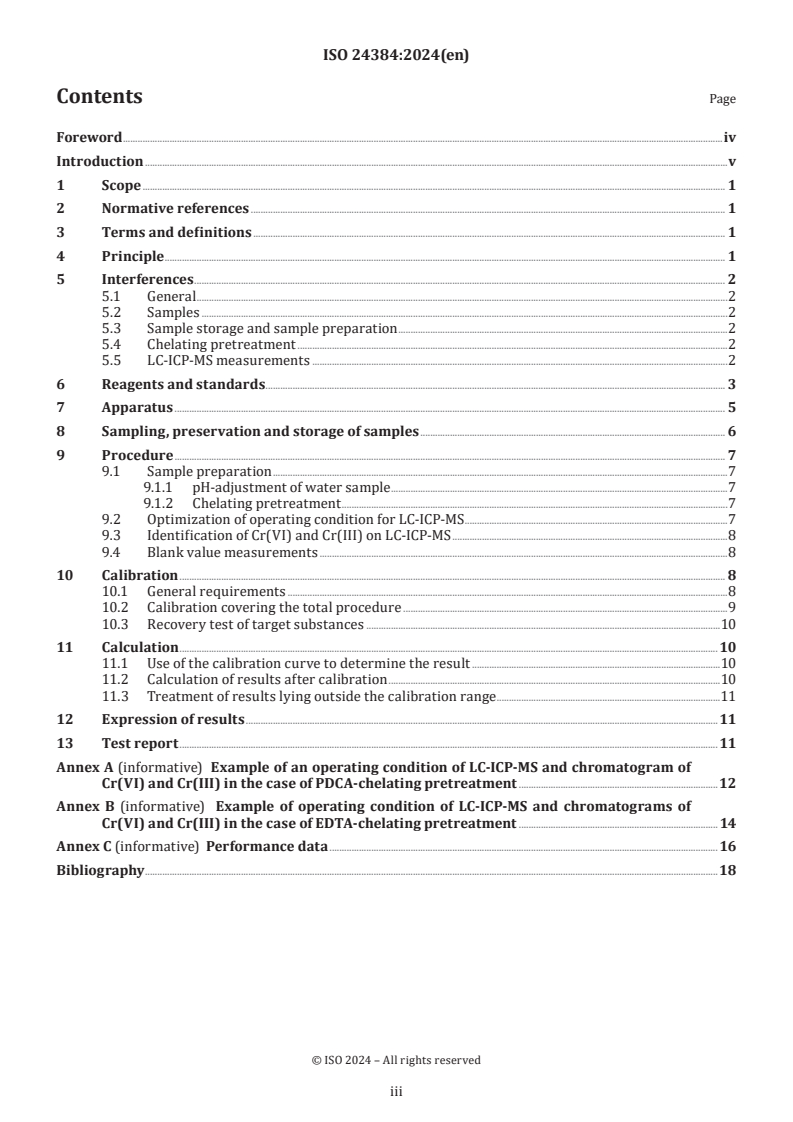
Contents Page
Foreword .iv
Introduction .v
1 Scope . 1
2 Normative references . 1
3 Terms and definitions . 1
4 Principle . 1
5 Interferences . 2
5.1 General .2
5.2 Samples .2
5.3 Sample storage and sample preparation .2
5.4 Chelating pretreatment .2
5.5 LC-ICP-MS measurements .2
6 Reagents and standards . . 3
7 Apparatus . 5
8 Sampling, preservation and storage of samples . 6
9 Procedure . 7
9.1 Sample preparation .7
9.1.1 pH-adjustment of water sample .7
9.1.2 Chelating pretreatment .7
9.2 Optimization of operating condition for LC-ICP-MS .7
9.3 Identification of Cr(VI) and Cr(III) on LC-ICP-MS .8
9.4 Blank value measurements .8
10 Calibration . 8
10.1 General requirements .8
10.2 Calibration covering the total procedure .9
10.3 Recovery test of target substances .10
11 Calculation . 10
11.1 Use of the calibration curve to determine the result .10
11.2 Calculation of results after calibration .10
11.3 Treatment of results lying outside the calibration range .11
12 Expression of results .11
13 Test report .11
Annex A (informative) Example of an operating condition of LC-ICP-MS and chromatogram of
Cr(VI) and Cr(III) in the case of PDCA-chelating pretreatment .12
Annex B (informative) Example of operating condition of LC-ICP-MS and chromatograms of
Cr(VI) and Cr(III) in the case of EDTA-chelating pretreatment . 14
Annex C (informative) Performance data .16
Bibliography .18
iii
Foreword
ISO (the International Organization for Standardization) is a worldwide federation of national standards
bodies (ISO member bodies). The work of preparing International Standards is normally carried out through
ISO technical committees. Each member body interested in a subject for which a technical committee
has been established has the right to be represented on that committee. International organizations,
governmental and non-governmental, in liaison with ISO, also take part in the work. ISO collaborates closely
with the International Electrotechnical Commission (IEC) on all matters of electrotechnical standardization.
The procedures used to develop this document and those intended for its further maintenance are described
in the ISO/IEC Directives, Part 1. In particular, the different approval criteria needed for the different types
of ISO document should be noted. This document was drafted in accordance with the editorial rules of the
ISO/IEC Directives, Part 2 (see www.iso.org/directives).
ISO draws attention to the possibility that the implementation of this document may involve the use of (a)
patent(s). ISO takes no position concerning the evidence, validity or applicability of any claimed patent
rights in respect thereof. As of the date of publication of this document, ISO had not received notice of (a)
patent(s) which may be required to implement this document. However, implementers are cautioned that
this may not represent the latest information, which may be obtained from the patent database available at
www.iso.org/patents. ISO shall not be held responsible for identifying any or all such patent rights.
Any trade name used in this document is information given for the convenience of users and does not
constitute an endorsement.
For an explanation of the voluntary nature of standards, the meaning of ISO specific terms and expressions
related to conformity assessment, as well as information about ISO’s adherence to the World Trade
Organization (WTO) principles in the Technical Barriers to Trade (TBT), see www.iso.org/iso/foreword.html.
This document was prepared by Technical Committee ISO/TC 147, Water quality, Subcommittee SC 2,
Physical, chemical and biochemical methods.
Any feedback or questions on this document should be directed to the user’s national standards body. A
complete listing of these bodies can be found at www.iso.org/members.html.
iv
Introduction
Chromium (Cr) exists in natural resources and is also widely used in industries as plating agents, paints,
dyes, catalysts, and dietary supplements. The Cr(VI) compounds are highly harmful and recognized to
be a human carcinogen. The Cr(III) compounds are recently used as a substitute for Cr(VI) compounds in
industries, e.g. plating. In wastewater, surface water, or drinking water, chromium mainly exists in two
oxidation states: +3 [Cr(III)] and +6 [Cr(VI)]. However, the proportion between Cr(VI) and Cr(III) is quite
variable. Therefore, the determination of the individual oxidation states of chromium is crucial to evaluate
and control the risk of chromium to human and environmental health. This document will be beneficial to
perform a robust, simple, and rapid determination of chromium of the individual oxidation states.
v
International Standard ISO 24384:2024(en)
Water quality — Determination of chromium(VI)
and chromium(III) in water — Method using liquid
chromatography with inductively coupled plasma mass
spectrometry (LC-ICP-MS) after chelating pretreatment
WARNING — Persons using this document should be familiar with normal laboratory practice. This
document does not purport to address all of the safety problems, if any, associated with its use. It is
the responsibility of the user to establish appropriate safety and health practices.
IMPORTANT — It is absolutely essential that tests conducted according to this document be carried
out by suitably qualified staff.
1 Scope
This document specifies a method for the determination of hexavalent chromium [Cr(VI)] and trivalent
chromium [Cr(III)] in water by liquid chromatography with inductively coupled plasma mass spectrometry
(LC-ICP-MS) after chelating pretreatment.
This method is applicable to the determination of Cr(VI) and Cr(III) dissolved in wastewater, surface
water, groundwater, or drinking water from 0,20 μg/l to 500 μg/l of each compound as chromium (Cr)
mass. Samples containing Cr at concentrations higher than the working range can be analysed following
appropriate dilution of the sample.
2 Normative references
The following documents are referred to in the text in such a way that some or all of their content constitutes
requirements of this document. For dated references, only the edition cited applies. For undated references,
the latest edition of the referenced document (including any amendments) applies.
ISO 8466-1, Water quality — Calibration and evaluation of analytical methods — Part 1: Linear calibration
function
3 Terms and definitions
No terms and definitions are listed in this document.
ISO and IEC maintain terminology databases for use in standardization at the following addresses:
— ISO Online browsing platform: available at https:// www .iso .org/ obp
— IEC Electropedia: available at https:// www .electropedia .org/
4 Principle
The chemical forms of various Cr(III) species in water samples are unified to a stable Cr(III) complex by
a chelating pretreatment with 2,6-pyridinedicarboxylic acid (PDCA) or ethylenediaminetetraacetic acid
[1][2]
(EDTA) after adjusting the sample solution pH to 6,9 ± 0,1. Liquid chromatography combined with
inductively coupled plasma mass spectrometry (LC-ICP-MS) determines the chromatographically separated
Cr(VI) and the Cr(III)-PDCA complex or Cr(III)-EDTA complex in the pretreated sample solutions.
5 Interferences
5.1 General
If any of the interferences described in 5.2 to 5.5 are recognized or can be expected due to additional
information about the sample, the sum of Cr(VI) and Cr(III) concentrations determined by the proposed
method should be compared with the total Cr concentration which can be determined by ICP-MS.
If the Cr(III) and Cr(VI) species are properly determined by the proposed method, the sum of Cr(III) and
Cr(VI) should agree with the total Cr with a difference of ≤30 %. An exceedance of this limit (30 %) indicates
the occurrence of interferences.
NOTE The water sample can contain Cr or Cr(III) species that cannot be complexed via EDTA or PDCA (e.g.
nanoparticles, colloids). These stable species can be so small that they are not retained even by filtration through
a 0,2 µm filter membrane. However, as they are uncomplexed, they will not be detected by the LC-ICP-MS analysis
and can thus result in a greater difference between the sum of Cr species determined by LC-ICP-MS and the total Cr
determination.
5.2 Samples
Reductants or oxidants in the sample may lead to false results for the Cr(VI) and/or Cr(III) concentration
through the reduction of Cr(VI) to Cr(III) or oxidation of Cr(III) to Cr(VI), respectively. For example, divalent
[1]
iron ions or ascorbic acid at 1 mg/l or 10 mg C/l, respectively, cause the reduction within 10 min. Organic
matter at high concentrations may slowly reduce Cr(VI) to Cr(III). For example, tartaric acid at 100 mg C/l
reduces Cr(VI) to Cr(III) in one night at room temperature, however, the same compound at 10 mg C/l does
not cause the reduction. The sample pH also changes the redox equilibrium between Cr(VI) and Cr(III) and
[3]
the complexation equilibrium between Cr species with coexisting inorganic and organic substances.
5.3 Sample storage and sample preparation
Potential sources of Cr contamination during sampling, sample storage, and sample preparation include:
labware, containers, sampling equipment, reagents, water and human contact. Potential unexpected redox
reaction between Cr(III) and Cr(VI) may occur during these operations. All apparatus and labware shall be
cleaned using the cleaning procedure (see Clause 7).
5.4 Chelating pretreatment
Transition metal cations at high concentrations in the sample solution may lead to a negative biased value
for the Cr(III) concentration because these metals decrease the concentration of free chelating agents due
to complex formation with chelating agents. For example, neither cobalt(II) nor nickel(II) up to 10 mg/l
[1]
interfere, however, these metal ions and also calcium ion interfere above 100 mg/l.
Large amounts of organic matter which strongly binds to Cr(III) species in the sample solution may lead to
a negatively biased value for the Cr(III) concentration. For example, Cr(III)-PDCA complex formation in the
PDCA chelating pretreatment is depressed by the presence of EDTA as an interfering substance at 100 mg/l
[1]
level, although not depressed at 10 mg/l. The opposite is also true and Cr(III)-EDTA complex formation in
the pretreatment of Cr(III) with EDTA is inhibited by the presence of large amounts of PDCA as an interfering
substance. The depression at the chelating procedure can be evaluated by recovery experiments (10.3).
5.5 LC-ICP-MS measurements
Polyatomic ions are formed in the argon plasma of the ICP-MS by the reaction among argon, water, reagents
40 12 + 37 16 +
and sample matrix, etc. The formation of Ar C and Cl O may interfere with the ICP-MS detection of
40 12 +
Cr at mass-to-charge ratio (m/z) 52 and at m/z 53, respectively. Some of the interferences such as Ar C
can be reduced by using a collision-reaction cell of the ICP-MS. On the other hand, some of the interferences
37 16 + [1]
such as Cl O can be reduced by chromatographic separation of chloride (Cl) ions from the Cr species.
High-resolution or tandem mass spectrometers, e.g. sector-field or MS/MS-type mass spectrometers, can
also reduce the polyatomic interferences very effectively.
LC retention time of Cr species may shift for water samples containing salts or organic matter at high
concentrations. If this causes the peak of Cr(III)-PDCA complex [or Cr(III)-EDTA complex] to overlap with
Cr(VI), it may cause positive and negative interferences to Cr(VI) and Cr(III), respectively. In such cases,
adjust elution conditions such as composition of eluent to ensure adequate separation.
The metallic parts of LC-ICP-MS instruments, e.g. LC columns, tubes and connectors, potentially contaminate
the eluent if in contact. Therefore, metallic parts or pathways should be avoided or reduced to a minimum.
6 Reagents and standards
Unless otherwise indicated, reagents of purity grade “for analysis” or “for trace analysis” are used as
reagents. If available, use only reagents of pro analysis grade (or purer) free of compounds containing Cr.
Weigh the reagents with an accuracy of ± 1 % of the nominal mass, unless stated otherwise.
Prepare alternative concentrations and volumes of solutions as described hereafter, if necessary.
Alternatively, use commercially available stock solutions of the required concentration.
6.1 Water, with an electrical resistivity of ≥ 18,2 MΩ cm (25 °C).
The water shall not contain any measurable quantity of Cr(III) and Cr(VI) or interfering compounds at or
above one-third the method quantification limit.
6.2 Nitric acid, w(HNO ) = 650 g/kg, ρ(HNO ) = 1,4 g/ml.
3 3
NOTE Nitric acid is available as ρ(HNO ) = 1,38 g/ml [w(HNO ) = 610 g/kg] and ρ(HNO ) = 1,42 g/ml
3 3 3
[w(HNO ) = 690 g/kg] as well as ρ(HNO ) = 1,40 g/ml [w(HNO ) = 650 g/kg].
3 3 3
6.3 Nitric acid stock solution, c(HNO ) = 6 mol/l.
Transfer 25 ml of water (6.1) to 100 ml volumetric flask (7.14), and add 27 ml of nitric acid (6.2) and then fill
up to mark with water (6.1).
6.4 Nitric acid solution for pH adjustment, c(HNO ) = 2 mol/l.
Transfer 33 ml of nitric acid stock solution (6.3) to a 100 ml volumetric flask (7.14) and fill up to mark with
water (6.1).
6.5 Sodium hydroxide, NaOH.
6.6 Sodium hydroxide solution for pH adjustment, c(NaOH) = 2 mol/l.
Weigh 8 g of sodium hydroxide pellets (6.5) and transfer them to a 100 ml beaker. Then add approximately
50 ml water (6.1) and stir with a stirrer (7.12) until the pellets have dissolved. Transfer to a 100 ml volumetric
flask (7.14) and fill up to the mark with water (6.1). Commercially available solution of sodium hydroxide can
be used to dilute them to the required concentration.
®1)
6.7 2,6-Pyridinedicarboxylic acid (PDCA), CAS Registry Number 499-83-2, C H NO
7 5 4.
6.8 Disodium hydrogenphosphate, Na HPO .
2 4
6.9 Ammonium acetate, CH COONH .
3 4
1) Chemical Abstracts Service (CAS) Registry Number® is a trademark of the American Chemical Society (ACS). This
information is given for the convenience of users of this document and does not constitute an endorsement by ISO of the
product named. Equivalent products may be used if they can be shown to lead to the same results.
6.10 Ethylenediamine-N,N,N’,N’-tetraacetic acid (EDTA) disodium salt dihydrate (CAS 6381-92-6,
C H Na N O ·2H O) or EDTA dipotassium salt dihydrate (CAS 25102-12-9, C H K N O ·2H O).
10 14 2 2 8 2 10 14 2 2 8 2
6.11 Ammonia solution, mass fraction, w(NH OH) = 280 g/kg.
6.12 Ammonia solution for pH adjustment, c(NH ) = 1 mol/l.
6.13 Potassium dichromate, K Cr O .
2 4 7
6.14 Chromium(III) nitrate nonahydrate, Cr(NO ) ⋅9H O.
3 3 2
6.15 Cr(VI) stock solution, ρ[Cr(VI)] = 1 000 mg/l.
WARNING — Potassium chromate can be carcinogenic.
Heat 5 g of potassium dichromate (6.13) at 150 °C for 1 h and then cool at room temperature in a dried
desiccator. Dissolve 2,829 g of the dried potassium dichromate (6.13) with water (6.1) in a 1 000 ml
volumetric flask (7.14) and fill up to mark with water (6.1). Commercially available Cr(VI) stock solution of
the required concentration can be used.
6.16 Cr(VI) standard solution, ρ[Cr(VI)] = 10 mg/l.
Transfer 1,00 ml of the Cr(VI) stock solution (6.15) to a 100 ml volumetric flask (7.14) and fill up to the mark
with water (6.1). Prepare this solution on the day of use.
6.17 Cr(III) stock solution, ρ[Cr(III)] = 1 000 mg/l.
Dissolve 7,696 g of chromium(III) nitrate nonahydrate (6.14) in 250 ml water and transfer to a 1 000 ml
volumetric flask (7.14). Add 50 ml of nitric acid stock solution (6.3) and fill up to the mark with water (6.1).
Commercially available Cr(III) stock solution of the required concentration can be used.
6.18 Cr(III) standard solution, ρ[Cr(III)] = 10 mg/l.
Transfer 1,00 ml of the Cr(III) stock solution (6.17) to a 100 ml volumetric flask (7.14) and fill up to the mark
with water (6.1). Prepare this solution on the day of use.
6.19 PDCA solution, c(PDCA) 0,02 mol/l.
Dissolve 3,35 g of 2,6-pyridinedicarboxylic acid (6.7), 2,85 g of disodium hydrogenphosphate (6.8), and
38,5 g of ammonium acetate (6.9) to 900 ml of water (6.1) in a bottle (7.16) of 1 000 ml. Adjust the pH of the
solution to pH 6,9 ± 0,1 using a pH meter (7.11) by adding the sodium hydroxide solution (6.6). Transfer the
adjusted PDCA solution to a 1 000 ml volumetric flask (7.14) and fill up to the mark with water (6.1).
The amount of NaOH solution is approximately 16,5 ml. The pH adjustment from pH 6,0 should be carefully
performed by adding of NaOH solution by small degrees (e.g. 0,1 ml), because the change of pH is drastic.
6.20 EDTA solution, c(EDTA) 0,025 mol/l.
Dissolve 9,31 g of ethylenediamine-N,N,N’,N’-tetraacetic acid disodium salt or 10,1 g of the dipotassium
salt (6.10) to 900 ml of water (6.1) in a bottle (7.16) of 1 000 ml. Adjust the pH of the solution to pH 6,9 ± 0,1
using a pH meter (7.11) by adding the sodium hydroxide solution (6.6). Transfer the adjusted EDTA solution
to a 1 000 ml volumetric flask (7.14) and fill up to the mark with water (6.1).
6.21 Mobile phase for LC.
A various mobile phase can be used in accordance with the type of LC column used. The composition of the
mobile phase depends on the chosen LC column. Examples are given in Annexes A and B. Weigh each mobile
phase reagent according to its composition, transfer the reagent to a bottle (7.16) and dissolve with water
(6.1). If pH adjustment is required, adjust the pH of the solution to the optimum pH by adding alkali or acid.
Transfer the adjusted mobile phase solution to volumetric flask (7.14) and fill with water (6.1) to adjust to
final concentrations.
The pH adjustment by immersing the pH glass electrode in the mobile phase may result in contamination of
the mobile phase. For this reason, a small amount of the mobile phase should be taken in advance into a test
tube (7.7) with a clean pipette (7.13) to determine the amount of alkali or acid required for pH adjustment.
The use of organic solvents in the mobile phase should be avoided because the carbon deteriorates stability
of measurements of LC-ICP-MS due to the deposits and the quantification of limit due to the polyatomic
interference, e.g. argon-carbon ion on m/z 52.
7 Apparatus
Apparatus or parts which may come into contact with a water sample or an eluent of LC should be non-
metallic and free from Cr and interfering substances.
7.1 Liquid chromatograph-inductively coupled plasma-mass spectrometer (LC-ICP-MS), including
LC and ICP-MS instruments.
The outlet of the LC column is connected to the inlet of the nebulizer of the ICP-MS using a connector tube.
The internal diameter of the connector tube should be less than 0,25 mm and the length should be as
short as possible (e.g. less than 100 mm) in order to avoid the separation efficiency obtained with LC. A
fluoropolymer or polyetheretherketone (PEEK) tube should be used. Since the operating conditions differ
according to the instruments, the operator shall thus refer to the instructions provided by the manufacturer
of each instrument. Examples of the operating conditions of LC-ICP-MS are given in Annexes A and B.
7.1.1 LC instrument, equipped with a pump for LC, a sample injector, and an LC column.
A column oven can be used to stabilize the column temperature. The column shall be capable of baseline
separation of Cr(VI) and Cr(III)-PDCA complex or Cr(III)-EDTA complex.
NOTE An autosampler or manual injector can be used as the sample injector. Various column types and mobile
phases can be used for separating Cr species. An anion exchange column or a mixed-mode-column with anion and
cation exchangers are typically used. Examples are provided in Annexes A and B.
7.1.2 ICP-MS instrument, inductively coupled argon plasma-mass spectrometer.
As a mass spectrometer, quadrupole mass spectrometer with a collision/reaction cell, double focusing mass
spectrometer, or tandem mass spectrometers (MS/MS-type) is available. Further information on the ICP-MS
[4]
instrumentation is given in ISO 17294-1:2004, Clause 5 .
7.2 Sample collection bottles, polyethylene, polypropylene, borosilicate glass, or fluoropolymer of a
capacity of 10 ml to 100 ml, with caps, lined with polymers.
7.3 Filter for sampling and LC-ICP-MS measurements, cellulose acetate, cellulose nitrate, or hydrophilic
polyvinylidene fluoride (PVDF) of pore size 0,45 μm.
NOTE Inline or automated filtration techniques can be applied for sample filtration or additional protection of the
analytical column.
7.4 Microlitre syringe
...
Questions, Comments and Discussion
Ask us and Technical Secretary will try to provide an answer. You can facilitate discussion about the standard in here.
Loading comments...