


ISO 6711:1981
(Main)Gas analysis — Checking of calibration gas mixtures by a comparison method
Gas analysis — Checking of calibration gas mixtures by a comparison method
Analyse des gaz — Vérification des mélanges de gaz pour étalonnage par une méthode de comparaison
Analiza plinov - Preverjanje kalibrirnih plinskih zmesi s primerjalno metodo
General Information
- Status
- Withdrawn
- Publication Date
- 31-May-1981
- Withdrawal Date
- 31-May-1981
- Technical Committee
- ISO/TC 158 - Analysis of gases
- Drafting Committee
- ISO/TC 158 - Analysis of gases
- Current Stage
- 9599 - Withdrawal of International Standard
- Start Date
- 17-Apr-1997
- Completion Date
- 14-Feb-2026
Buy Documents
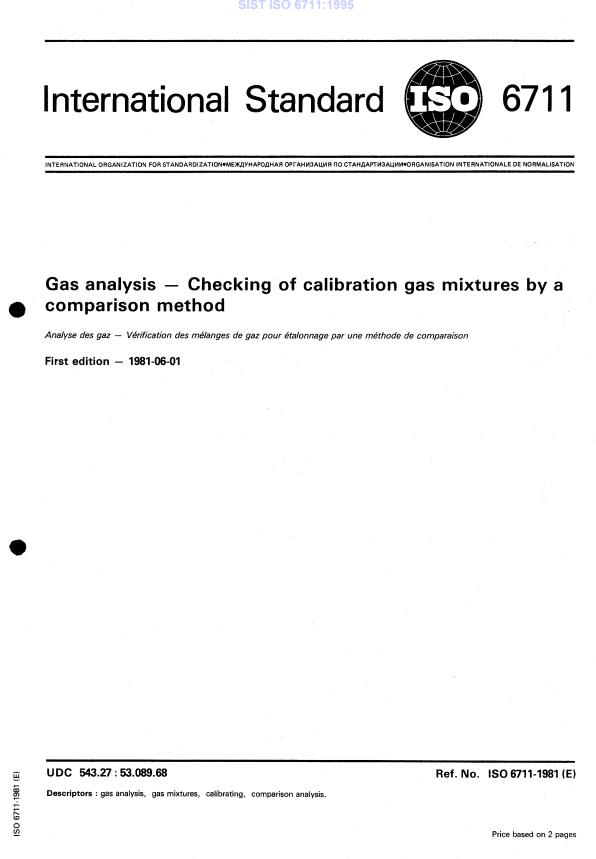



ISO 6711:1981 - Gas analysis -- Checking of calibration gas mixtures by a comparison method

ISO 6711:1981 - Analyse des gaz -- Vérification des mélanges de gaz pour étalonnage par une méthode de comparaison
Get Certified
Connect with accredited certification bodies for this standard

ECOCERT
Organic and sustainability certification.

Eurofins Food Testing Global
Global leader in food, environment, and pharmaceutical product testing.

Intertek Bangladesh
Intertek certification and testing services in Bangladesh.
Sponsored listings
Frequently Asked Questions
ISO 6711:1981 is a standard published by the International Organization for Standardization (ISO). Its full title is "Gas analysis — Checking of calibration gas mixtures by a comparison method". This standard covers: Gas analysis — Checking of calibration gas mixtures by a comparison method
Gas analysis — Checking of calibration gas mixtures by a comparison method
ISO 6711:1981 is classified under the following ICS (International Classification for Standards) categories: 71.040.40 - Chemical analysis. The ICS classification helps identify the subject area and facilitates finding related standards.
ISO 6711:1981 is available in PDF format for immediate download after purchase. The document can be added to your cart and obtained through the secure checkout process. Digital delivery ensures instant access to the complete standard document.
Standards Content (Sample)
SLOVENSKI STANDARD
01-avgust-1995
Analiza plinov - Preverjanje kalibrirnih plinskih zmesi s primerjalno metodo
Gas analysis -- Checking of calibration gas mixtures by a comparison method
Analyse des gaz -- Vérification des mélanges de gaz pour étalonnage par une méthode
de comparaison
Ta slovenski standard je istoveten z: ISO 6711:1981
ICS:
71.040.40 Kemijska analiza Chemical analysis
2003-01.Slovenski inštitut za standardizacijo. Razmnoževanje celote ali delov tega standarda ni dovoljeno.
INTERNATIONAL ORGANIZATION FOR STANDARDIZATlON*MEXIIYHAPOJiHAR OPrAHM3AUHR nO CTAHnAPTH3AUMM.ORGANISATION INTERNATIONALE DE NORMALISATION
Gas analysis - Checking of calibration gas mixtures by a
I
comparison method
~0
Analyse des gaz - Vérification des mélanges de gaz pour étalonnage par une méthode de comparaison
First edition - 1981-06-01
- UDC 543.27 : 53.089.68
Ref. No. IS0 6711-1981 (E)
'
Descriptors : gas analysis, gas mixtures, calibrating, comparison analysis.
c
i;
Co
O
E
Price based on 2 pages
Foreword
IS0 (the International Organization for Standardization) is a worldwide federation of
national standards institutes (IS0 member bodies). The work of developing Inter-
national Standards is carried out through IS0 technical committees. Every member
body interested in a subject for which a technical committee has been set up has the
right to be represented on that committee. International organizations, governmental
and non-governmental, in liaison with ISO, also take part in the work.
Draft International Standards adopted by the technical committees are circulated to
the member bodies for approval before their acceptance as International Standards by
the IS0 Council.
International Standard IS0 671 1 was developed by Technical Committee ISO/TC 158,
Analysis of gases, and was circulated to the member bodies in February 1980.
It has been approved by the member bodies of the following countries
Australia India South Africa, Rep. of
Belgium Ireland Spain
Bulgaria Italy United Kingdom
Czechoslovakia Mexico USSR
France Netherlands
Germany, F.R. Poland
No member body expressed disapproval of the document.
O International Organization for Standardization, 1981 O
Printed in Switzerland
INTER NAT1 ON AL STANDARD IS0 6711-1981 (E)
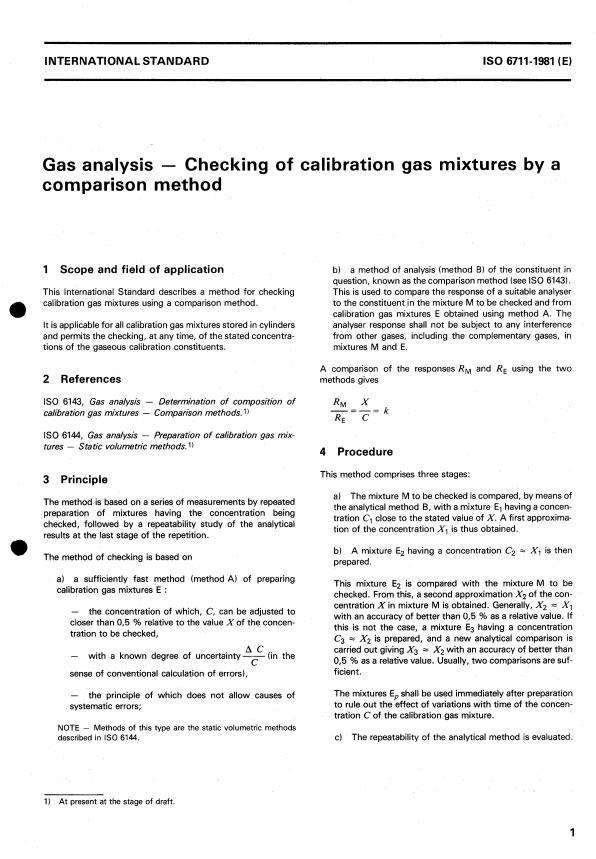
Gas analysis - Checking of calibration gas mixtures by a
comparison method
1 Scope and field of application b) a method of analysis (method B) of the constituent in
question, known as the comparison method (see IS0 6143).
This International Standard describes a method for checking This is used to compare the response of a suitable analyser
calibration gas mixtures using a comparison method. to the constituent in the mixture M to be checked and from
calibration gas mixtures E obtained using method A. The
analyser response shall not be subject to any interference
It is applicable for all calibration gas mixtures stored in cylinders
and permits the checking, at any time, of the stated concentra- from other gases, including the complementary gases, in
tions of the gaseous calibration constituents. mixtures M and E.
A comparison of the responses R, and RE using the two
2 References methods gives
IS0 6143, Gas analysis - Determination of composition of
calibration gas mixtures - Comparison methods. 1)
IS0 6144, Gas analysis - Preparation of calibration gas mix-
tures - Static volumetric methods.')
4 Procedure
This method comprises three stages:
3 Principle
a) The mixture M to be checked is compared, by means of
The method is based on a series of measurements by repeated
the analytical method B, with a mixture El having a concen-
preparation of mixtures having the concentration being
tration C1 close to the stated value of X. A first approxima-
checked, followed by a repeatability study of the analytical
tion of the concentration XI is thus obtained.
results at the last stage of the repetition.
A mixture E, having a concentration Cz = X, is then
b)
* The method of checking is based on
prepared.
a) a sufficiently fast method (method A) of preparing
This mixture E2 is compared with the mixture M to be
calibration gas mixtures E :
checked. From this, a second approximation Xz of the con-
centration X in mixture M is obtained. Generally, X2 = X1
- the concentration of which, C, can be adjusted to
with an accuracy of better than ü,5 % as a relative value. If
closer than 0,5 ?%O relative to the value X of the concen-
this is not the case, a mixture E3 having a concentration
tration to be checked,
C3 = X2 is prepared, and a new analytical comparison is
carried out giving X3 = X, with an accuracy of better than
- with a known degree of uncertaintyKCin the
0,5 % as a relative value. Usually, two comparisons are suf-
C
ficient.
sense of conventional calculation of errors),
- The mixtures shall be used immediately after preparation
the pr
...
INTERNATIONAL ORGANIZATION FOR STANDARDIZATlON*MEXIIYHAPOJiHAR OPrAHM3AUHR nO CTAHnAPTH3AUMM.ORGANISATION INTERNATIONALE DE NORMALISATION
Gas analysis - Checking of calibration gas mixtures by a
I
comparison method
~0
Analyse des gaz - Vérification des mélanges de gaz pour étalonnage par une méthode de comparaison
First edition - 1981-06-01
- UDC 543.27 : 53.089.68
Ref. No. IS0 6711-1981 (E)
'
Descriptors : gas analysis, gas mixtures, calibrating, comparison analysis.
c
i;
Co
O
E
Price based on 2 pages
Foreword
IS0 (the International Organization for Standardization) is a worldwide federation of
national standards institutes (IS0 member bodies). The work of developing Inter-
national Standards is carried out through IS0 technical committees. Every member
body interested in a subject for which a technical committee has been set up has the
right to be represented on that committee. International organizations, governmental
and non-governmental, in liaison with ISO, also take part in the work.
Draft International Standards adopted by the technical committees are circulated to
the member bodies for approval before their acceptance as International Standards by
the IS0 Council.
International Standard IS0 671 1 was developed by Technical Committee ISO/TC 158,
Analysis of gases, and was circulated to the member bodies in February 1980.
It has been approved by the member bodies of the following countries
Australia India South Africa, Rep. of
Belgium Ireland Spain
Bulgaria Italy United Kingdom
Czechoslovakia Mexico USSR
France Netherlands
Germany, F.R. Poland
No member body expressed disapproval of the document.
O International Organization for Standardization, 1981 O
Printed in Switzerland
INTER NAT1 ON AL STANDARD IS0 6711-1981 (E)
Gas analysis - Checking of calibration gas mixtures by a
comparison method
1 Scope and field of application b) a method of analysis (method B) of the constituent in
question, known as the comparison method (see IS0 6143).
This International Standard describes a method for checking This is used to compare the response of a suitable analyser
calibration gas mixtures using a comparison method. to the constituent in the mixture M to be checked and from
calibration gas mixtures E obtained using method A. The
analyser response shall not be subject to any interference
It is applicable for all calibration gas mixtures stored in cylinders
and permits the checking, at any time, of the stated concentra- from other gases, including the complementary gases, in
tions of the gaseous calibration constituents. mixtures M and E.
A comparison of the responses R, and RE using the two
2 References methods gives
IS0 6143, Gas analysis - Determination of composition of
calibration gas mixtures - Comparison methods. 1)
IS0 6144, Gas analysis - Preparation of calibration gas mix-
tures - Static volumetric methods.')
4 Procedure
This method comprises three stages:
3 Principle
a) The mixture M to be checked is compared, by means of
The method is based on a series of measurements by repeated
the analytical method B, with a mixture El having a concen-
preparation of mixtures having the concentration being
tration C1 close to the stated value of X. A first approxima-
checked, followed by a repeatability study of the analytical
tion of the concentration XI is thus obtained.
results at the last stage of the repetition.
A mixture E, having a concentration Cz = X, is then
b)
* The method of checking is based on
prepared.
a) a sufficiently fast method (method A) of preparing
This mixture E2 is compared with the mixture M to be
calibration gas mixtures E :
checked. From this, a second approximation Xz of the con-
centration X in mixture M is obtained. Generally, X2 = X1
- the concentration of which, C, can be adjusted to
with an accuracy of better than ü,5 % as a relative value. If
closer than 0,5 ?%O relative to the value X of the concen-
this is not the case, a mixture E3 having a concentration
tration to be checked,
C3 = X2 is prepared, and a new analytical comparison is
carried out giving X3 = X, with an accuracy of better than
- with a known degree of uncertaintyKCin the
0,5 % as a relative value. Usually, two comparisons are suf-
C
ficient.
sense of conventional calculation of errors),
- The mixtures shall be used immediately after preparation
the principle of which does not allow causes of
to rule out the effect of variations with time of the concen-
systematic errors;
tration C of the calibration gas mixture.
NOTE - Methods of this type are the static volumetric methods
described in IS0 6144.
c) The repeatability of the analytical method is evaluated.
1 I At present at the stage of draft.
...
Norme internationale
INTERNATIONAL ORGANIZATION FOR STANDARDIZATlON*ME~YHAPOflHAR OPTAHM3AUMR no CTAHflAPTM3AUMHSORGANlSATlON INTERNATIONALE DE NORMALISATION
Analyse des gaz - Vérification des mélanges de gaz pour
étalonnage par une méthode de comparaison
O
Gas analysis - Checking of calibration gas mixtures by a comparison method
Première édition - 1981-06-01
I
*
- U CDU 543.27:53.089.68 Réf. no : IS0 6711-1981 (FI
I
Descripteurs : analyse de gaz, mélange de gaz, étalonnage, méthode par comparaison.
c -
O
Prix basé sur 2 pages
!e
I
Avant-propos
L'ISO (Organisation internationale de normalisation) est une fédération mondiale
d'organismes nationaux de normalisation (comités membres de I'ISO). L'élaboration
des Normes internationales est confiée aux comités techniques de I'ISO. Chaque
comité membre intéressé par une étude a le droit de faire partie du comité technique
correspondant. Les organisations internationales, gouvernementales et non gouverne-
mentales, en liaison avec I'ISO, participent également aux travaux.
Les projets de Normes internationales adoptés par les comités techniques sont soumis
aux comités membres pour approbation, avant leur acceptation comme Normes inter-
nationales par le Conseil de I'ISO.
La Norme internationale IS0 6711 a été élaborée par le comité technique ISO/TC 158,
Analyse des gaz, et a été soumise aux comités membres en février 1980.
Les comités membres des pays suivant l'ont approuvée :
Pologne
Afrique du Sud, Rép. d' France
Allemagne, R.F. lnde Royaume-Uni
Tchécolsovaquie
Australie Irlande
Belgique Italie URSS
Bulgarie Mexique
Espagne Pays-Bas
Aucun comité membre ne t'a désapprouvée.
O Organisation internationale de normalisation, 1981 0
Imprimé en Suisse
IS0 6711-1981 (FI
NORM E I NTER NAT1 ON ALE
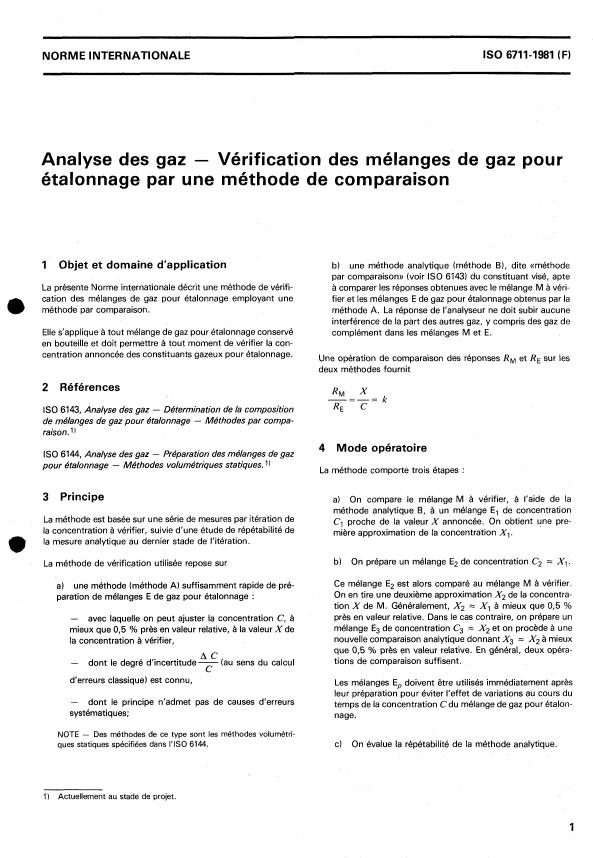
Analyse des gaz - Vérification des mélanges de gaz pour
étalonnage par une méthode de comparaison
1 Objet et domaine d’application b) une méthode analytique (méthode BI, dite «méthode
par comparaison)) (voir IS0 6143) du constituant visé, apte
La présente Norme internationale décrit une méthode de vérifi- à comparer les réponses obtenues avec le mélange M à véri-
cation des mélanges de gaz pour étalonnage employant une
fier et les mélanges E de gaz pour étalonnage obtenus par la
(I) méthode par comparaison.
méthode A. La réponse de l’analyseur ne doit subir aucune
interférence de la part des autres gaz, y compris des gaz de
Elle s’applique à tout mélange de gaz pour étalonnage conservé complément dans les mélanges M et E.
en bouteille et doit permettre à tout moment de vérifier la con-
centration annoncée des constituants gazeux pour étalonnage.
Une opération de comparaison des réponses R, et RE sur les
deux méthodes fournit
2 Références
IS0 6143, Analyse des gaz - Détermination de la composition
de mélanges de gaz pour étalonnage - Méthodes par compa-
raison.‘)
4 Mode opératoire
IS0 6144, Analyse des gaz - Préparation des mélanges de gaz
pour étalonnage - Méthodes volumétriques statiques. 1)
La méthode comporte trois étapes :
3 Principe
a) On compare le mélange M à vérifier, à l’aide de la
méthode analytique B, à un mélange E, de concentration
La méthode est basée sur une série de mesures par itération de
C, proche de la valeur X annoncée. On obtient une pre-
la concentration à vérifier, suivie d‘une étude de répétabilité de
mière approximation de la concentration X,.
la mesure analytique au dernier stade de l’itération.
b) On prépare un mélange E2 de concentration C2 = XI.
La méthode de vérification utilisée repose sur
Ce mélange E, est alors comparé au mélange M à vérifier.
a) une méthode (méthode A) suffisamment rapide de pré-
On en tire une deuxième approximation X2 de la concentra-
paration de mélanges E de gaz pour étalonnage :
tion X de M. Généralement, X2 = X1 à mieux que 0,5 %
- avec laquelle on peut ajuster la concentration C, à près en valeur relative. Dans le cas contraire, on prépare un
mélange E3 de concentration C3 = X2 et on procède à une
mieux que 0,5 % près en valeur relative, à la valeur Xde
nouvelle comparaison analytique donnant X3 = X2 à mieux
la concentration à vérifier,
que 0,5 % près en valeur relative. En général, deux opéra-
AC
- tions de comparaison suffisent.
dont le degré d’incertitude- (au sens du calcul
C
d’erreurs classique) est connu,
Les mélanges Ep doivent être utilisés immédiatement après
leur préparation pour éviter l’effet de variations au cours du
-
dont le principe n‘admet pas de causes d’erreurs
temps de la concentration Cdu mélange de gaz pour étalon-
systématiques;
nage.
NOTE - Des méthodes de ce type sont les méthodes volumétri-
ques statiq
...
Questions, Comments and Discussion
Ask us and Technical Secretary will try to provide an answer. You can facilitate discussion about the standard in here.
Loading comments...