


ISO 10897:2016
(Main)Collets for tool holders with taper ratio 1:10 — Collets, holders, nuts
General Information
- Abstract
ISO 10897:2016 specifies the dimensions, materials and manufacturing requirements, and designation of collets for tools with cylindrical shanks and their corresponding holders and nuts. For non-standardized clamping devices, such as clamping devices specified in drawings, these holders can be agreed upon between customer and supplier. Form A applies where a clamping range of H10 is sufficient. Form B can be used for any application without lateral cutting load. Annex A specifies the values for AT3 tolerance and AT4 tolerance.
- Status
- Published
- Publication Date
- 23-Aug-2016
- Current Stage
- 9093 - International Standard confirmed
- Start Date
- 23-Mar-2023
- Completion Date
- 29-Aug-2026
Buy Documents

ISO 10897:2016 - Collets for tool holders with taper ratio 1:10 -- Collets, holders, nuts
ISO 10897:2016 - Collets for tool holders with taper ratio 1:10 — Collets, holders, nuts
REDLINE ISO 10897:2016 - Collets for tool holders with taper ratio 1:10 — Collets, holders, nuts
ISO 10897:2016 - Collets for tool holders with taper ratio 1:10 — Collets, holders, nuts/24/2016

ISO 10897:2016 - Pinces de serrage pour mandrins a conicité 1:10 -- Pinces, mandrins a pinces, écrous de serrage
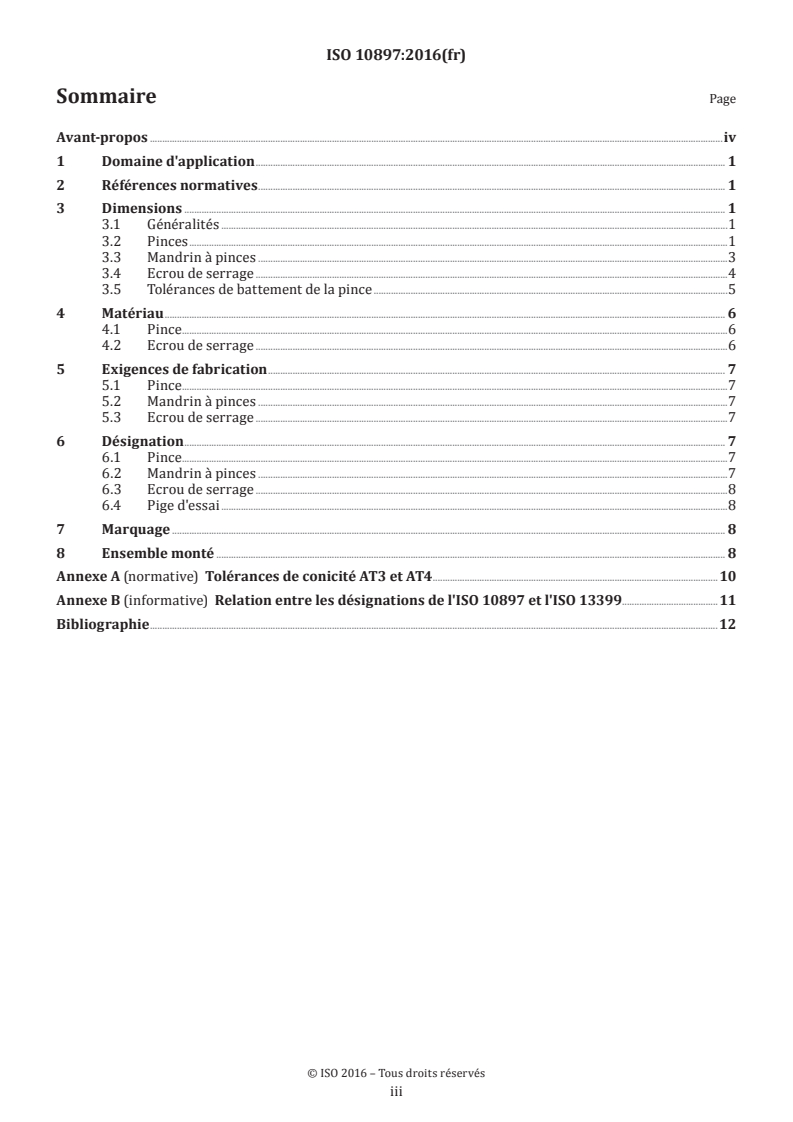
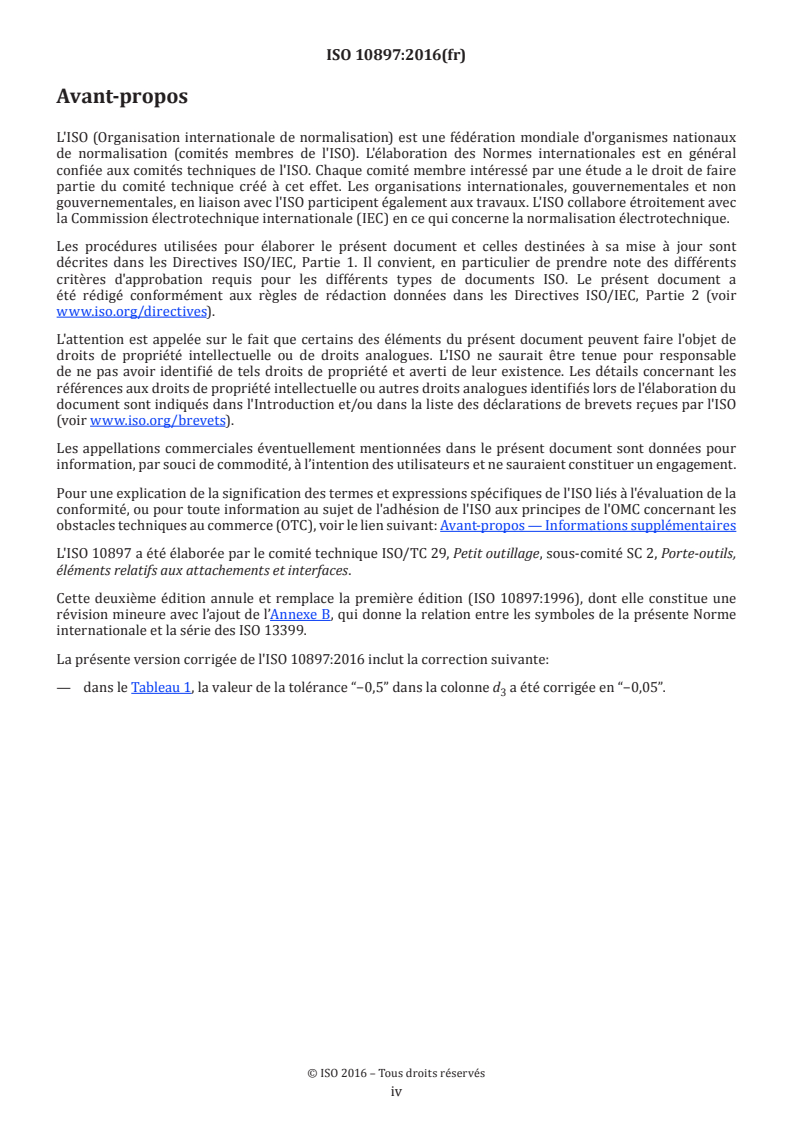
ISO 10897:2016 - Pinces de serrage pour mandrins à conicité 1:10 — Pinces, mandrins à pinces, écrous de serrage
REDLINE ISO 10897:2016 - Pinces de serrage pour mandrins à conicité 1:10 — Pinces, mandrins à pinces, écrous de serrage
ISO 10897:2016 - Pinces de serrage pour mandrins à conicité 1:10 — Pinces, mandrins à pinces, écrous de serrage/24/2016
Overview
ISO 10897:2016 specifies collets, holders and nuts for tool holders with a taper ratio of 1:10. The standard defines dimensions, materials, manufacturing requirements, run‑out testing, designation and marking for collets used with tools having cylindrical shanks. It covers two collet forms (A and B), the matching holder (form C) and nut (form D), and includes normative cone‑angle tolerances (AT3, AT4).
Key topics and technical requirements
- Scope & parts covered: dimensions and tolerances for collets, holders and nuts for taper 1:10 tool holders; designation and marking rules.
- Collet forms:
- Form A - unilaterally slotted, short clamping bore; suitable where a clamping range of H10 is sufficient.
- Form B - bilaterally slotted, continuous clamping bore; intended for applications without lateral cutting load.
- Materials & hardness:
- Collet steel with tensile strength ≥ 700 N/mm² (manufacturer’s choice).
- Hardening: Form A bore/taper hardened to ~56 HRC; Form B bore/taper hardened to ~44 HRC.
- Holder taper bore hardened to ~58 HRC; nut material/design at manufacturer’s discretion.
- Dimensional data: All dimensions and tolerances given in millimetres; unspecified tolerances default to ISO 2768-1 class “m”. Detailed nominal sizes and dimensions are provided by tables and figures in the standard.
- Run‑out testing & tolerances:
- Two run‑out classes (Class 1 - higher accuracy, Class 2 - normal).
- Test mandrel requirements: diameter tolerance H6, cylindricity/parallelism/roundness 0.002 mm, surface hardness ~58 HRC, Rz ≤ 4 μm, no longitudinal marks.
- Cone tolerances: Annex A lists AT3 and AT4 cone angle tolerances (values derived from ISO 1947).
- Designation & marking: Standardized naming (e.g., “Collet ISO 10897 - A 32 × 10”), required marking of nominal diameter and manufacturer/trademark.
Applications and who uses it
- CNC machining and precision tooling: ensures interchangeability and predictable clamping performance for rotary toolholders and spindles.
- Tooling manufacturers: design and produce collets, holders and nuts to ISO 10897:2016 dimensions and hardness specs.
- Machine tool integrators and maintenance teams: select compatible collets and holders for given spindles, verify run‑out, and maintain assembly accuracy.
- Quality and inspection: use the test mandrel and run‑out procedures from the standard for acceptance testing and system qualification.
Related standards
- ISO 2768-1 - General tolerances for linear/angular dimensions (referenced for unspecified tolerances).
- ISO 13399 - Cutting tool data representation (Annex B maps ISO 10897 symbols to ISO 13399).
- ISO 1947 - Source of cone tolerance concepts (AT3/AT4 values referenced in Annex A).
Keywords: ISO 10897:2016, collets, tool holders, taper ratio 1:10, collet run‑out, AT3, AT4, Form A, Form B, holder, nut, machining, CNC tooling.
Relations
- Effective Date
- 29-Jun-2013
Buy Documents
ISO 10897:2016 - Collets for tool holders with taper ratio 1:10 -- Collets, holders, nuts
ISO 10897:2016 - Collets for tool holders with taper ratio 1:10 — Collets, holders, nuts
REDLINE ISO 10897:2016 - Collets for tool holders with taper ratio 1:10 — Collets, holders, nuts
ISO 10897:2016 - Collets for tool holders with taper ratio 1:10 — Collets, holders, nuts/24/2016
ISO 10897:2016 - Pinces de serrage pour mandrins a conicité 1:10 -- Pinces, mandrins a pinces, écrous de serrage
ISO 10897:2016 - Pinces de serrage pour mandrins à conicité 1:10 — Pinces, mandrins à pinces, écrous de serrage
REDLINE ISO 10897:2016 - Pinces de serrage pour mandrins à conicité 1:10 — Pinces, mandrins à pinces, écrous de serrage
ISO 10897:2016 - Pinces de serrage pour mandrins à conicité 1:10 — Pinces, mandrins à pinces, écrous de serrage/24/2016
Get Certified
Connect with accredited certification bodies for this standard

DVS-ZERT GmbH
German welding certification society.
CARES (UK Certification Authority for Reinforcing Steels)
UK certification for reinforcing steels and construction.
EWF/IIW (European/International Welding Federation)
International welding personnel certification.
Sponsored listings
Frequently Asked Questions
ISO 10897:2016 is a standard published by the International Organization for Standardization (ISO). Its full title is "Collets for tool holders with taper ratio 1:10 — Collets, holders, nuts". This standard covers: ISO 10897:2016 specifies the dimensions, materials and manufacturing requirements, and designation of collets for tools with cylindrical shanks and their corresponding holders and nuts. For non-standardized clamping devices, such as clamping devices specified in drawings, these holders can be agreed upon between customer and supplier. Form A applies where a clamping range of H10 is sufficient. Form B can be used for any application without lateral cutting load. Annex A specifies the values for AT3 tolerance and AT4 tolerance.
ISO 10897:2016 specifies the dimensions, materials and manufacturing requirements, and designation of collets for tools with cylindrical shanks and their corresponding holders and nuts. For non-standardized clamping devices, such as clamping devices specified in drawings, these holders can be agreed upon between customer and supplier. Form A applies where a clamping range of H10 is sufficient. Form B can be used for any application without lateral cutting load. Annex A specifies the values for AT3 tolerance and AT4 tolerance.
ISO 10897:2016 is classified under the following ICS (International Classification for Standards) categories: 25.060.20 - Dividing and tool-workpiece holding devices. The ICS classification helps identify the subject area and facilitates finding related standards.
ISO 10897:2016 has the following relationships with other standards: It is inter standard links to ISO 10897:1996. Understanding these relationships helps ensure you are using the most current and applicable version of the standard.
ISO 10897:2016 is available in PDF format for immediate download after purchase. The document can be added to your cart and obtained through the secure checkout process. Digital delivery ensures instant access to the complete standard document.
Standards Content (Sample)
INTERNATIONAL ISO
STANDARD 10897
Second edition
2016-09-01
Collets for tool holders with taper
ratio 1:10 — Collets, holders, nuts
Pinces de serrage pour mandrins à conicité 1:10 — Pinces, mandrins
à pinces, écrous de serrage
Reference number
©
ISO 2016
© ISO 2016, Published in Switzerland
All rights reserved. Unless otherwise specified, no part of this publication may be reproduced or utilized otherwise in any form
or by any means, electronic or mechanical, including photocopying, or posting on the internet or an intranet, without prior
written permission. Permission can be requested from either ISO at the address below or ISO’s member body in the country of
the requester.
ISO copyright office
Ch. de Blandonnet 8 • CP 401
CH-1214 Vernier, Geneva, Switzerland
Tel. +41 22 749 01 11
Fax +41 22 749 09 47
copyright@iso.org
www.iso.org
ii © ISO 2016 – All rights reserved
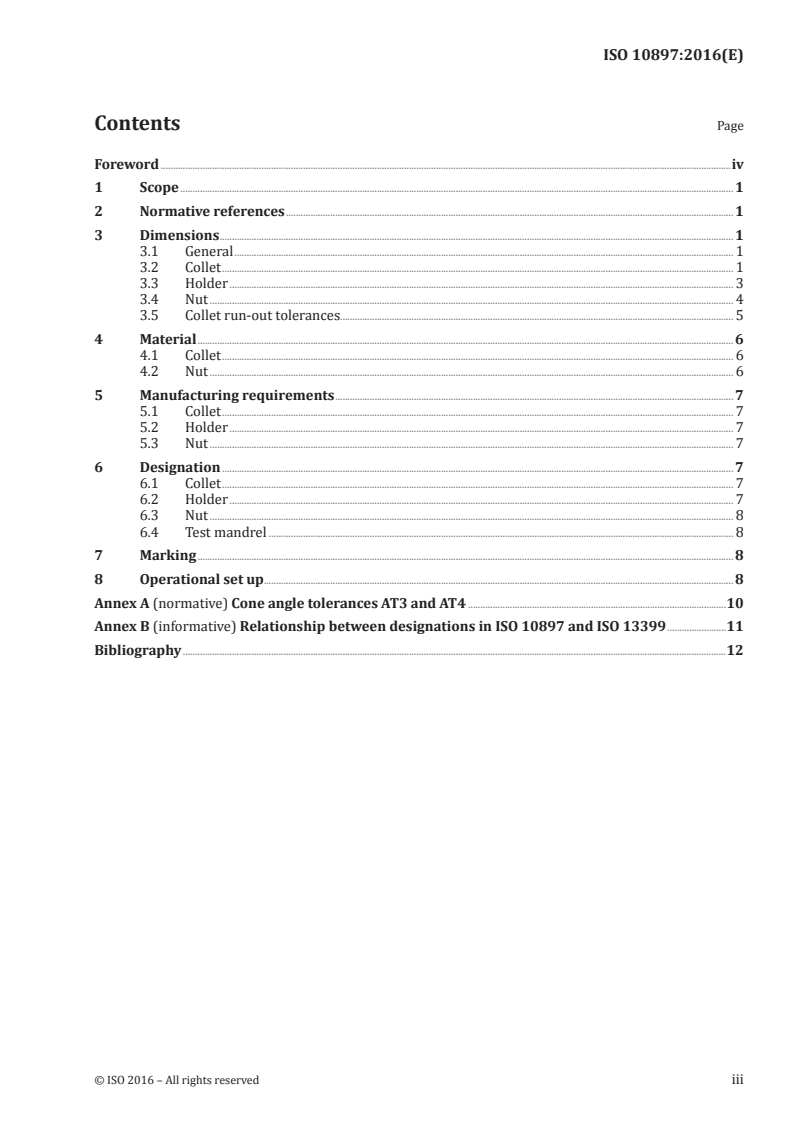
Contents Page
Foreword .iv
1 Scope . 1
2 Normative references . 1
3 Dimensions . 1
3.1 General . 1
3.2 Collet . 1
3.3 Holder . 3
3.4 Nut . 4
3.5 Collet run-out tolerances. 5
4 Material . 6
4.1 Collet . 6
4.2 Nut . 6
5 Manufacturing requirements . 7
5.1 Collet . 7
5.2 Holder . 7
5.3 Nut . 7
6 Designation . 7
6.1 Collet . 7
6.2 Holder . 7
6.3 Nut . 8
6.4 Test mandrel . 8
7 Marking . 8
8 Operational set up. 8
Annex A (normative) Cone angle tolerances AT3 and AT4 .10
Annex B (informative) Relationship between designations in ISO 10897 and ISO 13399 .11
Bibliography .12
Foreword
ISO (the International Organization for Standardization) is a worldwide federation of national standards
bodies (ISO member bodies). The work of preparing International Standards is normally carried out
through ISO technical committees. Each member body interested in a subject for which a technical
committee has been established has the right to be represented on that committee. International
organizations, governmental and non-governmental, in liaison with ISO, also take part in the work.
ISO collaborates closely with the International Electrotechnical Commission (IEC) on all matters of
electrotechnical standardization.
The procedures used to develop this document and those intended for its further maintenance are
described in the ISO/IEC Directives, Part 1. In particular the different approval criteria needed for the
different types of ISO documents should be noted. This document was drafted in accordance with the
editorial rules of the ISO/IEC Directives, Part 2 (see www.iso.org/directives).
Attention is drawn to the possibility that some of the elements of this document may be the subject of
patent rights. ISO shall not be held responsible for identifying any or all such patent rights. Details of
any patent rights identified during the development of the document will be in the Introduction and/or
on the ISO list of patent declarations received (see www.iso.org/patents).
Any trade name used in this document is information given for the convenience of users and does not
constitute an endorsement.
For an explanation on the meaning of ISO specific terms and expressions related to conformity
assessment, as well as information about ISO’s adherence to the WTO principles in the Technical
Barriers to Trade (TBT), see the following URL: Foreword — Supplementary information.
The committee responsible for this document is ISO/TC 29, Small tools, Subcommittee SC 2, Holding
tools, adaptive items and interfaces.
This second edition cancels and replaces the first edition (ISO 10897:1996), of which it constitutes a
minor revision with the addition of Annex B, showing the relationship between the symbols in this
International Standard and the symbols in the ISO 13399 series.
iv © ISO 2016 – All rights reserved
INTERNATIONAL STANDARD ISO 10897:2016(E)
Collets for tool holders with taper ratio 1:10 — Collets,
holders, nuts
1 Scope
This International Standard specifies the dimensions, materials and manufacturing requirements, and
designation of collets for tools with cylindrical shanks and their corresponding holders and nuts. For
non-standardized clamping devices, such as clamping devices specified in drawings, these holders can
be agreed upon between customer and supplier.
Form A applies where a clamping range of H10 is sufficient.
Form B can be used for any application without lateral cutting load.
Annex A specifies the values for AT3 tolerance and AT4 tolerance.
2 Normative references
The following documents, in whole or in part, are normatively referenced in this document and are
indispensable for its application. For dated references, only the edition cited applies. For undated
references, the latest edition of the referenced document (including any amendments) applies.
ISO 2768-1, General tolerances — Part 1: Tolerances for linear and angular di
...
International
Standard
ISO 10897
Second edition
Collets for tool holders with taper
2016-09-01
ratio 1:10 — Collets, holders, nuts
Corrected version
Pinces de serrage pour mandrins à conicité 1:10 — Pinces,
mandrins à pinces, écrous de serrage
2026-08
Reference number
© ISO 2016
All rights reserved. Unless otherwise specified, or required in the context of its implementation, no part of this publication may
be reproduced or utilized otherwise in any form or by any means, electronic or mechanical, including photocopying, or posting on
the internet or an intranet, without prior written permission. Permission can be requested from either ISO at the address below
or ISO’s member body in the country of the requester.
ISO copyright office
CP 401 • Ch. de Blandonnet 8
CH-1214 Vernier, Geneva
Phone: +41 22 749 01 11
Email: copyright@iso.org
Website: www.iso.org
Published in Switzerland
ii
Contents Page
Foreword .iv
1 Scope . 1
2 Normative references . 1
3 Dimensions . 1
3.1 General .1
3.2 Collet .1
3.3 Holder .3
3.4 Nut .4
3.5 Collet run-out tolerances .5
4 Material. 6
4.1 Collet .6
4.2 Nut .6
5 Manufacturing requirements . 7
5.1 Collet .7
5.2 Holder .7
5.3 Nut .7
6 Designation . 7
6.1 Collet .7
6.2 Holder .7
6.3 Nut .8
6.4 Test mandrel .8
7 Marking . . 8
8 Operational set up . 8
Annex A (normative) Cone angle tolerances AT3 and AT4 . 10
Annex B (informative) Relationship between designations in ISO 10897 and ISO 13399 .11
Bibliography .12
iii
Foreword
ISO (the International Organization for Standardization) is a worldwide federation of national standards
bodies (ISO member bodies). The work of preparing International Standards is normally carried out through
ISO technical committees. Each member body interested in a subject for which a technical committee
has been established has the right to be represented on that committee. International organizations,
governmental and non-governmental, in liaison with ISO, also take part in the work. ISO collaborates closely
with the International Electrotechnical Commission (IEC) on all matters of electrotechnical standardization.
The procedures used to develop this document and those intended for its further maintenance are described
in the ISO/IEC Directives, Part 1. In particular the different approval criteria needed for the different types
of ISO documents should be noted. This document was drafted in accordance with the editorial rules of the
ISO/IEC Directives, Part 2 (see www.iso.org/directives).
Attention is drawn to the possibility that some of the elements of this document may be the subject of patent
rights. ISO shall not be held responsible for identifying any or all such patent rights. Details of any patent
rights identified during the development of the document will be in the Introduction and/or on the ISO list of
patent declarations received (see www.iso.org/patents).
Any trade name used in this document is information given for the convenience of users and does not
constitute an endorsement.
For an explanation on the meaning of ISO specific terms and expressions related to conformity assessment,
as well as information about ISO's adherence to the WTO principles in the Technical Barriers to Trade (TBT),
see the following URL: Foreword — Supplementary information.
The committee responsible for this document is ISO/TC 29, Small tools, Subcommittee SC 2, Holding tools,
adaptive items and interfaces.
This second edition cancels and replaces the first edition (ISO 10897:1996), of which it constitutes a minor
revision with the addition of Annex B, showing the relationship between the symbols in this International
Standard and the symbols in the ISO 13399 series.
This corrected version of ISO 10897:2016 incorporates the following correction:
— in Table 1, the value of tolerance“−0,5” in the d column was corrected to “−0,05”.
iv
International Standard ISO 10897:2016(en)
Collets for tool holders with taper ratio 1:10 — Collets,
holders, nuts
1 Scope
This International Standard specifies the dimensions, materials and manufacturing requirements, and
designation of collets for tools with cylindrical shanks and their corresponding holders and nuts. For non-
standardized clamping devices, such as clamping devices specified in drawings, these holders can be agreed
upon between customer and supplier.
Form A applies where a clamping range of H10 is sufficient.
Form B can be used for any application without lateral cutting load.
Annex A specifies the values for AT3 tolerance and AT4 tolerance.
2 Normative references
The following documents, in whole or in part, are normatively referenced in this document and are
...
ISO/TC 29/SC
Date: 2016-09-01
Second edition
2016-09ISO/TC 29/SC /WG
Secretariat: AFNOR
Corrected version
2026-08
Collets for tool holders with taper ratio 1:10 — Collets, holders, nuts
Pinces de serrage pour mandrins à conicité 1:10 – — Pinces, mandrins à pinces, écrous de serrage
Copyright notice
This ISO document is a Draft International Standard and is copyright-protected by ISO. Except as permitted under © ISO
All rights reserved. Unless otherwise specified, or required in the applicable lawscontext of the user's country, neither its
implementation, no part of this ISO draft nor any extract from itpublication may be reproduced, stored in a retrieval
system or transmitted or utilized otherwise in any form or by any means, electronic, or mechanical, including
photocopying, recording or otherwiseor posting on the internet or an intranet, without prior written permission being
secured.
Requests for permission to reproduce should be addressed to . Permission can be requested from either ISO at the
address below or ISO'sISO’s member body in the country of the requester.
ISO copyright office
Case postale 56 • CP 401 • Ch. de Blandonnet 8
CH-12111214 Vernier, Geneva 20
Tel.Phone: + 41 22 749 01 11
Fax + 41 22 749 09 47
E-mail: copyright@iso.org
Website: www.iso.orgWeb www.iso.org
Reproduction may be subject to royalty payments or a licensing agreement.
Violators may be prosecuted.
Published in Switzerland
ii
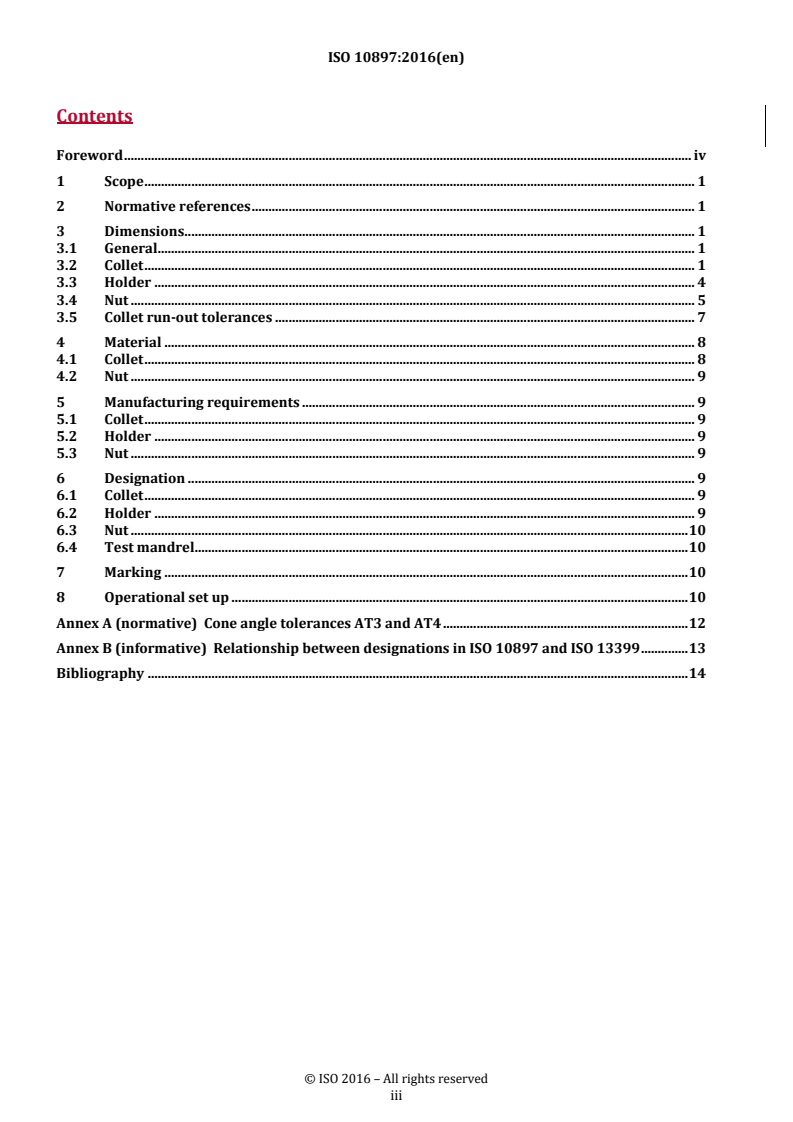
Contents
Foreword . iv
1 Scope . 1
2 Normative references . 1
3 Dimensions . 1
3.1 General . 1
3.2 Collet . 1
3.3 Holder . 4
3.4 Nut . 5
3.5 Collet run-out tolerances . 7
4 Material . 8
4.1 Collet . 8
4.2 Nut . 9
5 Manufacturing requirements . 9
5.1 Collet . 9
5.2 Holder . 9
5.3 Nut . 9
6 Designation . 9
6.1 Collet . 9
6.2 Holder . 9
6.3 Nut . 10
6.4 Test mandrel . 10
7 Marking . 10
8 Operational set up . 10
Annex A (normative) Cone angle tolerances AT3 and AT4 . 12
Annex B (informative) Relationship between designations in ISO 10897 and ISO 13399 . 13
Bibliography . 14
iii
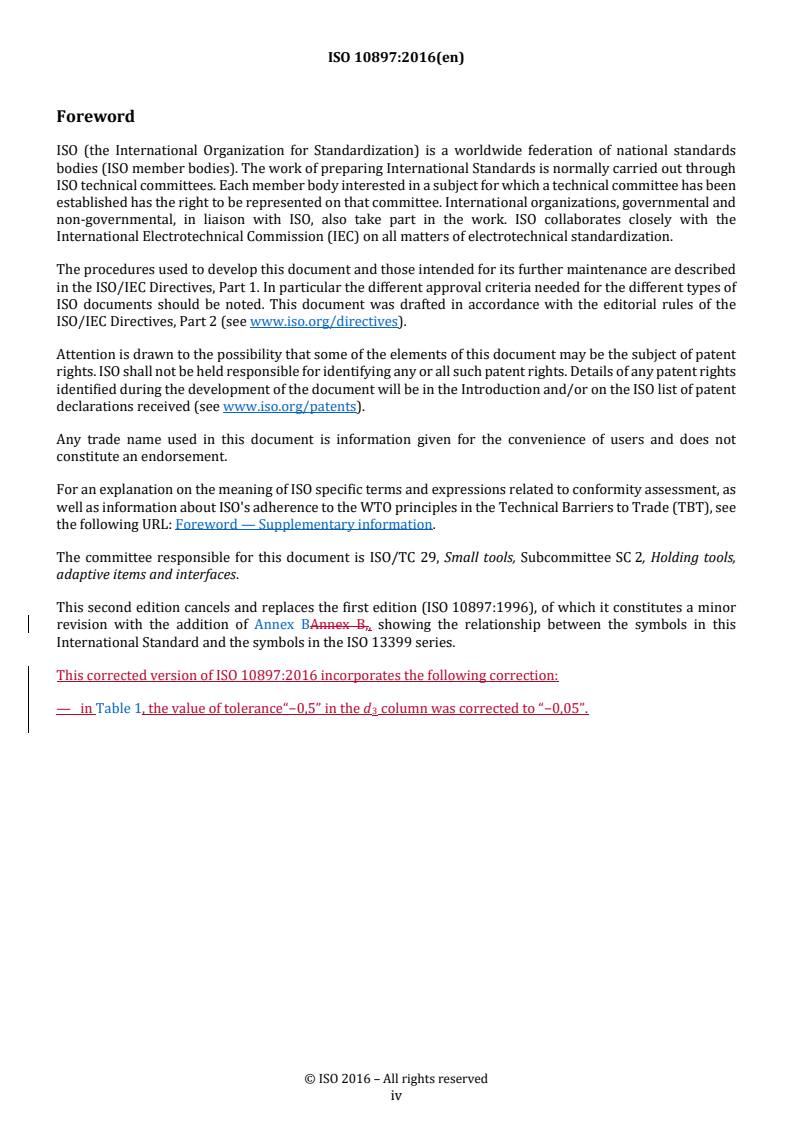
Foreword
ISO (the International Organization for Standardization) is a worldwide federation of national standards
bodies (ISO member bodies). The work of preparing International Standards is normally carried out through
ISO technical committees. Each member body interested in a subject for which a technical committee has been
established has the right to be represented on that committee. International organizations, governmental and
non-governmental, in liaison with ISO, also take part in the work. ISO collaborates closely with the
International Electrotechnical Commission (IEC) on all matters of electrotechnical standardization.
The procedures used to develop this document and those intended for its further maintenance are described
in the ISO/IEC Directives, Part 1. In particular the different approval criteria needed for the different types of
ISO documents should be noted. This document was drafted in accordance with the editorial rules of the
ISO/IEC Directives, Part 2 (see www.iso.org/directives).
Attention is drawn to the possibility that some of the elements of this document may be the subject of patent
rights. ISO shall not be held responsible for identifying any or all such patent rights. Details of any patent rights
identified during the development of the document will be in the Introduction and/or on the ISO list of patent
declarations received (see www.iso.org/patents).
Any trade name used in this document is information given for the convenience of users and does not
constitute an endorsement.
For an explanation on the meaning of ISO specific terms and expressions related to conformity assessment, as
well as information about ISO's adherence to the WTO principles in the Technical Barriers to Trade (TBT), see
the following URL: Foreword — Supplementary information.
The committee responsible for this document is ISO/TC 29, Small tools, Subcommittee SC 2, Holding tools,
adaptive items and interfaces.
This second edition cancels and replaces the first edition (ISO 10897:1996), of which it constitutes a minor
revision with the addition of Annex BAnnex B,, showing the relationship between the symbols in this
International Standard and the symbols in the ISO 13399 series.
This corrected version of ISO 10897:2016 incorporates the following correction:
— in Table 1, the value of tolerance“−0,5” in the d column was corrected to “−0,05”.
iv
Collets for tool holders with taper ratio 1:10 — Collets, holders, nuts
1 Scope
This International Standard specifies the dimensions, materials and manufacturing requirements, and
designation of collets for tools with cylindrical shanks and their corresponding holders and nuts. For non-
standardized clamping devices, such as clamping devices specified in drawings, these holders can be agreed
upon between customer and supplier.
Form A applies where a clamping range of H10 is sufficient.
Form B can be used for any application without lateral cutting load.
Annex AAnnex A specifies the values for AT3 tolerance and AT4 tolerance.
2 Normative references
The following documents, in whole or in part, are normatively referenced in this document and are
indispensable for its application. For dated references, only the edition cited applies. For undated references,
the latest edition of the referenced document (including any amendments) applies.
ISO 2768--1, General tolerances — Part 1: Tolerances for linear and angular dimensions without individual
tolerance indications
3 Dimensions
3.1 General
All dimensions and tolerances are given in millimetres. Tolerances not specified shall be of tolerance class “m”
in accordance with ISO 2768--1.
3.2 Collet
The dimensions of the collet shall be in accordance with the dimensions shown in Figure 1Figure 1 and
Figure 2Figure 2 and given in Table 1Table 1.
Surface roughness in micrometres
10897_ed2fig1.eps
Figure 1 — Collet form A, unilaterally slotted, with short clamping bore for cylindrical shanks
10897_ed2fig2.eps
Figure 2 — Collet form B, bilaterally slotted, with continuo
...
INTERNATIONAL ISO
STANDARD 10897
Second edition
2016-09-01
Collets for tool holders with taper
ratio 1:10 — Collets, holders, nuts
Pinces de serrage pour mandrins à conicité 1:10 — Pinces, mandrins
à pinces, écrous de serrage
Reference number
©
ISO 2016
© ISO 2016, Published in Switzerland
All rights reserved. Unless otherwise specified, no part of this publication may be reproduced or utilized otherwise in any form
or by any means, electronic or mechanical, including photocopying, or posting on the internet or an intranet, without prior
written permission. Permission can be requested from either ISO at the address below or ISO’s member body in the country of
the requester.
ISO copyright office
Ch. de Blandonnet 8 • CP 401
CH-1214 Vernier, Geneva, Switzerland
Tel. +41 22 749 01 11
Fax +41 22 749 09 47
copyright@iso.org
www.iso.org
ii © ISO 2016 – All rights reserved
Contents Page
Foreword .iv
1 Scope . 1
2 Normative references . 1
3 Dimensions . 1
3.1 General . 1
3.2 Collet . 1
3.3 Holder . 3
3.4 Nut . 4
3.5 Collet run-out tolerances. 5
4 Material . 6
4.1 Collet . 6
4.2 Nut . 6
5 Manufacturing requirements . 7
5.1 Collet . 7
5.2 Holder . 7
5.3 Nut . 7
6 Designation . 7
6.1 Collet . 7
6.2 Holder . 7
6.3 Nut . 8
6.4 Test mandrel . 8
7 Marking . 8
8 Operational set up. 8
Annex A (normative) Cone angle tolerances AT3 and AT4 .10
Annex B (informative) Relationship between designations in ISO 10897 and ISO 13399 .11
Bibliography .12
Foreword
ISO (the International Organization for Standardization) is a worldwide federation of national standards
bodies (ISO member bodies). The work of preparing International Standards is normally carried out
through ISO technical committees. Each member body interested in a subject for which a technical
committee has been established has the right to be represented on that committee. International
organizations, governmental and non-governmental, in liaison with ISO, also take part in the work.
ISO collaborates closely with the International Electrotechnical Commission (IEC) on all matters of
electrotechnical standardization.
The procedures used to develop this document and those intended for its further maintenance are
described in the ISO/IEC Directives, Part 1. In particular the different approval criteria needed for the
different types of ISO documents should be noted. This document was drafted in accordance with the
editorial rules of the ISO/IEC Directives, Part 2 (see www.iso.org/directives).
Attention is drawn to the possibility that some of the elements of this document may be the subject of
patent rights. ISO shall not be held responsible for identifying any or all such patent rights. Details of
any patent rights identified during the development of the document will be in the Introduction and/or
on the ISO list of patent declarations received (see www.iso.org/patents).
Any trade name used in this document is information given for the convenience of users and does not
constitute an endorsement.
For an explanation on the meaning of ISO specific terms and expressions related to conformity
assessment, as well as information about ISO’s adherence to the WTO principles in the Technical
Barriers to Trade (TBT), see the following URL: Foreword — Supplementary information.
The committee responsible for this document is ISO/TC 29, Small tools, Subcommittee SC 2, Holding
tools, adaptive items and interfaces.
This second edition cancels and replaces the first edition (ISO 10897:1996), of which it constitutes a
minor revision with the addition of Annex B, showing the relationship between the symbols in this
International Standard and the symbols in the ISO 13399 series.
iv © ISO 2016 – All rights reserved
INTERNATIONAL STANDARD ISO 10897:2016(E)
Collets for tool holders with taper ratio 1:10 — Collets,
holders, nuts
1 Scope
This International Standard specifies the dimensions, materials and manufacturing requirements, and
designation of collets for tools with cylindrical shanks and their corresponding holders and nuts. For
non-standardized clamping devices, such as clamping devices specified in drawings, these holders can
be agreed upon between customer and supplier.
Form A applies where a clamping range of H10 is sufficient.
Form B can be used for any application without lateral cutting load.
Annex A specifies the values for AT3 tolerance and AT4 tolerance.
2 Normative references
The following documents, in whole or in part, are normatively referenced in this document and are
indispensable for its application. For dated references, only the edition cited applies. For undated
references, the latest edition of the referenced document (including any amendments) applies.
ISO 2768-1, General tolerances — Part 1: Tolerances for linear and angular di
...
NORME ISO
INTERNATIONALE 10897
Deuxième édition
2016-09-01
Pinces de serrage pour mandrins à
conicité 1:10 — Pinces, mandrins à
pinces, écrous de serrage
Collets for tool holders with taper ratio 1:10 — Collets, holders, nuts
Numéro de référence
©
ISO 2016
DOCUMENT PROTÉGÉ PAR COPYRIGHT
© ISO 2016, Publié en Suisse
Droits de reproduction réservés. Sauf indication contraire, aucune partie de cette publication ne peut être reproduite ni utilisée
sous quelque forme que ce soit et par aucun procédé, électronique ou mécanique, y compris la photocopie, l’affichage sur
l’internet ou sur un Intranet, sans autorisation écrite préalable. Les demandes d’autorisation peuvent être adressées à l’ISO à
l’adresse ci-après ou au comité membre de l’ISO dans le pays du demandeur.
ISO copyright office
Ch. de Blandonnet 8 • CP 401
CH-1214 Vernier, Geneva, Switzerland
Tel. +41 22 749 01 11
Fax +41 22 749 09 47
copyright@iso.org
www.iso.org
ii © ISO 2016 – Tous droits réservés
Sommaire Page
Avant-propos .iv
1 Domaine d’application . 1
2 Références normatives . 1
3 Dimensions . 1
3.1 Généralités . 1
3.2 Pinces . 1
3.3 Mandrin à pinces . 3
3.4 Ecrou de serrage . 4
3.5 Tolérances de battement de la pince . 5
4 Matériau . 6
4.1 Pince . 6
4.2 Ecrou de serrage . 6
5 Exigences de fabrication. 7
5.1 Pince . 7
5.2 Mandrin à pinces . 7
5.3 Ecrou de serrage . 7
6 Désignation . 7
6.1 Pince . 7
6.2 Mandrin à pinces . 7
6.3 Ecrou de serrage . 8
6.4 Pige d’essai . 8
7 Marquage . 8
8 Ensemble monté . 8
Annexe A (normative) Tolérances de conicité AT3 et AT4 .10
Annexe B (informative) Relation entre les désignations de l’ISO 10897 et l’ISO 13399 .11
Bibliographie .12
Avant-propos
L’ISO (Organisation internationale de normalisation) est une fédération mondiale d’organismes
nationaux de normalisation (comités membres de l’ISO). L’élaboration des Normes internationales est
en général confiée aux comités techniques de l’ISO. Chaque comité membre intéressé par une étude
a le droit de faire partie du comité technique créé à cet effet. Les organisations internationales,
gouvernementales et non gouvernementales, en liaison avec l’ISO participent également aux travaux.
L’ISO collabore étroitement avec la Commission électrotechnique internationale (IEC) en ce qui
concerne la normalisation électrotechnique.
Les procédures utilisées pour élaborer le présent document et celles destinées à sa mise à jour sont
décrites dans les Directives ISO/IEC, Partie 1. Il convient, en particulier de prendre note des différents
critères d’approbation requis pour les différents types de documents ISO. Le présent document a été
rédigé conformément aux règles de rédaction données dans les Directives ISO/IEC, Partie 2 (voir www.
iso.org/directives).
L’attention est appelée sur le fait que certains des éléments du présent document peuvent faire l’objet de
droits de propriété intellectuelle ou de droits analogues. L’ISO ne saurait être tenue pour responsable
de ne pas avoir identifié de tels droits de propriété et averti de leur existence. Les détails concernant
les références aux droits de propriété intellectuelle ou autres droits analogues identifiés lors de
l’élaboration du document sont indiqués dans l’Introduction et/ou dans la liste des déclarations de
brevets reçues par l’ISO (voir www.iso.org/brevets).
Les appellations commerciales éventuellement mentionnées dans le présent document sont données
pour information, par souci de commodité, à l’intention des utilisateurs et ne sauraient constituer un
engagement.
Pour une explication de la signification des termes et expressions spécifiques de l’ISO liés à
l’évaluation de la conformité, ou pour toute information au sujet de l’adhésion de l’ISO aux principes
de l’OMC concernant les obstacles techniques au commerce (OTC), voir le lien suivant: Avant-propos —
Informations supplémentaires
L’ISO 10897 a été élaborée par le comité technique ISO/TC 29, Petit outillage, sous-comité SC 2, Porte-
outils, éléments relatifs aux attachements et interfaces.
Cette deuxième édition annule et remplace la première édition (ISO 10897:1996), dont elle constitue
une révision mineure avec l’ajout de l’Annexe B, qui donne la relation entre les symboles de la présente
Norme internationale et la série des ISO 13399.
iv © ISO 2016 – Tous droits réservés
NORME INTERNATIONALE ISO 10897:2016(F)
Pinces de serrage pour mandrins à conicité 1:10 — Pinces,
mandrins à pinces, écrous de serrage
1 Domaine d’application
La présente Norme internationale prescrit les dimensions, les matériaux et les exigences de fabrication
et spécifie la désignation des pinces pour outils à queue cylindrique lisse, les mandrins à pinces
correspondants et les écrous de serrage de ces mandrins. Les dispositifs de serrage non normalisés, tels
que par exemple ceux représentés sur les dessins, peuvent faire l’objet d’un accord client-fournisseur.
La forme A s’applique aux pinces pour lesquelles une capacité de serrage H10 est suffisante.
La forme B peut être utilisée pour les applications où il n’y a pas de force de coupe latérale.
L’Annexe A spécifie les valeurs pour la tolérance AT3 et la tolérance AT4.
2 Références normatives
Les documents suivants, entièrement ou en partie, sont référencés de façon normative dans le présent
document et sont indispensables à son application. Pour les références datées, seule l’édition citée
s’applique. Pour les références non datées, la dernière édition du document de référence s’applique (y
compris les éventuels amendements).
ISO 2768-1, Tolérances générales — Partie 1: Tolérances pour dimensions linéaires et angulaires non
affectées de tolérances individuelles
3 D
...
Norme
internationale
ISO 10897
Deuxième édition
Pinces de serrage pour mandrins à
2016-09-01
conicité 1:10 — Pinces, mandrins à
pinces, écrous de serrage
Version corrigée
2026-08
Collets for tool holders with taper ratio 1:10 — Collets, holders,
nuts
Numéro de référence
DOCUMENT PROTÉGÉ PAR COPYRIGHT
© ISO 2016
Tous droits réservés. Sauf prescription différente ou nécessité dans le contexte de sa mise en œuvre, aucune partie de cette
publication ne peut être reproduite ni utilisée sous quelque forme que ce soit et par aucun procédé, électronique ou mécanique,
y compris la photocopie, ou la diffusion sur l’internet ou sur un intranet, sans autorisation écrite préalable. Une autorisation peut
être demandée à l’ISO à l’adresse ci-après ou au comité membre de l’ISO dans le pays du demandeur.
ISO copyright office
Case postale 401 • Ch. de Blandonnet 8
CH-1214 Vernier, Genève
Tél.: +41 22 749 01 11
E-mail: copyright@iso.org
Web: www.iso.org
Publié en Suisse
ii
Sommaire Page
Avant-propos .iv
1 Domaine d'application . 1
2 Références normatives . 1
3 Dimensions . 1
3.1 Généralités .1
3.2 Pinces .1
3.3 Mandrin à pinces .3
3.4 Ecrou de serrage .4
3.5 Tolérances de battement de la pince .5
4 Matériau . 6
4.1 Pince .6
4.2 Ecrou de serrage .6
5 Exigences de fabrication . 7
5.1 Pince .7
5.2 Mandrin à pinces .7
5.3 Ecrou de serrage .7
6 Désignation . 7
6.1 Pince .7
6.2 Mandrin à pinces .7
6.3 Ecrou de serrage .8
6.4 Pige d'essai .8
7 Marquage . 8
8 Ensemble monté . 8
Annexe A (normative) Tolérances de conicité AT3 et AT4 .10
Annexe B (informative) Relation entre les désignations de l'ISO 10897 et l'ISO 13399.11
Bibliographie .12
iii
Avant-propos
L'ISO (Organisation internationale de normalisation) est une fédération mondiale d'organismes nationaux
de normalisation (comités membres de l'ISO). L'élaboration des Normes internationales est en général
confiée aux comités techniques de l'ISO. Chaque comité membre intéressé par une étude a le droit de faire
partie du comité technique créé à cet effet. Les organisations internationales, gouvernementales et non
gouvernementales, en liaison avec l'ISO participent également aux travaux. L'ISO collabore étroitement avec
la Commission électrotechnique internationale (IEC) en ce qui concerne la normalisation électrotechnique.
Les procédures utilisées pour élaborer le présent document et celles destinées à sa mise à jour sont
décrites dans les Directives ISO/IEC, Partie 1. Il convient, en particulier de prendre note des différents
critères d'approbation requis pour les différents types de documents ISO. Le présent document a
été rédigé conformément aux règles de rédaction données dans les Directives ISO/IEC, Partie 2 (voir
www.iso.org/directives).
L'attention est appelée sur le fait que certains des éléments du présent document peuvent faire l'objet de
droits de propriété intellectuelle ou de droits analogues. L'ISO ne saurait être tenue pour responsable
de ne pas avoir identifié de tels droits de propriété et averti de leur existence. Les détails concernant les
références aux droits de propriété intellectuelle ou autres droits analogues identifiés lors de l'élaboration du
document sont indiqués dans l'Introduction et/ou dans la liste des déclarations de brevets reçues par l'ISO
(voir www.iso.org/brevets).
Les appellations commerciales éventuellement mentionnées dans le présent document sont données pour
information, par souci de commodité, à l’intention des utilisateurs et ne sauraient constituer un engagement.
Pour une explication de la signification des termes et expressions spécifiques de l'ISO liés à l'évaluation de la
conformité, ou pour toute information au sujet de l'adhésion de l'ISO aux principes de l'OMC concernant les
obstacles techniques au commerce (OTC), voir le lien suivant: Avant-propos — Informations supplémentaires
L'ISO 10897 a été élaborée par le comité technique ISO/TC 29, Petit outillage, sous-comité SC 2, Porte-outils,
éléments relatifs aux attachements et interfaces.
Cette deuxième édition annule et remplace la première édition (ISO 10897:1996), dont elle constitue une
révision mineure avec l’ajout de l’Annexe B, qui donne la relation entre les symboles de la présente Norme
internationale et la série des ISO 13399.
La présente version corrigée de l'ISO 10897:2016 inclut la correction suivante:
— dans le Tableau 1, la valeur de la tolérance “−0,5” dans la colonne d a été corrigée en “−0,05”.
iv
Norme internationale ISO 10897:2016(fr)
Pinces de serrage pour mandrins à conicité 1:10 — Pinces,
mandrins à pinces, écrous de serrage
1 Domaine d'application
La présente Norme internationale prescrit les dimensions, les matériaux et les exigences de fabrication et
spécifie la désignation des pinces pour outils à queue cylindrique lisse, les mandrins à pinces correspondants
et les écrous de serrage de ces mandrins. Les dispositifs de serrage non normalisés, tels que par exemple
ceux représentés sur les dessins, peuvent faire l'objet d'un accord client-fournisseur.
La forme A s'applique aux pinces pour lesquelles une capacité de serrage H10 est suffisante.
La forme B peut être utilisée pour les applications où il n'y a pas de force de coupe latérale.
L’Annexe A spécifie les valeurs pour la tolérance AT3 et la tolérance AT4.
2 Références normatives
Les documents suivants, entièrement ou en partie, sont référencés de façon normative dans le présent
document et sont indispensables à son application. Pour les références datées, seule l'édition citée s'applique.
Pou
...
ISO/TC 29/SC 2
Date: 2016-04-18
ISO/FDIS 10897:2016(Ffr)
ISO/TC 29/SC 2/GT
Secrétariat: AFNOR
Deuxième édition
2016-09
Version corrigée
2026-08
Pinces de serrage pour mandrins à conicité 1:10 — Pinces, mandrins
à pinces, écrous de serrage
Collets for tool holders with taper ratio 1:10 — Collets, holders, nuts
Tous droits réservés. Sauf prescription différente ou nécessité dans le contexte de sa mise en oeuvre, aucune partie de
cette publication ne peut être reproduite ni utilisée sous quelque forme que ce soit et par aucun procédé, électronique
ou mécanique, y compris la photocopie, ou la diffusion sur l’internet ou sur un intranet, sans autorisation écrite préalable.
Une autorisation peut être demandée à l’ISO à l’adresse ci-après ou au comité membre de l’ISO dans le pays du
demandeur.
ISO copyright office
CP 401 • Ch. de Blandonnet 8
CH-1214 Vernier, Geneva
Phone: + 41 22 749 01 11
E-mail: copyright@iso.org
Website: www.iso.org
Publié en Suisse
ii
Sommaire
Avant-propos . iv
1 Domaine d'application . 1
2 Références normatives . 1
3 Dimensions . 1
3.1 Généralités . 1
3.2 Pinces . 1
3.3 Mandrin à pinces . 3
3.4 Ecrou de serrage . 4
3.5 Tolérances de battement de la pince . 6
4 Matériau . 7
4.1 Pince . 7
4.2 Ecrou de serrage . 8
5 Exigences de fabrication . 8
5.1 Pince . 8
5.2 Mandrin à pinces . 8
5.3 Ecrou de serrage . 8
6 Désignation . 8
6.1 Pince . 8
6.2 Mandrin à pinces . 9
6.3 Ecrou de serrage . 9
6.4 Pige d'essai . 9
7 Marquage . 9
8 Ensemble monté . 10
Annexe A (normative) Tolérances de conicité AT3 et AT4 . 12
Annexe B (informative) Relation entre les désignations de l'ISO 10897 et l'ISO 13399 . 13
Bibliographie . 14
iii
Avant-propos
L'ISO (Organisation internationale de normalisation) est une fédération mondiale d'organismes nationaux de
normalisation (comités membres de l'ISO). L'élaboration des Normes internationales est en général confiée
aux comités techniques de l'ISO. Chaque comité membre intéressé par une étude a le droit de faire partie du
comité technique créé à cet effet. Les organisations internationales, gouvernementales et non
gouvernementales, en liaison avec l'ISO participent également aux travaux. L'ISO collabore étroitement avec
la Commission électrotechnique internationale (IEC) en ce qui concerne la normalisation électrotechnique.
Les procédures utilisées pour élaborer le présent document et celles destinées à sa mise à jour sont décrites
dans les Directives ISO/IEC, Partie 1. Il convient, en particulier de prendre note des différents critères
d'approbation requis pour les différents types de documents ISO. Le présent document a été rédigé
conformément aux règles de rédaction données dans les Directives ISO/IEC, Partie 2 (voir
www.iso.org/directives).
Field Code Changed
L'attention est appelée sur le fait que certains des éléments du présent document peuvent faire l'objet de
droits de propriété intellectuelle ou de droits analogues. L'ISO ne saurait être tenue pour responsable de ne
pas avoir identifié de tels droits de propriété et averti de leur existence. Les détails concernant les références
aux droits de propriété intellectuelle ou autres droits analogues identifiés lors de l'élaboration du document
sont indiqués dans l'Introduction et/ou dans la liste des déclarations de brevets reçues par l'ISO (voir
www.iso.org/brevets).
Les appellations commerciales éventuellement mentionnées dans le présent document sont données pour
information, par souci de commodité, à l’intention des utilisateurs et ne sauraient constituer un engagement.
Pour une explication de la signification des termes et expressions spécifiques de l'ISO liés à l'évaluation de la
conformité, ou pour toute information au sujet de l'adhésion de l'ISO aux principes de l'OMC concernant les
obstacles techniques au commerce (OTC), voir le lien suivant: Avant-propos — Informations supplémentaires
L'ISO 10897 a été élaborée par le comité technique ISO/TC 29, Petit outillage, sous--comité SC 2, Porte-outils,
éléments relatifs aux attachements et interfaces.
Cette deuxième édition annule et remplace la première édition (ISO 10897:1996), dont elle constitue une
révision mineure avec l’ajout de l’Annexe Bl’Annexe B,, qui donne la relation entre les symboles de la présente
Norme internationale et la série des ISO 13399.
La présente version corrigée de l'ISO 10897:2016 inclut la correction suivante:
— dans le Tableau 1, la valeur de la tolérance “−0,5” dans la colonne d3 a été corrigée en “−0,05”.
iv
Pinces de serrage pour mandrins à conicité 1:10 — Pinces, mandrins
à pinces, écrous de serrage
1 Domaine d'application
La présente Norme internationale prescrit les dimensions, les matériaux et les exigences de fabrication et
spécifie la désignation des pinces pour outils à queue cylindrique lisse, les mandrins à pinces correspondants
et les écrous de serrage de ces mandrins. Les dispositifs de serrage non normalisés, tels que par exemple ceux
représentés sur les dessins, peuvent faire l'objet d'un accord client-fournisseur.
La forme A s'applique aux pinces pour lesquelles une capacité de serrage H10 est suffisante.
La forme B peut être utilisée pour les applications où il n'y a pas de force de coupe latérale.
L’Annexe AL’Annexe A spécifie les valeurs pour la tolérance AT3 et la tolérance AT4.
2 Références normatives
Les documents suivants, entièrement ou en partie, sont référencés de façon normative dans le présent
document et sont indispensables à son application. Pour les références datées, seule l'édition citée s'applique.
Pour les références non datées, la dernière édition du document de référence s'applique (y compris les
éventuels amendements).
ISO 2768--1, Tolérances générales — Partie 1: Tolérances pour dimensions linéaires et angulaires non affectées
de tolérances individuelles
3 Dimensions
3.1 Généralités
Toutes les dimensions et les tolérances sont données en millimètres. Les tolérances non spécifiées doivent
être d’une tolérance de classe "m" conformément à l’ISO 2768--1.
3.2 Pinces
Les dimensions des pinces doivent être conformes aux dimensions indiquées dans la Figure 1Figure 1 et la
Figure 2Figure 2 ainsi que dans le Tableau 1Tableau 1.
Rugosités de surfaces en micromètres
10897_ed2fig1_f.EPS
Figure 1 — Pince de forme A, fendue d'un seul côté, avec alésage non débouchant pour queues
cylindriques lisses
10897_ed2fig2_f.EPS
Figure 2 — Pince de forme B, fendue des deux côtés avec alésage débouchant pour queues
cylindriques lisses
Tableau 1 — Dimension des pinces
d
H7
a b l
Dimensio Forme A Forme B 6
d d
3 4
n d2 l1 l2 l3 l4 l5
±
...
NORME ISO
INTERNATIONALE 10897
Deuxième édition
2016-09-01
Pinces de serrage pour mandrins à
conicité 1:10 — Pinces, mandrins à
pinces, écrous de serrage
Collets for tool holders with taper ratio 1:10 — Collets, holders, nuts
Numéro de référence
©
ISO 2016
DOCUMENT PROTÉGÉ PAR COPYRIGHT
© ISO 2016, Publié en Suisse
Droits de reproduction réservés. Sauf indication contraire, aucune partie de cette publication ne peut être reproduite ni utilisée
sous quelque forme que ce soit et par aucun procédé, électronique ou mécanique, y compris la photocopie, l’affichage sur
l’internet ou sur un Intranet, sans autorisation écrite préalable. Les demandes d’autorisation peuvent être adressées à l’ISO à
l’adresse ci-après ou au comité membre de l’ISO dans le pays du demandeur.
ISO copyright office
Ch. de Blandonnet 8 • CP 401
CH-1214 Vernier, Geneva, Switzerland
Tel. +41 22 749 01 11
Fax +41 22 749 09 47
copyright@iso.org
www.iso.org
ii © ISO 2016 – Tous droits réservés
Sommaire Page
Avant-propos .iv
1 Domaine d’application . 1
2 Références normatives . 1
3 Dimensions . 1
3.1 Généralités . 1
3.2 Pinces . 1
3.3 Mandrin à pinces . 3
3.4 Ecrou de serrage . 4
3.5 Tolérances de battement de la pince . 5
4 Matériau . 6
4.1 Pince . 6
4.2 Ecrou de serrage . 6
5 Exigences de fabrication. 7
5.1 Pince . 7
5.2 Mandrin à pinces . 7
5.3 Ecrou de serrage . 7
6 Désignation . 7
6.1 Pince . 7
6.2 Mandrin à pinces . 7
6.3 Ecrou de serrage . 8
6.4 Pige d’essai . 8
7 Marquage . 8
8 Ensemble monté . 8
Annexe A (normative) Tolérances de conicité AT3 et AT4 .10
Annexe B (informative) Relation entre les désignations de l’ISO 10897 et l’ISO 13399 .11
Bibliographie .12
Avant-propos
L’ISO (Organisation internationale de normalisation) est une fédération mondiale d’organismes
nationaux de normalisation (comités membres de l’ISO). L’élaboration des Normes internationales est
en général confiée aux comités techniques de l’ISO. Chaque comité membre intéressé par une étude
a le droit de faire partie du comité technique créé à cet effet. Les organisations internationales,
gouvernementales et non gouvernementales, en liaison avec l’ISO participent également aux travaux.
L’ISO collabore étroitement avec la Commission électrotechnique internationale (IEC) en ce qui
concerne la normalisation électrotechnique.
Les procédures utilisées pour élaborer le présent document et celles destinées à sa mise à jour sont
décrites dans les Directives ISO/IEC, Partie 1. Il convient, en particulier de prendre note des différents
critères d’approbation requis pour les différents types de documents ISO. Le présent document a été
rédigé conformément aux règles de rédaction données dans les Directives ISO/IEC, Partie 2 (voir www.
iso.org/directives).
L’attention est appelée sur le fait que certains des éléments du présent document peuvent faire l’objet de
droits de propriété intellectuelle ou de droits analogues. L’ISO ne saurait être tenue pour responsable
de ne pas avoir identifié de tels droits de propriété et averti de leur existence. Les détails concernant
les références aux droits de propriété intellectuelle ou autres droits analogues identifiés lors de
l’élaboration du document sont indiqués dans l’Introduction et/ou dans la liste des déclarations de
brevets reçues par l’ISO (voir www.iso.org/brevets).
Les appellations commerciales éventuellement mentionnées dans le présent document sont données
pour information, par souci de commodité, à l’intention des utilisateurs et ne sauraient constituer un
engagement.
Pour une explication de la signification des termes et expressions spécifiques de l’ISO liés à
l’évaluation de la conformité, ou pour toute information au sujet de l’adhésion de l’ISO aux principes
de l’OMC concernant les obstacles techniques au commerce (OTC), voir le lien suivant: Avant-propos —
Informations supplémentaires
L’ISO 10897 a été élaborée par le comité technique ISO/TC 29, Petit outillage, sous-comité SC 2, Porte-
outils, éléments relatifs aux attachements et interfaces.
Cette deuxième édition annule et remplace la première édition (ISO 10897:1996), dont elle constitue
une révision mineure avec l’ajout de l’Annexe B, qui donne la relation entre les symboles de la présente
Norme internationale et la série des ISO 13399.
iv © ISO 2016 – Tous droits réservés
NORME INTERNATIONALE ISO 10897:2016(F)
Pinces de serrage pour mandrins à conicité 1:10 — Pinces,
mandrins à pinces, écrous de serrage
1 Domaine d’application
La présente Norme internationale prescrit les dimensions, les matériaux et les exigences de fabrication
et spécifie la désignation des pinces pour outils à queue cylindrique lisse, les mandrins à pinces
correspondants et les écrous de serrage de ces mandrins. Les dispositifs de serrage non normalisés, tels
que par exemple ceux représentés sur les dessins, peuvent faire l’objet d’un accord client-fournisseur.
La forme A s’applique aux pinces pour lesquelles une capacité de serrage H10 est suffisante.
La forme B peut être utilisée pour les applications où il n’y a pas de force de coupe latérale.
L’Annexe A spécifie les valeurs pour la tolérance AT3 et la tolérance AT4.
2 Références normatives
Les documents suivants, entièrement ou en partie, sont référencés de façon normative dans le présent
document et sont indispensables à son application. Pour les références datées, seule l’édition citée
s’applique. Pour les références non datées, la dernière édition du document de référence s’applique (y
compris les éventuels amendements).
ISO 2768-1, Tolérances générales — Partie 1: Tolérances pour dimensions linéaires et angulaires non
affectées de tolérances individuelles
3 D
...