


ISO 9658:2024
(Main)Steel — Determination of aluminium content — Flame atomic absorption spectrometric method
Steel — Determination of aluminium content — Flame atomic absorption spectrometric method
This document specifies a flame atomic absorption spectrometric method for the determination of acid-soluble and/or total aluminium in non-alloyed steel. The method is applicable to aluminium contents between 0,005 % (mass fraction) and 0,20 % (mass fraction).
Aciers — Détermination de l'aluminium — Méthode par spectrométrie d'absorption atomique dans la flamme
Le présent document prescrit une méthode de détermination par spectrométrie d'absorption atomique dans la flamme, de l'aluminium soluble dans l'acide et/ou l'aluminium total dans les aciers non alliés. La méthode est applicable aux teneurs en aluminium comprises entre 0,005 % (en masse) et 0,20 % (en masse).
General Information
- Status
- Published
- Publication Date
- 12-Sep-2024
- Technical Committee
- ISO/TC 17/SC 1 - Methods of determination of chemical composition
- Drafting Committee
- ISO/TC 17/SC 1 - Methods of determination of chemical composition
- Current Stage
- 6060 - International Standard published
- Start Date
- 13-Sep-2024
- Due Date
- 15-Jul-2024
- Completion Date
- 13-Sep-2024
Relations
- Effective Date
- 12-Feb-2026
- Effective Date
- 04-Feb-2023
- Effective Date
- 28-Jan-2023
Overview - What ISO 9658:2024 covers
ISO 9658:2024 specifies a flame atomic absorption spectrometric (FAAS) method for determining acid‑soluble and/or total aluminium in non‑alloyed steel. The procedure applies to aluminium contents from 0.005 % to 0.20 % (mass fraction). The standard describes sample preparation, required reagents and apparatus, instrument performance criteria, calibration and calculation of results, and reporting requirements.
Keywords: ISO 9658:2024, aluminium determination, steel analysis, flame atomic absorption spectrometry, FAAS, acid‑soluble aluminium.
Key technical topics and requirements
- Analytical principle: Dissolve test portion in a hydrochloric–nitric acid mixture; fuse any acid‑insoluble residue with an orthoboric acid/potassium carbonate mixture; nebulize the final solution into a dinitrogen monoxide–acetylene flame and measure atomic absorption at 309.3 nm (aluminium hollow‑cathode lamp).
- Scope and range: Applicable to non‑alloyed steel with aluminium between 0.005 % and 0.20 % mass fraction.
- Reagents and standards: Includes preparation of aluminium standard solutions (e.g., 2.0 g/L, 0.20 g/L, 0.020 g/L) and specific acid mixtures; use reagents of analytical grade and water conforming to ISO 3696.
- Apparatus & performance:
- FAAS with Al hollow‑cathode lamp (or equivalent source).
- Flame gases: dinitrogen monoxide and acetylene; strict purity to avoid Al contamination.
- Instrument performance criteria: limit of detection < 0.1 µg/mL, characteristic concentration < 1.0 µg/mL, precision thresholds for repeated absorbance measurements, and calibration linearity requirements.
- Sampling & sample prep: Per ISO 14284 or applicable national standards; typical test portion ~2.0 g, degreasing, acid digestion, filtration, fusion of residues when necessary.
- Quality controls: Parallel blank tests, calibration graphs, and precision assessment are specified.
Practical applications - who uses this standard
- Steel laboratories performing routine chemical composition analysis and quality control.
- Metallurgists and production engineers monitoring aluminium content to control de‑oxidation, grain refinement and mechanical properties.
- Third‑party testing and certification bodies verifying compliance with material specifications.
- Instrument manufacturers and lab analysts validating FAAS performance against ISO criteria. Practical benefits include reproducible aluminium determinations, traceability of results, and conformance with international best practice for non‑alloyed steel.
Related standards
- ISO 14284 - Sampling and preparation of samples for chemical composition
- ISO 3696 - Water for analytical laboratory use
- ISO 385, ISO 648, ISO 1042 - Laboratory glassware standards
ISO 9658:2024 provides a clear, standardized FAAS workflow to ensure accurate, reproducible aluminium measurements in steel, supporting quality control, material certification, and process optimization.
Buy Documents
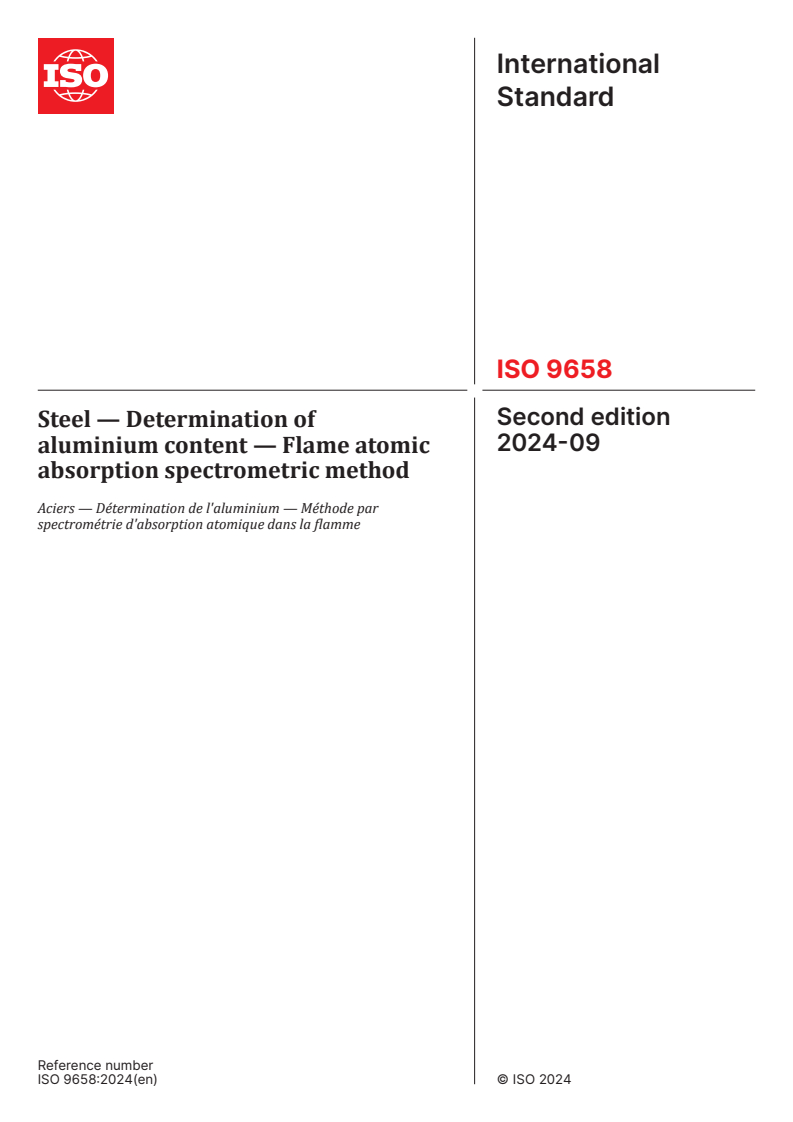

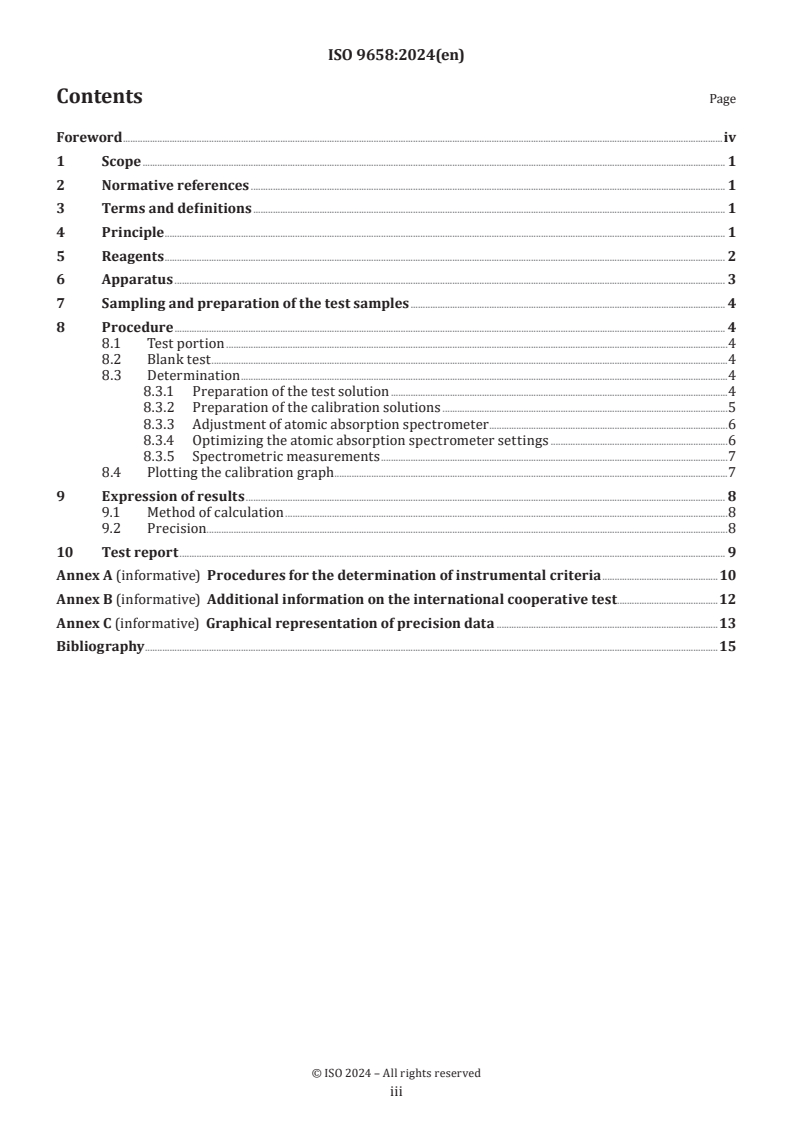

ISO 9658:2024 - Steel — Determination of aluminium content — Flame atomic absorption spectrometric method Released:13. 09. 2024
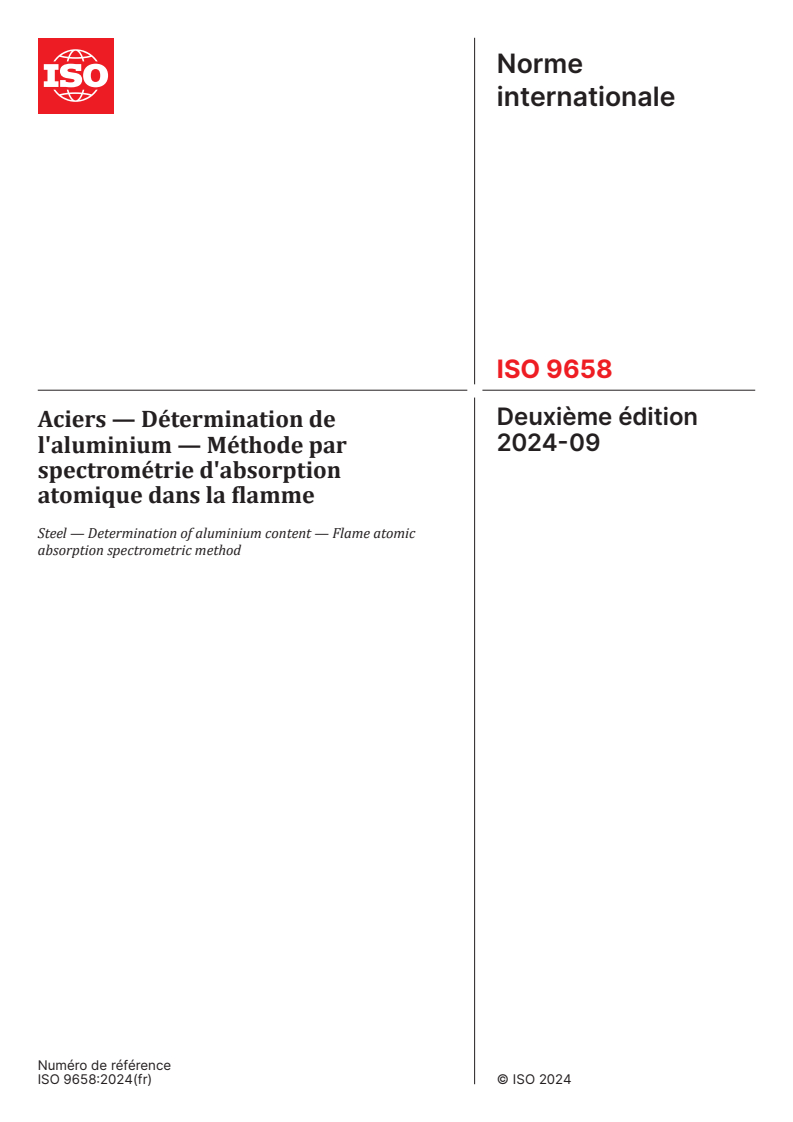

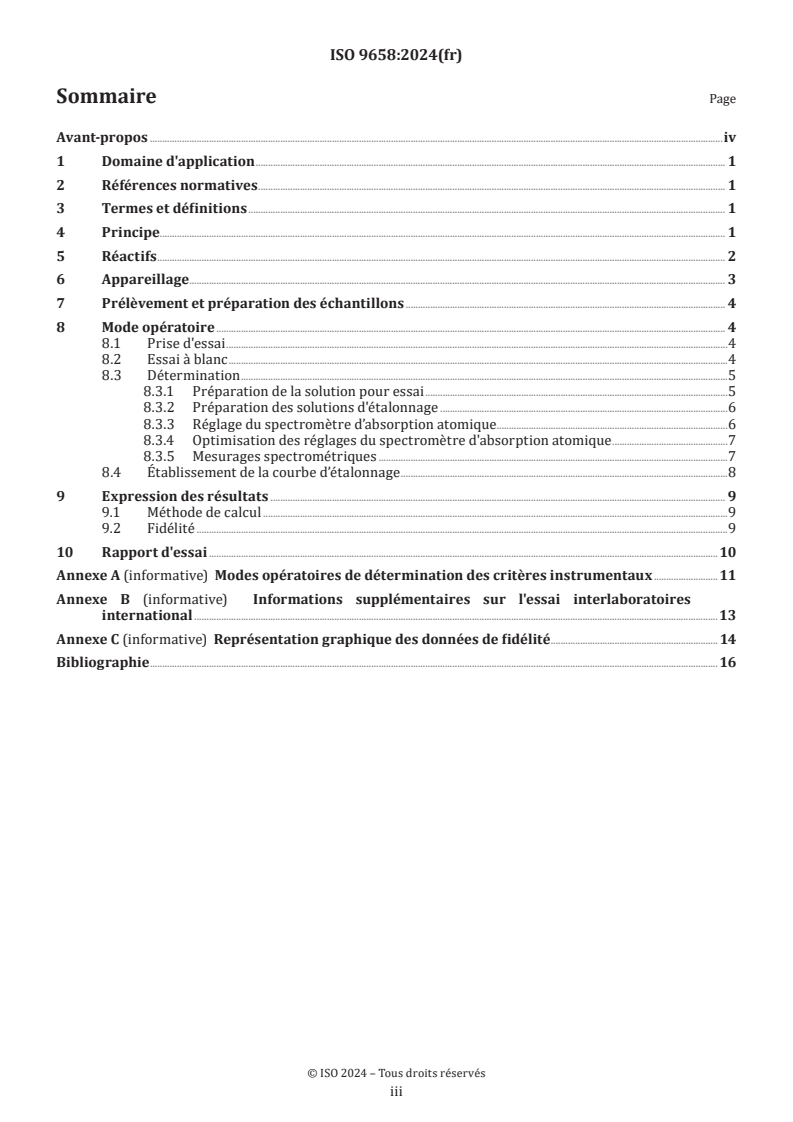
ISO 9658:2024 - Aciers — Détermination de l'aluminium — Méthode par spectrométrie d'absorption atomique dans la flamme Released:13. 09. 2024
Get Certified
Connect with accredited certification bodies for this standard

Element Materials Technology
Materials testing and product certification.

Inštitut za kovinske materiale in tehnologije
Institute of Metals and Technology. Materials testing, metallurgical analysis, NDT.
Sponsored listings
Frequently Asked Questions
ISO 9658:2024 is a standard published by the International Organization for Standardization (ISO). Its full title is "Steel — Determination of aluminium content — Flame atomic absorption spectrometric method". This standard covers: This document specifies a flame atomic absorption spectrometric method for the determination of acid-soluble and/or total aluminium in non-alloyed steel. The method is applicable to aluminium contents between 0,005 % (mass fraction) and 0,20 % (mass fraction).
This document specifies a flame atomic absorption spectrometric method for the determination of acid-soluble and/or total aluminium in non-alloyed steel. The method is applicable to aluminium contents between 0,005 % (mass fraction) and 0,20 % (mass fraction).
ISO 9658:2024 is classified under the following ICS (International Classification for Standards) categories: 77.080.20 - Steels. The ICS classification helps identify the subject area and facilitates finding related standards.
ISO 9658:2024 has the following relationships with other standards: It is inter standard links to EN ISO 9658:2024, ISO 11819-1:2023, ISO 9658:1990. Understanding these relationships helps ensure you are using the most current and applicable version of the standard.
ISO 9658:2024 is available in PDF format for immediate download after purchase. The document can be added to your cart and obtained through the secure checkout process. Digital delivery ensures instant access to the complete standard document.
Standards Content (Sample)
International
Standard
ISO 9658
Second edition
Steel — Determination of
2024-09
aluminium content — Flame atomic
absorption spectrometric method
Aciers — Détermination de l'aluminium — Méthode par
spectrométrie d'absorption atomique dans la flamme
Reference number
© ISO 2024
All rights reserved. Unless otherwise specified, or required in the context of its implementation, no part of this publication may
be reproduced or utilized otherwise in any form or by any means, electronic or mechanical, including photocopying, or posting on
the internet or an intranet, without prior written permission. Permission can be requested from either ISO at the address below
or ISO’s member body in the country of the requester.
ISO copyright office
CP 401 • Ch. de Blandonnet 8
CH-1214 Vernier, Geneva
Phone: +41 22 749 01 11
Email: copyright@iso.org
Website: www.iso.org
Published in Switzerland
ii
Contents Page
Foreword .iv
1 Scope . 1
2 Normative references . 1
3 Terms and definitions . 1
4 Principle . 1
5 Reagents . 2
6 Apparatus . 3
7 Sampling and preparation of the test samples . 4
8 Procedure . 4
8.1 Test portion .4
8.2 Blank test .4
8.3 Determination .4
8.3.1 Preparation of the test solution .4
8.3.2 Preparation of the calibration solutions .5
8.3.3 Adjustment of atomic absorption spectrometer .6
8.3.4 Optimizing the atomic absorption spectrometer settings .6
8.3.5 Spectrometric measurements .7
8.4 Plotting the calibration graph .7
9 Expression of results . 8
9.1 Method of calculation .8
9.2 Precision . . .8
10 Test report . 9
Annex A (informative) Procedures for the determination of instrumental criteria .10
Annex B (informative) Additional information on the international cooperative test .12
Annex C (informative) Graphical representation of precision data .13
Bibliography .15
iii
Foreword
ISO (the International Organization for Standardization) is a worldwide federation of national standards
bodies (ISO member bodies). The work of preparing International Standards is normally carried out through
ISO technical committees. Each member body interested in a subject for which a technical committee
has been established has the right to be represented on that committee. International organizations,
governmental and non-governmental, in liaison with ISO, also take part in the work. ISO collaborates closely
with the International Electrotechnical Commission (IEC) on all matters of electrotechnical standardization.
The procedures used to develop this document and those intended for its further maintenance are described
in the ISO/IEC Directives, Part 1. In particular, the different approval criteria needed for the different types
of ISO document should be noted. This document was drafted in accordance with the editorial rules of the
ISO/IEC Directives, Part 2 (see www.iso.org/directives).
ISO draws attention to the possibility that the implementation of this document may involve the use of (a)
patent(s). ISO takes no position concerning the evidence, validity or applicability of any claimed patent
rights in respect thereof. As of the date of publication of this document, ISO had not received notice of (a)
patent(s) which may be required to implement this document. However, implementers are cautioned that
this may not represent the latest information, which may be obtained from the patent database available at
www.iso.org/patents. ISO shall not be held responsible for identifying any or all such patent rights.
Any trade name used in this document is information given for the convenience of users and does not
constitute an endorsement.
For an explanation of the voluntary nature of standards, the meaning of ISO specific terms and expressions
related to conformity assessment, as well as information about ISO's adherence to the World Trade
Organization (WTO) principles in the Technical Barriers to Trade (TBT), see www.iso.org/iso/foreword.html.
This document was prepared by Technical Committee ISO/TC 17, Steel, Subcommittee SC 1, Methods of
determination of chemical composition, in collaboration with the European Committee for Standardization
(CEN) Technical Committee CEN/TC 459, ECISS - European Committee for Iron and Steel Standardization, in
accordance with the Agreement on technical cooperation between ISO and CEN (Vienna Agreement).
This second edition cancels and replaces the first edition (ISO 9658:1990), which has been technically
revised.
The main changes are as follows:
— re-assessment of the precision data;
— updating of the normative references;
— adding of some notes that can contribute to a better accuracy of the method;
— adding a Bibliography.
Any feedback or questions on this document should be directed to the user’s national standards body. A
complete listing of these bodies can be found at www.iso.org/members.html.
iv
International Standard ISO 9658:2024(en)
Steel — Determination of aluminium content — Flame atomic
absorption spectrometric method
1 Scope
This document specifies a flame atomic absorption spectrometric method for the determination of acid-
soluble and/or total aluminium in non-alloyed steel.
The method is applicable to aluminium contents between 0,005 % (mass fraction) and 0,20 % (mass fraction).
2 Normative references
The following documents are referred to in the text in such a way that some or all of their content constitutes
requirements of this document. For dated references, only the edition cited applies. For undated references,
the latest edition of the referenced document (including any amendments) applies.
ISO 385, Laboratory glassware — Burettes
ISO 648, Laboratory glassware — Single-volume pipettes
ISO 1042, Laboratory glassware — One-mark volumetric flasks
ISO 3696, Water for analytical laboratory use — Specification and test methods
ISO 14284, Steel and iron — Sampling and preparation of samples for the determination of chemical composition
3 Terms and definitions
For the purposes of this document, the following terms and definitions apply.
ISO and IEC maintain terminological databases for use in standardization at the following addresses
— ISO Online browsing platform: available at https:// www .iso .org/ obp
— IEC Electropedia: available at https:// www .electropedia .org/
3.1
acid-soluble aluminium
aluminium dissolved in an acid mixture
4 Principle
Dissolution of a test portion in dilute hydrochloric and nitric acids.
Fusion of the acid-insoluble residues with a mixture of orthoboric acid and potassium carbonate.
Nebulization of the solution into a dinitrogen monoxide-acetylene flame.
Spectrometric measurement of the atomic absorption of the 309,3 nm spectral line emitted by an aluminium
hollow cathode lamp.
NOTE Other suitable radiation sources can also be used, provided the criteria in 6.5.1 to 6.5.4 are still met.
5 Reagents
During the analysis, unless otherwise stated, use only reagents of recognized analytical grade and only
distilled water or water of equivalent purity as specified in ISO 3696.
5.1 Pure iron, containing less than 0,000 1 % (mass fraction) of aluminium or of low and known
aluminium content.
5.2 Hydrofluoric acid, ρ approximately 1,15 g/ml.
5.3 Hydrochloric acid, ρ approximately 1,19 g/ml, diluted 1 + 1.
5.4 Hydrochloric acid, ρ approximately 1,19 g/ml, diluted 2 + 100.
5.5 Sulfuric acid, ρ approximately 1,84 g/ml, diluted 1 + 1.
5.6 Hydrochloric-nitric acids mixture.
Mix three volumes of hydrochloric acid (ρ approximately 1,19 g/ml), one volume of nitric acid
(ρ approximately 1,40 g/ml) and two volumes of water.
This mixture shall be prepared immediately before use.
5.7 Fusion mixture.
Mix 1 part by mass of orthoboric acid (H BO ) and 1 part by mass of anhydrous potassium carbonate
3 3
(K CO ).
2 3
5.8 Fusion mixture solution.
Dissolve 20,0 g of the fusion mixture (5.7) in water and dilute to 100 ml.
5,0 ml of this solution contain 1,0 g of the fusion mixture (5.7).
5.9 Aluminium standard solution, 2,0 g /l.
Weigh, to the nearest 0,001 g, 2,000 g of high purity aluminium [99,9 % (mass fraction)], and dissolve in
40 ml of hydrochloric acid (ρ about 1,19 g/ml) and 10 ml of nitric acid (ρ about 1,40 g/ml). Boil to eliminate
oxides of nitrogen. Cool and transfer the solution quantitatively into a l 000 ml one-mark volumetric flask,
dilute to the mark with water and mix.
1 ml of this solution contains 2,0 mg of aluminium.
5.10 Aluminium standard solution, 0,20 g/l.
Transfer 20,0 ml of the aluminium standard (5.9) into a 200 ml one-mark volumetric flask. Dilute to the
mark with water and mix.
Prepare this standard solution immediately prior to use.
1 ml of this solution contains 0,20 mg of aluminium.
5.11 Aluminium standard solution, 0,020 g/l.
Transfer 20,0 ml of the aluminium standard solution (5.10) into a 200 ml one-mark volumetric flask. Dilute
to the mark with water and mix.
Prepare this standard solution immediately prior to use.
1 ml of this solution contains 0,020 mg of aluminium.
6 Apparatus
During the analysis, unless otherwise stated, ordinary laboratory apparatus and the following shall be used.
All laboratory glassware shall be class A, in accordance with ISO 385, ISO 648 or ISO 1042 as appropriate.
All glassware shall first be washed in hydrochloric acid (5.3), and then in water. The quantity of aluminium
present in the beakers and flasks can be checked by measuring the absorption of distilled water introduced
in the glassware after the acid wash.
6.1 Filter, 0,45 µm cellulose nitrate filter.
6.2 Filter funnel.
Two-piece acid-resistant filter funnel with a support screen between the funnel body and stem, designed for
the vacuum filtration of liquids. The stem of the funnel is fitted with a ground glass cap stopper or a rubber
stopper for insertion into an opening of the vacuum vessel.
6.3 Vacuum vessel.
Flask of capacity 500 ml, or large enough to contain a 100 ml one-mark volumetric flask, with an opening to
allow the insertion of the rubber stopper of the filter funnel stem.
6.4 Platinum crucible, capacity of about 30 ml.
6.5 Atomic absorption spectrometer.
WARNING — Follow the manufacturer’s instructions for igniting and extinguishing the dinitrogen
monoxide/acetylene flame to avoid possible explosion hazards. Wear tinted safety glasses whenever
the burner is in operation.
The spectrometer shall be equipped with an aluminium hollow-cathode lamp or other suitable radiation
source and supplied with dinitrogen monoxide and acetylene sufficiently pure to give a steady clear fuel-
lean flame, free from water and oil, and free from aluminium.
The atomic absorption spectrometer used will be satisfactory if, after optimization according to 8.3.4, the
limit of detection and characteristic concentration are in reasonable agreement with the values given by the
manufacturer and it meets the performance criteria given in 6.5.1 to 6.5.3.
The instrument should also conform to the additional performance requirement given in 6.5.4.
6.5.1 Minimum precision
The standard deviation of 10 measurements of the absorbance of the most concentrated calibration solution
shall not exceed 1,5 % of the mean absorbance of this solution.
The standard deviation of 10 measurements of the absorbance of the least concentrated calibration solution
(excluding the zero member) shall not exceed 0,5 % of the mean absorbance of the most concentrated
calibration solution.
6.5.2 Limit of detection
The limit of detection is a number, expressed in units of concentration (or amount) that describes the lowest
concentration level (or amount) of an element that can be determined to be statistically different from an
analytical blank.
The limit of detection of aluminium in a matrix similar to the final test solution shall be less than 0,1 μg/ml.
6.5.3 Calibration linearity
The slope of the calibration curve covering the top 20 % of the concentration range (expressed as a change
in absorbance) shall not be less than 0,7 times the value of the slope for the bottom 20 % of the concentration
range determined in the same way.
For instruments with automatic calibration using two or more calibration solutions, it shall be established
prior to the analysis, by obtaining absorbance readings, that the above requirements for calibration linearity
are fulfilled.
6.5.4 Characteristic concentration
The characteristic concentration for aluminium in a matrix similar to the final test solution shall be lower
than 1,0 μg/ml.
6.6 Ancillary equipment
Scale expansion can be used until the noise observed is greater than the readout error and is always
recommended for absorbances below 0,1. If scale expansion has to be used and the instrument does not
have the means to read the value of the scale expansion factor, the value can be calculated by measuring a
suitable solution with and without scale expansion and then dividing the signal obtained.
7 Sampling and preparation of the test samples
Sampling and sample preparation shall be carried out in accordance with ISO 14284 or appropriate national
standard for steel.
8 Procedure
8.1 Test portion
If necessary, degrease the test sample by cleaning in a suitable solvent. Evaporate the last traces of the
solvent by warming, cautiously.
Weigh, to the nearest 0,1 mg, approximately 2,0 g of the test sample.
8.2 Blank test
In parallel with the determination and following the same procedure, carry out a blank test using the same
quantities of all reagents, including pure iron (5.1) as used for the determination instead of the test portion.
Background correction may be required.
8.3 Determination
8.3.1 Preparation of the test solution
8.3.1.1 Dissolution of the test portion
Place the test portion (8.1) into a 250 ml beaker. Add, in small portions, 40 ml of the acid mixture (5.6) and
cover the beaker with a watch-glass. Heat until acid action ceases. Boil to eliminate oxides of nitrogen and cool.
8.3.1.2 Filtration of the test solution
Place a filter (6.1) on the support screen of a filter funnel (6.2). Moisten the filter with water and join the
body and stem of the funnel. Insert the stopper of the filter funnel stem into a vacuum vessel (6.3). Apply
vacuum gently to the vacuum vessel and filter the solution.
Wash the funnel sides and residue with warm hydrochloric acid (5.4) and warm water alternately until they
are visually free from iron.
Stop the vacuum gently.
When the filtrate is collected into the 500 ml vacuum vessel:
— If the volume of the filtrate and the washings is less than about 70 ml, transfer the solution quantitatively
into a 100 ml one-
...
Norme
internationale
ISO 9658
Deuxième édition
Aciers — Détermination de
2024-09
l'aluminium — Méthode par
spectrométrie d'absorption
atomique dans la flamme
Steel — Determination of aluminium content — Flame atomic
absorption spectrometric method
Numéro de référence
DOCUMENT PROTÉGÉ PAR COPYRIGHT
© ISO 2024
Tous droits réservés. Sauf prescription différente ou nécessité dans le contexte de sa mise en œuvre, aucune partie de cette
publication ne peut être reproduite ni utilisée sous quelque forme que ce soit et par aucun procédé, électronique ou mécanique,
y compris la photocopie, ou la diffusion sur l’internet ou sur un intranet, sans autorisation écrite préalable. Une autorisation peut
être demandée à l’ISO à l’adresse ci-après ou au comité membre de l’ISO dans le pays du demandeur.
ISO copyright office
Case postale 401 • Ch. de Blandonnet 8
CH-1214 Vernier, Genève
Tél.: +41 22 749 01 11
E-mail: copyright@iso.org
Web: www.iso.org
Publié en Suisse
ii
Sommaire Page
Avant-propos .iv
1 Domaine d'application . 1
2 Références normatives . 1
3 Termes et définitions . 1
4 Principe. 1
5 Réactifs . 2
6 Appareillage . 3
7 Prélèvement et préparation des échantillons . 4
8 Mode opératoire . 4
8.1 Prise d'essai .4
8.2 Essai à blanc .4
8.3 Détermination .5
8.3.1 Préparation de la solution pour essai .5
8.3.2 Préparation des solutions d'étalonnage .6
8.3.3 Réglage du spectromètre d’absorption atomique .6
8.3.4 Optimisation des réglages du spectromètre d'absorption atomique .7
8.3.5 Mesurages spectrométriques .7
8.4 Établissement de la courbe d’étalonnage .8
9 Expression des résultats . 9
9.1 Méthode de calcul .9
9.2 Fidélité .9
10 Rapport d'essai .10
Annexe A (informative) Modes opératoires de détermination des critères instrumentaux .11
Annexe B (informative) Informations supplémentaires sur l'essai interlaboratoires
international .13
Annexe C (informative) Représentation graphique des données de fidélité . 14
Bibliographie .16
iii
Avant-propos
L'ISO (Organisation internationale de normalisation) est une fédération mondiale d'organismes nationaux
de normalisation (comités membres de l'ISO). L'élaboration des Normes internationales est en général
confiée aux comités techniques de l'ISO. Chaque comité membre intéressé par une étude a le droit de faire
partie du comité technique créé à cet effet. Les organisations internationales, gouvernementales et non
gouvernementales, en liaison avec l'ISO participent également aux travaux. L'ISO collabore étroitement avec
la Commission électrotechnique internationale (IEC) en ce qui concerne la normalisation électrotechnique.
Les procédures utilisées pour élaborer le présent document et celles destinées à sa mise à jour sont
décrites dans les Directives ISO/IEC, Partie 1. Il convient, en particulier, de prendre note des différents
critères d'approbation requis pour les différents types de documents ISO. Le présent document a
été rédigé conformément aux règles de rédaction données dans les Directives ISO/IEC, Partie 2 (voir
www.iso.org/directives).
L'ISO attire l’attention sur le fait que la mise en application du présent document peut entraîner l’utilisation
d’un ou de plusieurs brevets. L’ISO ne prend pas position quant à la preuve, à la validité et à l’applicabilité de
tout droit de propriété revendiqué à cet égard. À la date de publication du présent document, l’ISO n'avait pas
reçu notification qu’un ou plusieurs brevets pouvaient être nécessaires à sa mise en application. Toutefois,
il y a lieu d’avertir les responsables de la mise en application du présent document que des informations
plus récentes sont susceptibles de figurer dans la base de données de brevets, disponible à l'adresse
www.iso.org/brevets. L’ISO ne saurait être tenue pour responsable de ne pas avoir identifié tout ou partie de
tels droits de propriété.
Les appellations commerciales éventuellement mentionnées dans le présent document sont données pour
information, par souci de commodité, à l’intention des utilisateurs et ne sauraient constituer un engagement.
Pour une explication de la nature volontaire des normes, la signification des termes et expressions
spécifiques de l'ISO liés à l'évaluation de la conformité, ou pour toute information au sujet de l'adhésion de
l'ISO aux principes de l’Organisation mondiale du commerce (OMC) concernant les obstacles techniques au
commerce (OTC), voir www.iso.org/avant-propos
Le présent document a été élaboré par le comité technique ISO/TC 17, Acier, sous-comité SC 1, Méthodes
de détermination de la composition chimique, en collaboration avec le comité technique CEN/TC 459,
ECISS - Comité européen de normalisation du fer et de l'acier, du Comité européen de normalisation (CEN)
conformément à l’Accord de coopération technique entre l’ISO et le CEN (Accord de Vienne).
Cette deuxième édition annule et remplace la première édition (ISO 9658:1990), qui a fait l'objet d'une
révision technique.
Les principales modifications sont les suivantes:
— réévaluation des données de fidélité;
— mise à jour des références normatives;
— ajout de quelques notes qui contribueraient à une meilleure exactitude de la méthode;
— ajout de la Bibliographie.
Il convient que l’utilisateur adresse tout retour d’information ou toute question concernant le présent
document à l’organisme national de normalisation de son pays. Une liste exhaustive desdits organismes se
trouve à l’adresse www.iso.org/members.html.
iv
Norme internationale ISO 9658:2024(fr)
Aciers — Détermination de l'aluminium — Méthode par
spectrométrie d'absorption atomique dans la flamme
1 Domaine d'application
Le présent document prescrit une méthode de détermination par spectrométrie d'absorption atomique dans
la flamme, de l'aluminium soluble dans l'acide et/ou l'aluminium total dans les aciers non alliés.
La méthode est applicable aux teneurs en aluminium comprises entre 0,005 % (en masse) et 0,20 % (en masse).
2 Références normatives
Les documents suivants sont cités dans le texte de sorte qu’ils constituent, pour tout ou partie de leur
contenu, des exigences du présent document. Pour les références datées, seule l’édition citée s’applique. Pour
les références non datées, la dernière édition du document de référence s'applique (y compris les éventuels
amendements).
ISO 385, Verrerie de laboratoire — Burettes
ISO 648, Verrerie de laboratoire — Pipettes à un volume
ISO 1042, Verrerie de laboratoire — Fioles jaugées à un trait
ISO 3696, Eau pour laboratoire à usage analytique — Spécification et méthodes d'essai
ISO 14284, Aciers et fontes — Prélèvement et préparation des échantillons pour la détermination de la
composition chimique
3 Termes et définitions
Pour les besoins du présent document, les termes et définitions suivants s'appliquent.
L'ISO et l'IEC tiennent à jour des bases de données terminologiques destinées à être utilisées en normalisation,
consultables aux adresses suivantes:
— ISO Online browsing platform: disponible à l'adresse https:// www .iso .org/ obp
— IEC Electropedia: disponible à l'adresse https:// www .electropedia .org/
3.1
aluminium soluble dans l'acide
aluminium mis en solution dans un mélange d'acides
4 Principe
Mise en solution d'une prise d'essai dans les acides chlorhydrique et nitrique dilués.
Fusion du résidu insoluble dans l'acide par un mélange d'acide orthoborique et de carbonate de potassium.
Nébulisation de la solution dans une flamme de monoxyde de diazote et d'acétylène.
Mesurage spectrométrique de l'absorption atomique de la raie spectrale à 309,3 nm émise par une lampe à
cathode creuse en aluminium.
NOTE D'autres sources de rayonnement appropriées peuvent également être utilisées, à condition que les critères
énoncés de 6.5.1 à 6.5.4 soient toujours respectés.
5 Réactifs
Au cours de l'analyse, sauf indication contraire, utiliser uniquement des réactifs de qualité analytique
reconnue et de l'eau distillée ou de l'eau de pureté équivalente, tel que spécifié dans l'ISO 3696.
5.1 Fer pur, avec une teneur en aluminium inférieure à 0,000 1 % (en masse) ou à teneur faible et connue
en aluminium.
5.2 Acide fluorhydrique, ρ 1,15 g/ml environ.
5.3 Acide chlorhydrique, ρ 1,19 g/ml environ, dilué 1 + 1.
5.4 Acide chlorhydrique, ρ 1,19 g/ml environ, dilué 2 + 100.
5.5 Acide sulfurique, ρ 1,84 g/ml environ, dilué 1 + 1.
5.6 Mélange d'acides chlorhydrique et nitrique.
Mélanger 3 volumes d'acide chlorhydrique (ρ 1,19 g/ml environ), 1 volume d'acide nitrique (ρ 1,40 g/ml
environ), et 2 volumes d'eau.
Ce mélange doit être préparé immédiatement avant l'emploi.
5.7 Mélange de fusion.
Mélanger 1 partie en masse de l'acide orthoborique (H B0 ) et 1 partie en masse de carbonate de potassium
3 3
anhydre (K C0 ).
2 3
5.8 Solution du mélange de fusion.
Mettre en solution 20,0 g du mélange de fusion (5.7) dans de l'eau et diluer à 100 ml.
5,0 ml de cette solution contiennent 1,0 g du mélange de fusion (5.7).
5.9 Solution étalon d'aluminium, 2,0 g/l.
Peser à 0,001 g près, 2,000 g d'aluminium de haute pureté [99,9 % (en masse)]; les mettre en solution par
40 ml d'acide chlorhydrique (ρ 1,19 g/ml environ) et 10 ml d'acide nitrique (ρ 1,40 g/ml environ). Porter à
l'ébullition afin d'éliminer les oxydes d'azote. Laisser refroidir et transvaser la solution quantitativement
dans une fiole jaugée de 1 000 ml, compléter au volume avec de l'eau et homogénéiser.
1 ml de cette solution contient 2,0 mg d'aluminium.
5.10 Solution étalon d'aluminium, 0,20 g/l.
Transvaser 20,0 ml de la solution étalon (5.9) dans une fiole jaugée de 200 ml. Compléter au volume avec de
l'eau et homogénéiser.
Préparer cette solution étalon immédiatement avant l'emploi.
1 ml de cette solution contient 0,20 mg d'aluminium.
5.11 Solution étalon d'aluminium, 0,020 g/l.
Transvaser 20,0 ml de la solution étalon d'aluminium (5.10) dans une fiole jaugée de 200 ml. Compléter au
volume avec de l'eau et homogénéiser.
Préparer cette solution étalon immédiatement avant l'emploi.
1 ml de cette solution contient 0,020 mg d'aluminium.
6 Appareillage
Au cours de l'analyse, sauf indication contraire, le matériel courant de laboratoire et les matériels suivants
doivent être utilisés.
Toute la verrerie de laboratoire jaugée doit être de classe A, conformément à l’ISO 385, l'ISO 648 ou l’ISO 1042,
selon le cas.
Toute la verrerie doit d'abord être nettoyée avec de l'acide chlorhydrique (5.3), puis avec de l'eau. La quantité
d'aluminium présente dans les béchers et les fioles peut être vérifiée en mesurant l'absorption de l'eau
distillée introduite dans la verrerie après le lavage avec de l'acide.
6.1 Filtre, filtre en nitrate de cellulose 0,45 μm.
6.2 Entonnoir filtrant.
Entonnoir filtrant en deux parties, résistant à l'acide, muni d'un support de tamis entre le corps de l'entonnoir
et la tige, conçu pour la filtration sous vide de liquides. La tige de l’entonnoir est équipée d’un bouchon en
verre rodé ou d’un bouchon en caoutchouc pour l’insertion dans l'ouverture de la fiole à vide.
6.3 Fiole à vide.
Fiole d'une capacité de 500 ml, ou suffisamment grande pour contenir une fiole jaugée de 100 ml, ayant une
ouverture permettant d'insérer le bouchon en caoutchouc de la tige d'entonnoir filtrant.
6.4 Creuset en platine, d'une capacité de 30 ml environ.
6.5 Spectromètre d'absorption atomique.
AVERTISSEMENT — Suivre les instructions du fabricant pour l'allumage et l'extinction de la flamme
monoxyde de diazote/acétylène afin d'éviter tout risque d'explosion. Porter des lunettes de sécurité
teintées lorsque le brûleur fonctionne.
Le spectromètre doit être équipé d'une lampe à cathode creuse en aluminium ou d'une autre source de
rayonnement et doit être alimenté en monoxyde de diazote et en acétylène suffisamment purs pour obtenir
une flamme pauvre en combustible, claire et stable, et exempte d'eau, d'huile et d'aluminium.
Le spectromètre d'absorption atomique utilisé sera satisfaisant si, après optimisation conformément au
8.3.4, la limite de détection et la concentration caractéristique sont raisonnablement en accord avec les
valeurs données par le fabricant, et s'il répond aux critères de performance donnés de 6.5.1 à 6.5.3.
Il est également recommandé que l'instrument soit conforme aux exigences de performance complémentaires
données en 6.5.4.
6.5.1 Fidélité minimale
L'écart-type de 10 mesurages de l'absorbance de la solution d'étalonnage la plus concentrée ne doit pas
excéder 1,5 % de l'absorbance moyenne de cette solution.
L'écart-type de 10 mesurages de l'absorbance de la solution d'étalonnage la moins concentrée (excepté le
terme zéro) ne doit pas excéder 0,5 % de l'absorbance moyenne de la solution d'étalonnage la plus concentrée.
6.5.2 Limite de détection
La limite de détection est un nombre, exprimé en unités de concentration (ou de quantité), qui décrit le plus
faible niveau de concentration (ou la quantité) d'un élément dont on peut déterminer qu'il est statistiquement
différent d'un blanc analytique.
La limite de détection de l'aluminium dans une matrice similaire à celle de la solution pour essai finale doit
être inférieure à 0,1 μg/ml.
6.5.3 Linéarité de l'étalonnage
La pente de la courbe d'étalonnage correspondant aux 20 % supérieurs de la gamme de concentrations
(exprimée en variation d'absorbance) ne doit pas être inférieure à 0,7 fois la valeur de la pente représentant
les 20 % inférieurs, déterminés de la même façon.
Pour les instruments ayant des étalonnages automatiques, utilisant deux solutions d’étalonnage ou plus, il
doit être établi que les exigences susmentionnées pour la linéarité de l'étalonnage sont remplies, par lecture
des absorbances, avant l’analyse.
6.5.4 Concentration caractéristique
La concentration caractéristique de l'aluminium dans une matrice similaire à celle de la solution pour essai
finale doit être inférieure à 1,0 μg/ml.
6.6 Équipement auxiliaire
L'expansion d'échelle peut être utilisée tant que le bruit observé est supérieur à l'erreur de lecture et est
toujours recommandée pour les absorbances inférieures à 0,1. S'il est nécessaire d'utiliser l'expansion
d'échelle et si l'instrument ne permet pas de lire la valeur du coefficient d'expansion d'échelle, la valeur peut
être calculée en mesurant une solution appropriée avec et sans expansion d'échelle, puis en divisant les
signaux obtenus.
7 Prélèvement et préparation des échantillons
Le prélèvement et la préparation des échantillons doivent être effectués conformément à l’ISO 14284 ou
conformément aux normes nationales applicables pour les aciers.
8 Mode opératoire
8.1 Prise d'essai
Si nécessaire, dégraisser l'échantillon pour essai en le nettoyant dans un solvant approprié. Évaporer les
dernières traces de solvant en chauffant avec précaution.
Peser, à 0,1 mg près, environ 2,0 g de l'échantillon pour essai.
8.2 Essai à blanc
Parallèlement à la détermination et en suivant le même mode opératoire, effectuer un essai à blanc en
utilisant les mêmes quantités de tous les réactifs que celles utilisées pour la détermination, et en utilisant le
fer pur (5.1) au lieu de la prise d'essai.
Une correction du bruit de fond peut être nécessaire.
8.3 Détermination
8.3.1 Préparation de la solution pour essai
8.3.1.1 Mise en solution de la prise d'essai
Placer la prise d'essai (8.1) dans un bécher de 250 ml. Ajouter, par petites fractions, 40 ml d’acide
chlorhydrique (5.6) et couvrir le bécher d’un verre de montre. Chauffer jusqu’à ce que l’action de l'acide
cesse. Faire bouillir la solution pour éliminer les oxydes d'azote et laisser refroidir.
8.3.1.2 Filtration de la solution pour essai
Placer un filtre (6.1) sur le support de l'entonnoir filtrant (6.2). Humecter le filtre avec de l'eau et assembler
la base avec la tige de l'entonnoir. Insérer le bouchon en caoutchouc de la tige de l'entonnoir filtrant dans la
fiole à vide (6.3). Appliquer un vide modéré à la fiole à vide et filtrer la solution.
Rincer les parois de l'entonnoir et son résidu alternativement avec de l'acide chlorhydrique (5.4) chaud et de
l'eau chaude jusqu'à élimination visuelle du fer.
Arrêter progressivement l'aspiration.
Lorsque le filtrat est récupéré dans la fiole à vide de 500 ml:
— si le volume du filtrat et des fractions de rinçage est inférieur à 70 ml environ, transvaser quantitativement
la solution dans une fiole jaugée de 100 ml, et poursuivre suivant 8.3.1.3 ou 8.3.1.4;
— si le vo
...
Questions, Comments and Discussion
Ask us and Technical Secretary will try to provide an answer. You can facilitate discussion about the standard in here.
Loading comments...