


ISO 12004-1:2020
(Main)Metallic materials — Determination of forming-limit curves for sheet and strip — Part 1: Measurement and application of forming-limit diagrams in the press shop
Metallic materials — Determination of forming-limit curves for sheet and strip — Part 1: Measurement and application of forming-limit diagrams in the press shop
This document specifies a procedure for developing forming-limit diagrams and forming-limit curves for metal sheets and strips of thicknesses from 0,3 mm to 4 mm.
Matériaux métalliques — Détermination des courbes limites de formage pour les tôles et bandes — Partie 1: Mesurage et application des diagrammes limites de formage dans les ateliers d'emboutissage
Le présent document spécifie une procédure pour l'établissement des diagrammes limites de formage et des courbes limites de formage pour les tôles et bandes métalliques d'épaisseur comprise entre 0,3 mm et 4 mm.
General Information
- Status
- Published
- Publication Date
- 25-Oct-2020
- Technical Committee
- ISO/TC 164/SC 2 - Ductility testing
- Drafting Committee
- ISO/TC 164/SC 2 - Ductility testing
- Current Stage
- 9060 - Close of review
- Completion Date
- 04-Jun-2031
Relations
- Effective Date
- 12-Feb-2026
- Effective Date
- 06-Jun-2022
- Effective Date
- 23-Apr-2020
Overview
ISO 12004-1:2020 specifies a practical, shop-floor procedure for developing forming-limit diagrams (FLDs) and forming-limit curves (FLCs) for metallic sheets and strips (thickness range 0.3 mm to 4 mm). The standard describes how to measure major and minor engineering strains on formed parts in the press shop, determine the onset of necking or fracture, and plot the material’s forming limits for use in process assessment and troubleshooting.
Key topics and technical requirements
- Scope: Measurement and application of FLDs/FLCs for sheet and strip metals in press-shop conditions (0.3–4 mm thickness).
- Principle: Apply a precise grid to the flat test piece, form until first fracture, then measure change in gauge lengths to calculate major/minor engineering strains and plot points on the FLD.
- Gauge lengths: Recommended 1.5 mm to 5.0 mm; initial lengths must be known to ±2%.
- Strain measurement: Use three adjacent gauge lengths in the major strain direction (repeat until within ±10 %) and measure orthogonal gauge length for minor strain. Calculate percent engineering strain from change in gauge length.
- Test conditions: Ensure uniform strain in the critical area prior to necking; any tooling that achieves this (presses, tensile machines, bulge rigs) is acceptable. Stop tests at the first occurrence of fracture.
- Grid patterns: Annex B shows common grid types (circular, square, center crosses) used to measure strain.
- Reporting: Clause 9 requires inclusion of reference to ISO 12004-1, part identification, thickness, plotted FLC/FLD, gauge length, and lubrication conditions. Optional items include mechanical properties, chemical composition and deviations (see Annex A for permitted FLC modifications).
Applications and users
- Who uses it: Press-shop engineers, stamping/die designers, quality/control engineers, material and process engineers in industries performing sheet metal forming (e.g., automotive, appliance, aerospace).
- Practical uses:
- Validate whether component features are in the safe-forming region or likely to neck/fail
- Compare forming behavior of production batches or tooling changes
- Support troubleshooting of stamping defects and optimize lubrication/tooling
Related standards
- ISO 12004-2 - determination of forming-limit curves under laboratory conditions (material characterization using defined strain paths).
- ISO 10275 - determination of tensile strain-hardening exponent (n-value), referenced for possible FLC adjustments (Annex A).
Keywords: ISO 12004-1:2020, forming-limit diagram, forming-limit curve, FLD, FLC, sheet metal formability, press shop measurement, strain measurement, metal forming.
Buy Documents
ISO 12004-1:2020 - Metallic materials -- Determination of forming-limit curves for sheet and strip
ISO 12004-1:2020 - Metallic materials — Determination of forming-limit curves for sheet and strip — Part 1: Measurement and application of forming-limit diagrams in the press shop/26/2020
ISO 12004-1:2020 - Matériaux métalliques -- Détermination des courbes limites de formage pour les tôles et bandes
ISO 12004-1:2020 - Matériaux métalliques — Détermination des courbes limites de formage pour les tôles et bandes — Partie 1: Mesurage et application des diagrammes limites de formage dans les ateliers d'emboutissage/26/2020
Get Certified
Connect with accredited certification bodies for this standard

Element Materials Technology
Materials testing and product certification.

Inštitut za kovinske materiale in tehnologije
Institute of Metals and Technology. Materials testing, metallurgical analysis, NDT.
Sponsored listings
Frequently Asked Questions
ISO 12004-1:2020 is a standard published by the International Organization for Standardization (ISO). Its full title is "Metallic materials — Determination of forming-limit curves for sheet and strip — Part 1: Measurement and application of forming-limit diagrams in the press shop". This standard covers: This document specifies a procedure for developing forming-limit diagrams and forming-limit curves for metal sheets and strips of thicknesses from 0,3 mm to 4 mm.
This document specifies a procedure for developing forming-limit diagrams and forming-limit curves for metal sheets and strips of thicknesses from 0,3 mm to 4 mm.
ISO 12004-1:2020 is classified under the following ICS (International Classification for Standards) categories: 77.040.10 - Mechanical testing of metals. The ICS classification helps identify the subject area and facilitates finding related standards.
ISO 12004-1:2020 has the following relationships with other standards: It is inter standard links to EN ISO 12004-1:2020, ISO 20852:2020, ISO 12004-1:2008. Understanding these relationships helps ensure you are using the most current and applicable version of the standard.
ISO 12004-1:2020 is available in PDF format for immediate download after purchase. The document can be added to your cart and obtained through the secure checkout process. Digital delivery ensures instant access to the complete standard document.
Standards Content (Sample)
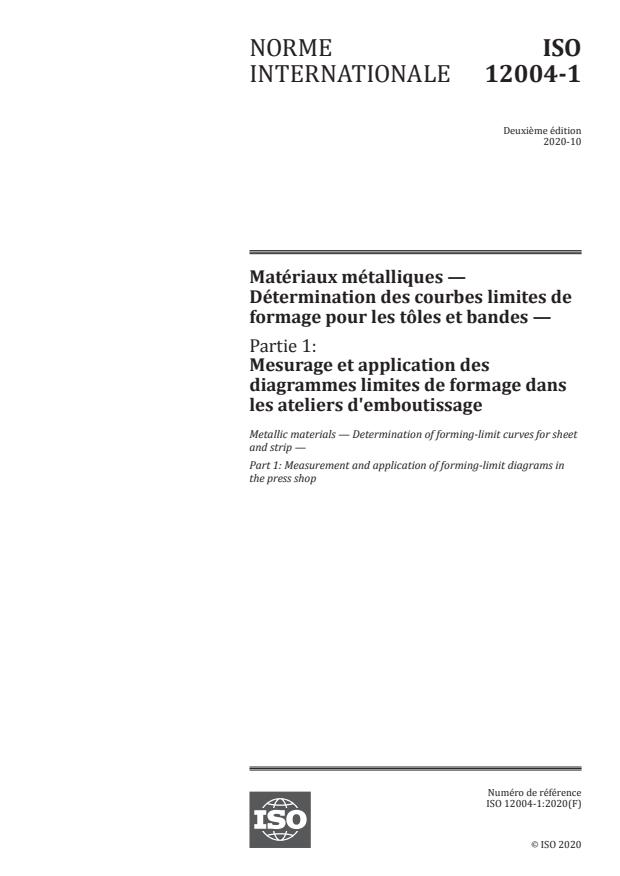
INTERNATIONAL ISO
STANDARD 12004-1
Second edition
2020-10
Metallic materials — Determination
of forming-limit curves for sheet and
strip —
Part 1:
Measurement and application of
forming-limit diagrams in the press
shop
Matériaux métalliques — Détermination des courbes limites de
formage pour les tôles et bandes —
Partie 1: Mesurage et application des diagrammes limites de formage
dans les ateliers d'emboutissage
Reference number
©
ISO 2020
© ISO 2020
All rights reserved. Unless otherwise specified, or required in the context of its implementation, no part of this publication may
be reproduced or utilized otherwise in any form or by any means, electronic or mechanical, including photocopying, or posting
on the internet or an intranet, without prior written permission. Permission can be requested from either ISO at the address
below or ISO’s member body in the country of the requester.
ISO copyright office
CP 401 • Ch. de Blandonnet 8
CH-1214 Vernier, Geneva
Phone: +41 22 749 01 11
Email: copyright@iso.org
Website: www.iso.org
Published in Switzerland
ii © ISO 2020 – All rights reserved
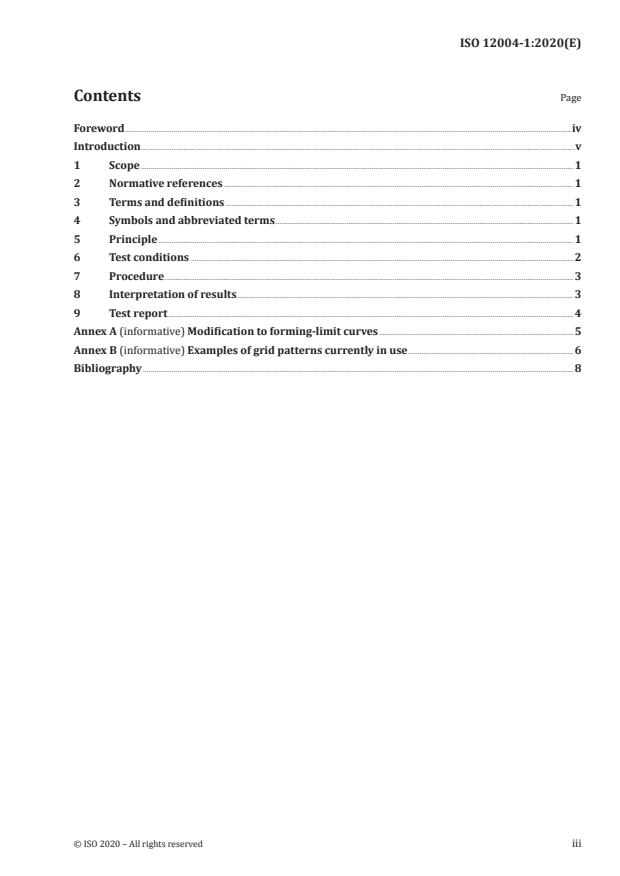
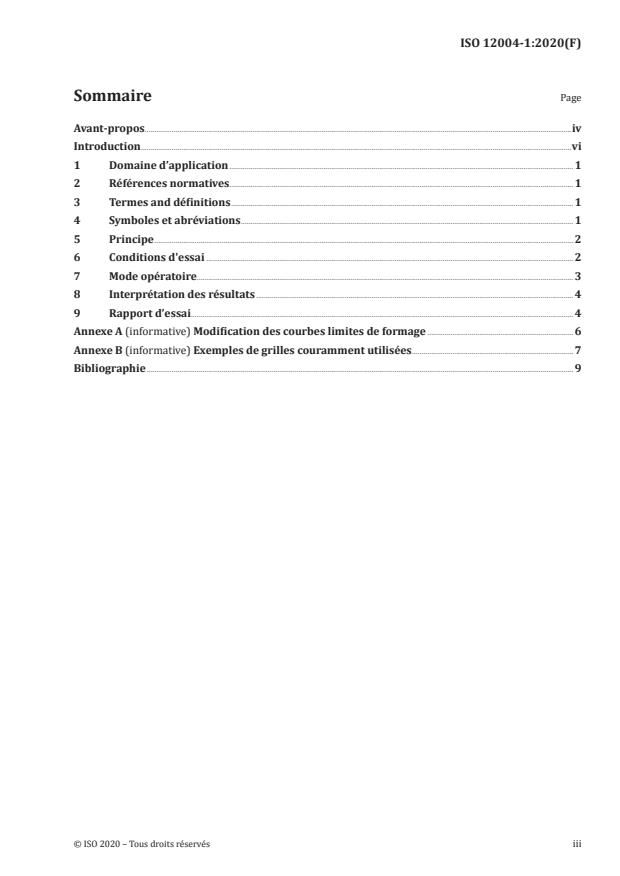
Contents Page
Foreword .iv
Introduction .v
1 Scope . 1
2 Normative references . 1
3 Terms and definitions . 1
4 Symbols and abbreviated terms . 1
5 Principle . 1
6 Test conditions . 2
7 Procedure. 3
8 Interpretation of results . 3
9 Test report . 4
Annex A (informative) Modification to forming-limit curves . 5
Annex B (informative) Examples of grid patterns currently in use . 6
Bibliography . 8
Foreword
ISO (the International Organization for Standardization) is a worldwide federation of national standards
bodies (ISO member bodies). The work of preparing International Standards is normally carried out
through ISO technical committees. Each member body interested in a subject for which a technical
committee has been established has the right to be represented on that committee. International
organizations, governmental and non-governmental, in liaison with ISO, also take part in the work.
ISO collaborates closely with the International Electrotechnical Commission (IEC) on all matters of
electrotechnical standardization.
The procedures used to develop this document and those intended for its further maintenance are
described in the ISO/IEC Directives, Part 1. In particular, the different approval criteria needed for the
different types of ISO documents should be noted. This document was drafted in accordance with the
editorial rules of the ISO/IEC Directives, Part 2 (see www .iso .org/ directives).
Attention is drawn to the possibility that some of the elements of this document may be the subject of
patent rights. ISO shall not be held responsible for identifying any or all such patent rights. Details of
any patent rights identified during the development of the document will be in the Introduction and/or
on the ISO list of patent declarations received (see www .iso .org/ patents).
Any trade name used in this document is information given for the convenience of users and does not
constitute an endorsement.
For an explanation of the voluntary nature of standards, the meaning of ISO specific terms and
expressions related to conformity assessment, as well as information about ISO's adherence to the
World Trade Organization (WTO) principles in the Technical Barriers to Trade (TBT), see www .iso .org/
iso/ foreword .html.
This document was prepared by Technical Committee ISO/TC 164, Mechanical testing of metals,
Subcommittee SC 2, Ductility testing, in collaboration with the European Committee for Standardization
(CEN) Technical Committee CEN/TC 459/SC 1, Test methods for steel (other than chemical analysis), in
accordance with the Agreement on technical cooperation between ISO and CEN (Vienna Agreement).
This second edition cancels and replaces the first edition (ISO 12004-1:2008), which has been
technically revised.
The main changes compared to the previous edition are as follows:
1) The title was changed to have three elements.
2) Clauses 2 and 3 were added from the previous edition, and the subsequent sections were
renumbered.
3) The description of when to use this document (ISO 12004-1) or ISO 12004-2 was revised in the
Introduction.
4) Throughout the document the use of engineering strain was clarified.
5) Subclause 6.2 was extended to include what was the subsequent Clause in the previous version.
6) The former note was moved to part of Clause 7, since it gives permission to use another method.
7) The text in Annex A and the figure captions in Annex B were clarified.
A list of all parts in the ISO 12004 series can be found on the ISO website.
Any feedback or questions on this document should be directed to the user’s national standards body. A
complete listing of these bodies can be found at www .iso .org/ members .html.
iv © ISO 2020 – All rights reserved
Introduction
A forming-limit diagram (FLD) is a diagram containing measured major/minor strain points on a
formed part.
An FLD can distinguish between safe and necked, or failed, points. The transition from safe to failed
points is defined by the forming-limit curve (FLC).
To determine the forming limit of materials, two different methods are possible.
1) Strain analysis of failed press shop components to determine component and process dependent FLCs
In the press shop, strain paths to reach these points are generally not known. Such an FLC depends
on the material, the component, and the chosen forming conditions. This method is described in
this document and is not intended to determine one unique FLC for each material.
2) Determination of FLCs under well-defined laboratory conditions
For evaluating formability, one unique FLC for each material in several strain states can be
measured. The determination of FLC must be specific and uses multiple linear strain paths. The
ISO 12004-2 is intended for this type of material characterization.
...
INTERNATIONAL ISO
STANDARD 12004-1
Second edition
2020-10
Metallic materials — Determination
of forming-limit curves for sheet and
strip —
Part 1:
Measurement and application of
forming-limit diagrams in the press
shop
Matériaux métalliques — Détermination des courbes limites de
formage pour les tôles et bandes —
Partie 1: Mesurage et application des diagrammes limites de formage
dans les ateliers d'emboutissage
Reference number
©
ISO 2020
© ISO 2020
All rights reserved. Unless otherwise specified, or required in the context of its implementation, no part of this publication may
be reproduced or utilized otherwise in any form or by any means, electronic or mechanical, including photocopying, or posting
on the internet or an intranet, without prior written permission. Permission can be requested from either ISO at the address
below or ISO’s member body in the country of the requester.
ISO copyright office
CP 401 • Ch. de Blandonnet 8
CH-1214 Vernier, Geneva
Phone: +41 22 749 01 11
Email: copyright@iso.org
Website: www.iso.org
Published in Switzerland
ii © ISO 2020 – All rights reserved
Contents Page
Foreword .iv
Introduction .v
1 Scope . 1
2 Normative references . 1
3 Terms and definitions . 1
4 Symbols and abbreviated terms . 1
5 Principle . 1
6 Test conditions . 2
7 Procedure. 3
8 Interpretation of results . 3
9 Test report . 4
Annex A (informative) Modification to forming-limit curves . 5
Annex B (informative) Examples of grid patterns currently in use . 6
Bibliography . 8
Foreword
ISO (the International Organization for Standardization) is a worldwide federation of national standards
bodies (ISO member bodies). The work of preparing International Standards is normally carried out
through ISO technical committees. Each member body interested in a subject for which a technical
committee has been established has the right to be represented on that committee. International
organizations, governmental and non-governmental, in liaison with ISO, also take part in the work.
ISO collaborates closely with the International Electrotechnical Commission (IEC) on all matters of
electrotechnical standardization.
The procedures used to develop this document and those intended for its further maintenance are
described in the ISO/IEC Directives, Part 1. In particular, the different approval criteria needed for the
different types of ISO documents should be noted. This document was drafted in accordance with the
editorial rules of the ISO/IEC Directives, Part 2 (see www .iso .org/ directives).
Attention is drawn to the possibility that some of the elements of this document may be the subject of
patent rights. ISO shall not be held responsible for identifying any or all such patent rights. Details of
any patent rights identified during the development of the document will be in the Introduction and/or
on the ISO list of patent declarations received (see www .iso .org/ patents).
Any trade name used in this document is information given for the convenience of users and does not
constitute an endorsement.
For an explanation of the voluntary nature of standards, the meaning of ISO specific terms and
expressions related to conformity assessment, as well as information about ISO's adherence to the
World Trade Organization (WTO) principles in the Technical Barriers to Trade (TBT), see www .iso .org/
iso/ foreword .html.
This document was prepared by Technical Committee ISO/TC 164, Mechanical testing of metals,
Subcommittee SC 2, Ductility testing, in collaboration with the European Committee for Standardization
(CEN) Technical Committee CEN/TC 459/SC 1, Test methods for steel (other than chemical analysis), in
accordance with the Agreement on technical cooperation between ISO and CEN (Vienna Agreement).
This second edition cancels and replaces the first edition (ISO 12004-1:2008), which has been
technically revised.
The main changes compared to the previous edition are as follows:
1) The title was changed to have three elements.
2) Clauses 2 and 3 were added from the previous edition, and the subsequent sections were
renumbered.
3) The description of when to use this document (ISO 12004-1) or ISO 12004-2 was revised in the
Introduction.
4) Throughout the document the use of engineering strain was clarified.
5) Subclause 6.2 was extended to include what was the subsequent Clause in the previous version.
6) The former note was moved to part of Clause 7, since it gives permission to use another method.
7) The text in Annex A and the figure captions in Annex B were clarified.
A list of all parts in the ISO 12004 series can be found on the ISO website.
Any feedback or questions on this document should be directed to the user’s national standards body. A
complete listing of these bodies can be found at www .iso .org/ members .html.
iv © ISO 2020 – All rights reserved
Introduction
A forming-limit diagram (FLD) is a diagram containing measured major/minor strain points on a
formed part.
An FLD can distinguish between safe and necked, or failed, points. The transition from safe to failed
points is defined by the forming-limit curve (FLC).
To determine the forming limit of materials, two different methods are possible.
1) Strain analysis of failed press shop components to determine component and process dependent FLCs
In the press shop, strain paths to reach these points are generally not known. Such an FLC depends
on the material, the component, and the chosen forming conditions. This method is described in
this document and is not intended to determine one unique FLC for each material.
2) Determination of FLCs under well-defined laboratory conditions
For evaluating formability, one unique FLC for each material in several strain states can be
measured. The determination of FLC must be specific and uses multiple linear strain paths. The
ISO 12004-2 is intended for this type of material characterization.
...
NORME ISO
INTERNATIONALE 12004-1
Deuxième édition
2020-10
Matériaux métalliques —
Détermination des courbes limites de
formage pour les tôles et bandes —
Partie 1:
Mesurage et application des
diagrammes limites de formage dans
les ateliers d'emboutissage
Metallic materials — Determination of forming-limit curves for sheet
and strip —
Part 1: Measurement and application of forming-limit diagrams in
the press shop
Numéro de référence
©
ISO 2020
DOCUMENT PROTÉGÉ PAR COPYRIGHT
© ISO 2020
Tous droits réservés. Sauf prescription différente ou nécessité dans le contexte de sa mise en œuvre, aucune partie de cette
publication ne peut être reproduite ni utilisée sous quelque forme que ce soit et par aucun procédé, électronique ou mécanique,
y compris la photocopie, ou la diffusion sur l’internet ou sur un intranet, sans autorisation écrite préalable. Une autorisation peut
être demandée à l’ISO à l’adresse ci-après ou au comité membre de l’ISO dans le pays du demandeur.
ISO copyright office
Case postale 401 • Ch. de Blandonnet 8
CH-1214 Vernier, Genève
Tél.: +41 22 749 01 11
E-mail: copyright@iso.org
Web: www.iso.org
Publié en Suisse
ii © ISO 2020 – Tous droits réservés
Sommaire Page
Avant-propos .iv
Introduction .vi
1 Domaine d’application . 1
2 Références normatives . 1
3 Termes and définitions . 1
4 Symboles et abréviations . 1
5 Principe . 2
6 Conditions d'essai . 2
7 Mode opératoire. 3
8 Interprétation des résultats . 4
9 Rapport d’essai . 4
Annexe A (informative) Modification des courbes limites de formage . 6
Annexe B (informative) Exemples de grilles couramment utilisées . 7
Bibliographie . 9
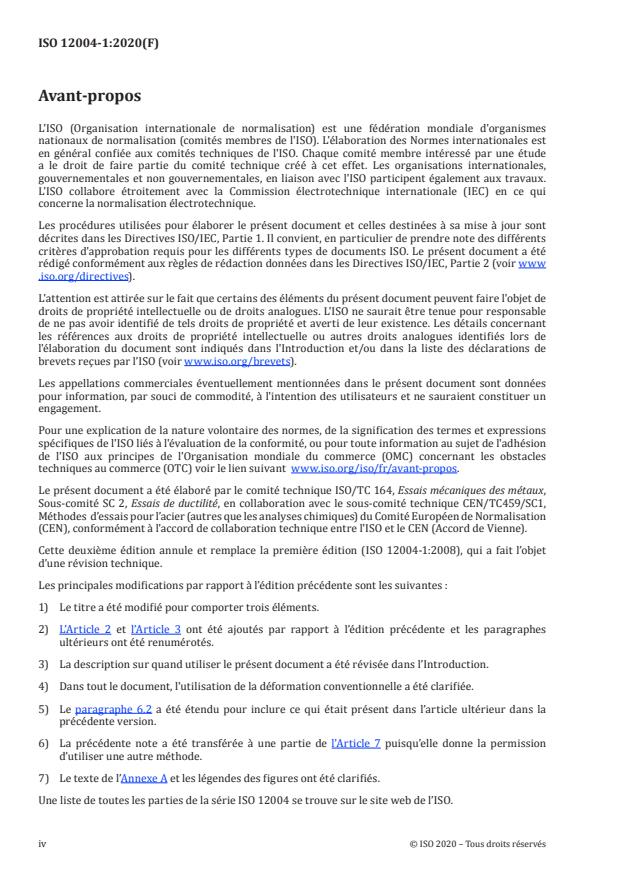
Avant-propos
L'ISO (Organisation internationale de normalisation) est une fédération mondiale d'organismes
nationaux de normalisation (comités membres de l'ISO). L'élaboration des Normes internationales est
en général confiée aux comités techniques de l'ISO. Chaque comité membre intéressé par une étude
a le droit de faire partie du comité technique créé à cet effet. Les organisations internationales,
gouvernementales et non gouvernementales, en liaison avec l'ISO participent également aux travaux.
L'ISO collabore étroitement avec la Commission électrotechnique internationale (IEC) en ce qui
concerne la normalisation électrotechnique.
Les procédures utilisées pour élaborer le présent document et celles destinées à sa mise à jour sont
décrites dans les Directives ISO/IEC, Partie 1. Il convient, en particulier de prendre note des différents
critères d'approbation requis pour les différents types de documents ISO. Le présent document a été
rédigé conformément aux règles de rédaction données dans les Directives ISO/IEC, Partie 2 (voir www
.iso .org/ directives).
L'attention est attirée sur le fait que certains des éléments du présent document peuvent faire l'objet de
droits de propriété intellectuelle ou de droits analogues. L'ISO ne saurait être tenue pour responsable
de ne pas avoir identifié de tels droits de propriété et averti de leur existence. Les détails concernant
les références aux droits de propriété intellectuelle ou autres droits analogues identifiés lors de
l'élaboration du document sont indiqués dans l'Introduction et/ou dans la liste des déclarations de
brevets reçues par l’ISO (voir www .iso .org/ brevets).
Les appellations commerciales éventuellement mentionnées dans le présent document sont données
pour information, par souci de commodité, à l'intention des utilisateurs et ne sauraient constituer un
engagement.
Pour une explication de la nature volontaire des normes, de la signification des termes et expressions
spécifiques de l'ISO liés à l'évaluation de la conformité, ou pour toute information au sujet de l'adhésion
de l'ISO aux principes de l'Organisation mondiale du commerce (OMC) concernant les obstacles
techniques au commerce (OTC) voir le lien suivant www .iso .org/ iso/ fr/ avant -propos.
Le présent document a été élaboré par le comité technique ISO/TC 164, Essais mécaniques des métaux,
Sous-comité SC 2, Essais de ductilité, en collaboration avec le sous-comité technique CEN/TC459/SC1,
Méthodes d’essais pour l’acier (autres que les analyses chimiques) du Comité Européen de Normalisation
(CEN), conformément à l'accord de collaboration technique entre l'ISO et le CEN (Accord de Vienne).
Cette deuxième édition annule et remplace la première édition (ISO 12004-1:2008), qui a fait l’objet
d’une révision technique.
Les principales modifications par rapport à l’édition précédente sont les suivantes :
1) Le titre a été modifié pour comporter trois éléments.
2) L’Article 2 et l’Article 3 ont été ajoutés par rapport à l’édition précédente et les paragraphes
ultérieurs ont été renumérotés.
3) La description sur quand utiliser le présent document a été révisée dans l’Introduction.
4) Dans tout le document, l'utilisation de la déformation conventionnelle a été clarifiée.
5) Le paragraphe 6.2 a été étendu pour inclure ce qui était présent dans l’article ultérieur dans la
précédente version.
6) La précédente note a été transférée à une partie de l'Article 7 puisqu’elle donne la permission
d’utiliser une autre méthode.
7) Le texte de l’Annexe A et les légendes des figures ont été clarifiés.
Une liste de toutes les parties de la série ISO 12004 se trouve sur le site web de l’ISO.
iv © ISO 2020 – Tous droits réservés
Il convient que l’utilisateur adresse tout retour d’information ou toute question concernant le présent
document à l’organisme national de normalisation de son pays. Une liste exhaustive desdits organismes
se trouve à l’adresse www .iso .org/ fr/ members .html.
Introduction
Un Diagramme Limite de Formage (DLF) est un diagramme contenant les points de mesure pour les
déformations majeure/mineure sur une pièce formée.
Un DLF permet de faire la distinction entre points bons et points en striction ou correspondant à une
rupture. La frontière entre points bons et points correspondants à une rupture est définie par la Courbe
Limite de Formage (CLF).
Pour déterminer la limite de formage de matériaux, deux méthodes différentes sont possibles :
1) Une analyse des déformations d’éléments emboutis en atelier et rompus pour déterminer des CLF
dépendant de l’élément et du processus :
Dans les ateliers d’emboutissage, les chemins de déformation pour obtenir ces points ne sont
généralement pas connus. Une telle CLF dépend du matériau, de l’élément et des conditions de
formage choisies. Cette méthode est décrite dans le présent document et n’a pas l’intention de
déterminer une CLF unique pour chaque matériau.
2) Détermination des CLF dans des conditions de laboratoire bien définies :
Pour évaluer la formabilité, une CLF unique pour chaque matériau à plusieurs états de déformation
peut être mesurée. La détermination de la CLF doit être spécifique et utilise des chemins de
déformation linéaires différents. L’ISO 12004-2 a pour objectif ce type de caractérisation du
matériau.
vi © ISO 2020 – Tous droits réservés
NORME INTERNATIONALE ISO 12004-1:2020(F)
Matériaux métalliques — Détermination des courbes
limites de formage pour les tôles et bandes —
Partie 1:
Mesurage et application des dia
...
NORME ISO
INTERNATIONALE 12004-1
Deuxième édition
2020-10
Matériaux métalliques —
Détermination des courbes limites de
formage pour les tôles et bandes —
Partie 1:
Mesurage et application des
diagrammes limites de formage dans
les ateliers d'emboutissage
Metallic materials — Determination of forming-limit curves for sheet
and strip —
Part 1: Measurement and application of forming-limit diagrams in
the press shop
Numéro de référence
©
ISO 2020
DOCUMENT PROTÉGÉ PAR COPYRIGHT
© ISO 2020
Tous droits réservés. Sauf prescription différente ou nécessité dans le contexte de sa mise en œuvre, aucune partie de cette
publication ne peut être reproduite ni utilisée sous quelque forme que ce soit et par aucun procédé, électronique ou mécanique,
y compris la photocopie, ou la diffusion sur l’internet ou sur un intranet, sans autorisation écrite préalable. Une autorisation peut
être demandée à l’ISO à l’adresse ci-après ou au comité membre de l’ISO dans le pays du demandeur.
ISO copyright office
Case postale 401 • Ch. de Blandonnet 8
CH-1214 Vernier, Genève
Tél.: +41 22 749 01 11
E-mail: copyright@iso.org
Web: www.iso.org
Publié en Suisse
ii © ISO 2020 – Tous droits réservés
Sommaire Page
Avant-propos .iv
Introduction .vi
1 Domaine d’application . 1
2 Références normatives . 1
3 Termes and définitions . 1
4 Symboles et abréviations . 1
5 Principe . 2
6 Conditions d'essai . 2
7 Mode opératoire. 3
8 Interprétation des résultats . 4
9 Rapport d’essai . 4
Annexe A (informative) Modification des courbes limites de formage . 6
Annexe B (informative) Exemples de grilles couramment utilisées . 7
Bibliographie . 9
Avant-propos
L'ISO (Organisation internationale de normalisation) est une fédération mondiale d'organismes
nationaux de normalisation (comités membres de l'ISO). L'élaboration des Normes internationales est
en général confiée aux comités techniques de l'ISO. Chaque comité membre intéressé par une étude
a le droit de faire partie du comité technique créé à cet effet. Les organisations internationales,
gouvernementales et non gouvernementales, en liaison avec l'ISO participent également aux travaux.
L'ISO collabore étroitement avec la Commission électrotechnique internationale (IEC) en ce qui
concerne la normalisation électrotechnique.
Les procédures utilisées pour élaborer le présent document et celles destinées à sa mise à jour sont
décrites dans les Directives ISO/IEC, Partie 1. Il convient, en particulier de prendre note des différents
critères d'approbation requis pour les différents types de documents ISO. Le présent document a été
rédigé conformément aux règles de rédaction données dans les Directives ISO/IEC, Partie 2 (voir www
.iso .org/ directives).
L'attention est attirée sur le fait que certains des éléments du présent document peuvent faire l'objet de
droits de propriété intellectuelle ou de droits analogues. L'ISO ne saurait être tenue pour responsable
de ne pas avoir identifié de tels droits de propriété et averti de leur existence. Les détails concernant
les références aux droits de propriété intellectuelle ou autres droits analogues identifiés lors de
l'élaboration du document sont indiqués dans l'Introduction et/ou dans la liste des déclarations de
brevets reçues par l’ISO (voir www .iso .org/ brevets).
Les appellations commerciales éventuellement mentionnées dans le présent document sont données
pour information, par souci de commodité, à l'intention des utilisateurs et ne sauraient constituer un
engagement.
Pour une explication de la nature volontaire des normes, de la signification des termes et expressions
spécifiques de l'ISO liés à l'évaluation de la conformité, ou pour toute information au sujet de l'adhésion
de l'ISO aux principes de l'Organisation mondiale du commerce (OMC) concernant les obstacles
techniques au commerce (OTC) voir le lien suivant www .iso .org/ iso/ fr/ avant -propos.
Le présent document a été élaboré par le comité technique ISO/TC 164, Essais mécaniques des métaux,
Sous-comité SC 2, Essais de ductilité, en collaboration avec le sous-comité technique CEN/TC459/SC1,
Méthodes d’essais pour l’acier (autres que les analyses chimiques) du Comité Européen de Normalisation
(CEN), conformément à l'accord de collaboration technique entre l'ISO et le CEN (Accord de Vienne).
Cette deuxième édition annule et remplace la première édition (ISO 12004-1:2008), qui a fait l’objet
d’une révision technique.
Les principales modifications par rapport à l’édition précédente sont les suivantes :
1) Le titre a été modifié pour comporter trois éléments.
2) L’Article 2 et l’Article 3 ont été ajoutés par rapport à l’édition précédente et les paragraphes
ultérieurs ont été renumérotés.
3) La description sur quand utiliser le présent document a été révisée dans l’Introduction.
4) Dans tout le document, l'utilisation de la déformation conventionnelle a été clarifiée.
5) Le paragraphe 6.2 a été étendu pour inclure ce qui était présent dans l’article ultérieur dans la
précédente version.
6) La précédente note a été transférée à une partie de l'Article 7 puisqu’elle donne la permission
d’utiliser une autre méthode.
7) Le texte de l’Annexe A et les légendes des figures ont été clarifiés.
Une liste de toutes les parties de la série ISO 12004 se trouve sur le site web de l’ISO.
iv © ISO 2020 – Tous droits réservés
Il convient que l’utilisateur adresse tout retour d’information ou toute question concernant le présent
document à l’organisme national de normalisation de son pays. Une liste exhaustive desdits organismes
se trouve à l’adresse www .iso .org/ fr/ members .html.
Introduction
Un Diagramme Limite de Formage (DLF) est un diagramme contenant les points de mesure pour les
déformations majeure/mineure sur une pièce formée.
Un DLF permet de faire la distinction entre points bons et points en striction ou correspondant à une
rupture. La frontière entre points bons et points correspondants à une rupture est définie par la Courbe
Limite de Formage (CLF).
Pour déterminer la limite de formage de matériaux, deux méthodes différentes sont possibles :
1) Une analyse des déformations d’éléments emboutis en atelier et rompus pour déterminer des CLF
dépendant de l’élément et du processus :
Dans les ateliers d’emboutissage, les chemins de déformation pour obtenir ces points ne sont
généralement pas connus. Une telle CLF dépend du matériau, de l’élément et des conditions de
formage choisies. Cette méthode est décrite dans le présent document et n’a pas l’intention de
déterminer une CLF unique pour chaque matériau.
2) Détermination des CLF dans des conditions de laboratoire bien définies :
Pour évaluer la formabilité, une CLF unique pour chaque matériau à plusieurs états de déformation
peut être mesurée. La détermination de la CLF doit être spécifique et utilise des chemins de
déformation linéaires différents. L’ISO 12004-2 a pour objectif ce type de caractérisation du
matériau.
vi © ISO 2020 – Tous droits réservés
NORME INTERNATIONALE ISO 12004-1:2020(F)
Matériaux métalliques — Détermination des courbes
limites de formage pour les tôles et bandes —
Partie 1:
Mesurage et application des dia
...
Questions, Comments and Discussion
Ask us and Technical Secretary will try to provide an answer. You can facilitate discussion about the standard in here.
Loading comments...